Category Archives: Lands

Jared Kushner heavily involved in planning Xi Jinping’s visit to Trump’s Mar-a-Lago resort

The New York Times reports: When President Trump and President Xi Jinping of China sit down for their first meeting next month in Palm Beach, Fla., they could use the balmy breezes and tranquil views at the Mar-a-Lago resort: Relations between the United States and China are as complex and chilly as they have been since the early days of the Reagan administration.

The list of issues that could open a new rift between these two men is long, such as the deployment of American antimissile batteries in South Korea, Mr. Trump’s campaign threats of a trade war or escalating tensions over the South China Sea and Taiwan.

The debate over where to hold Mr. Trump’s meeting with Mr. Xi captures the underlying angst. Chinese officials pushed for an invitation to Mr. Trump’s private resort, American officials said, because it would be more relaxed and informal than a summit meeting at the White House. Equally important, it would reduce the pressure on the two leaders to produce any agreements, which in the current environment is viewed as unrealistic.

Inside the Trump administration, the visit lays bare the unsettled nature of policy toward China. The White House is divided into camps, with a fiercely ideological, anti-China faction vying against more pragmatic elements. Mr. Trump’s son-in-law, Jared Kushner, has emerged as an influential, moderating voice. He is heavily involved in planning the presidential visit, a senior official said, and took part in a National Security Council meeting on Monday at which North Korea and China were discussed. [Continue reading…]


Facebooktwittermail

Wikileaks-Russia link revealed: site hosted in Russia, hacking suspect named

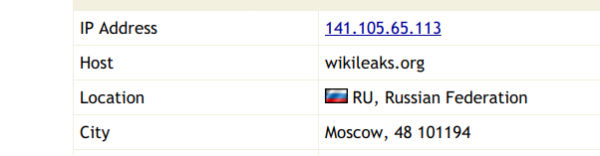
Inquisitr reports: The Wikileaks site is at least partly hosted on servers based in Russia — servers that it added just one week before the site released thousands of hacked emails from the account of John Podesta, chairman of the Hillary Clinton presidential campaign, in October of last year according to findings published in an online report on Sunday.

The Podesta emails, while containing no major revelations, revealed members of Clinton’s campaign speaking privately, in frank terms that proved embarrassing and likely damaging to her campaign for president against Donald Trump. United States intelligence agencies, according to a report issued by the Director of National Intelligence in January, concluded that a Russian government-sponsored hacking effort was behind the Podesta leak and other cyber-attacks — which were designed to help throw the election to Donald Trump.

Sunday’s online report, authored by freelance journalist Laurelai Bailey, examined a list of internet IP addresses used by Wikileaks to host its site, which houses numerous large troves of leaked and hacked documents, and found two addresses of servers in Russia and hosted by a company run by an individual named Peter Chayanov.

“Now the actual owner of the IP addresses is a man by the name of Peter Chayanov, whose IP addresses have hosted spammers and hackers, according to my sources, who work in internet backbone companies,” Bailey wrote. “Chayanov’s IP space is a virtual equivalent of a bad neighborhood that makes you lock your car doors when you drive through it. So this further implies a connection to Wikileaks and Russian hackers.”

To read the full report by Bailey, click on this link. [Continue reading…]

Patribotics reports: The internet is tightly controlled in Russia. Cyber criminals have to answer to Putin. Mr. Chayanov is the head of a firm called Hostkey, which hosts mail spammers and other malware and hacking tools, despite offering web space to Wikileaks. Wikileaks chose to use a Russian hacker to host their site – and they knew that he was connected to Vladimir Putin and operated with the blessing of Putin’s government.

Putin and Assange are thus already linked.

But it is much worse for Wikileaks – and the internet in general – even than it looks. In order not to bury the lede, I will report what appear to be the conclusions of the web developers and hackers on Twitter discussing Laurelai’s story, and then report on how they appeared to have arrived there.

* Wikileaks has handed Chayanov access to everything stored on its site and servers

* The Russian hacker and spammer can ‘monitor traffic

* He can tell who is reading anything on the Wikileaks site anywhere in the world

* The Russian hacker has access to all documents that have been sent to Wikileaks

* He can probably bust the anonymity of any computer or user who thought they were anonymously donating to Wikileaks

* It is not reasonable to suggest that this hacker is other than linked with Russia’s GRU – if he has it, they have it

* Through Julian Assange and his website, it appears that the Russian hacker and his government can track any readers of the Wikileaks site and any donors of material to it, thus allowing Russia to ‘blackmail’ anyone who ‘sent secrets’ to Wikileaks as a ‘whistleblower’. [Continue reading…]

Facebooktwittermail

The Trump-Putin honeymoon is over, but the marriage was a sham

James Miller writes: The Russian government’s love affair with Trump had more to do with fostering anti-Americanism than with seeking rapprochement. Russian media coverage reflects this. A careful study of the Kremlin-controlled media, working in both English and Russian, shows that the Russian media was never pro-Trump, but it was anti-Clinton. Trump received mostly neutral treatment, mixed with positive and negative coverage, while the Kremlin spread conspiracy theories and attacked Clinton’s policies. Russian articles about Trump tended to spread the narrative that the United States is a failing democracy and the game was rigged against any politician, like Trump, who did not view Russia as the enemy. They even warned that the establishment would likely find a way to sabotage Trump’s success. In this way, many articles that were “pro-Trump” were really just anti-Clinton, as Clinton was painted as a member of the establishment by both the Russian media and the Trump campaign.

But the Kremlin’s narrative about Trump was formed when Clinton had a commanding lead in the polls. In all likelihood, they never expected him to win. This means that the Kremlin has to find a new narrative to attack the United States. The anti-Americanism that is resurfacing in the Russian media now is just a return to form.

In an interesting twist, the Russian media is now warning that American society is fraying and a constitutional crisis may be brewing. Kiselyov used his TV show on March 5 to voice concern about what is happening in America. Partisanship and controversy are tearing the country apart, he said. “America is in the grips of hatred,” he warned viewers, a situation made more worrisome because of its culture of “free-flowing firearms.” [Continue reading…]

Facebooktwittermail

Russia appears to deploy forces in Egypt, eyes on Libya role

Reuters reports: Russia appears to have deployed special forces to an airbase in western Egypt near the border with Libya in recent days, U.S., Egyptian and diplomatic sources say, a move that would add to U.S. concerns about Moscow’s deepening role in Libya.

The U.S. and diplomatic officials said any such Russian deployment might be part of a bid to support Libyan military commander Khalifa Haftar, who suffered a setback with an attack on March 3 by the Benghazi Defence Brigades (BDB) on oil ports controlled by his forces.

The U.S. officials, who spoke on condition of anonymity, said the United States has observed what appeared to be Russian special operations forces and drones at Sidi Barrani, about 60 miles (100 km) from the Egypt-Libya border. [Continue reading…]

Facebooktwittermail

Monica Crowley lost White House job, now she’s got one with pro-Russian oligarch

The Daily Beast reports: A would-be Trump White House appointee who withdrew in the face of plagiarism allegations is now lobbying on behalf of a Ukrainian oligarch who has recently advocated greater concessions to the Russian government, according to newly filed documents.

Monica Crowley told the Justice Department’s National Security Division that she will represent billionaire Victor Pinchuk in discussions with U.S. government officials “and other policy makers” regarding “issues of concern to Mr. Pinchuk.”

Crowley, a Fox News contributor, was in line for a senior post at the White House National Security Council until reports from CNN and Politico reported that she had plagiarized large portions of her 2012 book What the (Bleep) Just Happened and her Columbia University Ph.D. dissertation.

Crowley dismissed the plagiarism allegations in her first public remarks on the controversy last week. “What happened to me was a despicable straight-up political hit job,” she said during an appearance on the Fox News show Hannity. “It’s been debunked, my editor has completely supported me and backed me up.” (It has not been debunked.)

She nevertheless withdrew from consideration for the post shortly after the allegations surfaced. Crowley will now be “providing outreach services on behalf of Mr. Victor Pinchuk,” according to a Friday filing with DOJ’s foreign agent registration office. [Continue reading…]

Facebooktwittermail

Defense Secretary Mattis withdraws Patterson as choice for undersecretary for policy

The Washington Post reports: Defense Secretary Jim Mattis has withdrawn retired senior diplomat Anne W. Patterson as his choice for undersecretary for policy after the White House indicated unwillingness to fight what it said would be a battle for Senate confirmation.

U.S. officials said that two members of the Senate Armed Services Committee, Sens. Tom Cotton (R-Ark.) and Ted Cruz (R-Tex.), were strongly opposed to Patterson’s nomination because she served as U.S. ambassador to Egypt from 2011 to 2013, a time when the Obama administration supported an elected government with ties to the Muslim Brotherhood that was ultimately overthrown by the Egyptian military.

The withdrawal leaves Mattis with a bench still empty of Trump-appointed senior officials, a situation that stretches across the administration as Cabinet secretaries have not chosen or the White House has not approved nominees. Although Obama administration holdovers remain in a few jobs, after eight weeks in office, President Trump has not nominated a single high official under Cabinet rank in the Defense or State departments. [Continue reading…]

Facebooktwittermail

‘Never Trump’ Republicans join call for select committee to investigate Russia and Trump

Josh Rogin writes: Democrats in Congress have long argued that the ongoing intelligence committee investigations into Russia’s interference in the presidential election and the Trump campaign’s ties to the Kremlin are unlikely to get to the bottom of the issue. Now a group of “Never Trump” Republicans are planning to pressure GOP leaders to establish a bipartisan select committee to take over the inquiries and settle the matter once and for all.

Stand Up Republic, a nonprofit organization led by former independent presidential candidate Evan McMullin and his running mate, Mindy Finn, is launching a public campaign aimed at building support among Republicans for consolidating the various congressional Russia-related investigations into one empowered and fully funded select committee. The organization’s ad, which goes live Tuesday with a six-figure television ad buy, makes the case that the Russia issue is too important not to investigate fully.

“Trump’s Russia crisis. Secret contacts. Conflicting stories. Mounting signs of hidden ties and shady deals. Fear our president is compromised,” says the narrator. “The values of liberty, justice and honor shaped America. Generations fought for freedom, and presidents of both parties stood against foreign tyrants like Vladimir Putin. Why won’t Donald Trump? Tell Congress to name a bipartisan select committee to get the truth?” [Continue reading…]

Facebooktwittermail

How the Netherlands made Geert Wilders possible

The Atlantic reports: In the 17th century, Dutch settlers flocked to the southern half of what is now Manhattan to establish New Amsterdam, a fur-trading post that would welcome Lutherans and Catholics from Europe; Anglicans, Puritans, and Quakers from New England; and Sephardic Jews who were, at the time, discouraged from settling in America’s other nascent regions. Though its English conquerors would rename the city New York, the values of diversity and tolerance that the Dutch introduced would remain the region’s hallmarks for centuries to come.

In the modern-day Netherlands, however, the Dutch Republic’s founding pledge that “everyone shall remain free in religion” will soon collide with the ambitions of one of the country’s most popular politicians.

“Islam and freedom are not compatible,” claims Geert Wilders, the Party for Freedom (PVV) leader who campaigns on banning the Quran, closing Dutch mosques, and ending immigration from predominantly Muslim countries. “Stop Islam,” the phrase that sits atop Wilders’s Twitter page, aptly summarizes his party’s platform. In December, Dutch courts found Wilders guilty of carrying his rhetoric too far, convicting him of discriminatory speech for rallying supporters in an anti-Moroccan call-and-response. Nonetheless, Wilders is a leading contender to receive the plurality of votes in the country’s parliamentary elections on March 15.

The nation’s peculiar path from “live and let live” to “Make the Netherlands Ours Again” (as Wilders recently said) has as its guideposts a changing definition of tolerance, some instances of political opportunism—and a pair of grisly assassinations.

From the mix of faith groups that inhabited New Amsterdam to the peaceful coexistence of Protestants, Catholics, and socialists throughout the Netherlands in the 20th century, the Dutch brand of multiculturalism has often been more “salad bowl” than “melting pot.” Each sect of society had its own schools, media outlets, and social groups; tolerance was the act of respecting those boundaries.

“Historically, Dutch tolerance has been more of a pragmatic strategy,” said Jan Rath, a professor of urban sociology at the University of Amsterdam. “Tolerance has been a way to contain oppositions or complications.” [Continue reading…]

Facebooktwittermail

Wilders, Russia and Twitter bots: How social media is serving Dutch populism

Financial Times reports: Follower numbers are a commonly recognised indicator of social media influence. Snapshot counts of Twitter and Facebook followers reveal that, in contrast to most other party leaders, Mr Wilders’ personal social media following dwarfs that of his party’s accounts by a ratio of 330:1 on Twitter and 133:1 on Facebook. By comparison, sitting prime minister Mark Rutte’s followers are outnumbered by those of his party, VVD, by 1.5:1 on Twitter and 3.4:1 on Facebook. 

However, an examination of the rate of growth of Dutch party leaders’ Twitter followings reveals Mr Wilders’ to be growing comparatively slowly — which is to be expected given that hisis the largest among party leaders’ followings. More intriguing are the bumps in the growth rate of the Wilders following, several of which coincide with specific news events. In particular, Mr Wilders’ conviction for race-related discrimination offences on December 9 last year and the terrorist attack in which a truck was driven into a Berlin crowd on December 19 boosted Mr Wilders’ following, which may suggest a reactive component to the motivations of people following Mr Wilders on Twitter.

The accusations of election interference in France made by the campaign of Mr Macron prompted a denial by RT, which said in a statement that it “adamantly rejects any and all claims that it has any part in spreading fake news in general and in relation to Mr Macron and the upcoming French election in particular.” The US Office of the Director of National Intelligence, however, asserted in a January report that RT and Sputnik functioned as part of a Russian “state-run propaganda machine” that was deployed in an attempt to influence the outcome of the US election.

FT Data calculated the frequencies with which a random sample of 100,000 of Mr Wilders’ Twitter followers mentioned the accounts of RT and Sputnik (@RT_com and @SputnikInt), along with those of the top five Dutch news outlets over a six-month period. We compared these to a sample of the same size taken from followers of the office of the Dutch prime minister (@MinPres), a non-partisan governmental account.

Although Mr Wilders himself did not disproportionately share content from either outlet, his followers were 12 times more likely to mention Sputnik and almost eight times more likely to mention RT than followers of Mr Rutte, prime minister. Notably, Mr Wilders’ followers mentioned RT more frequently than they did the Dutch national broadcaster NOS (@NOS). [Continue reading…]

Facebooktwittermail

U.S. to deploy missile-capable drones across border from North Korea

The Guardian reports: The US has declared it will permanently station missile-capable drones in South Korea in the latest round of military escalation in north-eastern Asia.

The drone deployment comes a week after North Korea carried out a test salvo of four missiles that landed off the coast of Japan, and a day before the US secretary of state, Rex Tillerson, embarks on a tour of a region widely regarded as the most dangerous corner of the world.

The US military in South Korea took the unusual step of publicly announcing the deployment of a company of Grey Eagle drones, which it said would add “significant intelligence, surveillance and reconnaissance capability” for American and South Korean forces.

Grey Eagles are designed to carry Hellfire missiles and together with the deployment of Thaad anti-ballistic missile defences in South Korea they represent a significant build-up of US military muscle in response to an accelerated programme of missile and nuclear testing by the North Korean regime. [Continue reading…]

Facebooktwittermail

Russian-backed Syria talks derailed as rebels boycott

Reuters reports: Russian-led peace talks on Syria were derailed on Tuesday as rebels backed by Turkey boycotted a third round of meetings in Kazakhstan and the Kremlin indicated there were international divisions over the process.

Russia, Syrian President Bashar al-Assad’s most powerful ally, said the rebels’ reasons for staying away were unconvincing and their decision came as a surprise. Describing the rebels as Turkish proxies, the Syrian government envoy said Ankara had broken “its commitments” to the Astana process.

The rebels said on Tuesday they would not attend the talks, scheduled for Tuesday and Wednesday, because of what they called Russia’s unwillingness to end air strikes on rebel-held areas and its failure to get the Syrian army and Iranian-backed militia to abide by a ceasefire. [Continue reading…]

Facebooktwittermail

For Russian TV, Syria isn’t just a foreign country — it’s a parallel universe

Muhammad Idrees Ahmad writes: With the world relapsing into old rivalries, disinformation is emerging as the continuation of war by other means. Propaganda has always been used by authoritarian states to control populations at home — but technological advances are allowing them to also neutralize enemies abroad. None has been more aggressive and resourceful in this regard than Russia. And nowhere has this weaponized information been more lethal than in its coverage of Syria — vividly exemplified by RT, the Kremlin’s international broadcaster.

There is a virtual consensus among multinational bodies and human rights organizations that together, Syrian President Bashar al-Assad’s regime and Russia hold the balance of responsibility for the killing and displacement in Syria. But hewing to the official Kremlin line, RT has cast Assad as the victim, his opponents as jihadists and his repression as a “war on terror.” The aim is less to persuade than to obfuscate. RT doesn’t have to tell a credible or coherent story as long as it can cast doubt on competing ones.

“There is no objectivity,” says RT editor-in-chief Margarita Simonyan, “only approximations of the truth.” Complete objectivity is indeed unachievable — yet it is a standard to which most journalists aspire. RT’s innovation is to dispense with objectivity altogether and make approximation of the truth its aspiration. News doesn’t have to be true as long as it feels true — and with truth thus relativized, fact becomes one with alternative fact. [Continue reading…]

Facebooktwittermail

Russian whistleblower might have been poisoned, court hears

The Guardian reports: A Russian whistleblower could have been poisoned with sorrel soup, but key evidence about his last meal was “flushed away” hours after his death, a court heard. Alexander Perepilichnyy, 44, died after collapsing while running near his home in Weybridge, Surrey, in November 2012.

The businessman’s death was originally attributed to natural causes, but traces of a chemical that can be found in the poisonous plant gelsemium were later found in his stomach. Fiona Barton QC, for Surrey police, said no “identifiable toxin” had been found in the body.

A pre-inquest hearing on Monday heard that, before his death, Perepilichnyy was helping a specialist investment firm uncover a $230m Russian money-laundering operation. Hermitage Capital Management previously claimed that Perepilichnyy could have been deliberately killed for helping it uncover the scam involving Russian officials. [Continue reading…]

Facebooktwittermail

Al Qaeda now leads the fight against Assad

Shiraz Maher writes: On 9 February, a grey-bearded and balding Syrian rebel commander wearing military dress appeared in an internet video calling for greater unity among the forces opposing President Bashar al-Assad. This was unremarkable. Syria’s rebel groups frequently issue unity statements, merge units and create umbrella groups – many of which, like the fruit of the medlar tree, turn rotten before they turn ripe.

Yet the message from Hashem al-Sheikh – a native of Aleppo imprisoned by Assad in 2005 for his jihadi beliefs and then released along with other Islamist prisoners in 2011 in an attempt to poison the nascent uprising against the regime – was hugely important in the context of the Syrian Civil War: it signalled the potential subsuming of the entire Syrian opposition to radical and reactionary forces, and to al-Qaeda in particular.

In the video, Hashem al-Sheikh announ­ced the creation of a powerful, extremist-dominated entity known as Hayat Tahrir al-Sham (HTS), or the “Committee for the Liberation of the Levant”.

One of the main groups that joined the new committee is Nur al-Din al-Zenki, a corrupt and brutal Islamist movement that was once backed by the CIA as a “vetted organisation”, though this designation was later revoked. In July last year, five months before Aleppo fell to Assad’s forces, the group’s members were filmed beheading Abdullah Tayseer in the eastern part of the city. Tayseer was a 13-year-old boy whom they accused of fighting for the regime.

Far more significant was the folding into HTS of Jabhat Fateh al-Sham (JFS), which until July was known as Jabhat al-Nusrah – and which represented al-Qaeda on the ground in Syria. JFS, comprised mainly of local fighters, had earned a degree of popular support among civilians because of its fighters’ valour and lack of corruption. The rebranding was an attempt by its leaders to recast it as a broader part of the overall uprising, and to capitalise on ordinary Syrians’ hatred of Islamic State (IS), which is widely seen as having usurped the revolution and diverted its aims.

Consequently, al-Qaeda has pursued an audacious line of messaging that seeks to portray the group in Syria as a responsible actor that follows a “middle path” between acquiescence and extremism. The corollary is clear: that it is both authentic and organic. “JFS is not a fringe group that exists on another planet,” wrote a spokesman, Mos­tafa Mahamed, shortly after it rebranded in 2016. “It is deeply embedded in society, made up from the average Syrian people.” [Continue reading…]

Facebooktwittermail

U.S. troop presence in Syria now at its highest. But how long will they remain for and why?

Time reports: The Trump Administration is intensifying America’s involvement in the ground war in Syria, having announced on March 9 that it is sending 400 more troops to join the fight against ISIS there.

The new deployment of Army Rangers and a U.S. Marine artillery unit raises fresh questions about the scope and timeline of the U.S. mission in Syria, where the number of American troops is now approaching a high of around a thousand (Washington has not disclosed an exact number). The U.S. is also sending another 2,500 troops to a staging base in Kuwait, awaiting possible deployment to Iraq or Syria.

Recent comments from U.S. officials suggest that the military is contemplating a deployment in Syria that extends far beyond the defeat of ISIS as a conventional armed force. In his testimony to the Senate Armed Services Committee on March 9, Army General Joseph Votel, who leads the U.S. Central Command, said additional forces may be needed in the future to help with “stability and other aspects of the operations.” The Pentagon is also considering lifting a formal cap of roughly 500 U.S. troops permitted on the ground in Syria, a limitation imposed by former President Barack Obama, according to the Washington Post.

The near doubling of the U.S. military deployment in eastern Syria, along with Votel’s comments, suggest a shift toward a more open-ended commitment of forces to Syria, echoing the prolonged U.S. military presence in Iraq or Afghanistan. But the escalation is also prompting calls to define the objectives of the mission over the long term in order to avoid a costly occupation both in terms of lives and resources. [Continue reading…]

Facebooktwittermail

Sweden, immigrants and Trump’s post-Enlightenment world

Anne Applebaum writes: The Enlightenment belief that we can know and understand reality — that we can measure it, weigh it, judge it, use reason to explain it — underlies all of the achievements of Western civilization, from the scientific revolution to the Industrial Revolution to democracy itself. Ever since René Descartes asked himself how it was possible to know that melting wax is the same thing as a candle, we have believed that reason, not mythology, sensibility, emotion or instinct, provides a superior way to understand the world. But is that still true?

If the strange case of Sweden and its immigrants is anything to go by, then the answer is probably no. This odd story began last month, when President Trump began ranting, memorably, about dangerous immigrants at a rally in Florida: “You look at what’s happening last night, in Sweden! Sweden! Who would believe this, Sweden!” The following morning, puzzled Swedes woke up to find the world’s media asking them what, actually, had happened last night. The answer — other than some road closures — was nothing.

In an Enlightenment world, that would have been the end of the story. In our post-Enlightenment world, things got more complicated. Trump explained that what he had seen “last night” was not a terrorist attack — though that was certainly implied in his speech — but a filmmaker named Ami Horowitz who was interviewed by Tucker Carlson on Fox News. The interview was indeed terrifying: For those unfamiliar with the techniques of emotional manipulation — and they are the same, whether used by Fox News or Russia Today — it should be mandatory viewing. As the two were speaking, a clip of an aggressive, brown-skinned man hitting a policeman, presumably in Sweden, alternated in the background, over and over, with a clip of a burning car. The repetitive, frightening images were bolstered by more clips from Horowitz’s film, in which Swedish police officers appeared to be confirming a massive rise in crime linked to immigration. Carlson, meanwhile, marveled at the stupidity and naivete of the Swedish nation helpless to confront this menace. No wonder the president was upset.

But the next day, the Swedish police officers protested: Horowitz had never asked them about immigration, and had cut their interviews to make it seem as if they were answering different questions. Moreover, while Sweden did — generously and admirably — accept 160,000 refugees in 2015, and while there are genuine problems absorbing and acculturating them, Swedish crime rates remain low, particularly if you compare them with crime rates in, say, Florida.

A faked film had inspired the president to cite an imaginary crisis — but the story didn’t end there. [Continue reading…]

Facebooktwittermail

The spat between Turkey and the Netherlands is all about winning votes

Ishaan Tharoor writes: The escalating crisis between Turkey and the Netherlands is a startling example of how this year’s crucial election campaigns can flare into international incidents.

The Dutch go to the polls this Wednesday for a parliamentary election seen as a bellwether for Europe’s political future, and all eyes are focused on far-right, Euroskeptic, anti-Islam populist Geert Wilders. Meanwhile, Turkey will hold a referendum next month on constitutional revisions that would scrap the country’s parliamentary system in favor of an executive presidency under the powerful President Recep Tayyip Erdogan. In their electoral bids, Erdogan and Wilders have found useful bogeymen in one another’s nations.

“The explanation for the Dutch-Turkish ‘crisis’ this weekend is pretty straightforward,” wrote Dutch political scientist Cas Mudde in a message to Today’s WorldView. “Both countries are currently engulfed in electoral campaigns that are dominated by authoritarian nativism.” [Continue reading…]

Facebooktwittermail