Category Archives: Lands

Why Brexit would be the perfect gift for Vladimir Putin

Garry Kasparov writes: olitics often makes for strange bedfellows. Far-right parties in the UK and across Europe push for anything that will weaken the European Union – a goal shared by Vladimir Putin and Donald Trump. This week, their fellow Brexiteer Boris Johnson went as far as to repeat the Kremlin line that Europe is partly to blame for Putin’s ongoing invasion of Ukraine.

One does not expect clear policy statements from Trump or Johnson, but Putin’s reasoning is irrefutable. His goal is to weaken the institutions, including Nato and the EU, that could thwart his neo-Soviet ambitions. The Kremlin was in mourning when Scotland narrowly voted to stay in the UK. Putin sees Europe as his enemy and wants his adversaries to be divided, smaller and weaker.

Divide and conquer isn’t new, but that doesn’t mean it isn’t effective. During his 16 years in power, Putin has done a good job of picking off the weakest, most pliable members from the herd of European leaders and using them as a wedge against a united Europe. He had Silvio Berlusconi, who boasted he was Putin’s personal advocate. He had Gerhard Schröder – and in fact still has him as chairman of the Nord Stream gas pipeline connecting Russia to Germany, which Schröder signed into effect as German chancellor.

Brexit isn’t simply an item on Putin’s wish list. Russia Today and Sputnik, Kremlin propaganda outlets that are inexplicably treated as legitimate news sources in the west, are full of Brexit articles (next to the pro-Trump ones).

Putin always supports the most divisive elements in European politics, and hopes they will repay the favour by voting to end the EU sanctions placed on Russia after his invasion of Ukraine. Europe’s anti-immigrant parties, the quasi-fascists and the not-so-quasi fascists, openly venerate the man who has annexed European territory and continues his military assault in Ukraine – a country Putin wishes to punish for following the dream of joining the EU, a dream some in Britain would freely abandon. [Continue reading…]


Facebooktwittermail

War crimes in Aleppo and Daraya

Amnesty reports: Armed groups surrounding the predominantly Kurdish Sheikh Maqsoud district of Aleppo city have repeatedly carried out indiscriminate attacks – possibly including with chemical weapons – that have struck civilian homes, markets and mosques, killing and injuring civilians, and have displayed a shameful disregard for human life, said Amnesty International today.

Two of the armed groups conducting attacks on Sheikh Maqsoud – Ahrar al Sham and Army of Islam – have sent representatives to the UN-brokered negotiations on Syria in Geneva, while the others have approved delegates to represent them at the talks.

There are around 30,000 civilians living in Sheikh Maqsoud, a district controlled by the Kurdish People’s Protection Unit (YPG) forces, and the area has come under sustained attack from opposition armed groups who control areas to the north, east and west of the district.

Among the weapons used by the armed groups are unguided projectiles which cannot be accurately aimed at specific targets, including home-made “Hamim” rockets and projectiles fitted with gas canisters known as “hell cannons”.

Amnesty has obtained the names of at least 83 civilians, including 30 children, who were killed by attacks in Sheikh Maqsoud between February and April. More than 700 civilians were also injured, according to the local field hospital. Video evidence seen by Amnesty shows artillery shelling, and rocket and mortar attacks carried out by the Fatah Halab (Aleppo Conquest) coalition of armed groups in the area, targeting YPG forces. [Continue reading…]

Vice News reports: Omar’s daughter is two months old, but he still hasn’t met her. He lives in Daraya, a rebel-controlled suburb of Damascus that’s besieged by the Syrian regime. His wife and child live just a few kilometers to the west, in the neighboring rebel suburb of Moadamiya. The Syrian army cut the road between the two enclaves in January shortly before his daughter was born.

On Thursday, Omar eagerly awaited the arrival of an international aid convoy that was scheduled to bring medicine and baby formula into Daraya. The Syrian government agreed to the delivery, and it was organized by the United Nations, the International Committee of the Red Cross (ICRC), and the Syrian Arab Red Crescent.

It would have been the first convoy to reach Daraya since it was first besieged in 2012 — but the trucks didn’t make it to the town.

According to the ICRC, it was turned away at the last checkpoint outside of Daraya. Just minutes after the convoy was sent back, the Local Council of Daraya — a committee that operates as the local government — reported that the Syrian army had shelled a group of civilians who’d gathered to receive the aid. A father and son were killed and five other civilians were injured, the council said.

The Syrian Observatory for Human Rights, a British-based monitoring group, said Syrian troops loyal to President Bashar al-Assad’s regime had fired into the town.

After the shelling, Omar rushed to a nearby field hospital where the wounded were being treated.

“The people are now filled with frustration and anger,” he told VICE News via messaging app. “To be honest, at this point we no longer trust the international community or the UN.”

Though it’s just a 20-minute drive from the center of Damascus, Daraya is one of the most isolated places in Syria: it’s been under siege for over four years, and it’s one of the few areas where no aid convoys have ever been permitted to enter. According to residents interviewed by VICE News, people survive on meager meals of lentil and rice soup that are often fortified with weeds or grass. The water supply was cut off two years ago. [Continue reading…]

Facebooktwittermail

Mustafa Badreddine, Hezbollah military commander, is killed in Syria

The New York Times reports: Mustafa Amine Badreddine, Hezbollah’s top military commander, who was directing its operations in Syria and was accused in a string of deadly attacks stretching across decades, has been killed in Damascus, Hezbollah officials confirmed on Friday.

Mr. Badreddine, 55, had been overseeing Hezbollah’s forces in Syria, which have been decisive in keeping President Bashar al-Assad in power through five years of war with various rebel and militant Islamist groups seeking to topple him.

Mr. Assad is a close ally of Hezbollah’s patron, Iran, which has long provided a conduit to supply Hezbollah with weapons to battle Israel. Now, Hezbollah is the most powerful of several Iran-backed Shiite paramilitary groups that, along with Iranian forces, are playing an ever more prominent role on the battlefield in Syria.

It remained unclear who was behind Mr. Badreddine’s death: Israel, or one of the insurgent groups Hezbollah has been fighting.

Hezbollah, which confirmed the death on Al Manar, its television network, said that Mr. Badreddine died in a “huge blast” near the Damascus airport, in which several of the group’s fighters were wounded. “The investigation will find out the nature of the blast as well as its reasons, and whether it was a result of an airstrike or rocket attack,” it said.

The timing of the attack was not provided. A Beirut-based television network, Al Mayadeen, which is also close to Hezbollah, initially reported that Mr. Badreddine had been killed in an Israeli airstrike, but it later removed that report. [Continue reading…]

The Guardian reports: Born in the southern Beirut suburb of Ghobeiry on 6 April 1961, Badreddine had a pronounced limp, believed to have been sustained while he fought alongside pro-Palestinian and pan-Arabist militias during the Israeli invasion of Lebanon in 1982.

His nom de guerre was Sayyed Zul Fikar: Sayyed indicating a claimed descent from the prophet Muhammad; Zul Fikar being the name of the legendary forked sword of Imam Ali, the prophet’s cousin and one of the most revered figures in Shia Islam.

Badreddine was arrested and sentenced to death in Kuwait in 1983 over his suspected involvement in a string of coordinated bombings in the tiny Gulf emirate that also targeted the US and French embassies. They were believed to be retribution for Kuwait and the west’s support for Iraq in its war with Iran.

The sentence, which had to be formally approved by the emir, was never carried out, perhaps as a consequence of a series of attacks and plane hijackings demanding the release of the Kuwait attackers, and which allegedly involved Mughniyeh. It was also never carried out because when the Iraqi dictator Saddam Hussein invaded Kuwait in August 1990, he threw open the doors of the country’s prisons, allowing Badreddine to escape.

This is where the trail disappears. It only emerges again in 2011, when UN prosecutors investigating a 2005 Beirut bombing that killed Lebanon’s prime minister, Rafik Hariri, indicted Badreddine. They alleged he was the coordinator of a sophisticated network that tracked and ultimately assassinated the popular billionaire. [Continue reading…]

Facebooktwittermail

Mustafa Badreddine, the pyromaniac playboy who led Hezbollah’s fight in Syria

Last August, Alex Rowell wrote: To close friends, he is “Dhu al-Faqar”—the name, meaning, “the cleaver of vertebrae,” of the legendary double-tipped sword given by the Prophet Muhammad to his son-in-law, Ali bin Abi Talib, the patron imam of Shia Islam. To the Kuwaiti government, who sentenced him to death in 1984 for a spate of audacious bombings on targets including the American and French embassies and the airport, he is Elias Fouad Saab. To prosecutors at the Special Tribunal for Lebanon (STL) in The Hague, who are currently trying him in absentia on suspicion of assassinating Lebanese Prime Minister Rafiq al-Hariri in 2005, he is Mustafa Amine Badreddine. To genteel dining companions — and multiple mistresses — entertained at his seaside home north of Beirut, he is the boat-owning, Mercedes-driving Christian jeweler, Sami Issa.

Or, rather, he was. The Frank Abagnale Jr. of jihad has found yet another preoccupation in the last few years. According to sources as discrepant as the U.S. Treasury Department and a militantly pro-Hezbollah newspaper in Beirut, the man who also goes by the name Safi Badr is currently leading the Party of God’s military intervention against the Syrian uprising, personally sitting in on meetings between President Bashar al-Assad and Hezbollah Secretary-General Hassan Nasrallah. It’s a distinction that earned the “Specially Designated Global Terrorist” a fresh dose of American sanctions just last week. [Continue reading…]

Facebooktwittermail

Beijing is setting the stage for war in the South China Sea

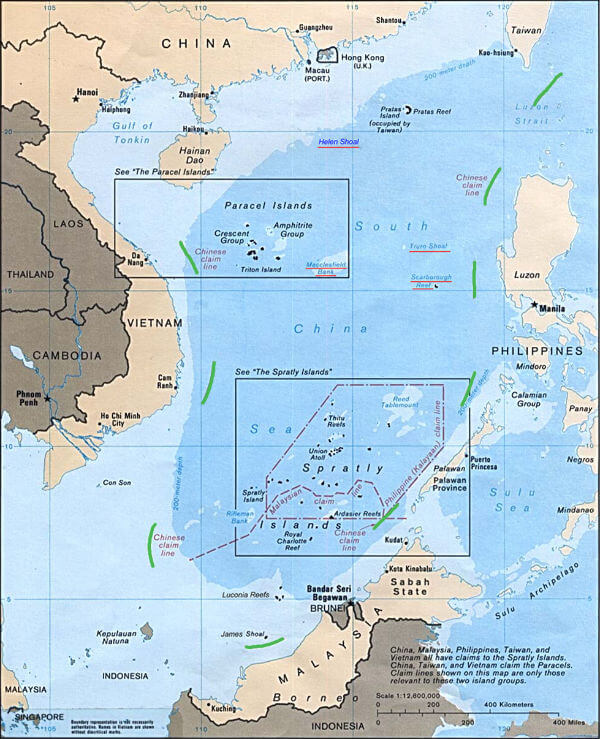
nine-dash-line

Steve Mollman writes: All any nation needs to go to war is a good provocation, and China is no exception. With its sweeping territorial claims, island-building, militarization, patriotic fervor, and prickly rhetoric, Beijing is setting itself up to be repeatedly provoked in the South China Sea. It might even be counting on it.

Consider the nation’s manmade, militarized island at Fiery Cross Reef in the Spratly archipelago. Though it didn’t even exist a few years ago, and for decades ships from other nations could routinely sail by it without disturbance, now Beijing feels provoked if anyone goes near it — and sends out warnings or makes aggressive gestures in response.

This week the USS William P. Lawrence, a guided missile destroyer from the US Navy, conducted a “freedom of navigation” operation near the island. It deliberately sailed within 12 nautical miles of Fiery Cross Reef. If the US recognized the reef as China’s territory to begin with — which it does not — that would be considered entering China’s territory.

The problem is China has claimed, outrageously, that nearly the entire sea is its own territory. Considering the fact that some $5 trillion in ship-borne trade passes through the strategic waterway every year, that’s a problem not just for the US, but any number of countries participating in the global economy. The US Navy’s operation was a reminder to China that the sea is open waters, despite any impromptu islands that might have been constructed of late.

China bases its sea claim on a “nine-dash line” that it drew on a map after World War 2. Never mind that the line conflicts with international norms and overlapping claims by nearby nations, including the Philippines, Vietnam, and Malaysia, nations whose coasts are much closer to the disputed sea than China’s. [Continue reading…]

Facebooktwittermail

Saudia Arabia and Iran: The Cold War of Islam

Der Spiegel reports: No previous US president had been made to suffer such an indignity when visiting America’s supposedly closest ally in the Arab world: When Barack Obama touched down at the airport in Riyadh in mid-April, King Salman opted to remain in his palace. The most powerful man in the world was received by the governor of Riyadh instead. There was no pomp or ceremonial reception and state-controlled television declined to broadcast the arrival. Obama seemed slightly at a loss on the tarmac before trying to cover up the affront with a broad smile.

The message was clear: Saudi Arabia feels as though it has been left in the lurch by America and is not afraid to show that it isn’t happy.

The story of the failed reception is more than just an anecdote from the international diplomatic stage. It serves to illustrate the massive geo-political shift and the growing conflict that has gripped the entire Middle East. It has become the Cold War of our era, pitting Saudi Arabia against Iran, the two rivals that are striving for supremacy in the region. And it is not entirely clear which side the US is on.

The Middle East as we have long known it is changing dramatically. And no matter where one looks, Tehran and Riyadh are standing behind at least one of the parties involved in the conflict. The kingdom of Saudi Arabia, host and protector of the holy sites in Mecca and Medina, sees itself as the home of Sunni Islam, to which the majority of the world’s Muslims belong. The Islamic Republic of Iran, a Shiite theocracy, claims leadership of the Shiites, which make up roughly 13 percent of Muslims worldwide. For both regimes, religion is an important tool of power.

Today’s bloodiest civil war, the conflict in Syria, is entering its sixth year and has thus far cost the lives of more than 250,000 people — and the cease-fire that has been in place for the last two months doesn’t look as though it will last much longer. In Syria, and also in the conflicts in Iraq and in Yemen, the fighting fronts run primarily along confessional lines: Sunnis against Shiites. A fragile peace holds in Lebanon and Bahrain, but it is one that could be shattered at any time by confessional unrest.

All of these proxy wars and confessional conflicts have unleashed a wave of migration among those who have been displaced: more than 6 million people from Syria and Iraq along with almost 3 million from Yemen. And out of the rubble of the Middle East, hydra-headed monster has risen that seeks to terrorize Brussels, Paris, Istanbul and the rest of the world: Islamic State. In an irony of history, the Sunni terror militia sees both Iran and Saudi Arabia as its enemies.

At its essence, the escalation in the Middle East also has to do with America and its changing role in the world. After decades of enmity with Iran, US President Barack Obama wanted to restart a dialogue with the country and he negotiated a nuclear treaty with Tehran. The hope is that the deal will limit Iran’s ability to pursue a nuclear weapon while making it possible for the country to do business with the West in return.

At the same time, though, the US would prefer to withdraw from this complicated, crisis-plagued region of the world. Current developments are also a product of this trend.

Iran, meanwhile, following decades of isolation, would like to revert to its former position of regional importance. The more Middle Eastern countries there are under the control of Shiites, the stronger Iran feels — and the more hard-pressed Saudi Arabia feels, a country whose rulers once rose to power by way of a pact with Sunni fundamentalists, the Wahhabis.

This new Cold War affects the entire world, making it vital to search out its causes and to scrutinize what is pushing Saudi Arabia and Iran to continue on the path of escalation. A team of SPIEGEL reporters went to both countries to investigate and spoke with politicians, religious leaders, activists, intellectuals and normal people on the streets. [Continue reading…]

Facebooktwittermail

Why many of Iran’s ‘moderates’ say they prefer Trump to Clinton

Jeremy Shapiro and Ellie Geranmayeh write: Much of the world seems fairly put off by Donald Trump. Europeans are annoyed that he has threatened to withdraw from NATO. The Japanese and South Koreans seem upset about his intention to withdraw US troops from their shores. Mexicans dislike him so much they are selling Donald Trump piñatas like hotcakes. Even the Chinese seem worried about his idea to slap them with a 45 percent tariff and his support for a nuclear-armed Japan.

So does anyone outside of America like Trump? Many people point to Russian President Vladimir Putin. He and Trump have expressed admiration for each other’s leadership qualities. But beyond Putin, there is (unsurprisingly) little foreign support for Trump’s trademark blend of American nationalism and xenophobia.

Recent conversations, however, have led us to suspect that there might be another country of potential Trump supporters out there: Iran. [Continue reading…]

Facebooktwittermail

Behind the carnage in Iraq: ISIS intends to divide and conquer

The Daily Beast reports: Baghdad suffered its deadliest day in months during a series of attacks Wednesday. The carnage not only shocked the capital, but also raised questions about whether Iraqi security forces are capable of reclaiming Mosul, Iraq’s second-largest city, which has been occupied for almost two years by the self-proclaimed Islamic State.

One obvious question is how Iraqi security forces can retake and secure Mosul if they cannot protect Baghdad from three suicide bombings in a matter of hours. But the picture is more complicated, and indeed, more problematic even than that.

The bombings targeted Shia neighborhoods in what appears to be part of the continuing ISIS effort to provoke a frenzy of ethnic cleansing similar to that of a decade ago. As one U.S. official immersed in the anti-ISIS war puts it, “Sunnis see ISIS as their protection — their wall against Shia revenge.”

The estimates of those killed Wednesday are as high as 150, with hundreds more injured. Among those reportedly killed were several women at a hair salon struck by a truck bomb as they prepared for their wedding day. [Continue reading…]

Facebooktwittermail

Lack of plan for ISIS detainees raises human rights concerns

The New York Times reports: The Islamic State calls them “inghimasi” — zealous foot soldiers who intend to fight to their deaths. And as the American-backed coalition has reclaimed territory from the group in Iraq and Syria, that fervor has kept prisoners from being much of a problem: The shooting only stops when almost every Islamic State fighter has been killed.

But that could change as the coalition moves toward the Islamic State’s largest urban strongholds — Mosul, Iraq, and Raqqa, Syria — raising a potential problem for the United States. If the coalition is successful and thousands of ordinary members of a collapsing Islamic State have nowhere left to retreat, will they start to surrender in greater numbers? And if so, who will be responsible for imprisoning them?

After the experiences of the past decade in the wars in Afghanistan and Iraq, the Obama administration is determined not to revive large-scale detention operations. But it is far from clear whether allies on the ground — especially rebels in Syria — are prepared to hold large numbers of prisoners, raising the prospect of an ugly aftermath to any victory.

“If they’re not killed but detained, we are concerned about the standards of care, who would do it and how it would be done,” Peter Maurer, the president of the International Committee of the Red Cross, said in an interview. [Continue reading…]

Facebooktwittermail

U.S. activates Romanian missile defense site, angering Russia

Reuters reports: The United States switched on an $800 million missile shield in Romania on Thursday that it sees as vital to defend itself and Europe from so-called rogue states but the Kremlin says is aimed at blunting its own nuclear arsenal.

To the music of military bands at the remote Deveselu air base, senior U.S. and NATO officials declared operational the ballistic missile defense site, which is capable of shooting down rockets from countries such as Iran that Washington says could one day reach major European cities.

“As long as Iran continues to develop and deploy ballistic missiles, the United States will work with its allies to defend NATO,” said U.S. Deputy Defence Secretary Robert Work, standing in front of the shield’s massive gray concrete housing that was adorned with a U.S. flag.

Despite Washington’s plans to continue to develop the capabilities of its system, Work said the shield would not be used against any future Russian missile threat. “There are no plans at all to do that,” he told a news conference.

Before the ceremony, Frank Rose, deputy U.S. assistant secretary of state for arms control, warned that Iran’s ballistic missiles can hit parts of Europe, including Romania. [Continue reading…]

Facebooktwittermail

Zionism threatens to bring anti-Semitism full-circle

Jonathan Ofir writes: Zionism is very much a mirror image of anti-Semitism. It was founded and based on an assumption that assimilation is bound to fail, and that the Jews must resort to other measures in order to protect their existence – as persons, but perhaps even more significantly – as a supposed nation. David Ben-Gurion’s words to the Mapai committee in 1938 reveal how the national aspect could supersede the humanitarian concern to actual people: ”If I knew that it was possible to save all the children of Germany by transporting them to England, and only half by transferring them to the Land of Israel, I would choose the latter, for before us lies not only the numbers of these children but the historical reckoning of the people of Israel.” In that same year he spoke to the Jewish Agency in regards to the Évian conference which sought to facilitate the plight of Jewish refugees, saying, “[I do] not know if the conference will open the gates of other countries. . . . But I am afraid [ it ] might cause tremendous harm to Eretz Yisrael and Zionism. . . . and the more we emphasize the terrible distress of the Jewish masses in Germany, Poland and Rumania, the more damage we shall cause” — to Zionism and Eretz Israel by promoting emigration to western countries. [Both quotes at this link.]

That is to say, that the priority of nationalism (as opposed to personal security) was extremely high in Zionism from the outset. Zionism sought to forge a sense of ‘nationhood’ for a people that were of a vast spectrum of ethnicity, language, even religion (from ultra-orthodox to atheist) and claim that they were one. The British (and notably Jewish) Secretary of State for India Edwin Montagu, in his critique of Her Majesty’s Government’s intentions to endorse a ‘Jewish national home” in Palestine in 1917, said: “I assert that there is not a Jewish nation. The members of my family, for instance, who have been in this country for generations, have no sort or kind of community of view or of desire with any Jewish family in any other country beyond the fact that they profess to a greater or less degree the same religion. It is no more true to say that a Jewish Englishman and a Jewish Moor are of the same nation than it is to say that a Christian Englishman and a Christian Frenchman are of the same nation: of the same race, perhaps, traced back through the centuries – through centuries of the history of a peculiarly adaptable race”. [Continue reading…]

Facebooktwittermail

Russia’s new missile means the nuclear arms race is back on

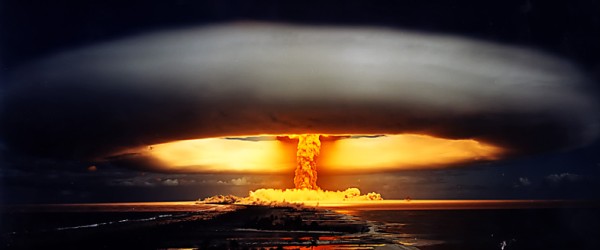
French nuclear test "Licorne",  French Polynesia, July, 1970

David Axe reports: Russia has a new nuclear missile — one that Zvezda, a Russian government-owned T.V. network, claimed can wipe out an area “the size of Texas or France.”

Actually, no, a single SS-30 rocket with a standard payload of 12 independent warheads, most certainly could not destroy Texas or France. Not immediately. And not by itself.

Each of the SS-30’s multiple independently targetable reentry vehicle warheads, or MIRVs, could devastate a single city. But Texas alone has no fewer than 35 cities of 100,000 people or more.

Which is not to say the instantaneous destruction of a dozen cities and the deaths of millions of people in a single U.S. state wouldn’t mean the end of the world as we know it.

Nobody nukes just Texas. And if Russia is disintegrating Texan cities, that means Russia is also blasting cities all over the United States and allied countries — while America and its allies nuke Russia right back.

Moscow’s arsenal of roughly 7,000 atomic weapons — 1,800 of which are on high alert — and America’s own, slighly smaller arsenal — again, only 1,800 of which are ready to fire at any given time — plus the approximately 1,000 warheads that the rest of the world’s nuclear powers possess are, together, more than adequate to kill every human being on Earth as well as most other forms of life.

One new Russian rocket doesn’t significantly alter that terrible calculus.

But that doesn’t mean you shouldn’t be alarmed. The SS-30 is only the latest manifestation of a worrying trend. After decades of steady disarmament, the United States and Russia are pouring tens of billions of dollars into building new and more capable nuclear weaponry that experts agree neither country needs, nor can afford.

The SS-30 by itself is just slightly more destructive than older Russian missiles. It’s what the new weapon represents that’s frightening. The post-Cold War nuclear holiday is over. And apocalyptic weaponry such as Russia’s new SS-30 are back at work making the world a very, very scary place. [Continue reading…]

Facebooktwittermail

‘Good Muslims’ or ‘Good citizens’: How Muslim women feel about integration

By Line Nyhagen, Loughborough University

A great many things have been said about Muslims as UK citizens, mainly by non-Muslims. The prime minister, David Cameron, believes that if more Muslim women became proficient in English, for example, it would help beat extremism and terrorism. Meanwhile, Trevor Phillips, the former chair of the Equality and Human Rights Commission, says that UK Muslims “See the world differently from the rest of us”.

Phillips also presented a controversial Channel 4 programme called What British Muslims Really Think, which put across the message that Muslims are more conservative than the majority population and don’t want to integrate into wider society.

The debate is often highly intemperate – and both Muslim and non-Muslim voices alike have suggested it contributes to further stigmatisation of an already marginalised and disadvantaged Muslim population. In this highly politicised climate, the relationship between Islam and citizenship has also come under scrutiny by Citizens UK, a charitable voluntary organisation with churches, mosques and unions among its members.

In July 2015, Citizens UK launched its Commission on Islam, Participation and Public Life headed by conservative MP Dominic Greave. Greave somewhat unfortunately framed the Commission’s work as aiming to “help tackle extremism”.

Continue reading

Facebooktwittermail

U.S. has taken in 1,736 Syrian refugees — less than a fifth of pledged intake

The New York Times reports: The Obama administration’s effort to step up asylum for Syrian refugees is going so slowly, it may not meet the president’s deadline for accepting at least 10,000 by the end of the fiscal year.

More than seven months since the president pledged to resettle the most vulnerable Syrians, the United States has let in less than a fifth of that number — 1,736 through the end of April, according to government figures.

Most of the world’s four million Syrian refugees live in countries in the region: Turkey, Lebanon and Jordan.

Canada has offered visas to more than 48,000 Syrians, according to the United Nations, and is also allowing private groups to sponsor Syrian families. More than 400,000 Syrians sought asylum in Germany last year, and Brazil has issued nearly 8,500 humanitarian visas to Syrians.

At the General Assembly debate that is scheduled to begin on Sept. 20, Mr. Obama plans to lead a special session at which world leaders are expected to publicly pledge to take in more refugees.

Russia, a major supporter of the government of President Bashar al-Assad of Syria, has not resettled a single Syrian refugee, according to the United Nations. [Continue reading…]

Facebooktwittermail

In remote corner of Iraq, an unlikely alliance forms against ISIS

Reuters reports: They share little more than an enemy and struggle to communicate on the battlefield, but together two relatively obscure groups have opened up a new front against Islamic State militants in a remote corner of Iraq.

The unlikely alliance between an offshoot of a leftist Kurdish organization and an Arab tribal militia in northern Iraq is a measure of the extent to which Islamic State has upended the regional order.

Across Iraq and Syria, new groups have emerged where old powers have waned, competing to claim fragments of territory from Islamic State and complicating the outlook when they win.

“Chaos sometimes produces unexpected things,” said the head of the Arab tribal force, Abdulkhaleq al-Jarba. “After Daesh (Islamic State), the political map of the region has changed. There is a new reality and we are part of it.”

In Nineveh province, this “new reality” was born in 2014 when official security forces failed to defend the Sinjar area against the Sunni Islamic State militants who purged its Yazidi population.

A Syrian affiliate of the Kurdistan Workers’ Party (PKK) came to the rescue, which won the gratitude of Yazidis, and another local franchise called the Sinjar Resistance Units (YBS) was set up.

The mainly Kurdish secular group, which includes Yazidis, controls a pocket of territory in Sinjar and recently formed an alliance with a Sunni Arab militia drawn from the powerful Shammar tribe.

“In the beginning we were unsure (about them),” said a wiry older member of the Arab force, which was assembled over the past three months and is now more than 400-strong. “We thought they were Kurdish occupiers.”

Their cooperation is all the more unusual because many Yazidis accuse their Sunni Muslim neighbors of complicity in atrocities committed against them by Islamic State, and say they cannot live together again. [Continue reading…]

Facebooktwittermail

Mosul: Suspicion and hostility cloud fight to recapture Iraqi city from ISIS

The Guardian reports: At the bottom of a hill near the frontline with Islamic State fighters, the Iraqi army had been digging in. Their white tents stood near the brown earth gouged by the armoured trucks that had carried them there – the closest point to Mosul they had reached before an assault on Iraq’s second largest city.

For a few days early last month, the offensive looked like it already might be under way. But that soon changed when the Iraqis, trained by US forces, were quickly ousted from al-Nasr, the first town they had seized. There were about 25 more small towns and villages, all occupied by Isis, between them and Mosul. And 60 miles to go.

Behind the Iraqis, the Kurdish peshmerga remained dug into positions near the city of Makhmour that had marked the frontline since not long after Mosul was seized in June 2014. The war had been theirs until the national army arrived. The new partnership is not going well.

On both sides, there is a belief that what happens on the road to Mosul will not only define the course of the war but also shape the future of Iraq. And, despite the high stakes, planning for how to take things from here is increasingly clouded by suspicion and enmity. [Continue reading…]

Facebooktwittermail

UN investigators tell states to stop Syria war crimes

Reuters reports: States backing Syria’s peace process must stop the warring parties from attacking unlawful targets such as hospitals and other civilian sites, U.N. war crimes investigators said in a statement on Wednesday.

Air strikes, shelling and rocket fire had been consistently used in recent attacks on civilian areas, the U.N. Commission of Inquiry on Syria said in a statement.

“Failure to respect the laws of war must have consequences for the perpetrators,” its chairman, Paulo Pinheiro, said. [Continue reading…]

Facebooktwittermail

As war strangles Yemen, many fear the grip will never break

yemen-bombing

The New York Times reports: The familiar thud of shelling echoed off the mountains that cradle this besieged and ravaged city. For a few terrifying minutes, a warplane circled over neighborhoods and humming afternoon markets before dropping a bomb that momentarily silenced the guns.

But the fighting never stops for long in Taiz, or across Yemen for that matter, a country that has endured 14 months of shattering civil war.

Yemen’s government and its main opponents, the Houthi rebels, have been negotiating for weeks to end the conflict, under intense pressure from the United States and from other Western nations alarmed that Al Qaeda’s local affiliate, Al Qaeda in the Arabian Peninsula, is gaining recruits, weapons and money in the midst of the country’s collapse.

A frenzied escalation of violence over the last few days is threatening a nationwide cease-fire that was supposed to build confidence for the talks. The bloodshed has laid bare the furious rivalries — between aging warlords, tribes, Islamist groups and regional powers — that are making Yemen’s hostilities almost impossible to stop.

Even if the negotiations somehow succeed, Yemenis scarred by the vicious fighting, past broken promises and deepening divisions say they fear that any truce would just be a prelude to an even uglier war, fought between regions, religious sects — even neighbors. [Continue reading…]

Facebooktwittermail