Category Archives: Lands

U.S.-backed force claims capture of ISIS’s de facto Syrian capital Raqqa

The Washington Post reports: U.S. backed forces in Syria claimed full control of the Islamic State’s onetime capital of Raqqa on Tuesday, heralding an end to the militants’ presence in their most symbolically important stronghold and bringing closer the likelihood of their complete territorial demise.

Talo Silo, a spokesman for the Syrian Democratic Forces, or SDF, said that military operations had halted and that members of the joint Kurdish-Arab force were clearing the city of explosive devices and hunting for sleeping cells.

It was still unclear whether some Islamic State pockets remained, but the SDF portrayed the battle for Raqqa as effectively over.

Besieged and severely weakened, dozens of militants had launched a final stand from inside Raqqa’s main hospital and stadium. But hundreds of others surrendered during the final days of the battle after local officials brokered a controversial deal which could see many escape prosecution. [Continue reading…]

Facebooktwittermail

Somalia bombing may have been revenge for botched U.S.-led operation

The Guardian reports: The man who killed more than 300 people with a truck bomb in the centre of Mogadishu on Saturday was a former soldier in Somalia’s army whose home town was raided by local troops and US special forces two months ago in a controversial operation in which 10 civilians were killed, officials in Somalia have said.

The death toll from the bombing now stands at more than 300, making it one of the most devastating terrorist attacks anywhere in the world for many years. On Tuesday remains of victims were still being brought out of rubble spread over hundreds of square metres.

Investigators believe the attack on Saturday may in part have been motivated by a desire for revenge for the botched US-led operation in August.

Al-Shabaab has not claimed responsibility for Saturday’s attack but a member of the cell detained by security forces has told interrogators the group was responsible, one security official told the Guardian. [Continue reading…]

Facebooktwittermail

Russian troll factory paid U.S. activists to help fund protests during election

The Guardian reports: Russian trolls posing as Americans made payments to genuine activists in the US to help fund protest movements on socially divisive issues, according to a new investigation by a respected Russian media outlet.

On Tuesday, the newspaper RBC published a major investigation into the work of a so-called Russian “troll factory” since 2015, including during the period of the US election campaign, disclosures that are likely to put further spotlight on alleged Russian meddling in the election.

The existence of the troll factory, which has a history of spamming Russian and English blogs and comment forums, has been reported on by many outlets including the Guardian, but the RBC investigation is the first in-detail look at the organisation’s activity during the election period.

RBC said it had identified 118 accounts or groups in Facebook, Instagram and Twitter that were linked to the troll factory, all of which had been blocked in August and September this year as part of the US investigation into Russian electoral meddling.

Many of the accounts had already been linked to Russian disinformation efforts in western outlets, but RBC said its sources at the troll factory had provided screenshots of the internal group administration pages of some of the groups, as proof they were run from Russia. It also spoke to former and current employees of the troll factory, all of whom spoke anonymously.

Perhaps the most alarming element of the article was the claim that employees of the troll factory had contacted about 100 real US-based activists to help with the organisation of protests and events. RBC claimed the activists were contacted by Facebook group administrators hiding their Russian origin and were offered financial help to pay for transport or printing costs. About $80,000 was spent during a two-year period, according to the report.

The main topics covered by the groups run from Russia were race relations, Texan independence and gun rights. RBC counted 16 groups relating to the Black Lives Matter campaign and other race issues that had a total of 1.2 million subscribers. The biggest group was entitled Blacktivist and reportedly had more than 350,000 likes at its peak. [Continue reading…]

Facebooktwittermail

Putin’s ‘chef,’ the man behind the troll factory

CNN reports: Yevgeny Prigozhin is a Russian oligarch dubbed “chef” to President Vladimir Putin by the Russian press. In 2002, he served caviar and truffles to President George W. Bush during a summit in St. Petersburg. Before that, he renovated a boat that became the city’s most exclusive restaurant.

But his business empire has expanded far beyond the kitchen. US investigators believe it was Prigozhin’s company that financed a Russian “troll factory” that used social media to spread fake news during the 2016 US presidential campaign, according to multiple officials briefed on the investigation. One part of the factory had a particularly intriguing name and mission: a “Department of Provocations” dedicated to sowing fake news and social divisions in the West, according to internal company documents obtained by CNN.

Prigozhin is one of the Kremlin’s inner circle. His company is believed to be a main backer of the St. Petersburg-based “Internet Research Agency” (IRA), a secretive technology firm, according to US officials and the documents reviewed by CNN. Prigozhin was sanctioned by the US Treasury Department in December of 2016 for providing financial support for Russia’s military occupation of Ukraine. Two of his companies, including his catering business, were also sanctioned by Treasury this year. [Continue reading…]

Facebooktwittermail

FBI uncovered Russian bribery plot before Obama administration approved controversial nuclear deal with Moscow

The Hill reports: Before the Obama administration approved a controversial deal in 2010 giving Moscow control of a large swath of American uranium, the FBI had gathered substantial evidence that Russian nuclear industry officials were engaged in bribery, kickbacks, extortion and money laundering designed to grow Vladimir Putin’s atomic energy business inside the United States, according to government documents and interviews.

Federal agents used a confidential U.S. witness working inside the Russian nuclear industry to gather extensive financial records, make secret recordings and intercept emails as early as 2009 that showed Moscow had compromised an American uranium trucking firm with bribes and kickbacks in violation of the Foreign Corrupt Practices Act, FBI and court documents show.

They also obtained an eyewitness account — backed by documents — indicating Russian nuclear officials had routed millions of dollars to the U.S. designed to benefit former President Bill Clinton’s charitable foundation during the time Secretary of State Hillary Clinton served on a government body that provided a favorable decision to Moscow, sources told The Hill.

The racketeering scheme was conducted “with the consent of higher level officials” in Russia who “shared the proceeds” from the kickbacks, one agent declared in an affidavit years later.

Rather than bring immediate charges in 2010, however, the Department of Justice (DOJ) continued investigating the matter for nearly four more years, essentially leaving the American public and Congress in the dark about Russian nuclear corruption on U.S. soil during a period when the Obama administration made two major decisions benefiting Putin’s commercial nuclear ambitions. [Continue reading…]

Facebooktwittermail

How America became a timid, cowardly, selfish nation

Susan B Glasser writes: Ai Weiwei is making a strong case for himself as America’s leading dissident of the Trump era.

Never mind that he’s Chinese, or that he lives in Berlin in de facto exile these days.

The legendary artist, who has long embraced political themes in his work, has gone full-out activist in a new feature-length documentary film about the global refugee crisis, called Human Flow and released in theaters across the U.S. Friday, and in a new, New York City-wide public art exhibit of 300 works in dozens of locations called “Good Walls Make Good Neighbors.”

Both are explicit rebuttals of the nationalistic, America-First-fueled policies espoused by Donald Trump, from his proposed Mexican border wall to his curbs on immigration that include admitting the smallest number of refugees to the U.S. in decades.

In a new interview for The Global Politico during a rare visit to Trump’s Washington, Ai referred to Trump’s win as “the moment I think history stopped,” a “backward” evolution that undermines liberal ideas like freedom of speech and human dignity everywhere.

Authoritarian leaders in China and elsewhere are the beneficiaries of Trump and the crisis of American democracy, said Ai, who spent four years under house arrest and forbidden to leave China before being allowed to leave the country two years ago.

“China is laughing about this situation,” he said. “China, Russia, they all laugh about it.”

When we met in Georgetown recently, I found Ai most compelling when talking about why he made the film, a “strangely beautiful” documentary, as the New York Times put it, shot in 23 countries from Asia to Africa to the Middle East and Europe over the course of a year.

It’s a call to action for Americans, he told me, and a commentary on what he sees as the breakdown of our society into a “timid” and “cowardly” and “selfish” place, one whose new role in the world is very much at odds with its self-identity as this liberal, generous nation.

“We have to save our own soul and our own mind and our own society,” he said. [Continue reading…]


Facebooktwittermail

Deadly overconfidence: Trump thinks missile defenses work against North Korea, and that should scare you

Ankit Panda and Vipin Narang write: Could a president’s overconfidence in U.S. defensive systems lead to deadly miscalculation and nuclear armageddon? Yes. Yes, it could. Last Wednesday, referring to potential American responses to North Korea’s missile and nuclear program, President Donald Trump told Sean Hannity “We have missiles that can knock out a missile in the air 97 percent of the time, and if you send two of them it’s gonna get knocked out.” If Trump believes — or is being told — that American missile defenses are that accurate, not only is he factually wrong, he is also very dangerously wrong. This misperception could be enough to lead the United States into a costly war with devastating consequences.

Here’s why: If Trump believes U.S. missile defenses work this effectively, he might actually think a first strike attempt to disarm North Korea of its missile and nuclear forces would successfully spare U.S. cities from North Korean nuclear retaliation. They probably wouldn’t. Believing that each ground-based midcourse missile defense (GMD) interceptor can provide anything close to a 97 percent interception rate against retaliation raises the temptation to attempt a so-called “splendid first strike” based on the assumption that missile defenses can successfully intercept any leftover missiles North Korea could then fire at the United States.

In this article, we first lay out the complexity of American missile defenses and explain why it’s way off the mark to believe U.S. ground-based missile defense interceptors are even close to as effective as Trump suggested. We then explain how overconfidence in national missile defense may tempt the president to consider a first strike with no actual guarantee that it can spare an American city — or multiple cities — from potential North Korean thermonuclear retaliation. For a president who has already expressed an inclination to visit “fire and fury” on Kim Jong Un and threatened to “totally destroy” his country, we’re obligated to take Trump’s misplaced confidence in GMD very seriously. His attraction to attempting a first strike will only grow if he is blind to an important gap in U.S. defenses. Not only might he still want to denuclearize North Korea by force, he might think it is actually possible to do so without putting the U.S. homeland at risk. [Continue reading…]

Facebooktwittermail

North Korea says ‘a nuclear war may break out any moment’

The Associated Press reports: North Korea’s deputy U.N. ambassador warned Monday that the situation on the Korean peninsula “has reached the touch-and-go point and a nuclear war may break out any moment.”

Kim In Ryong told the U.N. General Assembly’s disarmament committee that North Korea is the only country in the world that has been subjected to “such an extreme and direct nuclear threat” from the United States since the 1970s — and said the country has the right to possess nuclear weapons in self-defense.

He pointed to large-scale military exercises every year using “nuclear assets” and said what is more dangerous is what he called a U.S. plan to stage a “secret operation aimed at the removal of our supreme leadership.” [Continue reading…]

Facebooktwittermail

If Trump doesn’t want a nuclear war with North Korea, a ‘No First Use’ pledge might work better than threats

Steven J. Brams writes: Donald Trump has threatened to “totally destroy” North Korea with “fire and fury” should it cross some ambiguous tripwire. By being vague about where that tripwire lies, Trump seems to believe that his threat, coupled with harsher economic sanctions, will force Kim Jong Un to back down.

But just the opposite seems to have occurred. Instead, a war of words has broken out between Trump and Kim. This underscores the dangers that arise when there are no clear policy guidelines about what conditions constitute a threat to peace and can lead to war. It also tells us what may happen when each leader plays a “madman strategy” — pretending to be a madman to induce his antagonist to capitulate.

Game theorists such as Thomas Schelling have pointed out that the madman strategy can sometimes get results. It is equivalent to throwing the steering wheel out the window of your car, in sight of your adversary, when playing a game of chicken — showing that you are not going to be able to swerve, so your adversary must do so to avoid a head-on collision. Clearly, chicken is a dangerous game.

On the one hand, disaster might strike if both players stick with the madman strategy of making irrevocable commitments. The personal invectives and threats that Trump and Kim have hurled at each other might eventually be sufficient to cause one of them to escalate to nuclear war. If their posturing becomes real, this strategy’s logic leads to mutual catastrophe. [Continue reading…]

Facebooktwittermail

Interview with a former troll at Russia’s Internet Research Agency

Meduza reports: One of the many remarkable things about 2017 is that American journalists no longer have the Irish Republican Army in mind when writing “IRA,” which is now used most often to mean Russia’s Internet Research Agency — the “troll factory” responsible for buying ads on social media and polluting American online news discussion in an apparent effort to destabilize U.S. democracy. On October 15, the Russian independent news network Dozhd published the latest development in this ongoing story: an interview with a man who allegedly worked for the IRA from 2014-2015. Meduza summarizes that interview here.

*

Dozhd calls him “Maxim,” but that’s not his real name. The TV network says Max’s employment records confirm that he spent 18 months at 55 Savushkina in St. Petersburg, working for the Internet Research Agency (IRA), Russia’s infamous “troll factory.” He quit in early 2015, before Donald Trump even announced his presidential candidacy, but not too soon to get a taste of the “factory’s” war on Hillary Clinton.

According to Max, the IRA’s “foreign desk” had open orders to “influence opinions” and change the direction of online discussions. He says this department within the agency considered itself above the “Russian desk,” which he claims is generally “bots and trolls.” The foreign desk was supposedly more sophisticated. “It’s not just writing ‘Obama is a monkey’ and ‘Putin is great.’ They’ll even fine you for that kind of [primitive] stuff,” Max told Dozhd. People in his department, he says, were even trained and educated to know the nuances of American social polemics on tax issues, LGBT rights, the gun debate, and more.

Max says that IRA staff were tasked with monitoring tens of thousands of comments on major U.S. media outlets, in order to grasp the general trends of American Internet users. Once employees got a sense of what Americans naturally discussed in comment forums and on social media, their job was to incite them further and try to “rock the boat.”

According to Max, the Internet Research Agency’s foreign desk was prohibited from promoting anything about Russia or Putin. One thing the staff learned quickly was that Americans don’t normally talk about Russia: “They don’t really care about it,” Max told Dozhd. “Our goal wasn’t to turn the Americans toward Russia,” he claims. “Our task was to set Americans against their own government: to provoke unrest and discontent, and to lower Obama’s support ratings.”

The trolls at the IRA were also careful about covering their tracks. Max says anyone working in the foreign desk was required to post comments using a VPN, to disguise their Russian origins. He says an employee once shared a photograph taken at the IRA’s office, which was especially forbidden, because photos can contain revealing metadata. This incident also revealed that the IRA employed staff to spy on its own trolls, Max says.

Even two years before Americans actually voted on their next president, St. Petersburg trolls were told to attack Hillary Clinton, reminding Internet users about her wealth, her husband’s legacy, and her various corruption scandals. The IRA even encouraged employees to watch Netflix’s “House of Cards,” supposedly as an education in U.S. politics. Staff would also monitor each other’s use of English, nitpicking over grammar and punctuation, in order to weed out ESL formulations. [Continue reading…]

Facebooktwittermail

The time has come for Theresa May to tell Britain: Brexit can’t be done

Alastair Campbell writes: As she tries to move the Brexit negotiations forward, how much better would Theresa May and the country feel if the speech she made to her party went as follows.

“Leadership is about confronting the great challenges. But Brexit is the biggest challenge we have faced since the second world war. So I intend to devote my speech, in four parts, to this alone.

“First, I want to explain why I voted remain – because for all its faults, the European Union has been a force for good in Europe and in the UK. I believed that our future prosperity and security, and opportunities for our young people, would be enhanced by staying in. Second, I want to explain why, nonetheless, I was something of a reluctant remainer. The truth is, there is a lot wrong with the EU. So though I voted remain, I was not starry-eyed. I was determined that, had we won, we would also fight for reform.

“Third, I want to explain why I have been trying so hard to deliver the Brexit the people voted for. It was a close result. But leave won. I felt strongly that it was my duty to deliver the only Brexit that I believed could meet the demands of the majority of leavers – out of the single market and the customs union, out of the European court of justice.

“But precisely because I have a profound sense of duty, I want to tell you the absolute truth as I see it. It cannot be done. Yes, you can shout. You can storm out. But I have looked at it every which way. And, as your leader, I have concluded that it cannot be done without enormous damage to our economy, to your living standards, to our public services, to our standing in the world. This is damage I am not prepared to inflict. The cost is too high. [Continue reading…]

Facebooktwittermail

How Stalin — and the foreign press corps — hid Ukraine’s famine from the world

Anne Applebaum writes: In the years 1932 and 1933, a catastrophic famine swept across the Soviet Union. It began in the chaos of collectivization, when millions of peasants were forced off their land and made to join state farms. It was then exacerbated, in the autumn of 1932, when the Soviet Politburo, the elite leadership of the Soviet Communist Party, took a series of decisions that deepened the famine in the Ukrainian countryside. Despite the shortages, the state demanded not just grain, but all available food. At the height of the crisis, organized teams of policemen and local Party activists, motivated by hunger, fear, and a decade of hateful propaganda, entered peasant households and took everything edible: potatoes, beets, squash, beans, peas, and farm animals. At the same time, a cordon was drawn around the Ukrainian republic to prevent escape. The result was a catastrophe: At least 5 million people perished of hunger all across the Soviet Union. Among them were nearly 4 million Ukrainians who died not because of neglect or crop failure, but because they had been deliberately deprived of food.

Neither the Ukrainian famine nor the broader Soviet famine were ever officially recognized by the USSR. Inside the country the famine was never mentioned. All discussion was actively repressed; statistics were altered to hide it. The terror was so overwhelming that the silence was complete. Outside the country, however, the cover-up required different, subtler tactics. These are beautifully illustrated by the parallel stories of Walter Duranty and Gareth Jones.

In the 1930s, all of the members of the Moscow press corps led a precarious existence. At the time, they needed the state’s permission to live in the USSR, and even to work. Without a signature and the official stamp of the press department, the central telegraph office would not send their dispatches abroad. To win that permission, journalists regularly bargained with foreign ministry censors over which words they could use, and they kept on good terms with Konstantin Umansky, the Soviet official responsible for the foreign press corps. William Henry Chamberlin, then the Moscow correspondent for the Christian Science Monitor, wrote that the foreign reporter “works under a Sword of Damocles—the threat of expulsion from the country or of the refusal of permission to re-enter it, which of course amounts to the same thing.”

Extra rewards were available to those, like Walter Duranty, who played the game particularly well. Duranty was The New York Times correspondent in Moscow from 1922 until 1936, a role that, for a time, made him relatively rich and famous. British by birth, Duranty had no ties to the ideological left, adopting rather the position of a hard-headed and skeptical “realist,” trying to listen to both sides of the story. “It may be objected that the vivisection of living animals is a sad and dreadful thing, and it is true that the lot of kulaks and others who have opposed the Soviet experiment is not a happy one,” he wrote in 1935—the kulaks being the so-called wealthy peasants whom Stalin accused of causing the famine. But “in both cases, the suffering inflicted is done with a noble purpose.”

This position made Duranty enormously useful to the regime, which went out of its way to ensure that Duranty lived well in Moscow. He had a large flat, kept a car and a mistress, had the best access of any correspondent, and twice received coveted interviews with Stalin. But the attention he won from his reporting back in the U.S. seems to have been his primary motivation. His missives from Moscow made him one of the most influential journalists of his time. In 1932, his series of articles on the successes of collectivization and the Five Year Plan won him the Pulitzer Prize. Soon afterward, Franklin Roosevelt, then the governor of New York, invited Duranty to the governor’s mansion in Albany, where the Democratic presidential candidate peppered him with queries. “I asked all the questions this time. It was fascinating,” Roosevelt told another reporter.

As the famine worsened, Duranty, like his colleagues, would have been in no doubt about the regime’s desire to repress it. In 1933, the Foreign Ministry began requiring correspondents to submit a proposed itinerary before any journey into the provinces; all requests to visit Ukraine were refused. The censors also began to monitor dispatches. Some phrases were allowed: “acute food shortage,” “food stringency,” “food deficit,” “diseases due to malnutrition,” but nothing else. In late 1932, Soviet officials even visited Duranty at home, making him nervous.

In that atmosphere, few of them were inclined to write about the famine, although all of them knew about it. “Officially, there was no famine,” wrote Chamberlin. But “to anyone who lived in Russia in 1933 and who kept his eyes and ears open, the historicity of the famine is simply not in question.” Duranty himself discussed the famine with William Strang, a diplomat at the British embassy, in late 1932. Strang reported back drily that the New York Times correspondent had been “waking to the truth for some time,” although he had not “let the great American public into the secret.” Duranty also told Strang that he reckoned “it quite possible that as many as 10 million people may have died directly or indirectly from lack of food,” though that number never appeared in any of his reporting. Duranty’s reluctance to write about famine may have been particularly acute: The story cast doubt on his previous, positive (and prize-winning) reporting. [Continue reading…]

Facebooktwittermail

Mogadishu atrocity one of the most lethal acts of terrorism this century

The Guardian reports: The death toll in the bombing that hit the centre of Mogadishu on Saturday continues to rise, with more than 300 people now believed to have been killed and hundreds more seriously injured.

The scale of the loss makes the attack, which involved a truck packed with several hundred kilograms of military-grade and homemade explosives, one of the most lethal terrorist acts anywhere in the world for many years.

On Monday morning, Somalia’s information minister announced that 276 people had died in the attack with at least 300 people injured. Within hours, however, Abdikadir Abdirahman, the director of Amin ambulances, said his service had confirmed that 300 people died in the blast.

“The death toll will still be higher because some people are still missing,” Abdirahman told Reuters.

More victims continue to be dug from the rubble spread over an area hundreds of metres wide in the centre of the city. [Continue reading…]

Jason Burke writes: For many years, Somalia was a forgotten front among the various campaigns against violent extremist Islamists around the world.

The massive bombing of the centre of Mogadishu, the capital of Somalia, will bring the international spotlight back on to the battered country – at least for a few days.

Al-Shabaab, the tenacious and capable Islamist group based in the country, is almost certainly responsible for the huge truck bomb that killed as many as 300 people in Mogadishu on Saturday.

The attack proves once more it is among the most capable and tenacious militant organisations anywhere.

Al-Shabaab’s roots run back through a series of violent – and sometimes non-violent – revivalist Islamist movements in Somalia over the past 40 years. In the past decade, it has been fighting local, regional and international forces, and has survived significant strategic setbacks primarily by exploiting the weaknesses and failings of central government in the shattered state. [Continue reading…]

The Washington Post reports: Earlier this year, the White House loosened the rules governing U.S. operations in the country, declaring parts of Somalia to be an “area of active hostilities.”

A one-star general was assigned to coordinate operations from a compound within Mogadishu’s airport. The small, elite teams of U.S. Special Operations forces in Somalia were augmented with conventional Army troops who provide a variety of training for the Somali forces.

The Pentagon refuses to say precisely how many Americans are deployed to Somalia — believed to be a few hundred at most — but Defense Secretary Jim Mattis indicated earlier this year that the Trump administration would consider sending more personnel if asked by the Somali president.

It’s unlikely, though, that the weekend’s attack will result in any substantial American military buildup. As in other unstable parts of Africa, the U.S. strategy in Somalia has been to support allied forces by sharing intelligence, providing training and equipment, and conducting precision airstrikes — but not doing the fighting for them. [Continue reading…]

Facebooktwittermail

U.S. military to begin drills to evacuate Americans from South Korea

The New York Times reports: The United States military said on Monday that it would practice evacuating noncombatant Americans out of South Korea in the event of war and other emergencies, as the two allies began a joint naval exercise amid heightened tensions with North Korea.

The evacuation drill, known as Courageous Channel, is scheduled from next Monday through Friday and is aimed at preparing American “service members and their families to respond to a wide range of crisis management events such as noncombatant evacuation and natural or man-made disasters,” the United States military said in a statement.

It has been conducting similar noncombatant evacuation exercises for decades, along with other joint military exercises with South Korea. But when tensions escalate with North Korea, as they have recently, such drills draw outsize attention and ignite fear among South Koreans, some of whom take them as a sign that the United States might be preparing for military action against the North.

The South Korean government of President Moon Jae-in has repeatedly warned that it opposes a military solution to the North Korean nuclear crisis because it could quickly escalate into a full-blown war in which Koreans would suffer the most. [Continue reading…]

Facebooktwittermail

The world once laughed at North Korean cyberpower. No more

The New York Times reports: When North Korean hackers tried to steal $1 billion from the New York Federal Reserve last year, only a spelling error stopped them. They were digitally looting an account of the Bangladesh Central Bank, when bankers grew suspicious about a withdrawal request that had misspelled “foundation” as “fandation.”

Even so, Kim Jong-un’s minions still got away with $81 million in that heist.

Then only sheer luck enabled a 22-year-old British hacker to defuse the biggest North Korean cyberattack to date, a ransomware attack last May that failed to generate much cash but brought down hundreds of thousands of computers across dozens of countries — and briefly crippled Britain’s National Health Service.

Their track record is mixed, but North Korea’s army of more than 6,000 hackers is undeniably persistent, and undeniably improving, according to American and British security officials who have traced these attacks and others back to the North.

Amid all the attention on Pyongyang’s progress in developing a nuclear weapon capable of striking the continental United States, the North Koreans have also quietly developed a cyberprogram that is stealing hundreds of millions of dollars and proving capable of unleashing global havoc.

Unlike its weapons tests, which have led to international sanctions, the North’s cyberstrikes have faced almost no pushback or punishment, even as the regime is already using its hacking capabilities for actual attacks against its adversaries in the West.

And just as Western analysts once scoffed at the potential of the North’s nuclear program, so did experts dismiss its cyberpotential — only to now acknowledge that hacking is an almost perfect weapon for a Pyongyang that is isolated and has little to lose. [Continue reading…]

Facebooktwittermail

Iraqi forces launch operation for Kurdish-held oil fields, military base

The Washington Post reports: Clashes broke out early Monday in northern Iraq as Iraqi forces moved to recapture Kurdish-held oil fields and a military base near the city of Kirkuk, setting the stage for a battle between two U.S. allies.

After a three-day standoff, Iraqi forces advanced into the contested province with the goal of returning to positions they held before 2014, when they fled in the face of an Islamic State push. The positions have since been taken over by Kurdish troops.

The conflict between Kurdi­stan and the Iraqi government over land and oil is decades old, but a Kurdish referendum for independence last month inflamed the tensions. The Iraqi government, as well as the United States, Turkey and Iran all opposed the vote.

The flare-up presents an awkward dilemma for the United States, which has trained and equipped the advancing Iraqi troops, which include elite counterterrorism forces, and the Kurdish peshmerga on the other side.

But the Iraqi side is also backed up by Shiite militia forces close to Iran, at a time when the Trump administration has been vocal about curbing Iranian influence in the region, having sanctioned Iran’s Islamic Revolutionary Guard Corps last week. [Continue reading…]

Facebooktwittermail

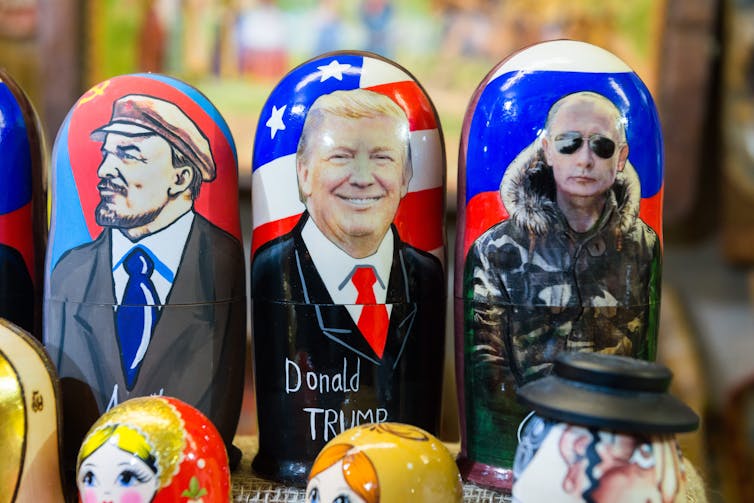
Russia is showing increasing contempt for Trump

File 20171013 3520 1vwwctj.jpg?ixlib=rb 1.1
It seems that Russian state media is starting to chip away at Trump’s burnished image.
Maxim Apryatin

By Cynthia Hooper, College of the Holy Cross

Four major Russia investigations are underway in Washington, along with at least six related federal inquiries.

Anxiety currently swirls around the Kremlin’s manipulation of popular social media platforms Facebook, YouTube and Instagram. Cybersecurity sleuths claim Russia used Pokemon Go to inflame racial tensions and accuse Twitter of deleting crucial data detailing Russian efforts to sow discord during the 2016 presidential election.

“Russia, Russia Everywhere,” read The New York Times Oct. 13 “Week in Technology” review.

But as a cultural historian, I’m interested in how Russia’s media outlets – many of which are state-controlled – are covering these same stories.

It’s no secret that for years the Kremlin has claimed Washington possesses a knee-jerk, anti-Russian bias. Moscow officials have cast recent U.S. charges that Russia has been acting to “undermine the U.S.-led liberal democratic order” as simply part of this same phenomenon, albeit one that has blossomed, of late, into full-fledged hysteria.

Russia’s most popular media outlets compare the investigations to those of the McCarthy era, calling them “witch hunts” focused on a “phantom menace.”

However, I’ve noticed something surprising. Amid all the emphasis of “Russophobia run wild,” Russian media coverage seems to have become more positive in regard to one issue: the Justice Department’s investigation led by Special Prosecutor Robert Mueller.

Continue reading

Facebooktwittermail

Russian trolls were schooled on ‘House of Cards’

Michael Isikoff reports: The Russians who worked for a notorious St. Petersburg “troll factory” that was part of Vladimir Putin’s campaign to influence the 2016 presidential election were required to watch the “House of Cards” television series to help them craft messages to “set up the Americans against their own government,” according to an interview broadcast Sunday (in Russian) with a former member of the troll factory’s elite English language department.

The interview, broadcast by the independent Russian TV station Rain, provides new insight into how the troll factory formerly known as the Internet Research Agency targeted U.S. audiences in part by posting provocative “comments” pretending to be from Americans on newspaper articles that appeared on the websites of the New York Times and Washington Post.

A central theme of this messaging was demonizing Hillary Clinton by playing up the past scandals of her husband’s administration, her wealth and her use of a private email server, according to the interview with the agency worker, identified only as “Maksim,” with his face concealed. [Continue reading…]

Facebooktwittermail