Category Archives: Lands

The invasion of Antarctica

antarctica

Simon Romero writes: On a glacier-filled island with fjords and elephant seals, Russia has built Antarctica’s first Orthodox church on a hill overlooking its research base, transporting the logs all the way from Siberia.

Less than an hour away by snowmobile, Chinese laborers have updated the Great Wall Station, a linchpin in China’s plan to operate five bases on Antarctica, complete with an indoor badminton court, domes to protect satellite stations and sleeping quarters for 150 people.

Not to be outdone, India’s futuristic new Bharathi base, built on stilts using 134 interlocking shipping containers, resembles a spaceship. Turkey and Iran have announced plans to build bases, too.

More than a century has passed since explorers raced to plant their flags at the bottom of the world, and for decades to come this continent is supposed to be protected as a scientific preserve, shielded from intrusions like military activities and mining.

But an array of countries are rushing to assert greater influence here, with an eye not just toward the day those protective treaties expire, but also for the strategic and commercial opportunities that exist right now.

“The newer players are stepping into what they view as a treasure house of resources,” said Anne-Marie Brady, a scholar at New Zealand’s University of Canterbury who specializes in Antarctic politics. [Continue reading…]

Facebooktwittermail

Middle East still rocking from First World War pacts made 100 years ago

isis-sykes-picot

Ian Black writes: In an idle moment between cocktail parties in the Arab capital where they served, a British and French diplomat were chatting recently about their respective countries’ legacies in the Middle East: why not commemorate them with a new rock band? And they could call it Sykes-Picot and the Balfour Declaration.

It was just a joke. These first world war agreements cooked up in London and Paris in the dying days of the Ottoman empire paved the way for new Arab nation states, the creation of Israel and the continuing plight of the Palestinians. And if their memory has faded in the west as their centenaries approach, they are still widely blamed for the problems of the region at an unusually violent and troubled time.

“This is history that the Arab peoples will never forget because they see it as directly relevant to problems they face today,” argues Oxford University’s Eugene Rogan, author of several influential works on modern Middle Eastern history.

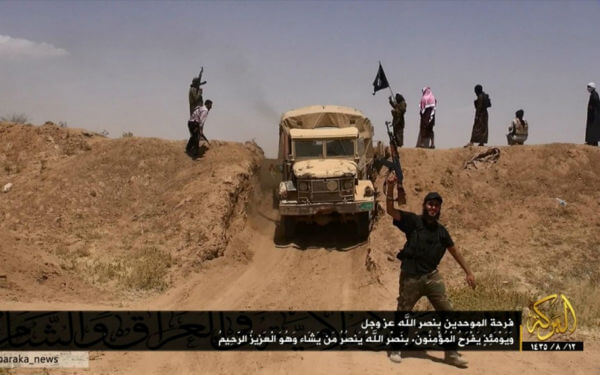
In 2014, when Islamic State fighters broke through the desert border between Iraq and Syria – flying black flags on their captured US-made Humvees – and announced the creation of a transnational caliphate, they triumphantly pronounced the death of Sykes-Picot. That gave a half-forgotten and much-misrepresented colonial-era deal a starring role in their propaganda war – and a new lease of life on Twitter. [Continue reading…]

Facebooktwittermail

Americans living in a fantasy world

Agrabah

Americans are famously ignorant about global geography. While many are apologetic about this deficit, it often gets waved off as a cultural gap that doesn’t really need filling — a bit like learning the metric system: useful in theory but something that most people are quite content to live without.

One of the latest widely cited examples speaks to the fact when it comes to acquiring knowledge about the world, the tutor that too many Americans rely on is Hollywood.

An editorial in Abu Dhabi’s The National (the English-language newspaper from the Gulf that mustn’t be called Persian) says:

A week of international ridicule over a poll that found about 30 per cent of Republican voters supported military aggression against the fictional Arab city of Agrabah has not sent the story away on a magic carpet. In a new poll conducted by WPA research, 44 per cent of Democratic voters questioned would support the United States taking in refugees from Agrabah, a made-up location from Disney’s Aladdin. Roughly 28 per cent said they were indifferent.

The latest poll sheds additional light on the mainstream American sentiment about the Middle East. It is clear that ignorance about the geography and people of the region extends across party lines.

It doesn’t just cut across party lines; it also unites some experts with those who naively view them as being reliably informed.

For instance, in an article on Clausewitz and ISIS that I posted here recently, David Johnson, a senior political scientist at the RAND Corporation, was quoted, saying:

If you go to Istanbul and look south the Caliphate is right there. You can point to it. It’s a state that views us as an enemy. What’s the mystery?

Before joining RAND, Johnson had a 24-year U.S. Army career “in a variety of command and staff assignments in the United States, Korea, and Europe,” so maybe he never went to Istanbul. If he had, he should have known that if you look south you will see the Sea of Marmara and beyond that, the southern half of the Marmara region of Turkey.

The territory under ISIS’s control is nowhere near in sight, being hundreds of miles off to the east-southeast, beyond Turkey’s borders in Syria and Iraq.

Call this an instance of matter-of-fact ignorance — which might be seen as an American specialty.

Ignorance is not a crime. Indeed, nothing is more important than recognizing the limits of ones knowledge if that knowledge is to be advanced. The worst mistake, however, is to imagine one knows (or be willing to pretend one knows) what one does not.

That is what leads to ill-conceived pronouncements on the fate of Agrabah and its imaginary residents.

Just imagine how much less raucous the internet would be (or how many more don’t knows pollsters would count) if everyone applied a bit more caution and discipline in differentiating between the known and the unknown, distinguishing between fact and opinion, and in acknowledging that what they may have chosen to repeat is merely hearsay.

Facebooktwittermail

As U.S. focuses on ISIS and the Taliban, Al Qaeda re-emerges

The New York Times reports: Even as the Obama administration scrambles to confront the Islamic State and a resurgent Taliban, an old enemy seems to be reappearing in Afghanistan: Qaeda training camps are sprouting up there, forcing the Pentagon and American intelligence agencies to assess whether they could again become a breeding ground for attacks on the United States.

Most of the handful of camps are not as big as those that Osama bin Laden built before the Sept. 11, 2001, attacks. But had they re-emerged several years ago, they would have rocketed to the top of potential threats presented to President Obama in his daily intelligence briefing. Now, they are just one of many — and perhaps, American officials say, not even the most urgent on the Pentagon’s list in Afghanistan.

The scope of Al Qaeda’s deadly resilience in Afghanistan appears to have caught American and Afghan officials by surprise. Until this fall, American officials had largely focused on targeting the last remaining senior Qaeda leaders hiding along Afghanistan’s rugged, mountainous border with Pakistan.

At least in public, the administration has said little about the new challenge or its strategy for confronting the threat from Al Qaeda, even as it rushes to help the Afghan government confront what has been viewed as the more imminent threat, the surge in violent attacks from the Taliban, the Haqqani network and a new offshoot of the Islamic State. Former administration officials have been more outspoken — especially those who were on the front lines of the original battle to destroy Al Qaeda’s central leadership. [Continue reading…]

Facebooktwittermail

A year of Taliban gains shows that ‘we haven’t delivered,’ top Afghan official says

The Washington Post reports: As the Afghan convoy entered the battered village, Taliban fighters opened fire. U.S.-trained Afghan policemen poured out of their Humvees and began wildly shooting their AK-47 rifles in every direction.

“The enemy is firing one bullet, and you are responding with dozens!” their commander, Col. Khalil Jawad, screamed into his radio in frustration. “Aim, then fire!”

A minute later, the militants melted away. On this day in early December in the southern province of Helmand, they had delivered their message: The Taliban is back, its fighters showing a battle discipline and initiative far superior to the Afghan security forces trained and equipped by the United States.

In private, top Afghan and American officials have begun to voice increasingly grim assessments of the resurgent Taliban threat, most notably in a previously undisclosed transcript of a late-October meeting of the Afghan National Security Council. [Continue reading…]

Facebooktwittermail

NSA’s targeting of Israeli leaders also caught private conversations between U.S. lawmakers and Israel lobby

The Wall Street Journal reports: President Barack Obama announced two years ago he would curtail eavesdropping on friendly heads of state after the world learned the reach of long-secret U.S. surveillance programs.

But behind the scenes, the White House decided to keep certain allies under close watch, current and former U.S. officials said. Topping the list was Israeli Prime Minister Benjamin Netanyahu.

The U.S., pursuing a nuclear arms agreement with Iran at the time, captured communications between Mr. Netanyahu and his aides that inflamed mistrust between the two countries and planted a political minefield at home when Mr. Netanyahu later took his campaign against the deal to Capitol Hill.

The National Security Agency’s targeting of Israeli leaders and officials also swept up the contents of some of their private conversations with U.S. lawmakers and American-Jewish groups. That raised fears — an “Oh-shit moment,” one senior U.S. official said — that the executive branch would be accused of spying on Congress.

White House officials believed the intercepted information could be valuable to counter Mr. Netanyahu’s campaign. They also recognized that asking for it was politically risky. So, wary of a paper trail stemming from a request, the White House let the NSA decide what to share and what to withhold, officials said. “We didn’t say, ‘Do it,’ ” a senior U.S. official said. “We didn’t say, ‘Don’t do it.’ ”

Stepped-up NSA eavesdropping revealed to the White House how Mr. Netanyahu and his advisers had leaked details of the U.S.-Iran negotiations — learned through Israeli spying operations — to undermine the talks; coordinated talking points with Jewish-American groups against the deal; and asked undecided lawmakers what it would take to win their votes, according to current and former officials familiar with the intercepts. [Continue reading…]

Facebooktwittermail

Could an end to Syria’s civil war be in sight?

By James L Gelvin, University of California, Los Angeles

If, as cliché has it, the definition of insanity is doing the same thing over and over and expecting different results, isn’t the recent flurry of diplomatic activity aimed at bringing about a negotiated settlement to the Syrian civil war insane?

None of the previous attempts to resolve the conflict among the warring parties through negotiations, such as the Geneva II talks in the beginning of 2014, has had a happy ending. And, in retrospect most observers would go so far as to say that they were doomed to failure.

But if, until now, there was zero chance for all principals, both external and internal, to work out a settlement, there currently exists a slender – a very slender – chance for success.

This is the straw at which Secretary of State John Kerry is grasping on the eve of talks in New York.

Continue reading

Facebooktwittermail

New Jaish al-Islam chief says group will not pull out of peace talks

Middle East Eye reports: The new head of a key rebel group in Syria has denied that it is pulling out of peace talks after its previous leader was killed in an airstrike last week.

Zahran Alloush was head of Jaish al-Islam, and was killed in a strike east of Damascus that was launched on Friday by forces loyal to President Bashar al-Assad, with conflicting reports indicating that the plane might have been Russian or Syrian.

Immediately after the killing the group announced that it would be pulling out of a negotiations council formed during an opposition conference in Riyadh earlier this month.

However, in his first public statements since taking over leadership of the group, Abu Hammam al-Buyedhani said Jaish al-Islam’s stance on negotiations “has not changed”.

“We will not adopt a position on our own without discussing it with our partners.”

The United Nations has set 25 January as a target date to begin peace talks on Syria. [Continue reading…]

Facebooktwittermail

Turkey may finally be ‘accepting the inevitable’ in Syria

Business Insider reports: A Kurdish militia with ties to an organization waging an insurgency in Turkey’s southeast region violated Turkey’s “red line” in Syria over the weekend by crossing the Euphrates River during an anti-ISIS operation.

The operation to take back Tishrin Dam from ISIS was staged by the Western-backed Syrian Democratic Forces and spearheaded by the Kurdish YPG — the military arm of the Kurdish Democratic Union Party (PYD).

It served as a huge blow to ISIS, which had relied on the dam to move weapons and fighters between its de-facto capital of Raqqa in Syria and the cities of Manbij and Jarablous it controls in the northern countryside of Aleppo Province.

But ISIS was not the only loser. The operation was also a major affront to Turkey, which declared the Euphrates a “red line” for Kurdish territorial expansion over the summer. Indeed, Turkey struck the YPG twice in October after it defied Ankara’s warning not to cross the river. [Continue reading…]

Facebooktwittermail

ISIS leaders fall, ISIS remains

Kyle Orton writes: Last night, Steve Warren, the American colonel who is the spokesman for the international campaign against the Islamic State (IS), the U.S.-led Operation INHERENT RESOLVE, announced that between December 7 and December 27, ten IS “leaders” had been killed. Col. Warren adumbrated the positions of the IS leaders, allowing the conclusion that five had been part of IS’s external operations wing, which conducts international terrorism, and five were part of IS’s internal operations, i.e. part of the military operations and security infrastructure that helps IS maintain and expand its statelet in Syria and Iraq. Col. Warren presented this as an important blow to IS that had assisted in the recent loss of territorial losses for IS. There is reason for scepticism on these points. [Continue reading…]

Facebooktwittermail

Suspects arrested after plotting New Year’s Eve attacks in Ankara and Brussels

The New York Times reports: Two Islamic State militants who were plotting a suicide attack on the Turkish capital, Ankara, on New Year’s Eve have been detained, Turkish officials said on Wednesday.

The two men were held after an early morning counterterrorism operation at a house in the Yakupabdal neighborhood of Ankara, according to the semiofficial Anadolu News Agency. Their identities and nationalities were not disclosed, but the Turkish news media reported that the men were of Turkish origin and had traveled to Syria.

They were planning attacks on the central Kizilay Square in Ankara, where large crowds gather annually to usher in the new year, a senior government official said. [Continue reading…]

CNN reports: Belgian authorities have arrested two people on suspicion of being involved in a plot to attack “emblematic sites” in Belgium’s capital during New Year’s celebrations, the country’s federal prosecutor’s office said Tuesday.

The men are members of a Muslim biker gang called the Kamikaze Riders and are suspected to have discussed attacking Brussels’ Grand Place square and other places where crowds gather as well as police and military facilities, a senior Belgian counterterrorism official told CNN on condition of anonymity. [Continue reading…]

Facebooktwittermail

The new face of racism in Germany

Anna Sauerbrey writes: Germany is not lacking in right-wing sentiment these days, but most people are careful about how they deploy their anti-immigrant rhetoric. And then there’s Björn Höcke.

Last month Mr. Höcke, a leading figure of the right-wing populist party Alternative für Deutschland, gave an openly racist speech on the “differing reproductive strategies” of Africans and Europeans. It was not the first time he had drawn on National Socialist themes, but this time he caused uproar, even in his own party, which has asked him to resign his membership.

Whatever happens to Mr. Höcke, though, his willingness to use overtly racist language has revived an age-old fear in Germany. He is, by all accounts, a typical German, an upright middle-class citizen — what we call a “Biedermann.” They are the core of our national self-perception. If they turn to the dark side, what does that say about Germany?

For years, racism and hate in Germany mostly came with clear social markers. In the minds of most, racists wore their heads shaved, feet heavily booted and arms rune-tattooed. They lived on the fringes of society, often in public housing, and made their living illicitly.

Not so Mr. Höcke. As a young man, he was a member of “Junge Union,” the youth organization of Chancellor Angela Merkel’s center-right Christian Democrats. He’s a high school history teacher on leave and a married father of four. He lives in the countryside and is invariably well dressed, though never in a showy way.

Is this the new face of hate in Germany? [Continue reading…]

Facebooktwittermail

How Sunni-Shia sectarianism is poisoning Yemen

Farea al-Muslimi writes: In a recent interview with Al Jazeera, Hamoud al-Mikhlafi, leader of a Taiz-based group fighting against Houthi militias and forces loyal to Yemen’s former president Ali Abdullah Saleh, described his opponents as “Persians” in reference to their Shia religious affiliation and support from Iran. In fact, both Saleh and the leaders of the Houthi militia belong to the Zaydi school of Islam, an indigenous Yemeni branch of Shia Islam that is distinct from the Twelver Shiism practiced in Iran. But Mikhlafi’s assertion fits with a growing sectarian polarization in Yemen that relies on language borrowed from the Sunni-Shia conflicts in Iraq, Syria, and Lebanon sponsored by Saudi Arabia and Iran, rather than drawing on Yemeni religious culture.

This is a rapidly growing phenomenon. Even Yemeni President Abd Rabbu Mansour Hadi has on occasion described the Houthis, who expelled him from Yemen in March 2015, as “Twelver Shia.” “And two years prior, the anti-Houthi tribal leader Hussein al-Ahmar called himself “the powerful lion of the Sunnis,” thus portraying himself as a defender of Yemen’s Sunni majorityagainst the other sect. [Continue reading…]

Saeed Al-Batati writes: Three years after they were kicked out of several cities in south Yemen, al-Qaeda in the Arabian Peninsula (AQAP) has come back and overrun two cities in the province of Abyan, local government officials and residents told Middle East Eye. But people who lived through al-Qaeda’s reign of Abyan in 2011 now talk about new “tolerant and friendly” militants.

In Zinjibar, the capital of Abyan province, a government official who spoke on condition of anonymity because of security concerns, said that early this month al-Qaeda militants quietly stormed military camps and police stations in the city without even drawing the attention of students in schools or public servants in their offices.

“Zinjibar is quiet. People are busy with their daily life,” the government officials said.

Many provinces in southern Yemen have been in a state of anarchy since the Saudi-backed forces supporting President Abd Rabbuh Mansour Hadi and local tribesmen drove out rebel Houthis. Then separatists and Islamists aligned with the Saudi-backed forces failed to fill the vacuum left by Yemeni soldiers who headed north to fight the Houthis. So al-Qaeda came in and took the place of the former government-run security agencies. [Continue reading…]

Facebooktwittermail

War by other means in the shadow of globalization

destruction

Peter Pomerantsev writes: perhaps this year’s most spectacular propagandists are those of ISIS, with its aggressive use of social media to recruit new combatants and slick, gruesome execution videos to provoke and frighten opponents. Though ISIS has killed roughly seven times fewer people in Syria than the Assad regime, the group has used social media (some 46,000 accounts on Twitter alone) to make itself look even more menacing than it is. Every social-media user who retweets or posts ISIS material, whether in support or censure, ultimately helps strengthen ISIS’s narrative of history-making stature and millenarian significance. The Islamic State’s terrorist attacks in Paris left 130 people dead in a spate of horrific violence, but the operation was executed in a manner that made it seem as if the organization had killed orders of magnitude more.

There is, of course, nothing new about using information as a vital instrument of war. But in the past information tended to be a handmaiden to action. Now the informational element appears to be as important as, if not more important than, the physical dimension. Take Russia’s air strikes in Syria. The Kremlin’s official rationale for the military campaign was to combat the Islamic State. But very few of its operations have actually been aimed at ISIS, with many more directed at U.S.-supported rebels fighting Syrian President, and Russian client, Bashar al-Assad. The Kremlin clearly has more in mind than defeating ISIS militarily. Russia has entered the Syrian stage in such a way as to surprise the West and ensure it will play a starring role in any narrative going forward — whether that narrative involves keeping Assad in power or a “global fight against terror.” The Russian military might be small compared to America’s, and the Russian economy may be a mess, but Vladimir Putin has cleverly undermined America’s reputation as a “global policeman” and boosted his stature as the man who is restoring Russia as a Great Global Power.

This is not “soft power” in the classic sense of projecting a positive national image through culture and public relations, but rather a case of using strategic narrative to keep your opponent intimidated, confused, and dismayed — of exploiting ubiquitous information to appear bigger, scarier, and more indispensable than reality would suggest. Russia’s bombing raids in Syria also have the positive side effects (for Moscow) of distracting from the conflict in Ukraine and helping maintain a steady torrent of refugees to Europe, which in turn strengthens right-wing parties in countries such as France and Hungary that peddle anti-refugee fears, are supported by the Kremlin, and advocate dropping Western sanctions against Russia. What matters in the information age is not so much “military escalation dominance” — the Cold War doctrine emphasizing the ability to introduce more arms than the enemy into a conflict. Rather, it’s “narrative escalation dominance” — being able to introduce more startling storylines than your opponent. [Continue reading…]

Facebooktwittermail

Kurdish leaders call for autonomy; Erdogan accuses them of treason

Reuters reports: Kurdish groups meeting in southeastern Turkey called for self-rule on Sunday amid heavy fighting in the region as the army pushed ahead with a security operation in which it says more than 200 Kurdish militants have been killed.

The Democratic People’s Congress (DTK), made up of Kurdish non-governmental organizations, made the call after a two-day meeting in Diyarbakir.

“The rightful resistance mounted by our people against the policies that degrade the Kurdish problem, is essentially a demand and struggle for local self-governance and local democracy,” said the final resolution of the meeting, titled “declaration of political resolution regarding self-rule”.

The declaration called for the formation of autonomous regions including several neighboring provinces of Diyarbakir to take account of cultural, economic and geographic affinities. [Continue reading…]

Al Jazeera reports: Turkey’s President Tayyip Erdogan said autonomy demands from a Kurdish leader were a “clear provocation” and his political party will be “taught a lesson”.

A Turkish prosecutor opened an investigation into Peoples’ Democratic Party (HDP) chief Selahattin Demirtas after he made recent calls for greater Kurdish self-governance in the country’s southeast.

Erdogan’s remarks targeting Demirtas on Tuesday could further widen the gulf between the government and the Kurdish opposition as violence increases in the region.

“A certain leader … talked nonsense and what he did is a clear provocation and treason,” Erdogan told reporters in Istanbul before departing on a trip to Saudi Arabia, adding the HDP would be “taught a lesson by our citizens and the law”. [Continue reading…]

Facebooktwittermail

I revealed the truth about President Erdogan and Syria. For that, he had me jailed

erdogan

Can Dündar writes: In Turkey, a debate as old as government itself is on the agenda again. This time, it is the Turkish government’s secret arms transfer to Syria that has revitalised the subject.

Early in 2014, a truck understood to belong to the Turkish intelligence service (MIT) was stopped near the Syrian border. The gendarmerie and the intelligence officials in control of the convoy pulled guns on each other. This was the moment the two blocks vying to rule the state came face to face. The truck was searched. Beneath the camouflage composed of medicines boxes, weapons and ammunition were found. The truck was held for a while, but following the intervention of government officials a safe passage into Syria was granted.

The government immediately discharged the prosecutor and gendarmerie who stopped the convoy and had them arrested. It was declared that the trucks contained humanitarian aid. This incident, which fuelled allegations that President Recep Tayyip Erdoğan’s government was intervening in the Syrian civil war, was rapidly covered up.

In May 2015, however, Cumhuriyet Daily, the newspaper I serve as the editor-in-chief, acquired the footage of this incident. It was clearly visible that the truck was loaded with arms. It was thus documented that the intelligence service was illegally carrying arms into the civil war raging in a neighbouring country. This was big news. We published details of the operation with photos, and uploaded the video to our website. [Continue reading…]

Facebooktwittermail

Strike that killed Syrian rebel chief complicates peace talks push, says U.S.

Reuters reports: Russian air strikes like the one that killed a top Syrian rebel leader last week send the wrong message to groups engaged in a political dialogue to end the conflict and complicate efforts to begin negotiations, the U.S. State Department said on Monday.

Syrian rebel chief Zahran Alloush, the leader of Jaysh al Islam who commanded thousands of fighters in the Damascus suburbs, was killed on Friday in an air strike that rebel sources said was carried out by Russian warplanes.

Jaysh al Islam was a participant in the Riyadh conference where Syrian opposition groups agreed on common aims for proposed political negotiations to end the country’s civil war and chose a former Syrian prime minister to represent them in the dialogue.

State Department spokesman Mark Toner said the United States did not provide support to Alloush’s group and had concerns about its “behavior on the battlefield,” but noted that Jaysh al Islam had fought Islamic State rebels and was participating in the political dialogue to end Syria’s civil war. [Continue reading…]

Facebooktwittermail

Out of touch: U.S. diplomacy shackled by security concerns

Peter Schwartzstein writes: The U.S. embassy in Cairo is a forbidding-looking fortress. Its imposing concrete blast walls are visible for miles, and cast an ugly shadow over a cluster of surrounding villas. Flanked on all sides by edgy soldiers in body armor and camouflage uniforms, the atmosphere can scarcely be called welcoming.

For diplomatic personnel posted across the Middle East, the security protocols are often no less daunting. Many are shuttled from their offices to their homes in armored vans with tinted windows. When the U.S. ambassador to Cairo’s car emerges onto one of the capital’s main drags, city police block lanes and back up traffic as they hustle to facilitate the convoy’s passage.

Given recent events, the U.S. instinct to wrap its foreign representatives in cotton wool is somewhat understandable. The mission in Cairo — considered relatively safe by regional standards — was attacked by a mob and the site of the stabbing of a U.S. citizen in the last four years alone. The list of assaults on State Department posts around the world runs long and lethal.

But to those who puzzle over Washington’s erratic foreign policy in these parts, this safety-centric tack has much to answer for. [Continue reading…]

Facebooktwittermail