Category Archives: Lands

State Dept ‘pivotal foreign policy moments of 2015’: Bringing peace to Syria?

The Christmas Eve post on the U.S. State Department’s official blog, DipNote, includes this improbable accomplishment: “Bringing Peace, Security to Syria.”

Is this supposed to be an expression of the Christmas spirit — peace on Earth and all that?

Facebooktwittermail

How Iraqis learned to fear and hate Americans in Ramadi eleven years ago

The Economist reported on December 29, 2004: There is only one traffic law in Ramadi these days: when Americans approach, Iraqis scatter. Horns blaring, brakes screaming, the midday traffic skids to the side of the road as a line of Humvee jeeps ferrying American marines rolls the wrong way up the main street. Every vehicle, that is, except one beat-up old taxi. Its elderly driver, flapping his outstretched hand, seems, amazingly, to be trying to turn the convoy back. Gun turrets swivel and lock on to him, as a hefty marine sergeant leaps into the road, levels an assault rifle at his turbanned head, and screams: “Back this bitch up, motherfucker!”

The old man should have read the bilingual notices that American soldiers tack to their rear bumpers in Iraq: “Keep 50m or deadly force will be applied”. In Ramadi, the capital of central Anbar province, where 17 suicide-bombs struck American forces during the month-long Muslim fast of Ramadan in the autumn, the marines are jumpy. Sometimes, they say, they fire on vehicles encroaching within 30 metres, sometimes they fire at 20 metres: “If anyone gets too close to us we fucking waste them,” says a bullish lieutenant. “It’s kind of a shame, because it means we’ve killed a lot of innocent people.”

And not all of them were in cars. Since discovering that roadside bombs, known as Improvised Explosive Devices (IEDs), can be triggered by mobile telephones, marines say they shoot at any Iraqi they see handling a phone near a bomb-blast. Bystanders to an insurgent ambush are also liable to be killed. Sometimes, the marines say they hide near the body of a dead insurgent and kill whoever comes to collect it. According to the marine lieutenant: “It gets to a point where you can’t wait to see guys with guns, so you start shooting everybody…It gets to a point where you don’t mind the bad stuff you do.”

Since September 1st, when the battalion’s 800 men were deployed to Ramadi, they have killed 400-500 people, according to one of their senior officers. A more precise estimate is impossible, because the marines rarely see their attackers. When fired upon, they retaliate by blitzing whichever buildings they think the fire is coming from: charred shells now line Ramadi’s main streets. “Sometimes it works in the insurgents’ favour,” admits Rick Sims, a chief warrant officer. “Because by the time we’ve shot up the neighbourhood, then the guys have torn up a few houses, they’re four blocks away, and we just end up pissing off the locals.” [Continue reading…]

Facebooktwittermail

Saudi Grand Mufti calls ISIS ‘part of the Israeli army’

Bruce Riedel writes: The most senior cleric in Saudi Arabia has called for greater Islamic cooperation against the Islamic State, while also labeling ISIS a “part of the Israeli army.” The revealing interview this week with Grand Mufti of Saudi Arabia Sheikh Abdulaziz Al Sheikh provides important insight into the Wahhabi establishment, which is the core partner of the House of Saud.

The Mufti praised the creation of an Islamic military alliance to fight terrorism, promising the alliance will defeat the Islamic State, which he labeled a heretical and un-Islamic movement. The new alliance is the brainchild of Deputy Crown Prince and Defense Minister Prince Muhammed bin Salman, the king’s favorite son.

The 72-year old cleric was asked about comments made by Abu Bakr al-Baghdadi, the self proclaimed caliph of the Islamic State, that the new alliance is not serious because it is not “killing Jews and liberating Palestine.” Al-Baghadi called the new Saudi-led alliance a pawn of the United States and Israel, promising that the “tanks of the mujahideen are moving closer to Israel day after day.”

Al Sheikh dismissed al-Baghdadi’s threat to Israel, calling it “simply a lie.” He added: “Actually Da’esh [another term for the Islamic State] is part of the Israeli soldiers,” therefore asserting a supposed relationship between the Israeli army and the Islamic State. [Continue reading…]

I imagine that among those observers who are already convinced that ISIS was created by the Saudis, the idea that it’s an Israeli creation must be equally appealing — and the Grand Mufti the least credible source for this ‘revelation.’ There are just too many conspiracy theories to choose from!

Facebooktwittermail

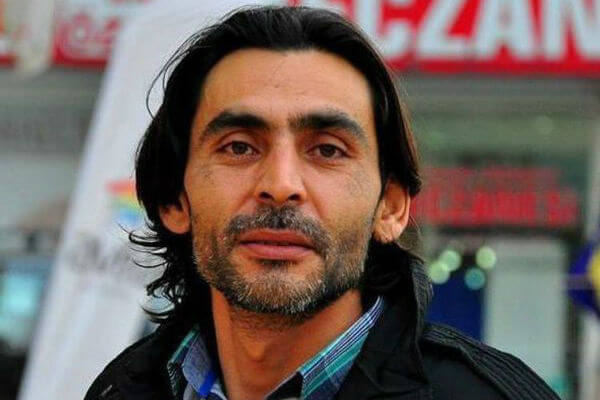
This Syrian filmmaker was assassinated in broad daylight after receiving death threats

Naji-al-Jerf

Borzou Daragahi reports: If all had gone according to plan, Syrian filmmaker and activist Naji al-Jerf, his wife, and their two daughters would be in the relative safety of France right now, 2,000 miles from Turkey’s troubled southeast.

But on Sunday, the violence increasingly spilling over from Syria into Turkey caught up with Jerf when he was gunned down in broad daylight by a masked assassin. He was 37.

Amid wailing and stunned friends and colleagues, he was buried in a hilltop cemetery plot Monday afternoon. “Congratulations, congratulations!” his anguished wife, Bushra Kashmar, cried as she gripped his coffin. “Now you will have the freedom that you wanted,” she said, wrapped in the flag of Syria’s revolution. “Now you will have the peace that you wanted.”

A foe of both ISIS and the Syrian regime, the independent filmmaker and native of Salamia, a town near the city of Hama, was among the peaceful democracy activists who spearheaded the 2011 uprising against Bashar al-Assad. They are now being subsumed by the ensuing violence and sidelined by a war that has become a regional conflagration with no end in sight. [Continue reading…]

Facebooktwittermail

Brazil rebuffs West Bank settler nominated as Israeli ambassador

Middle East Eye reports: Brazil has apparently rebuffed Israel’s nomination of a settler as its next ambassador in a move Israel says will damage diplomatic relations between the two countries.

Dani Dayan, a 60-year-old who lives in the West Bank settlement of Ma’ale Shomron, was nominated in August as Israel’s new ambassador to Brasilia.

However Brazil has yet to endorse the Argentina-born diplomat’s appointment, following lobbying in Brazil against his nomination and protests to President Dilma Rousseff about Dayan.

Ambassadorial appointments must be endorsed by the host nation – a process known as an agrément. However, if no endorsement is forthcoming within two months, it is understood that the choice has not been accepted.

Dayan was a senior member of the Yesha Council, an umbrella organisation of Jewish settlements in the West Bank, and Brazilian activists are worried that approving his selection would be seen as supporting Israel’s settlements, which are illegal under international law. [Continue reading…]

Facebooktwittermail

Qatari royals rush to Switzerland in nine planes after emir breaks leg

AFP reports: Unidentified individuals travelling in as many as nine planes belonging to Qatar’s royal family made an emergency trip to Switzerland over the weekend for medical reasons, according to a Swiss official.

A spokesman for Switzerland’s federal office of civil aviation confirmed local media reports that multiple aircraft made unscheduled landings at the Zurich-Kloten airport overnight from 25 to 26 December and that the planes were part of the Qatari royal fleet.

He gave no details as to who was on board or who any of the potential patients may have been.

“The emergency landing clearance was given by the Swiss air force,” he told AFP, explaining that the civil aviation office was closed during the hours in question.

Qatari authorities later said that the country’s former ruler, Sheikh Hamad bin Khalifa Al Thani, had been flown to Switzerland over the weekend for surgery after breaking a leg. [Continue reading…]

Facebooktwittermail

Anti-Muslim hate crimes on the rise in the U.S.

Southern Poverty Law Center reports: The year 2015 is drawing to a close with a continuing wave of firebombings and apparent hate crimes at mosques in various U.S. cities, including Christmas-weekend arson attacks in California and Texas.

There were no injuries in either of the two latest fire-bombings.

But at Houston’s Saavoy Masjid, a mosque operated by the Islamic Society of Greater Houston, damage was described as “significant.” A fire started at “multiple locations” around 2:45 p.m. on Christmas Day, just an hour after hundreds of people had been in the building for Friday prayers, authorities said.

The following day, someone threw a Molotov cocktail at a doorway of the Tracy Islamic Center in Tracy, Calif., east of Oakland, causing minor damage. [Continue reading…]

Facebooktwittermail

New York’s forgotten mosque

Wilson Fache writes: New York City is well known for its numerous ethnic quarters, like the tourist-packed Little Italy or the oddly authentic Chinatown. Far less well known however is a small neighbourhood that locals used to call “Little Syria”.

From the 19th to the first half of the 20th century, that enclave was the economic and cultural centre of the Arab diaspora in the US; that is before it was demolished in order to build a tunnel and then later, in the sixties, the World Trade Centre.

These few blocks were home to a large number of immigrants mainly coming from what was then known as “Greater Syria” (Bilad al-Sham), a region ruled by the Ottoman Empire that nowadays includes Syria as well as Lebanon, Jordan, Israel, the occupied Palestinian territories and a part of southern Turkey.

Civic associations like the Washington Street Historical Society have been advocating for years to raise awareness about the largely unknown quarter and preserve the few buildings that are left, such as St. George’s Syrian Catholic Church, which is located on Washington street.

For many years is was assumed that the neighbourhood was only ever inhabited by Christians. Since there was no record of a place of worship dedicated to another faith, it was assumed there had never been one. Then a few months ago, a professor at the University of Colorado Denver doing research on early Islam in the US came across an article entitled “Mohammedans now have a place of worship here”. [Continue reading…]

Facebooktwittermail

The migrant roots of ancient European ancestry

University of Cambridge

The first sequencing of ancient genomes extracted from human remains that date back to the Late Upper Palaeolithic period over 13,000 years ago has revealed a previously unknown “fourth strand” of ancient European ancestry.

This new lineage stems from populations of hunter-gatherers that split from western hunter-gatherers shortly after the ‘out of Africa’ expansion some 45,000 years ago and went on to settle in the Caucasus region, where southern Russia meets Georgia today.

Here these hunter-gatherers largely remained for millennia, becoming increasingly isolated as the Ice Age culminated in the last ‘Glacial Maximum’ some 25,000 years ago, which they weathered in the relative shelter of the Caucasus mountains until eventual thawing allowed movement and brought them into contact with other populations, likely from further east.

This led to a genetic mixture that resulted in the Yamnaya culture: horse-borne Steppe herders that swept into Western Europe around 5,000 years ago, arguably heralding the start of the Bronze Age and bringing with them metallurgy and animal herding skills, along with the Caucasus hunter-gatherer strand of ancestral DNA – now present in almost all populations from the European continent.

The research was conducted by an international team led by scientists from Cambridge University, Trinity College Dublin and University College Dublin. The findings were published last month in the journal Nature Communications.

Continue reading

Facebooktwittermail

A century after Sykes-Picot

Eugene Rogan writes: The British wartime alliance with the sharif of Mecca would be concluded after months of increasingly anxious negotiations, with both sides driven by wartime fears. Sharif Hussein had reason to believe the Young Turks sought his overthrow. Moreover, to realize his ambitious goal of carving an independent Arab kingdom from Ottoman domains, he needed Great Power support. The British feared their recent string of defeats to the Ottomans would encourage colonial Muslims to rebel against the Entente Powers. War planners in Cairo and Whitehall hoped that an alliance with the custodian of Islam’s holiest shrines would neutralize the appeal of the Ottoman sultan-caliph’s jihad at a moment when Britain’s military credibility was at its lowest point since the start of the war.

On the eve of the Arab Revolt, the Anglo-Hashemite alliance offered far less than both sides originally believed they were securing on first entering into negotiations. The British were not the invincible power they had appeared to be in early 1915 when first setting off to conquer Constantinople. The Germans had inflicted terrible casualties on the British on the western front, and even the Ottomans had dealt them humiliating defeats. Sharif Hussein and his sons had every reason to question their choice of ally.

Yet the Hashemites were in no position to bargain. All through their correspondence with Sir Henry McMahon, the high commissioner in Egypt, Sharif Hussein and his sons had presented themselves as leaders of a pan-Arab movement. By May 1916 it was apparent that there would be no broader revolt in Syria and Iraq. The most the sharifs could do was challenge Ottoman rule in the Hijaz. Success depended on their ability to mobilize the notoriously undisciplined Bedouin to their cause.

Arguably, the alliance survived because the Hashemites and the British needed each other more in the summer of 1916 than ever. Sharif Hussein had strained relations with the Young Turks to the breaking point; he knew they would seize the first opportunity to dismiss—even murder—him and his sons. The British needed the sharif’s religious authority to undermine the Ottoman jihad, which officials in Cairo and Whitehall feared recent Turkish victories had strengthened. Whatever the results of a Hashemite-led revolt, the movement would at least weaken the Ottoman war effort and force the Turks to divert troops and resources to restore order in the Hijaz and possibly in other Arab provinces. For their own reasons, both the British and the Hashemites were in a hurry to launch the revolt. [Continue reading…]

Facebooktwittermail

Life under siege: Inside Taiz, the Yemeni city being slowly strangled

Ghaith Abdul-Ahad writes: Ismail lies on green linoleum sheets, his black eyes too large for his gaunt face. Craning his neck, he tries to inspect the bandage covering his body, but weakness pulls him back. From the pillow, he whispers “hawan” (mortar).

Ismail, who says he is 12 but has the body of a six-year-old, used to make a few Yemeni riyals every day by washing graves in a new cemetery in the city of Taiz devoted to those killed in Yemen’s ongoing civil war.

Just before noon on one day in November, he and his two young cousins were sitting under a mango tree, cleaning the grave of a 10-year-old girl called Basma, when three mortar shells fell. A splatter of deep scars on the tree trunk and on the grave’s concrete surface mark the spot where one exploded. The two cousins, aged two and four, died instantly.

Ismail was severely injured and is now in the Rawdha, a hotel-turned-hospital in Taiz, Yemen’s second most populated city, a place being slowly strangled by a Houthi rebel siege. He is far from the only one here. One floor above, Amer recounts how he was hit by an explosion after dining in a restaurant and walking out into the street. The threads stitching folds of flesh on the stump of his left leg are black and new. [Continue reading…]

Facebooktwittermail

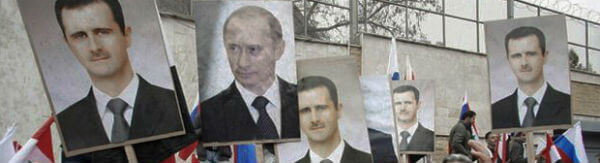
U.S. sees key goals met for Russia with bearable costs in Syria so far

Assad

Reuters reports: Three months into his military intervention in Syria, Russian President Vladimir Putin has achieved his central goal of stabilizing the Assad government and, with the costs relatively low, could sustain military operations at this level for years, U.S. officials and military analysts say.

That assessment comes despite public assertions by President Barack Obama and top aides that Putin has embarked on an ill-conceived mission in support of Syrian President Bashar al-Assad that it will struggle to afford and that will likely fail.

“I think it’s indisputable that the Assad regime, with Russian military support, is probably in a safer position than it was,” said a senior administration official, who requested anonymity. Five other U.S. officials interviewed by Reuters concurred with the view that the Russian mission has been mostly successful so far and is facing relatively low costs.

The U.S. officials stressed that Putin could face serious problems the longer his involvement in the more than four-year-old civil war drags on.

Yet since its campaign began on Sept. 30, Russia has suffered minimal casualties and, despite domestic fiscal woes, is handily covering the operation’s cost, which analysts estimate at $1-2 billion a year. The war is being funded from Russia’s regular annual defense budget of about $54 billion, a U.S. intelligence official said. [Continue reading…]

Facebooktwittermail

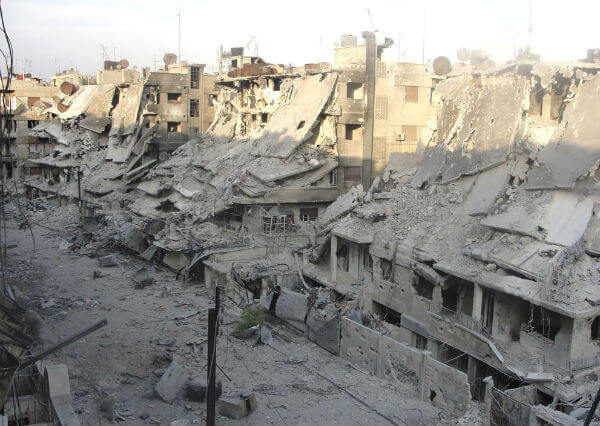
Homs: Syria’s Stalingrad

Homs

Thanassis Cambanis writes: More than four years of relentless shelling and shooting have ravaged beyond recognition this city, which once served as the symbolic capital of the revolution.

The buildings hang in tatters, concrete floors collapsed like sandcastles, twisted reinforced metal bars and window frames creaking in the wind like weather vanes. The only humans are occasional military guards, huddling in the foundations of stripped buildings. Deep trenches have been dug in thoroughfares to expose rebel tunnels. Everywhere the guts of buildings and homes face the street, their private contents slowly melting in the elements. Ten-foot weeds have erupted through the concrete.

As far as the government of Syria is concerned, the war in Homs is over. Rebel factions were defeated more than a year ago in the Old City, and the last holdouts, who carried on the revolt from the suburb of al-Waer, signed a cease-fire agreement this month. A few weeks before Christmas, busloads of fighters quit al-Waer for rebel-held villages to the north, under what the Syrian government and the United Nations hailed as a breakthrough cease-fire agreement to bring peace to one of the Syrian war’s most symbolic battlefields.

Gov. Talal al-Barazi, an energetic Assad-supporting Sunni, has been instrumental in pushing the cease-fires in Homs’s Old City and recently in al-Waer district. But almost none of the pro-uprising Sunnis who once filled its center have returned, and at times he seems to be presiding over a graveyard — an epic ruin destined to join Hiroshima, Dresden, and Stalingrad in the historical lexicon of siege and destruction.

By the end of a two-year siege of the Old City, the entire population of about 200,000 had fled, and more than 70 percent of the buildings in the area were destroyed. Today, according to the Syrian government, less than one-third of those who left have returned to the Homs area — but the ravaged city center is largely uninhabitable. Barazi said the cost of physically rebuilding the city would be enormous; without help from Russia, Iran, China, and other international donors, he said, full reconstruction would be impossible. Experts estimate it will cost upwards of $200 billion to rebuild across the entire country, or three times the country’s pre-war GDP.

And yet the Syrian government hopes to turn this shattered city into a symbol of its resurgent fortunes. Authorities showcase the reconstruction of Homs to spread a clear message: They intend to regain full control of the country. If they can tame Homs, a Sunni city where the majority of people actively embraced the revolt, they can do it anywhere.

There’s another more menacing message in the Homs settlement, however, as the neighborhoods that wholeheartedly sided with the revolution were entirely destroyed and have been left to collapse after the government’s victory. Almost no Sunnis have been allowed to return. Displaced supporters of the revolt from Homs understand that this is the regime’s second wave of punishment — they might never be allowed to go home. [Continue reading…]

Facebooktwittermail

Forget the sympathy – asylum is a refugee’s right

By Renos Papadopoulos, University of Essex

This year, the media has been full of tragic images of people risking their lives in a desperate attempt to flee their troubled countries. This phenomenon is not new, by any means, but the number of people involved has increased dramatically over a short period.

The statistics – which change almost daily – are staggering. It is estimated that more than 130,000 refugees and migrants have entered the European Union this year and more than 3,000 are known to have perished during their perilous crossing in the Mediterranean from Libya. Around 7,200 landed on just one Greek island, Lesvos, during May 2015. The numbers are equally shocking in other known crossings, notably from Somalia to Yemen and in the Far East to Indonesia and Australia.

The phenomenon is truly overwhelming. Whenever we are overwhelmed, we tend to oversimplify our perception in order to minimise our discomfort.

Perhaps the most common form of oversimplification is polarisation – and this is what we are witnessing around us now in relation to these images and statistics. On one side, some strongly oppose the uncontrolled influx of foreigners, arguing that developed countries can ill afford to host hordes of people. On the other are those who base their argument on compassion, urging governments to offer people dignified assistance in their hour of need.

In fact, neither view hits the mark.

Continue reading

Facebooktwittermail

Syria refugees: Family’s tragedy goes beyond one boy

refugees3

The New York Times reports: When Alan Kurdi’s tiny body washed up on a beach in Turkey, forcing the world to grasp the pain of Syria’s refugees, the 2-year-old boy was just one member of a family on the run, scattered by nearly five years of upheaval.

As a Turkish officer lifted the boy from the shallow waves at the edge of the Mediterranean Sea, one of Alan’s teenage cousins was alone on a bus in Hungary, fleeing the fighting back home in Damascus.

An aunt was stuck in Istanbul, nursing a baby, as her son and daughter worked 18-hour shifts in a sweatshop so the family could eat. Dozens of other relatives — aunts, uncles and cousins — had fled the war in Syria or were making plans to flee.

And just weeks after Alan’s image shocked the world in September, another aunt prepared to do what she had promised herself to avoid: set sail with four of her children on the same perilous journey.

“We die together, or we live together and make a future,” her 15-year-old daughter said, concluding, as have hundreds of thousands of other Syrians, that there was no going back, and that the way to security led through great risk. [Continue reading…]

Facebooktwittermail

Israel warns Brazil faces diplomatic downgrade unless it accepts settler as ambassador

Reuters reports: Brazil’s reluctance to accept an Israeli ambassador who is a West Bank settler has led to a standoff with Israel now warning it could downgrade diplomatic relations.

The appointment four months ago of Dani Dayan, a former head of the Jewish settlement movement, did not go down well with Brazil’s left-leaning government, which has supported Palestinian statehood in recent years.

Most world powers deem the Jewish settlements illegal.

Israel’s previous ambassador, Reda Mansour, left Brasilia last week and the Israeli government said on Sunday Brazil risked degrading bilateral relations if Dayan were not allowed to succeed him. [Continue reading…]

Facebooktwittermail

Turkey sees no normalization of Israel ties without end to Gaza blockade

Reuters reports: Turkey sees no normalization in ties with Israel unless its conditions for ending the Gaza blockade and compensation for the deaths of 10 Turkish activists in 2010 are met, a presidential spokesman said on Monday.

Relations between Turkey and Israel soured when the activists were killed in a raid by Israeli commandos on a Turkish boat, the Mavi Marmara, which was trying to breach the blockade.

Expectations of a breakthrough were intensified after senior officials met this month to try to repair ties. The talks have raised hopes of progress in negotiations to import Israeli natural gas, particularly since Turkey’s relationship with major energy producer Russia has worsened over Syria.

But comments from Presidential spokesman Ibrahim Kalin suggest Turkey may be trying to play tough in the negotiations. [Continue reading…]

Facebooktwittermail

Terror: After Paris, Tunisia and California, can we stop it spreading?

shadow7

Jason Burke writes: On a bleak day in November, Annelise Augustyns led her two children to the playground near their home in Brussels. Just over a week before, Islamist militants had killed 130 people and injured many more in a series of attacks in Paris. The Belgian capital had been under unprecedented lockdown for three days amid fears of a new attack there. Several of the Paris attackers had been traced to the Brussels neighbourhood of Molenbeek, a few miles from Augustyns’ apartment. They included at least one man who was now on the run.

To protect the population, the Belgian government had shut schools, cancelled sporting events and deployed soldiers on the streets. If the scenes were reminiscent of earlier conflicts, the enemy now was very different: a hybrid terrorist and insurgent entity in the Middle East calling itself the Islamic State.

Augustyns, a local government administrator, glanced at the armoured vehicle posted outside the entrance of the Gare du Midi. “We are worried of course,” she told me. “But what to do? We have to get on with our lives.”

Her words summed up the feelings of many across Europe that week, and indeed across much of the world last year. If 2014 was a year that set a grisly new record in the number of casualties inflicted by terrorist attacks – 33,000 people were killed, almost double the year before – then 2015 appears to have been worse. [Continue reading…]

Facebooktwittermail