EA Worldview reports: Amid in-fighting among Iran’s regime over US-supported “sedition”, President Rouhani has called on Washington to apologize again to Tehran for past actions.
In an interview with the Italian newspaper Corriere della Sera in Tehran, Rouhani said that the apology was necessary if the US wants to restore diplomatic relations with Iran:
One day these embassies will re-open but what counts is behavior and the Americans hold the key to this.
If they modify their policies, correct errors committed in these 37 years and apologize to the Iranian people, the situation will change and good things can happen.
In 2000, discussing grievances on both sides, Secretary of State Madeline Albright acknowledged the US “significant role” in the 1953 overthrow of Iran’s elected government and the American support of the Shah as he “brutally repressed political dissent”. She continued:
As President Clinton has said, the United States must bear its fair share of responsibility for the problems that have arisen in U.S.-Iranian relations. Even in more recent years, aspects of U.S. policy towards Iraq, during its conflict with Iran appear now to have been regrettably shortsighted, especially in light of our subsequent experiences with Saddam Hussein.
The President said the July 14 nuclear deal between Iran and the 5+1 Powers was a good starting point, but cautioned that the US must adhere to the terms: [Continue reading…]
Category Archives: Lands
U.S. State Dept: EU product labeling is not a boycott of Israel
The Jerusalem Post reports: The European Union’s guidelines on consumer labels for Israeli products produced over the pre-1967 lines is not tantamount to a boycott of Israel, Edgar Vasquez, a State Department spokesman, told The Jerusalem Post.
“We do not believe that labeling the origin of products is equivalent to a boycott. And as you know, we do not consider settlements to be part of Israel. We do not view labeling the origin of products being from the settlements as a boycott of Israel,” Vasquez said.
The EU has also insisted that the measure is not a boycott of Israel and that their concern is the consumer’s right to know as well as compliance with EU legislation. [Continue reading…]
Sinai’s stubborn insurgency: Why Egypt can’t win
Omar Ashour writes: The story of the Sinai insurgency goes back to the Israeli withdrawal from the territory in 1982. Since then, Egypt has mostly treated the area as a threat rather than an opportunity; Sinaians are potential informants, potential terrorists, potential spies, and potential smugglers, rather than full Egyptian citizens. According to a cable published by WikiLeaks, a senior Egyptian police official in Sinai once told a visiting American official delegation that “the only good Bedouin in Sinai was the dead Bedouin.”
Cairo’s official policies were designed to control and disempower Sinaians. They included preventing Sinaians from owning land, subjecting them to invasive scrutiny, and limiting any developmental projects. Such policies were ramped up after the second Palestinian intifada in 2000. Back then, several Egyptian security bureaucracies — principally the State Security Investigations (SSI, now renamed the National Security Apparatus) and the General Intelligence Service — believed that northeast Sinai was sending direct logistic support to Palestinian militant groups in Gaza. Since then, repression and attempted co-optation of selected tribal leaders has ruled the day.
Things escalated further after the simultaneous bombings of Taba and Nuweiba, where Israeli tourists used to spend vacation, in October 2004. The SSI had almost no information about the terrorists responsible and therefore conducted a wide crackdown in northeast Sinai. With the help of the Central Security Forces (CSF), the SSI arrested around 3,000 and held women and children hostage until other suspects surrendered. “They electrocuted us in the genitals for hours before asking any questions,” one of the former detainees told me in 2012. “Then the torture continues during and after the interrogations. Many of the young men swore revenge.” [Continue reading…]
Video: Inside Jabhat al-Nusra — Al Qaeda in Syria
Russia’s brazen lying about Syrian refugees
Scott Lucas writes: With the approach of a second round of international talks about Syria’s crisis, Russia has stepped up its deceptive propaganda in support of the Assad regime.
Deputy Foreign Minister Alexei Meshkov brazenly lied on Wednesday with the declaration, “Since the beginning of Russian operations, according to UN structures, more than one million people have returned to their homes in Syria.”
Meshkov gave no support for his claim, which was featured by Russian State outlet Sputnik News.
The UN has reported that more Syrians have fled their homes because of Russian bombing and the Syrian military’s offensives that Moscow is supporting. On October 26, the number was put at more than 120,000 since the start of the month, including at least 80,000 from Idlib and Hama Province and at least 44,000 from southern Aleppo Province.
The UN later revised the southern Aleppo figure to more than 75,000. The Syrian opposition and activists say the number from Aleppo and other areas is far higher than the UN’s totals. [Continue reading…]
A Russian dirty bomb? Or more dezinformatsiya?
The Daily Beast reports: A stray camera at a meeting of top Russian military leaders has allegedly captured a glimpse of the Kremlin’s possible plan for a bewildering and frightening new weapon — a radiation-scattering “dirty bomb.” One delivered by a drone submarine, which itself rides piggyback on another submarine.
The problem is: We have no way of knowing for sure if this is in fact an existing weapon or simply a media provocation designed to make us think that Russian President Vladimir Putin has got a dangerous new toy in his arsenal. If it’s real, then Russia is the first country we know about to come into possession of a weapon that, while not nearly as destructive as an atomic bomb, could spread lethal radiation over a wide area, rendering it uninhabitable. If the segment is a fake, it’s the latest in a long list of Kremlin media hoaxes.
“It’s true some secret data got into the shot, and it was subsequently deleted,” Kremlin spokesman Dmitry Peskov said Wednesday about the mysterious footage. “We hope that this won’t repeat.”
The technical aspects of such a device aren’t all that complicated. A dirty bomb is simply any munition containing conventional explosives wrapped in radioactive material. It explodes like any normal munition, but the fragments it scatters are irradiated and thus more dangerous for far longer periods of time than the debris from any standard bomb.
Compared to nuclear weapons, dirty bombs are easy to make — and their use, while highly provocative, is less likely to spark global Armageddon. But they’re still nasty enough that, back in the 1970s, the United States and Russia came pretty close to banning them. [Continue reading…]
Saudi Arabia’s manifesto for change in the face of rumours of coup plots
The Telegraph reports: Saudi Arabia has issued a manifesto for change in the face of rumours of coup plots and international pressure, ranging from economic reform to the role of women and allowing human rights groups into the country.
At a time when the country’s internal politics are under more scrutiny than at any time for decades, close advisers to the new King Salman and his powerful son have taken the unprecedented step of outlining a detailed programme of its future government to The Telegraph.
It amounts to a Thatcherite programme of budget cuts, increasing the role of the private sector, and reforms to the way the kingdom is governed.
It obliquely acknowledges that radical changes in the royal family since the king acceded to the throne in January, including the sidelining of a generation of older princes and the former heir to the throne, have met with opposition. There have been claims outside the country that disgruntled princes are attempting to mount a coup to replace the king with one of his brothers.
But the statement of principles shown to the Telegraph says that the way the country has been run since its founding a century ago must give way to “youth”. “These resolute and decisive changes may have annoyed some people but it does not amount to a crisis,” it says. [Continue reading…]
The UAE’s disappeared: Economist who criticised government disappears after arrest
The Independent reports: When plain-clothes security officers arrested prominent Emirati economist, Dr Naser bin Ghaith, in Abu Dhabi they drove him to his home in Dubai which was then searched. He was bundled back into a car. That was the last time he was seen by his family.
Nearly three months later they still have no idea where he was taken, why he was arrested and what charges he may be facing. They are terrified of speaking to the press or raising his case with the authorities. There has been no official comment about his arrest. The authorities have not even confirmed that he has been arrested. Dr Bin Ghaith has joined the ranks of the UAE’s disappeared.
Speaking in Dubai, the Emirati activist Ahmed Mansoor told The Independent that “there are hundreds of others” who have similarly disappeared. “The authorities tell the family ‘Don’t worry, it will only be a matter of days, he will call you’.” But the days turn into weeks and sometimes months before a call comes. [Continue reading…]
Leaked UAE emails could threaten peace talks in Libya
The New York Times reports: The United Arab Emirates was shipping weapons to favored belligerents in Libya over the summer in violation of an international arms embargo while simultaneously offering a highly paid job to the United Nations diplomat drafting a peace accord there, leaked Emirati emails show.
The leaked correspondence is threatening to undermine months of Libyan talks by tarring the diplomat with an apparent conflict of interest. The emails also open a new window into the hidden and contradictory machinations of regional players like the United Arab Emirates that have helped inflame the fighting even as their diplomats say they support a peaceful solution.
“The fact of the matter is that the U.A.E. violated the U.N. Security Council Resolution on Libya and continues to do so,” Ahmed al-Qasimi, a senior Emirati diplomat, wrote in an email on Aug. 4 to Lana Nusseibeh, the United Arab Emirates’ ambassador to the United Nations. [Continue reading…]
Israeli army unit storms hospital and kills Palestinian
Al Jazeera reports: An elite Israeli military force that operates undercover stormed the al-Ahli Hospital in Hebron and shot dead a 27-year-old Palestinian, the Palestinian Ministry of Health said.
Abdullah al-Shalaldeh was killed by five rounds fired early Thursday after 21 members of the elite unit – known as Mustaarabin – barged into the hospital room of his cousin, Azzam al-Shalaldeh, a ministry statement said.
The commandos wanted to question Azzam – who required surgery after earlier being shot by Israeli security forces – and his cousin tried to prevent them from doing so when the Israelis opened fire. [Continue reading…]
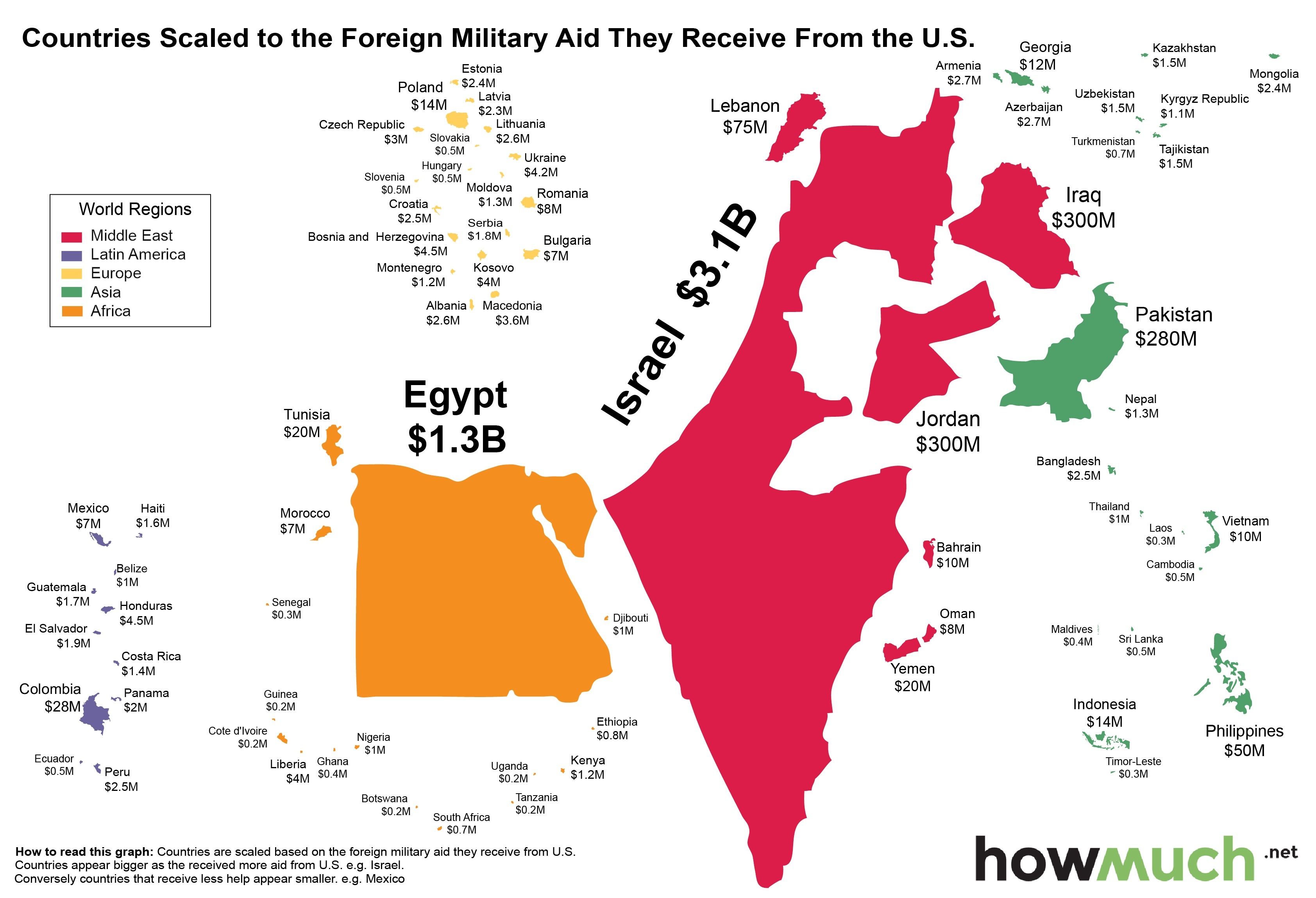
Map: As a recipient of U.S. military aid, Israel dwarfs the rest of the world
Beheadings trigger largest demonstration Kabul may have seen this century
This is how it looks when the silence breaks #ZabulBeheading #KabulProtest #ZabulSeven pic.twitter.com/14DQRgFpf4
— Omar Haidari (@OmarHaidari1) November 11, 2015
Yesterday, BBC News reported: About 2,000 people have protested in the eastern Afghan city of Ghazni against the killing of seven civilians by militants.
The murdered Hazaras included four men, one woman and two girls. Some had their throats slit – it is not clear by whom.
Their bodies were found at the weekend in southern Zabul province where fighting between rival Taliban factions has escalated over the last few days.
The seven Hazaras were killed after fighting erupted between two factions of the Taliban. It is not clear who murdered the abductees.
Some reports point the finger at foreign fighters, possibly from Uzbekistan, who are said to have joined a Taliban splinter group. But the deputy head of the breakaway faction denied any involvement in a phone call to the BBC.
However two days after the killings, eight other Hazara hostages were freed.
One of those released told the BBC that they had been held by foreign fighters who were speaking Uzbek. [Continue reading…]
TOLOnews reports: Thousands of women joined the protest march in the streets of Kabul on Wednesday morning which saw numbers swell by mid-morning to around 20,000.
Despite the cold and rain, demonstrators took to the streets over the beheading of seven Zabul residents who were kidnapped last month and killed by alleged Daesh militants a few days ago. [Continue reading…]
9 year old #ShukriyaTabasum with her father, beheaded by Taliban #ZabulBeheading #StopHazaraGenocide pic.twitter.com/gA1rDyjTra
— Ali Raza (@araza09) November 11, 2015
The Taliban turn on each other, but that may not be good news
The Daily Beast reports: Fierce fighting reportedly broke out over the weekend between rival Taliban groups, raising concerns that no faction will be strong enough to make a peace deal, even if it were inclined to do so, and possibly opening the way to more recruitment by the growing forces in Afghanistan of the so-called Islamic State.
While the United States and the Kabul government previously sought to “divide and conquer” the group, under the current circumstances in Afghanistan, this latest development may only heighten the fracturing of society and the chaos of war.
Throughout most of the two decades the group has existed, under the leadership of the one-eyed Mullah Omar the Taliban showed remarkable unity. They took power in the mid-1990s, then were ousted by the American-led invasion in 2001 for protecting Osama bin Laden, and in the years since they’ve struggled to retake the government — but, still, they stuck together.
Almost as soon as the death of Mullah Omar was confirmed last July — and revealed to have taken place two years earlier — the cracks began to show. [Continue reading…]
Why Iran and Russia aren’t as closely aligned on Syria as you might think
Saheb Sadeghi writes: Common and immediate objectives have united Iran and Russia on Syria in the short run, and this unity will probably be flexed against the West’s influence in the long term. However, when it comes to some key aspects of Syria’s future — including the nature of the government and the rebuilding of the Syrian military — differences between Tehran and Moscow are bound to come to the surface.
In broad terms, Iran and Russia have embarked on the same path and entered a new phase of the geopolitical game in Syria. A major power, Russia is trying to redefine its role in the world, as evidenced by its actions in Ukraine and Syria. After 40 years, Moscow has returned to the Middle East to prove that today’s world is different — and multipolar. Iran’s strategy also revolves around redefining its geopolitical role. Iran’s game in Syria, Iraq, Lebanon and even Yemen shouldn’t be considered only from an ideological point of view, but rather as the Islamic Republic seeking what can be defined as living space.
In the short run, both Iran and Russia will attempt to preserve Syrian President Bashar al-Assad’s position, help him maintain the territory his government now controls and retake territories that the Syrian army has recently lost. There is also the consideration of Russia seeking to test its new weapons and air force. In sum, the obvious aim is to weaken the position of Assad’s opponents in Syria as much as possible, and this short-term objective will ensure the current Iranian-Russian unity. [Continue reading…]
Geolocation once again disproves Russia’s targeting claims in Syria
Bellingcat reports: In just three days, Russian aircraft have carried out 137 sorties, targeting 448 “terrorist objects” throughout Syria, according to a Russian Ministry of Defense (MoD) press briefing held by spokesperson Igor Konashenkov on 9 November 2015. Three airstrikes previously posted on the MoD’s YouTube page were singled out by Konashenkov for closer examination. Given the Russian MoD’s well-documented propensity for fabricating information, it’s a worthwhile endeavor to verify the Russian MoD’s version of events.
The first video purports to show an airstrike on an “ammunition depot” in the governorate of Raqqa. According to Konashenkov, the depot contained “anti-tank systems, grenade launchers, and small arms,” and heavy vehicles were seen being loaded with weapons, which were “delivered to terrorist groups of the region.” Highlighting that the bombed depot was indeed located in Raqqa, the MoD presentation transitions to the video by having it zoom out from the approximate location where the strike allegedly took place: [Continue reading…]
In a major breakthrough, Syrian army frees Aleppo air base from ISIS control
The National reports: Syria’s army broke ISIL’s siege on a military air base in northern Aleppo province on Tuesday, scoring its first major breakthrough since Russia’s air campaign began.
Troops, backed by pro-government militia, broke through the extremist group’s more than year-long siege of the Kweyris military airport in the country’s north.
A group of soldiers penetrated ISIL lines west of the airport and reached government troops inside the base, firing into the air in celebration.
Experts said the base could be used by Russian planes in their air war against rebels fighting the regime of president Bashar al-Assad, aiding their efforts to retake Syria’s second city of Aleppo. [Continue reading…]
Aron Lund writes: Assad has long claimed that he is an indispensible ally for any state seeking to contain international terrorism. The growth of Sunni-sectarian radicalism within the Syrian opposition and the Islamic State’s near-destruction of the Iraqi state in 2014 have been of great help to him. For the first time in years, there now exists a sizeable Western political constituency advocating resumed cooperation with Assad. Not only on the hard-right and hard-left fringes of politics, these whispers are increasingly heard among security officials and diplomats too. There’s a long way to go still, but that sort of international shift represents the Assad regime’s only real chance of longtime survival, if not exactly victory.
By helping Assad score points against the Islamic State in places like Kweiris, the Russian government hasachieved a dual goal: it makes Assad’s government appear more viable and useful as an ally, and it lets Russia boast of progress against the Islamic State after weeks of having to explain its choice to bomb other groups instead. [Continue reading…]
Is the Iraqi army a lost cause?
By Jon Moran, University of Leicester
Building an army in a short space of time is a very difficult task. To be sure, there are some impressive examples. Cromwell’s republican New Model Army was put together while the English Civil War was already underway; Washington’s army of US Independence quickly wore down and beat the British in the 18th century; Napoleon’s revolutionary army was born from the French Revolution and swept all Europe before it; the Red Army of the Soviet Union was forged from the chaos of its defeat in World War I.
But the list of failures is just as spectacular. The South Vietnamese Army boasted billions of dollars, up-to-date equipment and state-of-the-art training, but couldn’t control even South Vietnam itself. It ultimately surprised observers only by holding on as long as it did after the Americans left.
The Soviet Union similarly built up the communist army in Afghanistan but always distrusted it as a fighting force; it ultimately suffered mass desertions.
And the latest ignominious addition to the list seems to be the Iraqi Army. Despite being nourished, trained and supplied by the US, it seems to be perpetually in trouble, whether failing to fend off terrorist groups or all but collapsing in the face of a stunning advance by Islamic State (IS).
Iran has stopped dismantling nuclear centrifuges, state media reports
Reuters reports: Iran has stopped dismantling centrifuges in two uranium enrichment plants, state media reported on Tuesday, days after conservative lawmakers complained to President Hassan Rouhani that the process was too rushed.
Last week, Iran announced it had begun shutting down inactive centrifuges at the Natanz and Fordow plants under the terms of a deal struck with world powers in July that limits its nuclear program in exchange for easing sanctions.
Iran’s hardliners continue to resist and undermine the nuclear deal, which was forged by moderates they oppose and which they see as a capitulation to the West.
“The (dismantling) process stopped with a warning,” Ali Shamkhani, Secretary of the National Security Council, was quoted as saying by the ISNA student news agency. [Continue reading…]