Category Archives: Lands

New Iraqi Shiite militia copycats ISIS atrocities

France 24 reports: The Islamic State organisation (IS), a jihadist group that controls parts of Syria and Iraq, is infamous for releasing gory images of the atrocities its fighters commit. But now, a newly-formed Shiite militia fighting IS in Iraq has committed a similar act by recording a video where its combatants pose with severed heads.

This video shows a group of Shiite militiamen holding up two severed heads, which they describe as belonging to IS fighters. Mugging for the camera, the men chant: “We are coming for you! We’ll behead you and make mountains with your skulls!” The men’s clothing, armbands and flag show that they belong to the “Islamic Movement of Iraq”, a little-known militia that was recently formed, and which documents its activities on a Facebook page. The video’s caption indicates it was filmed when the city of Amerli was taken back from IS earlier this month. It was captured by Iraqi soldiers, Kurd peshmerga fighters and Shiite militias, who were aided by US air strikes.

According to the group’s Facebook page, its leader is Alhaj Abou Jabar Alasadi, a man unknown on Iraq’s political scene. Strangely enough, on his own Facebook page, he recently posted a photo of himself posing with Iraq’s former prime minister, Nuri al Maliki, just two weeks after the Shiite politician stepped down. He had been accused of being too sectarian. [Continue reading…]

Facebooktwittermail

For Gaza’s children, ‘safety’ is just a word

Samer Badawi writes: As the smoke clears over Gaza and its residents begin to assess the damage of Israel’s 50-day war, no group has been more traumatized than this enclave’s children. They represent roughly half of Gaza’s population and, according to a report released on August 27, died at a rate of twelve a day, every day, during the conflict. Their parents, too, have perished in unprecedented numbers, leaving more than 1,500 of Gaza’s children orphaned.

Alaa Balata is one of them.

I met Alaa during one of the war’s temporary ceasefires. Israeli drones buzzed overhead, and the 17-year-old was surrounded by relatives who had been keeping a close eye on him since his parents perished. It had been fewer than two weeks since the incident, and Alaa spoke in the steady understatement of a person in shock, damming the sadness — at least for now.

When I asked him what happened, Alaa gestured toward the heap of rubble that was his uncle’s home. We were sitting on plastic chairs in a dirt alley flanked by cinder-block walls — a familiar scene in any Palestinian refugee camp. But here, in the heart of Jabalia, the path was strewn with shrapnel—the same dense metal that tore through every member of Alaa’s immediate family on the afternoon of July 29.

“It was the second day of Eid,” Alaa told me. A day earlier, on the first day of the Muslim feast marking the end of Ramadan, Alaa’s father decided to move the family to his brother’s house, which was was deep inside the camp and farther from the Israeli tanks shelling everywhere along Gaza’s border.

“He thought we would be safer here,” Alaa said. [Continue reading…]

Facebooktwittermail

Noam Chomsky: The fate of the Gaza ceasefire

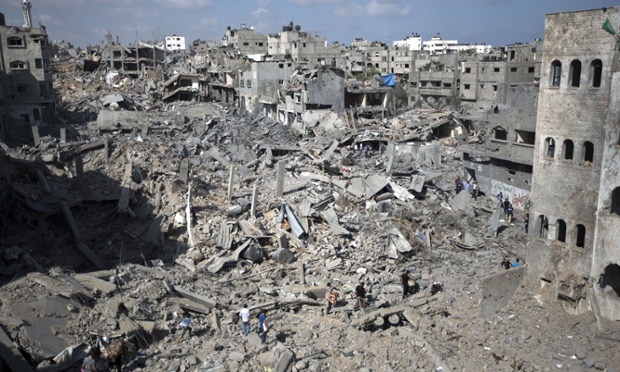
Is there nowhere on the face of the Earth where opinion polls aren’t taken? In the wake of the 50-day Israeli assault on Gaza, parts of that tiny strip of land now look, according to photographs, like a moonscape of destruction. At least 10,000 homes were obliterated and thousands more damaged; at least 175 major factories were pummeled into the dust. Its only power plant was destroyed, damaging electricity, water, and sewage systems. Large apartment houses, as well as the ministry of education, schools, and other sites, were hit and sometimes reduced to so much rubble. It was all part of a massive Israeli assault on Hamas, several of whose senior leaders were assassinated, but also on the Palestinian population, involving what looked like collective punishment for its support of that organization or simply living in proximity to it. And indeed, with almost no hope of rebuilding much of their world any time soon, you might think that Palestinians would hold the Hamas leadership at least somewhat responsible for the destruction that has rained down, as assumedly the Israelis wanted them to. But a recent poll by the Palestinian Center for Policy and Survey Research (PSR), begun in the last day before the ceasefire took hold, and carried out, in part, amid the rubble that is now Gaza, suggests otherwise.

It finds that Palestinian opinion couldn’t be clearer.  Support hasn’t been this high for Hamas since 2006, when it won a fair and square democratic election. If a presidential vote were held today, the pollsters of PSR discovered, Hamas leader Ismail Haniyeh would beat Fatah’s Mahmoud Abbas hands down. Here are just a few of the findings: “79% [of Palestinians] believe that Hamas has won the Gaza War; 3% believe Israel came out the winner; and 17% believe the two sides were losers… If new presidential elections are held today and only two [candidates] were nominated, Haniyeh, for the first time since we have started asking about his popularity about eight years ago, would receive a majority of 61% and Abbas would receive 32%. [The] vote for Haniyeh stands at 53% in the Gaza Strip and 66% in the West Bank. Abbas receives 43% in the Gaza Strip and 25% in the West Bank… A majority of 53% believe that armed confrontation is the most effective means to establish a Palestinian state next to the state of Israel. Only 22% believe negotiation is the best means to establish a Palestinian state and 20% believe that popular non-violent resistance is the most effective route to statehood.”

As historically has often been the case, massive bombings and other assaults do not destroy the support of populations for movements or governments, but tend to solidify it. In other words, Israeli policy is reducing civilized life for Palestinians in a major way and yet increasing the urge both to fight on and the desire for revenge. It’s an ugly pattern and, as TomDispatch regular Noam Chomsky (whose latest book, Masters of Mankind, is due out this week) indicates today, it’s been going on in this same fashion for a remarkably long time, as Israel continues to gobble up Palestinian lands on the West Bank, while working to hem Palestinians in yet further in the Gaza Strip. Tom Engelhardt

Ceasefires in which violations never cease
What’s next for Israel, Hamas, and Gaza?
By Noam Chomsky

On August 26th, Israel and the Palestinian Authority (PA) both accepted a ceasefire agreement after a 50-day Israeli assault on Gaza that left 2,100 Palestinians dead and vast landscapes of destruction behind. The agreement calls for an end to military action by both Israel and Hamas, as well as an easing of the Israeli siege that has strangled Gaza for many years.

This is, however, just the most recent of a series of ceasefire agreements reached after each of Israel’s periodic escalations of its unremitting assault on Gaza. Throughout this period, the terms of these agreements remain essentially the same.  The regular pattern is for Israel, then, to disregard whatever agreement is in place, while Hamas observes it — as Israel has officially recognized — until a sharp increase in Israeli violence elicits a Hamas response, followed by even fiercer brutality. These escalations, which amount to shooting fish in a pond, are called “mowing the lawn” in Israeli parlance. The most recent was more accurately described as “removing the topsoil” by a senior U.S. military officer, appalled by the practices of the self-described “most moral army in the world.”

Continue reading

Facebooktwittermail

Obama expects ISIS to still be in power when he leaves the White House

Rami Khouri: [C]ombining American militarism with Arab dictatorships is probably the stupidest recipe that anybody could possibly come up with to try to fight jihadi movements like al-Qaeda and Islamic State and others, because it was that combination of Arab autocracy and American militarism that actually nurtured and let these movements expand. There has to be a more intelligent, more realistic process that allows the people in the Middle East to roll back these threats. And these people need to be fought; I’m not saying you sit around and do nothing. You have to fight these people and eradicate them…

What do we do about this Islamic State? These guys are taking more territory. They’re enforcing their rule by force, by terrorizing people. And very few people are happily accepting them. They don’t — you know, ordinary people don’t have a choice. If the Islamic State comes in with their guns and chops people’s heads off or crucifies a couple of people, everybody else stays [inaudible]. And this should be a telltale sign that these groups only can operate in zones of chaos. And the United States and others, the British, have helped create these zones of chaos in the last 20 years in Afghanistan and in Iraq, most recently. So, there’s really a lot of shared responsibility for this terrible situation we’re in, but the bottom line is we need to figure out how to fight the two real problems, which Obama keeps repeating as his strategy, the two real problems of autocratic, nondemocratic, abusive, corrupt, pretty inefficient and mediocre Arab government systems, Arab regimes, across the board. And the other one is the repeated use of American, British, Israeli, other military power in the region to try to enforce an order that the West and the Israelis and others feel is suitable for them. Those two problems are two of the root causes of all of these issues that we’re seeing, and the Islamic State is simply a symptom of years and years of this, of these kinds of problems of bad governance.

The driving force behind President Obama’s formulation of a strategy for dealing with ISIS appears to have been the mere fact that he inadvertently revealed he lacked such a strategy.

In other words, the strategy he is about to unveil on Wednesday is not really a strategy for dealing with ISIS; it’s a strategy for dealing with the fact that he looked inept when he said he didn’t have a strategy.

Having been forced by embarrassment to quickly formulate this strategy, it appears to have been stitched together as an effort to deflect earlier criticisms. For instance, in Libya the administration was embarrassed by Obama’s reluctance to lead. This time, the New York Times reports, “the Obama administration is no longer ‘leading from behind,’ but plans to play the central role in building a coalition to counter ISIS.”

Still, by framing this as an operation likely to last longer than his administration, the president wants to insulate himself from the risk of personal failure, while most likely he passes on the most difficult phase to his successor:

The final, toughest and most politically controversial phase of the operation — destroying the terrorist army in its sanctuary inside Syria — might not be completed until the next administration.

What do we do about ISIS?

This isn’t a debate about the pros and cons of military action. As Khouri says: “You have to fight these people and eradicate them.”

If Obama invests less time on message management and more on genuine strategic thinking, then he might see that the coalition he’s trying to build should place at its core the people who have the ability and desire to fight ISIS: Syrians, Iraqis, and Kurds who should not be used as proxy forces following the commands of the Pentagon, but fighters fighting their own war with U.S. and allied support.

Facebooktwittermail

Nick Turse: American monuments to failure in Africa?

In light of recent history, perhaps it’s time to update that classic U.S. Army recruitment campaign slogan from “be all that you can be” to “build all that you can build.”  Consider it an irony that, in an era when Congress struggles to raise enough money to give America’s potholed, overcrowded highways a helping hand, building new roads in Afghanistan proved no problem at all (even when they led nowhere).  In fact, the U.S. military spent billions of taxpayer dollars in both Afghanistan and Iraq on nation-building infrastructural efforts of all sorts, and the Pentagon’s Inspector General (IG) repeatedly reported on the failures, disasters, and boondoggles that resulted.  In 2012, for instance, the IG found that of the $10.6 billion in Afghan funding it examined, $7 billion was “potentially wasted.”  And this has never ended.  In 2014, the IG typically reported that “some 285 buildings, including barracks, medical clinics, and even fire stations built by the Army [in Afghanistan] are lined with substandard spray insulation so prone to ignition that they don’t meet international building codes.”

As of this year, more U.S. and NATO money had been “squandered” on the “reconstruction” of Afghanistan than was spent on the full post-World War-II Marshall Plan to put a devastated Europe back on its feet.  And how has all that spending turned out?  One thing is certain: those torrents of money helped create a devastating economy of corruption.  As for reconstruction, the Inspector General found mainly “poor planning, shoddy construction, mechanical failures, and inadequate oversight.”  

As TomDispatch’s Nick Turse, author of the award-winning book Kill Anything That Moves: The Real American War in Vietnam, reminds us today, thanks to the counterinsurgency strategy that the U.S. military has pursued in these years, most of this spending came under the heading of “winning hearts and minds” in the countries the U.S. invaded.  Any American batallion-level commander in an Afghan village could essentially reach into his pocket and pull out the funds to build a schoolhouse.  And yet, in the United States, much of our educational infrastructure, built after World War II for the Baby Boomer generation, is in need of reconstruction funds that are no longer in any pockets.  The same holds true for American airports (none having been built in almost 20 years), bridges (almost half of them needing “major structural investments” in the next 15 years and 11% now considered “structurally deficient”), highways, dams, levees, sewage and water systems, and the like.  In 2013, the American Society of Civil Engineers gave the country’s infrastructure a grade of D+ and estimated that, to keep the U.S. a fully functioning first-world country, some $3.6 trillion dollars would have to be invested in infrastructural work by 2020. 

Fat chance.  Though no one ever comments on it, the constant spending of money to win hearts and minds in distant lands should be considered passing strange when hearts and minds are at stake in Rhode Island, Arkansas, and Oregon.  Stranger yet, the group designated to do that hearts-and-minds construction is also dedicated to destroying infrastructure in times of conflict.  It shouldn’t be surprising that nation-building, school by school, road by road, might not be its strong point.

Worse yet, as Nick Turse reports, continuing his remarkable ongoing investigation into the U.S. military’s “pivot” to Africa, even after the disasters of Afghanistan and Iraq, it seems that there are hearts and minds still to win out there and all of Africa to build in. Tom Engelhardt

How not to win hearts and minds in Africa
Hushed Pentagon investigation slaps U.S. Africa Command’s humanitarian activities
By Nick Turse

[This story was reported in partnership with the Investigative Fund at the Nation Institute. Additional funding was provided through the generosity of Adelaide Gomer.]

DAR ES SALAAM, Tanzania — Movie night in Mouloud, Djibouti.  Skype lessons in Ethiopia.  Veterinary training assistance in Garissa, Kenya.  And in this country on the east coast of Africa, work on both primary and secondary schools and a cistern to provide clean water.  These are all-American good works, but who is doing them — and why?  

As I sit in a room filled with scores of high-ranking military officers resplendent in their dress uniforms — Kenyans in their khakis, Burundians and Ugandans clad in olive, Tanzanians in deep forest green sporting like-colored berets and red epaulets with crossed rifles on their shoulders — chances are that the U.S. military is carrying out some mission somewhere on this vast continent.  It might be a kidnapping raid or a training exercise.  It could be an airstrike or the construction of a drone base.  Or, as I wait for the next speaker to approach the lectern at the “Land Forces East Africa” conference in Dar es Salaam, Tanzania, it could be a humanitarian operation run not by civilians in the aid business, but by military troops with ulterior motives — part of a near-continent-wide campaign utilizing the core tenets of counterinsurgency strategy.

Continue reading

Facebooktwittermail

French jihadist, alleged ISIS torturer, ‘looking for a destiny of his own’

Nicolas Henin, a French journalist who was released in April after being held hostage in Syria by ISIS, has identified Mehdi Nemmouche, who is also French, as one of his captors. Henin says that over a period of several months he was repeatedly tortured and beaten by Nemmouche.

In July, Nemmouche was charged with murder following the killing of four people at the Jewish Museum of Belgium, in Brussels, on May 24.

The case of Nemmouche raises concerns in at least two ways: firstly, because he is viewed as a fear come true by those who warn of the risk posed to the West by European passport holders returning from the war in Syria who, having been trained by ISIS, may bring their jihad home. Secondly, his violence is being linked to the rise of antisemitism across Europe, particularly in France.

Henin’s perspective on Nemmouche is interesting because unlike terrorism experts who maintain much more distance from their subjects, the French journalist got to know this individual in a much more intimate way: as his torturer.

It would be easy to conclude that the nature of this relationship would make it impossible for Henin to be objective. Maybe so. But I think it’s just as likely that a victim of torture would feel driven to try and understand the mind of his persecutor — especially when they were in the unusual situation of sharing the same first language.

For this reason, I find Henin’s brief psychological profile of Nemmouche particularly interesting.

Henin observed that Nemmouche “came to Syria not because he wanted to fight for a specific cause but because he was looking for a destiny of his own.”

The term “radicalization” appears in the media a lot these days and it conjures up images of empty vessels — young men susceptible to being radicalized.

While that might accurately describe the hapless path that leads some into jihad, there are others — and who’s to say which are more numerous — for whom jihad simply becomes the vehicle for a destiny they were already pursuing.

My hunch is that it is the latter kind of jihadist for whom ISIS has the greatest appeal — that they are pursuing destinies of their own for which they have been provided an ideological vehicle which legitimizes and articulates their visceral drives.

France has about 70,000 prisoners, 60-70% of whom are Muslim. However prevalent the radicalization of Muslim prisoners has become, only a small minority become jihadists. Given that only 5-10% of the French population is Muslim, France’s larger concern should be that so many Muslims are being thrown in jail.

The French journalist Marc Weitzmann recounts how one prisoner describes the system.

Karim Mokhtari, who was sentenced to 10 years in the mid-1990s after he tried to rob a drug trafficker and accidentally killed him with a shotgun, reveals in his book Redemption how easy it is to be approached by Islamists there. “In prison,” he told me, “there are two things you catch as soon as you get there. One is how lonely you are, and the other is how lonely you don’t want to be. So you look in the courtyard and you ask yourself, to which group do I belong? There are the junkies, there are the dealers, there are the rapists, and so forth. And there are the religious. Cleaner than the rest, they also seem to suffer less, they take care of each other. I watched them for a week, then the improvised Imam came to me to ask if I were a Muslim and I said no, not yet, and he introduced me to someone freshly converted — a European — who taught me the first rudiments of Arabic, the first prayers and rituals. And it went on from there.”

After the conversion rate started to turn the group into a force of some sort, the administration decided out of precaution to dismantle the religious group: The imam was transferred. He came to Mokhtari’s cell, as Mokhtari told me: “ ‘Listen’ he said, ‘I’m being transferred and I must leave. But you, your mission as a Muslim is to kill. Kill miscreants anywhere you find them. You need to keep in touch for that even when you’re out so do it. And if you need military training, we have places for that too.’ ”

“That’s when I realized what I was going into,” Mokhtari said. He was the son of a violent mixed marriage, and his French mother got divorced and remarried to a racist Frenchman who lived on welfare and off robbery. … Mokhtari started to get regularly beaten by the man, who also woke him up at 4.a.m. on Saturday nights to take him along with him on his robberies of villas and apartments while Karim kept watch. But despite an incomparably more violent background than Nemmouche endured, Karim Mokhtari never turned to terrorism.

In the following film, Mokhtari describes his own redemption.

Destiny is a dangerous and intoxicating idea. It empowers the individual by allowing him to shed doubt.

Where there is no internal struggle, conviction easily translates into action. Those pursuing their destiny, swiftly move forward, while those unsure of their destiny, are more inclined to waver, aware of their capacity to make mistakes. Destiny is dangerous both subjectively and objectively.

If we believe some individuals are destined to become to become terrorists, we’re also likely to view them as irredeemable.

Facebooktwittermail

After Syria and Iraq, ISIS makes inroads in South Asia

Reuters reports: Islamic State pamphlets and flags have appeared in parts of Pakistan and India, alongside signs that the ultra-radical group is inspiring militants even in the strongholds of the Taliban and al Qaeda.

A splinter group of Pakistan’s Taliban insurgents, Jamat-ul Ahrar, has already declared its support for the well-funded and ruthless Islamic State fighters, who have captured large swathes of territory in Iraq and Syria in a drive to set up a self-declared caliphate.

“IS (Islamic State) is an Islamic Jihadi organization working for the implementation of the Islamic system and creation of the Caliphate,” Jamat-ul Ahrar’s leader and a prominent Taliban figure, Ehsanullah Ehsan, told Reuters by telephone. “We respect them. If they ask us for help, we will look into it and decide.”

Islamist militants of various hues already hold sway across restive and impoverished areas of South Asia, but Islamic State, with its rapid capture of territory, beheadings and mass executions, is starting to draw a measure of support among younger fighters in the region.

Al Qaeda’s ageing leaders, mostly holed up in the lawless region along the Pakistan-Afghanistan border, are increasingly seen as stale, tired and ineffectual on hardcore jihadi social media forums and Twitter accounts that incubate potential militant recruits. [Continue reading…]

Facebooktwittermail

For Israel, the beginning of wisdom is to admit its mistakes

Avi Shlaim writes: Israel has a habit of justifying its actions in the occupied Palestinian territories, however illegal and indecent, in the name of security. But denying any security to the other side only perpetuates the conflict.

Five days after reaching a ceasefire with Hamas to end the latest round of fighting in Gaza, the Israeli cabinet decided to appropriate 988 acres of land on the West Bank, near the place where three Israeli teenagers were recently abducted and murdered, to make way for another illegal Jewish city. This is the biggest land grab in three decades. As the justice minister, Tzipi Livni, pointed out: “It was a decision that weakens Israel and damages its security.” What it proves, if further proof is needed, is that Israel’s leaders are determined to prevent a two-state solution to the conflict.

Operation Protective Edge, which came to an end after 50 days of fighting, was the third and deadliest war in six years between Israel and Hamas, the Islamic resistance movement that rules Gaza. Israel lost 66 soldiers and six civilians. On the Palestinian side, the war left 2,104 dead, mostly civilians, and 12,656 injured; 17,000 houses were destroyed or damaged; 520,000 people, out of a population of 1.8 million, were displaced. The damage to buildings and to the civilian infrastructure, estimated at $6bn, will take many years to repair.

What did Israel gain by unleashing the deadly firepower of the IDF against the caged population of this tiny coastal enclave? Virtually nothing. [Continue reading…]

Facebooktwittermail

Failure in Gaza

Assaf Sharon writes: The Israeli-Palestinian conflict has long ago become a shouting match over moral superiority. With seventy Israelis and more than two thousand Palestinians, most of them civilians, dead, the latest round of violence in Gaza, too, is being analyzed and discussed mostly on ethical grounds. But as fighting goes on, moral condemnation will likely do little to prevent the next round. Understanding how we got to this point — and, more importantly, how we can move beyond it — calls for an examination of the political events that led up to the operation and the political context in which it took place.

In Israel, endless controversy over Gaza has overlooked one question: How did we get here in the first place? Why, after a considerable period of relative calm, did Hamas resume rocket fire into Israel?

Before the current operation began, Hamas was at one of the lowest points in its history. Its alliance with Syria and Iran, its two main sources of support, had grown weak. Hamas’s ideological and political affinity with the Muslim Brotherhood turned from an asset into a burden, with the downfall of the Brotherhood in Egypt and the rise of its fierce opponent, General Abdel Fatah el-Sisi. Egypt’s closure of the Rafah crossing and the tunnels on its border with Gaza undermined Hamas’s economic infrastructure. In these circumstances, Hamas agreed last April to reconciliation with its political rival Fatah, based on Fatah’s terms. For example, the agreement called for a government of technocrats largely under the control of the Palestinian Authority led by Mahmoud Abbas.

But Benjamin Netanyahu viewed the reconciliation as a threat rather than an opportunity. While the separation of Gaza from the West Bank may not serve Israel’s interest (namely, effective government in the Palestinian Territories), it benefits Netanyahu’s policy of rejecting solutions that would lead to a separate Palestinian state. The reconciliation agreement robbed him of the claim that in the absence of effective rule over Gaza, there is no point in striking a deal with Abbas. [Continue reading…]

Facebooktwittermail

In the fight against ISIS, a coalition of rivals

The Washington Post reports: The urgent fight to keep Islamic State forces­ from taking over more of Iraq has led the Obama administration to tolerate, and in some cases even approve, things it once would have loudly protested.

When Iraqi Shiite militias, backed by Iran and long branded illegal by the administration, retook the town of Amerli from the Sunni Muslim militants last week, U.S. officials breathed a sigh of relief.

Qassem Suleimani, the head of the Iranian Revolutionary Guard Corps’ Quds Force and usually described as an arch­enemy of the United States, reportedly was present during the battle and was seen days later in an Internet-posted photo shaking hands with a militia fighter.

Farther north, Kurdish fighters have occupied the oil-rich city of Kirkuk, a prize the Kurds have long claimed but which lies outside the borders — recognized by both Baghdad and Washington — of Iraq’s semiautonomous Kurd­i­stan region. Far from insisting the fighters withdraw, the administration is glad that someone is defending the city from the Islamic State.

Such legal and policy niceties have become a luxury in the battle to push back the militants whom President Obama on Friday called “a savage organization” that “poses­ a significant threat” to the United States and its allies.

It is not, as one administration official said with significant under­statement, an ideal situation, and there is widespread recognition that facts are being created on the ground that are likely to cause problems in the future. [Continue reading…]

Facebooktwittermail

Iranian-Saudi agreement on Iraq may be near

Al-Monitor reports: A UN diplomatic source in Beirut told Al-Monitor that an Iranian-Saudi agreement on the formation of the next Iraqi government was almost done. The source, who spoke on condition of anonymity, revealed that the visit by the Iranian Assistant Foreign Minister Hussein Amir Abdul Lahian to Saudi Arabia on Aug. 26 was the move that crowned the agreement.

The source said that some felt a few weeks ago that removing Nouri al-Maliki from the Iraqi Prime Ministry and designating Haider al-Abadi on Aug.11 was the final sign of a Tehran-Riyadh agreement on Baghdad. But this impression was not true.

According to the diplomatic source, the move followed mutual attempts by the two parties to raise their negotiating ceilings. For its part, Iran tried to harden its stance for known reasons; it gave the impression that removing Maliki happened more because of internal Iraqi Shiite calculations linked to the position of Shiite cleric Ali al-Husseini al-Sistani, rather than a Shiite concession to the Sunnis or an Iranian concession to Saudi Arabia in Iraq. These calculations include compensating Maliki’s removal by strengthening his and his team’s position in governing and in the next government, as well as getting paid by the Sunni-Saudi team as a compensation. [Continue reading…]

Facebooktwittermail

As ISIS advances in Syria, Israel tightens its grip on the Golan Heights

The Economist: IS’s advance is prompting the 20,000 Druze who inhabit the Golan Heights, alongside a similar number of Israelis, to shift their allegiance. For decades under Israeli occupation they professed their loyalty to Syria. But now, as adherents of an esoteric offshoot of Islam that IS and Jabhat al-Nusra excoriate, they are quietly loosening their ties to Syria. They have stopped exporting their apples there—and their brides. Druze applications for Israeli citizenship have risen sharply, says the Israeli-appointed mayor of Majdal Shams, the biggest of the four Druze towns. Many Druze now look to Israel (and particularly to its Israeli Druze soldiers stationed on the heights) to protect their secular world, where women walk and drive their cars unveiled.

This raises the hopes of those in Israel’s hawkish government who want to extend the annexation of the Golan Heights indefinitely. Whereas a more dovish Israeli government in 1999 came close to a land-for-peace deal with Syria, few Israelis nowadays contemplate such a thing. Indeed, Israel’s current leaders often remind their voters how vulnerable Israel would have been to the threat of jihadists if its border with Syria had been realigned along the shore of Lake Galilee, as was mooted.

An army division, newly equipped with drones, and a new iron fence, are meant to secure the border. The nearby vineyards look set to provide Israel with excellent, if expensive, wine for some years to come.

Facebooktwittermail

The Hannibal Directive: How Israel killed its own troops and massacred Palestinians to prevent soldiers’ capture

Max Blumenthal writes: In the southern city of Rafah in the Gaza Strip, Aug. 1, 2014 is known as Black Friday. This was the day the Israeli military bombarded the city with almost every mode of destruction available to it, from F-16 missiles to Apache rockets to naval shelling to drone strikes and mortars.

Bulldozers ripped down homes at random while tanks barreled through neighborhoods, shelling anything in sight. In a matter of hours, at least 500 artillery shells and hundreds of missiles were dumped on the city, almost entirely in civilian areas. By the end, at least 190 people had been killed, so many that unequipped local hospitals were forced to store their corpses and body parts in ice cream coolers.

The target of the operation was not necessarily Rafah’s civilian population, though attacking it was part of the Israeli military’s underlying logic. Instead, the army apparently aimed to kill one of its own. Indeed, Israeli forces had invoked the Hannibal Directive, opening up an indiscriminate assault on the entire circumference of the area where one of its soldiers, Lt. Hadar Goldin, was allegedly taken captive by an ambush team from the Hamas military wing known as the Qassam Brigades.

It was one of possibly three instances during Israel’s 51-day war with Hamas that it initiated the Hannibal Directive. [Continue reading…]

Facebooktwittermail

England is dysfunctional, corrupt and vastly unequal. Why would Scotland want to be tied to such a country?

George Monbiot writes: Imagine the question posed the other way round. An independent nation is asked to decide whether to surrender its sovereignty to a larger union. It would be allowed a measure of autonomy, but key aspects of its governance would be handed to another nation. It would be used as a military base by the dominant power and yoked to an economy over which it had no control.

It would have to be bloody desperate. Only a nation in which the institutions of governance had collapsed, which had been ruined economically, which was threatened by invasion or civil war or famine might contemplate this drastic step. Most nations faced even with such catastrophes choose to retain their independence – in fact, will fight to preserve it – rather than surrender to a dominant foreign power.

So what would you say about a country that sacrificed its sovereignty without collapse or compulsion; that had no obvious enemies, a basically sound economy and a broadly functional democracy, yet chose to swap it for remote governance by the hereditary elite of another nation, beholden to a corrupt financial centre?

What would you say about a country that exchanged an economy based on enterprise and distribution for one based on speculation and rent? That chose obeisance to a government that spies on its own citizens, uses the planet as its dustbin, governs on behalf of a transnational elite that owes loyalty to no nation, cedes public services to corporations, forces terminally ill people to work and can’t be trusted with a box of fireworks, let alone a fleet of nuclear submarines? You would conclude that it had lost its senses. [Continue reading…]

Facebooktwittermail

Al Qaeda’s new front: Jihadi rap

Amil Khan writes: Abdel Majed Abdel Bary, the rapper suspected of murdering American journalist James Foley somewhere between Syria and Iraq, is the product of a British youth culture that has managed to merge two seemingly contradictory lifestyles: gangsta rap and jihad. Like Douglas McAuthur McCain — an American hip-hop fan who was recently killed fighting for the Islamic State — Abdel Bary represents a new and very scary evolution in modern jihadi history.

U.S. Secretary of Defense Chuck Hagel recently described the Islamic State as a threat “beyond anything we’ve ever seen.” Yet we are only just beginning to grasp what is different about this group. One reason is that it includes men in its ranks whom you might expect to see in a nightclub rather than fighting in the desert for an organization that would, traditionally, whip you for listening to music.

As a result of this cultural elasticity, the Islamic State has succeeded in attracting supporters outside its natural recruiting pool. Both McCain and another Westerner, Denis Mamadou Cuspert, a German citizen who died fighting with the Islamic State — and had a previous life as rapper Deso Dogg with three albums to his name — became converts as part of this broader appeal.

I first began to look into this hybrid phenomenon in 2008 when I was a journalist researching a subculture that had fused the extremism and violence of gangsta rap with that of al Qaeda — or at least a version of it. During a months-long investigation for British television station Channel 4, I met dozens of young men across London who tended to have three things in common: a history of criminal activity, an ambition to be a gangsta rapper and a fixation with the terrorist group begun by Osama bin Laden. [Continue reading…]

Facebooktwittermail

British hostage David Haines held by ISIS ‘helped thousands of people’

The Telegraph reports: The wife of the British hostage David Haines has described him as “everything to us” in her first comments since terrorists threatened to behead him.

Mr Haines, 44, is a father of two described by his wife as a “fantastic man and father”.

He made his home in Croatia after spending five years helping local people, including Muslim families, rebuild their homes after the Balkans war, and the town of Petrinja, where he helped put up 800 houses, was “in shock” over his seemingly hopeless plight.

Mr Haines, who was born on Humberside but raised in Scotland, has a 17-year-old daughter by his first wife Louise and a four-year-old daughter by his second wife Dragana, who is Croatian.

Speaking at the family’s home near Zagreb, Dragana Haines, 44, said: “He’s everything to us. He’s our life. He’s a fantastic man and father.

“Nobody can understand how we are feeling. My daughter keeps asking about him every day. She hasn’t seen her father for a year and a half. She has gone through so much. She sees me crying all the time.

“My daughter was on a play date and I had to bring her home when I got the news.

“I just can’t digest it right now. We just don’t want to do anything to endanger his life.”

Mr Haines and his wife, whom he met when she worked as his translator, were due to celebrate their fourth wedding anniversary in November, having married in Croatia in 2010, when Mr Haines wore a kilt.

He was known as the “Crazy Scotsman” by locals whom he helped during several spells working for aid agencies in parts of Croatia torn apart by civil war.

When he worked for the German aid agency Arbeiter-Samariter-Bund from 1999 to 2004 Mr Haines’s landlady in the Croatian town of Petrinja was Nena Skoric, 67, to whom he affectionately referred as “Mama”.

Sitting at her kitchen table, surrounded by photographs and memories of Mr Haines, Mrs Skoric said: “To me, it was like God had sent David to this place.

“It didn’t matter to him whether people were Croats, Serbs or Muslims, as long as they needed help.

“Many of the people from all sides had destroyed each other’s houses during the war. There were many families who had lost everything.

“But they all loved David. For years after he left they would come here and ask how he was. He was such a good man and he was like one of my family.

“I don’t know what is wrong with the kidnappers. Don’t they know he was helping Muslims? They don’t seem to care about that.”

Mr Haines helped “thousands” of local people as he led efforts to build new homes and schools for refugees returning to their shattered villages, and became so frustrated at the lack of available funds that he would donate a large slice of his salary to pay for materials and other essentials. [Continue reading…]

Facebooktwittermail

Disillusioned British jihadists seek amnesty

The Times reports: Dozens of British jihadists have become so disillusioned with fighting in Syria that they have contacted Britain begging to come home.

One jihadist, claiming to represent 30 Britons, approached an intermediary to complain of growing despondency among the men in his group. They had gone to fight against President Bashar al-Assad’s regime but were instead engaged primarily in fierce combat with rival rebel groups, he said.

The man contacted researchers from the International Centre for Study of Radicalisation and Political Violence at King’s College London in the past two weeks. He effectively sought amnesty, saying the group feared long prison terms but would be willing to enrol on a deradicalisation program and submit to surveillance.

The militants are from a group affiliated with Islamic State. More than 500 British citizens are believed to have travelled to the region since 2011. Most have joined Islamic State.

The British man told researchers: “We came to fight the regime and instead we are involved in gang warfare. It’s not what we came for, but if we go back we will go to jail.

“Right now we are being forced to fight — what option do we have?”

Shiraz Maher, who runs a research unit at ICSR that is in intermittent contact with about 50 British jihadists, said the man regretted being involved in the conflict. [Continue reading…]

Facebooktwittermail