Category Archives: Lands

Russian media and ‘journalistic independence’

e13-iconA couple of days ago, Glenn Greenwald wrote:

American media elites awash in an orgy of feel-good condemnation in particular love to mock Russian media, especially the government-funded English-language outlet RT, as being a source of shameless pro-Putin propaganda, where free expression is strictly barred (in contrast to the Free American Media). That that network has a strong pro-Russian bias is unquestionably true. But one of its leading hosts, Abby Martin, remarkably demonstrated last night what “journalistic independence” means by ending her Breaking the Set program with a clear and unapologetic denunciation of the Russian action in Ukraine:

I imagine most readers here will have already seen Martin’s widely publicized statement. Clearly she was flattered by gaining Greenwald’s attention, whose remarks she featured at the beginning of her next show.

Even so, anyone who thinks that Martin’s statement should be taken as a sign that RT values journalistic independence, is ignoring the reality of the Russian media and the organization she works for and chooses to continue working for despite her opposition to the invasion of Crimea.

RIA Novosti reports: On Wednesday, Izvestia daily newspaper reported that a ruling United Russia party deputy is readying legislation that would, among other things, make it a crime to “allow publication of false anti-Russian information.”

Starting Wednesday, staff at RIA Novosti’s Moscow-based English-language desk was asked to decide whether they wanted to work at [the newly created] Rossiya Segodnya or accept compensation packages. The bulk of the writers and editors for the English-language service have opted for the latter option.

The new agency is to be headed by Dmitry Kiselyov, a notoriously outspoken conservative TV presenter, and will share its editor-in-chief, Margarita Simonyan, with the Kremlin-funded TV news channel RT.

RT, which was formerly known as Russia Today, has been at the center of controversy recently with two reporters at the channel “going rogue” to openly criticize Russia’s interventions in the southern Ukrainian province of Crimea in the past few days. Criticism of the Kremlin typically gets little to no attention on RT, while content devoted to negative aspects of life in Western countries makes up a substantial part of its broadcasts.

Kiselyov’s ascendancy appears to point to efforts by the Russian authorities to appeal more to ultra-conservative values, a trend best signaled by last year’s passage of a law banning the promotion of homosexual “propaganda” to minors.

In Kiselyov’s most notorious on-screen harangue, dating back to 2012, he suggested it would be advisable to “burn or bury the hearts of gays” who die in car crashes.


Facebooktwittermail

Israeli spies find it increasingly difficult to enter the U.S.

n13-iconIntelNews.org reports: Articles in the Israeli media have accused the United States of quietly instituting a policy of denying entry visa requests from members of Israel’s security and intelligence agencies. In an article published on Tuesday, centrist newspaper Maariv cited “senior security personnel” who have allegedly been barred from entering the US. The centrist Hebrew-language daily said the past 12 months have seen “hundreds of cases” of employees in the Israeli intelligence community who have been told by US consular officials that they could not step foot on US soil. The paper said the visa rejections appear to affect mostly members of the Shin Bet, Israel’s domestic security agency, and the Mossad, which conducts covert operations abroad. Visa bans have also affected employees in Israel’s defense industries, said the article. The report suggests that the targeting of Israeli security and intelligence personnel appears to be deliberate, adding that it applies even to those Israeli intelligence or security officers that are already stationed on US soil. In what seems to be a change in policy, the latter are now being issued short-term visas, rather than multiyear entry permits. As a result, the paper says they are “forced” to cross from the US into Canada at regular intervals, in order to apply to have their visas renewed.

Facebooktwittermail

On Ukraine, Obama should listen to Kissinger

I know — why should anyone listen to Henry Kissinger?

I saw links to his Washington Post op-ed on Ukraine last night and my reaction was not: I must find out what Kissinger thinks.

But no one should get hung up on bylines.

Listen to what he’s saying without judging it on the basis of his political history, and I think that most people would recognize that what the 90-year-old former U.S. secretary of state is offering here is wise counsel.

Kissinger writes: Public discussion on Ukraine is all about confrontation. But do we know where we are going? In my life, I have seen four wars begun with great enthusiasm and public support, all of which we did not know how to end and from three of which we withdrew unilaterally. The test of policy is how it ends, not how it begins.

Far too often the Ukrainian issue is posed as a showdown: whether Ukraine joins the East or the West. But if Ukraine is to survive and thrive, it must not be either side’s outpost against the other — it should function as a bridge between them.

Russia must accept that to try to force Ukraine into a satellite status, and thereby move Russia’s borders again, would doom Moscow to repeat its history of self-fulfilling cycles of reciprocal pressures with Europe and the United States.

The West must understand that, to Russia, Ukraine can never be just a foreign country. Russian history began in what was called Kievan-Rus. The Russian religion spread from there. Ukraine has been part of Russia for centuries, and their histories were intertwined before then. Some of the most important battles for Russian freedom, starting with the Battle of Poltava in 1709, were fought on Ukrainian soil. The Black Sea Fleet — Russia’s means of projecting power in the Mediterranean — is based by long-term lease in Sevastopol, in Crimea. Even such famed dissidents as Aleksandr Solzhenitsyn and Joseph Brodsky insisted that Ukraine was an integral part of Russian history and, indeed, of Russia.

The European Union must recognize that its bureaucratic dilatoriness and subordination of the strategic element to domestic politics in negotiating Ukraine’s relationship to Europe contributed to turning a negotiation into a crisis. Foreign policy is the art of establishing priorities.

The Ukrainians are the decisive element. They live in a country with a complex history and a polyglot composition. The Western part was incorporated into the Soviet Union in 1939, when Stalin and Hitler divided up the spoils. Crimea, 60 percent of whose population is Russian, became part of Ukraine only in 1954, when Nikita Khrushchev, a Ukrainian by birth, awarded it as part of the 300th-year celebration of a Russian agreement with the Cossacks. The west is largely Catholic; the east largely Russian Orthodox. The west speaks Ukrainian; the east speaks mostly Russian. Any attempt by one wing of Ukraine to dominate the other — as has been the pattern — would lead eventually to civil war or breakup. To treat Ukraine as part of an East-West confrontation would scuttle for decades any prospect to bring Russia and the West — especially Russia and Europe — into a cooperative international system. [Continue reading…]

Facebooktwittermail

Estonia FM: Behind Kiev snipers ‘was somebody from the new coalition’

RFE/RL reports: Estonia’s Foreign Ministry says a leaked phone conversation between Foreign Minister Urmas Paet and European Union foreign-policy chief Catherine Ashton is authentic.

However, in a statement on March 5 the ministry rejected a claim Paet was giving an assessment of the new Ukrainian coalition’s involvement in deadly street violence in Kyiv.

The statement said the conversation between Ashton and Paet took place February 26 after the minister returned from a visit to Kyiv.

The ministry said Paet was giving an “overview of what he had heard” in the Ukrainian capital.

During the conversation, Paet says there are suspicions in Kyiv that someone from the new coalition might have been behind snipers who shot dead “people from both sides.”

Some Russian media interpreted Paet’s remark as his confirmation of a “link between the snipers in Maidan and leaders of [the then-]opposition.”

The statement quotes Paet as saying it was “not a coincidence” the phone call was intercepted and posted on the Internet.

This is the leaked conversation between Ashton and Paet:

Paet: All the evidence shows that the people who were killed by snipers from both sides among policemen and people from the streets, that they were the same snipers killing people from both sides…

Ashton: Well that’s… yeah.. that’s…

Paet: So then she also showed me some photos she said that as a medical doctor she can say that it’s the same handwriting…

Ashton: Yeah…

Paet: … the same kind of bullets, and it’s really disturbing that now the new coalition, that they don’t want to investigate what exactly happened. So there is stronger and stronger understanding that behind snipers, it was not Yanukovych, but it was somebody from the new coalition.

Ashton: I think we want to investigate. I didn’t pick that up, it’s interesting … Gosh.

Paet: So it was — and this is disturbing — if it starts now to live its own life very powerfully, it already discredits from its very beginning this new coalition.

Facebooktwittermail

Russia Today anchor resigns live on air

Russia Today America anchor Liz Wahl resigned live on air on Wednesday, saying: “I cannot be part of a network funded by the Russian government which whitewashes the actions of Putin.” RT dismissed her action by calling it a “self-promotional stunt.”

James Kirchick reports: Wahl, for her part, says that while the Kremlin influence over RT isn’t always overt, that journalists there understand what they have to do to succeed and fall into line accordingly. “I think management is able to manipulate the very young and naïve employees,” she says. “They will find ways to punish you covertly and reward those that do go along with their narrative.”

“It’s interesting that our motto is ‘Question More,’” she says of the RT slogan. (It once adorned posters showing President Obama morphing into former Iranian President Mahmoud Ahmadinejad with the words, “Who poses the greater nuclear threat?”)

“In order to succeed there you don’t question… In a way you kind of suppress any concerns that you have and play the game.”

Wahl recalls a story she attempted to report about last year’s French intervention in Mali, aimed at repelling an al-Qaeda takeover of the country. She interviewed a Malian man who “talked about what it was like to live under sharia law, people getting limbs amputated…And I thought it was probably one of the best interviews that I’ve ever done. I was touched by what he said as a first hand source, but he also talked about how the French were well-received there and how they were waving French flags and how they should have come sooner, how grateful a large part of the population was, having seen people being literally tortured and having their limbs cut off.”

That story, however, didn’t fit the RT narrative, which portrays every Western military intervention as an act of imperialism while depicting Russian ones as mere humanitarian attempts at “protecting” local populations, as the network constantly describes Moscow’s role in Crimea. Needless to say, Wahl’s interview with the thankful Malian never aired. “I was told after that it was a ‘weak’ interview,” Wahl said.

Though RT America has many American staffers, Wahl says that Russian expatriates call the shots. “They’re definitely at the top, the Russians, they’re kind of able to pull the strings… I just think it’s absurd that we’re just a few blocks away from the White House and this is all able to go along,” she says.

Having worked on the inside, Wahl perfectly understands RT’s marketing strategy, which is to appeal to a young, Western demographic cynical about mainstream media outlets and traditional political authority. “I think some of them are kind of like this hipster generation, they just kind of think it’s cool to question authority,” she says.

But what the network’s many young viewers don’t understand, or refuse to understand, is that the channel’s message emanates from the most authoritarian of sources: the Kremlin.

Facebooktwittermail

Why not seize Putin’s assets?

Stephen Beard writes: Few people know more about the mechanics of smart sanctions against Russians than Bill Browder, Chief Executive Officer of Hermitage Capital Management. Once the biggest foreign investor in Russia, Browder fell foul of the Kremlin after exposing corruption. His lawyer, Sergei Magnitsky, was later detained, and died in custody in murky circumstances. Browder lobbied for The Magnitsky Act, which has so far imposed asset freezes and visa bans on more than a dozen Russian officials. Browder argues that Putin could certainly be targeted too.

“He has lots of assets in the U.K., France, Germany and various places. I am sure there are plenty of intelligence agencies that have plenty of information about what Putin owns and where,” Browder says.

Putin’s true net worth has not been published. Some estimates suggest it could be as much $70 billion.

And here’s the problem: The Russian leader and his oligarchs own so much wealth that freezing it all would be a monumental task. Take Chelsea Football Club, now owned by one of Putin’s closest associates, Roman Abramovic. Are the British authorities really going to seize it? It just goes to show – admits Anne Applebaum – how dependent London has become on Russian cash. [Continue reading…]

Facebooktwittermail

Beijing and Moscow part ways over Ukraine

Foreign Policy reports: Days after Ukraine’s deposed President Viktor Yanukovych fled his Kiev palace, an unassuming, mid-level Chinese diplomat appeared before the United Nations Security Council to highlight Beijing’s support for the new pro-Western government, marking a rare diplomatic split from Moscow.

“We respect the choice made by the Ukrainian people on the basis of national conditions,” Shen Bo, a counselor at China’s U.N. mission said in a Feb. 24 statement that went largely unnoticed by the international press.

China and U.N. watchers say Beijing’s refusal to blindly follow Moscow’s lead during the Ukrainian crisis reflects a deep-seated anxiety about the path that Russian President Vladimir Putin has chosen to pursue. [Continue reading…]

Facebooktwittermail

Al Jazeera trial: prosecution presents contents of journalists’ hotel rooms

The Guardian reports: The second day of the trial of three al-Jazeera journalists in Egypt descended into farce on Wednesday when prosecutors presented the entire contents of their raided hotel rooms as evidence, and another co-defendant said he did not understand what the trial was about.

Australian ex-BBC correspondent Peter Greste, Canadian-Egyptian ex-CNN journalist Mohamed Fahmy, and local producer Baher Mohamed are among 20 people on trial in Egypt on charges of spreading misinformation and aiding terrorists. The case has sparked international outcry, and been portrayed worldwide as a serious attack on Egyptian press freedom.

But the case took a tragicomic turn when prosecutors presented box after box of everyday items and broadcast equipment as evidence of the defendants’ alleged terrorism – many as innocuous as electric cables, a computer keyboard, and a bumbag belonging to Peter Greste.

At one point judge Mohamed Nagy lost count of the number of cameras he had been shown, and struggled to open two of the suitcases in which the evidence was contained. Throughout the proceedings, two birds trapped inside the courtroom flew overhead. [Continue reading…]

Facebooktwittermail

Inside the corridor of death — Assad’s war against Syrian civilians

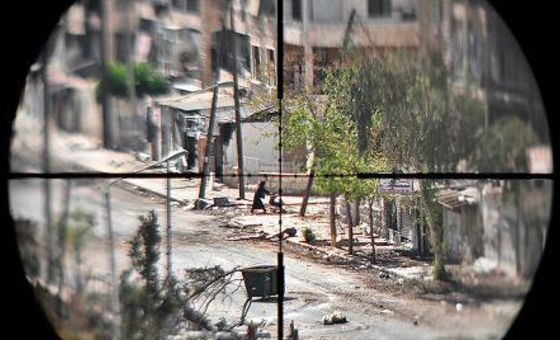
syria-sniper

Zaher Sahloul writes: In the last day of my medical mission to Aleppo in October 2013, I was asked to examine a toddler who had arrived at our hospital after being shot in the head by a sniper one hour earlier. His name was Hamza Ramadan, and he was just three years old. His heart was beating, but he exhibited no other signs of life. I was told that snipers had targeted Hamza, his mother, and his sister as they tried to sprint through the passage separating the opposition-controlled east side of Aleppo to the regime-controlled west.

That two-block street has now come to be known as “The Corridor of Death” (“Maabar Almawet” in Arabic). Snipers perched on the roofs of three regime-controlled buildings at the end of the passage have turned the place into a killing ground. Hamza’s mother and sister were killed instantly. Their bodies were rushed to the hospital, along with Hamza’s, in the back of a car owned by bystanders. (Ambulances are a luxury in Aleppo. According to the World Health Organization, more than 75 percent of Syria’s ambulances have been damaged in the conflict.)

Since the start of the first demonstrations in 2011, the Syrian regime has tried to cast the whole opposition as extremists and terrorists. This has been an effective strategy, playing into the fears of al Qaeda and jihadists that are prevalent in the United States and Europe. The more recent influx of foreign jihadists into Syria has added some legitimacy to such claims. The Western media has fallen into the regime’s trap, portraying the conflict as a fight between the government and terrorists — and sometimes implicitly justifying the regime’s crimes against its own people. The reality, as I saw it, is far more malicious: The government of President Assad is waging war not only against an armed enemy, but also against its own population.

My medical mission to Aleppo was organized by the Syrian American Medical Society (SAMS), a group dedicated to helping the victims of the war. My aim was to serve the victims of war in that ancient city and world heritage site, now the epicenter of aerial bombing and shelling. No amount of disaster management or trauma care training could have possibly prepared me for the brutal reality of the hospital I visited. At the hospital, which was code-named “M-1” for security reasons, the vast majority of our patients were local residents injured by shrapnel from barrel bomb attacks or indiscriminate shelling from fights between rebels and regime troops. But many, like Hamza, were civilians targeted in the most direct and ruthless way possible: by snipers.

The use of snipers gives the lie to government propaganda. Snipers know exactly whom they’re shooting. When snipers look through their telescopic sights at someone’s head or chest, they know if the target is a child or a fighter. According to the Aleppo Civilian Medical Council, snipers in the “Corridor of Death” gun down five to 20 civilians every day. Most of the victims die instantly. Those who survive are likely to suffer lifelong disabilities: amputations, loss of an eye, or spinal cord injury and paralysis are just a few on a long list of possibilities. The Oxford Research Group reports that 11,420 children (aged 17 and under) were recorded killed in the Syrian conflict by end of August 2013, from an overall total of 113,735 civilians and combatants killed. One in four of those child deaths were caused by small arms fire, including children targeted and summarily executed by snipers. Hamza was one of those unlucky children. [Continue reading…]

Facebooktwittermail

Ukraine crisis: The impact on nuclear proliferation

o13-iconSteven Pifer writes: Russia’s military occupation of Ukrainian territory on the Crimean peninsula constitutes a blatant violation of the commitments that Moscow undertook in the 1994 Budapest Memorandum on Security Assurances for Ukraine. The United States and United Kingdom, the other two signatories, now have an obligation to support Ukraine and penalize Russia.

When the Soviet Union collapsed in 1991, Ukraine found itself holding the world’s third largest nuclear arsenal, including some 1,900 strategic nuclear warheads that had been designed to attack the United States. Working in a trilateral dialogue with Ukrainian and Russian negotiators, American diplomats helped to broker a deal —the January 1994 Trilateral Statement — under which Ukraine agreed to transfer all of the strategic nuclear warheads to Russia for elimination and to dismantle all of the strategic delivery systems on its territory.

Kiev did this on the condition that it receive security guarantees or assurances. The Budapest Memorandum, signed on December 5, 1994, by the leaders of Ukraine, Russia, the United States and the United Kingdom (the latter three being the depositary states of the Non-Proliferation Treaty, that is, the states that receive the accession documents of other countries that join the treaty) laid out a set of assurances for Ukraine. These included commitments to respect Ukraine’s independence, sovereignty and existing borders; to refrain from the threat or use of force against Ukraine’s territorial integrity and independence; and to refrain from economic coercion against Ukraine. [Continue reading…]

Facebooktwittermail

As China looks on, Putin poses risky dilemma for the West

a13-iconDavid Rohde writes: One senior Obama administration official called Vladimir Putin’s actions in the Ukraine “outrageous.” A second described them as an “outlaw act.” A third said his brazen use of military force harked back to a past century.

“What we see here are distinctly 19th and 20th century decisions made by President Putin,” said the official who spoke on condition of anonymity to a group of reporters. “But what he needs to understand is that in terms of his economy, he lives in the 21st century world, an interdependent world.”

James Jeffrey, a retired career U.S. diplomat, said that view of Putin’s mindset cripples the United States’ response to the Russian leader. The issue is not that Putin fails to grasp the promise of western-style democratic capitalism. It is that he and other American rivals flatly reject it.

“All of us that have been in the last four administrations have drunk the Kool-Aid,” Jeffrey said, referring to the belief that they could talk Putin into seeing the western system as beneficial. “‘If they would just understand that it can be a win-win, if we can only convince them’ – Putin doesn’t see it,” Jeffrey said. “The Chinese don’t see it. And I think the Iranians don’t see it.”

Jeffrey and other experts called for short-term caution in the Ukraine. Threatening military action or publicly baiting Putin would likely prompt him to seize more of Ukraine by force. [Continue reading…]

Facebooktwittermail

Court bans activities of Hamas in Egypt

Reuters reports: An Egyptian court on Tuesday banned all Hamas activities in Egypt in another sign that the military-backed government aims to squeeze the Palestinian Islamist group that rules the neighboring Gaza Strip.

Hamas is an offshoot of Egypt’s Muslim Brotherhood, which the authorities have declared a terrorist group and which they have repressed systematically since the army ousted one of its leaders, Mohamed Mursi, from the presidency in July.

“The court has ordered the banning of Hamas’s work and activities in Egypt,” the judge, who asked not to be named, told Reuters.

During his year in power, Mursi gave red-carpet treatment to Hamas, angering many secular and liberal Egyptians who saw this as part of a creeping Islamist takeover following the 2011 uprising that toppled autocrat Hosni Mubarak.

The military-buttressed authorities now classify Hamas as a significant security risk, accusing it of supporting an Islamist insurgency that has spread quickly since Mursi’s fall, allegations the Palestinian group denies. [Continue reading…]

Facebooktwittermail

Iranian academics embrace U.S. sociologist in rare visit

n13-iconThe Washington Post reports: The presence of a prominent American scholar on Iranian university campuses this week, and the wide and positive reception he is receiving, is a sign that authorities here are attempting to fulfill promises of more openness in academia.

On Sunday, Tehran University’s School of Social Sciences hosted an event discussing the theory and work of Immanuel Wallerstein, a well-known critic of capitalism, best known for his world-systems analysis and his views about the decline of major powers, including the United States.

“I’m not sure what attracts people to my work. Maybe it’s that I’m an American, I say things that Americans don’t usually say and I have an analysis which seems to resonate in a lot of countries,” the 84-year-old Wallerstein said in an interview Monday.

Hundreds of students and professors crammed into the campus’ largest auditorium to hear Wallerstein’s remarks, which were preceded by discussions of his work by top Iranian sociologists, almost all of them delivered in English, a rarity in Iran.

“No government or social movement can be taken seriously if it is not addressing the issues of today,” Wallerstein told the audience toward the end of his hour-long speech, which at times dealt with topics that are often considered taboo in the Islamic republic, including women’s rights and corruption.

Wallerstein also spoke at Iran’s Centre for Strategic Studies, a think tank co-founded by Iran’s president, Hassan Rouhani. [Continue reading…]

Facebooktwittermail

Russia’s creeping annexation of Crimea

n13-iconNatalia Antelava writes: Andrei Ivaninchenko, a captain in the Ukrainian Army, didn’t have time to listen to Russian President Vladimir Putin on Tuesday afternoon. Ivaninchenko was busy coördinating talks between his commanders and senior Russian officers, checking on his troops, and taking an inventory of his food and water supplies.

By the time that Putin broke his silence over the movement of Russian troops into Crimea, the blockade of Ivaninchenko’s base on the outskirts of Sebastopol had entered its fourth day. But if he had taken the time to listen to Putin, he would have learned that the Russian soldiers pointing guns at him were merely figments of his imagination.

In his first press conference since the crisis began, Putin announced that no Russian troops — apart from those already stationed at the Russian Navy base in Sebastopol — were present anywhere in Crimea. When he was asked about the hundreds of well-armed soldiers in unmarked Russian uniforms who have been positioned outside of military sites and administrative buildings across the peninsula, Putin called them “self-organized local forces of volunteers.” As to their uniforms, Putin added that they could have been purchased at any store.

“If that’s the case,” Ivaninchenko said, looking straight at the armed men who were standing on the other side of an iron gate from us, “these are just bandits or irregular militiamen, and we should have no qualms about going out and shooting them.” But several Ukrainian Army officers told me that they are under strict orders from their own commanders to avoid any confrontation. “It will only take one shot,” Ivaninchenko told me, “and the whole of Crimea will be set on fire.” [Continue reading…]

Facebooktwittermail

Tide of opinion turns against Russia in Ukraine’s east

Reuters reports: More than 1,000 demonstrators with Ukrainian flags took to the streets of the eastern Ukrainian city of Donetsk on Tuesday, for the first time outnumbering pro-Moscow youths who have seized its government building, which flies the Russian flag.

President Vladimir Putin’s declaration on Saturday that Russia had the right to invade Ukraine was accompanied by pro-Russian demonstrations across Ukraine’s mainly Russian-speaking south and east.

But in the four days since, the tide of opinion in eastern cities appears to be turning back towards Kiev.

Bearing placards with slogans such as: “I am Russian. I don’t need protection,” the protesters marched near the occupied regional government building, staying far enough away to avoid clashing with the pro-Russian youths still inside.

“My parents are from Russia. I was born in Ukraine, but I am Russian. My children and grandchildren were born here. We are for Ukraine,” said Natalia Sytnik, who turned out to protest against the prospect of a Russian invasion. [Continue reading…]

Facebooktwittermail

Cyberattacks rise as Ukraine crisis spills to internet

n13-iconThe New York Times reports: The crisis in Ukraine has spread to the Internet, where hackers from both sides are launching large cyberattacks against opposing news organizations.

Security experts say that they are currently witnessing unusually large denial-of-service attacks, also called DDoS attacks, in which hackers flood a website with traffic to knock it offline. The attacks have been directed at both pro-Western and pro-Russian Ukrainian news sites.

In at least one case, hackers successfully defaced the website of the Kremlin-financed news network Russia Today, replacing headlines and articles containing the word “Russia” with the word “nazi.”

Experts say the attacks on pro-Western Ukrainian news sites closely resemble the attacks on Chechnyan news sites, which security experts say are under almost constant siege.

Matthew Prince, the chief executive and a co-founder of Cloudflare, a San Francisco company that helps websites speed up performance and mitigate DDoS attacks, said in an interview Tuesday that while this week’s attacks were similar to the attacks on Chechnyan news sites that use Cloudflare, it was not clear who was responsible for the attacks. [Continue reading…]

Facebooktwittermail

First Russian shots fired in Crimea

This is the nature of military escalation: it can just as easily be triggered by the fears of individual soldiers as it can by high-level decision making.

Channel 4 News reports: The first shots of the Russian occupation of Crimea were fired overnight at Belbek air force base. Luckily, they were into the air.

“But the Russians said if we did not stop, they would fire at our legs,” said Major Sergey Golovchanskyi of the Ukrainian air force.

He was among some 100 Ukrainian air force who had decided that they were going to take back the planes which the Russians had seized a couple of days ago. They marched up to the runway gate with a circular saw. That was when the Russians threatened them. They stopped, and the standoff continues. [Continue reading…]

Facebooktwittermail