Category Archives: Lands

Even Israel would benefit from a nuclear weapons-free Middle East

Scott McConnell writes: Faced with a contest between an arms-control intellectual—soberly pointing that a deal reducing Iran’s enrichment capacity and placing its remaining centrifuges under international inspection will do far more to ensure that Iran doesn’t build a nuclear weapon than continued sanctions and no deal at all—and a Nentayahuite screaming about Hitler and Munich and making racist comments about Iranians, the most attentive and educated slice of the population will favor diplomacy. But I suspect that more flamboyant arguments register more deeply with more of the American population. Obama risks having diplomats left high and dry without the backing of mass public opinion.

In fact, more emotive arguments to defend an Iran deal are available and shouldn’t be left in the closet. Take the obvious one. It is political malpractice that the administration’s allies, including those in Congress, fail to question the role Israel’s nuclear arsenal has played in the development of the current crisis. What role do Israel’s nukes play in pushing other Middle East states to take massive risks to develop their own nuclear technology? M.J. Rosenberg recently reminded readers of John F. Kennedy’s long and ultimately futile effort to monitor Israel’s nuclear program, constructed with blatant deception and dishonesty by French engineers at Dimona. Kennedy and the diplomats of the era pointed out again and again that by introducing nukes into the region, Israel risked setting off a cascade of nuclear proliferation. JFK was, of course, correct. If you speak to average Americans, there is an implicit assumption that the golden rule is a fair guide to thought and action, and there is something rather odd about Israel, stuffed to to gills with nuclear rockets and submarines, insisting that no one else can ever have them. But no one on Capitol Hill raises this point. What do they fear would happen to them?

(It’s a rhetorical question; I know they would face AIPAC-generated opposition. But I’m not sure AIPAC would know what to do if 40 members of Congress suggested exploring a nuclear free Mideast).

Farah Stockman writes: When Israeli Prime Minister Benjamin Netanyahu demands that Iran’s plutonium reactor at Arak be completely dismantled because it has “no peaceful purpose,” he is speaking from experience. Israel had built a similar plant, and engaged in similar deception, at Dimona.

That’s what spooks Israeli policymakers: Iran’s nuclear playbook feels all too familiar.

“When Israel looks at Iran, they see Iran as if Iran is like Israel 50 years ago,” said Avner Cohen, professor at the Monterey Institute of International Studies and author of “Israel and the Bomb” and “The Worst Kept Secret.”

If you look at things that way, the Iranian bomb feels downright inevitable.

But Iran isn’t Israel, Cohen points out. There are plenty of reasons the Iranian program could turn out differently.

Israel had a much deeper reason to seek the bomb. Surrounded by hostile neighbors bent on its destruction, Israel felt that nuclear weapons were the key to the Jewish state’s very survival. Iran faces no such existential threat.

And, unlike Israel, Iran signed the Nuclear Nonproliferation Treaty. Iran is therefore subject to far stricter inspections than Israel ever allowed at Dimona. If Iran does decide to try to start producing weapons-grade fuel, the world is likely to discover it in time to stop it.

And while Johnson’s administration pressed Israel to sign the Nuclear Nonproliferation Treaty, he looked the other way when Israel refused. Drawing attention to Israel’s refusal would have doomed the treaty. Arab countries would have jumped ship. At the end of the day, Americans could live with an Israeli bomb, as long as Israelis didn’t advertise it by testing it. Iran can’t expect the same deal.

“I think Iranians know the world is not going to allow them” to have a nuclear weapon, Cohen said.

Instead, he said, Iran appears to be trying to keep its nuclear options open, inching as close to the ingredients for a bomb as the Nonproliferation Treaty allows, while refraining from actually building one. [Continue reading…]


Facebooktwittermail

Iranian human rights activists blast Congress’s sanctions push

Ali Gharib writes: Many Iran hawks in Washington claim the mantle of human rights advocacy in their push for ever harsher measures against the Islamic Republic, up to and sometimes including the use of military force against Iran’s nuclear facilities. But there’s a disconnect: While D.C.’s Iran hawks never relent in their push for more sanctions, human rights activists working inside and outside Iran feel that sanctions are impinging on their work. That’s the backdrop for the push by the Obama administration to get Congress to hold off on more sanctions. But Members of Congress, especially from the Republican right, appear poised to press on in their quest to further cripple the Iranian economy.

“Adding more sanctions at this stage in the negotiations, when there is a lot of hope about the fate of nuclear talks with Iran, is tantamount to sabotage,” said Hadi Ghaemi, the head of the International Campaign for Human Rights in Iran, in a statement released by the group today. “The idea of adding more sanctions at this crucial point in the negotiations disappoints millions of Iranians who are hopeful these talks will lead to a compromise and help lift the sanctions, and sounds like a drumbeat leading to war.”

The release singled out a statement by Sen. Mark Kirk, one of Congress’s most avid Iran hawks, to reporters: “How do you define an Iranian moderate? An Iranian who is out of bullets and out of money.” The line refers to Iran’s moderate President Hassan Rouhani. While Iran’s elections are deeply flawed—only regime-approved candidates can run—it’s worth noting that Rouhani was not Supreme Leader Ali Khamenei’s choice for president. “The 18 million Iranians who defied the odds and voted for change in this year’s presidential elections might take issue with Senator Kirk’s insulting characterization,” noted Jamal Abdi, of the National Iranian American Council, a U.S.-based group that opposes new sanctions, in a press release.

Laying bare Kirk’s cynical attack on Iranian moderates requires only remembering his plea for Iran to free the Green movement leaders under house arrest; both Mir Hossien Mousavi and Mehdi Karroubi, while reformers, were also stalwarts of the Islamic Republic. And Kirk has made impolitic statements before: In 2011, he said, “It’s okay to take the food out of the mouths” of ordinary Iranians to punish them for the acts of their government. [Continue reading…]

Facebooktwittermail

Blasts target Iranian embassy in Beirut

Reuters reports: Two explosions, at least one caused by a suicide bomber, rocked Iran’s embassy in Lebanon on Tuesday, killing at least 23 people, including an Iranian cultural attaché, and hurling bodies, cars and debris across the street.

A Lebanese-based al Qaeda-linked group known as the Abdullah Azzam Brigades claimed responsibility for what it described as a double suicide attack on the Iranian mission in southern Beirut.

Lebanon has suffered a series of bomb attacks and clashes linked to the 2-1/2-year-old conflict in neighboring Syria.

Security camera footage showed a man in an explosives belt rushing towards the outer wall of the embassy before blowing himself up, Lebanese officials said. They said the second explosion was caused by a car bomb parked two buildings away from the compound.

In a Twitter post, Sheikh Sirajeddine Zuraiqat, the religious guide of the Abdullah Azzam Brigades, said the group had carried out the attack. “It was a double martyrdom operation by two of the Sunni heroes of Lebanon,” he wrote. [Continue reading…]

Facebooktwittermail

Strains with Israel over Iran snarl U.S. goals in Mideast

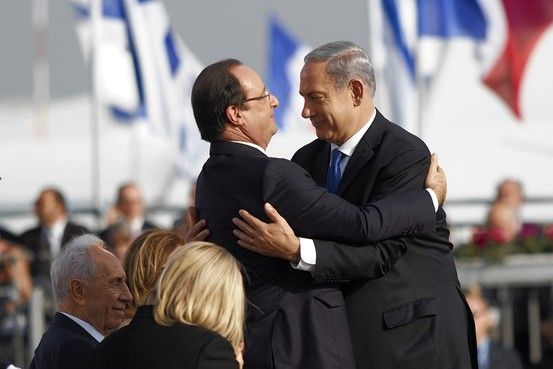
Hollande recoils slightly from Netanyahu's suffocating embrace.

Hollande recoils slightly from Netanyahu's suffocating embrace.

The Wall Street Journal reports: The Obama administration’s overtures to Iran are straining the U.S. alliance with Israel in ways not seen in decades, compounding concerns about the White House’s ability to manage the Middle East’s proliferating security crises, said current and former American diplomats.

In a sign of Israel’s growing disaffection with Washington, French President François Hollande was given a hero’s welcome when he arrived in Tel Aviv on Sunday for a three-day visit that would showcase Paris’s hard line against Iran’s nuclear program ahead of international talks in Geneva this week.

Mr. Netanyahu reiterated his criticism that the U.S.-backed compromise was a “very bad deal” while hailing Mr. Hollande for his opposition to the agreement at a joint news conference Sunday evening in Jerusalem.

“Your support and your friendship is real. It’s sincere. You were one out of six,” he said, referring to the six world powers participating in talks with Iran.

Both the U.S. and Israel insist the relationship is strong enough to sustain even a pronounced disagreement. But the State Department said on Sunday that it was considering sending Secretary of State John Kerry back to Jerusalem for the second time this month to try and repair the breach with Israeli Prime Minister Benjamin Netanyahu. [Continue reading…]

Facebooktwittermail

Why Iran’s military won’t spoil détente with the U.S.

Akbar Ganji writes: It is fair to assume that any deal between Iran and the United States to freeze Iran’s nuclear program will be greeted by the Iranian Revolutionary Guard Corps with cries of “Death to America!” Hassan Rouhani was elected president earlier this year with a mandate to seek just such a deal. But he still has to reckon with the fact that Iran’s most powerful military force has traditionally been a bastion for ideological hard-liners uninterested in building closer relations with the United States.

At the same time, any hope that the Revolutionary Guards have of playing the spoiler in a U.S.-Iranian rapprochement will be undermined by the fact that the force is implacably divided against itself, between those who are dead set against closer relations with the United States and those who are likely to support a deal.

This is not to suggest that the Revolutionary Guards don’t pose a threat to détente; its most hard-line factions certainly do. And those tend to be the most vocal — or at least the most visible. On September 30, just a few days after Rouhani’s breakthrough telephone conversation with U.S. President Barack Obama, the chief of the Guards, Mohammad Ali Jafari, labeled the move a “tactical error,” adding that his forces would be monitoring the issue in the future so that it could issue “necessary warnings.” Two weeks later, on October 13, Jafari declared that “the people have figured out what [the reformists] are up to and will not be duped by their provocations in the interests of the enemy.” That same day, Yahya Rahim Safavi, a general in the Guards, expressed the Islamic Republic’s standard ideological line against relations with Washington when he said that the United States had proved repeatedly that it could not be trusted.

Around the same time, however, other prominent Guardsmen were offering a strikingly different message, by way of a revisionist interpretation of recent Iranian history. [Continue reading…]

Facebooktwittermail

In Germany, legacy of Stasi puts different perspective on NSA spying

The Washington Post reports: The secret police, or Stasi, roped in an estimated 190,000 part-time, secret informants and employed an additional 90,000 officers full time – in total, more than one in every 50 adult East Germans as of 1990. East Germans who dared to criticize their government — even to a spouse, a best friend or a pastor — could wind up disappearing into its penal system for years.

In east Berlin sits the former Hohenschoenhausen prison, which was reserved for East Germany’s most politically sensitive cases.

Hubertus Knabe — a West German who smuggled banned books into the East, and later discovered that he had been betrayed by a priest who had encouraged him to do so — now has a plate-glass view of the most perilous destination for victims of Stasi surveillance. He is the director of the prison museum, which is hidden away in a Berlin neighborhood whose rows of imposing apartment blocks still house many former Stasi officers.

Knabe said the consequences of the Stasi’s excesses were far more devastating than anything ever associated with the NSA. “They forget what it’s like to live in a dictatorship versus a democracy,” he said of people who say that the NSA has behaved like the Stasi.

Former inmates now lead tours of the dank, tiny cells in which they were incarcerated, and they say they sometimes run into their old tormenters on the street or at the grocery store.

Many Germans — from both sides of the German border, since East German spying reached deep into its sibling country — have thick Stasi files that they can now request to see. More painfully, they can also learn which of their friends or associates did the collecting of information in those files.

Thousands of people who were collaborators have been chased from public life. Even now, new accusations of Stasi associations can dog politicians and celebrities around Germany.

“We hear that the Stasi was some kind of dilettante agency compared to the NSA,” since the NSA is probably collecting more data overall than the East Germans did, Knabe said. “But East Germans know that the Stasi was a lot worse.”

Knabe said the East German system created a level of fear that few of his fellow citizens truly have about the American spy efforts. Nevertheless, he said, there were other similarities. He has filed a criminal complaint about the NSA spying in a German court.

“The western system punished someone when they had committed a crime. The eastern system punished people when they were only thinking about committing a crime,” he said. If the NSA’s material starts being used not just for counterterrorism efforts but for other kinds of preemptive crime-fighting, he said, “that would be a completely different type of state.”

According to an ARD-Infratest dimap poll released Friday, just 35 percent of Germans find the U.S. government trustworthy, second only to Russia as a target of mistrust. [Continue reading…]

Facebooktwittermail

Give Snowden asylum in Germany

Malte Spitz and Hans-Christian Ströbele write: Almost every day, new information is released about how American and British intelligence agencies have monitored governments, embassies and the communications of whole societies. These revelations have provided us with a deep and terrifying insight into the uncontrolled power of intelligence agencies.

They show that data collection is no longer about targeted acquisition of information to avert threats, and it’s certainly not about the dangers of “international Islamist terrorism.” After all, which terrorist is going to call or text Chancellor Angela Merkel?

All of our current knowledge about this surveillance is thanks to one man, Edward J. Snowden. Without him, Ms. Merkel would still be a target for monitoring, and surveillance of German diplomats, businessmen and ordinary citizens would be continuing, undetected.

Without Mr. Snowden, there wouldn’t have been months of discussions in the German Bundestag, the European Parliament and the American Congress about better protection of citizens’ private and commercial communications. Mr. Snowden is paying a high price for having opened the eyes of the world. He can no longer lead a normal life.

He acted in an emergency situation to stop and prevent terrible things. According to both German and American law, the government can grant immunity when criminal laws are violated in order to defend the paramount right to freedom. Publicly announcing a crime should not be a crime. The United States has long had laws to protect whistle-blowers from punishment — and we Germans aspire to have such laws.

According to recent surveys by ARD, a German TV station, 60 percent of Germans see Mr. Snowden as a hero and only 14 percent as a criminal. They know his courageous revelations were intended to protect freedom and the values that we share with America. [Continue reading…]

Facebooktwittermail

The challenge of removing Syria’s chemical weapons

The New York Times reports: A plan announced over the weekend for getting the bulk of Syria’s chemical weapons out of the country in coming weeks has raised major concerns in Washington, because it involves transporting the weapons over roads that are battlegrounds in the country’s civil war and loading them onto a ship that has no place to go.

Security for the shipments is being provided entirely by Syrian military units loyal to President Bashar al-Assad, who has surprised American officials with how speedily he has complied with an agreement brokered by Russia to identify and turn over his chemical weapon stockpiles. Intelligence analysts and Pentagon officials say the shipments will be vulnerable to attack as they travel past the ruins of a war that has raged for two and a half years.

Asked over the weekend what the backup plan would be if the chemical weapons components were attacked by opposition forces linked to Al Qaeda, or even elements of Mr. Assad’s own forces, a senior American official said: “That’s the problem — no one has attempted this before in a civil war, and no one is willing to put troops on the ground to protect this stuff, including us.”

Another official noted that the choice now facing the United States and other nations was to “either leave the stuff in place and hope for the best, or account for it, get it out of there, and hope for the best. That’s the ‘least worst’ option.”

A range of current and former administration and Pentagon officials discussed the risks of moving the Syrian chemical munitions on the condition of anonymity. Most were reluctant to even disclose their concerns, because of the delicacy of the continuing operations to clear the country of chemical weapons. Even if the chemicals make it safely to a Syrian port and are loaded on cargo ships to be taken out of Syrian territory by the deadlines set in the agreement — Dec. 31 for the most critical material, Feb. 5 for most of the rest — the problems would hardly be over.

On Friday, Albania turned down an appeal by the United States to destroy the weapons on its territory, after thousands of Albanians took to the street in protest. Norway rejected an earlier request, saying it did not have the expertise or the facilities to destroy the weapons. The issue caused a major political dispute there as well.

As a result, Syria’s chemical weapons material may be on the high seas for a long time, as officials seek a country willing and able to destroy it. Already there are fears that the cargo ships bearing the material could become the weapons equivalent of a barge loaded with garbage that left Long Island in 1987 but could not find a place to unload for four months. American law prohibits the importation of chemical weapons for destruction here, and Russia says it is still overwhelmed by the task of destroying its own stockpiles. [Continue reading…]

Since the primary threat posed by these weapons (other than the threat they posed to Syria’s own population) was to Israel and since Israel is the primary beneficiary of Syria being disarmed, why not destroy the chemical weapons in Israel rather than transport them any greater distance?

Facebooktwittermail

Qatar migrant workers ‘treated like animals’

BBC News reports: Qatar’s construction sector is rife with abuse, Amnesty International (AI) has said in a report published as work begins on Fifa World Cup 2022 stadiums.

Amnesty says migrant workers are often subjected to non-payment of wages, dangerous working conditions and squalid accommodation.

The rights group said one manager had referred to workers as “animals”.

Qatari officials have said conditions will be suitable for those involved in construction of World Cup facilities.

It has not yet commented on the latest report.

Amnesty said it conducted interviews with 210 workers, employers and government officials for its report, The Dark Side of Migration: Spotlight on Qatar’s construction sector ahead of the World Cup. [Continue reading…]

Facebooktwittermail

Leader of prominent Syrian rebel group dies of wounds from strike last week

The Associated Press reports: The leader of one of Syria’s most prominent rebel units died early Monday of wounds sustained during a strike by government forces last week, his group said, dealing another blow to fighters reeling from a series of recent battlefield losses.

The death of Abdul-Qadir Saleh, founder of the Tawhid Brigade, followed advances by President Bashar Assad’s troops against rebels on two key fronts: the capture of a string of opposition-held suburbs south of Damascus and the taking of two towns and a military base outside the northern city of Aleppo.

An ongoing offensive meanwhile is driving hundreds of refugees into neighboring Lebanon, as government forces seek to dislodge rebels from a mountainous area that stretches north of the Syrian capital. A total of 6,000 have crossed to a Lebanese border town over the last three days, the U.N. says.

The Tawhid Brigade is one of Syria’s best known and powerful rebel groups, with an estimated 10,000 fighters, and is particularly strong in Aleppo province. Under Saleh’s command, the group last year spearheaded a rebel push that seized large sections of the provincial capital Aleppo. [Continue reading…]

Facebooktwittermail

Libyan official abducted amid unrest in Tripoli

The New York Times reports: The deputy chief of Libya’s intelligence service was abducted from the parking lot of the airport in Tripoli on Sunday afternoon as a standoff between militias and a general strike against militia rule virtually shut down the city.

The deputy intelligence chief, Mustafa Noah, was abducted just two days after a militia from the coastal city of Misurata opened fire on a nonviolent demonstration against the domination of Tripoli, Libya’s capital, by such armed brigades. The confrontation degenerated into a shootout that killed at least 43 and wounded hundreds, according to Libyan health officials.

Many across Libya called the weekend a watershed for the vexed revolution that ousted Col. Muammar el-Qaddafi two years ago. It brought the first large demonstration by residents of the capital against the freewheeling militias that arrived to help oust Colonel Qaddafi and never left the city, and it posed a major test of the weak transitional government’s ability to control the militias. Around nightfall on Sunday, a local council in Misurata said in a statement that all its fighters had withdrawn from the capital.

Today the Associated Press reports that Noah has been released.

Facebooktwittermail

State of emergency declared in Libyan capital

Al Jazeera reports: A 48-hour state of emergency has been declared in the Libyan capital, Tripoli, after a fresh wave of clashes broke out following a deadly protest against armed groups.

At least one person was killed and dozens wounded in Saturday’s clashes that took place a day after more than 40 people were killed in firing by gunmen.

Saturday’s gun battles broke out to the east of the capital in Tajoura, where rival gunmen clashed at checkpoints set up to stop more gunmen nearby city of Misrata from entering Tripoli, Mohammad Sasi, a local member of Libya’s congress said.

Thousands of protesters gathered in the city centre to mourn those killed in Friday’s attack when militias fired on a crowd urging the dissolution of unlawful armed groups.

Mourners called on their government to resign and armed militias to leave the city. [Continue reading…]

Facebooktwittermail

The fight against climate injustice

The New York Times reports: Following a devastating typhoon that killed thousands in the Philippines, a routine international climate change conference here turned into an emotional forum, with developing countries demanding compensation from the worst polluting countries for damage they say they are already suffering.

Calling the climate crisis “madness,” the Philippines representative vowed to fast for the duration of the talks. Malia Talakai, a negotiator for the Alliance of Small Island States, a group that includes her tiny South Pacific homeland, Nauru, said that without urgent action to stem rising sea levels, “some of our members won’t be around.”

From the time a scientific consensus emerged that human activity was changing the climate, it has been understood that the nations that contributed least to the problem would be hurt the most. Now, even as the possible consequences of climate change have surged — from the typhoons that have raked the Philippines and India this year to the droughts in Africa, to rising sea levels that threaten to submerge entire island nations — no consensus has emerged over how to rectify what many call “climate injustice.”

Growing demands to address the issue have become an emotionally charged flash point at negotiations here at the 19th conference of the United Nations Framework Convention on Climate Change, which continues this week.

“We are in a piece of land which is smaller than Denmark, with a population of 160 million, trying to cope with this extreme weather, trying to cope with the effect of emissions for which we are not responsible,” Farah Kabir, the director in Bangladesh for the anti-poverty organization ActionAid International, said at a news briefing here. [Continue reading…]

Facebooktwittermail

Prince Bandar bin Sultan, Saudi Arabia’s Gatsby, master spy

Christopher Dickey writes: Prince Bandar bin Sultan, once famous in Washington for his cigars, parties and charm, is now Saudi Arabia’s point man, fighting Iran in Syria and denouncing the Obama administration.

When the prince was the ambassador he was the toast of Washington, and plenty of toasts there were. Bandar bin Sultan smoked fine cigars and drank finer Cognac. For almost 30 years as Saudi Arabia’s regal messenger, lobbyist, and envoy, he told amazing stories about politicians and potentates, some of which, surprisingly, were true. Washington journalists loved him. Nobody had better access to more powerful people in higher places, or came with so much money, so quietly and massively distributed, to help out his friends.

Over the years, Bandar arranged to lower global oil prices in the service of Jimmy Carter, Ronald Reagan and both the Bushes. At the behest of the CIA’s Bill Casey, and behind the back of Congress, Bandar arranged for the Saudis to bankroll anti-Communist wars in Nicaragua, Angola and Afghanistan. He was thick with Dick Cheney, and he was so tight with the George H.W. Bush clan—the father, the mother, the sons, the daughters—that they just called him “Bandar Bush.”

Now, the prince is a spy, or, more precisely, the master spy of the Middle East. He is the point man for a vast Saudi program of covert action and conspicuous spending that helped overthrow the elected Muslim Brotherhood government in Egypt and is attempting to forge a new “Army of Islam” in Syria. Without understanding the man and his mission, there’s no way, truly, to understand what’s happening in the world’s most troubled region right now.

Bandar’s goal is to undermine Iranian power: strip away Tehran’s allies like Assad and Hezbollah; stop the Shiite mullahs from acquiring nuclear weapons; roll back their regional designs; and push them out of office if there’s any way to do that.

At the same time, he aims to crush the Muslim Brotherhood, a Sunni organization that pays lip service to democracy and is fundamentally anti-monarchy.

The Bandar program makes for some interesting alliances. Never mind that there’s no peace treaty between Saudi Arabia and Israel, in these parts, as they say too often, the enemy of my enemy is my friend, and Bandar has become the de facto anti-Iran ally of Israeli Prime Minister Benyamin “Bibi” Netanyahu. [Continue reading…]

Facebooktwittermail

Negotiating with Iran for an imperfect peace

Laura Secor writes: A week ago, negotiations in Geneva between Iran and six world powers adjourned without a deal. At issue was an interim agreement that would have frozen Iran’s nuclear program while the group worked out a broader, long-term settlement. By most accounts, the negotiations foundered over the late introduction of more stringent language about one of Iran’s facilities—a heavy-water reactor near Arak—and the removal of an explicit allowance for low-level uranium enrichment on Iranian soil. But meetings were set to resume this week, and, last Thursday, the International Atomic Energy Agency announced that Iran has not expanded its nuclear program since August, when President Hassan Rouhani took office. Just six months ago, productive talks with Iran—the kind that hold out the possibility of a historic breakthrough—were unthinkable. Now, for the first time in thirty-four years, Iran and the United States are speaking. Yet many in the West remain wary of a diplomatic solution. The nature of diplomacy, after all, is compromise, which means that an agreement with Iran will bring an end to the fantasy of total victory for either side.

Rouhani has committed himself to finding a quick resolution to the impasse, and the cumbersome, fractious machinery of the Iranian state has backed him with an unusual unity of purpose. The tone of the Iranian negotiating team is businesslike and frankly urgent. Gone are the grandiose diatribes and the repetitive talking points of the Ahmadinejad years. In their place is what the Iranian President, sounding like a member of the Council on Foreign Relations, calls “constructive engagement,” and the Supreme Leader, Ayatollah Ali Khamenei, sounding more like a member of a yoga collective, calls “heroic flexibility.”

Rouhani is a pragmatist who came to power, in part, on the strength of disaffection, both popular and élite, with the confrontational foreign policy of his predecessor. Surely his first priority is relief from the international sanctions, tied to the nuclear issue, on financial transactions and oil exports, which have caused hardship for the Iranian people. But it’s not difficult to imagine that, with Sunni extremism rising, particularly in Iraq and Syria, Rouhani and his team are also making long-term calculations about Iran’s strategic interests. So far, his foreign-policy agenda has not encountered the predicted hard-line obstruction in Tehran. On the contrary, during the Geneva talks the Supreme Leader tweeted, “Our #negotiators are children of the #Revolution. We strongly support those in charge of our diplomacy.”

On domestic matters, however, Rouhani’s support is less certain. He has fashioned a government of national unity at a time of profound political polarization. The President is a trusted member of the clerical élite, who also carries a mandate from reform-minded voters. They are waiting, with increasing impatience and skepticism, for him to make good on promises to relax censorship and to release more political prisoners. Meeting those demands will require Rouhani to persuade the conservative members of his coalition that liberalization will not threaten them or the system they uphold. He may hope to conclude the nuclear talks before addressing such delicate matters at home. But the longer Rouhani takes to satisfy reform-minded voters the more likely it is that his coalition will fracture. The Geneva talks look straightforward by comparison. [Continue reading…]

Facebooktwittermail

Mossad working with Saudis on contingency plans for potential attack on Iran?

The Jerusalem Post reports: The Mossad is working with Saudi officials on contingency plans for a potential attack on Iran in the event that Tehran’s nuclear program is not sufficiently curbed in the deal that may be concluded between Iran and world powers in Geneva this week, The Sunday Times reported.

Both Jerusalem and Riyadh have expressed displeasure at the deal being formulated between Iran and the P5+1 group of world powers that they see as doing little to stop Tehran’s progress toward a nuclear weapon.

According to the Times, Riyadh has already given its consent for Israel to use Saudi airspace for a potential attack on Iran.

The paper quoted a diplomatic source as saying the Saudis were willing to assist an Israeli attack by cooperating on the use of drones, rescue helicopters and tanker planes.

“Once the Geneva agreement is signed, the military option will be back on the table. The Saudis are furious and are willing to give Israel all the help it needs,” the Times quoted the source as saying. [Continue reading…]

Probably the most salient detail here is that the report appeared in The Sunday Times — that alone may be sufficient reason why it can be ignored.

But just suppose an Israeli-Saudi operation was in the works, this much we can reasonably assume: its existence and every detail about it, would be guarded with the highest possible secrecy.

Netanyahu has already milked verbal threats for all they are worth. If he actually has any military cards he can play (such as one facilitated by the Saudis), he’s going to keep quiet about it. More likely though is that this “leak” is just more bluster and it’s intended to threaten the P5+1 more than Iran.

Facebooktwittermail

Gaza has rarely felt more isolated

The Economist: In the vanguard of the Islamist surge across the region a few years ago, Gaza’s Islamists now feel like the last men standing. Trapped between the Mediterranean sea and the walls of two hostile neighbours, Egypt and Israel, they wonder how long they, too, can survive. “It’s hopeless,” cries a senior man from Hamas, the Palestinians’ Islamist movement. “We tried democracy and we failed. We tried to reach out to the Israelis, accepting two states, and failed. We tried the armed struggle, and we paid the price.”

In olden times a crossroads between Africa and Asia, the tiny enclave of Gaza has rarely felt more isolated. Egypt’s generals, who took power last summer, have destroyed 90% of the tunnels through which Gaza got its fuel, shrouding the place in darkness. Mothers wake at midnight when the electricity briefly flickers on, to flush toilets and iron clothes. Lifts in high-rise buildings do not work. Sewage flows untreated. Farmers, unable to irrigate their fields, face ruin. “I should never have tried it,” says the owner of a hotel that opened last summer, overlooking Gaza’s picturesque port. Paying for his generators costs him more than he earns in a night.

Much of the mess is of Hamas’s own making. Carried away by the Arab awakening, its politburo abandoned its old patrons in Syria and Iran and rushed to embrace the Islamists who had taken power in Egypt. But the fall of its president, Muhammad Morsi, has left Hamas friendless. It has been kept out of the current negotiations, under America’s aegis, between Palestine and Israel. The only time the world seems to notice Gaza is when violence erupts. Gazans say they have dropped off the map. [Continue reading…]

Facebooktwittermail

Egypt’s Brotherhood offers talks to end Morsi crisis

AFP reports: An Islamist coalition led by the Muslim Brotherhood on Saturday offered negotiations to end the deadly tumult since Egyptian president Mohamed Morsi’s overthrow, without explicitly insisting on his reinstatement.

The coalition “calls on all revolutionary forces and political parties and patriotic figures to enter a deep dialogue on exiting the current crisis,” it said in a statement.

The proposal comes after more than 1,000 people, mostly Morsi supporters, were killed in clashes with police and thousands more arrested following his overthrow by the military on July 3.

The coalition, which has organised weekly protests despite the crackdown, insisted in its statement on keeping up “peaceful opposition”, but said it wanted a “consensus for the public good of the country”.

Much of the Brotherhood’s leadership has been put on trial, including Morsi himself.

“We have no conditions, and neither should they,” Imam Youssef, a leader of the Islamist coalition member the Asala party, told AFP.

But he said the talks must lead to a “democratic” solution, and the coalition wanted them to start within two weeks.

The Islamists were prepared to respect the demands of the millions of protesters who called for Morsi’s ouster, Youssef said.

“We want a democratic solution, and it does not necessarily mean we have to be in power,” he added. [Continue reading…]

Facebooktwittermail