Category Archives: Lands

What did the president know and when did he know it?

I haven’t evolved in my assessment of the actual [surveillance] programs. I consistently have said that when I came into office I evaluated them. — President Obama, August 2013.

The Wall Street Journal reports: The National Security Agency ended a program used to spy on German Chancellor Angela Merkel and a number of other world leaders after an internal Obama administration review started this summer revealed to the White House the existence of the operation, U.S. officials said.

Officials said the internal review turned up NSA monitoring of some 35 world leaders, in the U.S. government’s first public acknowledgment that it tapped the phones of world leaders. European leaders have joined international outrage over revelations of U.S. surveillance of Ms. Merkel’s phone and of NSA’s monitoring of telephone call data in France.

The White House cut off some monitoring programs after learning of them, including the one tracking Ms. Merkel and some other world leaders, a senior U.S. official said. Other programs have been slated for termination but haven’t been phased out completely yet, officials said.

The account suggests President Barack Obama went nearly five years without knowing his own spies were bugging the phones of world leaders. Officials said the NSA has so many eavesdropping operations under way that it wouldn’t have been practical to brief him on all of them.

They added that the president was briefed on and approved of broader intelligence-collection “priorities,” but that those below him make decisions about specific intelligence targets.

The senior U.S. official said that the current practice has been for these types of surveillance decisions to be made at the agency level. “These decisions are made at NSA,” the official said. “The president doesn’t sign off on this stuff.” That protocol now is under review, the official added.


Facebooktwittermail

Could Merkel have been spied on without Obama’s approval?

Der Spiegel reports: Among the politically decisive questions is whether the spying was authorized from the top: from the US president. If the data is accurate, the operation was authorized under former President George W. Bush and his NSA chief, Michael Hayden. But it would have had to be repeatedly approved, including after Obama took office and up to the present time. Is it conceivable that the NSA made the German chancellor a surveillance target without the president’s knowledge?

The White House and the US intelligence agencies periodically put together a list of priorities. Listed by country and theme, the result is a matrix of global surveillance: What are the intelligence targets in various countries? How important is this reconnaissance? The list is called the “National Intelligence Priorities Framework” and is “presidentially approved.”

One category in this list is “Leadership Intentions,” the goals and objectives of a country’s political leadership. The intentions of China’s leadership are of high interest to the US government. They are marked with a “1” on a scale of 1 to 5. Mexico and Brazil each receive a “3” in this category.

Germany appears on this list as well. The US intelligence agencies are mainly interested in the country’s economic stability and foreign policy objectives (both “3”), as well as in its advanced weapons systems and a few other sub-items, all of which are marked “4.” The “Leadership Intention” field is empty. So based on the list, it wouldn’t appear that Merkel should be monitored.

Former NSA employee Thomas Drake does not see this as a contradiction. “After the attacks of September 11, 2001, Germany became intelligence target number one in Europe,” he says. The US government did not trust Germany, because some of the Sept. 11 suicide pilots had lived in Hamburg. Evidence suggests that the NSA recorded Merkel once and then became intoxicated with success, says Drake. “It has always been the NSA’s motto to conduct as much surveillance as possible,” he adds.

Facebooktwittermail

Don’t underestimate Germany’s reaction to NSA surveillance

True partnership and true progress requires constant work and sustained sacrifice. They require sharing the burdens of development and diplomacy; of progress and peace. They require allies who will listen to each other, learn from each other and, most of all, trust each other. — Sen. Barack Obama, Berlin, July 2008.

Both among commentators and across America in general, there is a commonplace reaction to foreign anger provoked by offensive American actions: it is dismissive.

What are they getting worked up about? Aren’t they being hypocritical? What do they expect?

The pervasive attitude is one of indifference and beneath that an assumption that as much as others might protest, everyone ultimately bows to American might.

When Chancellor Merkel challenged President Obama on the issue of NSA surveillance, 62 percent of Germans approved of her harsh reaction, but an additional 25 percent felt she had not been harsh enough.

That’s German bluster, many Americans might now think.

But this outrage has the potential of being translated into a tangible, economic effect: opposition to a trans-Atlantic free-trade agreement.

Since the latest revelations came out, some 58 percent of Germans say they support breaking off ongoing talks, while just 28 percent are against it. “We should put the negotiations for a free-trade agreement with the US on ice until the accusations against the NSA have been clarified,” says Bavarian Economy Minister Ilse Aigner, a member of the Christian Social Union, the Bavarian sister party to Merkel’s Christian Democrats.

Facebooktwittermail

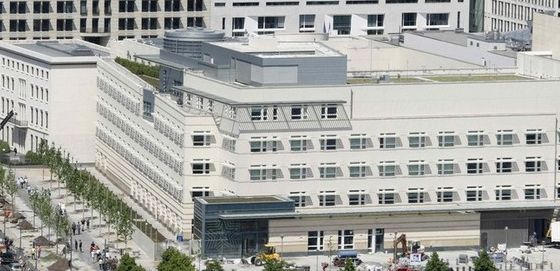
The U.S. embassy rooftop from which the NSA spies on the German government

window-like indentations on the roof of the US Embassy

Window-like indentations on the roof of the US Embassy are not glazed but rather veneered with 'dielectric' material and are painted to blend into the surrounding masonry. This material is permeable even by weak radio signals. Interception technology is allegedly located behind these radio-transparent screens.

Der Spiegel reports: A “top secret” classified NSA document from the year 2010 shows that a unit known as the “Special Collection Service” (SCS) is operational in Berlin, among other locations. It is an elite corps run in concert by the US intelligence agencies NSA and CIA.

The secret list reveals that its agents are active worldwide in around 80 locations, 19 of which are in Europe — cities such as Paris, Madrid, Rome, Prague and Geneva. The SCS maintains two bases in Germany, one in Berlin and another in Frankfurt. That alone is unusual. But in addition, both German bases are equipped at the highest level and staffed with active personnel.

The SCS teams predominantly work undercover in shielded areas of the American Embassy and Consulate, where they are officially accredited as diplomats and as such enjoy special privileges. Under diplomatic protection, they are able to look and listen unhindered. They just can’t get caught.

Wiretapping from an embassy is illegal in nearly every country. But that is precisely the task of the SCS, as is evidenced by another secret document. According to the document, the SCS operates its own sophisticated listening devices with which they can intercept virtually every popular method of communication: cellular signals, wireless networks and satellite communication.

The necessary equipment is usually installed on the upper floors of the embassy buildings or on rooftops where the technology is covered with screens or Potemkin-like structures that protect it from prying eyes.

That is apparently the case in Berlin, as well. SPIEGEL asked British investigative journalist Duncan Campbell to appraise the setup at the embassy. In 1976, Campbell uncovered the existence of the British intelligence service GCHQ. In his so-called “Echelon Report” in 1999, he described for the European Parliament the existence of the global surveillance network of the same name.

Campbell refers to window-like indentations on the roof of the US Embassy. They are not glazed but rather veneered with “dielectric” material and are painted to blend into the surrounding masonry. This material is permeable even by weak radio signals. The interception technology is located behind these radio-transparent screens, says Campbell. The offices of SCS agents would most likely be located in the same windowless attic.

This would correspond to internal NSA documents seen by SPIEGEL. They show, for example, an SCS office in another US embassy — a small windowless room full of cables with a work station of “signal processing racks” containing dozens of plug-in units for “signal analysis.”

On Friday, author and NSA expert James Bamford also visited SPIEGEL’s Berlin bureau, which is located on Pariser Platz diagonally opposite the US Embassy. “To me, it looks like NSA eavesdropping equipment is hidden behind there,” he said. “The covering seems to be made of the same material that the agency uses to shield larger systems.”

The Berlin-based security expert Andy Müller Maguhn was also consulted. “The location is ideal for intercepting mobile communications in Berlin’s government district,” he says, “be it technical surveillance of communication between cellphones and wireless cell towers or radio links that connect radio towers to the network.”

Apparently, SCS agents use the same technology all over the world. They can intercept cellphone signals while simultaneously locating people of interest. One antenna system used by the SCS is known by the affable code name “Einstein.”

When contacted by SPIEGEL, the NSA declined to comment on the matter.

Facebooktwittermail

The targeting of Chancellor Angela Merkel’s cellphone

Der Spiegel reports: There are strong indications that it was the SCS [the Special Collection Service jointly operated by the NSA and CIA] that targeted Chancellor Angela Merkel’s cellphone. This is suggested by a document that apparently comes from an NSA database in which the agency records its targets. This document, which SPIEGEL has seen, is what set the cellphone scandal in motion.

The document contains Merkel’s cellphone number. An inquiry to her team revealed that it is the number the chancellor uses mainly to communicate with party members, ministers and confidants, often by text message. The number is, in the language of the NSA, a “Selector Value.” The next two fields determine the format (“raw phone number”) and the “Subscriber,” identified as “GE Chancellor Merkel.”

In the next field, labeled “Ropi,” the NSA defines who is interested in the German chancellor: It is the department S2C32. “S” stands for “Signals Intelligence Directorate,” the NSA umbrella term for signal reconnaissance. “2” is the agency’s department for procurement and evaluation. C32 is the unit responsible for Europe, the “European States Branch.” So the order apparently came down from Europe specialists in charge of signal reconnaissance.

The time stamp is noteworthy. The order was transferred to the “National Sigint Requirements List,” the list of national intelligence targets, in 2002. That was the year Germany held closely watched parliamentary elections and Merkel battled Edmund Stoiber of Bavaria’s Christian Social Union to become the conservatives’ chancellor candidate. It was also the year the Iraq crisis began heating up. The document also lists status: “A” for active. This status was apparently valid a few weeks before President Obama’s Berlin visit in June 2013.

Finally, the document defines the units tasked with implementing the order: the “Target Office of Primary Interest”: “F666E.” “F6” is the NSA’s internal name for the global surveillance unit, the “Special Collection Service.”

Thus, the NSA would have targeted Merkel’s cellphone for more than a decade, first when she was just party chair, as well as later when she’d become chancellor. The record does not indicate what form of surveillance has taken place. Were all of her conversations recorded or just connection data? Were her movements also being recorded?

Facebooktwittermail

Spain warns U.S. of breakdown in trust after new NSA revelations

The Guardian reports: The Spanish government has warned the US that revelations of widespread spying by the National Security Agency could, if confirmed, “lead to a breakdown in the traditional trust” between the two countries.

The diplomatic row followed a report in Spain’s El Mundo newspaper on Monday, based on a leaked NSA document, claiming that the US had intercepted 60.5m phone calls in Spain between 10 December 2012 and 8 January this year.

In the latest revelations from the documents leaked by the US whistleblower Edward Snowden, El Mundo published an NSA graphic, entitled “Spain – last 30 days”, showing the daily flow of phone calls within Spain. On one day alone – 11 December 2012 – the NSA reportedly intercepted more than 3.5m phone calls. It appears that although the content of the calls was not monitored the serial and phone numbers of the handsets used, the locations, sim cards and the duration of the calls were. Emails and other social media were also monitored.

The White House has so far declined to comment on the El Mundo report. Spain, however, expressed its concern. José Manuel García Margallo, Spain’s foreign minister, warned of a breakdown in trust between Madrid and Washington at a press conference in Warsaw, where he was on an official visit. [Continue reading…]

Facebooktwittermail

Obama lied to Merkel when claiming to know nothing about NSA bugging her phone, says new report

BBC News reports: Mrs Merkel phoned the US president when she first heard of the spying allegations on Wednesday.

President Barack Obama apologised to the German chancellor and promised Mrs Merkel he knew nothing of the alleged phone monitoring and would have stopped it if he had, Der Spiegel reports.

But on Sunday Bild newspaper quoted US intelligence sources as saying NSA head Keith Alexander personally briefed the president about the covert operation targeting Mrs Merkel in 2010.

“Obama did not halt the operation but rather let it continue,” the newspaper quoted a senior NSA official as saying.

Her number was still on a surveillance list in 2013.

Bild is a tabloid that does not have a reputation for journalistic excellence. Even so, if a conflict between the NSA and the White House is escalating, then an NSA source might turn to this type of publication as a way of making a veiled threat. The report has the effect of sowing doubt about Obama’s statements even if NSA officials now make dismissive responses, pointing out the unreliability of the press.

Obama has a dilemma. On the one hand it is becoming increasingly evident that he will need to steer some kind of reform in the NSA’s operations. But at the same time he doesn’t want to foster the appearance of the agency having become a rogue operation since that would also make him look like a negligent, ineffectual president. Neither does he want to get into an open fight since by their nature, intelligence agencies are dirty fighters. He can be reasonably confident that none of his communications are being monitored by any foreign intelligence agencies, yet why should he assume the NSA would never spy on an American president?

In a speech NSA chief Keith Alexander gave this summer, as he referred to when Obama “first came on board,” either unconsciously or intentionally, the four-star general seemed to be alluding to the transience of elected officials. The president, his cabinet, and members of Congress, sustain the facade of democracy, but the captains of the state like Alexander generally move around in the background, loyal to the president and the Constitution as they like to declare, yet harboring the conceit that they are America’s most stalwart defenders.

Facebooktwittermail

Japan rejected NSA request for aid in tapping fiber-optic cables in 2011

Kyodo News International reports: The U.S. National Security Agency sounded out the Japanese government around 2011 for cooperation in wiretapping fiber-optic cables carrying phone and Internet data across the Asia-Pacific region, sources familiar with the matter said Saturday.

The agency’s overture was apparently aimed at gathering information on Beijing given that Japan is at the heart of optical cables that connect various parts of the region. But Japan rejected the request, citing legal restrictions and shortage of personnel in the tapping operations, the sources said.

The sources said the agency asked Japan if it could intercept personal information such as Internet and phone call data when communication data pass through Japan via cables connecting Japan, China and other parts of the region.

Facebooktwittermail

Obama’s tired of the Middle East — but is that a policy?

A New York Times report on a major reappraisal of President Obama’s approach to the Middle East tosses this sentence in close to the end:

After vigorous debate, the group decided to make the Middle East peace process a top priority — even after failing to broker an agreement during the administration’s first term — in part because Mr. Kerry had already thrown himself into the role of peacemaker.

Top priority? More like an afterthought.

The actual conclusion of the White House review — and note, this was a foreign policy review that didn’t actually involve the State Department (whose domain is what?) — was that the Middle East is very troublesome and the U.S. has no influence, so let’s just move on.

Each Saturday morning in July and August, Susan E. Rice, President Obama’s new national security adviser, gathered half a dozen aides in her corner office in the White House to plot America’s future in the Middle East. The policy review, a kind of midcourse correction, has set the United States on a new heading in the world’s most turbulent region.

At the United Nations last month, Mr. Obama laid out the priorities he has adopted as a result of the review. The United States, he declared, would focus on negotiating a nuclear deal with Iran, brokering peace between the Israelis and the Palestinians and mitigating the strife in Syria. Everything else would take a back seat.

That includes Egypt, which was once a central pillar of American foreign policy. Mr. Obama, who hailed the crowds on the streets of Cairo in 2011 and pledged to heed the cries for change across the region, made clear that there were limits to what the United States would do to nurture democracy, whether there, or in Bahrain, Libya, Tunisia or Yemen.

The president’s goal, said Ms. Rice, who discussed the review for the first time in an interview last week, is to avoid having events in the Middle East swallow his foreign policy agenda, as it had those of presidents before him.

“We can’t just be consumed 24/7 by one region, important as it is,” she said, adding, “He thought it was a good time to step back and reassess, in a very critical and kind of no-holds-barred way, how we conceive the region.”

Not only does the new approach have little in common with the “freedom agenda” of George W. Bush, but it is also a scaling back of the more expansive American role that Mr. Obama himself articulated two years ago, before the Arab Spring mutated into sectarian violence, extremism and brutal repression.

The blueprint drawn up on those summer weekends at the White House is a model of pragmatism — eschewing the use of force, except to respond to acts of aggression against the United States or its allies, disruption of oil supplies, terrorist networks or weapons of mass destruction. Tellingly, it does not designate the spread of democracy as a core interest. [Continue reading…]

A model of pragmatism? Or apathy.

Facebooktwittermail

On monsterphilia and Assad

Muhammad Idrees Ahmad writes: Earlier this month, the British street artist Banksy produced a video on Syria that attracted over five million viewers in three days. At a time of intensifying state repression, the target of Bansky’s satire was not the regime in Damascus but its opponents. By contrast, the most-watched video from the chemical attack in August, showing a traumatized young survivor, managed only half a million hits in over a month.

Six weeks after the attacks on Ghouta, the belt of densely populated suburbs of Damascus, that killed hundreds of civilians, regime forces have choked off food supplies to the targeted neighborhoods. Survivors of the chemical attack are now facing the threat of starvation. Children have been reduced to eating leaves; clerics have issued fatwas allowing people to eat cats and dogs.

The belated discovery of the Syrian conflict by “anti-imperialists” after the US government threatened war has inspired impassioned commentary. The strangulation of its vulnerable population has occasioned silence. But dog whistles from issue-surfing provocateurs like Banksy are unexceptional; they merit closer scrutiny when they come from respected essayists like David Bromwich.

In a recent front-page article for the London Review of Books, Bromwich identifies many rogues in the Syrian drama: Barack Obama, John Kerry, Saudi Arabia, Qatar, “the jihadists.” Conspicuously absent is Assad’s Baathist regime. Vladimir Putin is the closest Bromwich admits to a hero. The Syrian people are denied even a cameo.

When the Yale literature professor uses a tautology like “anti-government insurgency” to refer to Assad’s opponents, it is reasonable to assume intention. The word “government” conveys a certain benign authority; and when it is also said to be opposed by the universally reviled “jihadists,” then there is only one place a bien pensant reader can invest sympathy — and it’s not with the opposition. [Continue reading…]

Facebooktwittermail

19 Syria rebel groups reject Geneva talks

AFP reports: Nineteen Islamist groups fighting to topple President Bashar al-Assad have rejected outright a mooted US-Russian peace initiative for Syria dubbed Geneva 2, a statement said.

“We announce that the Geneva 2 conference is not, nor will it ever be our people’s choice or our revolution’s demand,” the groups said in a late Saturday statement read in an online video by Ahmad Eissa al-Sheikh, chief of the Suqur al-Sham chief.

“We consider it just another part of the conspiracy to throw our revolution off track and to abort it.”

The statement also warned that anyone who went to such talks would be committing “treason, and … would have to answer for it before our courts”.

The statement comes weeks after dozens of major rebel groups across Syria said the Western-backed opposition umbrella grouping the National Coalition had “failed”.

Facebooktwittermail

Iran will participate in upcoming Syria talks — if invited

CNN reports: Iran will take part in a conference intended to hash out a solution to the Syrian conflict before the end of the year — if it receives an invitation, an Iranian official said Saturday, according to state-run media.

“Iran will do its best to help solve the issue through dialogue between the Syrian parties,” said Foreign Minister Mohammad Javad Zarif, according to the Iranian news agency IRNA.

Speaking at a joint news conference with Lakhdar Brahimi, the U.N. special envoy on Syria, Zarif said Tehran would participate in the Geneva talks to help end the war through political means.

Brahimi arrived Saturday in Tehran with a delegation on his second trip to Iran since he was appointed to the U.N. mission, according to state-run Press TV. He is on a Middle East tour aimed at raising support for the planned meeting.

Facebooktwittermail

As Iraq seeks U.S. arms, bombs kill another 55

Reuters reports: A dozen bombings in Iraq killed 55 people on Sunday as the prime minister prepares to travel to Washington to seek President Barack Obama’s help in confronting a wave of sectarian violence fuelled by Syria’s civil war.

Killings, mostly blamed by the Shi’ite-led government on Sunni Islamists from al Qaeda, are running at daily rates not seen in five years and Nuri al-Maliki will ask Obama on Friday to speed up promised deliveries of drones and F-16 jets that he believes can help staunch the long desert border with Syria.

Iraq’s own security forces, trained and equipped by the U.S. troops who withdrew in late 2011 after a nine-year occupation, have been unable to prevent a surge in violence which has taken the civilian death toll so far this year to about 7,000. Sealing the Syrian border would only address part of the problem.

On Sunday, police reported 11 vehicles blowing up in mainly Shi’ite Muslim areas in and around Baghdad, killing 41 people in an apparently coordinated series of explosions typical of al Qaeda. A further 14 people were killed when a suicide bomber drove up to a line of soldiers waiting to collect their pay from a bank in the northern city of Mosul and detonated his car.

Facebooktwittermail

The NSA is undermining the fight against terrorism

The Guardian reports: Germany and France are to spearhead a drive to try to force the Americans to agree new transatlantic rules on intelligence and security service behaviour in the wake of the Snowden revelations and allegations of mass US spying in France and tapping of the German chancellor Angela Merkel’s mobile phone.

At an EU summit in Brussels that was hijacked by the furore over the activities of the National Security Agency in the US and Britain’s GCHQ, the French president, François Hollande, also called for a new code of conduct agreed between national intelligence services in the EU, raising the question of whether Britain would opt to join in.

Shaken by this week’s revelations of NSA operations in France and Germany, EU leaders and Merkel in particular warned that the international fight against terrorism was being jeopardised by the perception that mass US surveillance was out of control.

The leaders “stressed that intelligence-gathering is a vital element in the fight against terrorism”, a summit statement said. “A lack of trust could prejudice the necessary co-operation in the field of intelligence-gathering.”

Merkel drove the point home: “We need trust among allies and partners. Such trust now has to be built anew … The United States of America and Europe face common challenges. We are allies. But such an alliance can only be built on trust.” [Continue reading…]

Facebooktwittermail

NSA: Brazil and Germany lead calls for UN resolution on internet privacy

The Guardian reports: Brazil and Germany are spearheading efforts at the United Nations to protect the privacy of electronic communications in the wake of the Edward Snowden revelations and allegations of mass US spying.

Diplomats from the two countries, which have both been targeted by America’s National Security Agency, are leading efforts by a coalition of nations to draft a UN general assembly resolution calling for the right to privacy on the internet.

Although non-binding, the resolution would be one of the strongest condemnations of US snooping to date.

“This resolution will probably have enormous support in the GA [general assembly] since no one likes the NSA spying on them,” a western diplomat told Reuters on condition of anonymity.

The Brazilian president, Dilma Rousseff, has previously cancelled a state visit to Washington over the revelation that the NSA was scooping up large amounts of Brazilian communications data, including from the state-run oil company Petrobras. The drafting of the UN resolution was confirmed by the country’s foreign ministry.

The Associated Press quoted a diplomat who said the language of the resolution would not be “offensive” to any nation, particularly the US.

He added that it would expand the right to privacy guaranteed by the international covenant on civil and political rights, which went into force in 1976. [Continue reading…]

Facebooktwittermail

What’s going on in Syria is about a lot more than chemical weapons

Lauren Wolfe writes: We’re off talk of “intervention” in Syria, and on to trying to get everyone to the negotiating table. It’s not going very well.

The head of the Syrian opposition has made it clear that they will not attend talks in Geneva unless President Bashar Al-Assad is removed from office. Scheduled for 23 November, the peace conference may not even occur unless all parties get to the room. In the meantime, atrocities are continuing daily in a kind of vacuum – it’s as if there is no war unless we are talking about chemical weapons.

The thing is, this war is so horrifying, so brutal, that it is hard to hold the constantly occurring atrocities at the forefront of our minds. But they exist, they are happening every minute, and we have to face them squarely if we are ever going to stop them.

Here, then, are just a few of the stories I’ve come across in my reporting. They are painful, but I think you should know about them.

There is a 14-year-old girl in southern Turkey who won’t speak to the press. Having been abducted, raped, burned, and otherwise tortured in a house run by shabiha (plainclothes militia) members in Idlib, Syria, this girl has suffered “a nervous breakdown”, a family friend told me. I know she is there because I have spoken to the hospital treating her, and the United Nations has documented her case.

There is a 12-year-old girl in a house in Lebanon who will only speak to ask for her mother. About 10 days after the girl was first arrested, the family received a video of a man in a uniform raping her from behind in a cell-like room. The girl is completely naked in the silent video. I know this because a family friend has seen the video and described it to me; I have not seen it personally.

There is a woman in her 30s locked in her father’s house in Idlib. Upon returning home from eight months’ captivity in two separate shabiha-run houses in Syria, her husband turned her away, saying, “Now that all these men have been in and out of you, you are not fit to be the mother of my children.” This is why she now lives with her father, who occasionally tells her, “I wish you’d died.” I know this because an activist named Raiefa Sammei has gathered details of this story from multiple sources and relayed them to me in person. [Continue reading…]

Facebooktwittermail

Please tell me, Mr President, why a U.S. drone assassinated my mother

Rafiq ur Rehman writes: The last time I saw my mother, Momina Bibi, was the evening before Eid al-Adha. She was preparing my children’s clothing and showing them how to make sewaiyaan, a traditional sweet made of milk. She always used to say: the joy of Eid is the excitement it brings to the children.

Last year, she never had that experience. The next day, 24 October 2012, she was dead, killed by a US drone that rained fire down upon her as she tended her garden.

Nobody has ever told me why my mother was targeted that day. The media reported that the attack was on a car, but there is no road alongside my mother’s house. Several reported the attack was on a house. But the missiles hit a nearby field, not a house. All reported that five militants were killed. Only one person was killed – a 65-year-old grandmother of nine.

My three children – 13-year-old Zubair, nine-year-old Nabila and five-year-old Asma – were playing nearby when their grandmother was killed. All of them were injured and rushed to hospitals. Were these children the “militants” the news reports spoke of? Or perhaps, it was my brother’s children? They, too, were there. They are aged three, seven, 12, 14, 15 and 17 years old. The eldest four had just returned from a day at school, not long before the missile struck.

But the United States and its citizens probably do not know this. No one ever asked us who was killed or injured that day. Not the United States or my own government. Nobody has come to investigate nor has anyone been held accountable. Quite simply, nobody seems to care. [Continue reading…]

Facebooktwittermail

Islamophobia, surveillance-targeting, and the NYPD’s secret spying unit

Alex Kane writes: The Islamic Society of Bay Ridge sits on a bustling avenue steps away from the subway in the southwest corner of Brooklyn. Walk by the white building on a Friday afternoon, and nothing seems out of the ordinary. There are men waiting outside to enter the building to pray, while life goes on as usual around the building. Like any other mosque in New York City, the call to prayer blares out of loudspeakers five times a day; it’s the Islamic Society’s normality that makes its designation as a front for extremism and violence all the more jarring.

On August 28, the Associated Press disclosed that the New York City Police Department (NYPD) had been labeled the Bay Ridge institution — and 11 other mosques — “terrorism enterprises.” The designation, which allows the NYPD to infiltrate the mosque and record religious sermons normally protected under the First Amendment, evinced no expressions of shock from Zein Rimawi, the 59-year-old Palestinian-American co-founder of the mosque. The place where he goes to pray has been under the watchful eye of the police since at least 2003. He’s used to it by now, though he’s still angry that the surveillance exists.

A week after the AP story, we sat in an office at the mosque, surrounded by Qur’ans and a shirt reading “Free Egypt” in protest of the July 3 coup in that country. Rimawi calmly explained to me the presence of NYPD informants inside his mosque that day — “at least three of them,” he noted. I asked him how he could tell who was an informant, and he told me that in a tight-knit Muslim community like Bay Ridge, everyone knows each other. It’s easy to spot who’s out of place — especially if they’re asking a ton of questions.

His experience is by no means unique. Across New York City’s 800,000-person strong Muslim community, police infiltration by way of undercover officers or informants — usually people with criminal backgrounds who strike a deal with the NYPD — has become routine. The September 11 attacks sparked the NYPD’s transformation from municipal law enforcement agency to domestic intelligence service. Talk to Muslim leaders and activists, and stories of encounters with informants pour out. What emerges from these tales is a portrait of a police force that has tentacles reaching into every nook and cranny of New York City’s Muslim world, chilling activism, speech and association. [Continue reading…]

Facebooktwittermail