Reuters reports: Israel said it would not allow advanced weapons to fall into the hands of Hezbollah, after a raid on Syria that opposition sources said had hit an air force garrison believed to be holding Russian-made missiles destined for the militant group.
Israel has a clear policy on Syria and will continue to enforce it, officials said on Friday, after U.S. sources said Israel had launched a new attack on its warring neighbor.
Israel declined to comment on leaks to U.S. media that its planes had hit a Syrian base near the port of Latakia, targeting missiles that it thought were destined for its Lebanese enemy, Hezbollah.
“We have said many times that we will not allow the transfer of advanced weapons to Hezbollah,” said Home Front Defence Minister Gilad Erdan, a member of the inner security cabinet which met hours before the alleged Israeli attack.
Category Archives: Lands
Syrian forces capture town near chemical weapons site
Reuters reports: Syrian government forces have captured a northern town located near a chemical weapons site after days of heavy fighting, state media and a monitoring group said on Friday.
The town, Safira, is also located on a road that could be used to relieve government-controlled areas of Aleppo, Syria’s commercial hub.
Syrian state television said government forces had taken full control of the town, which had been occupied by rebels, including some from units linked to al Qaeda.
The British-based Syrian Observatory for Human Rights said the government had seized the town on Friday morning after more than three weeks of fighting.
The Organisation for the Prohibition of Chemical Weapons (OPCW), which has teams in Syria to eliminate the country’s chemical weapons arsenal, has said its teams were unable to reach two sites for inspection because they were too dangerous.
A source briefed on their operations said one of those sites was at Safira, which is southeast of Aleppo.
The chemical weapons site itself has been under government control but emptied of equipment because of fighting nearby, according to the OPCW.
Israeli strikes kill 4 militants in Gaza
The New York Times reports: Israeli military strikes killed four Palestinian militants from the military wing of Hamas, the Islamic group that controls Gaza, late Thursday and early Friday after five Israeli soldiers were wounded in an explosion near the Israel-Gaza border.
It was the deadliest confrontation in the area since November 2012, when an Israeli offensive set off eight days of fierce cross-border fighting, which ended with a fragile, Egyptian-brokered cease-fire.
The episode began late Thursday when Israeli soldiers from an elite engineering unit were on a mission to destroy part of a mile-long tunnel running beneath the border from Gaza into Israel. The military discovered the tunnel last month and said it could have been used for an attack against Israeli soldiers or civilians.
The Israeli forces were apparently working on both sides of the border. The military said in a statement that during the operation, Hamas detonated an explosive device that wounded five soldiers and that soldiers fired back in response. Gaza security officials and witnesses said one militant had been killed and several injured when the Israeli forces fired a tank shell at a group of Hamas gunmen. [Continue reading…]
Video — Aid to Syria: ‘If us two can do it, anyone can!’
Drone warfare as a form of terrorism
In their efforts to deflect criticism of drone warfare, President Obama and senior officials overseeing strikes in Pakistan and Yemen have repeatedly insisted that missiles are only fired when there is minimal risk to civilians and that the primary virtue of this weapons system is its precision.
This week, after Rafiq Rehman and his two children came all the way from Waziristan to testify before Congress on the impact of drone warfare, only five lawmakers bothered to show up. The assumption among campaigners seems to have been that the consciences of ordinary Americans would be stirred if they were to hear children describe what it’s like witnessing your 67-year-old grandmother getting blown up in a drone strike.
The death of Momina Bibi exactly a year ago illustrates how little value precision has if the target is a nameless figure on a computer screen. Yet the testimony of the Rehman family seems unlikely to have much impact on public opinion when Washington finds it so easy to ignore.
Al Jazeera reports:
[E]ven after what his family has been through, Rafiq Rehman said he does not resent the United States. In fact, even after witnessing his first Halloween weekend in the States, he does not believe all that much separates him from Americans.
“It’s very peaceful here. For the most part, there’s a lot of freedom and people get along with each other. They’re nice, they respect each other, and I appreciate that,” Rafiq told Al Jazeera.
“We’re all human beings,” he said. “I knew that Americans would have a heart, that they would be sympathetic to me. That’s why I came here — I thought if they heard my story, they would want to listen to me and influence their politicians.”
The attitude of the Obama administration seems to have been reflected in the decision to prevent the family’s lawyer, Shahzad Akbar, from accompanying them on their visit.
Akbar, a legal fellow with Reprieve, the U.K.-based advocacy organization that helped bring the family to the Washington, believes that his work has something to do with the denial. He only had trouble obtaining a visa after he started to litigate on the behalf of drone victims.
In an interview at his Islamabad office, Akbar told me that he was first denied entry to the United States in 2010, even though he had an open visa at the time. He said that the head of visa services at the U.S. embassy in Islamabad told him his visa could not be processed there because of his history. “And I looked at her and I said what do you mean by history? She just smiled and she said, ‘You know very well what I mean by history.’”
He assumes she was referring to his decision that year to sue the CIA station chief in Islamabad. “It’s very simple,” Akbar said. “You mess with [the] CIA and they mess with you to the extent they can.”
Even if Akbar had been there and even if the hearings had been well attended, I suspect that many lawmakers and other Americans would find it easy to marginalize the Rehman family’s experience.
America never tires of expressing its good intentions. We mean well. Accidents happen. Momina Bibi’s death was a mistake.
This month the Obama administration decided to release more than $1.6 billion in military and economic aid to Pakistan and in what looks like a rather transparent quid pro quo, the Pakistani government today issued a statement drastically reducing its claims about the number of civilians killed in drone attacks.
They now say that since 2008, 2,160 militants and 67 civilians have been killed.
There was no indication why the new data seem to differ so much from past government calculations and outside estimates.
A U.N. expert investigating drone strikes, Ben Emmerson, said this month that the Pakistani Foreign Ministry told him that at least 400 civilians have been killed by drone attacks in the country since they started in 2004.
Emmerson called on the Islamabad government to explain the apparent discrepancy, with the Foreign Ministry figure indicating a much higher percentage of civilian casualties.
The Bureau of Investigative Journalism, based in London, has estimated that drones have killed at least 300 civilians in Pakistan since 2008, while the Washington-based New America Foundation puts the figure at 185 civilians. Such estimates are often compiled from news media reports about the attacks.
Having made drone warfare one of the signatures of his presidency, Barack Obama’s level of comfort in utilizing this form of technology can be seen both through his willingness to joke about it, and his insistence on its judicious use. In his mind, the drone has somehow been turned into a symbol of restraint. Shock and awe has been replaced by carefully calibrated violence — even while it employs the far too infrequently cited brand: Hellfire.
The propaganda campaign the Obama administration has engaged in — now with the collusion of the Pakistani government — has always been a numbers game. It attempts to justify drone warfare on the basis of its supposed efficiency. Through a false equivalence — that drone strikes kill far fewer people and do less damage than air strikes — the drone is cast as the lesser of two evils. (This is a false equivalence because drone strikes are rarely employed as an alternative to an air strike. The 317 drone strikes in Pakistan Obama has authorized could not have been substituted by 317 air strikes.) And the measure of the drones’ success can be reduced to a numerical formula such as the one Pakistan just produced.
The effect of claiming that “just” 67 civilians have been killed (leaving aside the issue that this number is implausibly low) is that it masks the wider effect of drone warfare: that it has terrorized the populations in the areas where its use has become prevalent.
A reporter for the Washington Post interviewed a journalist in Pakistan and tried to get a sense of the psychological impact of drones. Was it, she asked, like living somewhere where there are lots of drive-by shootings? (Fear of random acts of violence might usefully offer some common ground, though the comparison might be a bit more realistic if one imagines a neighborhood where the shooters are armed with shoulder-launched missiles rather than handguns.)
Kiran Nazish describes what the presence of drones really means: that the fear of sudden death becomes ever-present.
Along with the few victims that Washington acknowledges, there are thousands more. Facing the risk of missile strikes, these are people afraid to go to market or to leave their own homes. And when the sky is blue, the danger rises, as high above, unseen but constantly heard, drones circle like vultures in search of their prey.
Powerless and with nowhere to flee, for the living victims of drone warfare, America has become an invisible and blind executioner.

NSA’s Mideast spying ‘intense’ amid regional upheaval, say experts
Al Arabiya reports: Leaked documents disclosed earlier this week revealed that the U.S. National Security Agency intercepted 125 billion phone calls and SMS messages in January 2013, many of them originating in the Middle East.
The NSA’s attention on the Middle East and the surrounding region is far more “intense than anything comparable in Europe,” according to Matthew Aid, a Washington, DC-based intelligence historian and expert.
Strained relations between the United States and Saudi Arabia over resolving the Syrian conflict could be a possible reason for the NSA’s particularly large targeting of Saudi Arabia – over 7.8 billion times in one month – said Aid.
Saudi-U.S. tension may have also resulted in Obama’s administration being “quite curious” over the kingdom’s thoughts on Syria, as the countries have consistently disagreed on the issue.
Aid, who in 2009 published a history on the NSA entitled “The Secret Sentry: The Untold History of the National Security Agency,” said that most of the former NSA contractor Edward Snowden’s leaks have not focused on the agency’s surveillance in the Middle East.
“We’re waiting for that shoe to drop, but it hasn’t,” Aid told Al Arabiya News, stating that leaks by Snowden’s associates have been largely focused “on those countries which will generate immediate reaction in the press and from the governments in question.”
Saudi Arabia and Iraq witnessed 7.8 billion wiretapping incidents from the NSA each, while Egypt and Jordan saw 1.8 billion and 1.6 billion respectively, according to Cryptome, a digital library that publishes leaked documents.
Additionally, over 1.7 billion wiretapping incidents were recorded in Iran. [Continue reading…]
Congressional inaction prompts states to take up issue of privacy law
The New York Times reports: State legislatures around the country, facing growing public concern about the collection and trade of personal data, have rushed to propose a series of privacy laws, from limiting how schools can collect student data to deciding whether the police need a warrant to track cellphone locations.
Over two dozen privacy laws have passed this year in more than 10 states, in places as different as Oklahoma and California. Many lawmakers say that news reports of widespread surveillance by the National Security Agency have led to more support for the bills among constituents. And in some cases, the state lawmakers say, they have felt compelled to act because of the stalemate in Washington on legislation to strengthen privacy laws.
“Congress is obviously not interested in updating those things or protecting privacy,” said Jonathan Stickland, a Republican state representative in Texas. “If they’re not going to do it, states have to do it.”
For Internet companies, the patchwork of rules across the country means keeping a close eye on evolving laws to avoid overstepping. Many companies have an internal team to deal with state legislation. And the flurry of legislation has led some companies, particularly technology companies, to exert their lobbying muscles — with some success — when proposed measures stand to harm their bottom lines.
“It can be counterproductive to have multiple states addressing the same issue, especially with online privacy, which can be national or an international issue,” said Michael D. Hintze, chief privacy counsel at Microsoft, who added that at times it can create “burdensome compliance.” For companies, it helps that state measures are limited in their scope by a federal law that prevents states from interfering with interstate commerce.
This year, Texas passed a bill introduced by Mr. Stickland that requires warrants for email searches, while Oklahoma enacted a law meant to protect the privacy of student data. At least three states proposed measures to regulate who inherits digital data, including Facebook passwords, when a user dies. [Continue reading…]
Chemical arms inspectors say Syria has destroyed all declared sites
The New York Times reports: The international chemical weapons watchdog said on Thursday that Syria had met an important deadline for the “functional destruction” of all the chemical weapons production and mixing facilities it declared to inspectors, rendering them inoperable, under a deal brokered by Russia and the United States.
While some experts depicted the announcement as a milestone, the measures left President Bashar al-Assad in control of a declared 1,290 tons of chemical weapons that are supposed to be destroyed by mid-2014, and an array of conventional weapons used in the country’s bloody civil war, in which over 100,000 people have died.
“The Assad regime continues to use artillery, air power and siege tactics against civilians, with thousands killed every month,” the British Foreign Office said in a statement. While the destruction of facilities is “an important first milestone, it brings no relief to the Syrian people.” [Continue reading…]
Egypt’s once ousted General Tohamy is now more powerful than ever
The New York Times reports: A year after the ouster of President Hosni Mubarak, the man responsible for rooting out government corruption, Gen. Mohamed Farid el-Tohamy, faced a very public barrage of allegations that he had deliberately covered up years of cronyism and self-dealing.
President Mohamed Morsi promptly fired the general, prosecutors opened an investigation, the news filled the papers and his career appeared to end in disgrace.
But now the general is back, and more powerful than ever. His protégé and friend, Gen. Abdul-Fattah el-Sisi, ousted Mr. Morsi about four months ago, and virtually the first move by the new government was to rehabilitate General Tohamy and place him in charge of the general intelligence service, one of the most powerful positions in Egypt.
Western diplomats and Egyptians close to the government say General Tohamy has emerged as the leading advocate of the lethal crackdown on Mr. Morsi’s Islamist supporters in the Muslim Brotherhood, in a drive to eviscerate the movement.
Any public trace of the corruption charges — leveled by one of the general’s own investigators — has disappeared.
“What happened to the prosecutors’ claim of evidence of his corruption and obstruction of justice?” asked Hossam Bahgat, one of the few Egyptian human rights advocates willing to publicly criticize General Tohamy. “Why was he ousted in that humiliating fashion? Why was he brought back from retirement the morning after the military takeover?” he continued. “There is zero public discussion of these very serious questions.” [Continue reading…]
High-ranking Muslim Brotherhood leader seized in Egypt
The New York Times reports: Egyptian security forces on Wednesday captured Essam el-Erian, one of the last few prominent leaders of the Muslim Brotherhood still at large after a crackdown on the group that began with the ouster of President Mohamed Morsi, its ally.
The seizure of Mr. Erian, a senior leader in the Brotherhood’s political arm and an adviser to the president, appears to complete the incarceration of the organization’s top leaders less than 18 months after they stood on the brink of consolidating power over the presidency and Parliament. He was among the most visible and outspoken leaders of the Brotherhood, Egypt’s mainstream Islamist movement, and his arrest caps a career that has traced the group’s evolution through years of repression, internal reforms, electoral victories and political failure.
The charges against Mr. Erian were not immediately clear, although many of his fellow Brotherhood leaders have been arrested on allegations of incitement to violence. [Continue reading…]
Syria fires official who tried to broker peace
The New York Times reports: The Syrian government on Tuesday fired a deputy prime minister who has lately been its most outspoken voice in favor of reform and who recently held meetings with American and Russian officials about peace talks that world leaders are trying to arrange to end Syria’s civil war.
The official, Qadri Jamil, was dismissed for spending too much time outside Syria, neglecting his duties and holding meetings “without coordinating with the government,” state television said. Mr. Jamil was fired shortly after he told the Russian news media that he had met with United States officials. Meetings between Syrian and American officials have been rare since the Syrian uprising began in 2011.
A State Department spokeswoman confirmed on Tuesday that the United States ambassador to Syria, Robert S. Ford, met with Mr. Jamil on Saturday in Geneva, calling the encounter one in “a long list” of meetings with people directly or indirectly connected to the Syrian government to discuss the potential peace talks.
Mr. Jamil, a Soviet-educated economist, was one of two members of tolerated opposition parties appointed to the government last year in a move billed as broadening its base. In an interview last month in Damascus, the Syrian capital, he blamed corrupt people on both sides for prolonging the war, and he said that despite his post, he was part of the “patriotic opposition,” which has not supported the armed uprising.
Behind the scenes, American and Russian officials have been meeting with Syrians inside and outside government to set up the planned talks. But there is little sign of movement, with the main exile opposition group demanding the departure of President Bashar al-Assad as a precondition and Mr. Assad saying he will not talk with those bearing arms against him. [Continue reading…]
Meanwhile, Reuters reports: International powers are unlikely to meet their goal of convening peace talks on Syria in Geneva next month as differences emerge between Washington and Moscow over opposition representation, Arab and Western officials said.
Failure of the main Syrian National Coalition to take a clear stance over the talks, which aim to find a political solution to Syria’s 2-1/2 year civil war, are also expected to contribute to a delay of up to one month, the officials told Reuters.
“A clearer picture will emerge when the United States and Russia meet next week, but all indications show that the November 23 goal will be difficult to meet,” said one of the officials involved in preparing for the talks.
U.S., Russian and U.N envoys are due to meet in Geneva next Tuesday as part of the preparation for the long-delayed peace conference, which was first proposed back in May.
A main point of contention, the official said, is the role of the Western-backed opposition coalition – an issue which has flared up since a meeting in London last week of Western and Gulf Arab countries opposed to Assad.
Intelligence officials confirm Obama misled Merkel

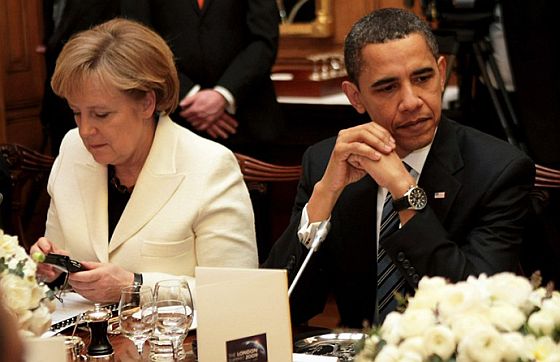
Obama pretending he can't see Merkel texting.
The Los Angeles Times reports: The White House and State Department signed off on surveillance targeting phone conversations of friendly foreign leaders, current and former U.S. intelligence officials said Monday, pushing back against assertions that President Obama and his aides were unaware of the high-level eavesdropping.
Professional staff members at the National Security Agency and other U.S. intelligence agencies are angry, these officials say, believing the president has cast them adrift as he tries to distance himself from the disclosures by former NSA contractor Edward Snowden that have strained ties with close allies.
The resistance emerged as the White House said it would curtail foreign intelligence collection in some cases and two senior U.S. senators called for investigations of the practice.
Precisely how the surveillance is conducted is unclear. But if a foreign leader is targeted for eavesdropping, the relevant U.S. ambassador and the National Security Council staffer at the White House who deals with the country are given regular reports, said two former senior intelligence officials, who spoke on condition of anonymity in discussing classified information.
Obama may not have been specifically briefed on NSA operations targeting a foreign leader’s cellphone or email communications, one of the officials said. “But certainly the National Security Council and senior people across the intelligence community knew exactly what was going on, and to suggest otherwise is ridiculous.”
If U.S. spying on key foreign leaders was news to the White House, current and former officials said, then White House officials have not been reading their briefing books.
Some U.S. intelligence officials said they were being blamed by the White House for conducting surveillance that was authorized under the law and utilized at the White House.
“People are furious,” said a senior intelligence official who would not be identified discussing classified information. “This is officially the White House cutting off the intelligence community.”
Any decision to spy on friendly foreign leaders is made with input from the State Department, which considers the political risk, the official said. Any useful intelligence is then given to the president’s counter-terrorism advisor, Lisa Monaco, among other White House officials.
When Angela Merkel phoned Barack Obama to tell him she didn’t appreciate being spied on by the NSA, it’s not as though Obama got blind-sided by the call. “You have a call on line one Mr President. It’s a woman with a German accent. She sounds pissed off.”
On the contrary, it’s reasonable to assume that Obama, in consultation with his staff, had time to craft a response, and if that response was not exactly crafted then it should at least have sounded halfway plausible.
Senior White House adviser: Just tell her you knew nothing about it but you promise it’ll never happen again.
Obama: But that’s going to sound like the lame excuse a 12-year-old would give in response to a reprimand from a school teacher.
Adviser: You got any better ideas?
The Most Powerful Man in the World: ….
What should he have said? How about:
I am aware of the reports you are referring to. I understand your concerns. I have ordered a comprehensive review of our surveillance policies and I am fully committed to taking whatever steps are necessary to restore trust between the United States and Germany. To that end, I’d like to invite you to send a team of your intelligence officials to meet their counterparts in Washington and in that context we will be able to address more specific issues and hopefully arrive at a common understanding.
You remain dear to my heart, Angela.
Well, maybe not the last bit.
Max Blumenthal offers unfiltered view into Israel’s commitment to ethnic supremacy
Max Blumenthal talks about his new book, Goliath: Life and Loathing in Greater Israel:
Rania Khalek: Challenging the pro-Israel narrative, as your book does, isn’t the most lucrative career move for an American journalist. With that in mind, why did you write this book?
Max Blumenthal: I was following a really successful book called Republican Gomorrah that got me on MSNBC, Air America [and] NPR, and I had a big liberal Democrat-oriented audience who were eager for my analysis of the radical right. I could’ve leveraged that into another book deal about Republican racism, made loads of money and sold tons of books. But this isn’t why I’m in journalism. I don’t look at journalism as a career. I look at it both as a profession and a craft and also as a means for exposing injustice. I’ve been watching the increasing violence and racism of Israeli society for most of my adult life, especially in their treatment of Palestinians. Having been born in 1977, I came of age during the First Intifada and then watched during the Second Intifada as Israel destroyed the Jenin Refugee camp. And then the Second Lebanon invasion happened. Israel basically carpet-bombed southern Lebanon, turning one-quarter of the country into refugees. Then there was Operation Cast Lead, the three-week assault on the besieged Gaza Strip that left 1,400 dead. It was so hard to watch, and it occurred after Barack Obama had been elected, someone I was deeply skeptical of. During the slaughter, I went to midtown New York and filmed a few hundred Jewish-Americans celebrating the attack. They were dancing a hora line outside the Israeli consulate and offering very clearly genocidal statements about the need to eradicate the cancer in Gaza. I put this online as a video, and it went viral. Before long, I was contacted by all kinds of people from across the Middle East who are directly affected by the Israel-Palestine crisis, inviting me to come there to see the situation on the ground. I agreed, and I put a lot of my book advance into the first extended reporting trip there in May 2009. That’s what led to me getting the deal to write Goliath and to spending the last four to five years of my life writing about this situation. It definitely changed my life in a lot of ways that I never expected, and I don’t think I’ll ever be able to see things the same way again.
RK: Goliath came out October 1. What has the reception been like so far, compared with that for Republican Gomorrah?
MB: Pro-Israel partisans in the US typically get hysterical about books like this because the real Israel is really impossible for them to grapple with. It shatters the dream castle Israel that goes to the heart of their identity as tribalistic, secular American Jews. I really believe that they are determined to ignore this book for as long as they can. It may take me going on national TV with one of those foam giant fingers and twerking on Abe Foxman for them to pay attention.
The other more obvious and salient reason why I’m not getting the same mainstream attention I got with Republican Gomorrah is because people like Rachel Maddow and Terry Gross, who can really move books, are simply afraid of the Israel issue and what it can do to their careers and the kind of pushback they’ll get from pro-Israel partisans behind the scenes. What we’re seeing is cowardice at the top of a hollow media establishment that extends into public radio. I think if shows like “Fresh Air” were to host me about Goliath, the response would be massive and mostly positive because I’m presenting the facts on the ground. Even people who don’t agree with my conclusions about what should happen in Israel-Palestine are hungry for this kind of information. [Continue reading…]
NSA hinted Israel was behind cyberattack on French president
AFP reports: France believed the United States attempted to hack into its president’s communications network, a leaked US intelligence document published on Friday suggests.
US agents denied having anything to do with a May 2012 cyber attack on the Elysee Palace, the official residence of French presidents, and appeared to hint at the possible involvement of Mossad, Israel’s intelligence agency, a classified internal note from the US National Security Agency suggests.
Extracts from the document, the latest to emerge from the NSA via former contractor Edward Snowden, were published by Le Monde newspaper alongside an article jointly authored by Glenn Greenwald, the US journalist who has been principally responsible for a still-unravelling scandal over large-scale US snooping on individuals and political leaders all over the world.
The document is a briefing note prepared in April this year for NSA officials who were due to meet two senior figures from France’s external intelligence agency, the DGSE. The French agents had travelled to Washington to demand explanations over their discovery in May 2012 of attempts to compromise the Elysee’s communications systems.
The note says that the branch of the NSA which handles cyber attacks, Tailored Access Operations (TAO), had confirmed that it had not carried out the attack and says that most of its closest allies (Australia, Britain, Canada and New Zealand) had also denied involvement.
It goes on to note: “TAO intentionally did not ask either Mossad or (Israel’s cyber intelligence unit) ISNU whether they were involved as France is not an approved target for joint discussions.” [Continue reading…]
UN confirms polio outbreak in Syria
The New York Times reports: United Nations officials confirmed an outbreak of polio among children in Syria on Tuesday, lending urgency to plans for vaccination campaigns there and in nearby countries to try to halt the spread of the disease.
Tests confirmed polio in 10 out of 22 children in Deir al-Zour Province in northeastern Syria who became ill this month, Oliver Rosenbauer, a spokesman for the World Health Organization, said. Results of tests on the other 12 children are expected soon, he added.
“With population movements, it can travel to other areas, so the risk is high of spread across the region,” Mr. Rosenbauer said.
United Nations officials said last week they were launching a campaign to immunize 2.4 million children in Syria against polio and other diseases. With thousands of refugees fleeing daily from Syria’s civil war to neighboring countries, they are also intensifying immunization efforts in six countries, including Lebanon, Jordan, Iraq and Turkey, which have taken in more than two million Syrian refugees, as well as Egypt and Israel.
Most of the affected children in Syria are under two years old, Mr. Rosenbauer said, underscoring the impact of 31 months of conflict on Syria’s health infrastructure. The United Nations says half a million Syrian children have not been inoculated against polio in a country where, before the conflict, 95 percent of the country’s population was immunized.
Despite the difficulty of delivering vaccines in a country convulsed by war, the United Nations Children’s Fund said it had vaccinated about a million Syrian children this year, including 800,000 who were vaccinated against polio.
After confirming the presence of the disease, attention is turning to identifying the source, Mr. Rosenbauer said. Public health officials have speculated that a possible source may have been jihadists traveling to Syria from Pakistan which, with Afghanistan and Nigeria, are the only countries where the disease is still endemic. [Continue reading…]
Lebanon suffers under the strain of a refugee crisis now out of control
The Observer reports: As you come through the military checkpoints on the way into Wadi Khaled, local mobile phones bleep with an unsolicited text: “The Ministry of Tourism welcomes you to Syria.”
This part of northern Lebanon, which juts like a knucklebone into Syria, is so close to the war that the villagers can watch the rockets land and palls of smoke rising across the hillsides. Children have swarmed up on to the first floor of the shell of a half-built house and are pointing excitedly to where the outlying villages of Homs begin. “I can see our house,” shouts Satash, six.
His mother, Maro, 28, stands back with her eyes cast down. “The older girls come up here and spend hours and hours sitting and looking out at Syria. I cannot even look.”
Satash’s home is, in reality, long gone. He now lives in Lebanon, in what used to be a shed for slaughtering chickens, with his parents and grandparents, his three-year-old sister and six orphaned cousins. The cousins’ mother was killed by shelling that stopped the delivery of medicines to treat her sickness; their father died from shrapnel wounds.
After fleeing in the middle of the night when a shell landed in their yard, taking only the clothes they stood up in, the family walked south for seven hours before crossing into Lebanon. They wandered for several months looking for help and accommodation, and ended up in the village of Knaisse in Wadi Khaled, only three miles from their Syrian home.
The family live in a shed, the rent waived by a kindly Lebanese. They have one blanket between five people, and plastic bags stuffed along the flimsy roof to stop the rain coming in. The grandmother lies on a scrap of matting, suffering from afflictions for which there is no money to buy treatment.
Maro and family live on a small monthly cash handout from a UN agency. Like most of the 1.3 million Syrian refugees now in Lebanon, a country of just 4.2 million people, they are worried about the snow that will start falling on the hills of Wadi Khaled within weeks. This will be their second winter here. “The room becomes like a refrigerator in the winter, the water floods like a lake all around and the wind is so cold,” said Maro’s husband, Ahmad, who is clearly under strain. He shouts again and again: “The people who stayed are dead under the rubble!” [Continue reading…]
Obama may ban spying on heads of allied states — including Israel?
The New York Times reports: President Obama is poised to order the National Security Agency to stop eavesdropping on the leaders of American allies, administration and Congressional officials said Monday, responding to a deepening diplomatic crisis over reports that the agency had for years targeted the cellphone of Chancellor Angela Merkel of Germany.
The White House informed a leading Democratic lawmaker, Senator Dianne Feinstein of California, of its plans, which grew out of a broader internal review of intelligence-gathering methods, prompted by the leak of N.S.A. documents by a former contractor, Edward J. Snowden.
In a statement on Monday, Senator Feinstein, chairwoman of the Senate Intelligence Committee, said, “I do not believe the United States should be collecting phone calls or emails of friendly presidents and prime ministers.” Ms. Feinstein, who has been a stalwart defender of the administration’s surveillance policies, said her committee would begin a “major review of all intelligence collection programs.”
The White House said Monday evening that no final decision had been made on the monitoring of friendly foreign leaders. But the disclosure that it is moving to prohibit it marks a landmark shift for the N.S.A., which has had nearly unfettered powers to collect data on tens of millions of people around the world, from ordinary citizens to heads of state, including the leaders of Brazil and Mexico.
It is also likely to prompt a fierce debate on what constitutes an American ally. [Continue reading…]
The 2013 ‘black budget’ for the U.S. intelligence community, provided to the Washington Post by Edward Snowden and published at the end of August, states that although overall the budget was declining it was being increased in specific areas:
“[W]e are investing in target surveillance and offensive CI [counterintelligence] against key targets, such as China, Russia, Iran, Israel, Pakistan, and Cuba.”
Monitoring the communications of the leaders of Israel, a country that has repeatedly made explicit threats that it might trigger another major conflict in the Middle East, would appear to serve the interests of both the U.S. and most of its allies.
Alexander did not ‘discuss’ Merkel surveillance with Obama, but was he briefed?
I think the main thing I want to emphasize is I don’t have an interest and the people at the NSA don’t have an interest in doing anything other than making sure that where we can prevent a terrorist attack, where we can get information ahead of time, that we’re able to carry out that critical task. We do not have an interest in doing anything other than that. — President Obama, August 9, 2013.
A report in the German newspaper Bild cites NSA sources claiming that in 2010, Gen. Keith Alexander briefed President Obama on the targeting of Chancellor Angela Merkel’s cellphone.
The NSA has responded with a statement saying:
[General] Alexander did not discuss with President Obama in 2010 an alleged foreign intelligence operation involving German Chancellor Merkel, nor has he ever discussed alleged operations involving Chancellor Merkel.
That sounds very much like a non-denial denial.
Given that as it was widely reported in the English-language press that Obama had been “briefed” on the surveillance, an unambiguous denial from the NSA would have simply said that Obama had not been briefed on this matter. He had not been briefed by Alexander or anyone else in the intelligence community.
A briefing involves nothing more than the exchange of information. Whether that exchange provokes discussion is another matter. Every U.S. president will be briefed on matters every single day during which he is a passive recipient of information.
That Obama presents the appearance of being a disengaged president, is well documented.
If Alexander presented Obama with a list of heads of state currently under U.S. surveillance — a list including Merkel’s name and/or position — and Obama scanned the list, noting who was being spied on and for how long, but this information provoked neither comments nor questions from the president, then he could certainly have been briefed while having no discussion.
Officials choose their words very carefully precisely because they are afraid of accused of lying. That they might at the same time be engaged in an effort to be deceptive is another matter, since in response to the suggestion that a statement might be misleading, they can always plead ignorance or regret or blame the press. Sorry if that wasn’t clear. Sorry if there’s a misunderstanding. You misinterpreted my statement.
The charade of a press briefing won’t, however, alleviate the credibility issue that Obama now has with Merkel. In her eyes the U.S. president must now appear to be either a liar, incompetent, or both.