Category Archives: Lands

Syria and how the U.S. antiwar movement forgot the spirit of internationalism

Danny Postel writes: The American peace movement has been celebrating what it sees as its victory on Syria. “The U.S. is not bombing Syria, as we certainly would have been if not for a huge mobilization of anti-war pressure on the president and especially on Congress,” writes Phyllis Bennis of the Institute for Policy Studies (IPS). This represents “an extraordinary, unforeseen victory for the global anti-war movement,” she goes on, one that “we should be savoring.” Robert Naiman of the organization Just Foreign Policy vaunts “How We Stopped the U.S. Bombing of Syria”.

This turn of events is “something extraordinary – even historic,” writes my good friend Stephen Kinzer, coming from a different but overlapping perspective. “Never in modern history have Americans been so doubtful about the wisdom of bombing, invading or occupying another country,” writes the author of the classic Overthrow: America’s Century of Regime Change from Hawaii to Iraq. “This is an exciting moment,” he rhapsodizes, “the start of a new, more realistic approach to foreign policy.”

The tireless progressive journalist David Sirota, whom I admire a lot, extols “How the Antiwar Majority Stopped Obama.” The opposition of “angry Americans” to the administration’s push for a military strike, he contends, proved “absolutely critical” and is “why there now seems to be a possibility of avoiding yet another war in the Middle East.”

I completely understand this jubilance. And yet it leaves me feeling uneasy.

Let me be clear: I too was against the Obama administration’s proposed military strike on Syria. I thought it strange that after two and a half years of doing essentially nothing about the deepening crisis in Syria, the White House suddenly decided to act with such a sense of urgency that it was unwilling to wait for the United Nations inspection team to complete its job. As if the world should just trust American claims about weapons of mass destruction. That went really well last time.

I also thought chemical weapons were exactly the wrong issue. To paraphrase Shadi Hamid of the Brookings Doha Center, why draw a “red line” at the use of chemical weapons but not at 100,000 dead? Or at two and a half years of crimes against humanity? The vast majority of the civilians killed since the Syrian uprising began in March of 2011 have died by means of conventional, not chemical weapons.

I agreed wholeheartedly with the International Crisis Group that the Obama administration’s case for action was based on “reasons largely divorced from the interests of the Syrian people,” who “have suffered from far deadlier mass atrocities during the course of the conflict without this prompting much collective action in their defence.”

Hinging its case on chemical weapons turned out to be a huge strategic mistake as well. Russia cleverly short-circuited the Obama administration, taking advantage of the thinness of its case. So Syria’s chemical weapons stockpiles will be removed from the equation – then what? The Assad killing machine, which was overwhelmingly nonchemical to begin with, can continue unfettered on its rampage. Chemical weapons issue – solved. The killing fields of Syria – no end in sight.

Given this horrific picture, it’s hard for me to share the peace movement’s triumphalism. Yes, a US military attack was thwarted – good. But is that where the story ends? [Continue reading…]


Facebooktwittermail

Rouhani is walking a political tightrope at home

Geneive Abdo writes: When President Hassan Rouhani touched down on Iranian soil after a dazzling week at the United Nations, he returned to criticism as well as cheers and applause. A crowd of demonstrators held placards and chanted the spent slogan “Death to America!” The protesters included members of the Basij militia, a hard-line paramilitary organization under the control of the Islamic Revolutionary Guards Corps (IRGC) and Supreme Leader Ayatollah Ali Khamenei.

The theatrics of the demonstrators reflect a much deeper conflict that is already underway in Tehran, as different factions debate whether Rouhani should have accepted a phone call from President Barack Obama, and, more important, whether Iran should trust the United States to unlock the stalemate over Iran’s nuclear program. Even though Khamenei has apparently given Rouhani the authority to expedite nuclear talks, other leaders in key institutions, such as the IRGC, began this past weekend to express their disapproval. There is increasing evidence that a broader opposition to Rouhani has begun to organize to derail any further progress from his diplomatic efforts.

In Iran’s first public, high-level criticism of Rouhani’s U.N. visit, Gen. Mohammad Ali Jafari, chief of the IRGC, said: “Just as he refused to meet Obama, he should also have refused to speak with him on the telephone and should have waited for concrete action by the United States.” Jafari also said, in an interview with the Tasnim news agency, “If we see errors being made by officials, the revolutionary forces will issue the necessary warnings.”

The operative word here is “revolutionary.” Jafari, defying a warning Rouhani issued to the Guards in mid-September to stay out of politics, is drawing a distinction between Rouhani and the president’s political faction anchored around former President Ali Akbar Hashemi Rafsanjani, and those who are seemingly more loyal to the values and ideology of the 1979 Islamic revolution. If, indeed, a line in the sand is being drawn, this is a remarkable development in Iranian politics whereby even the clerics of the system — such as Rouhani, one of Khamenei’s advisers and confidants for decades — are too far to the left to silence the hard-liners. [Continue reading…]

Facebooktwittermail

How America’s war on terror became a global war on tribal Islam

Muhammad Idrees Ahmad writes: Last May, a Syrian insurgent told The National’s Phil Sands about a meeting with US intelligence operators in Jordan. The rebel commander was hoping to procure weapons to resist a regime bristling with Russian arms. But he was surprised to learn that the Americans were more interested in the composition and activities of the opposition group Jabhat Al Nusra. Until the regime provoked the US with its use of poison gas, checking its serial atrocities was a secondary concern. The CIA was collecting coordinates of potential targets for its drones.

This hierarchy of concerns might seem at odds with the US rhetorical posture. But Damascus – until recently a preferred destination for CIA rendition flights – has successfully sapped US sympathy for the opposition by deploying the spectre of Al Qaeda. The opposition comprises myriad elements, most of them non-violent; foreign jihadists too have joined its ranks. But the regime and its backers in Tehran and Moscow have consistently exaggerated their strength. Consequently, the US, though not keen to see President Bashar Al Assad triumph, is less keen to see the opposition win and potentially add to the insecurity of Israel.

In the post-9/11 paranoia, many rogues have endeavoured to portray their local adversaries as part of a global terrorist threat. Russia did it with the Chechens; China with Uighurs; Israel with Palestinians – they all claimed to be fighting a “war on terror” against the same Islamist menace that threatened America. Others have followed the template. “Painting their peripheries as associated with Al Qaeda,” writes Akbar Ahmed in his remarkable new book The Thistle and the Drone: How America’s War on Terror Became a Global War on Tribal Islam, “many countries have sought to join the terror network because of the extensive benefits that it brings. They use the rhetoric of the war on terror to both justify their oppressive policies and to ingratiate themselves with the United States and the international system”.

This failure to distinguish regional struggles from global militancy allowed many states to harness US power to settle local disputes. The conflict between a centralising, hierarchical state and a recalcitrant, egalitarian periphery is not unique to Pakistan and the Federally Administered Tribal Areas (Fata). In the multi-ethnic Orient, geography rarely corresponds with identity. Many tribal societies have been left excluded on the margins. In turn they have resisted modernisation, seeing it as the centre’s tool for expanding its authority. Some of these conflicts, as in Chechnya, have simmered for centuries. But in most places, modus vivendi were evolved guaranteeing the autonomy of tribes while upholding state sovereignty.

The war on terror has disrupted this balance. [Continue reading…]

Facebooktwittermail

How close did Israel come to nuclear war in 1973?

Avner Cohen writes: week is the 40th anniversary of the Yom Kippur War, perhaps the most traumatic moment in Israel’s history. On Oct. 7, 1973 — the second day of the war — Israel’s borders along the Suez Canal in the south and the Golan Heights in the north collapsed under a massive assault by a coalition of Arab armies. Israel was caught unprepared.

The previous morning, Oct. 6, Moshe Dayan, Israel’s defense minister and a hero of the 1967 Six-Day War, had been so confident of Israel’s security that he’d opposed mobilizing the entirety of the reserve force, despite intelligence reports indicating that an Arab military offensive was imminent.

Just one day later, after visiting the front lines, Mr. Dayan was transformed into a prophet of doom. In a well-documented episode, he warned his generals of the demise of the “Third Temple,” a reference to the modern state of Israel. Mr. Dayan believed the country was fighting for its survival, and his mind turned to options of last resort. Israel’s nuclear arsenal, which first came into being on the eve of the 1967 war, had by 1973 grown to 10 or 20 atomic weapons. It was Israel’s ultimate insurance policy at a time of existential threat.

In the four decades since the 1973 war, rumors have blossomed that Israel stood at the nuclear brink during that war’s darkest hours. A number of journalists and scholars have asserted that during a dramatic meeting in one of the war’s early days, a panic-stricken Mr. Dayan persuaded the Israeli war cabinet, including the prime minister, Golda Meir, to arm the country’s weapons with warheads for possible use.

Some analysts have even claimed that Israel used this “nuclear alert” to blackmail the Nixon administration into providing Israel with a huge airlift of military supplies. Although these stories were based on anonymous sourcing and circumstantial evidence, they have become a central part of the lore surrounding the Yom Kippur War. Even my own early scholarship was to some degree influenced by this mythology. But in a January 2008 interview I conducted, Arnan Azaryahu, a senior aide to an Israeli cabinet minister at the time of the war, negated and refuted the nearly four-decade-old mythology alleging that Israel almost reached the nuclear brink in 1973. [Continue reading…]

See more interviews at The Avner Cohen Collection.

Facebooktwittermail

Assad is looking stronger than ever

Paul Wood writes: Everyone in rebel-held areas will tell you that the Islamists, of whichever stripe, are making gains because of the ‘secular’ FSA’s corruption and opportunism. That and the fact that most of the money and guns are going to the Islamists, sent by Qatar and Saudi Arabia. ‘Ali’ had been a flight attendant with Emirates before the war, living in Dubai and going to bars to pick up girls. Now he was in a Nusra Front brigade, he told me, but only because he thought they were really taking the battle to the regime. The emir of his group had banned smoking in line with Islamist doctrine. Ali would sneak outside for a crafty cigarette. He wasn’t an Islamist, he said, he just wanted Assad gone.

The bits of the FSA that continue to oppose Nusra and the Islamic State blame the West for their loss of power. ‘The Syrian people will welcome any support if the West continues to abandon us,’ the FSA’s commander for southern Syria, Abu Fadi, told me in Jordan. Abu Fadi said that, contrary to reports in the US newspapers, he had received almost no American help. None of his men had been trained in the camps that supposedly exist in Jordan. No weapons had been handed over. ‘We have had some new boots and jackets,’ he said with a snort. ‘That’s all.’

Isis and their satellites are still far from a majority but they have influence beyond their numbers. Public beheadings are now common in northern Syria. The BBC obtained pictures of one, the executioner dressed in black waving a severed head before a jubilant crowd.

Amid what the guidebooks call the ‘stylish and opulent’ surroundings of the Albergo hotel in Beirut, a western diplomat was briefing journalists. The room was all Persian rugs and wing-backed chairs. Waiters hovered. The official was his government’s main conduit to the Syrian rebels. I asked him what percentage of the rebels western countries could support: what percentage were not jihadis, not committing human rights abuses, looting or kidnapping — and were militarily effective?

There was a silence. Finally, he said: ‘Thirty per cent.’ It was a devastating admission. Then he paused and said he had been considering only the first three criteria. Adding in military effectiveness, you would have to say the West could support only 10 per cent.

Western diplomats are now scrambling to ensure that 10 per cent has at least the appearance of running the show. [Continue reading…]

Facebooktwittermail

CIA ramps up rebel training program designed to prolong war in Syria

The Washington Post reports: The CIA is expanding a clandestine effort to train opposition fighters in Syria amid concern that moderate, U.S.-backed militias are rapidly losing ground in the country’s civil war, U.S. officials said.

But the CIA program is so minuscule that it is expected to produce only a few hundred trained fighters each month even after it is enlarged, a level that officials said will do little to bolster rebel forces that are being eclipsed by radical Islamists in the fight against the government of Syrian President Bashar al-Assad.

The CIA’s mission, officials said, has been defined by the White House’s desire to seek a political settlement, a scenario that relies on an eventual stalemate among the warring factions rather than a clear victor. As a result, officials said, limits on the agency’s authorities enable it to provide enough support to help ensure that politically moderate, U.S.-supported militias don’t lose but not enough for them to win.

The officials, who spoke on the condition of anonymity to discuss intelligence matters, said the agency has sent additional paramilitary teams to secret bases in Jordan in recent weeks in a push to double the number of rebel fighters getting CIA instruction and weapons before being sent back to Syria.

The agency has trained fewer than 1,000 rebel fighters this year, current and former U.S. officials said. By contrast, U.S. intelligence analysts estimate that more than 20,000 have been trained to fight for government-backed militias by Assad’s ally Iran and the Hezbollah militant network it sponsors. [Continue reading…]

Facebooktwittermail

Syria’s jihad tourists

Der Spiegel reports: Foreign Islamists coming into Syria have been gathering in the relatively quiet north. But many of them are finding transit towns — with good food, video games and smoking — preferable to the front. When they do end up fighting, it’s often with each other.

Atmeh looks like the set for a movie about al-Qaida. New arrivals pulling suitcases on wheels search for their emirs, Africans and Asians can be seen on the village streets, and long-haired men dressed in traditional Afghan clothing walk around wielding AK-47s. There are patrons at the local kebab stand whose northern English dialect is peppered with Arabic words and phrases. “Subhan’Allah, bro, I asked for ketchup,” says one man. The many languages heard on the street include Russian, Azerbaijani and Arabic spoken with a guttural Saudi Arabian accent.

The once-sleepy smugglers’ nest on the Turkish border has become a mecca for jihad tourists from around the world. A year ago, SPIEGEL reporters in Atmeh met with one of the first foreign fighters in Syria, a young Iraqi who said that he had come to overthrow the dictatorship. Meanwhile, more than 1,000 jihadists are staying in and around Atmeh, making it the densest accumulation of jihadists in all of Syria. Ironically, while war rages in the rest of the country, the foreign jihadists have made one of Syria’s quietest spots into their base. Or perhaps they have chosen Atmeh precisely because it is so quiet. Once they arrive, many are reluctant to leave.

The Turkish mobile phone network provides strong reception, and the shops carry Afghan pakol wool hats, al-Qaida caps and knee-length black shirts made of the same coarse material used in the Pakistani tribal regions. New restaurants have popped up, and a company called International Contacts books flights and exchanges Saudi riyals, British pounds, euros and US dollars into the local currency. The pharmacy sells miswak, a teeth-cleaning stick from Pakistan with which the Prophet Muhammed supposedly brushed his teeth. The package label promises that the use of miswak increases the effectiveness of subsequent prayers by a factor of 70.

A third Internet café opened in mid-June to accommodate the many jihadists wanting to communicate with their relatives and friends at home via phone, email or chat programs. This prompted the owner of the first café to hang al-Qaida flags above his computers as a sign of loyalty to his customers. The move has improved business despite the growing competition. The heavily armed customers use Skype to tell their friends at home about what a paradise Atmeh is. The rents are cheap, they say, the weather and food are good, they can walk around with their weapons and, with a little luck, they can even find wives. In the evenings, the sound of several jihadists playing Counter-Strike spills into the streets in a cacophony of video game warfare. In Atmeh, the holy war is a costume spectacle, and everyone can feel as if he were part of it — without suffering any harm. [Continue reading…]

Facebooktwittermail

Syrian refugees destabilizing Lebanon

Der Spiegel reports: The war in Syria and its wave of refugees is destabilizing and overwhelming Lebanon. Now there are fears the hundreds of thousands of newcomers will never want to leave, and the sectarian conflict will worsen.

General Ibrahim Bachir saw it coming. He has been warning the government for over two years now: Stop wasting time and start building refugee camps to deal with the influx of Syrian refugees, he told them.

But the deeply divided and ineffective government authorities in Lebanon did nothing, he says — and now it’s too late: “We have all these problems,” the general says, “criminals, prostitutes and beggars everywhere — across the entire country!”

Bachir, 60, heads the High Relief Commission, the state agency charged with helping the masses of refugees fleeing the conflict in neighboring Syria. “But how is such a small country supposed to accommodate so many refugees?” he asks. “One in four people here is now a Syrian refugee.” [Continue reading…]

Facebooktwittermail

Israel should welcome Rouhani’s election victory

Meir Javedanfar writes: Iranian President Hassan Rouhani was the most moderate candidate among those allowed to run in the country’s June election. Yet within one month of Rouhani’s victory, Israel’s Prime Minister Benjamin Netanyahu publicly called him a “wolf in sheep’s clothing.”

Such a reaction would be understandable if Saeed Jalili, the most anti-Western ultraconservative candidate, had won. But why has the Israeli government greeted Rouhani with hostility?

The common refrain in Israel is that Rouhani’s moderate image — in contrast to his predecessor Mahmoud Ahmadinejad’s — will hamper Israel’s efforts to keep Iran isolated. Furthermore, Rouhani’s moderate tone could fool the United States and Europe into a false sense of security, resulting in the lifting of sanctions against Iran and even passivity toward the threat of Iran’s nuclear program.

Such concern likely peaked after Rouhani’s recent visit to the United Nations General Assembly, which led to a number of milestones in Iran’s troubled relationship with the U.S. The meeting between Iran’s foreign minister Mohammad Javad Zarif and U.S. Secretary of State John Kerry — the first such formal talks between the two countries since the 1978 Iranian Revolution — was followed by another major unprecedented milestone: a phone call between Rouhani and President Barack Obama.

To be sure, when it comes to Rouhani’s ability to usher real change to Iran’s nuclear program, a healthy dose of skepticism is called for. However, his election victory is not the threat that Netanyahu and his cabinet have alleged. In fact, there are good reasons for Israelis to welcome Rouhani’s rise to power.

Rouhani was elected on a platform of moderation. Among the presidential candidates, he was the most critical of Iran’s nuclear-negotiation strategy. His criticism focused on Iran’s intransigent posture at the talks, which forced it to pay a disproportionate price for its nuclear program. As Rouhani stated in a campaign video on June 5, 10 days before the election: “If centrifuges are turning, but the country is dormant, then we don’t choose this. If the arrangement is for Natanz [Iran’s nuclear enrichment site] to work but 100 other factories close because of sanctions and shortage of primary material or they only work at 20 percent of their capacity, then this is unacceptable.” [Continue reading…]

Facebooktwittermail

Israel suspected of conducting terrorist attack inside Iran

Suppose that an Israeli commander from the IDF’s Electronic Warfare (EW) Section was assassinated outside Tel Aviv. However terrorism might be defined legally, there’s little doubt that the press inside and outside Israel would describe such an event as an act of terrorism and likewise any country suspected of directing the attack would be described as a state-sponsor of terrorism.

At a time when Israel clearly feels threatened by an unprecedented diplomatic opening between the United States and Iran, there are strong grounds to suspect that the killing of an Iranian cyber warfare commander outside Tehran in the last few days should be viewed in the context of an ongoing secret war that Israel has been conducting against Iran for several years. Given the timing of the killing, it’s purpose appears quite transparent: to place President Rouhani in a more difficult negotiating position. Given, however, that the interests of the Israelis and the hardliners inside Iran are so closely aligned right now, it’s premature to conclude who was responsible.

The Telegraph reports: Mojtaba Ahmadi, who served as commander of the Cyber War Headquarters, was found dead in a wooded area near the town of Karaj, north-west of the capital, Tehran. Five Iranian nuclear scientists and the head of the country’s ballistic missile programme have been killed since 2007. The regime has accused Israel’s external intelligence agency, the Mossad, of carrying out these assassinations.

Ahmadi was last seen leaving his home for work on Saturday. He was later found with two bullets in the heart, according to Alborz, a website linked to the Revolutionary Guard Corps. “I could see two bullet wounds on his body and the extent of his injuries indicated that he had been assassinated from a close range with a pistol,” an eyewitness told the website.

The commander of the local police said that two people on a motorbike had been involved in the assassination. [Continue reading…]

Facebooktwittermail

Israel hopes to strengthen ties with Gulf rulers in anti-Iran alliance

The Times of Israel reports: Israel has held a series of meetings with prominent figures from a number of Gulf and other Arab states in recent weeks in an attempt to muster a new alliance capable of blocking Iran’s drive toward nuclear weapons, Israel’s Channel 2 reported Wednesday.

According to the report, Prime Minister Benjamin Netanyahu has been supervising a series of “intensive meetings” with representatives of these other countries. One “high ranking official” even came on a secret visit to Israel, the report said.

The report came a day after Netanyahu, in an overlooked passage of his UN speech, noted that shared concerns over Iran’s nuclear program “have led many of our Arab neighbors to recognize… that Israel is not their enemy” and created an opportunity to “build new relationships.”

The Arab and Gulf states involved in the new talks have no diplomatic ties with Jerusalem, the report noted. What they share with Israel, it said, is the concern that President Hasan Rouhani’s new diplomatic outreach will fool the US and lead to a US-Iran diplomatic agreement which provides for “less than the dismantling of the Iranian nuclear program.” [Continue reading…]

Facebooktwittermail

Egypt draws up plans to bomb Gaza

Ma’an News Agency reports: The Egyptian army has established a precautionary plan for military intervention in the Gaza Strip if attacks on Egyptian troops in the Sinai Peninsula intensify, Egyptian security officials said Wednesday.

Officials told Ma’an that Egyptian reconnaissance planes had entered the Gaza Strip’s airspace and examined a number of locations in Rafah and Khan Younis to be targeted if military attacks against Egyptian troops intensify in Sinai.

Egyptian aircraft could also target vehicles which travel across the border area delivering smuggled goods, sources added. More smuggling tunnels could also be destroyed, and sources highlighted that “all options are open.”

According to Egyptian military sources, the ongoing attacks in Sinai are carried out by organizations based both in Sinai Peninsula and in the Gaza Strip.

Certain militant groups in the Gaza Strip, according to Egyptian officials, are “behind the violence” in Sinai, including Ansar al-Sunna, which has ties to Hamas, as well as Ansar Beit al-Maqdis, among others.

As a result, sources argue that in order to maintain control over the Sinai, the Egyptian army has no choice but to shut down all smuggling tunnels and strike targets in Gaza if further red lines are crossed.

“The Egyptian army does not believe the population of Gaza is involved in the violence in Sinai, but certain factions strongly support Sinai groups. The tunnels play a major role in the communication between both sides,” a senior Egyptian official told Ma’an.

“In addition, Hamas, although its involvement is limited, is responsible for maintaining control of the smuggling tunnels as well as the factions operating in the coastal enclave,” he added.

Facebooktwittermail

Germany asks U.S. why NSA critic was denied entry

The Associated Press reports: Germany’s Foreign Ministry says it has contacted U.S. authorities over their decision to deny a German author entry to the United States.

Ilija Trojanow says he was refused permission to board a flight from Salvador da Bahia, Brazil, to Miami on Monday without explanation. He told the Spiegel Online website that the denial of entry might be linked to his criticism of the U.S. National Security Agency.

Trojanow was one of several prominent German authors who signed an open letter to Chancellor Angela Merkel urging her to take a firm stance against the mass online surveillance allegedly conducted by the NSA.

Facebooktwittermail

Afghans baulk at U.S. push for operations after 2014

Reuters reports: A U.S. bid to run unilateral counter-terrorism operations in Afghanistan after 2014 is threatening to derail a security pact between the two countries, an Afghan spokesman said, underlining Afghanistan’s tenuous ties with its main backer.

Most foreign combat troops are due to leave by the end of 2014, and the United States has been putting pressure on Afghanistan to finalize a bilateral security agreement by the end of this month.

The pact will set out the terms of a U.S. presence after 2014 and will be followed by similar deals with other countries such as Germany and Italy.

But two issues have emerged as potential “deal breakers”, President Hamid Karzai’s spokesman, Aimal Faizi, told reporters late on Tuesday. [Continue reading…]

Facebooktwittermail

Syria beyond the binaries

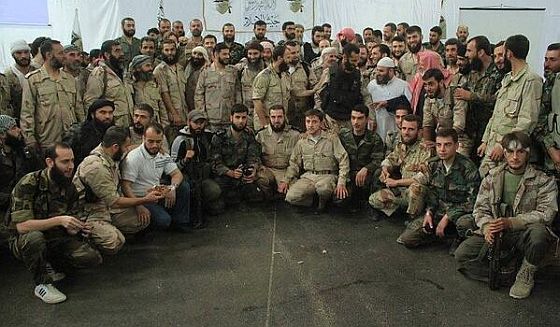
Jaish al-Islam commanders from  50 insurgent groups who merged on Sunday.

Jaish al-Islam commanders from 50 insurgent groups who merged on Sunday.

I suspect that for quite a few observers there’s something vaguely comforting about the spectacle of the rise of extremism in Syria. Why comforting? Because it reinforces the idea that however bad the Assad regime might be, the alternative seems destined to be worse. On that basis one can take comfort in the belief that the best course of action for those outside Syria is no action at all.

Indeed, the Assad regime itself seems willing to cater to those who want to balance both humanitarian and non-interventionist concerns through facilitating a symbolic intervention by destroying Syria’s chemical weapons arsenal. If the Syrian government is sufficiently cooperative in this undertaking it will no doubt earn qualified praise for doing so.

Which brings me to a headline in yesterday’s Washington Post: “Foreign extremists dominate Syria fight“. As if carried away by the sentiment in those words, the security analyst Matthew Aid then reposted the article on Tumblr with an even more sensational headline: “Most Fighting in Syria Being Done by AQ-Linked Militants, Not Free Syrian Army“.

The problem is, neither headline actually reflected the details of the report. No doubt Liz Sly, reporting from Beirut, wanted to convey some sense of Syria being taken over by foreign jihadists, yet the second sentence in her report acknowledges: “The number of Syrians battling to overthrow the regime led by President Bashar al-Assad outstrips by a large margin the thousands of Arabs and other non-Syrian Muslims who have streamed into Syria over the past two years to join in the fight.”

Further in to the report she says that conservative estimates put the number of foreign fighters at between 6,000 to 10,000 — though she fails to put that in context by referring to the estimated size of the fighting opposition: 100,000.

Supposedly, what is happening in Syria can only be comprehended in binary terms: Syrian vs foreign; moderate vs extremist; secular vs Islamist; Sunni vs Allawite. But the overarching effect of the imposition of these simplistic labels is to reinforce the sentiment that Syria is bad news and the less we hear about it the better.

On the other hand, for those who retain an interest in being provided with a more nuanced picture of what’s happening on the ground, there are commentators like Hassan Hassan who are capable of explaining some of the complexity in an ever-changing landscape while underlining the fact that whatever fissures do indeed exist inside the opposition, this remains a fight to topple the Assad regime.

Hassan notes that in the liberated areas of Syria, Salafi-leaning fighters are now dominant and among these the newly formed Jaish al-Islam (“the Army of Islam”) composed of at least 50 groups operating mainly around Damascus, has now displaced the FSA as the strongest rebel force.

The emerging trend, far from that of Syria being taken over by foreign fighters, may actually be going in the opposite direction:

Significant grassroots hostility is building in liberated Syrian areas against foreign-funded extremists and al Qaeda affiliates. These tensions do not always develop into sustained clashes — for almost all rebel groups, toppling the regime is the priority, not fighting extremist forces, which have proved indispensable in the battlefield.

According to an activist based in the northern city of Raqqa, when clashes erupted between the al Qaeda-affiliated ISIS and Ahfad al-Rasoul in August, local residents threw their support behind one or the other side — but the strongest condemnation was for the infighting itself. “When they see the regime’s warplanes shelling the city without a single shot in their direction, they get angry at the fighters who could do something,” the activist explained.

The size of extremist groups is not an accurate indicator of the support for their ideology within Syrian society. Fighting groups are also not ideologically homogenous, as many fighters join groups for their effectiveness on the battlefield and disciple — not their religious beliefs. Ahrar al-Sham members in Daraa, for example, can be remarkably different in terms of religiosity from members in more conservative northern areas such as Idlib or the Aleppo countryside.

The situation inside the country is more fluid and nuanced than many groups’ hard-line slogans would suggest. Moderates can be members of hard-line groups and vice versa. Some groups, such as Suqour al-Sham, include both secular members and Islamist veterans of the insurgency against the U.S. occupation of Iraq. For example, a former judge at Aleppo’s cassation court, a secular Syrian who does not pray, nevertheless supports an Islamic identity to the state.

For this reason, many moderate fighters are more concerned with the foreign networks and leaders than the rank-and-file members of hard-line groups. “We are not too worried about Jabhat al-Nusra,” said one FSA-affiliated officer in the eastern governorate of Deir Ezzor who said he worked in intelligence operations. “Once the fighting ends, we’ll bring them back. We know them. They’re our brothers, cousins, and neighbors — they’re the sons of our tribes. Our true struggle will be against [ISIS] and the Nusra leaders.”

Facebooktwittermail

Israel’s increasing sense of isolation

Joanna Paraszczuk reports: A sense of isolation prevails in Israel’s media on Wednesday — reflected in both news reporting and opinion pieces — following Prime Minister Binyamin Netanyahu’s Tuesday speech to the UN General Assembly.

Populist outlet Ynet and Channel 2 focus on comments made by Defense Minister Moshe Ya’alon on Wednesday morning. Ya’alon spoke out in support of Netanyahu’s stance on Iran, saying that the Prime Minister had “drawn an accurate picture” of Israel’s stance on Iran and President Hassan Rouhani.

“In the UN, the Prime Minister described an accurate reality about how we see the Iranian threat, which is ongoing, even though President Rouhani spoke sweetly and Western officials prefer not to face reality with open eyes,” Ya’alon told reporters during a tour of the Golan Heights.

The Defense Minister echoed Netanyahu’s words, saying that Iran posed a terror threat in the region and beyond, “Iran carries out terror in Afghanistan, it trains and arms Hezbollah, it tries to smuggle weapons into Gaza, it is investing in infrastructure of terrorism in South America and Asia and its centrifuges continue to turn. That is why we say you have to stop the Iranian nuclear program by all means.”

Channel 2 also carries comments from Security Cabinet member and Minister Silvan Shalom, who warned that Israel stands alone.

“We are quite alone in facing the Iranian threat to destroy us,” Shalom said, adding that Rouhani is no different from his predecessor, Mahmoud Ahmadinejad:

“Israel is trying to remove the mask from Rouhani’s face, he speaks sweetly and in a different way from Ahmadinejad, but he did not really no different from him. His aim is to gain more time to build a nuclear bomb, which would be an eternal insurance certificate for the ayatollahs’ regime,” Shalom added. [Continue reading…]

Setting aside for now the fact that Iran’s leaders persist in denying that the Islamic republic’s nuclear program is geared towards weapons production, Shalom’s characterization of the implications of a nuclear-armed Iran is quite revealing.

Having referred to “the Iranian threat to destroy us,” he then suggests that nuclear weapons would serve as an “eternal insurance certificate for the ayatollahs’ regime” — acknowledging that such weapons would serve Iran in exactly the same way that they serve all other nuclear powers: as the ultimate deterrent. Shalom clearly doesn’t share the view promoted by Alan Dershowitz and other members of the rabid wing of the Israel lobby: that Iran is a “suicide nation” willing to see itself destroyed by a retaliatory nuclear strike from Israel.

Moreover, to suggest that Iran’s rulers would want or need nuclear insurance is to acknowledge that an ad hoc coalition of regional powers — preeminently Israel and Saudi Arabia — remain reluctant to abandon their dreams of bringing about regime change in Tehran.

At the same time as engaging in last week’s whirlwind of diplomatic outreach, Hassan Rouhani made it very clear that he has a relatively small window of opportunity to make real progress as he faces pressure from a new axis of extremism revealing the common interests of Israel, Saudi Arabia, Iran’s Revolutionary Guard, and the Assad regime, all of whom for their own reasons feel deeply threatened by the possibility of Iranian-U.S. rapprochement.

Facebooktwittermail

Iran president’s phone call with Obama stirs hardline suspicions

Reuters reports: Iranian President Hassan Rouhani’s historic phone call with U.S. President Barack Obama is likely to provoke resistance from powerful hardliners in the Islamic Republic who have built their support on enmity with the West.

The first thing Rouhani did on his return to Tehran at the weekend was to state that he had acted within guidelines set by Supreme Leader Ayatollah Ali Khamenei when he took part in the highest-level contact between Iran and the United States in three decades.

The brief mobile phone conversation led many to speculate that since the election of the moderate Rouhani relations between Washington and Tehran, in the deep freeze since the U.S. embassy hostage crisis, may be about to improve.

Rouhani’s invocation of Khamenei, the man at the top of Iran’s complex political system, looked like a bid to ward off a backlash from hardline power centres and their supporters, some of whom were already lying in wait to throw eggs at the president’s motorcade.

The demonstrators’ chants of “Death to America” were, however, likely to be only the opening shots of a campaign against Rouhani by a conservative political and military establishment opposed to the West in general and to the United States and Israel in particular.

Such is the mistrust between Iran and the United States that a big sticking point of negotiations over Tehran’s disputed nuclear programme has been who should make the first move. [Continue reading…]

Facebooktwittermail