Category Archives: Lands

What happened to Egypt’s liberals after the coup?

Sharif Abdel Kouddous writes: Khaled Dawoud worked hard to remove Mohamed Morsi, Egypt’s first democratically elected president, from office.

As the spokesperson for the National Salvation Front, a loose coalition of non-Islamist parties and groups formed last November, he was a well-recognized voice of opposition to Morsi and the Muslim Brotherhood. In the weeks leading up to June 30, Dawoud traveled across the country, helping to drum up support and organize logistics for the massive anti-Morsi protests.

After the army ousted Morsi on July 3, Dawoud was a regular guest on local and international news channels, vociferously defending the overthrow and arguing that the president’s removal did not constitute a military coup.

“I do not have any regrets over Morsi’s removal because the Muslim Brotherhood were posing a major threat to the future of this country,” he says. “They betrayed every single principle of the Egyptian revolution.”

Yet now, Dawoud finds himself at odds with the group he once represented, and he is vilified by many of his former political allies.

The turning point came on August 14, when the military and security forces brutally cleared the two mass sit-ins in Cairo that formed the epicenter of support for the ousted president. Hundreds of people were killed in what Human Rights Watch describes as “the most serious incident of mass unlawful killings in modern Egyptian history.”

The National Salvation Front leadership, which includes former presidential candidates Hamdeen Sabahi and Amr Moussa, put out a statement applauding the raids. Two days later, Dawoud—who describes himself as a “leftist, not a liberal”—resigned as the group’s spokesperson.

“We wanted a political deal, we wanted Morsi removed, but we didn’t want to suppress [the Muslim Brotherhood] or kill them or consider them an outlawed organization,” he says, sitting on a heavily cracked black leather couch in the offices of Al-Ahram Weekly, the state-owned English-language publication where he has worked as a journalist since 1996. After resigning, he says, “even some close friends called me a Brotherhood sympathizer, a secret cell, a traitor and a US agent.”

Dawoud’s story is emblematic of Egypt’s convoluted political landscape, whose fault lines have shifted and rearranged in the aftermath of Morsi’s overthrow and the subsequent brutal crackdown on the Brotherhood and its allies.

Opposition to Morsi grew throughout his time in office, eventually stretching across nearly every sector of Egyptian society. It also had grassroots support, manifested in more than 9,000 protests and strikes during his year-long rule that culminated in calls for early presidential elections and the unprecedented June 30 mobilization.

His opponents included a broad swath of political and social movements, often characterized by conflicting ideologies and grievances. It included revolutionary activists, labor unions, human rights advocates, the Coptic Church, intransigent state institutions, former Mubarak regime members and sidelined business elites as well as the formal opposition—the flock of non-Islamist political parties and figures routinely lumped together as “liberals,” despite the fact that many of them have rejected any notion of political pluralism, a defining characteristic of liberalism.

The result has been a confusing, and increasingly atomized, political landscape. Of the disparate groups opposed to Morsi, some actively sought military intervention, fewer opposed any military role, while others—like Dawoud—stood by the military as it ousted the president, but eventually broke away in the face of mounting state violence and mass arrests of Islamists under the guise of a “war on terror.”

The military—which formed a coalition of convenience with the Brotherhood for much of 2011 to manage the post-Mubarak landscape and hold revolutionary aspirations and unfettered popular mobilizations in check—successfully co-opted the movement against Morsi and, along with the security establishment, emerged as the clearest winner from his overthrow. [Continue reading…]


Facebooktwittermail

Tunisia’s government falls, Arab democracy is born

Noah Feldman writes: If you blinked, you missed it, but the democratically elected Islamist government of an Arab country just promised to resign peacefully, with no threat of a coup d’etat in sight.

Tunisia is still a long way from political stability. Yet once again, the nation that started the Arab Spring is showing the rest of the region how it’s supposed to be done. Reasonable people facing deep disagreements are negotiating and power-sharing their way to the Holy Grail of legitimate constitutional democracy.

Start with the deal. Ennahda, the Islamic democratic party that formed a government after Tunisia’s free elections in 2011, didn’t agree to step down for nothing. In exchange for agreeing to resign in favor of a caretaker government of nonpartisan technocrats, Ennahda got the opposition to agree to ratify a draft constitution that has been painstakingly drafted and debated over the last year and a half.

Under the rules of the road, adopted after the old regime fell in January 2011, the constituent assembly can approve the constitution if two-thirds of its members vote in favor. That structure put a premium on consensus, the political value most valued by Tunisian political culture. It also put Ennahda in a tough position during the drafting process: Its slight coalition majority in the assembly gave it almost no leverage, because it needed lots of opposition votes to get to two-thirds. The only alternative was to go to the public, which might have approved the constitution by a bare majority. But that would have violated the goal of consensus, and Ennahda consistently refused to treat it as an option. [Continue reading…]

Facebooktwittermail

Iraq sliding towards civil war

Time reports: Early Monday morning, more than a dozen car bombs ripped through mostly Shi‘ite neighborhoods in Baghdad, killing at least 50 people and leaving dozens lying bloodied in the streets. The worst attack that day was in heavily Shi‘ite Sadr City, where a man parked a white car near an area where day laborers gather; a bomb inside erupted, killing seven people and wounding 16.

Such reports have become commonplace over the past few months, as violence in Iraq has escalated to levels unfathomable in almost any other country, and by any metric — death tolls, frequency, geographic distribution — it’s becoming worse. For decades, the Baath Party of toppled dictator Saddam Hussein, composed mostly of secular Sunnis, ruled Iraq’s majority Shi‘ite population and ruthlessly kept a lid on sectarian tensions. After the 2003 U.S.-led invasion overturned the Saddam regime, Shi‘ites controlled the new government. This year, violence in Iraq has been largely the result of a Sunni bombing campaign aimed at the Shi‘ite-dominated political status quo. The civil war in neighboring Syria — itself a volatile, sectarian conflict — has spilled across the border, and Sunni jihadi factions are operating in both countries. Now, four months before the next parliamentary elections, Iraq increasingly appears to be spiraling toward a civil war.

Since 2006, when Iraq then under U.S. occupation convulsed in sectarian bloodshed, violence has been driven mainly by internal divisions, and after the withdrawal of U.S. troops in 2011, the Shi‘ite-dominated government led by Prime Minister Nouri al-Maliki has been unable to stop the killing. “The struggle for power is not conducted along neat Shia versus Sunni or Islamist versus secular dividing lines,” a May report by British think tank Chatham House explained. “However, issues of identity, rights and interests have often found sectarian expression in periods of upheaval and transition.”

It’s spreading as well. Until this weekend, much of the violence has occurred in Baghdad and its environs, largely sparing Iraqi Kurdistan, an autonomous region in the north. For most of the past decade, Iraq’s Kurdish region has been immune to the bloodshed. When American troops occupied Iraq, no American soldiers were killed there. But this weekend, as the results of the region’s parliamentary elections were announced, suicide bombers in the Kurdish capital Erbil attacked a building housing the Kurdish security forces, setting off gunfights in the streets. According to the regional government, six attackers and six members of the security forces were killed.

Iraq’s tumultuous year began when the Shi‘ite-dominated government’s security forces raided the home of Sunni Finance Minister Rafia al-Issawi, touching off antigovernment protests in several provinces. In April, security forces clashed with protesters and Sunni gunmen in the northern city of Hawija, leaving dozens of mostly Sunnis dead. More than 700 people were killed in April alone.

Attacks then picked up in the spring and summer. According to the U.N. Assistance Mission for Iraq, more than 1,000 Iraqis were killed in July, the deadliest month in the country since sectarian violence peaked in 2006 and ’07. More than 800 were killed in August, and the U.N. estimates that nearly 1,000 were killed in September. Since the April protests began, more than 5,000 Iraqis have been killed in the violence. [Continue reading…]

Facebooktwittermail

More than 115,000 killed in Syrian conflict – monitoring group

Reuters reports: More than 115,000 people have been killed in Syria’s two-and-a-half-year-old civil war, including tens of thousands of soldiers, rebels and civilians, the Syrian Observatory for Human Rights said on Tuesday.

The figure suggested that around 5,000 people had died in September alone and that the bloodshed has not been slowed by an international deal for the elimination of Syria’s chemical weapons after an August 21 sarin gas attack in the Damascus area.

The British-based Observatory, which monitors violence through a network of activists, medical and military sources around Syria, said about 47,000 soldiers and militia fighters loyal to President Bashar al-Assad had been killed.

Rebel fighters, including army defectors, accounted for around 23,000 of the dead, the Observatory said.

More than 41,000 civilians have been killed, including 6,000 children and 4,000 women. The toll includes 3,000 unidentified people, according to the Observatory which says it documents deaths by obtaining film and photographs of bodies and seeking to confirm identities through family, medics and activists.

Facebooktwittermail

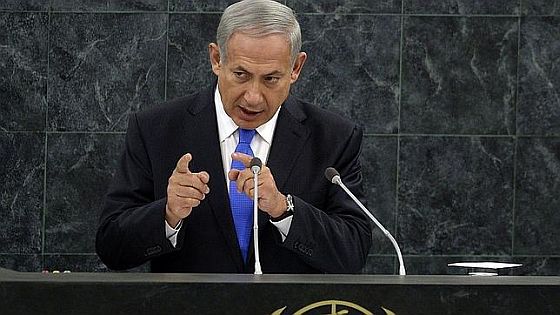
Netanyahu’s ‘The Speech that Never Was’

netanyahu-un

After Benjamin Netanyahu had delivered a speech at the U.N. which surprised no one, Chemi Shalev wrote:

In the streets and avenues leading up to the UN building on the East River, it was already clear the ball has long been over: the barricades were gone, the policemen were relaxed, the satellite trucks had moved elsewhere, the tension and anticipation of the first few days, when Rohani was in town, had all but dissipated. Inside the hall only a fraction of the fatigued foreign diplomats remained to hear Netanyahu, the last head of the state on the agenda, and even they seemed mainly anxious to go home and get back to their normal lives.

The situation in the media, where Netanyahu hopes to make an impact, wasn’t much better. A few hours after the US government had shut down many of its operations, with news networks anxiously breaking to their reporters in the Rose Garden where President Obama was set to make a statement; it was hard to drum up too much interest, not to mention excitement and buzz, over Netanyahu’s strident speech at the UN.

Because in the end, the Israeli prime minister gave the speech that everyone expected him to make, and, much to the media’s disappointment, he didn’t even bother this time to come up with an eye-catching gimmick for visuals.

Barak Ravid writes: One by one, Netanyahu’s donors, associates and supporters flocked in to watch. Casino magnate and owner of the Hebrew daily Yisrael Hayom, Sheldon Adelson, was followed by American-Jewish attorney Alan Dershowitz, former advisor Dore Gold, family friend Zeev Rubinstein and others. Last to enter was Sara Netanyahu, who took her place near the podium. When Netanyahu made his entrance, in front of a half-empty, drowsy hall, his friends, advisors, supporters and entourage all rose to their feet and applauded for several minutes.

Still, the fans the in stands hardly helped. The prime minister’s address resembled a game of the Israeli national soccer team. After weeks of aggressive marketing, spins, headlines and high expectations, the result was disappointing. We hoped to make it to the World Cup, but will have to do with the League Cup.

Netanyahu’s speech was tired, bothersome and boring. In contrast to the Iranian President Hassan Rohani’s sophisticated PR campaign, which led to his taking the UN by storm, Netanyahu sounded like an old, scratchy vinyl record. Not only did he fail to come up with a new effect that would call world attention to the Iranian nuclear threat, such as last year’s cartoon, the prime minister failed to offer any new pertinent information.

The New York Times reported: Mr. Netanyahu dismissed any thought of allowing Iran to enrich uranium to even a low level, insisting that the only way to assure it would never build a nuclear weapon was a complete dismantlement of its capability to enrich nuclear fuel. He exhorted the West to intensify economic sanctions on Iran instead of easing them, as Mr. Rouhani has demanded.

“I wish I could believe Rouhani, but I don’t,” Mr. Netanyahu told the General Assembly, where Iran’s seats were vacant. “Because facts are stubborn things.”

He said the international response to Iran’s entreaties for sanctions relief should be “distrust, dismantle and verify,” and he repeated his warnings that Israel reserved the right to preemptively strike Iran’s nuclear facilities if it deemed the Iranians were close to producing nuclear weapons.

Mohammad Khazaee, Iran’s ambassador to the United Nations, said afterward that his country had found Mr. Netanyahu’s speech inflammatory, rejected the notion that Iran was building a nuclear arsenal, and asserted its right to self-defense.

“The Israeli Prime Minister better not even think about attacking Iran let alone planning for that,” the Iranian ambassador said. He capped his remarks by saying that Iran’s “smile policy” was better than “lying.”

Hours before Mr. Netanyahu spoke, Iranian diplomats sought to make a pre-emptive strike of their own, calling him a persistent liar and warning President Obama not to allow the Israelis to subvert the positive spirit cultivated by Mr. Rouhani in his visit to the United Nations.

Facebooktwittermail

Iranian media splits over diplomatic outreach

Tehran Bureau reports: Hossein Shariatmadari, the chief editor of Iran’s leading hardline newspaper, appears to be in quite a quandary. Long Kayhan’s primary editorial writer, he kept silent for weeks as Iran’s new president, Hassan Rouhani, and his diplomatic team made a series of statements and gestures indicating their willingness to engage in substantive negotiations with the United States and its western allies. Then came the historic telephone exchange last week between Rouhani and Barack Obama, the first direct contact between the presidents of the Islamic republic of Iran and the United States since the 1979 revolution and the takeover of the US embassy in Tehran. On Sunday, Shariatmadari, faced with a choice between continued silence and condemnation, picked the latter.

“The last act of the New York trip, which should be considered most disheartening, and the largest advantage that our nation’s respectful president handed [our] opponent, was the phone conversation of his with the president of the US”, he said of Rouhani’s visit to address the UN General Assembly.

Rather than deal with the content of the conversation, Shariatmadari focused on the announcement by US national security advisor Susan Rice that the Iranian delegation had requested the call. “Based on what analysis and interpretation did his eminence, Mr Rouhani, and the meritorious entourage feel it necessary to trust the Americans and then present the United States’ trust-building efforts in such expansive and loud propaganda as one of the fruits of the New York trip? Furthermore, what kind of a ‘trust-building step’ is this, which neither side is willing to take responsibility for [initiating]?”

“Just take a look at the volume of reviews, analyses, and reports published by the American media, and by American and Zionist officials to see how they reframe the aforementioned telephone conversation in terms of the ‘capitulation of Islamic Iran’ and its weakness and despair due to the strain of the sanctions”, he wrote, without naming any specific media outlets.

Discussing the Kayhan editorial, a senior editor at an Iranian reformist publication told Tehran Bureau, “Shariatmadari is considered an icon in the principlist media realm. For about 20 years, his has been the first and last words among right-wing publications, and his first and last words have always been that under no circumstances should we negotiate with the United States.

“Undoubtedly, Rouhani did not converse with Obama without the consent of [supreme leader Ayatollah Ali] Khamenei. This has put Shariatmadari in a frightful predicament.”

The depth of that predicament was brought into clearer focus when the state-controlled Islamic Republic of Iran Broadcasting, long a source of hardline views essentially identical to Kayhan’s, offered a very different perspective on the presidential phone call to its millions of viewers. In its Channel One news programming on Saturday, IRIB presented wall-to-wall coverage of Rouhani and his youthful entourage’s return to Iran. Even as it censored out any coverage of the protesters, including Basij militia members, who chanted anti-Rouhani slogans at the airport, the network’s reporters roamed the streets of Tehran asking apparently typical citizens for their opinions of the 15-minute conversation between Iran’s president and that of the nation which for years it had called “the Great Satan”.

Every single one of the people whose interviews were aired welcomed the event. [Continue reading…]

Facebooktwittermail

Rouhani promises free media access while the Revolutionary Guard sends in tanks

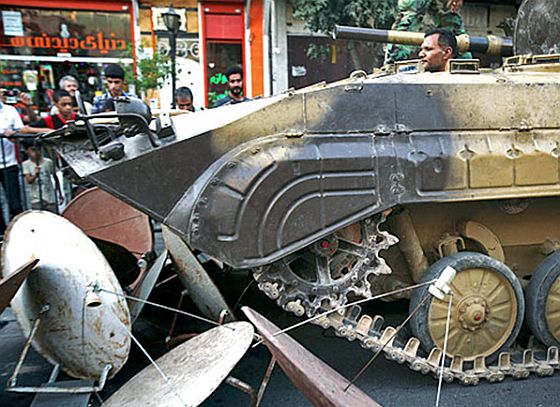
Satellite dishes in Shiraz being crushed by Iran's Revolutionary Guard tank.

Satellite dishes in Shiraz being crushed by Iran's Revolutionary Guard tank.

IranWire reports: Just two days after President Hassan Rouhani laughed off a question about access to satellite television in Iran during a press conference in New York, the Revolutionary Guards’ Fajr Brigade sent a tank into Shiraz to crush 800 pieces of satellite equipment.

“The Iranian government’s objective is to provide free access to information for the people,” Rouhani said during his Asia Society press conference. “Presently even Iranian villages have access to satellite [television]; all you have to do is to look at their rooftops.”

While period sweeps on satellite dishes and more recently satellite dish workshops are a feature of life in the Islamic Republic, a costly cat and mouse game between the authorities and citizens who seek free access to global culture and information, the Revolutionary Guards’ tank pageant is unprecedented in its violent show of force.

The timing raises questions as to whether powerful regime forces like the Revolutionary Guards will seek to obstruct his reforms and tar the image of moderation he seeks to present to the world. [Continue reading…]

Facebooktwittermail

Remember Cairo?

Shadi Hamid and Peter Mandaville write: With the world focused on the crisis in Syria and the possibility of a U.S.-Iranian détente, the fact that Egypt’s political situation is going from bad to worse has flown under the political radar. Much to the relief of the generals in Cairo — and likely also some members of U.S. President Barack Obama’s Middle East policy team — the United States appears to be kicking another difficult regional policy decision down the road.

This is a mistake. By countenancing the July 3 coup and the military’s subsequent crackdown on the supporters of ousted President Mohamed Morsy, the United States may be helping to sow seeds that could ripen into a costly and deeply destabilizing insurgency for years to come.

The Obama administration responded to the military crackdown, which resulted in more than 1,000 deaths, with the diplomatic equivalent of a few light raps on the knuckles of Egypt’s generals. It canceled joint military exercises with Egypt and announced that the White House’s national security staff would begin a comprehensive review of bilateral aid. Since late August, a recommendation to suspend the majority of U.S. military assistance to Cairo has been sitting with the president. Meanwhile, Egyptian security forces have re-escalated their campaign against the Muslim Brotherhood, raiding the movement’s strongholds and arresting the few remaining senior Brotherhood figures not already in custody.

The Obama administration knows that things are not going well in Egypt. U.S. officials — privately and rather halfheartedly — tried to walk back Secretary of State John Kerry’s bizarre claim that Egypt’s military leaders were “restoring democracy” and have also delayed delivery of F-16 fighters to Egypt. However, Washington’s overall response to the undoing of Egypt’s democratic process has not come close to matching the gravity of the crisis.

The Obama administration’s anemic response is indicative of the larger strategic drift of America’s response to the 2011 Arab uprisings. In the immediate aftermath of the revolutions in Egypt and Tunisia, Obama admitted that the United States had not pushed hard enough for democracy in the Arab world, and he promised a new way of doing business in the region. At arguably every major juncture since then, however, whenever Washington has had the opportunity to demonstrate its support for genuine democracy in Egypt, it has instead opted for some version of the “authoritarian bargain” that characterized U.S. regional policy for decades. [Continue reading…]

Facebooktwittermail

Westerners’ smuggled letters offer glimpse of Egyptian prisons

The New York Times reports on the conditions inside Egypt’s prisons revealed through the accounts provided by several Western prisoners including a United States citizen, Mohamed Soltan.

Mr. Soltan is a 25-year-old graduate of Ohio State University who moved to Egypt in February to work in the petroleum industry, said his sister, Hanaa Soltan, a clinical social worker in Washington, D.C.

Their father, Salah Soltan, a professor at Cairo University, is an outspoken member of the Muslim Brotherhood but hardly a die-hard. He made headlines in September when he publicly apologized for the Brotherhood’s mistakes, including failing to ally with liberal activists. Brotherhood officials dismissed the apology as Mr. Soltan’s personal views, and a few days later he, too, was arrested.

Ms. Soltan said her brother had been an opponent of the Brotherhood “and very vocal about it as well.”

But she said that after Gen. Abdul-Fattah el-Sisi responded to a wave of mass protests by ousting Mr. Morsi, her brother joined a Brotherhood-led sit-in at Rabaa Square here to defend what he considered the norms of American-style democracy. “He thought it did not matter how incompetent the elected leaders are,” she said. “There is no hope of realizing the fruits of the revolution if you don’t respect democracy and you throw out the results of the ballots on the basis of displeasure at someone’s missteps.”

Mr. Soltan was shot in the arm on Aug. 14, when security forces broke up sit-ins at Rabaa and another square, killing nearly a thousand people. He was recovering from surgery to remove the bullet when the police raided his home and arrested him, he wrote in his letter, which he addressed to his mother.

Thrown into a group cell nicknamed The Fridge, “a room without seats, benches, windows and lights,” he recalled that one guard joked “that he could get me anything I wanted, drugs, alcohol, prostitutes. Just not due process.”

Mr. Soltan wrote that he was blindfolded and questioned the next morning and told he would be charged with six crimes, none of which, he said, had “any basis in reality,” including “membership in a terrorist organization, membership in an armed militia, disturbing the peace, falsifying and spreading rumors about the internal affairs of Egypt, and finally, the killing of protesters.” (Interior Ministry officials have sometimes argued, implausibly, that Brotherhood snipers fired at the Brotherhood’s supporters.)

Mr. Soltan expressed shock and surprise over a ritual that Egyptians consider standard for criminal suspects: The detainees ran between rows of security officers who struck them with rocks and sticks, known here sarcastically as the Tashreefa, or honoring ceremony.

“The officers stripped off our pants and shirts as they beat us with clubs,” he wrote. [Continue reading…]

Facebooktwittermail

Syria: Fuel-air bombs strike school

Human Rights Watch: A Syrian government airstrike using fuel-air explosive bombs hit outside a secondary school in the opposition-held city of Raqqa on September 29, 2013, killing at least 14 civilians. At least 12 of those killed were students attending their first day of classes.

A Raqqa resident who went to the school immediately after the attack told Human Rights Watch that he saw 14 bodies, including some without limbs. A doctor from National Hospital in Raqqa said he saw 12 dead bodies, most of them students, and the hospital treated 25 wounded.

The blast wounds and flash burns visible on victims in videos and photographs, coupled with the body positions and few shrapnel wounds, indicates the use of fuel-air explosives (FAE), also known as “vacuum bombs,” Human Rights Watch said. More powerful than conventional high-explosive munitions of comparable size, fuel-air explosivesinflict extensive damage over a wide area, and are therefore prone to indiscriminate impact in populated areas.

“While the world tries to bring Syria’s chemical weapons under control, government forces are killing civilians with other extremely powerful weapons,” said Priyanka Motaparthy, Middle East child rights researcher at Human Rights Watch. “Even students on their first day of school are not safe.” [Continue reading…]

Facebooktwittermail

Israel puts ‘Iranian spy’ on display but has yet to charge him after 20 days of detention

Ali Mansouri, an Iranian-born Belgian citizen also known as Alex Mans, was arrested by Israel’s internal security services Shin Bet on September 11. His possession of a couple of nondescript photographs in which the U.S. embassy in Tel Aviv can be seen, has been presented as evidence that he was engaged in espionage. (Anyone who wants to find better photos of the embassy just has to use Google.)

The fact that after 20 days in detention (during the first nine of which Mansouri was prevented from consulting a lawyer) investigators don’t appear to have found sufficient evidence to put him on trial, might explain why he has yet to be charged.

At the same time, Israeli authorities were shameless in trying to exploit the political value of holding an Iranian in handcuffs as he was put on display for the press today.

Reuters reports: A man arrested on suspicion of being an Iranian spy appeared in an Israeli court on Monday and some Israeli analysts questioned the timing of the affair, suggesting it was being showcased as part of efforts to discredit Tehran’s new opening to Washington.

As Prime Minister Benjamin Netanyahu flew on Sunday to the United States for a visit focused on Iran’s nuclear program, Israel’s Shin Bet security service announced that Ali Mansouri had been arrested on September 11 on suspicion of spying for the Iranian Revolutionary Guards.

It said Mansouri, a 55-year-old Iranian-Belgian national, had photographed the U.S. Embassy in Tel Aviv and intended to establish business ties in Israel as a cover for espionage.

An Israeli official told reporters on Netanyahu’s flight that Mansouri’s picture-taking outside the embassy – whose exterior can be seen in numerous images on the Internet – was an attempt “to collect intelligence for a possible terror attack”.

That allegation was challenged by Mansouri’s lawyer, Michal Okabi, after a hearing on Monday in a court in the Tel Aviv suburb of Petah Tikva in which the suspect, who did not speak, was ordered held for eight more days.

“The apocalyptic picture that the Shin Bet is painting is a lot more complicated and the attempt to claim that our client came here in order to carry out attacks in Israel is far from reality and without foundation,” Okabi told reporters.

Some Israeli media commentators questioned the timing of the news, released in a Shin Bet statement that included photographs it said he had taken outside the beachfront mission and at Tel Aviv’s Ben-Gurion airport. No formal charges have been filed.

Asked by Reuters whether the decision to publicize Mansouri’s arrest was influenced by Netanyahu’s U.S. trip, the Shin Bet declined to comment.

Facebooktwittermail

Syrian militant Islamists denounce SNC and form ‘Islamic Alliance’

Charles Lister writes: In a video issued late on September 24, the chief political leader of Liwa al-Tawhid, Abdulaziz Salameh, speaking on behalf of 12 other Islamist militant groups in Syria, condemned the “unrepresentative” Western-backed Syrian National Coalition (SNC) and called explicitly for “an Islamic framework based on sharia [Islamic law].”

The video was issued along with a scanned statement, personally signed by the senior leadership of all 13 groups, encorporating existing members of the SNC, members of the hardline Salafist coalition the Syrian Islamic Front, and also Jabhat al-Nusra. As such, a new “Islamic Coalition” was formed.

All 13 groups – specifically, Jabhat al-Nusra, Harakat Ahrar al-Sham al-Islamiyya, Liwa al-Tawhid, Liwa al-Islam, Suqor al-Sham, Liwa al-Haq, Harakat Fajr al-Sham al-Islamiyya, Harakat al-Nour al-Islamiyya, Kataib Nour al-Din al-Zinki, Liwa al-Furqan, Liwa al-Ansar, Tajamu Fastaqm Kamr Umrat and Forqat al-Tisaa Ashr – represent Syria’s most sizeable and powerful insurgent groups. The inclusion of the core of the SNC force – incorporating Liwa al-Tawhid, Liwa al-Islam and Suqor al-Sham – effectively depletes the SNC’s armed wing, the Syrian Military Council (SMC). As all four groups were also members of the SNC-linked Syrian Islamic Liberation Front coalition, with Suqor al-Sham leader Sheikh Ahmed Abu Issa its leader, it is likely that that moderate Islamist coalition has ceased to exist as a single organisational structure.

The announcement is potentially extremely significant for the long-term nature of the Syrian opposition. The SNC has long been accused of retaining minimal on-the-ground control of insurgent groups technically under its command, and this public renunciation of its leadership and its political foundations will likely prove extremely damaging for its long-term role inside Syria. The group’s 13 signatories currently play the lead roles in insurgent theatres across Syria, particularly throughout the north, in Homs, Damascus and as far south as al-Quneitra governorate.

While the significant Aleppo-based Asifat al-Shamal did not sign into the alliance, it issued a written statement expressing support for its objectives. Meanwhile, moderate forces Alwia Ahfad al-Rasoul and Jabhat al-Asala wa Tanmia will likely remain the SMC’s most significant multi-governorate-level actors, although the latter notably without one of its key constituent groups, Kataib Nour al-Din al-Zinki. [Continue reading…]

Facebooktwittermail

Libya: In search of a strongman

Nicolas Pelham writes: It is perhaps a measure of how close Libya is to breaking apart that two years after ousting one dictator, many Libyans are craving another. Rapacious brigades of armed volunteers, who are based in Misrata and Benghazi in the east, and the creaking military inherited from the old regime, which is based in the capital city of Tripoli and the west, are hurtling toward a new civil war, and the country’s ineffectual authorities seem unable to stop them. Local militias have captured the oil fields and ports, starving the government of 90 percent of its revenues; Benghazi is rife with political assassinations; in the south, Colonel Qaddafi’s kinsmen have plugged the Great Man-Made River that funnels water from the Sahara’s vast aquifers to the coast; and tribesmen across the country sporadically cut off the roads or close the airports that tie the provinces to the capital. Libya’s current prime minister, Ali Zeidan, threatens to restore order with force, but his men retreat after a few shots. Confusion about whether to rely on the armed irregulars who revolted against Qaddafi or the instruments of the old regime only compounds his powerlessness.

Libyans overwhelmingly aspire to the dream of a new democratic order that animated the ideals of the revolution. But increasingly many consider such a system too delicate to overcome the country’s deep fissures. Since antiquity Libya has been a composite of separate principalities—Tripolitania in the west, Cyrenaica in the east, and Fezzan in the south—a division that has played out not only geographically and historically, but also ideologically, with the west gravitating towards the more laissez-faire Maghreb, and the east spawning religious movements, from early Christian communities to Omar Mukhtar, the warrior Muslim mystic who led the revolt against Italy’s colonial conquest. In July 2012, great numbers of the country’s six million people braved the lawless streets—where alarming numbers of weapons have proliferated since the revolution—to register and vote in the first free national election in half a century. As multiple forces assert power in different parts of the country, however, the old regional divisions have reemerged. Only a strongman, many feel, can hold Libya together. But who could it be?

The souqs buzz hopefully with names. Khalifa Haftar, Colonel Qaddafi’s old commander-in-chief, who led Libya’s army into a brutal but woefully unsuccessful invasion of Chad in 1987, appeals to those nostalgic for the old order. After abandoning his men in the Sahara, he fled to Virginia, and, backed by the CIA, schemed with little apparent success to usurp Libya’s crown. When Libya’s revolution erupted in February 2011, he returned with pomp and a convoy of plush cars as commander of Libya’s rebel ground forces.

Raised in the ways of Qaddafi, however, Haftar has failed to shake off criticism that he acts like him. A Western spy recalls meeting him during the revolution in a Libyan oil company’s offices in Benghazi, where he proudly displayed his battle plans for the assault on Tripoli on a tourist roadmap of Libya. Might the agent have a few radios to spare, he asked, so that he could talk to the front? His convoy continues to circle Libya like a medieval travelling court. [Continue reading…]

Facebooktwittermail

Libya: Must it get worse before it gets better?

The Economist reports: “The only road to paradise,” runs a joke doing the rounds in the cafés of Tripoli, Libya’s seafront capital, “is the one to the international airport.” Most Libyans still revel in the freedom and sense of possibility brought on by the NATO-backed war that ousted Colonel Muammar Qaddafi two years ago. “Yet before, when someone disappeared, you knew they were with Qaddafi forces,” reminisces a rebel-turned-security man. “Now we have no idea.” That was made clear earlier this month when the government denounced the kidnap of the daughter of Abdullah al-Senussi, Qaddafi’s former spy chief, only to discover that one of its own forces had nabbed her; she was freed a few days later.

Libya has hit its rockiest patch since Qaddafi’s demise. No one has managed to reassert full authority over the tribes, regions and groups welded together under the colonel’s iron rule. Institutions of state, absent under Qaddafi, have yet to take firm shape. In the past few weeks the country’s key oil ports have been blockaded by disgruntled workers and militias. Assassinations and carjackings are rife. Water and electricity have been cut off in Tripoli for the past week. On September 11th a bomb was defused in Tripoli; another went off in Benghazi, the cradle of the anti-Qaddafi revolt and the main city of the east.

Security is the biggest complaint. “A state at its most basic has a monopoly of force,” says Anas al-Gomati, who runs Sadeq, a Libyan think-tank. “Here you can argue that the government works for the militias.” The authorities, with Western help, are in the process of building an army and police force which are supposed to take over from the militias on its payroll, most notably the Supreme Security Committee (SSC), a collection of former rebels which functions as a temporary police force, and the Libyan Shield, a group of Islamist militias that form a quasi-army. But a third of the men in these groups will refuse to drop their guns and come under the authority of the new security forces, reckons Hasham Bisher, who heads Tripoli’s SSC. Islamists in particular are loth to disband, fearing they may then be suppressed, as they were under Qaddafi.

So the government’s ability to keep law and order outside Tripoli is weak—“and arguably within it too,” says Claudia Gazzini of International Crisis Group, a Brussels-based think-tank. The starkest illustration of this is the authorities’ inability to end the blockade that has reduced oil exports, the government’s main source of revenue, to under a tenth of the 1.6m barrels a day produced before the uprising. Some factions appear to be trying to sell oil to fund a campaign for federalism, with Benghazi as the capital of an autonomous eastern region. Others are protesting against the government’s general incompetence. [Continue reading…]

Facebooktwittermail

Ret. Gen. Boykin promotes End Times view of war in Syria

Mother Jones: Lt. Gen. Jerry Boykin, a top executive at the influential Family Research Council, has joined the chorus of religious conservatives touting the Syrian conflict as a prelude to Armageddon. On Wednesday, Boykin appeared on Prophetic Perspectives on Current Events, a talk show hosted by dominionist preacher Rick Joyner (see the video above). The pair discussed a passage in Isaiah 17, which predicts Damascus will be reduced to “a ruinous heap.”

“One of the scriptures that has never been fulfilled and has to be fulfilled before this age can end is that Damascus will be destroyed, never inhabited again,” Joyner explained. “What in the world could cause a city to be destroyed and never inhabited again?” Boykin didn’t hesitate. “One of the ways Damascus could be destroyed, never to be re-occupied, would be through a chemical attack,” he replied. ” So let’s just take a scenario: The Free Syrian Army takes Damascus and Bashar al-Assad is in a desperate mode now…. What would be his final act? Well it may very well be to unload all his chemical weapons on the population center there in Damascus. Destroy the city and destroy it in a way that he just kills maybe millions of people. But the byproduct is that he has residue there that could make Damascus uninhabitable and for a very long time.”

This is not the first time Boykin has embraced the notion that war in the Middle East will lay waste to the Syrian capital—and pave the way for Jesus’s return. He recently wrote an endorsement for Damascus Countdown, a fictionalized account of the looming biblical conflict by best-selling author Joel Rosenberg. And he has spoken at several of Ronseberg’s annual Epicenter Conferences, which explore the Middle East’s role in biblical prophesy.

Facebooktwittermail

Syrian opposition groups stop pretending

Rania Abouzeid writes: The pretense that the so-called Syrian opposition-in-exile speaks for those inside the country, never firm to begin with, was further exposed late on Tuesday, in a two-minute video statement called “Communiqué No. 1,” which was issued by eleven armed rebel groups that are influential in northern Syria. Their message was simple: the Western-backed hotel revolutionaries jetting from capital to capital, claiming leadership in the political National Coalition and an interim government-to-be, don’t speak for them—and they won’t listen to them. The new coalition, which has yet to announce its name, also said it wants Islamic Sharia law to be the basis of any future government, and that the various opposition parties should unite within “an Islamic framework.”

There has long been a disconnect between those fighting and bleeding inside Syria and the political and diplomatic machinations of those in exile. What is new here is that at least three of the eleven groups—Liwa al-Tawhid, Liwa al-Islam, and Suqour al-Sham—are aligned with the military wing of the National Coalition, the Supreme Military Council, which is supported by the West and is what passes for the leadership of the loose franchise outfit known as the Free Syrian Army (F.S.A.). Now they have publicly thrown in their lot with Jabhat al-Nusra, which also signed on to the statement and is connected to Al Qaeda.

This public alliance of affiliates of the F.S.A. and of Al Qaeda, however, is more of a shift on paper than a marked change in how things work on the ground. There has long been operational coördination on a local level—for a particular battle or in a certain geographic area. All that has really happened at this stage is that a fig leaf has dropped.

The fighting men within Syria have long despised their political and military leaders-in-exile. It’s common to hear them say, “We are in the khanadik”—trenches—“and they are in the fanadik,” hotels. In late August, four of the leaders of the F.S.A.’s five fronts said that the National Coalition—their own political counterparts—had no legitimacy. They threatened to resign from the Supreme Military Council because of, among other things, “the lying promises of those states who claim to be friends of Syria,” who have not provided assistance “worthy of the sacrifices of the Syrian people.”

The disunity goes deeper. Colonel Abdul-Jabbar Agaydee, the top F.S.A. commander in the northern city of Aleppo and a man who doesn’t spend his time in hotel lobbies, has lambasted the Supreme Military Council, of which he himself is a member, saying it is “completely disconnected from reality.” [Continue reading…]

Facebooktwittermail

Ruling Islamist party in Tunisia to step down

The New York Times reports: Tunisia’s governing Islamist party, Ennahda, thrust into power by the Arab Spring, has agreed to step down after months of political wrangling with a hard-bargaining opposition.

In three weeks, the Ennahda-led government is to hand over power to an independent caretaker government that will lead the country through elections in the spring. The deal comes as part of negotiations to restart Tunisia’s democratic transition after secular opposition groups, protesting the assassinations of two of their politicians, stalled work on a new constitution and an election law this summer.

The two sides will enter discussions this week mediated by the Tunisian General Labor Union, the nation’s largest. Its deputy secretary general, Bouali Mbarki, announced Ennahda’s acceptance of the plan on Saturday.

The move comes less than three months after the Islamist government of President Mohamed Morsi of Egypt, also elected during the Arab Spring uprisings, was ousted by the military.

Ennahda officials have repeatedly made statements in recent weeks signaling the party’s readiness to resign as a way to break the political impasse. The opposition, and the union, have until now pressed for more concrete action. [Continue reading…]

Facebooktwittermail