Category Archives: Lands

Trump handed Putin a stunning victory

Molly K McKew writes: President Donald Trump needed to accomplish two things this week during his visits to Poland and the G-20 Summit in Hamburg. First, he needed to reassure America’s allies that he was committed to collective defense and the core set of values and principles that bind us together. Second, he needed to demonstrate that he understands that the greatest threat to that alliance, those values, and our security is the Kremlin.

Trump delivered neither of these. In very concrete terms, through speech and action, the president signaled a willingness to align the United States with Vladimir Putin’s worldview, and took steps to advance this realignment. He endorsed, nearly in its totality, the narrative the Russian leader has worked so meticulously to construct.

The readout of Trump’s lengthy meeting with Putin included several key points. First, the United States will “move on” from election hacking issues with no accountability or consequences for Russia; in fact, the U.S. will form a “framework” with Russia to cooperate on cybersecurity issues, evaluating weaknesses and assessing potential responses jointly. Second, the two presidents agreed not to meddle in “each other’s” domestic affairs—equating American activities to promote democracy with Russian aggression aimed at undermining it, in an incalculable PR victory for the Kremlin. Third, the announced, limited cease-fire in Syria will be a new basis for cooperation between the U.S. and Russia; Secretary of State Rex Tillerson went so far as to say that the Russian approach in Syria—yielding mass civilian casualties, catastrophic displacement, untold destruction and erased borders—may be “more right” than that of the United States.

Each of these points represents a significant victory for Putin. Each of them will weaken U.S. tools for defending its interests and security from the country that defines itself as America’s “primary adversary.” Trump has ceded the battle space—physical, virtual, moral—to the Kremlin. And the president is going to tell us this is a “win.” [Continue reading…]


Facebooktwittermail

Once dominant, the United States finds itself isolated at G-20

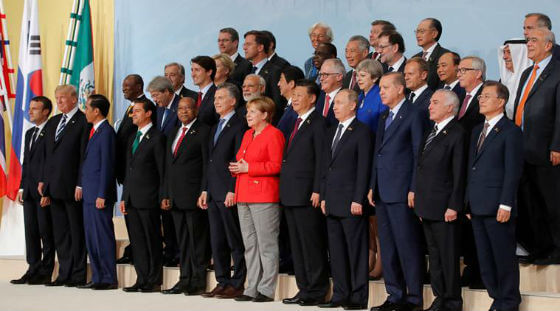
Trump was shunted to the far left and placed under Emmanuel Macron’s close supervision.

The New York Times reports: For years the United States was the dominant force and set the agenda at the annual gathering of the leaders of the world’s largest economies.

But on Friday, when President Trump met with 19 other leaders at the Group of 20 conference, he found the United States isolated on everything from trade to climate change, and faced with the prospect of the group’s issuing a statement on Saturday that lays bare how the United States stands alone.

Chancellor Angela Merkel of Germany, the host of the meeting, opened it by acknowledging the differences between the United States and the rest of the countries. While “compromise can only be found if we accommodate each other’s views,” she said, “we can also say, we differ.”

Ms. Merkel also pointed out that most of the countries supported the Paris accord on climate change, while Mr. Trump has abandoned it. “It will be very interesting to see how we formulate the communiqué tomorrow and make clear that, of course, there are different opinions in this area because the United States of America regrettably” wants to withdraw from the pact, she said.

Mr. Trump seemed to relish his isolation. For him, the critical moment of Friday was his long meeting with the Russian president, Vladimir V. Putin, which seemed to mark the reset in relations that Mr. Trump has been desiring for some time. It also provided Mr. Putin the respect and importance he has long demanded as a global partner to Washington.

Where previous American leaders saw their power as a benevolent force, and were intent on spreading prosperity through open markets and multilateral cooperation, Mr. Trump has portrayed himself as a nationalist, a unilateralist and a protectionist, eager to save American jobs.

What recent events have underscored, though — and especially at the G-20 — is that no nation is today large or powerful enough to impose rules on everyone else. In advancing his views, Mr. Trump has alienated allies and made the United States seem like its own private island. [Continue reading…]

Facebooktwittermail

U.S. plans to test THAAD missile defenses as North Korea tensions mount

Reuters reports: The United States plans to carry out a new test of its THAAD missile defense system against an intermediate-range ballistic missile in the coming days, two U.S. officials told Reuters on Friday, as tensions with North Korea climb.

Despite being planned months ago, the U.S. missile defense test will gain significance in the wake of North Korea’s launch of an intercontinental ballistic missile (ICBM) on July 4 that has heightened concerns about the threat from Pyongyang.

The test will be the first of the Terminal High Altitude Area Defense (THAAD) to defend against a simulated attack by an intermediate-range ballistic missile (IRBM), one of the officials said. The THAAD interceptors will be fired from Alaska.

The United States has THAAD interceptors in Guam that are meant to help guard against a missile attack from a country such as North Korea. [Continue reading…]

Facebooktwittermail

225 years ago Alexander Hamilton anticipated the rise of Trump and the subversion of American democracy

On August 18, 1792, Alexander Hamilton wrote: The truth unquestionably is, that the only path to a subversion of the republican system of the Country is, by flattering the prejudices of the people, and exciting their jealousies and apprehensions, to throw affairs into confusion, and bring on civil commotion….

When a man unprincipled in private life desperate in his fortune, bold in his temper, possessed of considerable talents, having the advantage of military habits—despotic in his ordinary demeanour—known to have scoffed in private at the principles of liberty—when such a man is seen to mount the hobby horse of popularity—to join in the cry of danger to liberty—to take every opportunity of embarrassing the General Government & bringing it under suspicion—to flatter and fall in with all the non sense of the zealots of the day—It may justly be suspected that his object is to throw things into confusion that he may “ride the storm and direct the whirlwind.” [Continue reading…]

Facebooktwittermail

Trump accepts Putin’s word that Russia didn’t hack the U.S. election, says Lavrov

The Washington Post reports: Eight months after an unprecedented U.S election — one that U.S. intelligence agencies say the Russian government tried to sway — President Trump and President Vladimir Putin sat for their first meeting on Friday, a friendly encounter that ended in confusion over whether Trump accepted assurances that the Kremlin was innocent of any wrongdoing during the campaign.

Trump, believed to be the intended beneficiary of the Russian meddling, emerged from the extraordinary meeting — which dragged so long that Trump’s wife tried once to break it up — with a deal including Russia and Jordan on a partial Syrian ceasefire. The agremeent would mark the first time Washington and Moscow had operated together in Syria to try to reduce the violence.

But there were no grand bargains on U.S. sanctions on Russia, the Ukraine crisis or the other issues that have divided the nations for years.

The meeting, on the sidelines of the Group of 20 summit, opened with Trump telling Putin it was an “honor to be with you.” In the closed-door discussion, Trump pressed Putin “on more than one occasion” on Russia’s interference in the 2016 presidential elections, Secretary of State Rex Tillerson, who attended the two-hour-and-16-minute meeting, told reporters.

Tillerson said “President Putin denied such involvement” but agreed to organize talks “regarding commitments of noninterference in the affairs of the United States and our democratic process.”

But Tillerson’s counterpart, Russian Foreign Minster Sergei Lavrov, said that Trump had heard out Putin’s assurances that Moscow did not run a hacking and disinformation effort, and dismissed the entire investigation into the Russian role.

“President Trump said that this campaign has taken on a rather strange character, because after many months, whenever these accusations are made, no facts are brought,” Lavrov told Russian reporters. “The U.S. president said that he heard clear statements from President Putin about this being untrue, and that he accepted these statements.”

The two presidents, he said, are “looking for mutually beneficial agreements and not trying to act out some confrontation scenarios, not trying to create problems out of nothing.” [Continue reading…]

Facebooktwittermail

Angela Merkel uses eyes and hands to try and convince Putin that North Korea fired an ICBM

The determination that North Korea fired an intercontinental ballistic missile (ICBM) this week is based on the extrapolation of its range if aimed on a standard trajectory rather than the very steep trajectory of its actual launch, as illustrated below:


In conversation with Vladamir Putin today, Angela Merkel appears to have had difficulty in pressing home the argument as her eyes tracked the steep trajectory of the missile:


Then she resorted to hand motions:

Facebooktwittermail

Cholera spreads as war and poverty batter Yemen

The New York Times reports: The Yemeni farm laborer was picking crops in a hot field when the call came. His children, all seven of them, had fallen gravely ill.

Some were vomiting, others had diarrhea, and all were listless, indicating that they had fallen victim to the latest disaster to afflict this impoverished corner of the Arabian Peninsula: one of the worst outbreaks of cholera infection in recent times.

The laborer, Abdulla Siraa, set about frantically trying to raise money to treat the children — $240, or about six times what he typically earns in a month — and raced as fast as he could on the 30 miles home over roads virtually destroyed in Yemen’s civil war.

“I spent the whole journey reciting Quranic verses and praying for the survival of my children,” he said.

But when he arrived, he learned that his 4-year-old daughter, Ghadeer, had already died, after hours of calling out for him, though the rest of his children would survive.

For much of the world, cholera, a bacterial infection spread by water contaminated with feces, has been relegated to the history books. In the 19th century, it claimed tens of millions of lives across the world, mainly through dehydration and electrolyte imbalance.

That ended with modern sanitation and water systems. When it pops up now, it is usually treated easily with rehydration solutions and, if severe, with antibiotics.

But the war currently battering Yemen has damaged infrastructure and deepened poverty, allowing the disease to come roaring back. Cholera is also on the rise in the Horn of Africa because of long-simmering conflicts there. Yemen’s African neighbors, Somalia, South Sudan, Ethiopia and Kenya, have had a total of about 96,000 cholera cases since 2014, international aid groups say.

The crises in Africa, however, pale in comparison to the one in Yemen. [Continue reading…]

Facebooktwittermail

Israel’s forthcoming security dilemma

Nadav Pollak writes: In recent weeks Israel and Hizballah continued a time-honored tradition that tends to flare up in the hot months of summer: exchanging harsh words and threats regarding what each side will do to the other in the next war. These are not empty threats. Each side has the ability to inflict tremendous damage on the other. But even though both sides are ready for a war, neither Israel nor Hizballah wants one now. The main purpose of their heated rhetoric is the maintenance of deterrence and alertness. However, a recent development might raise the temperature even more.

In a speech at the Herzliya Conference on June 22, Israel’s head of military intelligence, Maj. Gen. Herzi Halevi, basically confirmed prior reports in Arab media that the Iranian Revolutionary Guard Corps (IRGC) is working to establish an independent weapons industry in Lebanon focused on advanced missiles. This worrying development reportedly had become the focus of the Israel Defense Forces (IDF) and the Israeli cabinet in recent weeks, with some wondering if there will be a point at which Israel will need to execute a preemptive strike in Lebanon that might spark a war.

In recent years Israel attacked numerous arms shipments on their way to Hizballah. These advanced arms shipments reportedly included anti-ship missiles, surface-to-air missiles, and surface-to-surface ballistic missiles. Some of these missiles are accurate and can hit strategic sites in Israel, such as military bases and important civilian infrastructure. The Israeli prime minister and minister of defense time and time again said such capabilities in the hands of Hizballah would be a red line and insisted that Israel will act to prevent the flow of advanced weapons to the militant group. According to some estimates, Israel was able to destroy 60 percent of these advanced arms shipments. This might be cause for celebration, but it seems that these airstrikes changed something in Iran’s thinking.

Israeli media reported this week that the IRGC is pushing for a Hizballah-controlled advanced weapons industrial base because this would make Israel’s interdiction operations obsolete. Tehran likely hopes that Israel will avoid attacking Hizballah in Lebanon, fearing that such a direct attack might lead to war. As such, the closer the production line is to the customer, the better.

Iran’s calculus has some merit. It appears that Israel and Hizballah have an unspoken understanding: As long as Israel does not attack Hizballah on Lebanese soil and its attacks do not result in Hizballah casualties, the organization usually chooses not to retaliate. [Continue reading…]

Facebooktwittermail

Trump misrepresents intelligence findings on Russian interference in U.S. election

The New York Times reports: President Trump said on Thursday that only “three or four” of the United States’ 17 intelligence agencies had concluded that Russia interfered in the presidential election — a statement that while technically accurate, is misleading and suggests widespread dissent among American intelligence agencies when none has emerged.

The “three or four” agencies referred to by Mr. Trump are the Central Intelligence Agency, the National Security Agency, the F.B.I. and the Office of the Director of National Intelligence, all of which determined that Russia interfered in the election. Their work was compiled into a report, and a declassified version was released on Jan. 6 by the director of national intelligence. It said that all four agencies had “high confidence” that Russian spies had tried to interfere in the election on the orders of President Vladimir V. Putin.

The reason the views of only those four intelligence agencies, not all 17, were included in the assessment is simple: They were the ones tracking and analyzing the Russian campaign. The rest were doing other work.

The intelligence community is a sprawling enterprise that includes military officers who track enemy troop movements, accountants who analyze the finances of Islamist militants and engineers who design spy satellites. There are soldiers, sailors and Marines; tens of thousands of civilian government employees and tens of thousands of private contractors.

Asked about Russia’s election meddling during a news conference on Thursday in Poland, Mr. Trump repeated his familiar refrain that “it could” have been Russia or other countries that interfered in the election, and then appeared to suggest that there was hardly an intelligence community consensus on the matter.

“Let me just start off by saying I heard it was 17 agencies,” he said when asked about the intelligence assessment.

“I said, ‘Boy, that’s a lot.’ Do we even have that many intelligence agencies, right? Let’s check it. And we did some very heavy research,” Mr. Trump continued. “It turned out to be three or four — it wasn’t 17 — and many of your compatriots had to change their reporting, and they had to apologize, and they had to correct.”

Mr. Trump was also correct about inaccurate news reports. Some, including an article in The New York Times, incorrectly reported that all 17 American intelligence agencies had endorsed the assessment.

But there is no evidence that significant uncertainty or dissent exists across the intelligence community, simply because not all 17 were involved in the assessment of Russian interference. [Continue reading…]

Facebooktwittermail

Trump’s plan to team up with Putin in Syria — and leave Assad in power

The Daily Beast reports: For once, Rex Tillerson is not freelancing.

Late Wednesday, ahead of the first-ever meeting between Donald Trump and Vladimir Putin, the secretary of state suggested that the U.S. is willing to explore “joint mechanisms” with Russia to stabilize the vicious Syrian civil war.

After a dizzying series of policy shifts on Syria, administration and congressional sources tell The Daily Beast that Team Trump is introducing the beginnings of a new strategy for Syria—one that, in the short term at least:

• leaves dictator Bashar al-Assad in power;

• acquiesces to the idea of “safe zones” proposed by Russia and its allies;

• leans on cooperation from Moscow, including the use of Russian troops to patrol parts of the country.

It’s the sort of plan that observers have long suspected would ultimately emerge as Trump’s approach—despite his pledge that Assad has “no role” in governing the Syrian people. Top Trump aides from Jared Kushner to former national security adviser Michael Flynn have pushed for closer coordination with Russia on Syria for months. [Continue reading…]

Facebooktwittermail

Russians are suspects in nuclear site hackings, sources say

Bloomberg reports: Hackers working for a foreign government recently breached at least a dozen U.S. power plants, including the Wolf Creek nuclear facility in Kansas, according to current and former U.S. officials, sparking concerns the attackers were searching for vulnerabilities in the electrical grid.

The rivals could be positioning themselves to eventually disrupt the nation’s power supply, warned the officials, who noted that a general alert was distributed to utilities a week ago. Adding to those concerns, hackers recently infiltrated an unidentified company that makes control systems for equipment used in the power industry, an attack that officials believe may be related.

The chief suspect is Russia, according to three people familiar with the continuing effort to eject the hackers from the computer networks. One of those networks belongs to an aging nuclear generating facility known as Wolf Creek — owned by Westar Energy Inc., Great Plains Energy Inc. and Kansas Electric Power Cooperative Inc. — on a lake shore near Burlington, Kansas.

The possibility of a Russia connection is particularly worrisome, former and current officials say, because Russian hackers have previously taken down parts of the electrical grid in Ukraine and appear to be testing increasingly advanced tools to disrupt power supplies. [Continue reading…]

Facebooktwittermail

The message behind the murder: North Korea’s assassination sheds light on chemical weapons arsenal

The Washington Post reports: In a case with a thousand plot twists, there has been but one constant in the murder investigation of Kim Jong Nam: Nothing is ever what it seems.

The victim himself — the playboy half brother of North Korean leader Kim Jong Un — was traveling under false papers when he died and had to be identified using DNA. The two women accused of killing him turned out to be hired dupes, paid a few dollars to perform what they thought was a reality-TV stunt.

Stranger still was the murder weapon, liquid VX, a toxin so powerful that a few drops rubbed onto the skin killed the victim in minutes, yet it failed to harm the two women who applied the poison with their bare hands. Even more mysterious: why North Korea would go to extravagant lengths to use a battlefield-grade chemical weapon on foreign soil, only to work equally hard to cover its tracks.

For the prosecutors preparing for the first court hearings later this month, some of the mysteries behind Kim Jong Nam’s death inside a Malaysian airport terminal will likely never be resolved. But nearly five months after the killing, U.S. and Asian officials have a clearer view of the attack’s significance. In carrying out history’s first state-sponsored VX assassination in a country 3,000 miles from its borders, North Korea has demonstrated a new willingness to use its formidable arsenal of deadly toxins and poisons to kill or intimidate enemies on foreign soil, analysts say.

Seen in the light of North Korea’s recent flurry of provocative missiles tests, Kim Jong Nam’s killing now looks to many experts like a proving exercise for a weapons system — in this case, a robust chemical-weapons stockpile that Pyongyang is thought to have built over decades and kept carefully under wraps. [Continue reading…]

Facebooktwittermail

Jerry Brown to announce a climate summit meeting in California

The New York Times reports: Even before President Trump took office, Gov. Jerry Brown of California let it be known he was ready to do battle over climate change, vowing in December that California would launch its own satellite if Mr. Trump cut funding for federal space missions.

On Thursday evening, Governor Brown will mount a new challenge to the administration on climate change. In a videoconference address to a global citizen festival in Hamburg, Germany, where President Trump and other officials will negotiate wording of a statement on the Paris climate change accord, Governor Brown will issue a sweeping invitation to a global “climate action” summit meeting in San Francisco.

“Look, it’s up to you and it’s up to me and tens of millions of other people to get it together to roll back the forces of carbonization and join together to combat the existential threat of climate change,” Brown will tell the thousands of people expected to attend the festival. In the message, a preview of which was provided by aides, he will invite “entrepreneurs, singers, musicians, mathematicians, professors” and others who represent “the whole world” to the September 2018 conference in San Francisco. [Continue reading…]

Facebooktwittermail

North Korea’s newly tested ICBM can likely reach targets throughout most of the continental United States

Jeffrey Lewis writes: it is important to understand that 7,000 km is the range that North Korea demonstrated. It is minimum. Those of us who study proliferation are now in the process of modeling the missile to determine its maximum range. And I don’t like what I see.

The new missile appears to share a lot of common characteristics with the new missile, called the Hwasong-12, tested on May 14. My colleagues at the Middlebury Institute, along with friends at the Union of Concerned Scientists, have been modeling this missile very carefully. We measured its length and width, located the weld lines that showed where the propellant tanks are located, estimated its weight by analyzing the crane that lifted it into place, and determined the power of its engine by tracking the missile’s acceleration down to the tenth of a second.

We concluded that this missile is larger than most experts initially thought. Moreover, it has a much better engine and more efficient airframe than anything North Korea has ever built.

The Hwasong-12 was large. The Hwasong-14 is larger still. It appears to be wider than the Hwasong-12, and has a second stage—a missile on top of a missile—that extends its range. Although it is too early to offer a definitive judgment about the full capability of the Hwasong-14, a two-stage missile of this size and sophistication should be able to deliver a nuclear weapon-size payload much farther than just Alaska, to targets throughout most of the continental United States.

It is possible that North Korea’s Hwasong-14 underperformed. But it is more likely that North Korea simply did not test the missile to its full range, wanting to bring it down into the sea. That is fairly straightforward for rockets that use liquid fuel, where it is possible to simply stop the engine to reduce the range.

China, for instance, conducted several reduced range tests of its DF-5 ICBM before conducting a full-range test in 1980. Another test fell short because the second stage engine turned off a few seconds too soon. Whatever happened, the capabilities demonstrated this week are probably not the full capability of the missile.

The bottom line is that there is no reason at this point to conclude that the Hwasong-14 has a range of “only” 7,000 km or that it is just Alaska that is within range. The technologies on display in the Hwasong-12 and Hwasong-14 suggest that the latter is much more capable. And there is no reason to think that North Korea cannot build an ICBM that can reach anywhere in the United States.

That isn’t a reason to panic. But it is a reason to face squarely the reality that North Korea is a nuclear-weapons state that can target the United States. [Continue reading…]


Facebooktwittermail

Pentagon is confident that U.S. might be able to intercept an incoming North Korean nuclear missile

Reuters reports: Not everybody asserts as confidently as the Pentagon that the U.S. military can defend the United States from the growing threat posed by North Korea’s intercontinental ballistic missile capability.

Pyongyang’s first test on Tuesday of an ICBM with a potential to strike the state of Alaska has raised the question: How capable is the U.S. military of knocking down an incoming missile or barrage of missiles?

Briefing reporters on Wednesday, Pentagon spokesman Navy Captain Jeff Davis said: “We do have confidence in our ability to defend against the limited threat, the nascent threat that is there.”

Davis cited a successful test in May in which a U.S.-based missile interceptor knocked down a simulated incoming North Korean ICBM. But he acknowledged the test program’s track program was not perfect.

“It’s something we have mixed results on. But we also have an ability to shoot more than one interceptor,” Davis said.

An internal memo seen by Reuters also showed that the Pentagon upgraded its assessment of U.S. defenses after the May test.

Despite hundreds of billions of dollars spent on a multi-layered missile defense system, the United States may not be able to seal itself off entirely from a North Korean intercontinental ballistic missile attack. [Continue reading…]

Facebooktwittermail

How Trump could tweet his way into nuclear war with North Korea

Laura Rosenberger writes: North Korea’s apparent test of an intercontinental ballistic missile puts it closer to having the ability to hit the United States with a nuclear warhead. This is an extraordinarily dangerous development.

I worked on North Korea policy in both the George W. Bush and Obama administrations, at the State Department and on the National Security Council, so I know firsthand just how difficult the challenges posed by North Korea are to deal with. I know how constrained the policy options are, and I’m familiar with the many difficult choices involved in selecting from a menu of bad options. And I know the incredibly complicated coordination — both within our own government, and with our allies and partners — that is necessary to implement a strategy to handle it.

But President Trump’s reaction to North Korea’s missile test was to immediately reach for his phone and sound off with chest-thumping statements on Twitter. This is a very reckless reaction, and one that risks miscalculation by adversary and ally alike.


North Korea will parse every word of Trump’s Twitter statements to try to understand what they mean. That’s because North Korea uses its own propaganda mouthpieces in an intricate way to signal its intentions to both internal and external audiences. As a government official working on North Korea, I spent hours working with analysts poring over North Korean statements to understand Pyongyang’s thinking — whether and how it differs from past statements — and cutting through the bluster to identify the core point it was communicating. Its words are carefully chosen, and it uses different formulas to send different signals.

We know from watching Pyongyang’s reactions to previous U.S. statements that it read our words in a similar way. North Korean officials will look for clear signals of intention in Trump’s tweets. The problem is, it’s not clear that Trump has any idea what his intentions are. He is sending signals that foreign officials will attach meanings to — meanings he may not have intended and might not even realize he’s sending. [Continue reading…]

Facebooktwittermail

Four things to know about North and South Korea

File 20170705 21675 xudwrd
People watch news of missile test on a public TV screen in North Korea.
AP Photo/Jon Chol Jin

By Ji-Young Lee, American University School of International Service

Editor’s note: North Korea tested what it claims was an intercontinental ballistic missile at 9:40 a.m. Pyongyang time on July 3. Some analysts say this is evidence that Alaska is now within striking distance of nuclear weapons held by strongman Kim Jong Un.

In response, the U.S. conducted joint military exercises with South Korea, and President Donald Trump accused China of supporting the North Korean government through trade.

Professor Ji-Young Lee of American University answers four questions to help put this conflict into context.


Why is there a North and a South Korea?

Before there was a South and North Korea, the peninsula was ruled as a dynasty known as Chosŏn, which existed for more than five centuries, until 1910. This period, during which an independent Korea had diplomatic relations with China and Japan, ended with imperial Japan’s annexation of the peninsula. Japan’s colonial rule lasted 35 years.

When Japan surrendered to the Allies in 1945, the Korean peninsula was split into two zones of occupation – the U.S.-controlled South Korea and the Soviet-controlled North Korea. Amid the growing Cold War tensions between Moscow and Washington, in 1948, two separate governments were established in Pyongyang and Seoul. Kim Il-Sung, leader of North Korea, was a former guerrilla who fought under Chinese and Russian command. Syngman Rhee, a Princeton University-educated staunch anti-communist, became the first leader of South Korea.

Continue reading

Facebooktwittermail