The Guardian reports: Iraqi forces have advanced to the base of the toppled minaret of Mosul’s Great Mosque of al-Nuri, hours after it was destroyed by Islamic State militants, as the bitter eight-month battle to recapture the city reached a tipping point.
The destruction of the mosque marked a pivotal moment in the war against Isis, which declared its now withered caliphate from there three years ago. The terror group’s wanton act of sabotage was widely seen as a harbinger of its imminent defeat.
Across northern Iraq, only a portion of Mosul’s old city and a small adjoining neighbourhood remain under Isis control. The nearby towns of Tel Afar and Hweija, both of which are surrounded, make up the remainder of the group’s territory, a mere sliver of the lands over which it had lorded at the height of its power in mid-2014.
As its fortunes have turned, the group’s remaining members have fled Iraq for the deserts of Syria. So rapid has been their capitulation that plans are now being drafted for a decisive battle later this year, somewhere between the Syrian and Jordanian borders, areas far from those that Isis had coveted.
Lined up in pursuit are a range of players who had have staked claims throughout the fight with Isis, as well as parallel regional conflicts, and have waited for the time to consolidate. As the organisation crumbles, all sides have now started competing for an edge, who gets to define what emerges from the collapse of Isis is a prize bigger than winning the war itself. [Continue reading…]
Category Archives: Lands
Obama’s secret struggle to punish Russia for Putin’s election assault
The Washington Post reports: Early last August, an envelope with extraordinary handling restrictions arrived at the White House. Sent by courier from the CIA, it carried “eyes only” instructions that its contents be shown to just four people: President Barack Obama and three senior aides.
Inside was an intelligence bombshell, a report drawn from sourcing deep inside the Russian government that detailed Russian President Vladimir Putin’s direct involvement in a cyber campaign to disrupt and discredit the U.S. presidential race.
But it went further. The intelligence captured Putin’s specific instructions on the operation’s audacious objectives — defeat or at least damage the Democratic nominee, Hillary Clinton, and help elect her opponent, Donald Trump.
At that point, the outlines of the Russian assault on the U.S. election were increasingly apparent. Hackers with ties to Russian intelligence services had been rummaging through Democratic Party computer networks, as well as some Republican systems, for more than a year. In July, the FBI had opened an investigation of contacts between Russian officials and Trump associates. And on July 22, nearly 20,000 emails stolen from the Democratic National Committee were dumped online by WikiLeaks. [Continue reading…]
Saudi and allied autocrats demand Qatar shuts down Al Jazeera
Reuters reports: Four Arab states boycotting Qatar over alleged support for terrorism have sent Doha a list of 13 demands including closing Al Jazeera television and reducing ties to their regional adversary Iran, an official of one of the four countries said.
The demands aimed at ending the worst Gulf Arab crisis in years appear designed to quash a two decade-old foreign policy in which Qatar has punched well above its weight, striding the stage as a peace broker, often in conflicts in Muslim lands.
Doha’s independent-minded approach, including a dovish line on Iran and support for Islamist groups, in particular the Muslim Brotherhood, has incensed some of its neighbors who see political Islamism as a threat to their dynastic rule.
The list, compiled by Saudi Arabia, the United Arab Emirates (UAE), Egypt and Bahrain, which cut economic, diplomatic and travel ties to Doha on June 5, also demands the closing of a Turkish military base in Qatar, the official told Reuters.
Turkey’s Defense Minister Fikri Isik rejected the demand, saying any call for the base to be shut would represent interference in Ankara’s relations with Doha. He suggested instead that Turkey might bolster its presence.
“Strengthening the Turkish base would be a positive step in terms of the Gulf’s security,” he said. “Re-evaluating the base agreement with Qatar is not on our agenda.” [Continue reading…]
In an editorial, the New York Times says: [B]y attacking Al Jazeera, the Saudis and their neighbors are trying to eliminate a voice that could lead citizens to question their rulers. Al Jazeera was the prime source of news as the Arab Spring rocked the Middle East in 2011.
That uprising ousted the military-backed autocrat Hosni Mubarak and led to Egypt’s first free election, which brought the Muslim Brotherhood to power. A loose political network founded in Egypt in 1928, the Muslim Brotherhood has renounced violence. The real reason it’s been labeled a terrorist group is that autocratic regimes see it as a populist threat. [Continue reading…]
For CNBC, Abid Ali writes: Al-Jazeera has been a constant thorn in the side of its neighbors. The news network was the first independent media network in the Middle East winning plaudits with more than 20 years of broadcasting. But after the Arab Spring, Doha was forced to tone down coverage to maintain stability in neighboring countries, especially in Bahrain.
Qatar has been forging an independent foreign policy since the discovery of gas and a palace coup where the former Emir ousted his pro-Saudi leaning father. Since 1995 the country has been on a tear with a construction boom reshaping the desert state. While Qataris are the world’s richest per capita ($130,000), in neighboring Saudi Arabia more than 35 percent live under the national poverty line.
“The State of Qatar recognizes that a decision to close Al-Jazeera will infringe on their sovereignty,” Wadah Khanfar, the former director general of Al-Jazeera, told CNBC in a phone interview. “The independence of the state is at risk. If they move against Al-Jazeera what next? They will stand firm.” [Continue reading…]
Election hackers altered voter rolls, stole private data, officials say
Time reports: The hacking of state and local election databases in 2016 was more extensive than previously reported, including at least one successful attempt to alter voter information, and the theft of thousands of voter records that contain private information like partial Social Security numbers, current and former officials tell TIME.
In one case, investigators found there had been a manipulation of voter data in a county database but the alterations were discovered and rectified, two sources familiar with the matter tell TIME. Investigators have not identified whether the hackers in that case were Russian agents.
The fact that private data was stolen from states is separately providing investigators a previously unreported line of inquiry in the probes into Russian attempts to influence the election. In Illinois, more than 90% of the nearly 90,000 records stolen by Russian state actors contained drivers license numbers, and a quarter contained the last four digits of voters’ Social Security numbers, according to Ken Menzel, the General Counsel of the State Board of Elections. [Continue reading…]
U.S. lags behind much of developed world in social progress
Bloomberg reports: America leads the world when it comes to access to higher education. But when it comes to health, environmental protection, and fighting discrimination, it trails many other developed countries, according to the Social Progress Imperative, a U.S.-based nonprofit.
The results of the group’s annual survey, which ranks nations based on 50 metrics, call to mind other reviews of national well-being, such as the World Happiness Report released in March, which was led by Norway, Denmark, and Iceland, or September’s Lancet study on sustainable development. In that one, Iceland, Singapore, Sweden, and the U.S. took spots 1, 2, 3, and 28—respectively.
The Social Progress Index released this week is compiled from social and environmental data that come as close as possible to revealing how people live. “We want to measure a country’s health and wellness achieved, not how much effort is expended, nor how much the country spends on healthcare,” the report states. Scandinavia walked away with the top four of 128 slots. Denmark scored the highest. America came in at 18. [Continue reading…]
How an entire nation became Russia’s test lab for cyberwar
Wired reports: The clocks read zero when the lights went out.
It was a Saturday night last December, and Oleksii Yasinsky was sitting on the couch with his wife and teenage son in the living room of their Kiev apartment. The 40-year-old Ukrainian cybersecurity researcher and his family were an hour into Oliver Stone’s film Snowden when their building abruptly lost power.
“The hackers don’t want us to finish the movie,” Yasinsky’s wife joked. She was referring to an event that had occurred a year earlier, a cyberattack that had cut electricity to nearly a quarter-million Ukrainians two days before Christmas in 2015. Yasinsky, a chief forensic analyst at a Kiev digital security firm, didn’t laugh. He looked over at a portable clock on his desk: The time was 00:00. Precisely midnight.
Yasinsky’s television was plugged into a surge protector with a battery backup, so only the flicker of images onscreen lit the room now. The power strip started beeping plaintively. Yasinsky got up and switched it off to save its charge, leaving the room suddenly silent.
He went to the kitchen, pulled out a handful of candles and lit them. Then he stepped to the kitchen window. The thin, sandy-blond engineer looked out on a view of the city as he’d never seen it before: The entire skyline around his apartment building was dark. Only the gray glow of distant lights reflected off the clouded sky, outlining blackened hulks of modern condos and Soviet high-rises.
Noting the precise time and the date, almost exactly a year since the December 2015 grid attack, Yasinsky felt sure that this was no normal blackout. He thought of the cold outside—close to zero degrees Fahrenheit—the slowly sinking temperatures in thousands of homes, and the countdown until dead water pumps led to frozen pipes.
That’s when another paranoid thought began to work its way through his mind: For the past 14 months, Yasinsky had found himself at the center of an enveloping crisis. A growing roster of Ukrainian companies and government agencies had come to him to analyze a plague of cyberattacks that were hitting them in rapid, remorseless succession. A single group of hackers seemed to be behind all of it. Now he couldn’t suppress the sense that those same phantoms, whose fingerprints he had traced for more than a year, had reached back, out through the internet’s ether, into his home.
The Cyber-Cassandras said this would happen. For decades they warned that hackers would soon make the leap beyond purely digital mayhem and start to cause real, physical damage to the world. In 2009, when the NSA’s Stuxnet malware silently accelerated a few hundred Iranian nuclear centrifuges until they destroyed themselves, it seemed to offer a preview of this new era. “This has a whiff of August 1945,” Michael Hayden, former director of the NSA and the CIA, said in a speech. “Somebody just used a new weapon, and this weapon will not be put back in the box.”
Now, in Ukraine, the quintessential cyberwar scenario has come to life. Twice. On separate occasions, invisible saboteurs have turned off the electricity to hundreds of thousands of people. Each blackout lasted a matter of hours, only as long as it took for scrambling engineers to manually switch the power on again. But as proofs of concept, the attacks set a new precedent: In Russia’s shadow, the decades-old nightmare of hackers stopping the gears of modern society has become a reality. [Continue reading…]
In Yemen’s secret prisons, UAE tortures and U.S. interrogates
The Associated Press reports: Hundreds of men swept up in the hunt for al-Qaida militants have disappeared into a secret network of prisons in southern Yemen where abuse is routine and torture extreme — including the “grill,” in which the victim is tied to a spit like a roast and spun in a circle of fire, an Associated Press investigation has found.
Senior American defense officials acknowledged Wednesday that U.S. forces have been involved in interrogations of detainees in Yemen but denied any participation in or knowledge of human rights abuses. Interrogating detainees who have been abused could violate international law, which prohibits complicity in torture.
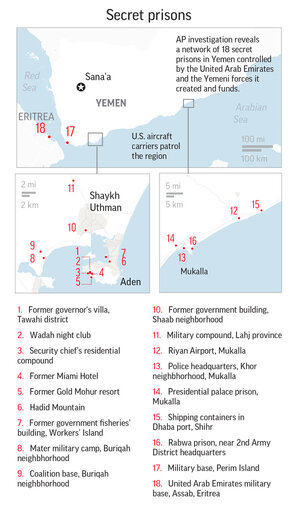
The AP documented at least 18 clandestine lockups across southern Yemen run by the United Arab Emirates or by Yemeni forces created and trained by the Gulf nation, drawing on accounts from former detainees, families of prisoners, civil rights lawyers and Yemeni military officials. All are either hidden or off limits to Yemen’s government, which has been getting Emirati help in its civil war with rebels over the last two years.
The secret prisons are inside military bases, ports, an airport, private villas and even a nightclub. Some detainees have been flown to an Emirati base across the Red Sea in Eritrea, according to Yemen Interior Minister Hussein Arab and others.
Several U.S. defense officials, speaking on condition of anonymity to discuss the topic, told AP that American forces do participate in interrogations of detainees at locations in Yemen, provide questions for others to ask, and receive transcripts of interrogations from Emirati allies. They said U.S. senior military leaders were aware of allegations of torture at the prisons in Yemen, looked into them, but were satisfied that there had not been any abuse when U.S. forces were present. [Continue reading…]
The U.S. is destroying whole neighborhoods in Raqqa
The Daily Beast reports: The U.S.-led bombing and shelling of Raqqa, the city claimed by the so-called Islamic State as its capital in eastern Syria, is destroying entire neighborhoods but doing nothing for desperate residents and those trying to flee for their lives, according to a well-known human rights group that reports on the situation there.
The assault began June 6 with the U.S. declaring its goal as the annihilation of ISIS extremists there. As of Tuesday, the U.S.-led Coalition had carried out 262 airstrikes against the city, with that onslaught augmented by heavy artillery barrages.
“The people of the city describe the situation as Doomsday,” the group, Raqqa is Being Slaughtered Silently, reported on its web blog. The organization sometimes known by its initials, RIBSS or RBSS, has won worldwide renown for surreptitiously gathering reports on the plight of the mostly Arab civilian population suffering under the rule of the self-proclaimed “Caliphate.” ISIS has responded by hunting down and murdering RIBSS members, and today the group operates under cover.
“The population are in a state of chaos and don’t know which neighborhoods to go to for better protection,” it said in the posting one week ago. “Hundreds of shells and bombs fall on the city arbitrarily every day,” and heavy machine fire “reaches most of the neighborhoods” in the ISIS-held parts of the city. [Continue reading…]
Destroying Great Mosque of al-Nuri ‘is ISIS declaring defeat’
The Guardian reports: The destruction came as Iraqi troops edged to within 50 metres of the mosque, in a densely packed neighbourhood of central western Mosul, more than eight months into the battle to free the city.
“As our Iraqi security force [ISF] partners closed in on the al-Nuri mosque, Isis destroyed one of Mosul and Iraq’s great treasures,” said Maj Gen Joseph Martin, commanding general of the US-led coalition fighting Isis.
“This is a crime against the people of Mosul and all of Iraq, and is an example of why this brutal organisation must be annihilated. The responsibility of this devastation is laid firmly at the doorstep of Isis, and we continue to support our Iraqi partners as they bring these terrorists to justice.
“However, the battle for the liberation of Mosul is not yet complete, and we remain focused on supporting the ISF with that objective in mind.”
Isis had vowed to defend the city it seized in July 2014 and had been fiercely resisting advancing forces this summer.
“They blew it up because they did not want the place they announced the caliphate from to be the place where the Iraqi military announces its victory over them,” said Hisham al-Hashimi, an author on extremist groups and a former government adviser.
The loss of the site is another devastating blow to Iraq’s heritage, which has been ravaged by 14 years of war since the US-led invasion to oust Saddam Hussein. The militants’ control over northern Iraq has taken a particularly heavy toll, with globally significant archaeological sites being vandalised and pillaged.
“When I looked out of the window and saw the minaret was no longer there, I felt a part of me had died,” Ahmed Saied, a 54-year-old schoolteacher in Mosul, told Reuters.
“In the early morning, I climbed up to my house roof and was stunned to see the Hadba minaret had gone,” Nashwan, a labourer living in the Khazraj neighbourhood near the mosque, said by phone. “I broke into tears. I felt I had lost a son of mine.”
The mosque was destroyed on the Night of Power, one of the holiest dates in the Islamic calendar, when the Qur’an was revealed to the prophet Muhammad. It was built in the 12th century by Noureddine al-Zanki, a famed commander and a contemporary of Saladin, whose family ruled the provinces of Aleppo and Mosul on behalf of the Abbasid caliph in Baghdad.
The mosque was one of the great monuments in Islam after the grand mosques of Mecca and Medina, al-Aqsa in Jerusalem and the Umayyad mosque in Damascus, rivalling others such as the Amr ibn al-’As mosque in Egypt and other more modern structures built in recent centuries. [Continue reading…]
Trump appointee is a Saudi government lobbyist
The Center for Public Integrity reports: One of President Donald Trump’s newest appointees is a registered agent of Saudi Arabia earning hundreds of thousands of dollars to lobby on the kingdom’s behalf, according to U.S. Department of Justice records reviewed by the Center for Public Integrity.
Since January, the Saudi Arabian foreign ministry has paid longtime Republican lobbyist Richard Hohlt about $430,000 in exchange for “advice on legislative and public affairs strategies.”
Trump’s decision to appoint a registered foreign agent to the President’s Commission on White House Fellowships clashes with the president’s vow to clean up Washington and limit the influence of special interests.
Trump singled out lobbyists for foreign governments for special criticism, saying they shouldn’t be permitted to contribute to political campaigns. Hohlt is himself a Trump donor, though his contributions came before he registered to represent Saudi Arabia. [Continue reading…]
Intel chiefs tell investigators Trump suggested they refute collusion with Russians
CNN reports: Two of the nation’s top intelligence officials told Special Counsel Robert Mueller’s team and Senate investigators, in separate meetings last week, that President Donald Trump suggested they say publicly there was no collusion between his campaign and the Russians, according to multiple sources.
Director of National Intelligence Dan Coats and National Security Agency Director Adm. Mike Rogers described their interactions with the President about the Russia investigation as odd and uncomfortable, but said they did not believe the President gave them orders to interfere, according to multiple sources familiar with their accounts.
Sources say both men went further than they did in June 7 public hearings, when they provided little detail about the interactions.
The sources gave CNN the first glimpse of what the intelligence chiefs said to Mueller’s investigators when they did separate interviews last week. Both men told Mueller’s team they were surprised the President would suggest that they publicly declare he was not involved in collusion, sources said. Mueller’s team, which is in the early stages of its investigation, will ultimately decide whether the interactions are relevant to the inquiry. [Continue reading…]
White House tries to get GOP to water down Russia sanctions bill
The New York Times reports: The White House is quietly lobbying House Republicans to weaken a bill overwhelmingly passed by the Senate last week that would slap tough new sanctions on Russia for its meddling in the 2016 election and allow Congress to block any future move by President Trump to lift any penalties against Moscow.
The effort is designed to head off an awkward and politically damaging veto fight between the Trump administration and the Republican-controlled Congress on Russia at a time when Mr. Trump is laboring under the shadow of multiple investigations about his campaign’s potential collusion with Moscow.
House Republicans, normally hawkish on Russia, face a choice between demonstrating a hard line against Moscow in the face of its misconduct and sparing their own president a potentially embarrassing confrontation. [Continue reading…]
Sadiq Khan adds voice to calls for UK to remain in single market
The Guardian reports: Sadiq Khan, the mayor of London, is calling on the government to fight to keep Britain in the single market, as senior opposition politicians step up the pressure on Theresa May for a softer Brexit after her Commons majority was wiped out at the general election.
Khan said: “The prime minister sought a mandate from the British people for her version of hard Brexit but the electorate registered their opposition. It’s time she heeded the message.
“The Brexit goalposts have been moved. The government must now listen to the will of the people by putting aside ideology, and negotiating a sensible Brexit that ensures continued membership of the single market.”
He said continued single market membership represented the best chance to preserve London’s tech, pharmaceutical and financial services industries.
Some of the prime minister’s cabinet colleagues, including the chancellor, Philip Hammond, appear to have taken the election result as a vindication of their view that the economy must take priority in the negotiations, which started on Monday.
Hammond told the BBC on Thursday morning, as May prepared to travel to Brussels to meet her EU counterparts, that transitional arrangements as the UK leaves could last as long as four years, to avoid a “cliff edge” for businesses. [Continue reading…]
‘This is a very real threat’: Top intelligence officials lay out blunt case on Russian hacking as Trump again casts doubt
Business Insider reports: Current and former officials said in testimony before the congressional intelligence committees on Wednesday that Russian hackers infiltrated election systems in at least 21 states leading up to Election Day in a “well-planned, well-coordinated” campaign directed by Russian President Vladimir Putin.
The overlapping House and Senate hearings were held amid questions about President Donald Trump’s stance on Russia’s election interference and whether he believes it occurred at all.
Former FBI Director James Comey told the Senate Intelligence Committee earlier this month that Trump asked about the Russia investigation only with regard to how it affected him personally rather than how it affected US national security. And The New York Times reported that Trump — who has called the investigation a “fake” attempt by Democrats to justify their defeat — was questioning whether Russia was behind the hacks as late as March in conversations with intelligence chiefs.
White House press secretary Sean Spicer did not provide a definitive answer Tuesday when asked whether Trump believed Russia interfered in the election, telling reporters that he had not “sat down” with Trump and asked him about it since he took office five months ago.
There were many questions the witnesses — including former Homeland Security Secretary Jeh Johnson and one of the FBI’s top counterintelligence officials, Bill Priestap — could not answer because of restrictions on disclosing classified information in an open setting. But they were unequivocal on one point: Americans should have no doubt that Russia meddled in the election. [Continue reading…]
NATO jet approached plane carrying Russian defense minister, reports say
The Washington Post reports: A NATO F-16 fighter approached and was then warned away from a jet carrying Russia’s defense minister, Russian media reported Tuesday, the latest in a string of aerial incidents that have marked rising tensions between the West and Russia.
The incident occurred over the Baltic Sea in northeast Europe, according to reporters traveling with the defense minister, Sergey Shoigu, in international airspace crowded with Russian and NATO jets testing one another’s nerve in close — sometimes dangerously — proximity.
There was no immediate comment from NATO, which has been conducted military exercises in Eastern Europe. The Russian reports did not indicate which nation was flying the NATO warplane.
On Tuesday, the Pentagon claimed an armed Russian Su-27 buzzed an American RC-135 reconnaissance plane, closing to a distance of five feet. U.S. officials told Fox News that the maneuver was “provocative.” Russian officials blamed the pilot of the spy plane.
But no incidents yet have involved high-ranking members of the Russian or U.S. armed forces on board. [Continue reading…]
ISIS blows up Mosul mosque where it declared ‘caliphate’
The New York Times reports: The Islamic State on Wednesday night destroyed Mosul’s centuries-old Al Nuri Grand Mosque and its distinctive leaning minaret, one of Iraq’s most famous landmarks, according to the Iraqi and American militaries.
Shortly after the military’s report, the terrorist group used its news agency to claim that the mosque had actually been destroyed by an American airstrike.
Col. Ryan Dillon, an American military spokesman in Baghdad, said that the coalition had confirmed, through drone surveillance footage, that the mosque had been destroyed. “We don’t know how,” said Colonel Dillon, who added that the coalition was investigating.
But shortly afterward, the United States Central Command issued a statement bluntly accusing the Islamic State of destroying the mosque.
“As our Iraqi Security Force partners closed in on the al-Nuri mosque, ISIS destroyed one of Mosul and Iraq’s great treasures,” Maj. Gen. Joseph Martin, the American commander for the operation, said in the statement. “This is a crime against the people of Mosul and all of Iraq, and is an example of why this brutal organization must be annihilated.”
The mosque is where the Islamic State leader, Abu Bakr al-Baghdadi, ascended a pulpit in 2014 and declared a caliphate after his fighters took control of Mosul and swept through other areas of northern Iraq and Syria. [Continue reading…]
France’s Macron says sees no legitimate successor to Syria’s Assad
Reuters reports: President Emmanuel Macron said on Wednesday he saw no legitimate successor to Syrian President Bashar al-Assad and France no longer considered his departure a pre-condition to resolving the six-year-old conflict.
He said Assad was an enemy of the Syrian people, but not of France and that Paris’ priority was fighting terrorist groups and ensuring Syria did not become a failed state.
His comments were in stark contrast to those of the previous French administration and echo Moscow’s stance that there is no viable alternative to Assad.
“The new perspective that I have had on this subject is that I have not stated that Bashar al-Assad’s departure is a pre-condition for everything because nobody has shown me a legitimate successor,” Macron said in an interview with eight European newspapers.
“My lines are clear: Firstly, a complete fight against all the terrorist groups. They are our enemies,” he said, adding attacks that killed 230 people in France had come from the region. “We need everybody’s cooperation, especially Russia, to eradicate them.” [Continue reading…]
The new ‘King’ of Saudi Arabia
Simon Henderson writes: The latest Saudi transition had been predictable since soon after King Salman ascended the throne on the death of his older half-brother Abdullah in January 2015. Within three months, Salman had positioned Muhammad bin Salman, the eldest son of his third wife, as his intended eventual successor. The only question was when the transition would occur. It has now happened, although raising new questions: When will MbS, as he is known, become king in name and under what circumstances?
Those answers are hard to guess, but the king’s now-dismissed predecessor, Muhammad bin Nayef, or MbN, was long perceived by many as a stopgap. Additionally, although an experienced minister of interior and the kingdom’s counterterrorism chief, he was scarred by the 2009 experience of having a supposedly surrendering jihadist meet him wearing a rectal device.
King Salman’s own health is also uncertain. At eighty-one, he walks with a cane and, when meeting foreign leaders, sits before a computer screen to remind him of his talking points. Once reputed to be the House of Saud’s institutional memory, Salman now often displays a puzzled visage and has leaned increasingly on MbS for advice, apparently regarding him as almost a reincarnation of King Abdulaziz, known as Ibn Saud, Salman’s father and the founder in 1932 of Saudi Arabia. [Continue reading…]