Category Archives: Russia

Russia agrees to ‘ceasefire’ during which it will continue bombing Syria

Syria Deeply reports: World powers agreed Friday to the “cessation of hostilities” in Syria in one week and to redouble efforts to deliver humanitarian aid to civilians across the country, but failed to secure a nationwide ceasefire or an end to Russian bombing.

U.S. Secretary of State John Kerry announced the deal in Munich shortly after a marathon meeting with top diplomats from more than a dozen countries, including Russia, to push forward a ceasefire deal and to resurrect peace talks that collapsed last week.

“First, we have agreed to accelerate and expand the delivery of humanitarian aid beginning immediately,” Kerry told reporters.

“Second, we have agreed to implement a nationwide cessation of hostilities to begin in a target of one week’s time. That’s ambitious, but everybody is determined to move as rapidly as possible to try to achieve this.”

Kerry was quick to acknowledge that the meeting produced commitments on paper only.

“What we need to see in the next few days are actions on the ground, in the field,” he said, adding that “without a political transition, it is not possible to achieve peace.”

Russian foreign minister Sergei Lavrov said that Moscow would not halt its air raids in Syria, saying the cessation of hostilities did not apply to the Islamic State group (ISIS) and the al-Nusra Front, the al-Qaida affiliate in Syria.

Diplomats from the U.S. and the E.U. have said very few of Russia’s air raids have targeted Islamic extremist groups; instead, they have primarily targeted western-backed rebel groups seeking to oust President Bashar al-Assad. [Continue reading…]

The Washington Post reports: Russian warplanes resumed their bombardment of rebel positions across Syria within hours of the deal, striking areas in the countryside around the northern city of Aleppo in support of a 10-day-old government offensive to lay siege to the city.

In Brussels, Russian Foreign Minister Sergei Lavrov told reporters that Moscow would continue its attacks against groups including the Islamic State.

The Russians have repeatedly said that they consider a number of Islamist groups fighting within the opposition to be “terrorist,” and have used this formulation to justify air attacks that have largely targeted the anti-Assad opposition.

Under the agreement, the United States and Russia will chair a task force to adjudicate questions about where and when bombing is permitted. But it remains unclear how those decisions will be made. [Continue reading…]

U.S. State Department: Statement of the International Syria Support Group

Meeting in Munich on February 11 & 12, 2016, as the International Syria Support Group (ISSG), the Arab League, China, Egypt, the EU, France, Germany, Iran, Iraq, Italy, Jordan, Lebanon, the Organization of Islamic Cooperation, Oman, Qatar, Russia, Saudi Arabia, Turkey, United Arab Emirates, the United Kingdom, the United Nations, and the United States decided that humanitarian access will commence this week to besieged areas, and an ISSG task force will within one week elaborate modalities for a nationwide cessation of hostilities. [Continue reading…]

Facebooktwittermail

Putin is a bigger threat to Europe’s existence than ISIS

George Soros writes: Putin is a gifted tactician, but not a strategic thinker. There is no reason to believe he intervened in Syria in order to aggravate the European refugee crisis. Indeed, his intervention was a strategic blunder because it embroiled him in a conflict with Turkey’s president, Recep Tayyip Erdoğan, which has hurt the interests of both.

But once Putin saw the opportunity to hasten the EU’s disintegration, he seized it. He has obfuscated his actions by talking of cooperating against a common enemy, Isis. He has followed a similar approach in Ukraine, signing the Minsk agreement but failing to carry out its provisions.

It is hard to understand why US and EU leaders take Putin at his word rather than judging him by his behaviour. The only explanation I can find is that democratic politicians seek to reassure their publics by painting a more favourable picture than reality justifies. The fact is that Putin’s Russia and the EU are engaged in a race against time: the question is which one will collapse first.

The Putin regime faces bankruptcy in 2017, when a large part of its foreign debt matures, and political turmoil may erupt sooner than that. The president’s popularity, which remains high, rests on a social compact requiring the government to deliver financial stability and a slowly but steadily rising standard of living. Western sanctions, coupled with the sharp decline in the price of oil, will force the regime to fail on both counts. [Continue reading…]

Facebooktwittermail

Aleppo airlift: Maybe the U.S. has not run out of options in Syria

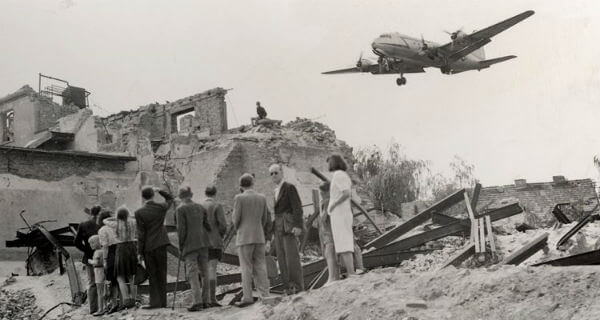
berlin-airlift

After I posed the question, can the U.S. take action to protect Aleppo? a reader reasonably asked: What would a productive engagement look like? Indeed.

For several years, the off-the-shelf answer to this question has included imposing a no-fly zone. The frequency with which this option has been proposed — and then ignored or dismissed — has undermined its credibility. Even so, it’s worth remembering that the northern no-fly zone enforced following the First Gulf War in 1991 provided the basis for the development of enduring Kurdish self-rule in what has since become the most stable part of Iraq. American actions in the Middle East are not always destined to make things fall apart.

The U.S. and its allies could have imposed a no-fly zone in Syria. But President Obama delayed long enough for that option to get knocked off the table by Vladimir Putin.

The latest high-profile proponents of a no-fly zone, Michael Ignatieff and Leon Wieseltier, seem to be engaged in an exercise in wishful thinking.

I don’t doubt that their outrage over American inaction is heartfelt. Even so, they gloss over the fact that since Russia now controls Syrian airspace, there isn’t the faintest chance the Obama administration would be willing to try and impose a no-fly zone because — as officials keep on saying — the U.S. isn’t going to risk starting World War Three.

Does that mean, therefore, that U.S. Syria policy now rests in the hands of John Kerry and his efforts to breath life into a political track — an approach that has little more vitality than the Middle East peace process? If that’s true, then the conventional wisdom is probably right: nothing can be done.

Dualistic thinking is always convenient. Debate gets simplified if we only have to weigh up two options. Other options are easy to marginalize, not necessarily because they are unworthy of consideration but because the debate risks becoming open-ended if too much gets brought to the table. Thus the current debate has largely been reduced to military action versus diplomacy and with the former ruled out, Kerry ends up as the embodiment of U.S. Syria policy. Unfortunately for him, diplomatic successes are much harder to accrue than frequent flier miles — especially when the U.S. has no bargaining power.

The Russians now say that they intend to carry on bombing Syria through the rest of this month while proposing a truce in March. Translated into plain English, that means they will continue bombing until their current military objectives have been accomplished.

Russia’s UN Ambassador Vitaly Churkin says that their airstrikes are being conducted in a “transparent manner” and says Russia’s critics are politically exploiting humanitarian issues.

“They rather crudely use humanitarian matters in order to play, we believe, a destructive role as far as the political process is concerned,” he says.

So this is Russia’s position: It claims it’s military actions are constructive while it accuses the proponents of diplomacy of undermining the political process.

No one should be in any doubt: for Assad and his powerful allies, Geneva is now just a sideshow — a useful distraction and an occasional stage for diplomatic games.

With no military options and no effective diplomacy, it’s easy to see why so many have concluded that nothing can be done.

But there’s never nothing…

In 1948, having as many as one million soldiers based in Germany, the Soviet Union tightened a blockade around Berlin. At that time, the U.S. had 31,000 combat troops in West Germany. It seemed very reasonable to conclude that there was nothing the West could do to prevent the whole of Berlin coming under the control of the Soviets. The only way of preventing that outcome was to break the blockade and launch an airlift, unprecedented in scale.

The airlift began on June 24 and was anticipated to run for three weeks. The Communist press in East Berlin mocked the project, describing it as “the futile attempts of the Americans to save face and to maintain their untenable position in Berlin.”

Over the following weeks and months, the U.S., Britain, and France, succeeding in delivering up to 6,000 tons of supplies every day, as a result of which on May 12, 1949, the Soviets lifted the blockade. The operation continued through the end of September in order to amass a sufficient stockpile of supplies in the event that the airlift needed to be restarted.

In the course of the airlift’s operation, 2,326,406 tons of supplies were carried on 278,228 flights. And this was at a time that Europe was still weighed down by the economically crippling effects of World War Two.

The cost of the Berlin airlift was equivalent to less than the United States gives to Israel each year in military aid.

In August 2014, President Obama was persuaded to intervene in Iraq to provide humanitarian assistance to 40,000 Yazidis, trapped in the Sinjar Mountains, under threat from ISIS. The operation continued for a few days and the Yazidis were led to safety by Kurdish fighters from the PKK and YPG. This wasn’t reminiscent of 1948, but it was an emergency response.

At times of crisis the U.S. has often shown its willingness and capacity to make constructive interventions. (Acknowledging that fact doesn’t require we ignore America’s destructive impact on the world.)

What the U.S. did in Berlin and the Sinjar Mountains does not offer a template for humanitarian operations in Syria, although it might suggest new ways to consider the application of military resources to serve humanitarian goals.

Obama might be unwilling to risk direct conflict between American and Russian fighter jets patrolling the same skies, but when the U.S. started sending cargo planes into Berlin, in was on the assumption that the Soviets would not risk a war by attacking non-combatant aircraft. The same principle could apply to Syria. Whatever Churkin claims, delivering food, clothing, and medicine to those in need is a legitimate humanitarian endeavor.

UN Resolution 2165 was passed with Russia’s support to “ensure that humanitarian assistance, including medical and surgical supplies, reaches people in need throughout Syria through the most direct routes,” but the UN’s ability to make good on that promise is currently being obstructed by both Russia and the Assad regime.

Moreover, the UN has increasingly come under fire from Syrians who see humanitarian aid being used to support the Assad regime. “For many of us in Syria, the UN has turned from a symbol of hope into a symbol of complicity,” besieged Syrians wrote in a letter to Stephen O’Brien, the UN Undersecretary for Humanitarian Affairs.

There are cities across Syria under siege with populations facing starvation. If the U.S. was to start humanitarian airlift operations whose scope might initially be quite limited, it would send several important messages:

  • Assad’s policy of siege warfare will not continue unchallenged
  • The West has not turned its back on those Syrians now facing starvation
  • Russia is not being given a free hand in shaping Syria’s future

This isn’t a political solution for the war in Syria and the logistical challenges would be huge, but facing emergencies has more to do with the willingness to act than it has with being able to construct the perfect plan.

Discovering what is possible often requires ignoring the many ways in which one risks failing. If the Berlin airlift had been proposed on the assumption that it would need to continue for 15 months, it would most likely have been dismissed as impossible and never undertaken.

Facebooktwittermail

Can the U.S. take action to protect Aleppo?

flight-from-Aleppo

Michael Ignatieff and Leon Wieseltier write: Aleppo is an emergency, requiring emergency measures. Are we no longer capable of emergency action? It is also an opportunity, perhaps the last one, to save Syria. Aleppo is the new Sarajevo, the new Srebrenica, and its fate should be to the Syrian conflict what the fate of Sarajevo and Srebrenica were to the Bosnian conflict: the occasion for the United States to bestir itself, and for the West to say with one voice, “Enough.” It was after Srebrenica and Sarajevo — and after the air campaign with which the West finally responded to the atrocities — that the United States undertook the statecraft that led to the Dayton accords and ended the war in Bosnia.

The conventional wisdom is that nothing can be done in Syria, but the conventional wisdom is wrong. There is a path toward ending the horror in Aleppo — a perfectly realistic path that would honor our highest ideals, a way to recover our moral standing as well as our strategic position. Operating under a NATO umbrella, the United States could use its naval and air assets in the region to establish a no-fly zone from Aleppo to the Turkish border and make clear that it would prevent the continued bombardment of civilians and refugees by any party, including the Russians. [Continue reading…]

Any military strategy that’s designed “to recover our moral standing” is dubious — and not simply because there are those who doubt that the U.S. possessed much the moral standing in the first place.

The effectiveness of a military strategy can’t be assessed on the basis of the worthiness of its non-military goals.

The authors in their sweeping assertion that they are offering “a perfectly realistic path,” dodge the awkward details on how this would work.

Are they assuming that once the boundaries of this no-fly zone had been defined, Russian and Syrian aircraft would then obediently comply?

Or do they assume that as soon as a few jets had been shot down the intended lesson would have swiftly been learned?

Turkey already shot down a Russian jet on the edge of this arena. What lessons, if any, have been drawn from that incident and are they now being applied to this future scenario?

“If the Russians and Syrians sought to prevent humanitarian protection and resupply of the city, they would face the military consequences,” we are told by the armchair generals.

“Military consequences” is a phrase of political bluster — especially when coming from two writers who profess no military expertise. If pressed to spell out what these military consequences might be, I expect Ignatieff and Wieseltier would defer to the actual generals.

My point here is not to dismiss the idea that at this late hour there might be a constructive military intervention in Syria, but simply to say that such an argument needs more detail and substance and fewer passionate declarations. It needs to credibly show how this would work rather than simply why it should be undertaken.

Currently, Obama administration officials are cynically curtailing all discussion about their military options by claiming that they only have two choices: start World War III or do essentially nothing (beyond repeating their mantra that their is no military solution in Syria).

“What do you want me to do, go to war with Russia?” John Kerry is reported to have asked a Syrian NGO representative in London last week.

The choice is false but it is gladly being picked up by ideological anti-interventionists who are attracted by the rhetorical utility of this device when offered to those who have little interest in questioning its validity.

To those who insist on framing this crisis in terms of World War III, I would ask two questions: What makes you think it hasn’t already begun? And why do you think its defining attribute necessarily involves a clash between the U.S. and Russia?

A world war involves global instability and a contagion of violent conflict. There are active conflicts in Pakistan, Afghanistan, Yemen, Iraq, Syria, Turkey, Egypt, and Libya. There is unrest in Saudi Arabia, Bahrain, Palestine, Israel, and elsewhere.

As the EU struggles to handle the refugee crisis, European unity is being fractured, placing its future in jeopardy.

If through the power of inattention, Americans could indeed successfully insulate themselves from the effects of global strife, then perhaps this could endure as a land of blissful ignorance.

Instead, what is more predictable is that the more disengaged the U.S. becomes, the less influence it will have and the fewer options it can consider.

No one will benefit from America’s self-imposed paralysis.

Facebooktwittermail

Syrian opposition see Obama’s support having been worthless

The New York Times reports: The United States and its allies have spent many millions of dollars backing Syrian opposition fighters they deem relatively moderate and secular, and civilian groups whose work on small businesses and local councils they billed as the cornerstone of Syria’s future.

But the very Syrians who benefited — and risked their lives in the process — now say that investment is in danger of going down the drain, and they see little urgency from Washington, diplomatic or military, to save it.

“What are you going to do, other than statements?” Zakaria Malahifji, the political chief of one of the largest rebel groups given weapons and salaries by the C.I.A. and its counterparts in several European and Arab states, demanded in a recent message to contacts at the French Embassy.

In nearly five years of war and insurrection, many Syrians have been repeatedly disillusioned by what they saw as a mismatch between tough American rhetoric against the Syrian government and comparatively modest efforts to aid some of its opponents. President Obama said President Bashar al-Assad must go, and drew a red line over the use of chemical weapons, but backed off on both, diminishing anti-government Syrians’ trust.

But the confusion and despair has reached a new level over the last week, as forces backing Mr. Assad have pushed farther north into Aleppo Province, sending tens of thousands of new refugees to the Turkish border. With insurgent groups losing troops and territory, their villages shattered by Russian warplanes, civilians and fighters have in recent days used phrases like “no hope,” “it’s finished” and “it’s over.”

“Bye-bye, revolution,” Abu al-Haytham, a spokesman for Thuwwar al-Sham, another rebel group supported through the C.I.A. program, said in a text message on Friday from Tal Rifaat, a town in northern Aleppo that is increasingly threatened by the government advance.

American-backed insurgents have long been used to the American stance in recent years, that the United States did not want them to actually win the war — lest a sudden toppling of Mr. Assad lead to Islamist rule — but wanted to prevent them from losing for long enough to pressure the government to negotiate for a political solution.

Now they fear that the United States and its allies may actually let them lose. [Continue reading…]

Facebooktwittermail

Why are Russian engineers working at an ISIS-controlled gas plant in Syria?

Foreign Policy reports: The Syrian government originally awarded the contract to construct the Tuweinan facility [the largest such facility in Syria, located 60 miles southwest of Raqqa] to Stroytransgaz in 2007. The construction utilized a Syrian subcontractor, Hesco, which was owned by Russian-Syrian dual national George Haswani. Last November, the Treasury Department sanctioned Haswani for allegedly brokering oil sales between the Islamic State and the Assad regime, charges he denies.

The partnership between Hesco and Stroytransgaz goes far beyond this one deal. The companies have worked in joint projects in Sudan, Algeria, Iraq, and the UAE since 2000, according to Haswani’s son-in-law, Yusef Arbash, who runs Hesco’s Moscow office.

Construction continued slowly until a coalition of Syrian rebel groups seized the facility in a joint operation with the al Qaeda-affiliated al-Nusra Front in January 2013. Abu Khalid, a member of the Qwais al-Qarani brigade, which was a part of the rebel coalition, said that when they entered the area, Russian engineers and advisors had already fled, leaving Syrian employees behind. “We decided to protect this plant; we thought it is belonging to Syrian people since it was owned by the Syrian state,” he said.

The Islamic State has been in control of the facility since early 2014. A senior Turkish official said that after its seizure, Stroytransgaz, through its subcontractor Hesco, continued the facility’s construction with the Islamic State’s permission. He also claimed that Russian engineers have been working at the facility to complete the project.

Syrian state-run newspaper Tishreen published a report appearing to corroborate this claim. In January 2014, after the facility was captured by the Islamic State, the paper cited Syrian government sources, saying that Stroytransgaz had completed 80 percent of the project and expected to hand over the facility to the regime during the second half of the year. The article didn’t mention that the facility was under the control of the Islamic State. [Continue reading…]

Facebooktwittermail

Chechen leader threatens foes in bid to gain Putin’s support

Ramzan-Kadyrov

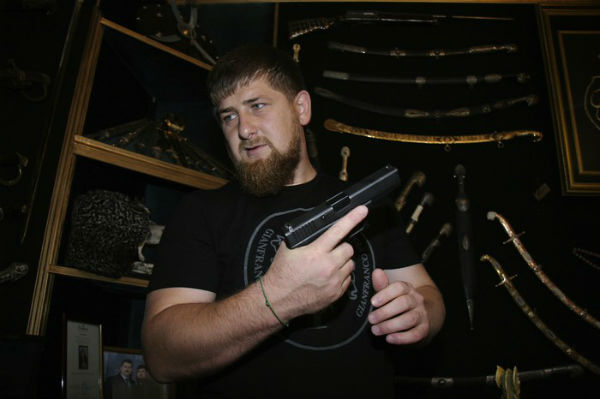
The Associated Press reports: The Kremlin-backed strongman of Chechnya has issued a stream of threats against Russia’s liberal opposition, but his primary audience appears to be the Russian president himself.

With Ramzan Kadyrov’s five-year stint as regional leader about to expire, he is trying to parlay his strong personal ties with President Vladimir Putin to extend his hold on power. The Russian president must now decide whether to keep him in place or yield to rising pressure from law-enforcement agencies to get rid of the wayward strongman, who has ruled Chechnya like his personal fiefdom.

Putin has seen the burly, red-haired 39-year-old former rebel as essential to keeping Chechnya stable after two separatist wars, and has given him privileges no one else in Russia’s tightly controlled political system has seen. If he backs Kadyrov for another term, the Chechen leader is certain to easily win the popular vote set for September.

Kadyrov has converted his personal relationship with Putin into a steady flow of federal subsidies and immunity from federal controls. Even Russia’s all-powerful security agencies have been forced to bow to Kadyrov’s diktat, maintaining a symbolic presence in Chechnya but depending entirely on his will.

Kadyrov’s unprecedented clout has worried many in Russia, who see it as a dangerous erosion of federal authority and a looming threat to the country’s integrity. The Chechen leader’s defiant posture also has won him numerous enemies among the leaders of law-enforcement agencies, but they have had to bite their tongues. [Continue reading…]

Facebooktwittermail

U.S. credibility is plummeting among Syrians and across the region

Josh Rogin writes: In the eyes of the Syrian opposition, Russia and Iran are making a mockery of the peace process, and Kerry’s reluctance to acknowledge this is putting them in deadly harm. It also creates more problems for America’s regional allies, aids the Islamic State and dims the prospects for future peace talks. “The failures of the negotiations end up lowering the credibility of the moderate opposition in front of the Syrian people,” said [Riyad] Hijab. [Hijab is leader of the High Negotiating Committee that represented the Syrian opposition at last week’s meetings in Geneva.] “United States credibility is plummeting within the population of Syria but also in the region as a whole.”

This week, it is Syrians near Aleppo who are paying the price. Regime forces, with Russian support, are advancing toward the Turkish border, threatening to cut off opposition groups and civilians from their source of aid. At least 35,000 people have joined the flood of refugees since the collapse of the talks, ahead of what many anticipate will be another in a long line of starvation sieges the regime is perpetrating on cities. Hijab said there are now 18 cities under siege, three more than when the talks began.

Moscow wants the peace talks to fail, Hijab said. He accused the Russian air force of using illegal cluster bombs indiscriminately against civilians. (Human rights groups support those claims.) “The situation has taken a horrible turn, specifically in terms of the scorched earth policy of the Russian aircraft and the way that they are bombing, literally destroying everything,” he said. “The other side has been moving to ensure the failure of any negotiation through horrendous bombardment.”

Hajib said the Obama administration is still pressuring the opposition to return to talks despite the ongoing offensive, but the opposition is insisting that Russia adhere by the UN resolutions first. In a press conference with reporters last week, Kerry said of the Syrian-Russian attacks on civilians, “It’s not going to stop just by whining about it.” He called on rebel leaders to return to the negotiating table. [Continue reading…]

While listening to U.S. State Department spokesmen John Kirby at yesterday’s press briefing, one might not have accused him of whining, but instead adopting President Obama’s standard position: a baseless confidence that whoever can make the most reasonable argument will win the day — as though politics conforms to the rules of a debating society.

Kerry and Obama must be very perplexed about how unreasonable it is that Russia regards bombing as more useful than diplomacy. But what is actually very unreasonable is the notion that anyone would be fooled by Washington’s toothless efforts at peacemaking.

Facebooktwittermail

UN fears for hundreds of thousands if Syria troops encircle Aleppo

Reuters reports: Hundreds of thousands of civilians could be cut off from food if Syrian government forces encircle rebel-held parts of Aleppo, the United Nations said on Tuesday, warning of a massive new flight of refugees from a Russian-backed assault.

Syrian government forces, backed by Russian air strikes and Iranian and Lebanese Hezbollah fighters, have launched a major offensive in the countryside around Aleppo, which has been divided between government and rebel control for years.

The assault to surround Aleppo, once Syria’s biggest city with 2 million people, amounts to one of the most important shifts of momentum in the five year civil war that has killed 250,000 people and already driven 11 million from their homes. [Continue reading…]

Facebooktwittermail

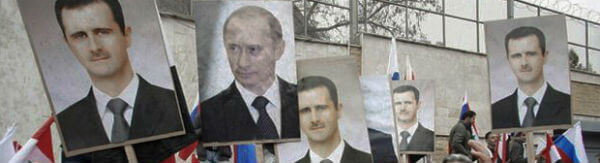
Putin, Assad, and the nexus of torture and terror

Assad

Last October, Patrick Cockburn welcomed the arrival of Russian forces in Syria, suggesting that the “intervention of Russia could be positive in de-escalating the war”. He wrote:

Overall, it is better to have Russia fully involved in Syria than on the sidelines so it has the opportunity to help regain control over a situation that long ago spun out of control. It can keep Assad in power in Damascus, but the power to do so means that it can also modify his behaviour and force movement towards reducing violence, local ceasefires and sharing power regionally.

Posturing as a neutral observer, Cockburn no doubt preferred the language of “de-escalation” rather than military solutions, yet having noted that “Russia is at least a heavy hitter, capable of shaping events by its own actions,” he could hardly have been surprised by the massive onslaught on Aleppo over the last few days.

After Obama’s hollow demands for Assad’s departure, Washington has now moved towards what almost amounts to a quiet alliance with the regime by shutting down what was left of a meager weapons supply to rebel groups.

As Emile Hokayem writes:

Just as Russia escalates politically and militarily, the Obama administration is cynically de-escalating, and asking its allies to do so as well. This is weakening rebel groups that rely on supply networks that the U.S. oversees: In the south, the United States has demanded a decrease in weapons deliveries to the Southern Front, while in the north, the Turkey-based operations room is reportedly dormant.

The result is a widespread and understandable feeling of betrayal in the rebellion, whose U.S.-friendly elements are increasingly losing face within opposition circles. This could have the ironic effect of fragmenting the rebellion — after years of Western governments bemoaning the divisions between these very same groups.

Assad is far from being able to declare he has won the war, but he is close to winning the argument about how it gets framed.

He always claimed that he was fighting terrorism — deploying the rhetorical gift which neoconservatism freely bestowed on authoritarian rulers around the globe after 9/11 — and before long, it looks like this is how the war in Syria will neatly be defined: the regime vs ISIS and al Qaeda. And that’s a fight Assad has no interest in winning.

Nevertheless, it’s worth being reminded why the continuation of Assad’s rule should not be mistaken as a harbinger of peace. If a year or two from now, violence no longer rains down from the sky in the form of barrel bombs and Russian airstrikes, it will most likely continue without restraint in the domain where this regime has always exercised its ruthless power: by imprisoning, torturing, and murdering its opponents.

In “Out of Sight, Out of Mind: Deaths in Detention in the Syrian Arab Republic,” a newly released report for the UN Human Rights Council, we learn:

Interrogators and guards employed gruesome methods of torture to kill detainees. In 2014, a detainee held in a centre under the control of the 4th Division of the Syrian army had his genitals mutilated during torture. Bleeding severely and left without treatment, he died three days later. A detainee of a Military Security branch in Homs witnessed an elderly man being severely beaten, and then hung by his wrists from the ceiling. The guards burned his eyes with a cigarette, and pierced his body with a heated, sharp metal object. After hanging in the same position for three hours, the man died.

Other detainees died as a result of injuries and wounds sustained during torture. Victims received little or no medical care to treat the wounds and developed severe infections that eventually led to their demise. In the Air Force Intelligence Branch in Aleppo, a detainee suffered severely from an infected wound in his leg sustained during torture. Unable to stand up, he was eventually placed in the corridor outside the cell, receiving no medical care. After a few days, fellow detainees observed that he was dead. His family was later able to obtain the body through unofficial channels. Due to marks of torture and the severe emaciation of his corpse, his family could first only recognise him by an identifying tag. A 15-year-old boy detained in 2013 by the 4th Division in a detention facility near Yafour (Rif Damascus) reported seeing several male detainees dying due to torture and inhuman prison conditions and denial of medical assistance.

A large number of deaths were caused by the squalid conditions in which detainees were kept. Prison conditions were similar across detention facilities. They included severely overcrowded cells where prisoners were often forced to stand and sleep in shifts, stripped to their underwear. Lack of clean drinking water, sanitation, lice infestations and other unhygienic conditions caused the spread of disease and infections. Many prisoners were forced to use their toilet as a source of drinking water.

Anyone who believes this is “the lesser of two evils” or the kind of toughness required for “stability,” is delusional.

On the contrary, this type of institutionalized violence has long had an instrumental role in fostering terrorism.

Facebooktwittermail

Syria: Putin policy has become Obama policy because the U.S. has offered no serious alternative

Roger Cohen writes: the Obama administration still pays lip service to the notion that Assad is part of the problem and not the solution, and that if the Syrian leader may survive through some political transition period he cannot remain beyond that. But these are words. It is President Vladimir Putin and Russia who are “making the weather” in Syria absent any corresponding commitment or articulable policy from President Obama.

Aleppo, Syria’s largest city, is now virtually encircled by the Syrian Army. A war that has already produced a quarter of a million dead, more than 4.5 million refugees, some 6.5 million internally displaced, and the destabilization of Europe through a massive influx of terrorized people, is about to see further abominations as Aleppo agonizes.

Aleppo may prove to be the Sarajevo of Syria. It is already the Munich.

By which I mean that the city’s plight today, its exposure to Putin’s whims and a revived Assad’s pitiless designs, is a result of the fecklessness and purposelessness over almost five years of the Obama administration. The president and his aides have hidden at various times behind the notions that Syria is marginal to core American national interests; that they have thought through the downsides of intervention better than others; that the diverse actors on the ground are incomprehensible or untrustworthy; that there is no domestic or congressional support for taking action to stop the war or shape its outcome; that there is no legal basis for establishing “safe areas” or taking out Assad’s air power; that Afghanistan and Iraq are lessons in the futility of projecting American power in the 21st century; that Syria will prove Russia’s Afghanistan as it faces the ire of the Sunni world; and that the only imperative, whatever the scale of the suffering or the complete evisceration of American credibility, must be avoidance of another war in the Middle East.

Where such feeble evasions masquerading as strategy lead is to United States policy becoming Putin’s policy in Syria, to awkward acquiescence to Moscow’s end game, and to embarrassed shrugs encapsulating the wish that — perhaps, somehow, with a little luck — Putin may crush ISIS. [Continue reading…]

Facebooktwittermail

Kerry ‘blames opposition’ for continued Syria bombing

Middle East Eye reports: US Secretary of State John Kerry told Syrian aid workers, hours after the Geneva peace talks fell apart, that the country should expect another three months of bombing that would “decimate” the opposition.

During a conversation on the sidelines of this week’s Syria donor conference in London, sources say Kerry blamed the Syrian opposition for leaving the talks and paving the way for a joint offensive by the Syrian government and Russia on Aleppo.

“‘He said, ‘Don’t blame me – go and blame your opposition,’” one of the aid workers, who asked to remain anonymous to protect her organisation, told Middle East Eye.

Kerry told reporters on Friday, as tens of thousands fled the Syrian government and Russian bombardment of Aleppo, that both Russia and Iran, another of Syria’s allies, have told him that they are prepared for a ceasefire in Syria.

He said he would know “whether or not these parties are serious” after a meeting of the International Syria Support Group – 17 nations including the US and Russia – scheduled to be held in Munich next week.

But Kerry left the aid workers with the distinct impression that the US is abandoning efforts to support rebel fighters. [Continue reading…]

Facebooktwittermail

Russian aggression drives Swedish defense spending

Defense News reports: Sweden’s discomfort over Russia’s long-term political and military ambitions in the Baltic Sea and High North has risen further after a senior military chief stated the Nordic state could find itself under attack “within a few years.”

The warning, made by Swedish Armed Forces’ Maj. Gen. Anders Brännström, came the same week that NATO Secretary General Jens Stoltenberg confirmed, in the organization’s Annual Report, that Russian Tupolev Tu-22M3 bombers accompanied by Sukhoi Su-27 jets conducted a simulated “training” nuclear strike targeting key Swedish defense installations in March 2013.

Brännström stated, in an internal military document forwarded to officers and soldiers attending the armed forces’ Markstrids’ (Land Combat) conference in the sub-Arctic town of Boden, that the changed post-Cold War security landscape will require Sweden to downgrade international missions and prioritize reinforcing national defense readiness and capabilities. [Continue reading…]

Facebooktwittermail

Under the watchful Western eyes, Syria unravels

Syria1

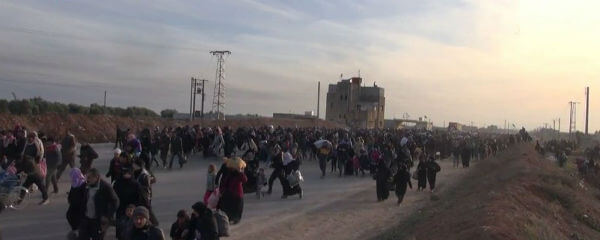
Hisham Melhem writes: Once again tens of thousands of Syrians are being uprooted and forced to flee their ancestral lands around the ancient city of Aleppo by the incessant assaults waged against them by the government that claims to represent them in Damascus. The country roads leading to the Turkish borders are being traversed by haggard people carrying with them remnants of shattered lives, dragging little children shivering in February’s cold, wandering under the last skies of Syria, and wondering if they will ever return.

Syria’s northern skies have been given by the Assad regime to Russia’s prowling bombers which have been spewing deadly fires and cluster bombs indiscriminately against areas controlled by the opposition groups. The ground has been given to marauding fighters from neighboring Lebanon and Iraq and from as far away as Afghanistan and other Central Asian states, in what can only be called a new “Shiite Internationale”, to help a minority regime bereft of the manpower needed to retake and subdue the rebellious country.

Those in the West, particularly in the United States, who may have allowed themselves to entertain the scandalous notion that things could not get worse in Syria, should be forced to see the blank and numb faces of people on the move who are already beyond pain and hope, to realize the folly of their wishful thinking. Syria’s new tragic chapter is unfolding under watchful but impotent Western eyes.

Secretary of State John Kerry, who has a deep and almost mystical belief in the power of diplomacy to settle violent disputes, a belief based on the naïve assumption that his peers are as rational and as well-meaning like him, found himself doing what he does best with Russia; pleading for cooperation, and reminding Russians of their obligation to enforce the U.N. Security Council Resolution 2254 that they co-sponsored to provide a roadmap to a political agreement.

White House press secretary Josh Earnest was truly earnest when he borrowed one of Kerry’s retorts, reminding the Russians that their “military strategy inside of Syria undermines the goals of their political strategy”. If only those obtuse Russians would listen to us explaining to them how best to reconcile their seemingly contradictory goals. The naiveté of this political position is matched only by the immense self-deception the Obama administration shared with many Syria “hands” in academe claiming that there is no ‘military’ solution to the civil war in Syria. [Continue reading…]

Facebooktwittermail

Obama’s disastrous betrayal of the Syrian rebels

Emile Hokayem writes: What a difference a year makes in Syria. And the introduction of massive Russian airpower.

Last February, President Bashar al-Assad’s regime and its Shiite auxiliaries mounted a large-scale attempt to encircle Aleppo, the northern city divided between regime and rebels since 2012 and battered by the dictator’s barrel bombs. Islamist and non-Islamist mainstream rebels — to the surprise of those who have derided their performance, let alone their existence — repelled the offensive at the time. What followed was a string of rebel advances across the country, which weakened Assad so much that they triggered Moscow’s direct intervention in September, in concert with an Iranian surge of forces, to secure his survival.

Fast-forward a year. After a slow start — and despite wishful Western assessments that Moscow could not sustain a meaningful military effort abroad — the Russian campaign is finally delivering results for the Assad regime. This week, Russian airpower allowed Assad and his allied paramilitary forces to finally cut off the narrow, rebel-held “Azaz corridor” that links the Turkish border to the city of Aleppo. The city’s full encirclement is now a distinct possibility, with regime troops and Shiite fighters moving from the south, the west, and the north. Should the rebel-held parts of the city ultimately fall, it will be a dramatic victory for Assad and the greatest setback to the rebellion since the start of the uprising in 2011.

In parallel, Russia has put Syria’s neighbors on notice of the new rules of the game. Jordan was spooked into downgrading its help for the Southern Front, the main non-Islamist alliance in the south of the country, which has so far prevented extremist presence along its border. Turkey’s shooting down of a Russian military aircraft that crossed its airspace in November backfired: Moscow vengefully directed its firepower on Turkey’s rebel friends across Idlib and Aleppo provinces. Moscow also courted Syria’s Kurds, who found a new partner to play off the United States in their complex relations with Washington. And Russia has agreed to a temporary accommodation of Israel’s interests in southern Syria.

Inside Syria, and despite the polite wishes of Secretary of State John Kerry, the overwhelming majority of Russian strikes have hit non-Islamic State (IS) fighters. Indeed, Moscow and the Syrian regime are content to see the United States bear the lion’s share of the effort against the jihadi monster in the east, instead concentrating on mowing through the mainstream rebellion in western Syria. Their ultimate objective is to force the world to make an unconscionable choice between Assad and IS. [Continue reading…]

Facebooktwittermail

Rebel setbacks in Syria have far reaching consequences

Hassan Hassan writes: Is Syrian president Bashar Al Assad finally winning? One can feel a deep sense of grief running through opposition factions whether inside or outside Syria over how events have unfolded over the past two weeks.

Pro-regime forces have made a series of major gains in northern, central and southern Syria over the past week.

More strikingly, they broke a three-year siege imposed by the rebels around the Shia towns of Nubbol and Zahraa, 20 kilometres from Aleppo city, which represents a major setback for the rebels especially as it could disrupt a game of encirclement and counter-encirclement that sustained the rebels’ control of much of Aleppo since 2012.

Five months after the regime’s forces seemed incapable of halting the string of victories achieved by the rebels in northern Syria, which led to the Russian military intervention to prop up their ally, the regime appears to be on the offensive. The offensive is seen n northern Latakia, the western Ghouta near Damascus, Deraa and in the rural areas of Hama, Idlib and Aleppo. The regime appears to have made an impressive comeback.

It is hard to judge how one side is doing through such tactical gains. The rebels were clearly on the winning side just a year ago, while the regime’s army suffered from a shortage in manpower, as admitted by Mr Al Assad himself during his last speech in August.

The breaking of the siege of Nubbol and Zahraa last week, as well as the siege of Kweiris airbase near Raqqa in November and the takeover of Sheikh Maskeen in Deraa last month, were spearheaded by foreign militias beholden to Iran.

The opposition’s real crisis is much deeper, hence the state of grieving widely felt by the rebels. These setbacks come amid profound internal, regional and international challenges that could tip the balance dramatically in favour of the regime. [Continue reading…]

Facebooktwittermail

As Syrians flee anew, neighbors’ altruism hardens into resentment

refugee5

The New York Times reports: When the Syrian refugees first started streaming into this bedraggled border town, Gassim al-Moghrebi was their tireless benefactor, distributing donations of food, money and clothes and sheltering as many as possible in two apartments he owned.

“All of Ramtha was just like me,” Mr. Moghrebi said, describing a good will rooted in family ties that spanned the border, and sympathy for the victims of a pitiless war. “One man had 10 apartments. He gave them to the Syrians for free.”

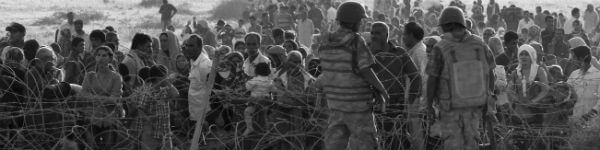
But now, as Syria witnesses a new escalation of violence, including waves of Russian airstrikes, and as Syrians flee for safety again by the tens of thousands, neighboring countries are increasingly overwhelmed and reluctant to let them in. In many places, that early altruism has hardened into resentment — an ominous turn for those fleeing war.

Desperate Syrians are backed up at the borders of Jordan and Turkey, barred from entering or else just allowed to trickle in. Increasingly, they find escape routes closing. [Continue reading…]

Facebooktwittermail

Bombarded Aleppo lives in fear of siege and starvation

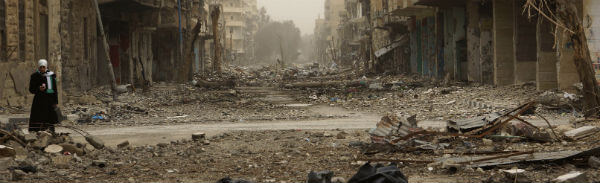
The Guardian reports: The bombs are falling so fast in Aleppo now that often rescuers don’t have time to reach victims between blasts. If the deadly explosions that struck on just one day last week had been evenly spaced, they would have struck every other minute around the clock.

“Sometimes there are so many airstrikes, we are just waiting and waiting at our headquarters, and the jets don’t leave the skies,” says Abdulrahman Alhassan, a 29-year-old former bank engineer from the city who coordinates “white helmet” rescue teams in the city.

“When at last we can’t see any more, we have to rush to all the sites to rescue people and evacuate them at once,” he said. On Friday, the group counted 900 airstrikes by government forces and their Russian backers, apparently throwing every weapon they have at the already devastated city.

Aid groups and people still inside the city believe the barrage is preparing the way for a blockade. The main supply line north of Aleppo has already been cut, and it will not take long before shortages bite in a ruined, desperate city.

“The Russian airstrikes are trying to completely destroy the area before they get on the ground and start the siege,” said Saad, a 35-year-old aid worker who chose to stay on and is now trapped inside the city. He says the bombing campaign was hitting both morale and food supplies. [Continue reading…]

Facebooktwittermail