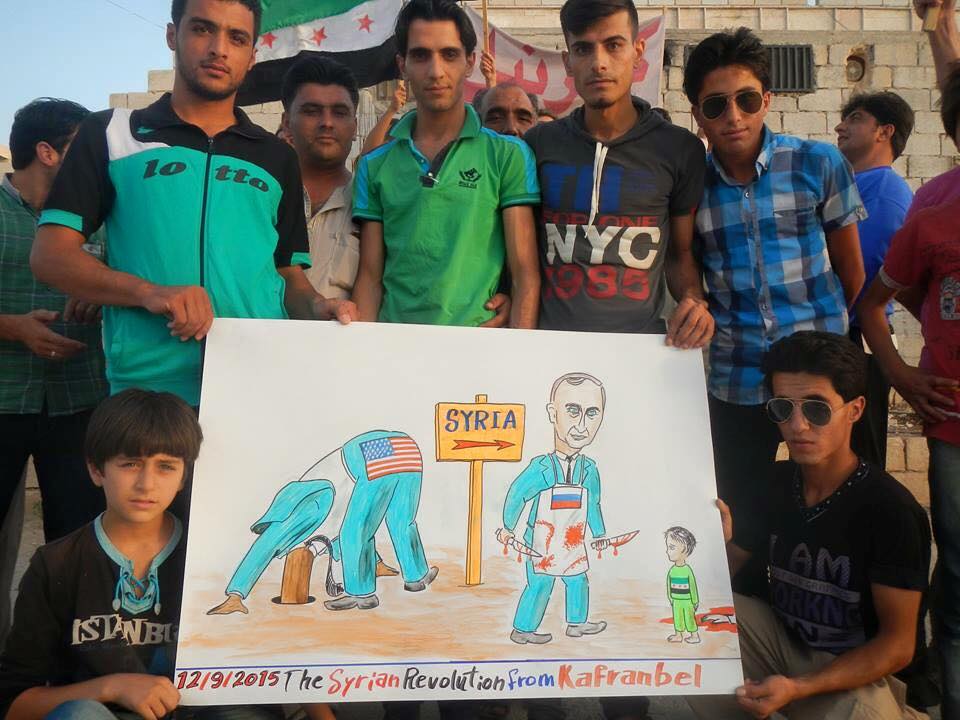
Scott Lucas writes: With the approach of a second round of international talks about Syria’s crisis, Russia has stepped up its deceptive propaganda in support of the Assad regime.
Deputy Foreign Minister Alexei Meshkov brazenly lied on Wednesday with the declaration, “Since the beginning of Russian operations, according to UN structures, more than one million people have returned to their homes in Syria.”
Meshkov gave no support for his claim, which was featured by Russian State outlet Sputnik News.
The UN has reported that more Syrians have fled their homes because of Russian bombing and the Syrian military’s offensives that Moscow is supporting. On October 26, the number was put at more than 120,000 since the start of the month, including at least 80,000 from Idlib and Hama Province and at least 44,000 from southern Aleppo Province.
The UN later revised the southern Aleppo figure to more than 75,000. The Syrian opposition and activists say the number from Aleppo and other areas is far higher than the UN’s totals. [Continue reading…]
Category Archives: Russia
A Russian dirty bomb? Or more dezinformatsiya?
The Daily Beast reports: A stray camera at a meeting of top Russian military leaders has allegedly captured a glimpse of the Kremlin’s possible plan for a bewildering and frightening new weapon — a radiation-scattering “dirty bomb.” One delivered by a drone submarine, which itself rides piggyback on another submarine.
The problem is: We have no way of knowing for sure if this is in fact an existing weapon or simply a media provocation designed to make us think that Russian President Vladimir Putin has got a dangerous new toy in his arsenal. If it’s real, then Russia is the first country we know about to come into possession of a weapon that, while not nearly as destructive as an atomic bomb, could spread lethal radiation over a wide area, rendering it uninhabitable. If the segment is a fake, it’s the latest in a long list of Kremlin media hoaxes.
“It’s true some secret data got into the shot, and it was subsequently deleted,” Kremlin spokesman Dmitry Peskov said Wednesday about the mysterious footage. “We hope that this won’t repeat.”
The technical aspects of such a device aren’t all that complicated. A dirty bomb is simply any munition containing conventional explosives wrapped in radioactive material. It explodes like any normal munition, but the fragments it scatters are irradiated and thus more dangerous for far longer periods of time than the debris from any standard bomb.
Compared to nuclear weapons, dirty bombs are easy to make — and their use, while highly provocative, is less likely to spark global Armageddon. But they’re still nasty enough that, back in the 1970s, the United States and Russia came pretty close to banning them. [Continue reading…]
Why Iran and Russia aren’t as closely aligned on Syria as you might think
Saheb Sadeghi writes: Common and immediate objectives have united Iran and Russia on Syria in the short run, and this unity will probably be flexed against the West’s influence in the long term. However, when it comes to some key aspects of Syria’s future — including the nature of the government and the rebuilding of the Syrian military — differences between Tehran and Moscow are bound to come to the surface.
In broad terms, Iran and Russia have embarked on the same path and entered a new phase of the geopolitical game in Syria. A major power, Russia is trying to redefine its role in the world, as evidenced by its actions in Ukraine and Syria. After 40 years, Moscow has returned to the Middle East to prove that today’s world is different — and multipolar. Iran’s strategy also revolves around redefining its geopolitical role. Iran’s game in Syria, Iraq, Lebanon and even Yemen shouldn’t be considered only from an ideological point of view, but rather as the Islamic Republic seeking what can be defined as living space.
In the short run, both Iran and Russia will attempt to preserve Syrian President Bashar al-Assad’s position, help him maintain the territory his government now controls and retake territories that the Syrian army has recently lost. There is also the consideration of Russia seeking to test its new weapons and air force. In sum, the obvious aim is to weaken the position of Assad’s opponents in Syria as much as possible, and this short-term objective will ensure the current Iranian-Russian unity. [Continue reading…]
Geolocation once again disproves Russia’s targeting claims in Syria
Bellingcat reports: In just three days, Russian aircraft have carried out 137 sorties, targeting 448 “terrorist objects” throughout Syria, according to a Russian Ministry of Defense (MoD) press briefing held by spokesperson Igor Konashenkov on 9 November 2015. Three airstrikes previously posted on the MoD’s YouTube page were singled out by Konashenkov for closer examination. Given the Russian MoD’s well-documented propensity for fabricating information, it’s a worthwhile endeavor to verify the Russian MoD’s version of events.
The first video purports to show an airstrike on an “ammunition depot” in the governorate of Raqqa. According to Konashenkov, the depot contained “anti-tank systems, grenade launchers, and small arms,” and heavy vehicles were seen being loaded with weapons, which were “delivered to terrorist groups of the region.” Highlighting that the bombed depot was indeed located in Raqqa, the MoD presentation transitions to the video by having it zoom out from the approximate location where the strike allegedly took place: [Continue reading…]
In a major breakthrough, Syrian army frees Aleppo air base from ISIS control
The National reports: Syria’s army broke ISIL’s siege on a military air base in northern Aleppo province on Tuesday, scoring its first major breakthrough since Russia’s air campaign began.
Troops, backed by pro-government militia, broke through the extremist group’s more than year-long siege of the Kweyris military airport in the country’s north.
A group of soldiers penetrated ISIL lines west of the airport and reached government troops inside the base, firing into the air in celebration.
Experts said the base could be used by Russian planes in their air war against rebels fighting the regime of president Bashar al-Assad, aiding their efforts to retake Syria’s second city of Aleppo. [Continue reading…]
Aron Lund writes: Assad has long claimed that he is an indispensible ally for any state seeking to contain international terrorism. The growth of Sunni-sectarian radicalism within the Syrian opposition and the Islamic State’s near-destruction of the Iraqi state in 2014 have been of great help to him. For the first time in years, there now exists a sizeable Western political constituency advocating resumed cooperation with Assad. Not only on the hard-right and hard-left fringes of politics, these whispers are increasingly heard among security officials and diplomats too. There’s a long way to go still, but that sort of international shift represents the Assad regime’s only real chance of longtime survival, if not exactly victory.
By helping Assad score points against the Islamic State in places like Kweiris, the Russian government hasachieved a dual goal: it makes Assad’s government appear more viable and useful as an ally, and it lets Russia boast of progress against the Islamic State after weeks of having to explain its choice to bomb other groups instead. [Continue reading…]
Assad’s lifeline: The authoritarian stabilization pact in Syria
Steven Heydemann writes: The Syrian conflict has become a testing ground for techniques of authoritarian stabilization — the coordinated efforts of an interconnected network of authoritarian governments to prop up a like-minded regime threatened by a popular insurgency. Syria today stands out as a case of how developed global authoritarian networks have become. It sheds important light on the growing capacity of authoritarian actors to mobilize for the collective defense of regimes that are seen as central to the stability of such networks.
The authoritarian stabilization pact between Russia, Iran, and Syria that has kept Bashar al-Assad in power offers a stark example of an emerging international landscape in which democracies will find their room for maneuver increasingly constrained. Existing international institutions, notably the UN Security Council, have proven inadequate to respond to the challenges posed by the rise of such transnational authoritarian networks. Without a coordinated effort among democracies to overcome the institutional paralysis that has prevented decisive international action in cases like Syria, including formal legal standing for norms such as the Responsibility to Protect, democracies will find themselves at a significant disadvantage in resolving major regional and international conflicts, even as they — along with millions of Syrians — are compelled to bear the growing adjustment costs imposed by an increasingly polarized international order.
Russian President Vladimir Putin’s decision in late September to escalate Russia’s military support for the Assad regime, in close cooperation with Iran and its proxy, Hezbollah, provides a troubling but important case of authoritarian collective action to prevent the collapse of a strategically important ally. Syria’s experience underscores the growing scope of strategic and military cooperation among leading authoritarian regimes, as well as their increasingly sophisticated integration of military, political, economic, and diplomatic instruments — all buttressed by the effective use of conventional and social media to influence public opinion and create alternate realities justifying their actions. The pragmatic, non-ideological nature of this emerging authoritarian mutual defense pact permits alliances of convenience among both state and non-state actors (including Hezbollah forces, pro-Assad militias, and a range of Shi’a mercenaries from Iraq, Afghanistan, and Pakistan) and between authoritarian regimes that might otherwise be ideologically irreconcilable. In this ecumenical spirit, the leader of Hezbollah, Hassan Nasrallah, and the Primate of the Russian Orthodox Church have both endorsed Putin’s intervention in Syria, while Russian priests bless the missiles being loaded aboard Russian fighter jets. The Syrian case thus highlights the deepening cooperation among the Assad regime’s authoritarian allies, which now includes joint combat operations, intelligence sharing, and more tightly-linked diplomatic efforts. Russia has presented these new forms of cooperation as an alternative, authoritarian version of a “coalition of the willing,” drawing support from Egypt, China, and other authoritarian regimes that endorse the counter-terrorism narrative that Russia has used to justify its expanded intervention. [Continue reading…]
Senior U.S. intelligence official says escalation of Russian bombing in Syria ‘should be fun’
When journalists grant government sources anonymity, the proforma explanation for doing so is the following line (or one of its common variants): officials spoke on the condition of anonymity because they’re not authorized to comment publicly.
That claim is almost always false. Authorization is besides the point. The primary reason for an official wanting anonymity is so that his or her remarks will have no return address. No one other than the journalist offering their source camouflage will be in a position to come back with a follow-up question. When there is no risk of any comeback, assertions can be made and opinions expressed in the knowledge that they will escape critical scrutiny. Likewise, propositions can be floated and later easily abandoned.
Another reason sources want anonymity is for the same reason that internet trolls conceal their identities: they don’t want to be held responsible for the language they use. They imagine that invisibility creates space for unvarnished honesty — even though the evidence more often shows that this kind of freedom from social inhibitions has a habit of releasing the inner jerk.
The Daily Beast reports: [S]ix U.S. intelligence and military officials told The Daily Beast that they hoped an ISIS attack on Russian civilians would force Putin to finally take the gloves off and attack the group, which the U.S. has been trying to dislodge from Iraq and Syria for more than a year, without success.
“Now maybe they will start attacking [ISIS],” one senior defense official smugly wondered last week. “And stop helping them,” referring to ISIS gains in Aleppo that came, in part, because the group took advantage of Russian strikes on other rebels and militant outfits.
Since the plane crashed, Russia has struck two ISIS-controlled areas in Syria: Raqqa and Palmyra.
“I suppose now he’ll really let ISIS have it. This should be fun,” one senior intelligence official told The Daily Beast. [Continue reading…]
Fun, perhaps, if you’re an intelligence analyst with a 9-5 job in Langley, Virginia, or the Pentagon. But although Raqqa and Palmyra are under the control of ISIS, they still have civilian populations. And bombing isn’t fun for anyone on the receiving end.
It is already clear that in its bombing operations in Syria, Russia is not greatly concerned about the precision of its targeting. It’s definition of inefficiency is for a jet to return to its base without releasing its bombs.
Those U.S. officials who now relish the prospect of Russia “finally take the gloves off” against ISIS are conjuring images of what are euphemistically described as “robust kinetic operations” — the type that ISIS apparently deserves. Implicit in this characterization is the assumption that restraint is an expression of timidity, the antidote to which is unrestrained force.
In reality, the effect of indiscriminate bombing will be to tell local populations that there are no outside forces working for their liberation.
If the enemies of ISIS pose a greater threat than ISIS itself, the logic for joining ISIS only becomes more compelling.

Two foreign coalitions take turns bombing areas under ISIS control and civilians are expected to tell the difference https://t.co/odQSXp6jsO
— Hassan Hassan (@hxhassan) November 9, 2015
Suspects in jet bombing expose their ISIS allies in Syria to a backlash from Russia
The New York Times reports from Cairo: Within months of the military takeover here two years ago, a little-known group calling itself Ansar Beit al-Maqdis managed to penetrate rings of checkpoints and heavy security to carry out a string of startling attacks, assassinating a senior police official at his home near here and blowing up a security headquarters here and in Mansoura, Egypt.
They were inside jobs. The Egyptian authorities concluded that the group had received crucial advice from two policemen, Lt. Mohamed Eweis and Col. Sameh el-Azizi, who were among a series of military and security officers the group eventually recruited.
Now the same group, operating as the Sinai Province of the Islamic State, is the prime suspect in yet another inside job: The bombing of the Russian charter jet that exploded last week in midair over the desert north of Sharm el Sheikh, Egypt, which killed all 224 people aboard. British and American officials say they believe it increasingly likely that the group planted the bomb before takeoff.
No government has confirmed that the Sinai Province has taken responsibility. But the group has eagerly claimed it and others in the Islamic State, also known as ISIS or ISIL, have celebrated — positions that reflect drastic changes in both the Islamic State and the Sinai Province since the Egyptian unit first pledged its allegiance one year ago. Attacks by the Sinai Province, previously a mostly Bedouin group that focused mainly on fighting the Egyptian security forces, have quickly grown in sophistication and bloodshed. If its role in bringing down the plane is confirmed, the Sinai Province may have even momentarily surprised and surpassed its vicious parent, and, some analysts said, risked a broad backlash against the Islamic State itself.
If the militants in the Sinai found an inside man who could help bring down a Russia-bound jet, “did the ISIS guys in Syria say, ‘Sure, why not? The more enemies the merrier?’ ” asked William McCants, a researcher at the Brookings Institution and the author of “The ISIS Apocalypse,” a study of the group. “Or are they just celebrating it after the fact, so they don’t look out of the loop on such a major attack?”
The parent group, based in Raqqa, Syria, has much to lose by approving or even embracing the apparent bombing, he argued. Although supporters of the Islamic State are calling the jet’s crash retribution against Russia for its intervention in Syria to prop up President Bashar al-Assad, Mr. McCants noted that the Russians had mostly attacked Western-backed rebel groups that were foes of the Islamic State.
“Russia has been hitting their enemies for them,” Mr. McCants argued. “I can’t imagine the guys in Raqqa want Russia to go all in against them.” [Continue reading…]
TASS reports: Russian Aerospace Forces have made 137 sorties over last three days and delivered airstrikes at 448 infrastructure facilities of terrorists in Syria, Russian Defense Ministry official spokesman Igor Konashenkov told journalists on Monday.
“Over the last three days, Russian jets made 137 sorties in the Syrian Arab Republic and destroyed 448 facilities of terrorist infrastructure in the provinces of Aleppo, Damascus, Idlib, Latakia, Raqqa, Hama and Homs,” Konashenkov said. [Continue reading…]
Russia says bomb may have caused plane crash in Egypt
The Wall Street Journal reports: Russia’s prime minister said Monday that a bomb may have downed the passenger jet that crashed in Egypt, Moscow’s strongest acknowledgment yet that it may have been a terrorist attack.
Russia’s shift in tone followed assertions by British and American officials that terrorism was the likely cause of the Oct. 31 crash of a Russian-operated Airbus A321 in Egypt’s Sinai Peninsula. All 224 people on board died.
“The probability of a terrorist act, of course, is held as a cause of what happened,” Prime Minister Dmitry Medvedev said in an excerpt of a forthcoming interview with Rossiiskaya Gazeta, according to state news agency TASS.
The Kremlin’s spokesman added that the U.K. shared some intelligence with Russia regarding the crash, but didn’t comment on the nature of that information. [Continue reading…]
A strike on a vital artery of Egypt’s economy
Emad Mostaque writes: In the 14 years since 9/11, the “War on Terror” has been unsuccessful, with near $2tn spent, hundreds of thousands if not millions of civilians killed and the number of jihadists in the world up from under 1,000 to over 100,000, with these groups becoming more sophisticated and learning from their mistakes.
Unlike Algeria in the 90s, where terrorists had to hide in mountainous terrain and among underprivileged communities, new, un-decryptable communication technologies and regional chaos allow for distributed terror groups with access to powerful explosives and munitions. This presents a severe challenge when a group like Isis, whose message is designed to appeal to a limited group – primarily disillusioned Islamists, oppressed sectarians and easily malleable westerners – does not care about winning “hearts and minds”.
Even if Isis were not behind the attack (we believe it was), it has dominated the media after this event and the results of any investigation are likely to take many months, again showing its mastery of social leverage.
Just the fear of security lapses in Egypt, which are unlikely to be fixed any time soon, has led to the UK stopping flights and other airlines banning hold luggage. It is difficult to see what will reverse this. There is a key difference between this and even an attack on a hotel, a localised event that typically hits tourism for a while before it recovers, whereas hitting a key transportation mechanism is a far more profound act. [Continue reading…]
Russian war propaganda in Syria much like America’s in Iraq
Aron Lund writes: When the United States was occupying Iraq, senior Bush administration officials like Washington Don kept blaming “terrorists” of the “Baathist dead-ender” or “al-Qaeda” variety for everything new setback. To be sure, Baathists and al-Qaeda loyalists were a prominent part of the mix, and they would later become dominant. But in the early days, Iraq’s insurgency seems to have been considerably more diverse than what we now see in Syria. In 2003-2004, it consisted of innumerable little local groups that spanned the full range of ideologies from secular nationalism to jihadism; they would even on occasion bridge the Sunni-Shia divide. And yet, U.S. President George W. Bush could get away with telling his people that the Iraqi resistance was all “al-Qaeda types, Ansar al-Islam types, terrorist groups” and conclude that it was better to “fight them there than here.”
A decade later in Syria, the roles are reversed. Russian politicians will contemptuously label any Syrian who has taken up arms to stop the depredations of Bashar al-Assad’s army a “jihadi terrorist” and in lieu of a political strategy, they smirk and puff their chests and say “bring ‘em on.” Their American counterparts sound like the anti-Iraq War tankie left in 2003-2004, eyes darting nervously around the room as they try to explain that there are good salafi insurgents and bad salafi insurgents. Give it a year more, and they’ll be complaining about Russia’s “cowboy attitude.”
Not that their respective supporters seem to notice, or care. But if you’re not a die-hard partisan of either Vladimir Putin or of the late and unlamented presidency of George W. Bush, you will by now have noticed that the Kremlin’s “anti-terrorist” discourse is essentially indistinguishable from the bullshit shoveled into the media by the American White House ten years ago, and equally self-serving, misleading, and destructive. [Continue reading…]
Saudi support to rebels slows Assad advance, say pro-Damascus sources
Reuters reports: Offensives by the Syrian army and its allies backed by Russian air strikes are going more slowly than expected due to increased Saudi support to rebels, senior sources close to the Syrian government said, as the insurgents pressed a counter attack on Friday.
Rebels captured the village of Atshan in Hama province, the second setback for the government and its allies in that area in as many days, the Syrian Observatory for Human Rights and rebels said. The nearby town of Morek fell to rebels on Thursday.
Backed by Russian air strikes, the Syrian army and allies including the Iranian Revolutionary Guards Corps and Lebanon’s Hezbollah have launched several offensives in areas vital to President Bashar al-Assad’s control of western Syria.
But analysts say the government gains have been at best modest, one saying earlier this week the only breakthrough thus far was a minimal advance south of Aleppo.
U.S. officials have voiced a similar view, while rebels have said the Russian-backed attacks are failing and they expect more gains for their side.
In a frank assessment of the situation facing the government side, the two senior sources – neither of them Syrian – said the course of battle had been slowed by more military support to the rebels from Saudi Arabia, which is vying for influence with Iran across the Middle East and wants Assad gone from power.
They cited increased supplies of anti-tank TOW missiles to the rebels as a big factor. [Continue reading…]
Anti-ISIS airstrikes are killing more civilians than ISIS fighters
Hassan Hassan writes: Last Thursday, Russian fighter jets carried out devastating raids in the ISIL-held Syrian city of Albukamal, near the Iraqi border. At least 30 civilians were killed in the twin attacks in the city centre. Many more were seriously injured. According to activists who document atrocities, not a single ISIL member was killed in the raids.
Leaflets dropped by the regime also warned this was only the start: “The intensity of the attacks is increasing. The worst is coming. Crushing attacks will be directed to this area.”
The leaflets suggest the raids were not intended to attack ISIL specifically but were part of a systematic campaign against the local population. Also, even before the current intensity of the air strikes increases in Deir Ezzor, the government still kills more than three times the number of those killed by ISIL. According to DeirEzzor24, an organisation whose members inside the province risk their lives to document ISIL’s daily atrocities, 77 people were killed by the regime last month, compared with 25 civilians killed by the terrorist group.
The level of devastation committed by the regime in ISIL-held areas often goes unnoticed. No condemnation was issued from the US-led coalition of the massacre of civilians, which reinforces the feeling often expressed by locals that the regime, Russia and the international coalition seem to be taking turns in attacking residential areas, especially as ISIL has adjusted to the air attacks and evacuated its bases.
If the international coalition believes that ISIL does not command the support of the local population living under it, as officials often claim, then silence over such atrocities cannot be justified. Locals living under ISIL are the international coalition’s safety net against the group and its attempts to ensconce itself in areas under its control, especially in border areas where locals still view it with suspicion.
Silence over such atrocities and failure to distance the anti-ISIL coalition from them only bolsters the group’s claims that there is a global war on those communities. The attacks in those areas, in particular, have no apparent tactical purpose other than to punish the local population. [Continue reading…]
Why is Russia bombing my town?
Raed Fares writes: On Jan. 29, 2014, I pulled into my driveway after a typical day of work. But after I got out of my car, a masked gunman jumped from his hiding place and fired bullets into my chest. A second gunman then appeared and fired more shots. As I lay bleeding, I felt death embrace me. I did not call for help, for fear the gunmen would return, but as I bled, I wondered what sort of twisted individuals would need to kill others to prove that they were right. No, I thought, only God has the right to remove me from life — and God ultimately saved me from their treachery.
Those gunmen, I am almost certain, were sent from the so-called Islamic State (which we refer to as Daesh because it is neither Islamic nor a state). I am a media and civil society activist from Kafranbel, Syria, a village that has gained global attention for its witty and sarcastic protest banners. We have fought the regime, we have fought extremism and we have maintained our focus on bringing a civil democracy to Syria. The Assad regime has bombed us nonstop since August 2012, killing more than 500 civilians. The Islamic State also used to attack here, raiding our offices and assaulting our activists, but its attempt to kill me was its last gasp in Kafranbel. The people of Kafranbel rose up and kicked the group out. The Islamic State has no presence here today.
Russian warplanes are attacking us anyway. [Continue reading…]
Sharm el-Sheikh airport officials reveal porous security
The Associated Press reports: All bags are put through a scanner as passengers enter Sharm airport, and carry-on bags go through a second machine at the gate before boarding.
But a scanner in the sorting area for checked-in bags often is not working, all the airport officials speaking to AP said.
One of the officials said the breakdowns in the 10-year-old CTX scanner were because operators didn’t use it properly — “human stupidity,” he said — rather than technical faults.
He said he has seen people unplugging the machine to save power, or because they think they are “giving it a break,” which contributes to the breakdowns.
Another of the officials said the staff made sure the scanner was operating well enough whenever international experts came to review measures at the airport.
“We only care about appearances,” he said. “Once they (higher-ups) hear something is coming, suddenly everything gets fixed. … We wish we had visits every day.”
Several of the officials argued that it was “not that important” that the machine broke down because when it was working, it is only used to scan a sample of the bags, not all of them. [Continue reading…]
FBI to help Russia investigate plane crash in Egypt
The New York Times reports: The F.B.I. has agreed to help the Russian government with its investigation into the deadly crash of a Russian charter plane in the Sinai Peninsula in Egypt, senior American officials said on Saturday.
Some American officials said that the Russians want help doing a forensic analysis to determine what brought down the Airbus A321-200, while other officials said that the request from the Russians was more general. Although most of the debris is scattered over nearly eight square miles in the desert, some parts of the plane were taken to Russia for analysis.
It is rare for the Russians to make such a request, which was first reported on Friday by CBS News, and some American officials interpreted it as a sign of the challenges facing investigators. [Continue reading…]
The New York Times reports: Russian officials said Saturday that more than 70,000 of their citizens were in Egypt awaiting the arrival of jets being sent to carry them home. British officials said on Saturday that there were about 19,000 Britons at Sharm el Sheikh and that it would take 10 days to get them all home.
The exodus from Sharm el Sheikh has dealt a devastating blow to Egypt’s already sputtering tourism industry. The loss of foreign currency from tourists is likely to greatly increase downward pressure on the value of the Egyptian pound, compounding the damage to the broader economy.
Only a small number of Western European airlines operated direct flights to Sharm el Sheikh before the crash, flying from Britain, Belgium, Germany, Italy and Switzerland. Airlines from some countries, including France and the Netherlands, stopped offering direct service in recent years, in part out of security concerns, European officials said. [Continue reading…]
Global reaction to Egyptian plane crash a real test for Sisi – he received no such censure over Rabaa massacre, which killed 1000+ people.
— Louisa Loveluck (@leloveluck) November 6, 2015
The New York Times reports: Six days after the crash of a Russian charter flight from the Egyptian resort area of Sharm el Sheikh, the government of Egypt is finding itself increasingly isolated in its resistance to the possibility that a terrorist’s bomb brought down the plane.
Britain has concluded the cause was most likely a bomb. President Obama has said pointedly that he takes the possibility “very seriously.” After standing arm in arm with Egypt for six days in discouraging any such discussion of terrorism, even President Vladimir V. Putin on Friday suspended Russia’s flights to Egypt for fear of another attack, stranding tens of thousands of tourists at the resort.
But the government of Egypt, critically dependent on the money tourists bring to Sharm el Sheikh’s resorts, has dismissed any suggestion that a bombing killed the 224 people aboard as “premature,” “surprising” and “unwarranted.”
The widening chasm between Egypt and the world, some say, recalls an earlier crash, in 1999, when EgyptAir Flight 990 plunged into the ocean off the coast of Nantucket Island. Although American investigators said flight records pointed to the decisions of an Egyptian pilot, the Egyptian government blamed a malfunction in the Boeing airplane, and 17 years later the Egyptian-American dispute over the cause is still unresolved.
In that case, the Egyptian investigation was cloaked in mystery and, critics say, politicized from that start.
“I don’t anticipate the Egyptian investigation here to be any more transparent than their work on EgyptAir 990,” James E. Hall, the former head of the National Transportation Safety Board who oversaw that investigation, said in an interview. [Continue reading…]
ISIS’s ‘most potent’ crew is now in Sinai — and says it bombed Russia’s jet
The Daily Beast reports: Soon after Russian planes began dropping bombs on Islamic militants in Syria a month ago, in an effort to prop up the country’s embattled dictator Bashar al-Assad, ISIS vowed that Russia, and by extension its citizens, would be a target. Last Saturday, Russian Metrojet Flight 9268 departed Sharm el-Sheikh, Egypt, and flew directly over the homebase of an ISIS affiliate with the ambition, and perhaps the capability, to make good on that threat.
The growing fears that an explosive device may have brought down the airplane, killing all 224 on board, stems in part from the rise of the ISIS affiliate in the northern part of the Sinai peninsula.
Over the past four years, the self-proclaimed Islamic State’s branch in Egypt’s Sinai peninsula has grown into a formidable threat. It “is one of the group’s most active and potent ISIL affiliates,” a U.S. counterterrorism official told The Daily Beast, using an alternative acronym for the group.
The branch, which calls itself the Islamic State of the Sinai, or Wilayat al Sinai, has twice claimed responsibility for taking down the Russian airliner, most recently on Wednesday. But it hasn’t offered any of ISIS’ trademark evidence, such as martyr statements or videos of the plane crashing. Rather, the group said essentially: “Trust us, we did it.” And that only added to the mystery about how the plane came down.
U.S. officials said this week that some intelligence points to ISIS or its affiliate in Sinai as having detonated bomb on the Russian airliner, though the Obama administration has yet to publicly make that claim, and scant evidence has been put forward.
If Wilayat al Sinai turned its sights on foreign citizens, it would mark a significant evolution in ISIS’ regional strategy, from gobbling up territory to launching attacks on civilians beyond its holdouts in Iraq and Syria. It would also stand as one of the deadliest attack by a terror group since 9/11, and the first successful attack since then against civilian aviation. [Continue reading…]
How Egypt became Russia’s top tourism destination
Adam Chandler writes: On Friday, as my colleague Krishnadev Calamur reported, Russia suspended all flights to Egypt while investigators move to determine whether a bomb brought down a plane of Russian tourists in Sinai last weekend.
This is particularly bad news for Egypt. Prior to the crash—which now looks increasingly less mysterious—Russia and Egypt were enjoying a renaissance of political and economic ties. Russian President Vladimir Putin and Egyptian President Abdel Fattah el-Sisi have a strongman bro-ship reminiscent of the days when Gamal Abdul Nasser and Nikita Khrushchev were diverting the Nile together.
During Sisi’s visit to Moscow in August, the third since Sisi took power in 2014, the two men discussed creating a free-trade zone and building a nuclear power plant in Egypt. Putin was also the first major head of state to visit Egypt since the reign of Sisi began. [Continue reading…]