Category Archives: Syria

Kurds advance against ISIS in northeastern Syria

Reuters: Kurdish forces backed by U.S.-led air strikes are pressing an attack on Islamic State in northeastern Syria that has killed at least 170 members of the jihadist group this week, a Kurdish official and a monitoring group said on Wednesday.

The official said Kurdish YPG fighters and allied militia have encircled Islamic State militants in a dozen villages near the town of Tel Tamr in Hasaka province. The region is important in the battle against Islamic State because it borders land controlled by the jihadists in Iraq.

The Kurdish YPG appear to be trying to drive Islamic State from a stronghold in the mountainous Jabal Abdul Aziz area to the southwest of Tel Tamr, said Rami Abdulrahman, who runs the Syrian Observatory for Human Rights monitoring group.

Facebooktwittermail

Defense Intelligence Agency report in 2012 warned about rise of ISIS in Iraq

Fox News reports: Seventeen months before President Obama dismissed the Islamic State as a “JV team,” a Defense Intelligence Agency report predicted the rise of the terror group and likely establishment of a caliphate if its momentum was not reversed.

While the report was circulated to the CIA, State Department and senior military leaders, among others, it’s not known whether Obama was ever briefed on the document.

The DIA report, which was reviewed by Fox News, was obtained through a federal lawsuit by conservative watchdog Judicial Watch. Documents from the lawsuit also reveal a host of new details about events leading up to the 2012 Benghazi terror attack — and how the movement of weapons from Libya to Syria fueled the violence there. [Continue reading…]

Facebooktwittermail

ISIS solidifies foothold in Libya to expand reach

The Wall Street Journal reports: Islamic State leaders in Syria have sent money, trainers and fighters to Libya in increasing numbers, raising new concerns for the U.S. that the militant group is gaining traction in its attempts to broaden its reach and expand its influence.

In recent months, U.S. military officials said, Islamic State has solidified its foothold in Libya as it searches for ways to capitalize on rising popularity among extremist groups around the world.

“ISIL now has an operational presence in Libya, and they have aspirations to make Libya their African hub,” said one U.S. military official, using an acronym for the group. “Libya is part of their terror map now.”

Islamic State’s growth as a powerful anti-Western force has militant groups throughout the world trying to latch onto its notoriety. But until recently, affiliates have operated with a great degree of independence and there was little evidence they were taking orders from the group’s core leadership in Syria and Iraq, American officials said.

The core group benefited by pointing to the mushrooming number of affiliates to show its self-styled caliphate was expanding. But the gains in North Africa mark the first expansion of the group’s reach outside the Middle East beyond rebranding efforts by militants trying to secure direct support from the Syrian-based extremists, U.S. officials said. [Continue reading…]

Facebooktwittermail

U.S. ground forces in Syria — the first in a series of such missions?

The New York Times reports: American Special Operations forces mounted a rare raid into eastern Syria early Saturday, killing a leader of the Islamic State and about a dozen militant fighters, as well as capturing his wife and freeing an 18-year-old Yazidi woman whom Pentagon officials said had been held as a slave.

In the first successful raid by American ground troops since the military campaign against the Islamic State began last year, two dozen Delta Force commandos entered Syria aboard Black Hawk helicopters and V-22 Ospreys and killed the leader, a man known as Abu Sayyaf. One American military official described him as the Islamic State’s “emir of oil and gas.”

Even so, Abu Sayyaf is a midlevel leader in the organization — one terrorism analyst compared him to Al Capone’s accountant — and likely is replaceable in fairly short order. And the operation, while successful, comes as the Islamic State has been advancing in the Iraqi city of Ramadi, demonstrating that the fight against the Sunni militant group in both Iraq and Syria remains very fluid.

Yet the Pentagon’s description of a nighttime raid that found its intended target deep inside Syria without any American troops being wounded or killed illustrates not only the effectiveness of the Delta Force, but of improving American intelligence on shadowy Islamic State leaders. [Continue reading…]

Foreign Policy adds: the fact that the White House gave the green light for an operation into Syria, combined with reports that the Delta operators removed a substantial trove of intelligence material from the site, might indicate that the raid could be the first in a series of such missions.

Delta has had a task force in Iraqi Kurdistan since at least last year with a mission of trying to find Islamic State leaders to kill or capture. During the war against the Islamic State’s predecessor organization, al Qaeda in Iraq, Delta and the other components of the military’s Joint Special Operations Command developed a system called “F3EAD” — for Find, Fix, Finish, Exploit, Analyze, Disseminate — in which strike forces would raid objectives such as militant safe houses not only to kill or capture the militants but to gain as much material of intelligence value as possible. By sucking information out of hard drives and cell phones, as well as quickly interrogating anyone taken prisoner, Delta and other JSOC forces were able to launch several missions a night, each based on intelligence gained in the previous raid. That dynamic could repeat itself here. [Continue reading…]

Facebooktwittermail

Tide of Syria civil war turns against Assad as rebels make sweeping gains

The Telegraph reports: The posters of President Bashar al-Assad once hung proud in Syria’s capital. Supporters of the regime would confidently predict the defeat of the “terrorists” – the accepted term for the rebel opposition.

In the last few weeks, however, the the insurgents have turned the tide of the civil war by winning a string of battlefield victories against Mr Assad’s forces.

In the north, a newly unified rebel coalition called the “Army of Conquest” managed to capture Idlib, a provincial capital, and much of the surrounding territory.

They pressed on to Jisr al-Shughour, seizing most of this strategically important city and besieging about 250 regime soldiers inside its hospital. That victory threatens a vital supply line to Latakia, the coastal heartland of Mr Assad’s Alawite sect.

In the south, another insurgent alliance known as the “Southern Front” made steady gains in Deraa province, joining up a patchwork of opposition-held villages into one expanse of rebel-controlled territory. If this advance continues, the rebels could press northwards along the main highway to Damascus itself. [Continue reading…]

Facebooktwittermail

ISIS leader, Abu Sayyaf, killed in Syria by U.S. special forces

Reuters reports: American special operations forces killed a senior Islamic State leader who helped direct the group’s oil, gas and financial operations during a raid in eastern Syria, U.S. officials said on Saturday.

The White House said President Barack Obama ordered the overnight raid that killed the man identified as Abu Sayyaf. U.S. officials said his wife, Umm Sayyaf, was captured in the raid and was being held in Iraq.

This was the first known U.S. special forces operation inside Syria apart from a failed secret effort to rescue a number of U.S. and other foreign hostages held by Islamic State in northeastern Syria last year.

White House National Security Council spokeswoman Bernadette Meehan said in a statement that U.S. personnel based out of Iraq conducted the operation in al-Amr in eastern Syria.

“During the course of the operation, Abu Sayyaf was killed when he engaged U.S. forces,” Meehan said.

“The president authorized this operation upon the unanimous recommendation of his national security team and as soon as we had developed sufficient intelligence and were confident the mission could be carried out successfully and consistent with the requirements for undertaking such operations,” Meehan said.

Meehan said the operation was conducted “with the full consent of Iraqi authorities” and “consistent with domestic and international law.”

The White House said the U.S. did not inform Syrian President Bashar al-Assad’s government in advance of the raid, or coordinate with Damascus. Shortly before the U.S. announcement, Syrian state television said the Syrian army killed an Islamic State leader responsible for oil-related affairs, identifying him as Abu al-Taym al-Saudi. [Continue reading…]

Facebooktwittermail

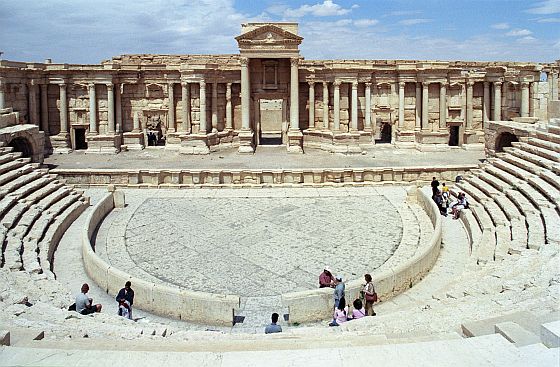
ISIS pulls back from Palmyra but fear of ‘cultural atrocity’ remains

The Guardian reports: The ruins of Palmyra have long enchanted visitors, its famous queen Zeinobia occupying the same iconic status for Syrians as Cleopatra does for Egypt.

But the once-bustling Silk Road hub known in antiquity for its community of artisans and merchants of varied ethnicity and religion is now in the crosshairs of the terror group Islamic State, whose fighters have looted and destroyed historical and cultural artefacts in Iraq.

“Palmyra constitutes one of the most beautiful and impressive panoramas to have survived from classical antiquity,” said historian Tom Holland. “Its ruins are as beautiful as they are well-preserved.

“More than that, though, it is a monument to the great melting pot of cultures that bordered the eastern flank of the Roman empire: the same melting pot that would ultimately serve to incubate Islam. Its destruction is too awful to contemplate.” [Continue reading…]

Facebooktwittermail

ISIS advance in Syria endangers ancient ruins at Palmyra

Palmyra

The New York Times reports: Islamic State militants advanced to the outskirts of the Syrian town of Palmyra on Thursday, putting the extremist group within striking distance of some of the world’s most magnificent antiquities.

That raised fears that the ancient city of Palmyra, with its complex of columns, tombs and ancient temples dating to the first century A.D., could be looted or destroyed. Militants from the Islamic State, also known as ISIS or ISIL, have already destroyed large parts of ancient sites at Nimrud, Hatra and Nineveh in Iraq. Islamic State leaders denounce pre-Islamic art and architecture as idolatrous even as they sell smaller, more portable artifacts to finance their violent rampage through the region.

The fighting on Thursday took place little more than a mile from the city’s grand 2,000-year-old ruins, which stand as the crossroad of Greek, Roman, Persian and Islamic cultures.

People in Palmyra described a state of anxiety and chaos, with residents trying to flee the northern neighborhoods. [Continue reading…]

Facebooktwittermail

The Freedom Charter for Syria

FREE-Syria: In 1953 a unique idea was proposed in South Africa: ask citizens across the country what their hopes and dreams were for the future. The African National Congress (ANC), in cooperation with the South African Indian Congress, the South African Coloured People’s Organization, and the South African Congress of Democrats created the National Action Council (NAC) to do just that. The NAC recruited South Africans from all walks of life and trained more than 50,000 volunteers. Surveying continued until 1955, when representatives from across South Africa went to Kliptown to help create the Freedom Charter. The Freedom Charter was adopted by the ANC and its associating organizations that same year.

In the following decades, the Freedom Charter was distributed to every corner of South Africa and became a symbol for hope and unity for the people. Due to apartheid, the Freedom Charter could not be used in an official political capacity until the end of apartheid in 1994. The Freedom Charter formed the bases for many articles in South Africa’s Post-Apartheid Constitution.

FREE-Syria recognized the influential nature that such a document can have and proposed creating a Syrian Freedom Charter.

Rafif Jouejati, Director of FREE-Syria, talks to Danny Postel, Associate Director of the University of Denver’s Center for Middle East Studies, about the Freedom Charter:

Facebooktwittermail

Traces of chemicals in Syria add to pressure on Obama to enforce a ‘red line’

The New York Times reports: If President Obama hoped that the danger of chemical warfare in the Middle East receded when Syria gave up tons of poison gas, mounting evidence that toxic weapons remain in the strife-torn country could once again force him to decide just how far he is willing to go to enforce his famous “red line.”

The discovery of traces of ricin and sarin in Syria, combined with the use of chlorine as a makeshift weapon in the country’s grinding civil war, undercut what Mr. Obama had viewed as a signal triumph of his foreign policy, the destruction of President Bashar al-Assad’s chemical arsenal.

But Mr. Obama appears no more eager to use military force against Mr. Assad’s government today than he was in 2013 when he abruptly called off a threatened airstrike in exchange for a Russian-brokered agreement in which Syria voluntarily gave up its chemical weapons. Instead, the Obama administration responded to reports of violations this time by seeking renewed assistance from Russia and exploring a new United Nations Security Council resolution addressing Syria’s continued use of chemicals as weapons.

“You’re dealing with a regime that is not very credible on weapons of mass destruction programs,” said Robert Ford, the Obama administration’s former ambassador to Syria. “No one should be surprised the regime didn’t declare all of its facilities. But the bad news in all of this is the regime is using chemical weapons regularly — even if not sarin gas now, they’re using chlorine gas regularly and they are not deterred from doing so.” [Continue reading…]

Facebooktwittermail

Syrians toppled the state and left Assad in power

Hassan Hassan writes: Profound divisions within the regime over the role of Iran continue to take a toll on Mr Al Assad. Sources I have spoken to reveal how the regime is facing a real challenge of military leadership, especially in northern and southern Syria.

Long-standing Alawite officers believe that they, along with their family members, have built Syria’s security and military institutions over decades. When Iranian and Hizbollah officers started to take a lead role in the conflict in 2011, many of those officers felt alienated. While such tensions do not always bring action, such discontent is becoming more obvious as generals leave their jobs to sit at home or leave the country. Many of them blame the president for mismanaging the conflict and for empowering Iranian and Hizbollah operatives at the expense of the army generals.

The sources say that high-level army leadership that commanded the military for decades is now almost non-existent. Instead, the regime replaced them with lower-ranking officers who had little experience and so became reliant on Hizbollah and the Iranians. Since the conflict began, scores of officers have exited the stage – either killed in action, assassinated, defected or because they simply preferred to stay on the sidelines. Some other officials have left the country.

Even though such officials oppose the president’s policies, most of them have not sided with the opposition or gone public about their discontent. When asked why such officers do not organise to replace Mr Al Assad, one source, who does not hide his contempt for the opposition, said the officers prefer to disengage from politics as “organising requires massive resources and is highly risky”. While officers are opposed to Iranian dominance, that does not mean they necessarily look for a change from outside the inner circle. The main concern, for some of them, is that the army is crumbling in favour of militias and those backed by Iran, which will consequently mean the regime is unsustainable. [Continue reading…]

Facebooktwittermail

Syrians risked their lives to collect evidence of Assad’s war crimes. Will their cases ever be heard in court?

Julian Borger reports: One day in February 2014, a dusty and dented pick-up truck approached an Isis checkpoint outside the Syrian border town of Tell Abyad, carrying two men dressed in the simple djellaba robes and loose keffiyehs worn by local farmers. The fighter on duty checked their identity cards and cast an eye over the fertiliser bags and scraps of wood piled in the back of the vehicle. The driver and his passenger said they were in the area to visit relatives, and the fighter waved them through.

The two men drove across the Turkish border, having cleared the last – and potentially most lethal – obstacle on a long clandestine journey. Hidden under the sacks of fertiliser in the back of the truck was a batch of documents salvaged from the battlefields of Syria’s bloody conflict, and smuggled across the country at enormous risk. Amid the thousands of pages of military orders and government reports that had just come across the border was vital evidence of war crimes, which could one day form the core of an international prosecution of Bashar al-Assad and his regime.

The driver of the pick-up, a stocky man in his 40s named Adel, was the chief investigator for the Commission for International Justice and Accountability (CIJA). An independent organisation set up by experts on humanitarian law, with funding from western governments, its aim is to collect evidence of atrocities committed by the Syrian regime and opposition, in preparation for the day when they can be judged by a tribunal. Adel and his team of 50 investigators had made many such trips in the three years since the CIJA was established, but these smuggling runs through Tell Abyad in the first months of 2014 would prove to be the most fruitful. They were carrying the greatest find of the investigation so far: a complete set of documents from the provinces of Raqqa and Deir ez-Zor, which provided a clear picture of the regime’s machinery of repression, and showed how tightly it is controlled by Assad and his inner circle.

Adel had visited Raqqa and Deir ez-Zor in December 2013, with introductions from mutual acquaintances to a handful of the commanders of Islamist militias in the region. These militias had scored a string of victories over the Syrian army earlier that year, seizing government buildings in the process. Adel was interested in what was inside these buildings – the paperwork left behind in filing cabinets and underground archives. In Raqqa, leaders of the local Salafist militia offered to help collect what Adel was looking for; over the next few days, they came to him with plastic bags and cardboard boxes full of papers from the abandoned secret police headquarters in the town of Taqba and from Raqqa city itself.

In Deir ez-Zor, the situation was more complicated. The dominant military force there was the Nusra Front, an al-Qaida offshoot opposed to any venture associated with the west. But one of the group’s local commanders – a man of “grace and education”, according to Adel – agreed to covertly provide assistance. His fighters allowed Adel’s investigators to comb through the military intelligence building and sweep up the files and loose papers scattered around its deserted shell.

By January 2014, Adel’s archive had rapidly grown to fill a dozen boxes – about 150kg of paper – which were stacked against the walls in a house he had rented in Raqqa. He had collected documents from many abandoned government facilities in his earlier sorties into Syria, but had never seen anything like this. “I opened the first box of documents and I saw right away how important they were,” he said. “They were from the security service, not just the military, and they provided a blueprint of how things happened in the regime’s security apparatus. What was particularly important in the documents from Raqqa and Deir ez-Zor was that their security branches kept copies of orders coming down from Damascus and the reports going up the chain. They provide the vital linkage evidence of crimes occurring on the ground.” [Continue reading…]

Facebooktwittermail

How ISIS uses water as weapon of war

Walaa Hussein writes: The Middle East is facing a water crisis. As the region experiences conflicts over water and faces the continuous risk of war breaking out, experts on water predict that the Islamic State (IS) aims to exacerbate this water crisis, as evidenced by its efforts to seize rivers and dams in Syria and Iraq, starting in 2013.

The Arab League has worked since 2008 to establish a new Arab convention on water usage, which would establish parameters on how to deal with the water crisis. However, the final draft is still under review because of the reservations of some member states.

PricewaterhouseCoopers, an international consulting organization, has identified numerous regions where the water crisis threatens to transform into a global conflict. Turkey, Syria and Iraq are included on that list, due to the Turkish dams controlling the Tigris and Euphrates rivers. Iran and Iraq are also witnessing a competition over the confluence of the Tigris and Euphrates rivers, known as Shatt al-Arab. Also included is Egypt, Sudan and Ethiopia, which are witnessing a conflict over the Nile. Egypt, Sudan, Libya, Chad and Niger are also experiencing a crisis in relation to an 800-meter (0.5-mile) deep underground water field and the Nubian sandstone aquifer. Libya wants to invest in this aquifer to extend an artificial river and supply its coastline with freshwater. [Continue reading…]

Facebooktwittermail

The Afghans fighting Assad’s war

Der Spiegel reports: His war only lasted from one dawn to the next. When the sun rose for the second time over the Syrian city of Aleppo, Murad, a farmer from Afghanistan, was still cowering on the second floor of the house he was supposed to defend to the death. That, at least, is what his Iranian officer had ordered him to do.

How, though, did he get to this war-torn city far away from his village in the mountains of Afghanistan? All he had wanted was an Iranian residence permit, he says. But at the end of his trip, he found himself fighting as a mercenary in the Syrian civil war on the side of the Bashar Assad regime.

On that morning in Aleppo, Murad didn’t know how many from his unit were still alive, nor did he know where he was or who he was fighting against. His four magazines had been empty for hours. When a violent explosion caused the house he was in to collapse, he found himself thinking about his daughters, he says. “I screamed and thought I was suffocating. And then, everything around me was quiet.”

Men arrived and pulled Murad, who was still screaming, out of the rubble. He was lucky, even if he didn’t see it that way at first. “I thought they would kill me immediately. But they bandaged me up and took me to their quarters. There was someone there who spoke a bit of Persian and he told me I didn’t need to be afraid.”

That was seven months ago. Since then, Murad and another Afghan have been sitting in a makeshift prison belonging to the al-Shamiya Front, one of Aleppo’s larger rebel formations. They are being held in a neon-lit basement, next to a roaring generator. The walls are crumbling, a product of the myriad explosions that have shaken the city. In addition to Afghans, Pakistanis and Iranians have also been taken prisoner by other rebel groups, all of them fighting on the front lines. [Continue reading…]

Facebooktwittermail

House arrest reports add to mystery surrounding fate of Syrian security chief

The Guardian: Mystery surrounds the fate of a senior Syrian security chief who is rumoured to have fallen foul of President Bashar al-Assad, against a background of recent rebel gains, growing Iranian influence and reports of intrigue and disarray in Damascus.

Lt Gen Ali Mamlouk, the head of the country’s national security council, was reported on Monday to be under house arrest in the Syrian capital following a rash of speculation about his whereabouts at a time of deepening crisis for the regime.

According to the Daily Telegraph, the 69-year-old was arrested on suspicion of planning a coup and talking to the opposition because he has qualms about Iran, Assad’s most loyal ally. Tehran is playing an increasingly pivotal role in Syria.

Facebooktwittermail

Has ISIS lost its head?

The Daily Beast reports: Abu Bakr al-Baghdadi, the Islamic State’s leader, has been moved from Iraq to the Syrian city of Raqqa, the terror army’s de facto capital, amid tight security two months after sustaining serious shrapnel wounds leaving his spine damaged and his left leg immobile, say jihadist defectors.

He is said to be mentally alert and able to issue orders, but his physical injuries are now prompting the so-called Islamic State’s governing Shura Council to make a final decision on a temporary stand-in leader who can move back and forth between front-lines in Syria and Iraq and is able to handle day-to-day leadership in the self-declared caliphate.

That leader will be, in effect, under al-Baghdadi, a super deputy to the caliph — in Arabic, na’ib al-malik, or viceroy. According to Islamic State defectors debriefed by opposition activists in neighboring Turkey, the election will pit two Iraqis and a Syrian against each other — all well-known figures within the terror army’s top leadership.

These sources say nine doctors to treat the infirm al-Baghdadi were also taken to Raqqa, including a senior physician from Mosul’s general hospital, but the entire al-Baghdadi caravan of attending medics, aides and body guards was split into separate convoys to avoid attracting attention from U.S. satellite surveillance and inviting a coalition airstrike or drone attack. At least one doctor didn’t know who his patient was when he arrived in Raqqa and was ordered brusquely to stop asking questions about the man’s identity. [Continue reading…]

Facebooktwittermail

Assad fires an intel chief

The Daily Beast reports: The sacking of yet another Syrian intelligence chief has raised suspicions that President Bashar al-Assad’s inner circle is fraying under the pressure of recent battlefield losses to the rebels. Disputes over the out-sized role Iran is playing to prop up the beleaguered Damascus regime are thought to be central to these internal disputes.

Ali Mamlouk, the head of the country’s National Security Bureau, and considered a trusted security adviser to the Assad family since the 1970s, has been accused of plotting a coup and placed under house arrest, according to a report today in Britain’s Daily Telegraph. In the past few weeks two other spy chiefs have been removed or killed.

In April, Rustum Ghazaleh, head of the Political Security Directorate, died in hospital after he was beaten up on the orders of General Rafiq Shehadeh, his counterpart in military intelligence, who was in turn sacked. The two argued ]over the increasing power of Iranian advisers in Damascus. [Continue reading…]

Facebooktwittermail