Category Archives: Syria

Assad says yet to see real steps on ISIS by Trump, U.S. forces ‘invaders’

Reuters reports: Syrian President Bashar al-Assad said he had yet to see “anything concrete” from U.S. President Donald Trump over his vow to defeat Islamic State and called U.S. forces in Syria “invaders” because they were there without government permission.

Assad, in an interview with Chinese TV station Phoenix, said “in theory” he still saw scope for cooperation with Trump though practically nothing had happened in this regard.

Assad said Trump’s campaign pledge to prioritize the defeat of Islamic State had been “a promising approach” but added: “We haven’t seen anything concrete yet regarding this rhetoric.”

Assad dismissed the U.S.-backed military campaign against Islamic State in Syria as “only a few raids” he said had been conducted locally. “We have hopes that this administration … is going to implement what we have heard,” he added.

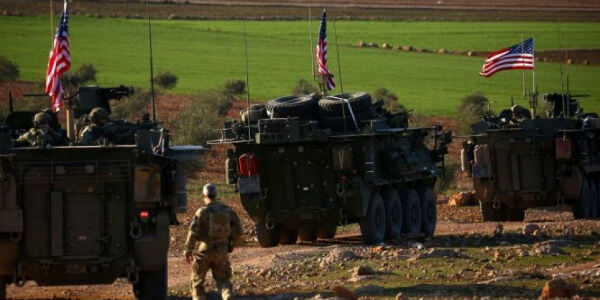
Asked about a deployment of U.S. forces near the northern city of Manbij, Assad said: “Any foreign troops coming to Syria without our invitation … are invaders.” [Continue reading…]

Facebooktwittermail

With a show of Stars and Stripes, U.S. forces in Syria try to keep warring allies apart

The Washington Post reports: The U.S. military is getting drawn into a deepening struggle for control over areas liberated from the Islamic State that risks prolonging American involvement in wars in Syria and Iraq long after the militants are defeated.

In their first diversion from the task of fighting the Islamic State since the U.S. military’s involvement began in 2014, U.S. troops dispatched to Syria have headed in recent days to the northern town of Manbij, 85 miles northwest of the extremists’ capital, Raqqa, to protect their Kurdish and Arab allies against a threatened assault by other U.S. allies in a Turkish-backed force.

Russian troops have also shown up in Manbij under a separate deal that was negotiated without the input of the United States, according to U.S. officials. Under the deal, Syrian troops are to be deployed in the area, also in some form of peacekeeping role, setting up what is effectively a scramble by the armies of four nations to carve up a collection of mostly empty villages in a remote corner of Syria. [Continue reading…]

Facebooktwittermail

Assad is a long way from victory in Syrian conflict

David Gardner writes: The expression “you break it, you own it” became a geopolitical jingle after the US in 2003 used a bull to liberate the china shop of Iraq, where their soldiers still find themselves, hundreds of billions of dollars later, fighting the most virulent jihadis yet. But translated into Russian for Syria, the meaning would appear to be: “we break it, you pay for it, but we and our friends own it”.

No doubt the Kremlin sees signs the US under President Donald Trump has ditched any idea of toppling President Assad. In Europe, moreover, political panic about any further surge of migrants and refugees from the region seems paramount.

Yet the confidence of Moscow — and Tehran — should not hide the fact that they have a real and costly dilemma on their hands in Syria.

First, the extent to which the Assad government controls the roughly 35 per cent of Syrian territory it holds is moot. The manpower shortages of a minority regime have made it dependent on Russia, Iran and powerful paramilitaries such as Lebanon’s Hizbollah. Damascus has had to subcontract local control to a mosaic of warlords and militias, private armies and racketeers — all invested in the lucrative distortions of a war economy characterised by penury for the mass of Syrians, roughly half of whom have been uprooted. There is nothing stable about that.

Second, to what extent are Russia and Iran willing to assist the Assads in breaking out of their mini-state and reconquering the rest of Syria?

The Syrian state almost certainly does not have the numbers to retake and garrison eastern Syria. Look at how Palmyra in central Syria keeps changing hands — the regime has only just recaptured this Graeco-Roman jewel after it fell to Isis for a second time in December while the focus was on Aleppo. Palmyra, moreover, was taken back after US air strikes on Isis there. The Syrian conflict is protean and shape-changing, but President Assad would be unwise to bet the palace on the recurrence of such a weird coalition.

Third, ostensible control of “useful Syria” is false comfort. Aside from the security fact that much of the rest is jihadi-infested, this implies the east is almost all “useless” desert. It is not. The resilience of the almost 50-year-old Assad regime required the energy resources and crops of the east. Raqqa, Hasaka and Deir Ezzor provinces produced 60 per cent of the country’s cereals, 75 per cent of its cotton, and all its oil and gas in 2010, before the rebellion. Far from useless, the east is essential to a regime recovering minimal self-sufficiency. Syria’s power-generating capacity, dependent on gasfields in the east, is about a quarter of what it was before the war. [Continue reading…]

Facebooktwittermail

Reassessing Obama’s legacy of restraint

Paul Miller writes: Obama’s foreign policy worldview came from his self-conscious effort to learn the lessons of history — specifically, the lessons of the George W. Bush administration — which no one will fault. As anyone who has ever taken a class in history or political science knows, Obama knew George Santayana’s famous aphorism that “those who cannot remember the past are doomed to repeat it.” But learning the lessons of history can be difficult, even deceptive. Obama does not seem to have known Robert Jervis’ important riposte to Santayana that “those who remember the past are condemned to make the opposite mistake.”

Obama made the opposite mistake. In his eagerness to avoid making Bush’s mistakes, he made a whole new set of mistakes. He over-interpreted the recent past, fabricating the myth about a hyper-interventionist establishment. As a result, he overreacted to the situation he inherited in 2009 and, crucially, never adjusted during his eight years in office. In this sense and others, he contrasts starkly with Bush, who made major changes in his second term. The result is that Obama retrenched when he should have engaged. He oversaw the collapse of order across the Middle East and the resurgence of great power rivalry in Europe while mismanaging two wars and reducing America’s military posture abroad to its smallest footprint since World War II. Despite the paeans of Obama’s admirers, this is not a foreign policy legacy future presidents will want to emulate. [Continue reading…]

Facebooktwittermail

Syrian children suffering staggering levels of trauma, report warns

The Guardian reports: Children in Syria are suffering from “toxic stress”, a severe form of psychological trauma that can cause life-long damage, according to a study that charts a rise in self-harm and suicide attempts among children as young as 12.

A report by Save the Children and its partner agencies in Syria paints a harrowing picture of the country’s children, 5.8 million of whom are in need of aid, after a war which reaches its sixth year next week.

Authors of the study, the largest of its kind to be undertaken during the conflict, warned the nation’s mental health crisis had reached a tipping point, where “staggering levels” of trauma and distress among children could cause permanent and irreversible damage.

More than 70% of children interviewed experienced common symptoms of “toxic stress” or post-traumatic stress disorder, such as bedwetting, the study found. Loss of speech, aggression and substance abuse are also commonplace. About 48% of adults reported seeing children who have lost the ability to speak or who have developed speech impediments since the war began, according to the report, entitled Invisible Wounds (pdf). [Continue reading…]

Facebooktwittermail

Pentagon plan to seize Raqqa calls for significant increase in U.S. participation

The Washington Post reports: A Pentagon plan for the coming assault on Raqqa, the Islamic State capital in Syria, calls for significant U.S. military participation, including increased Special Operations forces, attack helicopters and artillery, and arms supplies to the main Syrian Kurdish and Arab fighting force on the ground, according to U.S. officials.

The military’s favored option among several variations currently under White House review, the proposal would ease a number of restrictions on U.S. activities imposed during the Obama administration.

Officials involved in the planning have proposed lifting a cap on the size of the U.S. military contingent in Syria, currently numbering about 500 Special Operations trainers and advisers to the combined Syrian Democratic Forces, or SDF. While the Americans would not be directly involved in ground combat, the proposal would allow them to work closer to the front line and would delegate more decision-making authority down the military line from Washington. [Continue reading…]

Facebooktwittermail

U.S., Hezbollah and Russia operate in de facto alliance as Assad’s forces retake Palmyra

The Washington Post reports: Syrian government forces recaptured the historic city of Palmyra from the Islamic State on Thursday, aided by Lebanon’s Hezbollah, the Russian military and, indirectly, U.S. airstrikes.

The government victory came nearly three months after the Islamic State marched back into the town in a surprise assault that appeared to have taken the Syrian army unawares.

The Syrian army announced in a statement read on state television Thursday evening that its forces were in complete control of Palmyra after a push on the town in recent days that saw Islamic State defenses rapidly collapse. [Continue reading…]

Facebooktwittermail

UN details Assad and Putin’s war crimes in Aleppo

Michael Weiss reports: In a report released today on the recapture of East Aleppo by pro-Syrian government forces, the United Nations Human Rights Council concludes that the much-touted “evacuation” of civilians from the rebel-enclave last year was actually a “war crime of forced displacement” because it was carried out for strategic reasons rather than any regard for protecting non-combatants or for military necessity. The population transfer had in fact been overseen by the International Committee of the Red Cross.

The 37-page report, based on the work of a Commission of Inquiry, lays blame on both sides of the conflict for failing to take sufficient safeguards against against the loss of life or the destruction of vital infrastructure, although it finds that the Syrian and Russian air forces wrought a particularly devastating toll.

Warplanes targeted hospitals, bakeries and schools in a non-stop bombing campaign that lasted for months, beginning in September 2016. ”Approximately 300 people — including 96 children — were killed in the first four days of the offensive alone,” the report states. [Continue reading…]

Facebooktwittermail

Syrian peace talks flounder as participants ask: Where is America?

The Washington Post reports: The vacuum in U.S. policy on Syria is being keenly felt at the latest round of peace talks aimed at negotiating a political solution to the Syrian war — talks that seem destined to wind down this week without meaningful progress.

Five days into a round of discussions intended to take place between delegations representing the Syrian government and the opposition, government and opposition negotiators still have not met. Instead, the talks, due to end Friday, have become snarled in debates about procedures and process without yet addressing the major issues surrounding the remote possibility of finding a political solution to the nearly six-year-old war.

These talks, known as Geneva IV because they represent the fourth round of discussions aimed at securing a political settlement on the basis of a communique drafted in Geneva by the United States and Russia in 2012, are taking place against the backdrop of a new regional balance of power in which Russia has the leading role in Syria.

For the first time, the United States is not taking the initiative in pushing for a negotiated settlement. The rout of rebels from their stronghold in eastern Aleppo in December was a defeat for U.S. policy as well as for the Syrian opposition, and it effectively left a vacuum of U.S. decision-making on Syria that has yet to be filled by the new Trump administration. [Continue reading…]

Facebooktwittermail

After Oscar win, Russian Embassy calls Syria’s White Helmets ‘actors,’ not life-savers

Amanda Erickson writes: When “The White Helmets,” a documentary short about volunteer rescue workers in Syria, took home an Oscar on Sunday night, the group’s press officer was elated. He tweeted: “The world stands with the white helmets. Standing ovation at the Oscars. We have won.”

The film follows three volunteers from Syria Civil Defense, more commonly known as the White Helmets, as they do the heartbreaking work of rescuing civilians from the rubble. (At one point, they pull a 1-month-old “miracle baby,” unharmed, from a collapsed building. He’d been trapped for half a day.) The group was founded by locals along with a former British army officer and United Arab Emirates-based consulting firm called Analysis Research and Knowledge. Its membership is overwhelmingly Syrian, though it has received training from ARK and a Turkish NGO. The White Helmets receive funding from U.S. and European governments, operating on a budget of about $26 million.

The organization says it has saved about 60,000 lives. More than 140 of its volunteers have been killed. For these efforts, the White Helmets have been nominated for a Nobel Peace Prize.

The documentary has garnered good press and glowing reviews. But not everyone reacted so positively to the win. The Twitter account run by the Russian Embassy in Britain attacked the film Tuesday morning, calling the documentary a fiction populated by actors. [Continue reading…]

Facebooktwittermail

U.S. blocks Syrian rescue worker from attending the Oscars

The New York Times reports: Khaled Khatib, a Syrian rescue worker who served as a cinematographer on the Oscar-nominated documentary short “The White Helmets,” has been barred by American officials from traveling to Los Angeles for Sunday’s Academy Awards ceremony, according to the Associated Press.

The AP reported that the Department of Homeland Security blocked Mr. Khatib after discovering “derogatory information” about him. Mr. Khatib had planned to fly from Istanbul to Los Angeles on Saturday. The AP said he had been detained earlier in the week by Turkish officials for undisclosed reasons, and that he needed a passport waiver to travel to the United States, which was denied. Raed Saleh, the leader of the White Helmets, was also to attend the Oscars; there was no indication that his plans were upended.

Mr. Khatib had planned to attend the ceremony after the Trump administration’s travel ban was lifted. The ban had halted or slowed travel from seven Muslim-majority countries, including Syria, but it was frozen by the courts.

A member of the White Helmets, a group that searches for survivors in the rubble of bombed-out buildings, Mr. Khatib also filmed the group’s rescue efforts for the 40-minute film, which was made for Netflix and directed by Orlando von Einsiedel. [Continue reading…]

Facebooktwittermail

For Syrian refugees, there is no going home

The New York Times reports: In the makeshift tent settlements that dot fields and villages in the Bekaa Valley of Lebanon, Syrian refugees are digging in, pouring concrete floors, installing underground sewerage and electric wires, and starting businesses and families.

What they are not doing is packing up en masse to leave, despite exhortations from Syrian and Lebanese officials, who have declared that safety and security are on the march in neighboring Syria and that it is time for refugees to go home.

But as a new round of peace talks convened Thursday in Geneva, Syrians interviewed at a randomly selected camp in the Bekaa Valley this week offered a unanimous reality check. Their old homes are either destroyed or unsafe, they fear arrest by security forces and they know that despite recent victories by pro-government forces, the fighting and bombing are far from over. They are not going anywhere.

About 1.5 million Syrians have sought refuge in Lebanon, making up about a quarter of the population, according to officials and relief groups, and there is a widely held belief in Lebanon that refugees are a burden on the country’s economy and social structure.

Nearly six years into a war that began with a security crackdown on protests against President Bashar al-Assad, countries once eager to see him ousted are now more focused on containing the migrant crisis and defeating the Islamic State, and are willing to consider a settlement that allows Mr. Assad to remain in power.

That leaves many governments invested in vague hopes that such a settlement, however rickety or superficial, will somehow stop the metastasis of the Syrian crisis and ease fears of Islamic State terrorism — often conflated with concerns about ordinary Syrian refugees — that have fueled the rise of right-wing politicians.

And it gives many countries a strong stake in declaring Syria safe for return, even without resolving the political issues that started the conflict, including human rights abuses by the Syrian government.

Mr. Assad, Syrian officials and their allies in Lebanon are reading that mood. The Hezbollah leader, Hassan Nasrallah, has called for the return of migrants, and Lebanon’s president, Michel Aoun, has called on global powers to facilitate it.

But in a tent settlement in the village of Souairi, Syrians made clear that neither a fig-leaf deal nor an outright government victory would send many of them home.

Every family interviewed had at least one member who had disappeared after being arrested or forcibly drafted by the government. The refugees said they cared less about whether Mr. Assad stayed or went than about reforms of the security system. Without an end to torture, disappearances and arbitrary arrests, they said, they would remain wary of going back.

Virtually all said that they dreamed of going back, but that it was increasingly a dream for the next generation. [Continue reading…]

Facebooktwittermail

‘Al-Qaeda is eating us’: Syrian rebels are losing out to extremists

The Washington Post reports: The biggest surviving rebel stronghold in northern Syria is falling under the control of al-Qaeda-linked extremists amid a surge of rebel infighting that threatens to vanquish what is left of the moderate rebellion.

The ascent of the extremists in the northwestern province of Idlib coincides with a suspension of aid to moderate rebel groups by their international allies.

The commanders of five of the groups say they were told earlier this month by representatives of the United States, Saudi Arabia and Turkey that they would receive no further arms or ammunition until they unite to form a coherent front against the jihadists, a goal that has eluded the fractious rebels throughout the six years of fighting.

The freeze on supplies is unrelated to the change of power in Washington, where the Trump administration is engaged in a review of U.S. policy on Syria, U.S. officials say. It also does not signal a complete rupture of support for the rebels, who are continuing to receive salaries, say diplomats and rebel commanders.

Rather, the goal is to ensure that supplies do not fall into extremist hands, by putting pressure on the rebels to form a more efficient force, the rebel commanders say they have been told.

Instead it is the extremists who have closed ranks and turned against the U.S.-backed rebels, putting the al-Qaeda-linked groups with whom the moderates once uneasily coexisted effectively in charge of key swaths of territory in Idlib, the most important stronghold from which the rebels could have hoped to sustain a challenge to Syrian President Bashar al-Assad.

Moderate rebels still hold territory in southern Syria, in pockets around Damascus, and in parts of Aleppo province where they are fighting alongside Turkish troops against the Islamic State.

But the loss of Idlib to the extremists has the potential to prolong — or at least divert — the trajectory of the war at a time when the United Nations is reconvening peace talks in Geneva aimed at securing a political settlement. The talks opened Thursday with little sign that progress was likely. [Continue reading…]

Facebooktwittermail

Russia helped Assad destroy Syria and now wants the world to pay for its reconstruction

Financial Times reports: Russia is pressing world powers to provide Syria with billions of dollars for reconstruction to bolster its faltering efforts to resolve the Arab state’s six-year conflict.

Sign up By signing up you confirm that you have read and agree to the terms and conditions, cookie policy and privacy policy.
But European and Gulf states, angered by Russia’s military intervention that tilted the war in favour of President Bashar al-Assad, will only contribute if Moscow secures a peace settlement that sets the terms for an eventual political transition, western diplomats say.

“They [Russia] go in, they mess it all up, they break everything and want everyone to pay for it,” said a European diplomat.

The issue is expected to be raised at UN-backed talks between the Syrian government and rebels that begin in Geneva on Thursday. Russia is the dominant foreign player involved in the war, but after helping broker a ceasefire between the warring parties in December, it has struggled to bring the adversaries closer to a political agreement.

Mikhail Bogdanov, Russia’s deputy foreign minister in charge of Middle East issues, told a meeting of EU ambassadors in Moscow last week that the reconstruction of Syria would top the agenda very soon, according to European diplomats. He said “tens of billions of dollars” would be needed, while warning that “nothing” should be expected from Russia, the diplomats said.

“The Russians really do not want to inherit a completely destroyed Syria — that’s a problem that would stick with them as long as Iraq has been haunting the Americans,” said a Middle East-based diplomat. [Continue reading…]

Facebooktwittermail

Europe’s child-refugee crisis

Lauren Collins writes: Wasil awoke to the sound of a knife ripping through nylon. Although he was only twelve years old, he was living alone in a small tent at a refugee camp in Calais, France, known as the Jungle. Men entered his tent; he couldn’t tell how many. A pair of hands gripped his throat. He shouted. It was raining, and the clatter of the drops muffled his cries, so he shouted louder. At last, people from neighboring tents came running, and the assailants disappeared.

Wasil had left his mother and younger siblings in Kunduz, Afghanistan, ten months earlier, in December, 2015. His father, an interpreter for nato forces, had fled the country after receiving death threats from the Taliban. Later, Wasil, as the eldest son, became the Taliban’s surrogate target. Wasil was close to his mother, but she decided to send him away as the situation became increasingly dangerous. Her brother lived in England, and she hoped that Wasil could join him there. To get to Calais, Wasil had travelled almost four thousand miles, across much of Asia and Europe, by himself. Along the way, he had survived for ten days in a forest with only two bottles of water, two biscuits, and a packet of dates to sustain him. Before leaving home, he hadn’t even known how to prepare a meal.

Wasil was stunned by the conditions of the Jungle. The camp, a forty-acre assemblage of tents, situated on a vast windswept sandlot that had formerly served as a landfill, didn’t seem fit for human habitation. “I did not come here for luxury,” Wasil told me, in excellent English, which he had learned from his father. “But I can’t believe this is happening in Europe.” A chemical plant loomed nearby. There was no running water, and when it rained the refugees’ tents filled with mud and the camp’s rudimentary roads became impassable.

The Jungle had one thing to recommend it: its proximity to the thirty-mile-long Channel Tunnel, which connects France and England at the Strait of Dover. Thousands of refugees and migrants from all over the world congregated at the camp, amid rats and burning trash, with the sole objective of making it, whether by truck, train, or ferry, onto British soil. On one of Wasil’s first days at the camp, he called his mother on his cell phone. “Are you safe?” she asked. “I was saying to her, ‘I’m in a good condition, I am too safe. I’m going to school and learning French. . . . I can touch the water that one side is here and the other side is England,’ ” Wasil recalled. “I’m not telling her the real situation.” [Continue reading…]

Facebooktwittermail

A journey through Assad’s Syria

Fritz Schaap writes: On an icy January evening in eastern Aleppo, a grotesque scene of destruction, five men are standing around a fire in a battered oil drum in a butcher’s shop.

Their trousers are dirty and their faces are covered with soot. There has been no running water for a long time. Every evening, the men come here to warm up, burning table legs and chairs from the ruins. In what is left of their apartments, there are no heating stoves.

The fear, though, is finally gone, says shop owner Ahmed Tubal. For over four years, various rebel groups had controlled their neighborhood of al-Shaar, but Syrian and Russian jets recently transformed half of the city into rubble to wipe them out.

The rebels and their supporters have left the city and following the regime’s victory, only those who support Syrian President Bashar Assad have remained. “The bombing was necessary to drive out the Islamists,” says Tubal, a short man with tired eyes. “Otherwise they would never have left.” The other men voice their approval. “We were so exhausted. We just wanted it to stop. And if that meant that everything had to be destroyed even further, then that was just the price we had to pay.”

A visit to Assad’s Syria, a rump state around the large cities in the west, over which the dictator has regained control thanks to Russian and Iranian support, is like entering an apocalyptic world. Large Mercedes tractor-trailers drive water tanks through Aleppo’s ruins while the streets are patrolled by armored vehicles manned by Russian soldiers. Assad can frequently be seen on television while fear can be seen in the eyes of many residents.

Our journey leads us to the three largest cities in northern and western Syria: Aleppo, Latakia and Homs. Aleppo has become symbolic of the brutal bombing campaign. Latakia, the regime stronghold on the Mediterranean, was largely untouched by the war and is still a popular vacation spot in the summer. And Homs, once the center of the uprising, was destroyed and is now slated to become a model of reconstruction. [Continue reading…]

Facebooktwittermail

Why the U.S. should rethink its anti-ISIS Syria strategy

Hassan Hassan writes: The imminent battle to dislodge ISIL from Raqqa can deliver many things. It can be a deadly blow to ISIL in a country where it has little experience – relative to Iraq where it originated. It can be the beginning of a process to steer much of the country in a new direction. Or it can merely reset the conditions for a more chaotic north where ISIL will still be a player and other jihadist organisations will return.

The most significant battle against ISIL in Syria is muddled by the conflict between Turkey and the Kurdish militias in northern Syria. Both the United States and Turkey exerted little effort over the past two and a half years to adequately prepare for this battle. As the battle approaches, the two find themselves stuck with the forces they perceive as better positioned to do the job, when neither choice is appropriate for such an important battle.

The US had an Iraq-first strategy for the best part of the Operation Inherent Resolve, while it relied on the YPG, the Kurdish People’s Protection Units, to fight in Syria. Whereas the international coalition prepared well for Mosul and ensured that Kurdish and Shia militias do not fight in the city, the same has not been done in Syria. Kurdish militias appear primed to spearhead the fight in Raqqa. [Continue reading…]

Facebooktwittermail

Syria is on the brink of partition – here’s how it got there

By Scott Lucas, University of Birmingham

After nearly six years of uprising, conflict and chaos, the partition of Syria is imminent. President Bashar al-Assad will of course rail against it; his crucial ally Iran will probably resist too, and the marginalised US won’t even acknowledge the prospect. But the lines are nonetheless being drawn.

With pro-Assad forces back in control of Aleppo city, a newly co-operative Turkey and Russia are ready to pursue partition as a short-term resolution. The Syrian opposition and many rebels will embrace it as their best immediate option, and the leading Kurdish political and military groups will settle for whatever autonomy they can get. If things continue shaping up this way, by the end of 2017, Syria will quite probably become a country of four parts.

The Russia- and Iran-backed Assad regime is set to hold much of the south and west, and most of Syria’s cities. There’ll most likely be a Turkish/rebel area, effectively a “safe zone”, in parts of northern Syria; the Syrian opposition will probably control Idlib province and possibly other pockets of territory in the northwest; while the Kurds will have some form of autonomy in the northeast.

A settlement like this has been a long time coming. Neither the Assad regime nor its enemies will settle for just a part of Syria, and both have survived years of intense conflict. The opposition and rebels still control territory from the north to the south; Assad clings on with the help of Russian aerial bombardments and Iranian-led ground forces. All the while, the Kurdish Democratic Party (PYD) and its YPG militia are still defending territory against both IS and the Assad regime.

If the lines of a potential partition were clear some time ago, what stood in the way of recognising them was the challenge of Aleppo city. Without recapturing it, the Assad regime had no hope of claiming an economic recovery (however disingenousouly) in the areas it controlled, let alone in the entire country. But the city was surrounded by opposition-controlled territory; Assad’s military was far too depleted to change the game, and even with outside support, its campaign would be protracted.

Continue reading

Facebooktwittermail
