Category Archives: Syria

Syrian parliament condemns Israel’s ‘war of annihilation’

During the period since Israel launched its latest assault on Gaza, more than 300 people have been killed in Syria, mostly by the Syrian government, mostly by barrel bombs. The Syrian parliament, nevertheless felt that it was important to go on the record, denouncing the Israeli operation:

The People’s Assembly expressed on Saturday a vehement condemnation of Israel’s brutal aggression it has unleashed against the besieged Palestinian people in the Gaza Strip over the past days.

The Assembly dismissed in a statement on Saturday the aggression as “a war of annihilation” that demands international prosecution for the Israeli enemy’s authorities and all their supporters.

Likewise, Syria’s closest military ally, Iran, is deeply troubled about the plight of Palestinians in Gaza (Palestinians in Syria, not so much):

Iran Majlis Speaker Ali Larijani has condemned the silence of international organizations on the Israeli regime’s ruthless massacre of Palestinians.

In separate telephone conversations with his Emirati, Pakistani and Syrian counterparts on Tuesday, Larijani highlighted the Muslim leaders’ responsibility in preventing the criminal Zionist regime’s ruthless actions and the carnage of Gazans.

Facebooktwittermail

Kurds enter Syria from Turkey to fight ISIS

AFP reports: Hundreds of Kurdish fighters have entered northern Syria to help battle jihadists besieging the Kurdish city of Ain al-Arab, a monitor said Tuesday.

“At least 800 Kurdish fighters crossed the Turkish-Syrian border to help their comrades in Ain al-Arab (Kobane in Kurdish), which is under total siege by Islamic State jihadists,” Syrian Observatory for Human Rights director Rami Abdel Rahman told AFP.

A Kurdish Syrian activist said the flow of fighters came as the Kurdistan Workers’ Party (PKK), blacklisted in Turkey as a terrorist organisation, gave orders for Kurdish fighters to move to protect Kobane.

“Fighters started going into Kobane from Turkey some four or five days ago,” said Havidar, who goes by only one name.

“But the latest entry, last night, came after orders from the higher leadership of the PKK. Last night, there were celebrations in Kobane — fighters were firing into the air as they arrived in the town,” he told AFP.

The Observatory’s Abdel Rahman also said the mobilisation had come after a call by the PKK, which has branches in Turkey, Iran, Iraq and Syria.

“The Kurds are preparing for an assault by the Islamic State,” he said.

Syrian Kurds have been fighting the IS for many months.

“But this is the first time that the jihadists appear to be advancing while the Kurds are suffering real setbacks. That is because IS has brought in a lot of weapons from Iraq,” said Havidar, referring to weapons seizures from the Iraqi army amid an IS offensive there.

“Kurds going in to fight are from everywhere — Turkey, Iran, Syria and others. Even some Kurds based in Europe are saying they want to go fight,” he added. [Continue reading…]

Facebooktwittermail

Syria’s allies are stretched by widening war

The Wall Street Journal reports: The Lebanese movement Hezbollah, facing a heavy strain on its resources, is recruiting more fighters in Syria and bringing in fresh but inexperienced forces from Lebanon to shore up Bashar al-Assad’s regime.

In the past year, Hezbollah’s battle-tested fighters helped Syrian forces retake territory around the capital Damascus and other key cities such as Homs and Aleppo, paving the way for Mr. Assad to win a third, seven-year term as president in elections last month.

But Hezbollah members and people involved in the group’s operations in Syria said the militant group is now stretched thin by two conflicts involving its Shiite allies that threaten to erode, if not undo, its successes in Syria.

A Sunni rebellion against the Shiite-dominated government in neighboring Iraq is drawing home Iraqi Shiites who have been fighting alongside Hezbollah in Syria, according to pro-government militiamen in Syria.

On Monday, Islamic State, the extremist group leading the fresh insurgency in Iraq, captured more territory in Syria by routing rival rebel factions from the city of Deir-Ezzour, according to Syrian activists and a spokesman for the rebel umbrella group known as the Free Syrian Army. The city is the seat of the resource-rich province of Deir-Ezzour bordering Iraq and the conquest gave Islamic State control of nearly 80% of the province. [Continue reading…]

Facebooktwittermail

Islamic State in Syria, back with a vengeance

Hassan Hassan writes: The Islamic State’s stunning advances in Syria over the past month defy basic military instincts. Consider, for example, the group’s remarkable turn of fortunes in the eastern province of Deir ez-Zor in recent months, where ISIS—as the group was formerly known—all but vanished in February after local rebels joined forces to batter the remaining ISIS strongholds in the province. Rebel groups elsewhere had likewise planned in May to push against ISIS’s last fortress in Raqqa, another eastern province, so as to drive the group out of the country entirely. Yet ISIS, or the Islamic State as it is now called, is now back with a vengeance.

The Islamic State is now on the offensive in much of Syria, especially in the east and north. If the group manages to retake the ground it had lost after most of the rebel groups declared war against it in January and February, this is likely to indurate its staying power in Syria. And there are signs that the group might eventually consolidate its presence in the east and make inroads into the north, especially as it seems to be following new strategies during its latest push.

The group has been focusing on negotiations, rather than only brute force, which in large part explains its striking successes of late. Although the Islamic State has attacked a few cities and towns in Deir ez-Zor and forcefully displaced its residents, it tends to do so only with towns that had bled it before, such as Khisham and Shuhail (the latter was long perceived as a stronghold of al-Qaeda affiliated Jabhat al-Nusra). In other villages and towns, the Islamic State has sent envoys to negotiate a deal in which local fighters surrender, pledge allegiance to Abu Bakr al-Baghdadi, and implement sharia, and in exchange the Islamic State spares residents from any harm. The terms of these deals vary from one area to another. [Continue reading…]

Facebooktwittermail

The victims of the war in Syria dying the loneliest deaths

Lauren Wolfe writes: In April, United Nations High Commissioner for Human Rights Navi Pillay said torture was routinely being used in government detention facilities and “almost certainly” in “a systematic or widespread manner.” Mental health support, as I recently wrote, is nearly nonexistent, both for Syrians who’ve suffered torture and for those who have not, both inside their country and in nearby states holding burgeoning numbers of refugees. And now suicide, according to doctors and social workers I spoke with, is rapidly becoming a very real fallout of this war — one that is so taboo, it is rarely spoken of within families, let alone publicly.

“Suicide is strictly forbidden in Islam,” said Haid N. Haid, a Beirut-based Syrian sociologist and Middle East program manager at the Heinrich Boll Foundation. Scholars often forbid the recitation of a funerary prayer for people who’ve committed suicide, as a way to punish the families of the dead and to deter others from taking their own lives. The cause of death is usually obscured — it is called an “accident” or “natural.” Suicide, Haid emphasized, is always “a big scandal that people will talk about for a long time.”

Despite the taboo, doctors I spoke with said they are seeing more and more cases of people with suicidal impulses — a trend confirmed by the number of reported instances in which, because of a feeling of being unable to provide for one’s family as a refugee, or because of the shame of rape, pregnancy through rape, or sexual humiliation, it has been carried out. Hard data are difficult to come by. But while I was unable to find formal statistics on suicide in the Syrian war, the picture painted by doctors working in and near the country is decidedly bleak — and given how precious few mental health services are available to Syrians affected by the war, it is probably just the tip of the iceberg. [Continue reading…]

Facebooktwittermail

Syria: Should the West work with Assad?

Fred Hof writes: The combination of the Islamic State in Iraq and al-Sham (ISIS) running amok in Iraq and the appearance of an Assad regime military victory in western Syria have added octane to arguments that Washington should forego its step-aside guidance to Bashar al-Assad. An unnamed senior Obama administration official recently told The Daily Beast, “Anyone calling for regime change in Syria is frankly blind to the past decade; and the collapse of eastern Syria, and the growth of Jihadistan, leading to thirty to fifty suicide attacks a month in Iraq.” The senior official was wise to insist on anonymity: he or she implied that a murderous regime is part of the solution and attributed blindness to a president who, nearly three years ago, told Assad to step aside. Other analysts have gone farther, suggesting that the West work with Assad to counter ISIS and rebuild Syria. Should Washington and its allies consider cooperating with the Assad regime?

There are two aspects of the “do business with Assad thesis:” one posits that the regime has won; and the other suggests that the ISIS rampage in Iraq wipes the slate clean in terms of the Assad regime’s complicity in creating the problem to be solved. Thus, the regime’s role in the establishment of al-Qaeda in Iraq becomes yesterday’s news. The regime’s sheer brutality — serving as a magnet for ISIS and its cadre of Sunni foreign fighters — becomes irrelevant. The de facto collaboration of ISIS and the regime in seeking to obliterate Assad’s Syrian opposition may, once that pesky opposition disappears, be safely put to the side. The sheer scope of the ISIS emergency, according to this line of thinking, makes it mandatory for the West to work with the Assad regime to beat ISIS.

Indeed, the Syrian opposition is back on its heels and perhaps headed for a knockdown; if not a knockout. In Aleppo, it faces a murderous barrage of regime barrel bombs to its front and ISIS assaults to its back. Whatever Bashar al-Assad and Abu Bakr Al-Baghdadi may think of one another personally, their top tactical priority in Syria is identical: destroy the Syrian nationalist opposition to the Assad regime.

That destruction is vital to both parties. From the beginning, Assad has maintained that terrorists, top-heavy with foreign fighters, are his only opponents of consequence. By focusing his firepower on the nationalist opposition and by largely ignoring the ISIS phenomenon, he seeks to give his argument the attribute of truth and restore his value to the West. As for ISIS, exterminating Assad’s opposition opens up two possibilities: incorporating non-regime Syria into its declared state; and setting the stage for its ultimate showdown with the regime (unless, of course, it and the regime extend indefinitely their live-and-let-live arrangement).

Is the definitive defeat of the Syrian opposition inevitable and (if so), would that defeat mandate a renewal of the transactional relationship between the regime and the West? [Continue reading…]

Facebooktwittermail

Lebanon’s closed doors for Palestinian refugees

IPS reports: Tens of thousands of Palestinians living in Syria have been uprooted since the violent government crackdown on the uprising and the ensuing battles that ensnared their communities. For around 50,000 of them, Lebanon was their only safe route out but now it seems this door is being closed on them.

The family of 19-year-old Iyad was exiled from Palestine in 1948 upon creation of the state of Israel and fled to Yarmouk camp in Damascus, Syria, where they settled but violence and war have once again uprooted their community. Iyad now finds himself on the run from Syria, but his security in Lebanon is far from assured.

Having fled to Lebanon in December last year, Iyad was intent on traveling onto Libya and from there to make the perilous journey to the now renowned Italian island of Lampedusa. However, last month his plans were thwarted when the Lebanese security services detained him, along with 48 other young Palestinian men, as they tried to leave Lebanon through Rafiq Hariri airport in Beirut. [Continue reading…]

Facebooktwittermail

U.S. may agree to Assad retaining control over chemical weapons facilities

Defense One reports: Syria’s regime may be able to retain parts of its shuttered chemical-arms factories under “compromise” terms devised by a global watchdog agency.

The United States could endorse the concept in order to finalize a plan this week for dealing with the dozen contested sites, even though doing so would require making “serious” concessions to President Bashar Assad’s government, said Robert Mikulak, Washington’s envoy to the Organization for the Prohibition of Chemical Weapons.

“We are not, however, prepared to go further or engage in further haggling,” Mikulak told the agency’s 41-nation governing board on Tuesday.

He indicated that the plan from the agency’s Netherlands-based staff would impose new “tunnel perimeters” and “more effective monitoring measures” for at least some of Syria’s five underground facilities, while demolishing seven fortified hangars. [Continue reading…]

Facebooktwittermail

U.S. ignored warnings before ISIS takeover of a key border city

The Daily Beast reports: Three weeks ago, a group of leaders from the opposition Free Syrian Army warned U.S. officials that a strategic city along the Iraqi border was about to fall to ISIS. It was the latest in a long series of increasingly anxious cries for help. The rebels never heard back from the Americans.

Five days ago, the predictions came true. Free Syrian Army units in the city of Der al Zour handed over their territory to the Islamic State of Iraq and al Sham, following weeks of desperate requests for help to international officials, including a direct appeal in a private meeting with U.S. Ambassador to the United Nations Samantha Power.

“[The U.S. officials] showed an understanding of the situation but there was no movement at all,” the commander of the FSA battalion near Der al Zour told The Daily Beast in an interview. “There’s no clear American position in that part of Syria. We told the Americans we are going to fight ISIS and ISIS is close to us, but they did nothing.”

Two leaders of the Free Syrian Army in eastern Syria told The Daily Beast that the moderate rebels in the area greatly outnumbered the ISIS fighters returning from Iraq in stolen American-made vehicles. But the FSA battalion, weakened from months of being under siege, did not have enough ammunition to engage ISIS in the fight. They retreated south, giving up what they controlled of Der al Zour to ISIS without ISIS having to fire a shot.

“Der al Zour was surrounded for several months by ISIS and the regime. The siege included no food and water. Our battalion was weakened,” the FSA commander said. “The FSA numbers are big, but we don’t have weapons, we don’t have ammunition, we don’t have anything.”

For several weeks prior, FSA leaders had tried to sound the alarm. If Der al Zour fell to ISIS, the extremist group would have control of the transportation routes from their stronghold in Raqqa, Syria to their new territories in northern Iraq. The area is also rich in oil and gas resources and was the last FSA stronghold along the rapidly disappearing Iraq-Syria border. [Continue reading…]

Facebooktwittermail

Holder pushes for witch-hunt against potential terrorists

For several decades, thousands of Americans — some of them religious extremists, some ethnic supremacists and most believing that they have God on their side — have been traveling to the Middle East to fight in a foreign army notorious for committing war crimes and abusing human rights.

Americans are free to join the Israel Defense Forces so long as Israel does not declare war on the United States. There is no law that stands in the way of this kind of foreign military enrollment, even though some radicalized Americans who have followed this path went on to become terrorists.

Never is an American who moves to Israel, even one who illegally constructs a home on Palestinian land in the West Bank, referred to as a “potential terrorist” — that potentiality supposedly can only be found in Muslims.

The New York Times now reports:

Attorney General Eric H. Holder Jr. on Tuesday implored more European countries to adopt American-style counterterrorism laws and tactics, including undercover stings to prevent potential terrorists from traveling to Syria.

Mr. Holder’s speech in Oslo amounted to a full-throated endorsement of America’s pre-emptive counterterrorism strategy, which began in earnest under President George W. Bush after the Sept. 11 attacks. The F.B.I. has created elaborate ruses to ensnare people who express interest in joining terrorist groups or attacking America. That has led to a number of high-profile cases but has also attracted criticism that the United States is manufacturing terrorism cases and entrapping Muslims.

Prosecutors have also arrested people before they boarded international flights, charging them with providing support to terrorist groups. Such laws do not exist in every country.

“In the face of a threat so grave, we cannot afford to be passive,” Mr. Holder said in prepared remarks. “Rather, we need the benefit of investigative and prosecutorial tools that allow us to be pre-emptive in our approach to confronting this problem. If we wait for our nations’ citizens to travel to Syria or Iraq, to become radicalized, and to return home, it may be too late to adequately protect our national security.”

Try and unpack the meaning of the phrase become radicalized and some mangled reasoning quickly surfaces.

If the process of radicalization had not begun before an individual decided to abandon their home and travel to Syria or Iraq, does that mean that the U.S. or any other Western government should view, for instance, anyone who wants to go and work in a refugee camp in Syria as a potential terrorist?

On the other hand, if it is conceded that this mysterious psychological transformation called radicalization is determined not so much by where an individual is physically located as much as what they are influenced by and how they perceive those people they identify with as being under threat, then the premise of the geographically located terrorist breeding ground starts to fall apart.

In those cases where individuals have had the opportunity to explain their motives for turning towards extremism, the most common explanations are that it has been a response to witnessing the impunity with which Israel uses violence to subjugate the Palestinian people, or because they believe that the United States used 9/11 to launch a war on Islam. In other words, they became radicalized by watching the news — not by traveling to Syria or by participating in online jihadist forums.

Even during the era of McCarthyism when conservatives were whipping up anti-communist hysteria in America, the question posed by the House Committee on Un-American Activities, was: “Are you now or have you ever been a member of the Communist Party of the United States?”

If Eric Holder had been on that committee maybe they would have been asking: “Are you now, have you ever been, or might you ever become a member of the Communist Party of the United States?”

In truth, the U.S. government has no business nor skill in predicting the future and hunting for potential terrorists.

The growth of ISIS has been driven by its success on the battleground — not the failure of foreign governments to monitor their own citizens.

And the challenge ISIS presents will not be met by hoping it destroys itself.

More than anything else, Americans are victims of simplistic narratives — analysis all too often gets reduced to kindergarten language about “good guys” and “bad guys,” while reference to “moderates” and “extremists” passes for nuanced interpretation.

In large part this results from the fact that the actors on the ground are so rarely included in the discussion.

As a recent conversation on Britain’s Channel 4 News illustrates, however, it is possible to talk about what is happening in Syria and Iraq while acknowledging that despite the gruesome headlines, the participants in this conflict are by-and-large self-motivated, autonomous adults.

Facebooktwittermail

Assad’s ‘machinery of death’ worst since the Nazis

As Israel once again commits war crimes in Gaza, perpetuating the collective punishment of a population being held under siege, why is it that so many of those in the West who express their outrage at the behavior of the Israelis, have remained largely silent for the last three years in response to the atrocities committed by the Syrian government? That silence is all the more ironic when in their effort to raise awareness about Gaza, some activists on social media are using — without correct attribution — images of civilian casualties in Syria.

The Daily Beast reports: Tens of thousands of photographs showing the Syrian government’s torture, murder, and mass starvation of civilians in custody are evidence of the kind of systematic atrocities not seen since Hitler’s Nazi regime exterminated millions during World War II, according to the State Department’s top war crimes official.

Stephen Rapp, the State Department’s ambassador-at-large for War Crimes and director of the Office of Global Criminal Justice, has reviewed large sections of a huge collection of photos and written records of Syrian government atrocities smuggled out of the country by a former military photographer known as “Caesar.” Rapp spoke about the evidence at a July 3 event at the Atlantic Council in Washington.

“This is solid evidence of the kind of machinery of cruel death that we haven’t seen frankly since the Nazis,” he said. “If it is as it appears thus far, we’re talking about more than 10,000 individuals being killed in custody over the period from 2011 to 2013, including largely men but also some very, very young men and boys and women… It’s shocking to me, as a prosecutor—I’m used to evidence not being so strong.”

Rapp’s strong condemnatioin of Assad and his call for international action to respond to Assad’s crimes against humanity comes as the Obama administration is engaged in an internal debate over how hard to actually push for regime change in Syria, given the rise of terrorism in the region.

Another former war crimes prosecutor who has reviewed some of the evidence tells The Daily Beast that he believes the photos indicate at least indirect “Russian government responsibility” for the atrocities. [Continue reading…]

Facebooktwittermail

Syrian women refugees struggling alone to care for their families

The Guardian reports: Women are the sole providers for one in four Syrian refugee families, struggling to provide food and shelter for their children and often facing harassment, humiliation and isolation, according to a report from the UN high commissioner for refugees.

More than 145,000 Syrian families now living in Egypt, Lebanon, Iraq and Jordan are led by women, it says. The civil war in Syria has torn apart families and communities, forcing almost three million people – mostly women and children – to flee the country.

Those interviewed for the report, Woman Alone – the Fight for Survival by Syrian Refugee Women, said they lacked resources, jobs, food, housing, protection and security. One in three reported they did not have enough to eat.

“For hundreds of thousands of women, escaping their ruined homeland was only the first step in a journey of grinding hardship,” said António Guterres, the UNHCR chief. “They have run out of money, face daily threats to their safety, and are being treated as outcasts for no other crime than losing their men to a vicious war. It’s shameful. They are being humiliated for losing everything.” [Continue reading…]

Facebooktwittermail

Why one Canadian woman joined ISIS’s Islamic state

CBC News reports: Eight months ago, Umm Haritha, a 20-year-old woman from Canada, made her way to Turkey against her parents’ wishes with a half-empty suitcase and $1,500.

Within a week she was in Syria, and a few weeks later she was married to Abu Ibrahim al-Suedi, a 26-year-old Palestinian from Sweden fighting for Islamic State in Iraq and Syria (ISIS), the Sunni jihadist group battling the Syrian regime.

It is not clear whether Umm Haritha’s marriage to Abu Ibrahim was arranged before her travel to Syria. Regardless, it only lasted five months.

On May 5, Abu Ibrahim, whose real name is Taha Shade, was in a car en route to a meeting in Deir ez-Zor with members of rival faction Jabhat al-Nusra. What was meant to be a gathering to finalize a peace treaty between ISIS and al-Nusra turned deadly when an al-Nusra fighter on a motorbike sped up to Shade’s car and detonated his explosive belt.

At the time, Shade was wearing his own explosive belt, which also went off and blew him to pieces.

Two days later, Umm Haritha tweeted about her husband’s death, calling on “Allah” to “destroy those who backstabbed the brothers and resurrect Abu Ibrahim with noor [light] from every piece of his body.”

Umm Haritha’s journey to Syria highlights an underreported part of the western Jihadist experience in Syria. [Continue reading…]

Facebooktwittermail

‘Water war’ threatens Syria lifeline

Al Jazeera reports: When severe water cuts began to hit Aleppo province in early May, residents started referring to a “water war” being waged at the expense of civilians. Images of beleaguered women and children drinking from open channels and carrying jerry cans of untreated groundwater only confirmed that the suffering across northern Syria had taken a turn for the worse.

However, lost in the daily reports was a far more pernicious crisis coming to a head: a record six-metre drop in Lake Assad, the reservoir of Syria’s largest hydroelectric dam and the main source of water for drinking and irrigation to about five million people.

Under the watch of the Islamic State group – formerly known as the Islamic State of Iraq and the Levant (ISIL) – levels in Lake Assad have dropped so low that pumps used to funnel water east and west are either entirely out of commission or functioning at significantly reduced levels. The shortages compel residents in Aleppo and Al Raqqa to draw water from unreliable sources, which can pose serious health risks.

The primary reason behind the drop appears to be a dramatic spike in electricity generation at the Euphrates Dam in al-Tabqa, which has been forced to work at alarmingly high rates.

“[Lake Assad] is pumping out more than it is receiving. This is because the electricity generators are working 24 hours a day, more than they should be,” Waleed Zayat, a mechanical engineer working for the Syrian opposition’s interim government’s Ministry of Water Resources and Agriculture in Aleppo, told Al Jazeera. [Continue reading…]

Facebooktwittermail

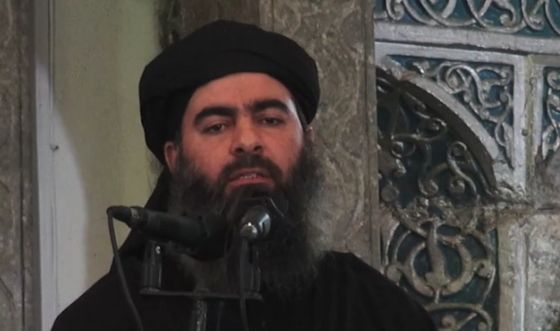
Has the leader of ISIS been killed?

Caliph-Ibrahim

Abu Bakr al-Baghdadi, the ISIS leader and recently self-declared Caliph Ibrahim, ruler of the so-called Islamic State, has until now kept a very low profile.

His first officially released video shows him delivering a sermon in Mosul.

Why the appearance now?

Perhaps in order to dispel rumors that he has been severely injured or might even be dead. Of course such reports might be a ruse to draw him out of hiding and thus make him an easier target to be killed. Either way, there’s no disputing al-Baghdadi’s vulnerability.

International Business Times reports: Abu Bakr al-Baghdadi, the leader of the Sunni militant outfit Islamic State of Iraq and the Levant (Isis), is said to have been severely injured in the raging battle forcing him to flee to neighbouring Syria.

According to a report in the Iraqi news network Al Sumaria, the insurgent leader was injured during a raid led by Iraq’s Shiite-led security forces in the west of Anbar.

“The Iraqi security forces carried out an operation in the city of Qaim on the border with Syria based on accurate intelligence and with the help of the Air Force where the leader of ISIL, Abu Bakr Al-Baghdadi was seriously injured,” said Haidar al-Shara, a representative of the international parliament in Iraq.

However, the report has so far not been independently verified. If confirmed, it will be a severe blow to the militant group which has been marching on several Iraqi cities.

The Iraqi official said: “After being hit, al-Baghdadi, with a range of elements of his organisation fled into Syrian territory because of its proximity to Qaim,” adding: “al-Baghdadi might be killed as a result of the severity of his injuries.”

If al-Baghdadi has indeed fled back to Syria, so much for ISIS’s claim that it has erased the boundary between Syria and Iraq. At this point in time, ISIS appears to recognize that one side of a supposedly non-existent border is safer than the other.

Facebooktwittermail

Iran’s role in Syria

Nader Hashemi and Danny Postel, directors of the Center for Middle East Studies at the University of Denver, interviewed by IranWire:

How does the Syrian opposition interpret Iran’s involvement in Syria?

Nader Hashemi: The Syrian opposition understandably views Iran as an enemy state, which is the biggest backer and sustainer of Assad’s criminal enterprise. The fingerprints of the Islamic Republic are all over the atrocities in Syria. The full story of Iran’s involvement in Syria has yet to be told. If we ever get to the point where there’s a full investigation, we’ll likely see that Iran’s involvement has been much larger and more significant than has been publicly admitted and reported. There’s a lot of evidence to suggest that Bashar al-Assad is hugely in debt to the Iranian regime for its survival, increasingly so as the conflict has gone on.

Danny Postel: The Hezbollah’s Syrian surge, for example, in 2013, was critical. It came at a time when Assad was very vulnerable, and that’s why Hezbollah was drawn in. And we now have reports of Iraqi fighters in Syria, which Iran has played a direct role in, and Afghan fighters.

Hashemi: There was a piece in the Wall Street Journal a few weeks ago reporting that the Iranian government is paying a $500 bribe to Afghan Shia refugees in Iran to fight in Syria, which is quite revealing. This suggests that the Syrian regime does not have enough troops to do its fighting, and must rely on external forces to do its dirty work. It also suggests that the Assad regime is not as strong as it, and its backers, claim it to be. It does have a weakness in terms of fighters, otherwise why would you have thousands of Hezbollah troops doing some of the regime’s heavy lifting?

If you read the Iranian press, one month ago, the Iranian deputy foreign minister Amir Abdollahian was giving a talk at the University of Tehran where he admitted publicly that Assad was about to fall, and then Iran stepped up its involvement to save the regime. That most likely happened in late 2012 or early 2013, when it looked like the regime was on very shaky ground.

Iran is invested in supporting the Assad regime right till the end, and they’re doing it not for reasons of religious doctrine or political ideology. It’s pure realpolitik. The Iranian regime realizes that the survival of the Assad regime is central to Iran’s national security and defense doctrine — particularly with respect to Israel. If there’s a toppling of the Assad regime, Iran’s regional clout — specifically its access to Hezbollah — diminishes significantly. [Continue reading…]

Facebooktwittermail