Reuters reports: On Sunday, September 29, President Bashar al-Assad declared to the world, via an interview on Italian television, his resolve to clear Syria of chemical weapons – accepting a Russian-brokered deal to avert punitive U.S. action.
That same morning his forces appear to have dropped some of the most powerful conventional weapons yet used in the civil war, in the rebel-held town of Raqqa. Evidence at the scene and witness testimony led Human Rights Watch to conclude that the 14 dead, many of them children, were killed by “vacuum bombs”.
As his government works with U.N. inspectors to destroy its chemical weapons, the scale of Assad’s remaining arsenal – and faltering supplies to his enemies – suggest he need not fear giving up poison gas shells of the kind that killed hundreds in rebel areas two months ago and prompted threats from Washington.
Relative armed strength is hard to estimate and is only one factor that may decide a war that has divided Syria on sectarian lines and drawn in rival foreign powers. But Assad’s use of such powerful weaponry while international attention is on his chemical disarmament underlines the difficulties facing the rebels – and their Western allies who want to force him out.
Air traffic data suggesting Qatar may have stopped shipping arms to Assad’s opponents, and other evidence of supply problems for the rebels despite a U.S. pledge to help, may also help explain recent government gains. Western fears of Islamists in rebel ranks complicates efforts to arm other opposition groups.
“As worries grow over Islamist influence, the rebels seem to be struggling more than they were to get supplies,” said David Hartwell, an analyst at IHS Jane’s. “At the same time, the government are throwing in everything they’ve got.”
Thermobaric or fuel-air explosives, known as vacuum bombs, are a small but fearsome part of the conventional array of artillery, tanks and aircraft Syrian troops have deployed since hostilities broke out in the wake of street protests in 2011.
Like much of Assad’s equipment, experts believe the bombs that hit Raqqa were Russian-made. Similar to devices in U.S. stocks, they detonate a cloud of vapor above the ground with a massive blast that sucks in oxygen from a wide area. That kills people in a variety of ways, including by rupturing their lungs. [Continue reading…]
Category Archives: Syria
The gradual rehabilitation of Syria’s Assad
Abdelbari Atwan writes: After two and a half years of brutal war the international community has reached a consensus that rehabilitation of Assad is preferable to the deep uncertainties of any alternative. There are many indicators and reasons:
First: the Americans and Europeans are prepared, not only to contemplate Assad’s candidacy in next summer’s presidential elections, but even to extend his current term by a further two years, postponing elections until 2015 with the excuse that security problems will make organizing the ballot extremely difficult, particularly in areas outside government.
Second: the erosion of international and regional isolation of the Syrian regime, following Assad’s agreement to sign up to the Chemical Weapons Convention and allow inspectors from the Organization for the Prohibition of Chemical Weapons (OPCW) to oversee the destruction of his arsenal. All of these factors enhance the legitimacy of the Assad regime.
Third: US-Iranian rapprochement has already seen John Kerry in one to one talks with his Iranian counterpart, foreign minister Mohammad Javad. Do not be surprised if Kerry meets Syrian foreign minister Walid Muallem in the coming weeks.
Fourth: the revival of Palestinian diplomatic relations with the regime after two and a half years of estrangement. Two days ago, Abbas Zaki, the personal envoy of President Mahmoud Abbas, met with President Assad. At the same time, a Hamas delegation, led by Mohammed Nasr, a member of the political bureau, visited Tehran and the two sides agreed to normalize their relationship again and mooted the return of Hamas to its base in Damascus – Khaled Meshaal uprooted it in April this year, breaking with the Assad regime, a long term supporter of the Palestinian resistance.
Fifth: rapid normalization of relations between the new government of Egypt led by Abdel Fattah El Sisi and its Syrian counterparts, and deteriorating relations between Egypt and the Obama administration which has suspended military aid to the junta estimated at more than $1.5 billion annually.
Sixth: there are indicators that the Government of Recep Tayyip Erdogan in Turkey is shifting its stance under mounting US pressure and Syrian allegations that it is supporting “terrorism” over the border in Syria. Turkey is starting to impose restrictions on the movement of jihadist groups across Turkish territory and has frozen some bank accounts belonging to known extremist groups.
Turkey also fears an explosion of sectarian and ethnic conflicts at home, mirroring those already tearing Iraq and Syria apart (the latter also shares Turkey’s Kurdish ‘problem’).
Seventh: widening gaps between the various elements within the Syrian opposition, and the lack of a unified universally representative umbrella. The armed opposition is now dominated by armed jihad groups and riven with division; there are frequent clashes between the Free Syrian Army and the Islamic State in Iraq and Syria. [Continue reading…]
Prince Bandar distances Saudis from U.S. over policies in Syria, Iran and Egypt
The Wall Street Journal reports: Saudi Arabia’s intelligence chief told European diplomats this weekend that he plans to scale back cooperating with the U.S. to arm and train Syrian rebels in protest of Washington’s policy in the region, participants in the meeting said.
Prince Bandar Bin Sultan al-Saud’s move increases tensions in a growing dispute between the U.S. and one of its closest Arab allies over Syria, Iran and Egypt policies. It follows Saudi Arabia’s surprise decision on Friday to renounce a seat on the United Nations Security Council.
The Saudi government, after preparing and campaigning for the seat for a year, cited what it said was the council’s ineffectiveness in resolving the Israeli-Palestinian and Syrian conflicts.
Diplomats here said Prince Bandar, who is leading the kingdom’s efforts to fund, train and arm rebels fighting Syrian President Bashar al-Assad, invited a Western diplomat to the Saudi Red Sea city of Jeddah over the weekend to voice Riyadh’s frustration with the Obama administration and its regional policies, including the decision not to bomb Syria in response to its alleged use of chemical weapons in August.
“This was a message for the U.S., not the U.N.,” Prince Bandar was quoted by diplomats as specifying of Saudi Arabia’s decision to walk away from the Security Council membership.
Top decisions in Saudi Arabia come from the king, Abdullah bin Abdulaziz al Saud, and it isn’t known if Prince Bandar’s reported remarks reflected a decision by the monarch, or an effort by Prince Bandar to influence the king. However, the diplomats said, Prince Bandar told them he intends to roll back a partnership with the U.S. in which the Central Intelligence Agency and other nations’ security bodies have covertly helped train Syrian rebels to fight Mr. Assad, Prince Bandar said, according to the diplomats. Saudi Arabia would work with other allies instead in that effort, including Jordan and France, the prince was quoted as saying. [Continue reading…]
Obama administration’s talk on Syria is based mostly on wishful thinking
McClatchy reports: At a public talk this month, a European Union official eschewed the bland language of diplomacy and told some hard truths about Syria: that the West had ignored Arab leaders’ warnings that President Bashar Assad wouldn’t go easily, that the opposition is in no shape to negotiate and that humanitarian aid reaches only a fraction of the needy.
“Wishful thinking harms people,” warned Kristalina Georgieva, the EU commissioner for international cooperation, humanitarian aid and crisis response, speaking at the New America Foundation, a public policy institute in Washington. “Because of wishful thinking, people die.”
Yet blunt assessments of the situation in Syria are still rare in Washington, where Obama administration officials cling to the dream that a moderate opposition can coalesce, beat back al Qaida extremists and shape Syria into a pluralistic democracy after Assad exits via a negotiated transition.
In reality, none of the ground conditions for such an outcome are in place, according to analysts who monitor the country’s civil war, which is in its third year with a death toll of more than 115,000. And with al Qaida and other militant Islamists dominating the rebel side, it’s unclear whether there’s even the political will anymore to see the opposition carry out the stated U.S. policy goal of toppling Assad.
“Anyone paying attention to the rise of radicals has to be coming to these conclusions. Assad is better for America than a jihadist win,” said Joshua Landis, the director of the Center for Middle East Studies at the University of Oklahoma and the author of the blog Syria Comment.
Though U.S. officials privately acknowledge many of the obstacles that Georgieva raised in her talk, there’s little such discussion in public. At White House and State Department briefings, in congressional hearings and at think tank events, U.S. officials keep pushing a message that the Syrian opposition is becoming more unified, moderate forces will prevail and Assad must go. There’s seldom an answer to the crucial question of who or what would replace him.
Day after day, the State Department gives updates on preparations for a long-delayed peace conference in Geneva, even though opposition leaders have said they won’t attend. [Continue reading…]
Syria’s citizen journalists
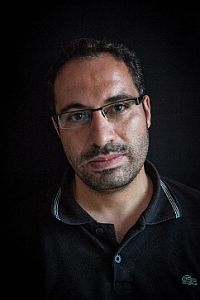
Matthew Shaer writes: Of all the citizen reporters I met, Jameel Salou was the closest to a traditional journalist. He was also the only one to encourage me to use his real name. “I have nothing to hide,” he told me.
Salou, who is 33, had served several stints in jail. In 2000, he and some friends were arrested for running a popular news website, Eye on Syria. They spent five years in Sednaya Prison, where Salou was beaten so badly by the guards that he lost sight in his left eye. Later, he was falsely accused of planting a bomb in a Damascus square and held captive by a branch of the military security services for 40 days. “Before we went to jail, we hated the regime and we hated its corruption,” Salou, who is slouchy and round with thinning black hair, told me. “After being in jail, we wanted to try hard to topple it.”Jameel Salou
In 2010, Salou reopened Eye on Syria, recruiting activists he had met in Sednaya. But in 2011, the office was shelled and all of the equipment was destroyed, so Salou set up a new operation called the Free Syrian News Agency.
He has since built a large network of unpaid informants. Using cheap Sony Cyber-shot cameras, they have documented the spread of the fighting from Damascus toward Aleppo and Homs. He is perhaps best known for his precise documentation of the Ghouta chemical attack, where he and 13 colleagues were able to identify many of the victims long before the United Nations arrived on the scene.
Although many of his colleagues cover the revolution only from the rebel side, Salou insists on broadcasting rebel misdeeds as well those perpetrated by the regime. When a rebel unit was accused of summarily executing Syrian army soldiers, the Free Syrian News Agency carried a report on the alleged crime.
Last year, Salou held a conference for female revolutionaries in the city of Rakka. The site of the conference was controlled by the opposition, but the fact that women were included rankled members of ISIS, who later grew angry with Salou for his efforts to tally the number of regime soldiers killed by rebels. Salou was arrested for the third time in his life, although “kidnapped” may be a more accurate term, since ISIS has no authority to arrest anyone. He was released only when an FSA commander intervened on his behalf.
In July, Salou fled Syria for the Turkish city of Antakya with his wife and children. He has received death threats, and in Reyhanli, where he travels regularly for work, he said that he has been trailed by ISIS sympathizers. “I’m sentenced to death from both sides,” he said. “By the regime and by ISIS. If either finds me, they will kill me.”
Unlike foreign journalists, who have the option of covering the civil war, many Syrian citizen journalists told me that they felt the war had been thrust upon them—that if they don’t publicize its atrocities, no one will. “Other people might forget, but we can never forget,” Salou told me. “Our duty is to be witnesses.” [Continue reading…]
Kafranbel’s fight against isolationism abroad and at home

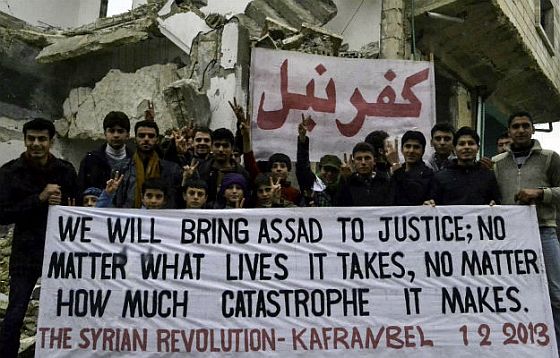
Amal Hanano traveled to Kafranbel in northern Syria, famous for its witty posters and banners, where she met 40-year-old Raed Faris and his partner, 33-year-old Ahmad Jalal, the creative couple behind the banners.
For six weeks this summer, Kafranbel went silent.
The people of the town had been coming to Faris for months. They begged him to stop creating the antagonistic banners and organizing the protests that had attracted international attention. They blamed the protests for the regime’s air raids that were devastating the town.
This is the twisted logic that plagues people in Syria. Facing continuously escalating violence, many civilians have directed blame toward the revolution. Obviously, you can’t blame the Syrian regime for being vicious and relentless — that’s just what it is, and always was. It was the revolution that should have known its limits: In many Syrians’ eyes, the revolution had brought death and destruction, invited unwanted extremists, and steered the country to the point of no return. Returning to silence, they reasoned, was the way to end the nightmare that had been unleashed on their country.
Faris tried to compromise. He moved the protests to an inconspicuous side street, away from the main square. He banned children from attending the Friday protests and changed the set time of the gathering. Nothing stopped the residents’ complaints. And so after a protest on July 15 that featured a banner dedicated to Trayvon Martin’s family, he stopped.
“Without popular support, we can’t do this anymore,” Faris said. At first he was angry — especially when the air raids did not stop. On July 27, during the holy month of Ramadan, the bombs fell at sunset while the town broke its fast. Several people were killed in the now-silent town. And still the people blamed the protests.
“While I search for your mistakes and you search for mine, while we search for someone to blame, we realize that we have lost because we no longer trust each other,” Faris wrote on his Facebook page on July 31. “Our revolution needs us all. Let us search for each other, for victory is nothing but grasping each others’ hands in solidarity.”
After a few weeks, Faris’s anger waned. The time off had given him time to reflect. He stopped focusing on what the world wanted to hear and see. Instead, he began to listen to the town, and worked on a plan to regain his lost legitimacy.
One August evening, activists set up screens, projectors, and sound systems in five different public spaces across Kafranbel. For two hours, news was broadcast on the screens — a report from Al Jazeera, a compilation of YouTube videos, and a special local news broadcast produced by the media team. Men stopped on the street to watch. They pulled up chairs and lined the sidewalks. Some had not watched the news for months. Others had not seen the YouTube videos at all.
After two years of projecting Kafranbel to the world, Faris had brought back the world into Kafranbel.
The media team started to put together the broadcasts every day. They compiled videos of the early protests, of the banners shared around the word, and stories about Kafranbel’s martyrs. Faris and his team ignored calls from journalists who asked for new banners and cartoons. They didn’t even create artwork or organize a protest after the horrific Aug. 21 chemical weapons attack on the eastern Damascus suburbs.
After a few weeks of these outdoor events, people requested that the protests and banners return. They regained their pride in their town’s defiance. And so on Aug. 30, Kafranbel reclaimed its revolutionary role.
Isolationism — which many Syrians view as President Barack Obama’s foreign policy with regards to their home country — works both ways. Many activists inside and outside Syria realize that there is no longer a reason to convince the world to action. No one is coming to save Syria.
The collective message of Kafranbel’s body of work is the opposite of isolationism. It’s an awakening to the world after decades of neglect and forced isolation by the Assad regime. Sadly, Syrians have realized their costly awakening has come to an unwelcoming world.
Over the last two and a half years, Kafranbel’s banners projected the same message over and over: “Listen to us. Watch us. Respond.”
The message is slightly different now. Children and men alike proudly walk the streets of Kafranbel. They chant for their brave town. They are no longer hiding on side streets or standing on a stage for the world. Instead, their message is: “We are here. We are not going anywhere. Watch us if you wish.”
Saudi Arabia rejects U.N. Security Council seat in protest move
The New York Times reports: Saudi Arabia stunned the United Nations and even some of its own diplomats on Friday by rejecting a highly coveted seat on the Security Council, a decision that underscored the depth of Saudi anger over what the monarchy sees as weak and conciliatory Western stances toward Syria and Iran, Saudi Arabia’s regional rival.
The Saudi decision, which could have been made only with King Abdullah’s approval, came a day after it had won a Security Council seat for the first time, and it appeared to be unprecedented.
The Saudi Foreign Ministry released a statement rejecting the seat just hours after the kingdom’s own diplomats — both at the United Nations and in Riyadh, the Saudi capital — were celebrating their new seat, the product of two years of work to assemble a crack diplomatic team in New York. Some analysts said the sudden turnabout gave the impression of a self-destructive temper tantrum.
But one Saudi diplomat said the decision came after weeks of high-level debate about the usefulness of a seat on the Security Council, where Russia and China have repeatedly drawn Saudi anger by blocking all attempts to pressure Syria’s president, Bashar al-Assad. Abdullah has voiced rising frustration with the continuing violence in Syria, a fellow Muslim-majority nation where one of his wives was born. He is said to have been deeply disappointed when President Obama decided against airstrikes on Syria’s military in September in favor of a Russian-proposed agreement to secure Syria’s chemical weapons. [Continue reading…]
Jets bomb Syrian city after intelligence general killed
Reuters reports: Syrian air force jets bombarded the eastern city of Deir al-Zor on Friday after heavy overnight clashes and the killing of one of President Bashar al-Assad’s top military intelligence officers, activists said.
General Jama’a Jama’a was shot dead on Thursday by snipers in the midst of a battle with rebels including forces linked to al Qaeda, the Syrian Observatory for Human Rights said.
His death, celebrated by rebels and opposition activists, marked a significant setback for Assad’s bid to retain a hold over the city, capital of the eastern oil-producing province.
A death notice published on Facebook said Jama’a’s body was being flown back for burial on Friday in his home village of Zama in the mountains overlooking the Mediterranean – the heartland of Assad’s Alawite sect. [Continue reading…]
Syria: ‘Chemical weapons sites’ and ‘rebel-held territory’
I get the sense that for some people, a belief that the chemical weapons attack near Damascus on August 21 was carried out by rebels, has some of the elements of religious conviction. Faith can be sustained by the smallest of infrequent ‘signs’ — such a sign appeared in a New York Times report on Tuesday.
A Western diplomat in the Arab world said that though the Syrian government was legally responsible for dismantling its chemical weapons under an international agreement, its opponents should also cooperate in the process, because several chemical weapons sites were close to confrontation lines or within rebel-held territory.
Emptywheel reads this as “the clearest indication yet that it isn’t just access routes to chemical weapons sites that the rebels control, but that the rebels control some of the sites themselves.”
Not so fast. Firstly, given the short shelf-life of armed chemical weapons, we shouldn’t assume that a chemical weapons site necessarily contains any chemical weapons. It may only contain the materials necessary for assembling such weapons. Moreover, there’s a big difference between having access to such a site and having the knowledge to make use of what it contains.
Secondly — and just as important — chemical weapons sites “within rebel-held territory” does not necessarily imply chemical weapons sites under rebel control. Since the Assad regime retains control of all of Syrian air space, even where rebels might have closed off land routes to a particular site, it may still remain under government control and still be receiving supplies by air.
Al Qaeda’s rise in northern Syria leaves Turkey with dilemma
Reuters reports: The rise of al Qaeda in parts of Syria’s north has left Turkey facing a new security threat on its already vulnerable border and raised questions about its wholesale support for rebels battling President Bashar al-Assad.
Turkey has long championed more robust backing for Syria’s fractious armed opposition, arguing it would bring a quicker end to Assad’s rule and give moderate forces the authority they needed to keep more radical Islamist elements in check.
But with Islamist groups such as Jabhat al-Nusra and the Islamic State of Iraq and the Levant (ISIL) taking territory in parts of the north near the border in recent weeks, it is a strategy that increasingly looks to have been a miscalculation.
Ankara has found itself facing accusations that indiscriminate support for the rebels has allowed weapons and foreign fighters to cross into northern Syria and facilitated the rise of radical groups.
“We are being accused of supporting al Qaeda,” a source close to the Turkish government said, adding that U.S. officials had raised concerns on the sidelines of the U.N. General Assembly meetings in New York last month.
“They were politely but aggressively critical. The attention has focused away from Assad to al Qaeda,” the source said, echoing frustration voiced by other officials in Ankara that this was playing into Assad’s hands.
As if on cue, the Turkish army said on Wednesday it had fired on ISIL fighters over the border after a stray mortar shell hit Turkish soil. It has retaliated in the past in such cases but this appeared to be the first time its response had targeted al Qaeda-linked fighters. [Continue reading…]
Dozens of Syrian fighting groups break ties with main opposition, says rebel commander
The Associated Press reports: Several dozen rebel groups in southern Syria have broken with the main political opposition group in exile, a local commander said in a video posted Wednesday, dealing a potential new setback to Western efforts to unify moderates battling President Bashar Assad’s regime.
The Turkey-based Syrian National Coalition, the political arm of the Free Syrian Army rebel group, has long struggled to win respect and recognition from the fighters. It is widely seen as cut off from events on the ground and ineffective in funneling aid and weapons to the rebels.
In the video, a rebel in military fatigues read a statement with about two dozen fighters standing behind him, some holding a banner with FSA emblems.
FSA spokesman Louay Mikdad told The Associated Press that the video is authentic and identified the man speaking as a captain in one of the rebel groups, Anwar al-Sunna, which posted the video.
The rebel in the video said political opposition leaders have failed to represent those trying to bring down Assad.
“We announce that we withdraw our recognition from any political group that claims to represents us, first among them the Coalition and its leadership which have relinquished the principles of the homeland and the revolution,” he said.
He named 66 groups that he said support his statement. The man suggested rebel groups would reorganize, saying that “we are unifying the forces of the revolution militarily and politically,” but did not explain further. [Continue reading…]
Eat cats and dogs, imam tells starving Syrians
The Telegraph reports: An imam in a rebel-held district of Damascus has issued a fatwa allowing residents to eat cats and dogs, in a desperate bid to ward off starvation after months under siege by the Assad regime.
Salah al-Khatib, the cleric who issued the edict, said he had been left with no choice but to lift the usual restrictions under Islamic law, after government forces and pro-regime militias choked off food and medical supplies to three rebel-held suburbs of Damascus and to a camp housing Palestinian refugees.
This is “not because it is religiously permitted, but because it is a reflection of the reality we are suffering”, Mr Khatib told AFP on Tuesday.
Tens of thousands of civilians remain trapped in these areas, some of them living under siege for more than a year. Residents have told The Telegraph that as food has run out, they have been forced in recent weeks to survive on stray dogs, rotting animal carcasses, tree leaves and weeds.
“I have watched the poorer families eat stray dogs because they have nothing else,” said Ehab, a resident of the Yarmouk camp, speaking to The Telegraph via Skype. “There is no food here now.” [Continue reading…]
Al Qaeda’s Syrian strategy
Barak Barfi and Aaron Y. Zelin write: Al Qaeda is storming across northern Syria. Last month, the al Qaeda affiliate the Islamic State of Iraq and al-Sham (ISIS) captured the city of al-Bab in the northern province of Aleppo from a rival rebel militia. The capture of the city, one of the largest in the region, gives ISIS control over a key transit point linking Aleppo to its strongholds to the east. And that’s just the latest in a long string of ISIS’s military successes: After brief clashes with outgunned rebel opponents, ISIS took the towns of Azaz and Jarablus, which straddle Syria’s border with Turkey.
To commemorate its victories, the first thing ISIS did in these places was hang its black flag from the top of the highest building. After that, it began to gradually impose its strict interpretation of Islamic law.
ISIS has embarked on al Qaeda’s most comprehensive campaign yet to win Arab hearts and minds by providing social services to a war-ravaged society. But though the organization’s star is ascendant, its abuses, coupled with an international strategy to limit its influence, could still torpedo its plan to transform northern Syria into an Islamic emirate under its command.
ISIS is thought to count 5,000 to 6,000 fighters within its ranks. That means it’s a lot smaller than other rebel groups, such as the hard-line Salafi Syrian Islamic Front, which boasts 15,000 to 20,000 fighters. But ISIS has one important advantage: Many of its members have previously fought in other jihads, including in Iraq, Afghanistan, Yemen, and Libya.
Nowhere is ISIS stronger than in the northern province of Raqqa. It controls the governorate’s capital, Raqqa city, whose prewar population of approximately 277,300 residents has mushroomed due to an influx of displaced persons from other regions. Meanwhile, the brigades affiliated with the Free Syrian Army (FSA) are focused on squabbling among themselves. As a result, no FSA unit is strong enough to challenge the group in Raqqa, making it the largest city al Qaeda has ever controlled in the Islamic world.
ISIS has exploited its grip on the region to supply the provincial capital with the commodities essential to function. It provides most of the wheat for the city’s bread factories, trucking the grain in from its silos in the northern parts of the province on the border with Turkey. It also delivers the majority of the city’s oil needs, drawing on rebel-controlled wells in eastern Syria.
ISIS is doing far more than keeping the lights on. It runs a court with a mix of judges and religious scholars that draws on a strict interpretation of Islamic law. It adjudicates cases ranging from theft to financial malfeasance. According to Raqqan politicians and residents, in one ruling this summer the court ordered that a house confiscated by a rebel brigade be returned to its owner. It also provides abandoned houses to those whose living quarters were destroyed by regime bombings.
ISIS’s Raqqa Outreach Bureau, meanwhile, is trying to educate residents in what it considers the proper teachings of Islam. Raqqan politicians and residents say that the organization distributes pocket Qurans and flash drives with jihadi chants and videos showing the group’s military operations. Some of the leaflets that ISIS circulates include: “The Prohibition of Democracy,” “The Virtue of Jihad Over Remaining Silent,” and “Excommunicating the Alawites” — the latter a reference to the heterodox minority sect to which President Bashar al-Assad’s clan belongs. Nor has ISIS just restricted its attention to adults: It recently opened a children’s school in a city where the education system ceased functioning long ago.
By providing such services, ISIS seeks to prove that al Qaeda can make positive contributions and build institutions to serve society. Unlike in Iraq, the organization has produced dozens of videos highlighting this outreach. In doing so, the group hopes to illustrate that it has learned the lessons of its failures in the last decade, when Iraqi Sunnis rebelled against al Qaeda’s brutal ways. “As for our mistakes, we do not deny them,” ISIS spokesman Abu Muhammad al-Adnani al-Shami noted in a July 30 audio release. “Rather, we will continue to make mistakes as long as we are humans. God forbid that we commit mistakes deliberately.”
Despite these efforts, however, ISIS has proved unable to avoid the mistakes that have caused it to lose support in countries such as Mali and Yemen. The al Qaeda affiliate continues to persecute anti-Assad activists who don’t agree with its hard-line Islamic vision — the incarceration of Father Paolo Dall’Oglio, an outspoken regime critic, has particularly angered Raqqans, according to residents of the city.
In other areas of northern Syria, the horror stories have been even worse. In Aleppo province, ISIS imprisoned a 14-year-old girl in dungeon-like conditions for use in a prisoner exchange, according to a fellow inmate. As a consequence of ISIS’s growing strength, many journalists have been kidnapped — and many more have opted to stay out of Syria. [Continue reading…]
Crush of Syrian refugees overwhelming efforts to help, aid groups say
McClatchy reports: Only weeks ahead of what forecasters say could be a brutal winter, humanitarian aid agencies working on the Syrian conflict are sounding the alarm that little is being done to provide assistance to a refugee population that’s expected to reach 3 million by the end of the year.
The United Nations has collected only half of the $5 billion it needs to provide assistance, and humanitarian aid groups say they’re resigned that they’ll be able to provide help to only a portion of the 2 million refugees outside Syria and the millions more who’ve fled their home but remain in Syria.
“The reality is, a huge amount of aid is needed and as long as countries are sending guns and ammunition rather than food or blankets, the crisis is only going to worsen,” said Noah Gottschalk, senior humanitarian policy adviser for Oxfam America, an international aid group that focuses on poverty and hunger.
“It’s not too late, but it’s getting closer and closer. The clock is ticking,” Gottschalk added, referring to the narrow window of opportunity to mobilize winter aid before communities begin to suffer and roads to some areas become impassable. [Continue reading…]
Farewell to Syria, for a while
The Syrian writer and political dissident, Yassin al-Haj Saleh, recently fled from Damascus where he had been in hiding for the last two years, and returned to Raqqa, the city of his youth where he hoped to be reunited with several of his brothers. During a grueling 19-day journey to reach the city, he learned that two of his brothers had been captured and that the city was now under the control of the Islamic State of Iraq and the Levant, al Qaeda.
In Raqqa, I spent two months and a half in hiding without succeeding in getting one piece of information about my brother Firas. Nothing could be worse than this. Therefore, instead of celebrating my arrival at Raqqa, I had to keep in hiding in my own liberated city, watching strangers oppress it and rule the fates of its people, confiscating public property, destroying a statue of Haroun Al-Rasheed or desecrating a church; taking people into custody where they disappeared in their prisons. All the prisoners were rebel political activists while none of them was chosen from the regime’s previous loyalists or shabiha. With the exception of this flagrant oppression of the people, their property and symbols, the new rulers have shown no sign of the spirit of public responsibility which is supposed to be the duty of those who are in power.
I wished to stay in Raqqa for the longest possible time to understand why events had taken this turn and to form an idea about the new leaders. I was able to collect some useful information but not as much as I had wished because I was not able to explore the city’s streets and listen to the people tell me their stories, not to mention holding interviews with the Emirs of the State of Iraq and the Levant and their mujahideen.
Not to walk in the streets of Raqqa in autumn? This is not an adequate reason for leaving, yet it is quite important on its own for me. At the onset of the Revolution, I used to say jokingly to my friends: I wish to topple the regime so as to get a passport. I wanted a passport to feel free and to travel where I wished. Today I leave behind comrades who will carry the struggle on. Our presence together inside the country used to give us courage and the strength to continue. I do not feel bitter, but I am a little angry. I realize how impossible our situation has become, yet notwithstanding, I feel that whenever I am able to understand something or shed light on another, I believe I am taming the brutal multi- headed monster which wants to keep us in darkness, without the right to speak up, and not desiring but what it desires.
What frightens me most now is not to be able to understand the world outside Syria and for things to lose their clarity for me. I used to understand things Syrian. Syria was my country. I do not know exactly what I am going to do in exile. I always felt ill at ease with this word. It seems to me to be making a mockery of the people still inside the country. Perhaps its meaning will change and expand to include the whole of our terrible experience: the experience of uprootedness, seeking asylum, dispersion then eventually the hope of return. I do not know exactly what I am going to do, but I am now part of this massive Syrian exodus and the dreamt of return, although it feels right now as an amputation.
This is our country which is all that we have. I know that there is no other country that can be as merciful to us as this terrible country.
Assad expresses respect for the West and contempt for Arabs and Hamas
The Lebanese Al-Akhbar English interviewed Bashar al-Assad:
Assad is bitter. “Not one Arab official has contacted us with a plan for mediation or for an Arab solution,” he says. The Arabs, he says, were always only an echo of their Western “masters,” if not worse.
The Syrian president adds that the West, despite all its flaws, “Always dealt with us more honorably than some Arabs.” Kofi Annan was honest and resigned, he remarks, while his Arab aides were not.
The conversation moves to Hamas when the president is asked about the reports regarding Meshaal’s visit to Tehran, and whether Damascus, specifically the presidential palace, would be his next stop. But Assad is keen on clarifying everything in this regard, ending all equivocation.
First, Assad says that the Muslim Brotherhood, for 80 years, has been known for its opportunism and betrayal, but stresses that Damascus did not treat Hamas in the beginning as being part of the international Islamist organization. “The Europeans would come to us and ask what Hamas was doing here, and we would say that it was a resistance movement,” the Syrian president says, adding that only that capacity made Syria welcome and sponsor Hamas.
Assad says, “When the crisis began, [Hamas officials] claimed that they gave us advice. This is a lie. Who are they to give Syria advice? Then they said that we asked for their help, which is also not true. What business do they have in internal Syrian affairs?”
Later, the president of the World Federation of Muslim Scholars, Yusuf al-Qaradawi, made his insulting statements about Syria. Assad says, “Yes, we demanded that they take a stance. A while later, they came and said that they spoke with Qaradawi. We said that those who want to take a political stance should do so publicly. What value does a stance have if taken in closed rooms?”
Estrangement between Hamas and the Syrian regime ensued. Assad holds that Hamas ultimately decided to abandon resistance and to fully merge with the Muslim Brotherhood. He adds, “This was not the first time they had betrayed us. It happened before in 2007 and 2009. Their history is one of treachery and betrayal.” Assad then wished “someone would persuade them to return to being a resistance movement,” but says that he doubts this will happen. “Hamas has sided against Syria from day one. They have made their choice,” he adds.
Syrian combatants urged to let inspectors visit chemical sites
The New York Times reports: Pressure mounted on Syrian rebels on Monday to permit access to chemical weapons sites in areas under their control, as the head of the international watchdog on such toxic munitions said the rapidly shifting lines in the civil war made it difficult for inspectors to reach some locations.
Ahmet Uzumcu, director general of the Organization for the Prohibition of Chemical Weapons, which won the Nobel Peace Prize last Friday, told the BBC that the government of President Bashar al-Assad had been cooperating with inspectors who had reached 5 out of 20 chemical weapons production sites.
But some other sites had “access problems,” he said, reflecting perils and complexities facing inspectors who are trying to dismantle chemical weapons facilities as the war rages around them.
Some roads “change hands from one day to another, which is why we appeal to all sides in Syria to support this mission, to be cooperative and not render this mission more difficult,” Mr. Uzumcu said. “It’s already challenging.”
A Western diplomat in the Arab world, moreover, said that while the Syrian government was legally responsible for dismantling its chemical weapons, its opponents should cooperate in the process, as several chemical weapons sites were close to confrontation lines or within rebel-held territory.
“The international community also expects full cooperation from the opposition,” the diplomat said, speaking on condition of anonymity to discuss a sensitive issue.
There were clear signs from inspectors in Syria “that the government is delivering on its responsibilities and the opposition needs to hear a clear signal that they must play their part, too, in making sure that the inspectors have free and unhindered access to the chemical weapons sites with complete safety and security,” the diplomat said. “However divided the opposition might be, it would look very bad if the government was seen to be cooperating fully, while inspections were held up because of problems with the opposition.”
The inspection team has not publicly cited any specific instance of opposition fighters impeding access to chemical weapons sites. [Continue reading…]