The Telegraph reports: Isil has cancelled holidays for militants in its Syrian stronghold of Raqqa as it maximises available manpower ahead of a feared international assault on the city.
Over the past two weeks, the group has accelerated its drive to defend Raqqa, sources inside the area told The Telegraph, digging trenches alongside checkpoints and strengthening a network of underground bunkers.
“Isil cancelled holidays, increased the number of shifts, and asked all members to be present – even the administrators,” said a source in regular contact with civilians inside the city.
Although the extremist group is far from defeat, it is under pressure across several battlefronts, losing strongholds including the Iraqi city of Ramadi in December and the ancient town of Palmyra in March. As Kurdish and Syrian rebel forces prepare to edge towards Raqqa, the city is frequently the target of airstrikes by the US-led coalition, as well as the Syrian air force and Russian warplanes that began an air campaign in the country in late September.
In an attempt to block the view of circling drones, the militants have started hanging sheets across shop-fronts and homes. They are also believed to have moved several key headquarters underground. [Continue reading…]
Category Archives: Syria
Turkish military’s influence rises again

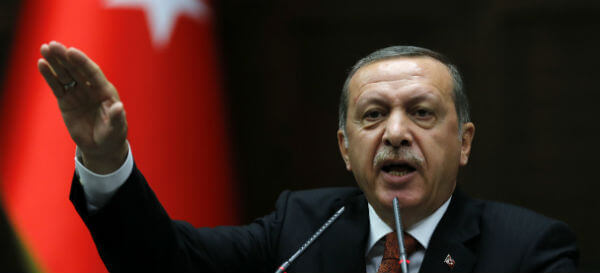
The Wall Street Journal reports: After 13 years of being methodically marginalized during Recep Tayyip Erdogan’s tenure atop Turkish politics, the army is regaining its clout as the president sidelines his political rivals.
Turkey’s military, which has forced four civilian governments from power since 1960, is re-emerging as a pivotal actor alongside Mr. Erdogan, who has long viewed the army as a potentially dangerous adversary.
Mr. Erdogan’s moves to sideline political opponents — he forced out his handpicked prime minister this month amid a power struggle — has cleared the way for Turkey’s generals to play a greater role in shaping Mr. Erdogan’s attempts to extend his global influence.
Turkish generals are tempering Mr. Erdogan’s push to send troops into Syria, managing a controversial military campaign against Kurdish insurgents, and protecting Turkey’s relations with Western allies who view the president with suspicion. By steering clear of politics, they re-emerged as a central player in national security decisions.
“The Turkish military is the only agent that wants to put on the brakes and create checks-and-balances against Erdogan,” said Metin Gurcan, a former Turkish military officer who now works as an Istanbul-based security analyst.
It is in Syria where the military is most clearly acting as a check on the president. When Mr. Erdogan last year debated sending Turkish forces into Syria to set up a safe zone for those fleeing the fighting, military leaders expressed strong reservations, former Turkish officials and allies of Mr. Erdogan said. That, they said, helped put the idea on hold.
The debate returned last week when Mr. Erdogan threatened to send Turkish troops into Syria to end weeks of Islamic State rocket attacks on a Turkish border town.
Sending large numbers of combat troops into Syria is still a hard sell for the military, allies of Mr. Erdogan and U.S. officials said. If Turkey were to act without the support of the U.S. and its other North Atlantic Treaty Organization allies, the military fears its soldiers could be bombed by Russian jets and would face international condemnation.
“This is a very realistic headquarters. They know what Turkey’s armed forces are capable of. They’re not adventurous,” said Can Kasapoglu, a defense analyst with the Center for Economic and Foreign Policy Studies, a Turkish think tank.
The Turkish military and Mr. Erdogan’s press office both declined to discuss their relationship.
The restoration of the Turkish army’s influence has resurrected concerns all the way up to the presidential palace that generals might try to topple Mr. Erdogan, a polarizing figure whose extensive crackdown on domestic dissent has triggered alarm in Western capitals, according to people familiar with the matter. [Continue reading…]
Untangling the complicated legacies of colonialism and failed Arab regimes overshadowing today’s conflicts in the Middle East
Rami G Khouri writes: Why have most Middle Eastern lands that Great Britain, Italy, and France managed as mandates or colonies become violent wrecks and sources of large-scale conflict and human despair? It is just as dishonest to blame mainly Western colonialism for our national wreckages and rampant instability as it is to blame only Arab people and culture for those failings. We need a more complete and integrated analysis of the multiple phenomena that shaped our last erratic century.
Initially, we must absolutely acknowledge that Arab states’ inability to achieve sustainable economic growth and pluralistic democracies is the core reason for our problems today. The main reason for this reason, however, is to be found in a more complex set of interlocking relationships among powerful political actors inside our countries and capitals far and near.
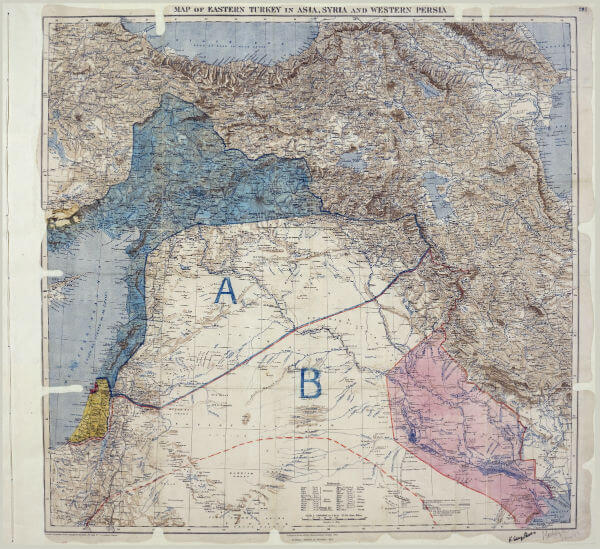
This requires going back before 1916, maybe a century or two, to recall how European powers conquered much of the world as colonies or sites of unchecked imperial plunder. The main problem with Sykes-Picot is not only what happened in and after 1916; it is also heavily a consequence of the European colonial mindset that matured in the century before 1916, and continued to exercise its colonial prerogatives for decades to follow — perhaps even in today’s continued use of European, Russian, and American military power across our region.
At the same time, three critical issues after 1916 made it virtually impossible for many Arab countries to transition from Euro-manufactured instant states born on after-dinner napkins in the hands of Cognac-mellowed British and French colonial officers, to stable, democratic, prosperous sovereign states.
These three issues were, in their historical order:
1) British support for Zionism and a Jewish state in Palestine in November 1917, which plunged Palestine into endless Zionism-Arabism warfare since then, and sucked in other Arab states, Iran, and others yet;
2) the discovery of large amounts of oil in the Middle East in the 1930s especially, which the West needed to maintain access to for its own industrial expansion; and,
3) the post-1947 Cold War between the U.S.-led West and the Russian-led Soviet Communist states that was translated into perpetual proxy wars across the Middle East for forty-four years, and maybe is resurfacing today in new guises. [Continue reading…]
Don’t blame Sykes-Picot for the Middle East’s mess

Steven A. Cook and Amr T. Leheta write: Sometime in the 100 years since the Sykes-Picot agreement was signed, invoking its “end” became a thing among commentators, journalists, and analysts of the Middle East. Responsibility for the cliché might belong to the Independent’s Patrick Cockburn, who in June 2013 wrote an essay in the London Review of Books arguing that the agreement, which was one of the first attempts to reorder the Middle East after the Ottoman Empire’s demise, was itself in the process of dying. Since then, the meme has spread far and wide: A quick Google search reveals more than 8,600 mentions of the phrase “the end of Sykes-Picot” over the last three years.
The failure of the Sykes-Picot agreement is now part of the received wisdom about the contemporary Middle East. And it is not hard to understand why. Four states in the Middle East are failing — Syria, Iraq, Yemen, and Libya. If there is a historic shift in the region, the logic goes, then clearly the diplomatic settlements that produced the boundaries of the Levant must be crumbling. History seems to have taken its revenge on Mark Sykes and his French counterpart, François Georges-Picot, who hammered out the agreement that bears their name.
The “end of Sykes-Picot” argument is almost always followed with an exposition of the artificial nature of the countries in the region. Their borders do not make sense, according to this argument, because there are people of different religions, sects, and ethnicities within them. The current fragmentation of the Middle East is thus the result of hatreds and conflicts — struggles that “date back millennia,” as U.S. President Barack Obama said — that Sykes and Picot unwittingly released by creating these unnatural states. The answer is new borders, which will resolve all the unnecessary damage the two diplomats wrought over the previous century.
Yet this focus on Sykes-Picot is a combination of bad history and shoddy social science. And it is setting up the United States, once again, for failure in the Middle East.
For starters, it is not possible to pronounce that the maelstrom of the present Middle East killed the Sykes-Picot agreement, because the deal itself was stillborn. Sykes and Picot never negotiated state borders per se, but rather zones of influence. And while the idea of these zones lived on in the postwar agreements, the framework the two diplomats hammered out never came into existence.
Unlike the French, British Prime Minister David Lloyd George’s government actively began to undermine the accord as soon as Sykes signed it — in pencil. The details are complicated, but as Margaret Macmillan makes clear in her illuminating book Paris 1919, the alliance between Britain and France in the fight against the Central Powers did little to temper their colonial competition. Once the Russians dropped out of the war after the Bolshevik Revolution in 1917, the British prime minister came to believe that the French zone that Sykes and Picot had outlined — comprising southeastern Turkey, the western part of Syria, Lebanon, and Mosul — was no longer a necessary bulwark between British positions in the region and the Russians.
Nor are the Middle East’s modern borders completely without precedent. Yes, they are the work of European diplomats and colonial officers — but these boundaries were not whimsical lines drawn on a blank map. They were based, for the most part, on pre-existing political, social, and economic realities of the region, including Ottoman administrative divisions and practices. The actual source of the boundaries of the present Middle East can be traced to the San Remo conference, which produced the Treaty of Sèvres in August 1920. Although Turkish nationalists defeated this agreement, the conference set in motion a process in which the League of Nations established British mandates over Palestine and Iraq, in 1920, and a French mandate for Syria, in 1923. The borders of the region were finalized in 1926, when the vilayet of Mosul — which Arabs and Ottomans had long associated with al-Iraq al-Arabi (Arab Iraq), made up of the provinces of Baghdad and Basra — was attached to what was then called the Hashemite Kingdom of Iraq.
On a deeper level, critics of the Middle East’s present borders mistakenly assume that national borders have to be delineated naturally, along rivers and mountains, or around various identities in order to endure. It is a supposition that willfully ignores that most, if not all, of the world’s settled borders are contrived political arrangements, more often than not a result of negotiations between various powers and interests. Moreover, the populations inside these borders are not usually homogenous.
The same holds true for the Middle East, where borders were determined by balancing colonial interests against local resistance. These borders have become institutionalized in the last hundred years. In some cases — such as Egypt, Iran, or even Iraq — they have come to define lands that have long been home to largely coherent cultural identities in a way that makes sense for the modern age. Other, newer entities — Saudi Arabia and Jordan, for instance — have come into their own in the last century. While no one would have talked of a Jordanian identity centuries ago, a nation now exists, and its territorial integrity means a great deal to the Jordanian people.
The conflicts unfolding in the Middle East today, then, are not really about the legitimacy of borders or the validity of places called Syria, Iraq, or Libya. Instead, the origin of the struggles within these countries is over who has the right to rule them. The Syrian conflict, regardless of what it has evolved into today, began as an uprising by all manner of Syrians — men and women, young and old, Sunni, Shiite, Kurdish, and even Alawite — against an unfair and corrupt autocrat, just as Libyans, Egyptians, Tunisians, Yemenis, and Bahrainis did in 2010 and 2011.
The weaknesses and contradictions of authoritarian regimes are at the heart of the Middle East’s ongoing tribulations. Even the rampant ethnic and religious sectarianism is a result of this authoritarianism, which has come to define the Middle East’s state system far more than the Sykes-Picot agreement ever did. [Continue reading…]

Activists claim: Ben Rhodes told us he’s ‘not proud of our Syria policy’
The Daily Beast reports: Senior White House official Ben Rhodes told Syrian-American activists at a gathering on Wednesday that he was “not proud” of the Obama administration’s Syria policy, according to three people who participated in the interchange.
But Rhodes waved off any suggestion that the United States should be responsible for a conflict that has left millions displaced and hundreds of thousands dead, those attendees said.
“We aren’t proud of our Syria policy — but we don’t have any good options… nothing we could have done would have made things better,” Rhodes said, according to three individuals present: Ibrahim Al-Assil, a fellow at the Middle East Institute; Kenan Rahmani, a policy adviser with the Coalition for a Democratic Syria, and a third individual, who requested to stay anonymous.
Ned Price, a spokesman for the National Security Council disputed the activists’ characterization of the conversation. Rhodes “in no way indicted or distanced himself from our Syria policy,” Price said.The three activists, as well as a fourth activist, the Syrian American Council’s Omar Hossino, were present for various parts of the conversation with Rhodes. Hossino told The Daily Beast that he began to weep as he told Rhodes about the cost in human life that had taken place as a result of the war, and excused himself from the conversation.
“We’re not the ones killing Syrians. [President Bashar al-]Assad is the one killing people,” Rhodes said, according to three of the individuals present.
It was, as one advocate said, a poor explanation. “It would be as if the Bush administration argued that ‘a hurricane destroyed New Orleans, so it’s not our responsibility,’” Al-Assil told The Daily Beast. [Continue reading…]
Hezbollah avoids blaming Israel for death of top commander in Syria
The Washington Post reports: In a surprise announcement Saturday, Lebanon’s Hezbollah militia blamed the recent killing of a militant described as its top commander in Syria on extremist Sunni insurgents. Many expected the powerful Shiite group to point a finger at its traditional nemesis, Israel.
Hezbollah revealed a day earlier that Mustafa Badreddine, one of its most senior figures, died in a mysterious blast in Damascus, the Syrian capital. Before leading thousands of militants in Syria, Badreddine, 55, is suspected of having roles in the assassination of a Lebanese prime minister in 2005, and other bombings that date to the attack on the U.S. Marine barracks in Beirut in 1983.
Analysts said Friday that Badreddine’s killing appeared to bear the hallmarks of an airstrike by Israel, which has targeted a number of the Lebanese militants in Syria in recent years. But in a statement, Hezbollah blamed it on “artillery bombardment carried out by takfiri groups in the area.”
Hezbollah uses “takfiri,” an Arabic word, to describe its extremist Sunni Muslim enemies, including al-Qaeda and the Islamic State.
Hezbollah didn’t specify which group killed Badreddine or when he died.
But the Syrian Observatory for Human Rights, a Britain-based monitoring group, said there has been no shelling for more than a week in the area where Hezbollah said Badreddine was killed, Reuters reported.
If Hezbollah had blamed Israel for his death, the group would have come under pressure to launch a tough retaliation that, in turn, would risk triggering war. Israel and Hezbollah fought a brief but devastating war in 2006. [Continue reading…]
How ISIS uses the internet: Talking on Telegram and sending viruses to their enemies
BuzzFeed reports: Abu Majad figured that when ISIS came for him, it would be with a knife on a dark street, or a bomb planted on his car. The 34-year-old had been living in southern Turkey since fleeing Syria nearly three years ago and knew that his outspoken stance against ISIS — online and in his hometown in northern Syria — had put him in the terrorist group’s crosshairs. What he wasn’t expecting was to wake up on the morning of March 29 to a virus planted by ISIS within a seemingly innocuous email attachment.
“Everything about this looked like a real email, sent from the admin of my own website. It looked safe, but it was not. They were trying to get my login information, my passwords. They were trying to get things that could have put real lives in danger,” said Abu Majad, who asked that his nickname be used instead of his real name to protect himself and his remaining family in Syria from reprisal attacks by ISIS. “It was very clever. When I saw it I thought to myself, Shit, now they are professional hackers?”
Cybersecurity experts and intelligence agencies who monitor ISIS say the malware is just one more sign that ISIS is growing more sophisticated in its use of the internet.
“I don’t think it is far-fetched to say that the internet is a major reason why ISIS is so successful, and so worrying, as far as global terror movements go,” said one U.S. intelligence officer, who spoke to BuzzFeed News in Washington, D.C., and asked not to be named as he wasn’t authorized to speak to the press. “They have always been ‘good’ at the internet, at the strategy of how they use it. Now they are smarter at the internet too.” [Continue reading…]
Kurdish tensions undermine the war against ISIS
Hassan Hassan writes: Amnesty International has in seven months issued two major reports highlighting allegations of war crimes by rebel and Kurdish forces in northern Syria. The two reports are related to a secondary conflict brewing between Arabs and Kurds from Hasakah to Qamashli to Aleppo, which could easily spin out of control and add to the many conflicts that already plague the country.
The United States has an unintentional hand in this new conflict, and de-escalation hinges largely on whether Washington is willing to review its strategy in northern Syria, which sometimes privileges the appearance of success in the battle against ISIL over sustainable policies.
On Friday, Amnesty published a damning new report accusing rebel factions in Aleppo, organised under the Army of Conquest, of committing acts that may amount to war crimes. The rights group said it gathered strong evidence of indiscriminate attacks that killed at least 83 civilians, including 30 children, in the Kurdish-dominated Sheikh Maqsoud between February and April.
On October 13 last year, Amnesty issued a report, Forced Displacement and Demolitions in Northern Syria, accusing the Kurdish political party PYD, the Democratic Union Party, of carrying out a wave of forced displacement and home demolitions that it also said may amount to war crimes. The shelling of civilians by rebel forces cannot be justified, and perpetrators must be punished and restrained by their regional backers. The attacks on Sheikh Maqsoud were encouraged by some supporters of the opposition living abroad, after the PYD’s military wing, the YPG, attacked the rebels in February. Worse, such calls continue to be heard and more indiscriminate attacks can be expected. [Continue reading…]
Belgium to begin air strikes against ISIS in Syria
AFP reports: Belgium will extend its F-16 air strikes against Islamic State jihadists in Iraq into Syria, the government said Friday, as it grapples with the aftermath of deadly IS-claimed bomb attacks in Brussels in March.
“In accordance with UN Resolution 2249, the engagement will be limited to those areas of Syria under the control of IS and other terrorist groups,” a spokesman for Prime Minister Charles Michel told AFP after a cabinet meeting.
“The objective will be to destroy these groups’ refuges,” the spokesman said, adding that the strikes would begin on July 1.
Belgium launched its first attacks against IS in Iraq in late 2014 as part of the US-led coalition, but decided against strikes in Syria amid public fears over getting dragged into a wider conflict. [Continue reading…]
How Russia allowed homegrown radicals to go and fight in Syria with ISIS
Reuters reports: Four years ago, Saadu Sharapudinov was a wanted man in Russia. A member of an outlawed Islamist group, he was hiding in the forests of the North Caucasus, dodging patrols by paramilitary police and plotting a holy war against Moscow.
Then his fortunes took a dramatic turn. Sharapudinov, 38, told Reuters that in December 2012 Russian intelligence officers presented him with an unexpected offer. If he agreed to leave Russia, the authorities would not arrest him. In fact, they would facilitate his departure.
“I was in hiding, I was part of an illegal armed group, I was armed,” said Sharapudinov during an interview in a country outside Russia. Yet he says the authorities cut him a deal. “They said: ‘We want you to leave.’”
Sharapudinov agreed to go. A few months later, he was given a new passport in a new name, and a one-way plane ticket to Istanbul. Shortly after arriving in Turkey, he crossed into Syria and joined an Islamist group that would later pledge allegiance to radical Sunni group Islamic State.
Reuters has identified five other Russian radicals who, relatives and local officials say, also left Russia with direct or indirect help from the authorities and ended up in Syria. The departures followed a pattern, said Sharapudinov, relatives of the Islamists and former and acting officials: Moscow wanted to eradicate the risk of domestic terror attacks, so intelligence and police officials turned a blind eye to Islamic militants leaving the country. Some sources say officials even encouraged militants to leave. [Continue reading…]
Syrian activists keep alive the revolutionary spirit of 2011 uprising
Syria’s peace plan is flawed and Jabhat Al Nusra knows it
Hassan Hassan writes: If the United States and Russia do not see that Al Qaeda’s main Syrian franchise is benefiting from the peace process, they should look again. In recent months, Jabhat Al Nusra has led a number of battles against the forces of Bashar Al Assad in the north, while poorly-executed ceasefires are causing people to question the efficiency of nationalist forces.
The reactions of some Syrians in the opposition towards the regime losses, especially in the context of the government’s violations of the recent truces, were captured by one activist’s Facebook post: “Some of us take to the streets to protest against Jabhat Al Nusra and demand that it breaks away from Al Qaeda,” he wrote. “Had jihadist groups like Jabhat Al Nusra done everything we wanted them to do, the only place in which we could raise our revolution’s flag today would be in Taksim Square in Turkey.”
For Jabhat Al Nusra, the gains against the regime do not have to hold. Mr Al Assad can retake the areas, but the fact that it is battling the regime while other forces stand by watching weakens the latter’s stance in the eyes of some Syrians. Jabhat Al Nusra has even produced footage of its recent operations using drones, including an ambush against a foreign fighter, the blowing up of a Baath party building and the storming of a government base in Aleppo. [Continue reading…]
Four ideas about the crisis of the Arab world that need to be repudiated

An editorial in The Economist says: Arab states are suffering a crisis of legitimacy. In a way, they have never got over the fall of the Ottoman empire. The prominent ideologies — Arabism, Islamism and now jihadism — have all sought some greater statehood beyond the frontiers left by the colonisers. Now that states are collapsing, Arabs are reverting to ethnic and religious identities. To some the bloodletting resembles the wars of the former Yugoslavia in the 1990s. Others find parallels with the religious strife of Europe’s Thirty Years War in the 17th century. Whatever the comparison, the crisis of the Arab world is deep and complex. Facile solutions are dangerous. Four ideas, in particular, need to be repudiated.
First, many blame the mayhem on Western powers — from Sykes-Picot to the creation of Israel, the Franco-British takeover of the Suez Canal in 1956 and repeated American interventions. Foreigners have often made things worse; America’s invasion of Iraq in 2003 released its sectarian demons. But the idea that America should turn away from the region — which Barack Obama seems to embrace — can be as destabilising as intervention, as the catastrophe in Syria shows.
Lots of countries have blossomed despite traumatic histories: South Korea and Poland — not to mention Israel. As our special report (see article) sets out, the Arab world has suffered from many failures of its own making. Many leaders were despots who masked their autocracy with the rhetoric of Arab unity and the liberation of Palestine (and realised neither). Oil money and other rents allowed rulers to buy loyalty, pay for oppressive security agencies and preserve failing state-led economic models long abandoned by the rest of the world.
A second wrong-headed notion is that redrawing the borders of Arab countries will create more stable states that match the ethnic and religious contours of the population. Not so: there are no neat lines in a region where ethnic groups and sects can change from one village or one street to the next. A new Sykes-Picot risks creating as many injustices as it resolves, and may provoke more bloodshed as all try to grab land and expel rivals. Perhaps the Kurds in Iraq and Syria will go their own way: denied statehood by the colonisers and oppressed by later regimes, they have proved doughty fighters against IS. For the most part, though, decentralisation and federalism offer better answers, and might convince the Kurds to remain within the Arab system. Reducing the powers of the central government should not be seen as further dividing a land that has been unjustly divided. It should instead be seen as the means to reunite states that have already been splintered; the alternative to a looser structure is permanent break-up.
A third ill-advised idea is that Arab autocracy is the way to hold back extremism and chaos. In Egypt Mr Sisi’s rule is proving as oppressive as it is arbitrary and economically incompetent. Popular discontent is growing. In Syria Bashar al-Assad and his allies would like to portray his regime as the only force that can control disorder. The contrary is true: Mr Assad’s violence is the primary cause of the turmoil. Arab authoritarianism is no basis for stability. That much, at least, should have become clear from the uprisings of 2011.
The fourth bad argument is that the disarray is the fault of Islam. Naming the problem as Islam, as Donald Trump and some American conservatives seek to do, is akin to naming Christianity as the cause of Europe’s wars and murderous anti-Semitism: partly true, but of little practical help. Which Islam would that be? The head-chopping sort espoused by IS, the revolutionary-state variety that is decaying in Iran or the political version advocated by the besuited leaders of Ennahda in Tunisia, who now call themselves “Muslim democrats”? To demonise Islam is to strengthen the Manichean vision of IS. The world should instead recognise the variety of thought within Islam, support moderate trends and challenge extremists. Without Islam, no solution is likely to endure. [Continue reading…]
War crimes in Aleppo and Daraya
Amnesty reports: Armed groups surrounding the predominantly Kurdish Sheikh Maqsoud district of Aleppo city have repeatedly carried out indiscriminate attacks – possibly including with chemical weapons – that have struck civilian homes, markets and mosques, killing and injuring civilians, and have displayed a shameful disregard for human life, said Amnesty International today.
Two of the armed groups conducting attacks on Sheikh Maqsoud – Ahrar al Sham and Army of Islam – have sent representatives to the UN-brokered negotiations on Syria in Geneva, while the others have approved delegates to represent them at the talks.
There are around 30,000 civilians living in Sheikh Maqsoud, a district controlled by the Kurdish People’s Protection Unit (YPG) forces, and the area has come under sustained attack from opposition armed groups who control areas to the north, east and west of the district.
Among the weapons used by the armed groups are unguided projectiles which cannot be accurately aimed at specific targets, including home-made “Hamim” rockets and projectiles fitted with gas canisters known as “hell cannons”.
Amnesty has obtained the names of at least 83 civilians, including 30 children, who were killed by attacks in Sheikh Maqsoud between February and April. More than 700 civilians were also injured, according to the local field hospital. Video evidence seen by Amnesty shows artillery shelling, and rocket and mortar attacks carried out by the Fatah Halab (Aleppo Conquest) coalition of armed groups in the area, targeting YPG forces. [Continue reading…]
Vice News reports: Omar’s daughter is two months old, but he still hasn’t met her. He lives in Daraya, a rebel-controlled suburb of Damascus that’s besieged by the Syrian regime. His wife and child live just a few kilometers to the west, in the neighboring rebel suburb of Moadamiya. The Syrian army cut the road between the two enclaves in January shortly before his daughter was born.
On Thursday, Omar eagerly awaited the arrival of an international aid convoy that was scheduled to bring medicine and baby formula into Daraya. The Syrian government agreed to the delivery, and it was organized by the United Nations, the International Committee of the Red Cross (ICRC), and the Syrian Arab Red Crescent.
It would have been the first convoy to reach Daraya since it was first besieged in 2012 — but the trucks didn’t make it to the town.
According to the ICRC, it was turned away at the last checkpoint outside of Daraya. Just minutes after the convoy was sent back, the Local Council of Daraya — a committee that operates as the local government — reported that the Syrian army had shelled a group of civilians who’d gathered to receive the aid. A father and son were killed and five other civilians were injured, the council said.
The Syrian Observatory for Human Rights, a British-based monitoring group, said Syrian troops loyal to President Bashar al-Assad’s regime had fired into the town.
After the shelling, Omar rushed to a nearby field hospital where the wounded were being treated.
“The people are now filled with frustration and anger,” he told VICE News via messaging app. “To be honest, at this point we no longer trust the international community or the UN.”
Though it’s just a 20-minute drive from the center of Damascus, Daraya is one of the most isolated places in Syria: it’s been under siege for over four years, and it’s one of the few areas where no aid convoys have ever been permitted to enter. According to residents interviewed by VICE News, people survive on meager meals of lentil and rice soup that are often fortified with weeds or grass. The water supply was cut off two years ago. [Continue reading…]
Mustafa Badreddine, Hezbollah military commander, is killed in Syria
The New York Times reports: Mustafa Amine Badreddine, Hezbollah’s top military commander, who was directing its operations in Syria and was accused in a string of deadly attacks stretching across decades, has been killed in Damascus, Hezbollah officials confirmed on Friday.
Mr. Badreddine, 55, had been overseeing Hezbollah’s forces in Syria, which have been decisive in keeping President Bashar al-Assad in power through five years of war with various rebel and militant Islamist groups seeking to topple him.
Mr. Assad is a close ally of Hezbollah’s patron, Iran, which has long provided a conduit to supply Hezbollah with weapons to battle Israel. Now, Hezbollah is the most powerful of several Iran-backed Shiite paramilitary groups that, along with Iranian forces, are playing an ever more prominent role on the battlefield in Syria.
It remained unclear who was behind Mr. Badreddine’s death: Israel, or one of the insurgent groups Hezbollah has been fighting.
Hezbollah, which confirmed the death on Al Manar, its television network, said that Mr. Badreddine died in a “huge blast” near the Damascus airport, in which several of the group’s fighters were wounded. “The investigation will find out the nature of the blast as well as its reasons, and whether it was a result of an airstrike or rocket attack,” it said.
The timing of the attack was not provided. A Beirut-based television network, Al Mayadeen, which is also close to Hezbollah, initially reported that Mr. Badreddine had been killed in an Israeli airstrike, but it later removed that report. [Continue reading…]
The Guardian reports: Born in the southern Beirut suburb of Ghobeiry on 6 April 1961, Badreddine had a pronounced limp, believed to have been sustained while he fought alongside pro-Palestinian and pan-Arabist militias during the Israeli invasion of Lebanon in 1982.
His nom de guerre was Sayyed Zul Fikar: Sayyed indicating a claimed descent from the prophet Muhammad; Zul Fikar being the name of the legendary forked sword of Imam Ali, the prophet’s cousin and one of the most revered figures in Shia Islam.
Badreddine was arrested and sentenced to death in Kuwait in 1983 over his suspected involvement in a string of coordinated bombings in the tiny Gulf emirate that also targeted the US and French embassies. They were believed to be retribution for Kuwait and the west’s support for Iraq in its war with Iran.
The sentence, which had to be formally approved by the emir, was never carried out, perhaps as a consequence of a series of attacks and plane hijackings demanding the release of the Kuwait attackers, and which allegedly involved Mughniyeh. It was also never carried out because when the Iraqi dictator Saddam Hussein invaded Kuwait in August 1990, he threw open the doors of the country’s prisons, allowing Badreddine to escape.
This is where the trail disappears. It only emerges again in 2011, when UN prosecutors investigating a 2005 Beirut bombing that killed Lebanon’s prime minister, Rafik Hariri, indicted Badreddine. They alleged he was the coordinator of a sophisticated network that tracked and ultimately assassinated the popular billionaire. [Continue reading…]
Mustafa Badreddine, the pyromaniac playboy who led Hezbollah’s fight in Syria
Last August, Alex Rowell wrote: To close friends, he is “Dhu al-Faqar”—the name, meaning, “the cleaver of vertebrae,” of the legendary double-tipped sword given by the Prophet Muhammad to his son-in-law, Ali bin Abi Talib, the patron imam of Shia Islam. To the Kuwaiti government, who sentenced him to death in 1984 for a spate of audacious bombings on targets including the American and French embassies and the airport, he is Elias Fouad Saab. To prosecutors at the Special Tribunal for Lebanon (STL) in The Hague, who are currently trying him in absentia on suspicion of assassinating Lebanese Prime Minister Rafiq al-Hariri in 2005, he is Mustafa Amine Badreddine. To genteel dining companions — and multiple mistresses — entertained at his seaside home north of Beirut, he is the boat-owning, Mercedes-driving Christian jeweler, Sami Issa.
Or, rather, he was. The Frank Abagnale Jr. of jihad has found yet another preoccupation in the last few years. According to sources as discrepant as the U.S. Treasury Department and a militantly pro-Hezbollah newspaper in Beirut, the man who also goes by the name Safi Badr is currently leading the Party of God’s military intervention against the Syrian uprising, personally sitting in on meetings between President Bashar al-Assad and Hezbollah Secretary-General Hassan Nasrallah. It’s a distinction that earned the “Specially Designated Global Terrorist” a fresh dose of American sanctions just last week. [Continue reading…]
Lack of plan for ISIS detainees raises human rights concerns
The New York Times reports: The Islamic State calls them “inghimasi” — zealous foot soldiers who intend to fight to their deaths. And as the American-backed coalition has reclaimed territory from the group in Iraq and Syria, that fervor has kept prisoners from being much of a problem: The shooting only stops when almost every Islamic State fighter has been killed.
But that could change as the coalition moves toward the Islamic State’s largest urban strongholds — Mosul, Iraq, and Raqqa, Syria — raising a potential problem for the United States. If the coalition is successful and thousands of ordinary members of a collapsing Islamic State have nowhere left to retreat, will they start to surrender in greater numbers? And if so, who will be responsible for imprisoning them?
After the experiences of the past decade in the wars in Afghanistan and Iraq, the Obama administration is determined not to revive large-scale detention operations. But it is far from clear whether allies on the ground — especially rebels in Syria — are prepared to hold large numbers of prisoners, raising the prospect of an ugly aftermath to any victory.
“If they’re not killed but detained, we are concerned about the standards of care, who would do it and how it would be done,” Peter Maurer, the president of the International Committee of the Red Cross, said in an interview. [Continue reading…]
U.S. has taken in 1,736 Syrian refugees — less than a fifth of pledged intake
The New York Times reports: The Obama administration’s effort to step up asylum for Syrian refugees is going so slowly, it may not meet the president’s deadline for accepting at least 10,000 by the end of the fiscal year.
More than seven months since the president pledged to resettle the most vulnerable Syrians, the United States has let in less than a fifth of that number — 1,736 through the end of April, according to government figures.
Most of the world’s four million Syrian refugees live in countries in the region: Turkey, Lebanon and Jordan.
Canada has offered visas to more than 48,000 Syrians, according to the United Nations, and is also allowing private groups to sponsor Syrian families. More than 400,000 Syrians sought asylum in Germany last year, and Brazil has issued nearly 8,500 humanitarian visas to Syrians.
At the General Assembly debate that is scheduled to begin on Sept. 20, Mr. Obama plans to lead a special session at which world leaders are expected to publicly pledge to take in more refugees.
Russia, a major supporter of the government of President Bashar al-Assad of Syria, has not resettled a single Syrian refugee, according to the United Nations. [Continue reading…]