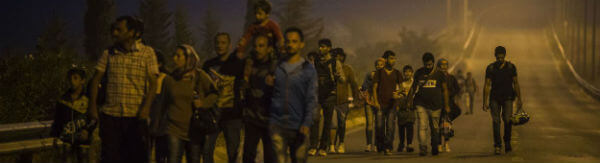
Politico reports: The border crossing where hundreds of thousands of Syrian refugees entered Turkey in the first years of the war is almost deserted. It’s been closed for a year, and any Syrian hoping to be smuggled to safety in the neighboring country risks being shot.
Just across the frontier, in Syria, the situation is infinitely worse. Some 45,000 civilians were displaced by recent fighting between moderate rebels and ISIL in mid-April, and 20,000 are sleeping out in the open, aid workers say.
“People are sitting on blankets, sleeping under the trees,” Ali al-Sheikh, a Syrian humanitarian volunteer, said at the Kilis border crossing Saturday. “They are short of drinking water. There are very few tents. There is sewage all around.”
This is the scene that German Chancellor Angela Merkel and European Council President Donald Tusk didn’t see when they visited a model refugee camp 50 kilometers from the border last weekend. The town of Kilis, whose 90,000 inhabitants have been nominated for a Nobel Peace Prize for their warm reception of 130,000 Syrians, was deemed too dangerous to visit.
Violence is on the rise, with ISIL militants frequently firing rockets from Syria into Turkey. Since January, 17 people have been killed and 61 wounded in cross-border attacks. The latest occurred the day before Merkel and Tusk’s visit aimed at propping up the controversial EU-Turkey deal that the German chancellor regards as key to limiting the arrivals of refugees in Europe. [Continue reading…]
Category Archives: Syria
Syria: Airstrikes destroy Aleppo’s Al Quds hospital, killing 14
Médecins Sans Frontières: Fourteen people, including at least two doctors, were killed Wednesday night in the bombing of a hospital supported by Doctors Without Borders/Médecins Sans Frontières (MSF) in the northern Syrian city of Aleppo, the medical humanitarian organization said today.
According to hospital staff on the ground, the Al Quds hospital in Aleppo was destroyed by at least one airstrike which directly hit the building, reducing it to rubble. Other airstrikes in the neighborhood also hit areas close to the hospital.
“MSF categorically condemns this outrageous targeting of yet another medical facility in Syria,” said Muskilda Zancada, MSF head of mission for Syria. “This devastating attack has destroyed a vital hospital in Aleppo, and the main referral center for pediatric care in the area. Where is the outrage among those with the power and obligation to stop this carnage?”
The situation in Aleppo city, consistently at the frontlines of the brutal conflict, was critical even before this attack. An estimated 250,000 people remain in the city, which has seen dramatic increases in levels of bombardment, fighting and fatalities in recent weeks. Only one road remains open in and out of the non-government held areas. If this road becomes blocked, the city will be besieged. [Continue reading…]
The Guardian reports: The Syrian government considers any medical facilities in opposition-held territory as legitimate military targets, saying that they are de facto illegal. Hospitals in opposition-held parts of Syria are refusing to share GPS coordinates with Russian and Syrian authorities because of repeated attacks on medical facilities and workers, fearing that sharing the locations would make the hospitals targets.
As early as 2013, the UN independent commission of inquiry investigating alleged war crimes in Syria said attacks on medical facilities were being used systematically as a weapon of war by the Assad regime. Attacks by both sides on medical facilities have continued unabated in recent months. MSF said in February that a total of 94 airstrikes and shelling attacks hit facilities supported by the organisation in 2015 alone.
In February last year, the NGO Physicians for Human Rights said it had documented 224 attacks on 175 health facilities since the start of the conflict, and 599 medical personnel had been killed. The attacks continued after the Russian intervention – the organisation documented at least 10 attacks by Russian aircraft on medical facilities in October alone, the first month of Russia’s aerial campaign. [Continue reading…]
Europe’s failure on refugees echoes the moral collapse of the 1930s

Patrick Kingsley writes: In 1938, representatives from 32 western states gathered in the pretty resort town of Evian, southern France. Evian is now famous for its water, but back then, the delegates had something else on their minds. They were there to discuss whether to admit a growing number of Jewish refugees, fleeing persecution in Germany and Austria. After several days of negotiations, most countries, including Britain, decided to do nothing.
On Monday, I was reminded of the Evian conference when British MPs voted against welcoming just 600 child refugees a year over the next half-decade. The two moments are not exactly comparable. History doesn’t necessarily repeat itself. But it does echo, and it does remind us of the consequences of ethical failure. Looking back at their inaction at Evian, delegates could claim they were unaware of what was to come. In 2016, we no longer have that excuse.
Nevertheless, both in Britain and across Europe and America, we currently seem keen to forget the lessons of the past. In Britain, many of those MPs who voted against admitting a few thousand refugees are also campaigning to unravel a mechanism – the European Union – that was created, at least in part, to heal the divisions that tore apart the continent during the first and second world wars.
Across Europe, leaders recently ripped up the 1951 refugee convention – a landmark document partly inspired by the failures of people such as the Evian delegates – in order to justify deporting Syrians back to Turkey, a country where most can’t work legally, despite recent legislative changes; where some have allegedly been deported back to Syria; and still more have been shot at the border.
Emboldened by this, the Italian and German governments have since joined David Cameron in calling for refugees to be sent back to Libya, a war zone where – in a startling display of cognitive dissonance – some of the same governments are also mulling a military intervention. Where many migrants work in conditions tantamount to slavery. Where three separate governments are vying for control. And where Isis runs part of the coastline.
In Greece, Europe’s leaders have forced the bankrupt government to lock up all arriving asylum seekers – and then reneged on a promise to help care for them, or move them to better-resourced countries elsewhere on the continent. The result is a dire situation on the Greek islands, where the world’s richest continent has contrived to jail babies, and then deny them access to adequate amounts of milk formula.
In Denmark, asylum seekers are forced to hand over valuables to pay for their stay, and volunteers have been prosecuted as smugglers for giving them lifts. In America, where boatloads of refugees were turned away from US ports in the 30s, more than 30 governors have refused to accept Muslim refugees. Some called for an outright ban on anyone fleeing a war that is ironically the partial result of catastrophic mistakes in American foreign policy over the past two decades. [Continue reading…]
Targeted air strikes kill five Syrian ‘White Helmets’ rescue workers near Aleppo
Reuters reports: Overnight air strikes and a rocket attack on an opposition-held area west of Aleppo killed five rescue workers, who appeared to have been deliberately targeted, a monitoring group and colleagues nearby said.
The raids, which the rescue workers said consisted of two air strikes and at least one rocket, hit a centre for the Syrian Civil Defence, known as the “White Helmets”, in the town of Atareb, some 25 km (15 miles) west of Aleppo.
Fighting has intensified in Aleppo province in recent weeks as a partial truce brokered the United States and Russia has all but broken down.
The Civil Defence corps work as first responders in opposition-held territory where medical infrastructure has broken down. [Continue reading…]
Should states take legal action against people who went to fight in Syria but haven’t committed terrorist acts?
The New York Times reports: Ten young Muslim men, bored by a mundane life in France and haunted by a “feeling of uselessness,” as one put it, were seduced by a leading Islamic State recruiter in Europe in 2013. Within months, they were in Syria under the watchful eyes of hooded, Kalashnikov-wielding militants, doing push-ups, fiddling with weapons and imbibing the ideology.
But the harsh regimen, most have since told investigators, was not to their liking, and it was not long before they hastened back to their families in the Strasbourg area, where they were almost immediately picked up by the French authorities.
What to do with hundreds, perhaps thousands, of such young men in Europe is now among the biggest challenges facing governments and security services.
After the Paris and Brussels terrorist attacks, which were carried out in part by Europeans who had spent time in Syria with the Islamic State, France and other countries are grappling with how far to go in tightening laws to prosecute, monitor and restrict the movements of returnees.
At the heart of the debate is whether to take pre-emptive legal action against people who have not committed terrorist acts or even been implicated in a plot, but who have simply been to Syria and possibly received training in Islamic State camps. [Continue reading…]
Israel’s vow to keep Golan Heights brings ‘deep concern’ at Security Council
The New York Times reports: Israel’s assertion last week that it will never give up the Golan Heights, captured from Syria in the 1967 war, drew a terse response on Tuesday from the United Nations Security Council, which said that a 35-year-old resolution rejecting Israeli sovereignty over the disputed land remains in effect.
The Security Council president for April, Ambassador Liu Jieyi of China, told reporters after a closed meeting that its 15 members had “expressed their deep concern over recent Israeli statements about the Golan, and stressed that the status of the Golan remains unchanged.”
He emphasized that Resolution 497 of December 1981, a response to Israel’s annexation of the area that month, had not been rescinded. The resolution states that “the Israeli decision to impose its laws, jurisdiction and administration in the occupied Syrian Golan Heights is null and void and without international legal effect.” [Continue reading…]
Many killed in Aleppo as fierce fighting shatters Syria’s fragile truce
The Guardian reports: Large-scale fighting has erupted in the Syrian city of Aleppo and the surrounding countryside, upending a fragile truce that was meant to pave the way for peace talks and threatening a siege of the opposition-held part of the city and a humanitarian catastrophe.
Government warplanes on Tuesday killed five civil defence workers in airstrikes on the emergency teams’ facilities, highlighting the growing ferocity of the conflict after the halt of the UN-mediated negotiations.
“The shells are everywhere, there are dead people on the ground, and they’re washing the blood from the streets,” said one resident in the government-controlled part of Aleppo.
The latest fighting comes days after a halt in peace talks in Geneva that were brokered by Washington and Moscow, and the deployment of Russian artillery last week in support of an offensive that Syrian government officials have long pledged to pursue. [Continue reading…]
Obama warns Europe of the dangers of withdrawing from the world in a challenging age
The Los Angeles Times reports: President Obama challenged European nations on Monday to resist the forces that would divide their increasingly fragile union, calling their cooperation with one another and the U.S. essential to combating a new wave of economic and security trials.
Speaking in Germany on the final day of a three-nation international trip, Obama revived a theme he first expounded on when he visited this country as a candidate eight years ago and spoke of a more collaborative approach to the world’s challenges that would rely on strong European partners. His vision has helped navigate the global economic collapse, forge an international climate agreement and launch a diplomatic approach toward curbing Iran’s nuclear ambitions, Obama said.
“None of those things could have happened if I, if the United States, did not have a partnership with a strong and united Europe,” he argued.
But in the wake of the recent attacks on European capitals by Islamic State, the continued instability of the Middle East that resulted in a refugee crisis that has hit Europe hardest and continued economic insecurity for many, Obama acknowledged a tendency “to withdraw” that was increasingly common on both sides of the Atlantic. Such detachment could only offer “false comfort,” Obama warned. [Continue reading…]
UN urges U.S. and Russia to act quickly to save Syria peace talks
The New York Times reports: The United Nations special envoy for Syria on Friday called for urgent intervention by the United States, Russia and other powers to save fragile peace talks threatened by escalating hostilities and stalled negotiations.
The envoy, Staffan de Mistura, said a partial cease-fire that came into effect at the end of February was still in effect but “in great trouble if we don’t act quickly.” He added that a meeting of the International Syria Support Group led by Russia and the United States, which brokered the truce, was “urgently required.”
His comments came at the end of a week in which opposition negotiators pulled out of formal peace talks to protest mounting violations of the truce and the government’s refusal to allow deliveries of humanitarian aid to civilians trapped by fighting. [Continue reading…]
A Syrian rebel’s slaying in Turkey points to the long, lethal reach of ISIS
The Washington Post reports from Nizip in Turkey: On a drizzly afternoon this month, they gathered in the tree-lined cemetery here to bid farewell to a charismatic rebel and outspoken enemy of the Islamic State.
The mourners wept as they hoisted his coffin, draped in the three-star flag of Syria’s opposition. They proudly recalled his valor in battles against government forces and his defiance of the religious extremists who have tried to overtake their rebellion.
But the way that Zaher al-Shurqat’s life ended filled those at his funeral with dread.
An apparent Islamic State militant followed the 36-year-old into an alley in the Turkish city of Gaziantep and fired a round into his head. He was the fourth prominent Syrian critic of the Islamic State to be assassinated in the past six months in southern Turkey, far beyond the militants’ stronghold in Syria.
“We’re not safe here in Turkey. ISIS is watching us,” said a 24-year-old former rebel who attended the funeral in Nizip, a town about 30 miles east of Gaziantep. As do many fellow Syrians who have taken refuge in the area, the man spoke on the condition of anonymity for fear of the militant group, also known as ISIS and ISIL. [Continue reading…]
The rise and deadly fall of ISIS’s oil tycoon
The Wall Street Journal reports: Islamic State oil man Abu Sayyaf was riding high a year ago. With little industry experience, he had built a network of traders and wholesalers of Syrian oil that at one point helped triple energy revenues for his terrorist bosses.
His days carried challenges familiar to all oil executives—increasing production, improving client relations and dodging directives from headquarters. He also had duties unique to the extremist group, including approving expenses to cover the upkeep of slaves, rebuilding oil facilities damaged by U.S. airstrikes and counting towers of cash.
Last May, U.S. Special Forces killed Abu Sayyaf, a nom de guerre, at his compound in Syria’s Deir Ezzour province. The raid also captured a trove of proprietary data that explains how Islamic State became the world’s wealthiest terror group.
Documents reviewed by The Wall Street Journal describe the terror group’s construction of a multinational oil operation with help from officious terror-group executives obsessed with maximizing profits. They show how the organization deals with the Syrian regime, handles corruption allegations among top officials, and, most critically, how international coalition strikes have dented but not destroyed Islamic State’s income.
Defense Secretary Ash Carter called the May 16, 2015, raid a “significant blow” against Islamic State and heralded the death of Abu Sayyaf, the terror group’s No. 2 oil executive.
In the 11 months since, U.S. and allied forces have launched hundreds more strikes against terrorist-controlled oil facilities and killed dozens of militants working in Islamic State’s oil and finance business. U.S. officials estimate that at least 30% of the group’s oil infrastructure has been destroyed, and taxes have replaced oil as the group’s largest profit center. [Continue reading…]
Obama ramps up special forces mission in Syria against ISIS
Reuters reports: President Barack Obama announced on Monday the biggest expansion of U.S. ground troops in Syria since the civil war there began, saying he would dispatch 250 special forces soldiers to help local militia to build on successes against Islamic State.
The new deployment increases U.S. forces in Syria six-fold to about 300. While the total U.S. ground force is still small by comparison to other American deployments, defense experts said it could help shift the momentum in Syria by giving more Syrian fighters on the ground access to U.S. close air support.
Obama said the move followed victories that clawed back territory from Islamic State.
“Given the success, I’ve approved the deployment of up to 250 additional U.S. personnel in Syria, including special forces, to keep up this momentum,” Obama said in a speech in the German city of Hanover, the last stop on a foreign tour that has taken him to Saudi Arabia and Britain. [Continue reading…]
The New York Times reports: The United States has opened a new line of combat against the Islamic State, directing the military’s six-year-old Cyber Command for the first time to mount computer-network attacks that are now being used alongside more traditional weapons.
The effort reflects President Obama’s desire to bring many of the secret American cyberweapons that have been aimed elsewhere, notably at Iran, into the fight against the Islamic State — which has proved effective in using modern communications and encryption to recruit and carry out operations.
The National Security Agency, which specializes in electronic surveillance, has for years listened intensely to the militants of the Islamic State, and those reports are often part of the president’s daily intelligence briefing. But the N.S.A.’s military counterpart, Cyber Command, was focused largely on Russia, China, Iran and North Korea — where cyberattacks on the United States most frequently originate — and had run virtually no operations against what has become the most dangerous terrorist organization in the world. [Continue reading…]
Reuters reports: Towering over his Kurdish partner at a checkpoint in northern Iraq, U.S. volunteer John Cole cuts an unusual figure on the road to the newest front in the war against Islamic State.
Seven feet (2.1 metres) tall and holding his assault rifle upside down, Cole is among a relatively small band of Westerners who have made their own way to Iraq to take up arms against the militant group – even though Kurdish authorities say they need foreign money and weapons more than men.
Exactly how much fighting Cole has done is unclear, but the 23-year-old said that – unlike most regular U.S. soldiers stationed nearby – he has participated in offensives against Islamic State that involved artillery fire and airstrikes. [Continue reading…]
Al Jazeera reports: Iraq’s military has warned civilians against returning to Ramadi after dozens were killed by mines apparently planted by the Islamic State of Iraq and the Levant (ISIL, also known as ISIS) group in the city’s streets and buildings.
Iraqi forces reclaimed Ramadi from ISIL fighters in December and tens of thousands of residents have moved back to Ramadi, the provincial capital of Anbar, in the past two months.
Most of them have returned from camps east of the city where they took refuge prior to the army’s advance late last year. [Continue reading…]
These Syrian-American Christians love Trump because they say he’s like Assad
The Daily Beast reports: Perched on a hard orange seat high above the dirt floor of the Pennsylvania Farm Show Complex & Expo Center, waiting for the Harrisburg Trump rally to start, Pastor Joseph Moussa told me Donald Trump gives him hope, in part, because he reminds him of Assad.
Yes, that Assad — Bashar al-Assad — the one whose army is accused of killing upwards of a quarter-million Syrians. In some important ways, Moussa said, Trump and Assad sound similar. And he likes it.
Besides appreciating Trump’s plainspokenness and apparent invulnerability to pressure from lobbyists, Moussa and other Syrian-American Christians living in Pennsylvania like Trump for a unique reason: They think he will do the least to undermine Assad — and, by extension, the most to protect their fellow Christians back in Syria.
“Mr. Trump, he is the only candidate that ever said, ‘I am an evangelical and I am proud of it, and I am gonna protect the Christians,’” he said.
Like any other ethnic group, Pennsylvania’s Syrian-American community isn’t a monolith. And describing it in sweeping terms is as foolish as it is uninformative. But conversations with numerous Syrian-American leaders in the Keystone State indicate that Trump may find many devoted supporters among their numbers. Many of these Christians fervently back Bashar al-Assad, as they feel he treats Syria’s Christians fairly and is their best protection against spreading Islamist extremism in the region. So they like Trump, as they feel he’s their best hope for limiting Western intervention on behalf of the rebels seeking to take down Assad. To an extent, they see Trump and Assad as two of a kind when it comes to protecting the region’s Christians. [Continue reading…]
‘My soul is in Damascus’: Portraits of life on the refugee trail
In a moving series of sketches, Ghaith Abdul-Ahad captures grueling journeys blighted by poverty and exploitation: Last summer, the Turkish port city of Izmir became the springboard for hundreds of thousands of refugees hoping to reach Greece. They came looking for smugglers to take them to sea – and lifejackets to keep them alive. Every third shop on Fevzi Pasha Boulevard, a wide shopping street that led to the smugglers’ quarter, was happy to oblige.
“Original Yamaha,” shopkeepers would shout to passing refugees. “Come in and try one.” Some shoe-sellers and tailors put their usual stock in the basements, and started selling crudely made lifejackets instead. Smugglers block-booked the rooms of nearby hotels for their clients. Greece lay just across the Aegean.
In 2015, if there was a ground zero for Europe’s migration crisis, it was here, on the western Turkish coast. But a few months on, a deal has been struck between the EU and Ankara which should see most migrants arriving in Greece being deported back to Turkey, and the picture is very different. The hotels are empty. And the shopkeepers on Fevzi Pasha Boulevard are largely back to their original stock.
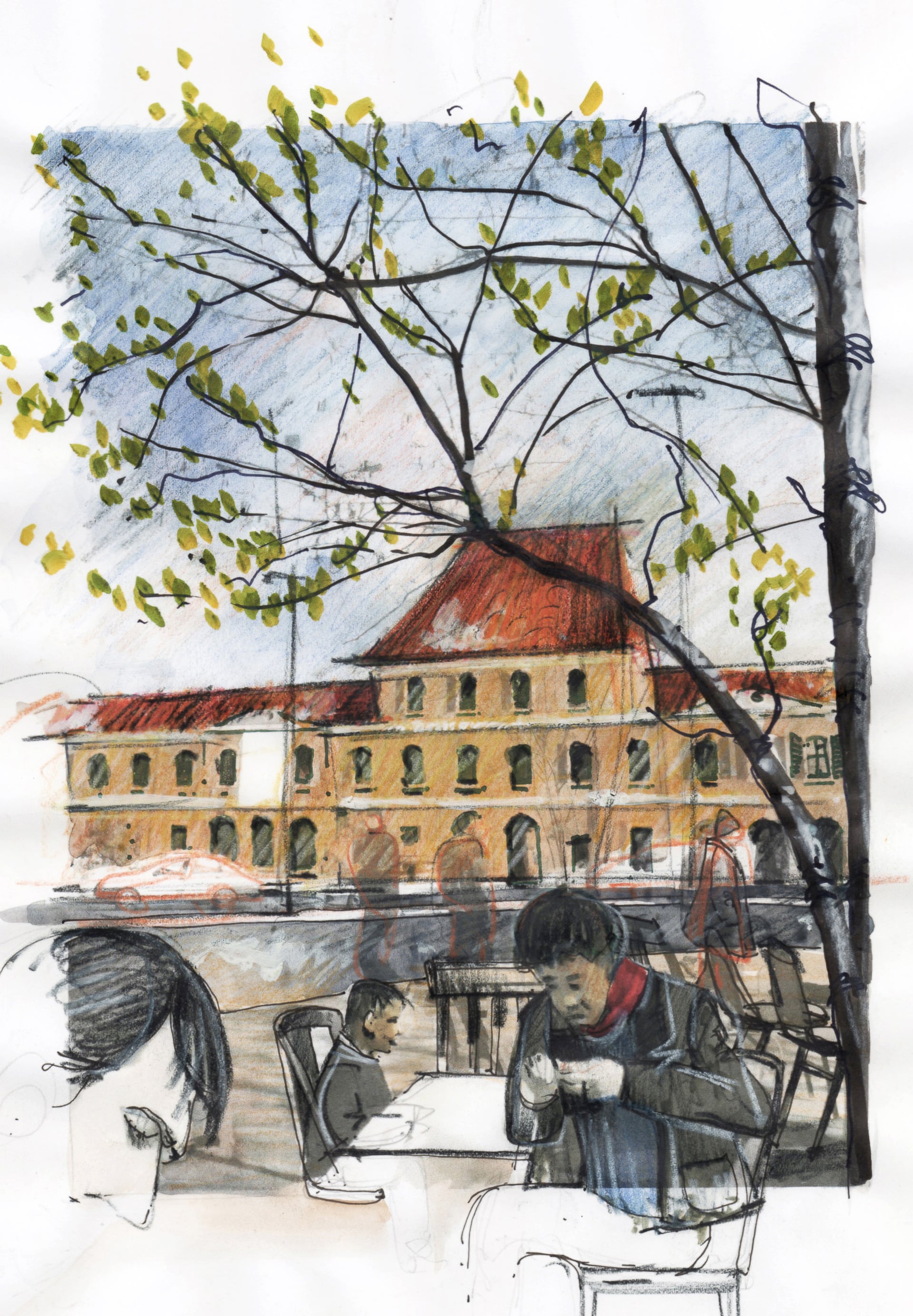
Sitting in a cafe in front of the train station, a thick orange scarf wrapped around his neck, a Syrian tailor watches people timidly as his son makes castles out of sugar cubes. A few weeks ago this cafe and the square teemed with smugglers conducting their illicit trade in the open, and refugees negotiating prices. Today, two Turkish police officers stand on a street corner to scare away smugglers and their clients. [Continue reading…]
Frozen life in wartime Syria

Janine di Giovanni writes: Five years is a long time to be frozen in the grip of war. Five years is a primary-school education. Five years is hundreds of thousands of memories in a single human life.
“I have not seen or eaten a tomato in a year,” Ahmed Mujahid, 23, recently told me by Skype. His home in Darayya, Syria, has been bombed several times; now he stays with friends, or wherever he can. “I think it was last summer when I last tasted a tomato, and that was uneatable, because it was green. There are children who have been born in these five years who don’t know the taste of fruit.”
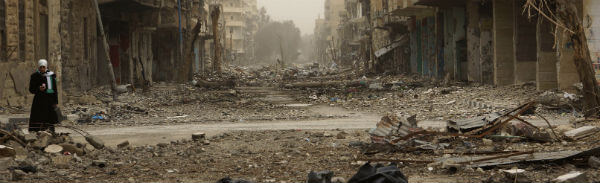
Syria has now endured five years of war. We know the figures that illustrate that time passing: as many as 470,000 dead; nearly five million refugees; some six million displaced inside the battered country. The opposition walked out of peace talks in Geneva last week. No one seemed surprised. Those in Syria have little hope. When you live through war for that long, you become accustomed to the misery, the drudgery, to not having water, electricity or medical care.
After a while, you forget the book you were reading when the war started, or the love affair you had just ended. Your life is put on hold. With a terrible nonchalance, you get used to the sound of bombs falling.
“This is the background music in which we live our lives,” a friend told me in Aleppo in 2012 as a rocket crashed nearby.
Four years later, my friend is dead, so I can’t ask him what background music he hears now.
Something else happens, as well, when wars continue for too long. The rest of the world grows tired of the photographs of the dead, the smashed hospitals and destroyed schools, tired of the statistics on hunger and rape and how many shells have landed in civilian areas. Five years deadens compassion. [Continue reading…]
The Defense Department made a big gaffe that helps Putin and Assad in Syria
Business Insider reports: The spokesman for the US military operation against ISIS made a comment in a Wednesday press briefing in Baghdad that helps justify Russia’s continued attacks on Syria’s largest city in the midst of a truce.
US Army Col. Steve Warren, the spokesman for Operation Inherent Resolve in Iraq, was asked whether Russian airstrikes on Aleppo, the current epicenter of the war, meant that Moscow was preparing to end the cessation of hostilities (CoH) agreement between government forces and the opposition signed on February 29.
Warren responded that it was “complicated” because al-Nusra “holds Aleppo” and is not party to the agreement.
Warren said of Russia:
I’m not going to predict what their intentions are. What I do know is that we have seen, you know, regime forces with some Russian support as well begin to mass and concentrate combat power around Aleppo. … That said, it’s primarily al-Nusra who holds Aleppo, and of course, al-Nusra is not part of the cessation of hostilities. So it’s complicated.
As Middle East analyst Kyle Orton noted on Twitter, Warren came “pretty close” to saying that the coalition supports Russia’s airstrikes in the city. Those strikes, however, are aimed at degrading any and all opposition to Bashar Assad — the embattled Syrian president who the Obama administration has repeatedly insisted “has to go.” [Continue reading…]
Google’s new YouTube analysis app crowdsources war reporting
Wired reports: In armed conflicts of the past, the “fog of war” meant a lack of data. In the era of ubiquitous pocket-sized cameras, it often means an information overload.
Four years ago, when analysts at the non-profit Carter Center began using YouTube videos to analyze the escalating conflicts in Syria and Libya, they found that, in contrast to older wars, it was nearly impossible to keep up with the thousands of clips uploaded every month from the smartphones and cameras of both armed groups and bystanders. “The difference with Syria and Libya is that they’re taking place in a truly connected environment. Everyone is online,” says Chris McNaboe, the manager of the Carter Center’s Syria Mapping Project. “The amount of video coming out was overwhelming…There have been more minutes of video from Syria than there have been minutes of real time.”
To handle that flood of digital footage, his team has been testing a tool called Montage. Montage was built by the human rights-focused tech incubator Jigsaw, the subsidiary of Google’s parent company Alphabet that was formerly known as a Google Ideas, to sort, map, and tag video evidence from conflict zones. Over the last few months, it allowed six Carter Center analysts to categorize video coming out of Syria—identifying government forces and each of the slew of armed opposition groups, recording the appearance of different armaments and vehicles, and keeping all of that data carefully marked with time stamps and locations to create a searchable, sortable and mappable catalog of the Syrian conflict. “Some of our Montage investigations have had over 600 videos in them,” says McNaboe. “Even with a small team we’ve been able to go through days worth of video in a relatively short amount of time.” [Continue reading…]
The problem with rebuilding a Palmyra ruin destroyed by ISIS – does it simply help Assad?
Adam Taylor writes: London Mayor Boris Johnson unveiled a stunning site in his city’s historic Trafalgar Square on Tuesday: a replica of the 2,000-year-old Arch de Triumph from Palmyra, Syria.
The original arch, once part of the internationally famous UNESCO world heritage site in Palmyra, was destroyed in an explosion by the Islamic State after it took control of the city last year. This new 20-foot-tall re-creation of the monument was crafted by the Institute of Digital Archaeology, a joint venture among Harvard University, the University of Oxford and Dubai’s Museum of the Future, which used 3-D imaging technology to map the arch and digital tools to carve it out of Egyptian marble.
During the unveiling ceremony, Johnson told spectators that they were gathered “in defiance of the barbarians” who destroyed the arch, the BBC reports. But despite the triumphant nature of the day and the clear delight that many had in the rebuilding of the historic ruin, some were concerned about what, exactly, Palmyra had come to represent.
Although few would argue that the ancient sites of Palmyra shouldn’t be protected, there are concerns that the city’s ancient wonders could become a propaganda tool for the regime of Syrian President Bashar al-Assad. Annie Sartre-Fauriat, an expert on Syrian heritage who works with UNESCO, said the Palmyra site should be evaluated and perhaps restored once the conflict is over.
“For the moment, we should not be fooled of the manipulations of opinion by a bloody dictator,” Sartre-Fauriat said.
Syria’s government declared just last month that it had forced the Islamic State from Palmyra after a prolonged campaign. “The liberation of the historic city of Palmyra today is an important achievement and another indication of the success of the strategy pursued by the Syrian army and its allies in the war against terrorism,” Assad said at the time.
For Assad and the Syrian regime, the capture of Palmyra seems to have been not only a symbol of the newfound prowess the Syrian military had on the battlefield with Russian air support, but also a claim that Syrians were the only ones who could protect Syria’s heritage. Palmyra itself had relatively little strategic value for the Islamic State, Aymenn Jawad al-Tamimi, a fellow at the Middle East Forum think tank, told Al Jazeera as the city was liberated. “Palmyra is more important for the regime, symbolically, to present itself as the defender of civilisation against barbarism,” Tamimi said.
This message has an international audience, too. The Islamic State’s destruction of Palmyra had created a global outcry. Now the Syrian regime and its Russian backers were able to portray themselves as the protectors of the ancient cultural site. In the days after their troops took Palmyra, the Syrian regime quickly took Western journalists to the ancient city to show them what the Islamic State had destroyed and what, by extension, Syrian troops had saved.
In doing so, the Syrian regime was ignoring the damage it had caused to Palmyra, Sartre-Fauriat said. Assad’s troops had inflicted their own damage on the site, Sartre-Fauriat explained, firing shells and rockets into ancient sites and also looting graves. [Continue reading…]