Simon Jenkins writes: What separates a necessary defender of the British state and a Stasi in the making? Seventy world human rights organisations today write to the British prime minister, deploring his response to recent revelations of what his spies have been up to. His response, in their view, has been “to condemn rather than to celebrate investigative journalism“.
David Cameron’s remarks have been extraordinary. They have contrasted with the American response to the same revelations about what are closely allied electronic spying agencies, the NSA in America and GCHQ in Britain. Washington, from president to congress to the press, has accepted that democratic and judicial oversight has broken down. Internet and phone traffic has been comprehensively hacked and stored, to be accessed globally by hundreds of thousands of staff. The system appears both insecure and out of control. Not a voice in America, not even the agencies themselves, opposes urgent reform.
In Britain there has been no questioning, only a hysterical rubbishing of the press. Even reporting the revelations has been said to jeopardise national security and “put lives at risk”. Parliamentary oversight has been made to look puny and ignorant. There is not talk of investigating the intelligence community, only of whether the press should be prosecuted. This is not a free state at work. [Continue reading…]
Category Archives: United Kingdom
How a NATO exercise almost triggered a nuclear war
The Observer reports: Chilling new evidence that Britain and America came close to provoking the Soviet Union into launching a nuclear attack has emerged in former classified documents written at the height of the cold war.
Cabinet memos and briefing papers released under the Freedom of Information Act reveal that a major war games exercise, Operation Able Art, conducted in November 1983 by the US and its Nato allies was so realistic it made the Russians believe that a nuclear strike on its territory was a real possibility.
When intelligence filtered back to the Tory government on the Russians’ reaction to the exercise, the prime minister, Margaret Thatcher, ordered her officials to lobby the Americans to make sure that such a mistake could never happen again. Anti-nuclear proliferation campaigners have credited the move with changing how the UK and the US thought about their relationship with the Soviet Union and beginning a thaw in relations between east and west.
The papers were obtained by Peter Burt, director of the Nuclear Information Service (NIS), an organisation that campaigns against nuclear proliferation, who said that the documents showed just how risky the cold war became for both sides.
“These papers document a pivotal moment in modern history – the point at which an alarmed Thatcher government realised that the cold war had to be brought to an end and began the process of persuading its American allies likewise,” he said.
“The Cold War is sometimes described as a stable ‘balance of power’ between east and west, but the Able Archer story shows that it was in fact a shockingly dangerous period when the world came to the brink of a nuclear catastrophe on more than one occasion.”
Able Archer, which involved 40,000 US and Nato troops moving across western Europe, co-ordinated by encrypted communications systems, imagined a scenario in which Blue Forces (Nato) defended its allies after Orange Forces (Warsaw Pact countries) sent troops into Yugoslavia following political unrest. The Orange Forces had quickly followed this up with invasions of Finland, Norway and eventually Greece. As the conflict had intensified, a conventional war had escalated into one involving chemical and nuclear weapons.
Numerous UK air bases, including Greenham Common, Brize Norton and Mildenhall, were used in the exercise, much of which is still shrouded in secrecy. However, last month Paul Dibb, a former director of the Australian Joint Intelligence Organisation, suggested that the 1983 exercise posed a more substantial threat than the Cuban missile crisis of 1962. “Able Archer could have triggered the ultimate unintended catastrophe, and with prompt nuclear strike capacities on both the US and Soviet sides, orders of magnitude greater than in 1962,” he said. [Continue reading…]
Greenwald’s partner was detained in UK for promoting ‘political’ causes
The Guardian reports: The detention of the partner of a former Guardian journalist has triggered fresh concerns after it emerged that a key reason cited by police for holding him under terrorism powers was the belief that he was promoting a “political or ideological cause”.
The revelation has alarmed leading human rights groups and a Tory MP, who said the justification appeared to be without foundation and threatened to have damaging consequences for investigative journalism.
David Miranda is the partner of Glenn Greenwald, the journalist who – often in collaboration with the Guardian – has broken many stories about the extent and scope of spying by the US National Security Agency. Miranda was stopped at Heathrow airport in August and held by the Metropolitan police for nine hours while on his way home to Brazil.
Miranda, it has been claimed, was carrying some 58,000 encrypted UK intelligence documents. He had spent a week in Berlin visiting a journalist, Laura Poitras, who has worked with Greenwald on many of his stories, which have been based on information leaked by the former NSA contractor Edward Snowden.
Now documents referred to in court last week before a judicial review of Miranda’s detention shine new light on the Metropolitan police’s explanation for invoking terrorism powers – a decision critics have called draconian. [Continue reading…]
Britain claimed Greenwald’s partner was involved in ‘espionage’ and ‘terrorism’
Reuters reports: British authorities claimed the domestic partner of reporter Glenn Greenwald was involved in “terrorism” when he tried to carry documents from former U.S. intelligence contractor Edward Snowden through a London airport in August, according to police and intelligence documents.
Greenwald’s partner, David Miranda, was detained and questioned for nine hours by British authorities at Heathrow on August 18, when he landed there from Berlin to change planes for a flight to Rio De Janeiro, Brazil.
After his release and return to Rio, Miranda filed a legal action against the British government, seeking the return of materials seized from him by British authorities and a judicial review of the legality of his detention.
At a London court hearing this week for Miranda’s lawsuit, a document called a “Ports Circulation Sheet” was read into the record. It was prepared by Scotland Yard – in consultation with the MI5 counterintelligence agency – and circulated to British border posts before Miranda’s arrival. The precise date of the document is unclear.
“Intelligence indicates that Miranda is likely to be involved in espionage activity which has the potential to act against the interests of UK national security,” according to the document.
“We assess that Miranda is knowingly carrying material the release of which would endanger people’s lives,” the document continued. “Additionally the disclosure, or threat of disclosure, is designed to influence a government and is made for the purpose of promoting a political or ideological cause. This therefore falls within the definition of terrorism…” [Continue reading…]
GCHQ revelations show Britain needs a parliamentary inquiry into mass surveillance
Member of Parliament Tom Watson writes: Spymasters past and present have been busy of late condemning Edward Snowden and the Guardian. The “most catastrophic loss to British intelligence ever” is how Sir David Omand described the whistleblower’s leaks of confidential data.
The MI5 chief, Andrew Parker, stopped short of a direct attack on the Guardian for exposing GCHQ’s data surveillance programme Tempora, but his speech claimed that publishing such information gives terrorists the ability “to strike at will”.
Even some sections of the media have taken the side of the spooks. The Daily Mail said the Guardian had shown a “lethal irresponsibility”. Now the police have been asked by Tory MP Julian Smith to investigate the Guardian, while Liam Fox has successfully called on parliament to do the same with the support of the prime minister.
In truth, the Guardian is under attack for carrying out its public duty. It acted courageously, in the public interest, to uncover and reveal a government programme that has gained access to the private communications of millions of individuals. Tempora has been mining our internet communications data, en masse, without public knowledge or any kind of public debate. So the newspaper should be thanked for bringing this to our attention so that we can now have a proper conversation about whether mass surveillance is necessary and proportionate in the fight against terrorism. [Continue reading…]
British MPs set to investigate Guardian’s involvement in Snowden leaks
The Guardian reports: A powerful group of MPs will investigate the Guardian’s publication of stories about mass surveillance based on leaks by US whistleblower Edward Snowden, as part of a wider inquiry into counter-terrorism.
Keith Vaz, the Labour head of the Commons home affairs committee, said he would look into “elements of the Guardian’s involvement in, and publication of, the Snowden leaks” hours after the prime minister suggested a select committee might look at the issue.
It had emerged the matter would be considered by Vaz’s parliamentary committee after former Tory cabinet minister Liam Fox asked him to investigate what damage the Guardian may have caused to national security.
“I have received a letter from Liam Fox requesting that the home affairs select committee consider elements of the Guardian’s involvement in, and publication of, the Snowden leaks,” Vaz said.
“I will be writing to assure Dr Fox that the committee is currently conducting an inquiry into counter-terrorism and we will be looking at this matter as part of it.”
A spokesman for Vaz could not confirm whether Alan Rusbridger, the Guardian editor-in-chief, would be called to give evidence, saying this would be a matter for all committee members to decide. [Continue reading…]
Snowden leaks: David Cameron urges committee to investigate Guardian
The Guardian reports: David Cameron has encouraged a Commons select committee to investigate whether the Guardian has broken the law or damaged national security by publishing secrets leaked by the National Security Agency whistleblower Edward Snowden.
He made his proposal in response to a question from former defence secretary Liam Fox, saying the Guardian had been guilty of double standards for exposing the scandal of phone hacking by newspapers and yet had gone on to publish secrets from the NSA taken by Snowden.
Speaking at prime minister’s questions on Wednesday, Cameron said: “The plain fact is that what has happened has damaged national security and in many ways the Guardian themselves admitted that when they agreed, when asked politely by my national security adviser and cabinet secretary to destroy the files they had, they went ahead and destroyed those files.
“So they know that what they’re dealing with is dangerous for national security. I think it’s up to select committees in this house if they want to examine this issue and make further recommendations.” [Continue reading…]
The Guardian knew that they were dealing with goons acting on the orders of Cameron’s intelligence chiefs who wouldn’t take no for an answer. They also knew that destroying the hard drives in question had no security significance whatsoever, given that copies of the files on those drives were all safe outside the UK.
On July 18th, [editor, Alan] Rusbridger received a call from Oliver Robbins, the U.K.’s deputy national-security adviser, alerting him that agents would be coming to the Guardian’s offices to seize the hard drives containing the Snowden files. Rusbridger again explained that the files were also on encrypted computers outside England, but his reasoning did not sway Robbins. Rusbridger asked if, instead, his staff members could destroy the files themselves, and Robbins consented. That Saturday, Rusbridger told associates to take the five laptops from the bunker to the basement and to smash the hard drives and circuit boards in front of two agents from the GCHQ.
If Cameron wants to draw any lesson from the incident, it should be that the editor of The Guardian is smarter than his own deputy national security adviser. By agreeing to let the drives get destroyed, the British government threw away its best opportunity to discover which files Snowden had taken — something that neither the NSA nor GCHQ has ever been able to establish.
Britain and Iran pave way for reopening of London and Tehran embassies
The Guardian reports: Britain and Iran have taken a significant step toward reopening their respective embassies in Tehran and London by appointing chargés d’affaires and holding talks about staffing on the eve of new negotiations over Iran’s nuclear programme.
William Hague, the UK foreign secretary, revealed to MPs that on Tuesday that talks with the Iranian government had taken place last week in a much more positive atmosphere following intensifying diplomatic contacts in the wake of the election of the moderate President Hassan Rouhani last June.
Progress would have to take place on a “step-by-step reciprocal basis”, Hague said, but he made clear he hoped the moves would pave the way to reopen the British embassy. “We are open to more direct contact,” he said, adding that the coming months “may be unusually significant” in British-Iranian relations.
A non-resident diplomat is to be appointed by both countries and talks have already been held about the key issues of numbers and conditions for local staff – often harassed in the past by the Iranian authorities. Inspection of premises was another matter being addressed. [Continue reading…]
How Britain became the most spied on, monitored and surveilled democratic society there has ever been
John Lanchester writes: In August, the editor of the Guardian rang me up and asked if I would spend a week in New York, reading the GCHQ files whose UK copy the Guardian was forced to destroy. His suggestion was that it might be worthwhile to look at the material not from a perspective of making news but from that of a novelist with an interest in the way we live now.
I took Alan Rusbridger up on his invitation, after an initial reluctance that was based on two main reasons. The first of them was that I don’t share the instinctive sense felt by many on the left that it is always wrong for states to have secrets. I’d put it more strongly than that: democratic states need spies.
The philosopher Karl Popper, observing the second world war from his academic post in New Zealand, came up with a great title for his major work of political thought: The Open Society and Its Enemies. It is, in its way, a shocking phrase – why would the open society have enemies? (But then, the title of Charles Repington’s The First World War, published in 1920, was shocking too, because it implied that there would be another one.)
We do have enemies, though, enemies who are in deadly earnest; enemies who wish you reading this dead, whoever you are, for no other reason than that you belong to a society like this one. We have enemies who are seeking to break into our governments’ computers, with the potential to destroy our infrastructure and, literally, make the lights go out; we have enemies who want to kill as many of us, the more innocent the better, as possible, by any means possible, as a deliberate strategy; we have enemies who want to develop nuclear weapons, and thereby vastly raise the stakes for international diplomacy and the threat of terrorism; and we have common-or-garden serious criminals, who also need watching and catching.
I get all that. It doesn’t thrill me to bits that the state has to use the tools of electronic surveillance to keep us safe, but it seems clear to me that it does, and that our right to privacy needs to be qualified, just as our other rights are qualified, in the interest of general security and the common good.
My week spent reading things that were never meant to be read by outsiders was, from this point of view, largely reassuring. Most of what GCHQ does is exactly the kind of thing we all want it to do. It takes an interest in places such as the Horn of Africa, Iran, and North Korea; it takes an interest in energy security, nuclear proliferation, and in state-sponsored computer hacking.
There doesn’t seem to be much in the documents about serious crime, for which GCHQ has a surveillance mandate, but it seems that much of this activity is covered by warrants that belong to other branches of the security apparatus. Most of this surveillance is individually targeted: it concerns specific individuals and specific acts (or intentions to act), and as such, it is not the threat.
Even Julian Assange thinks that, and said as much in his alarming and perceptive book Cypherpunks: “Individual targeting is not the threat.” When the state has specific enemies and knows who they are and the kind of harm they intend, it is welcome to target them to make the rest of our polity safe. I say again, on the evidence I’ve seen, this is mainly what GCHQ does. I would add that the Guardian and its partners have gone to a lot of trouble to prevent any unnecessarily damaging detail about this work being published.
The problems with GCHQ are to be found in the margins of the material – though they are at the centre of the revelations that have been extracted from the Snowden disclosures, and with good reason. The problem and the risk comes in the area of mass capture of data, or strategic surveillance. This is the kind of intelligence gathering that sucks in data from everyone, everywhere: from phones, internet use from email to website visits, social networking, instant messaging and video calls, and even areas such as video gaming; in short, everything digital.
In the US, the Prism programme may have given the NSA access to the servers of companies such as Google and Facebook; in the UK, GCHQ has gained a similar degree of access via its Tempora programme, and the two of them together have a cable- and network-tapping capabilities collectively called Upstream, which have the ability to intercept anything that travels over the internet. This data is fed into a database called XKeyscore, which allows analysts to extract information “in real time”, ie immediately, from a gigantic amount of hoovered-up data.
In addition, the NSA has encouraged technology companies to install secret weaknesses or “backdoors” into their commercially available, supposedly secure products. They have spent a very great deal of money ($250m a year alone on weakening encryption), on breaking commercially available security products. Other revelations have been published in Der Spiegel, and concern the NSA exploitation of technology such as the iPhone.
What this adds up to is a new thing in human history: with a couple of clicks of a mouse, an agent of the state can target your home phone, or your mobile, or your email, or your passport number, or any of your credit card numbers, or your address, or any of your log-ins to a web service.
Using that “selector”, the state can get access to all the content of your communications, via any of those channels; can gather information about anyone you communicate with, can get a full picture of all your internet use, can track your location online and offline. It can, in essence, know everything about you, including – thanks to the ability to look at your internet searches – what’s on your mind.
To get a rough version of this knowledge, a state once had to bug phones manually, break into houses and intercept letters, and deploy teams of trained watchers to follow your whereabouts. Even then it was a rough and approximate process, vulnerable to all sorts of human error and countermeasures. It can now have something much better than that, a historically unprecedented panoply of surveillance, which it can deploy in a matter of seconds.
This process is not without supervision, of course. In order to target you via one of these “selectors” – that’s the technical term – the agent of the state will have to type into a box on his or her computer screen a Miranda number, to show that the process is taking place in response to a specific request for information, and will also need to select a justification under the Human Rights Act. That last isn’t too arduous, because the agent can choose the justification from a drop-down menu. This is the way we live now.
And yet nobody, at least in Britain, seems to care. In the UK there has been an extraordinary disconnect between the scale and seriousness of what Snowden has revealed, and the scale and seriousness of the response. One of the main reasons for that, I think, is that while some countries are interested in rights, in Britain we are more focused on wrongs. [Continue reading…]

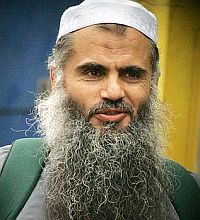
I know Abu Qatada — he’s no terrorist
Victoria Brittain, former associate foreign editor of The Guardian, writes: The voluntary departure from Britain of Omar Othman, better known as Abu Qatada, is a triumph for the independence of the judiciary over this and previous governments’ high-profile attempts to send him to face a trial in Jordan, where the evidence against him was obtained by torture. Our judiciary has safeguarded a prominent political refugee who our society chose to persecute in a disgraceful way.
Since 2007 as many as 12 senior British judges in various courts have recognised the torture origins of the evidence against him, which successive prime ministers and home secretaries have, until a few weeks ago, publicly put all their political weight into ignoring. The US, aided by the UK, on behalf of its key ally Jordan, went so far as to kidnap UK residents Jamil el-Banna and Bisher al-Rawi on a business trip in Africa, torture them in Bagram airbase in Afghanistan, and take them to Guantánamo in order to interrogate them about Othman. When those men sued the British authorities for what they had done, parliament was persuaded to create secret courts to adjudicate on secret defences.
The British judges’ success is that the Jordanian government has now made a change in its law that applies only to Othman and no one else. In his case the burden of proof is now on the prosecutor to show that any statement made against him in court was not produced by torture or any other form of ill-treatment – a reversal of the previous situation.
In addition, his safety in Jordan is enormously enhanced by the new conditions agreed, which include his detention in a civilian facility, the exclusion of the Jordanian intelligence service from any access to him, monitoring by an independent human rights body, and a commitment that Britain will be contacted if there are concerns.
But the most recent phase of this long saga has left poison in our society. The home secretary, prime minister, mayor of London, countless MPs – including senior Labour party figures – have led the media in reckless and prejudiced comments, making Othman the most demonised individual in Britain. [Continue reading…]
BNP and EDL supporters chased through London by women dressed as badgers

International Business Times reports: A rally by extremists from the British National Party and the English Defence League was dwarfed by opposition campaigners staging rival protests in London on Saturday 1 June.
Shortly after lunch, a die-hard core of around 50 BNP and EDL supporters was confronted outside parliament by hundreds of activists from anti-extremist groups including Unite Against Fascism and Hope Not Hate.
But in the event, both groups were upstaged by agitators of a different stripe. Decked out from head to toe in black and white, the group that won the day were campaigning neither for race war nor ethnic equality, but an end to the government’s cull on badgers.
And it was the pro-badger campaigners who appeared to steal a march on the political activists.
Young women dressed in fake fur were seen chasing doughty nationalist supporters down London’s Whitehall as a large number of security forces in iridescent jackets looked on from police lines.
After London attack, Britain grapples with anti-Muslim rage
GlobalPost reports: The London Islamic Cultural Society sits on a quiet street in Wood Green, a multiethnic, working-class neighborhood in north London.
Next door is the Greek Cypriot Women’s Organisation and across the street is the Gospel Centre, an evangelical Christian church with a billboard depicting a smiling Jesus in an England soccer jersey and the caption “No one saves better.”
But on Tuesday, only the mosque bore a warning to its members on the door.
“Security Alert: This Mosque will open 10 minutes before each prayer and close 15 minutes after each Prayers,” reads a sign posted next to a prayer time reminder and a flier for an upcoming fundraising carnival.
Mosques and Muslim community centers around the UK have been on alert since the May 22 murder of an off-duty soldier by two men with alleged ties to Islamic extremism.
Suspects Michael Adebolajo, 28, and Michael Adebowale, 22, were shot by police and injured after confronting officers after the killing. Adebowale was released from the hospital Tuesday and immediately taken into police custody in south London.
Amid the emotional public response to the brutal public killing of Drummer Lee Rigby, 25, a violent minority has chosen to direct its anger at members of Britain’s Muslim community. [Continue reading…]
The reaction to the Woolwich murder denies British Muslims a political voice
Rachel Shabi writes: This debate isn’t just sealed shut, it has round-the-clock protection. In the context of the Woolwich killers, there is to be no connection made to British foreign policy in the Middle East. That, we are told, is because the link is erroneous, an attempt to justify (as opposed to just understand), and an appeasement to terrorists. Oh, and also: those making the link only do so because of a tedious tendency to blame the west for everything.
All that’s bad enough, but British Muslims also say that, for them, making this connection is even harder because of the fear that, despite being just as worried about the issue as anyone else, they will be viewed as having somehow stepped on to a conveyor belt that leads inexorably to violent extremism.
It is no surprise that those policing this closed debate should be politicians and the defenders of a disastrous series of invasions in the Middle East – for who would want to claim that the very policies they deployed or supported are the ones that even partly account for blowback terror? British politicians avoid saying it even as their own security officials warn that foreign policy in places such as Iraq has created a greater risk of terrorism on British soil. And meanwhile, the fact that violent extremists all cite the same thing – occupation and wars in Muslim lands – is hastily dismissed as a crazed coincidence.
Of course, only a really tiny proportion of this anger actually turns violent – but to stifle a discussion over any element of causality is essentially to dismiss the reasons why people might be confused, outraged or frustrated by Britain’s foreign policy in the first place. And the anger over western policy is obvious; its causes both real and palpable. Corrosive, hypocritical western policy is one key subject that is constantly raised in conversations across the Middle East. There’s the long-standing dishonesty in the way the west in effect endorses Israel’s continued military occupation of the Palestinian people. [Continue reading…]
EDL raises risk of terrorism, say most Britons
British Future: Most people believe that far right groups like the English Defence League stir up hatred and violence in Britain in a way which increases the risk of future terrorist incidents. A rising proportion of Britons say they would never join the EDL – a view held by 84% of people who have heard of the group – according to new polling released this weekend.
After the brutal murder of a soldier in Woolwich by Islamist extremists, new polling published this weekend shows a clear public rejection of effort by one extreme fringe to capitalise on the activities of another, instead capturing growing opposition to the far right. Most of the public want the media to be more wary of giving either extremist group a media platform to spread hateful views.
61 per cent agree that ‘organisations like the English Defence League are stirring up hatred and violence between groups and making the risk of attacks of this kind more likely’ according to a new Survation poll, published in the Mail on Sunday. Only 14 per cent disagree.
Meanwhile, The Independent reports: Evidence emerged last night that one of the suspects involved in the killing of the British soldier Lee Rigby was well known to anti-terror police and the security services for at least three years before the brutal Woolwich attack. Michael Adebolajo was arrested in Kenya under suspicion of being at the centre of an al-Qa’ida-inspired plot in 2010, The Independent on Sunday can reveal.
He was one of seven men arrested by Kenyan police after landing on an island off the Kenyan coast in November 2010. Local press reports of the arrests referred to Mr Adebolajo as a “Nigerian with a British passport” who was “suspected of masterminding the racket”. Police claimed the men were travelling to Somalia to join the ranks of the al-Shabaab terrorist group. His family claimed he was held in detention and tortured before being deported back to Britain without charge.
After the incident, members of his family said he was “pestered” by MI5 agents pressuring him to become an informant for them and infiltrate radical Islamic extremist groups. Relatives said other family members were also harassed and questioned by the UK authorities. In an exclusive interview with The IoS, Mr Adebolajo’s brother-in law claimed constant demands to get him to spy on Muslim clerics might have pushed him over the edge.
How Margaret Thatcher fueled the conflict in Ireland
Gerry Adams writes: Margaret Thatcher was a hugely divisive figure in British politics. Her right wing politics saw Thatcher align herself with some of the most repressive and undemocratic regimes in the late 20th century – including apartheid South Africa and Chile’s Pinochet. Her description of the ANC and Mandela as terrorists was evidence of her ultra conservative view of the world.
She championed the deregulation of the financial institutions, cuts in public services and was vehemently anti-trade union. She set out to crush the trade union movement. The confrontation with the miners and the brutality of the British police was played out on television screens night after night for months. The current crisis in the banking institutions and the economic recession owe much to these policies. And she went to war in the Malvinas.
But for the people of Ireland, and especially the north, the Thatcher years were among some of the worst of the conflict. For longer than any other British Prime Minister her policy decisions entrenched sectarian divisions, handed draconian military powers over to the securocrats, and subverted basic human rights.
Thatcher refused to recognise the right of citizens to vote for representatives of their choice. She famously changed the law after Bobby Sands was elected in Fermanagh South Tyrone. And when I and several other Sinn Féin leaders were elected to the Assembly in 1982 we were barred from entry to Britain.
Margaret Thatcher’s government defended structured political and religious discrimination and political vetting in the north, legislated for political censorship and institutionalised to a greater extent than ever before collusion between British state forces and unionist death squads.
It under her leadership that in 1982 that the Force Research Unit (FRU) was established as a unit within the British Army Intelligence Corps. This British Army agency recruited agents who were then used to kill citizens. Among them was loyalist Brian Nelson. He was a former British soldier and member of the Ulster Defence Association who was recruited by FRU in 1983. He became the UDA’s Senior Intelligence Officer and his associates in FRU helped him to update his intelligence files, including photo-montages of potential victims.
In the summer of 1985 Nelson travelled to South Africa where he helped negotiate a deal for that ultimately saw the UDA, UVF and Ulster Resistance acquire 200 AK47 automatic rifles, 90 Browning pistols, 500 fragmentation grenades, ammunition and 12 RPG rocket launchers. The shipment arrived in the north in late 1987 or early 1988.The Thatcher government was across all the details of this shipment. Its impact on the streets of the north is evident in the statistics of death. In the three years prior to receiving this weapons shipment the loyalist death squads killed 34 people. In the three years after the shipment they killed 224 and wounded countless scores more.
The extent of the role of FRU in the killing of citizens is formidable. But it was the killing of human rights lawyer Pat Finucane in February 1989 that reveals the depth of the structured state collusion policy being pursued by the Thatcher government. [Continue reading…]
Unlike Margaret Thatcher, miners believed in society
Ken Capstick writes: In 1984 Britain had 186 working coalmines and approximately 170,000 coalminers. Today we have four coalmines and around 2,000 miners. They lived in close-knit communities built around and based on employment at the local colliery. Miners were a hardy race of people who faced constant danger in the cause of mining coal but underneath that they were caring, sensitive individuals with a commitment to the communities in which they lived. They looked after their old and young as well as those who were ill or infirm.
They built and provided their own welfare facilities and, well before today’s welfare state was built, miners created their own welfare systems to alleviate hardship. They rallied around each other when times were hard. They recognised the need for cohesion when at any time disaster could strike a family unit or indeed a whole community. The latest pit to close, Maltby in Yorkshire, still has a death and general purpose fund to help fellow miners and their families in times of hardship. In short, miners believed in society.
These values were the exact opposite of those Margaret Thatcher espoused. For miners, greed was a destructive force, not a force for good. From the valleys of Wales to the far reaches of Scotland, miners were, by and large, socialists by nature but this was tempered by strong Christian beliefs. Thatcher’s threat to butcher the mining industry, destroy the fabric of mining communities and in particular the trade union to which miners had a bond of loyalty, was met with the fiercest resistance any government has met in peacetime.
It might just be a scene in a film, but Pete Postlethwaite’s speech at the end of Brassed Off perfectly captures the spirit of the miners and the grievous suffering that Thatcher inflicted on industrial workers across Britain.
The Guardian reports: “I’ll tell you what really annoyed us miners,” said Pete Mansell, sipping a pint of John Smith’s on Monday. “She said we were the enemy within. We weren’t. We were just looking after our lives, our families, our kids and our properties, everything that we ever had. We were fighting for that big style.”
Along with most of the other men drinking in the Black Bull pub in Aughton, Rotherham, the 55-year-old former pit worker had borne witness to the fiercest confrontation in the miners strike at the nearby Orgreave coking plant on 18 June 1984.
Almost 30 years have gone by since Margaret Thatcher characterised those who took part in the “battle of Orgreave” as thugs. But in a village that one drinker said had been “decimated by Thatcher”, the words still cut deep. It is perhaps no surprise that those gathered in the pub were having what they described as a party after hearing about her death.
“I’m not a hypocrite,” said Mansell, who is from the nearby pit village of Swallownest and worked underground for 22 years. “I spoke ill of her when she was alive and I’ll speak ill of her now she’s dead. She doesn’t mean two iotas to me.”
The rise and fall of Margaret Thatcher
In ‘Revolution,’ an episode from Andrew Marr’s History of Modern Britain, his assessment of Margaret Thatcher becomes most unpalatable when he veers towards gushing admiration, yet more importantly he highlights the worst feature of Thatcher’s reign: the extent of her influence.
Dancing on the streets in celebration of her death is a bit like celebrating the death of a monarch while remaining the subject of a monarchy.
After Thatcher fell from power, Thatcherism lived on, not least through her ideological step-child, Tony Blair. Since she had already sold off all of Britain’s other assets, he sold off politics itself and exchanged ideology for marketing. The only ideology that remained sacrosanct was the one he had been bequeathed by Thatcher: that of small government and free-market economics.
The Thatcher-Blair era helped set the stage for global economic crisis and through Britain’s vassal status to the U.S., a decade of wars in the Middle East.

Since 2007 as many as 12 senior British judges in various courts have recognised the torture origins of the evidence against him, which successive prime ministers and home secretaries have, until a few weeks ago, publicly put all their political weight into ignoring. The US, aided by the UK, on behalf of its key ally Jordan, went so far as to kidnap UK residents