Category Archives: United States

Why the apocalypse is in America’s DNA

FeatureStefany Anne Golberg writes: Harold Camping expected a spectacular death. He thought he would see horses and towering flames. Instead Harold Camping fell down at home last month at the age of 92 and never got up again.

Judgment Day is upon us, the radio evangelist proclaimed a few years ago, setting May 21, 2011 as the date. All across America, billboards became Camping advertisements for Apocalypse. “Cry mightily unto GOD for HIS Mercy” was one suggestion, “Joy to the World” claimed another. All across the nation, there were Americans who laughed, and those who readied themselves. Camping’s believers stopped paying their credit cards, quit their jobs, said farewell to friends. Some spent their life’s savings in preparation for the End — some spent it on the Rapture campaign itself.

When Judgment Day did not come, Camping tried to assuage believers. “Please forgive me, America!” a new billboard read. “I was terribly wrong about … May 21, 2011. There is forgiveness in those who trust in Jesus Christ.” Then he said that he had gotten the timing wrong and that the End would, in fact, happen in October. But October passed the same as ever and then Harold Camping had a stroke. By that time, accounts of thousands who had mistakenly given up their Earthly existence came pouring through the news. “Yet though we were wrong,” wrote Camping in a letter to his Family Radio Family, “God is still using the May 21 warning in a very mighty way.” Look at the millions and billions of people who heard the message of Christ’s imminent return, Harold Camping wrote. And he would still come, Camping assured us.

Reporters and Average Joes expressed outrage at Camping’s Rapture campaign. Camping’s followers were treated in the media as ridiculous and occasionally as tragic, Camping as a fraud and a heretic. The whole thing is an anomaly, the American media told the world, America is not like this.

But America is like this, and it always has been. [Continue reading…]

Facebooktwittermail

Why I hate coming home to America

OpinionHost/producer for HuffPost Live, Ahmed Shihab-Eldin, writes: It’s not easy coming back home to America when your name is Ahmed.

I want to look forward to returning home from a trip abroad, but thanks to my name or as the TSA officer put it — my “profile” — I’ve come to dread it.

The last four times I’ve traveled abroad (to Turkey, Kuwait, Lebanon and Switzerland), Homeland Security has detained me upon arrival. It’s as frustrating as it is ironic, because although in Arabic my name, Ahmed, means, “blessed,” each time I land at JFK airport, I can’t help but feel somewhat cursed.

On Sunday night, after attending the World Economic Forum in Davos for the first time, I was detained for two hours upon arrival. In October, I was held for almost four, returning home after a 14-hour trip to Turkey where I moderated a UN conference on peace in the Middle East. For what it’s worth, I breezed through security in Istanbul.

In Davos — where I interviewed some of the world’s wealthiest, most powerful and highest-profile people — the running joke among our production team, and many of the other participants was how unusually friendly and hospitable the thousands of police officers, special forces, and security guards were. My team passed through security checkpoint after checkpoint at each of the various venues with respect and dignity.

Why then, you might be wondering, am I detained every time I set foot on U.S. soil? As it is always abstractly and bluntly explained to me: My “name” and “my profile” are simply a “match.”

Like all Americans (and every human being for that matter), I want to be safe. But I can’t help but question the efficacy of our national security policy, including the practice of detaining U.S. citizens because something (never specifically explained) about a name or person’s identity is said to match that of someone somewhere in the world who is deemed to pose a threat to America. [Continue reading…]

Facebooktwittermail

Justin Bieber is lucky that he’s rich — and white. Poor immigrants don’t get off so lightly

OpinionSadhbh Walshe writes: Anytime I feel called upon to devote column inches to the antics of a teenage pop sensation in meltdown mode, I die a little. But after seeing a petition to the White House calling for the deportation of Justin Bieber for allegedly egging his neighbor’s mansion and subsequently driving under the influence has already gathered nearly 80,000 signatures, it seems necessary to take up his cause. This is not, I assure you, because he turned in what must be the sweetest mugshot ever or even because I’m so terribly concerned about his ultimate fate – I think we all know he’s going to be just fine – but simply because many other legal immigrants in the same position would almost certainly not be.

Since Bieber came under investigation earlier this month for the egg throwing incident, lawyers at the American Civil Liberties Union (ACLU) and elsewhere have been trying to use his case to highlight the fact that, if convicted, the potential consequences could be much more severe for Bieber, who is a legal immigrant from Canada (he has a US visa for his extraordinary ability in the arts), than they would be if he were an American citizen. As the ACLU’s Diana Scholl pointed out in a recent blog post, if the damage to his neighbor’s property were found to be over $400, Bieber could be charged with felony vandalism under California law and, if convicted, could be subject to mandatory detention in a privately run immigrant prison before being deported back to his native Canada. This is because under US immigration law, any legal alien convicted of an aggravated felony faces mandatory detention and deportation and many Americans might be surprised to know just how many crimes are classified as “aggravated felonies” when they are committed by immigrants.

Before any concerned Beliebers start flinging their bras over the barbed wire fences of one of our many immigrant detention centers that are mostly run by for profit corporations like the Corrections Corporation of America (CCA) and GEO Group, Inc, I should stress that it’s highly unlikely that Bieber will end up in one of them. Although his neighbors have claimed the damage to their property is in the region of $20,000, well over the threshold that would make the egg attack a felony, investigators who subsequently searched Bieber’s home unsurprisingly failed to uncover any evidence against the performer. (As the Guardian’s Marina Hyde succinctly put it, “What were they looking for? An omelette?“) But even if the police had unearthed a nest of egg bombs in the star’s kitchen, chances are Bieber would still be safe, simply because the kind of immigrants that get deported do not tend to be either Canadian or rich. [Continue reading…]

Facebooktwittermail

America’s rise as a superpower

In Der Spiegel, Hans Hoyng writes: “Sarajevo, 21st-century version.” This is how political scientist Anne-Marie Slaughter, the director of policy planning under former Secretary of State Hillary Clinton, refers to what is currently brewing off the Chinese coast, where the territorial claims of several nations overlap.

The analogy to the period prior to the outbreak of World War I is striking. China, “the Germany of (that) time,” as American historian Robert Kagan puts it, is the emergent world power still seeking to define its role within the global community. At the same time, China is staking its claim to natural resources, intimidating its neighbors and developing massive naval power to secure its trade routes.

In taking these steps, China could easily become a rival to another world power, the United States of America, which would assume the role once played by Great Britain in this historical comparison. Just as the United Kingdom did at the time, the United States is now building alliances with its rival’s neighbors. And leaders in Beijing have responded to such attempts to encircle their country with a similar sense of outrage as that displayed by the German Reich.

The current crisis in the East China Sea illustrates once again that there are still lessons to be learned from World War I a century after it began and, upon closer inspection, that politicians on both sides are trying to avoid making the same mistakes. But the current crisis in East Asia diverges from the situation leading up to World War I in one important respect: There is currently no country able to assume the role once played by the United States, which, with its late entry into the war, decided its outcome and eventually outpaced both its winners and losers.

The US’s entry into the war in 1917 marked the beginning of its path to becoming a world power. In fact, according to historian Herfried Münkler, this was precisely the goal of some politicians in Washington. Treasury Secretary William Gibbs McAdoo, a son-in-law of President Woodrow Wilson, was already forging plans to replace the pound sterling with the dollar as the foremost international reserve currency.

But his father-in-law, a lawyer and political scientist, and America’s only president to enter politics after serving as the president of a university, had no such prosaic intentions. Wilson, the descendent of Scottish Presbyterians and a staunch idealist, and yet down-to-earth and in many respects, such as his racism, a son of the South, wanted to save the world and end war once and for all.

He failed, of course, with peace lasting only 20 years after World War I. Nevertheless, American politicians today justify military intervention with the same arguments Wilson used to convince the country to put an end to its isolation and intervene in Europe. [Continue reading…]

Facebooktwittermail

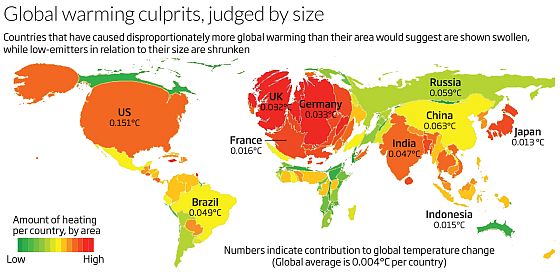
The United States’ disproportionate impact on global warming

global-warming-culprits

New Scientist reports: It’s a chart that no one wants to top, but global warming’s worst offenders, in absolute terms, are the US, China, Russia, Brazil, India, Germany and the UK. New calculations suggest that these nations are responsible for more than 60 per cent of the global warming between 1906 and 2005.

Damon Matthews of Concordia University in Montreal, Canada, and his colleagues calculated national contributions to warming by weighting each type of emission according to the atmospheric lifetime of the temperature change it causes. Using historical data, they included carbon dioxide from burning fossil fuels and changes in land use – such as deforestation. They also accounted for methane, nitrous oxide and sulphate aerosols. These together account for 0.7 °C of the world’s 0.74 °C warming between 1906 and 2005.

The US is the clear leader, responsible for 0.15 °C, or 22 per cent of the 0.7 °C warming. China accounts for 9 per cent, Russia for 8 per cent, Brazil and India 7 per cent each, and Germany and the UK for 5 per cent each. [Continue reading…]

Facebooktwittermail

Americans’ views of other countries

PolicyMic: A new Pew Poll conducted near the end of 2013 asked Americans which countries they liked and which ones they didn’t. While the results are colored by ongoing events across the world, they also reflect Americans’ long-standing attitudes towards some of our neighbors.

At the top of America’s favorite-country list is Canada, at 81% approval, presumably because Canada is about as inoffensive and friendly a country as you can imagine. Americans also remained steadfast friends with Great Britain at 79% approval, and were big fans of Japan at 70% approval despite the two nations’ economic competition.

Other countries didn’t fare so well on the favorability index. Israel remains largely liked by Americans at 61%, but if a Gallup poll from 2012 is to be believed, that’s down from 68% in 2011 and 71% in 2012 (Gallup’s numbers seem higher than Pew’s, so the spread may be less significant). But it’s now more widely disliked than France at 26% and 24% respectively. The ratings have a partisan spin, with 74% of Republicans and just 55% of Democrats approving of Israel this year. [Continue reading…]

None of these numbers are particularly surprising, but for me the most striking one is a 52% unfavorable view of Mexico.

I’m inclined to assume that American views of Mexico and of Mexicans are firmly intertwined and thus that this unfavorable view of America’s southern neighbor is mirrored in views about Mexicans who live this side of the border.

I used to live in California and was at that time a legal alien but like the many illegal aliens in that state, I was more struck by the fact that we were being branded as aliens rather than which might be deemed legal or illegal.

Moreover, since I was not visibly alien (so long as I kept my mouth shut), the greatest insult in being branded this way was clearly being imposed on the people who were visibly indigenous to this continent.

Whether it’s in North America or the Middle East, the settlers have no right to pass judgement on who belongs on these lands.

Facebooktwittermail

Record-high 42% of Americans identify as independents

Gallup: Forty-two percent of Americans, on average, identified as political independents in 2013, the highest Gallup has measured since it began conducting interviews by telephone 25 years ago. Meanwhile, Republican identification fell to 25%, the lowest over that time span. At 31%, Democratic identification is unchanged from the last four years but down from 36% in 2008.

The results are based on more than 18,000 interviews with Americans from 13 separate Gallup multiple-day polls conducted in 2013.

In each of the last three years, at least 40% of Americans have identified as independents. These are also the only years in Gallup’s records that the percentage of independents has reached that level.

Americans’ increasing shift to independent status has come more at the expense of the Republican Party than the Democratic Party. Republican identification peaked at 34% in 2004, the year George W. Bush won a second term in office. Since then, it has fallen nine percentage points, with most of that decline coming during Bush’s troubled second term. When he left office, Republican identification was down to 28%. It has declined or stagnated since then, improving only slightly to 29% in 2010, the year Republicans “shellacked” Democrats in the midterm elections.

Not since 1983, when Gallup was still conducting interviews face to face, has a lower percentage of Americans, 24%, identified as Republicans than is the case now. That year, President Ronald Reagan remained unpopular as the economy struggled to emerge from recession. By the following year, amid an improving economy and re-election for the increasingly popular incumbent president, Republican identification jumped to 30%, a level generally maintained until 2007.

Democratic identification has also declined in recent years, falling five points from its recent high of 36% in 2008, the year President Barack Obama was elected. The current 31% of Americans identifying as Democrats matches the lowest annual average in the last 25 years.

Facebooktwittermail

Naturally, more people see the U.S. as the greatest threat to world peace — and would like to live here

Huffington Post reports: There’s really no way to sugarcoat it: The rest of world believes that the United States is the country that poses the greatest threat to world peace, beating out all challengers by a wide margin.

This is the conclusion of a massive world opinion poll conducted by Win/Gallup International and released at the close of 2013. The poll, which was first conducted in 1977, asked over 66,000 thousand people across 65 countries this year a variety of questions about the world, including which country they would most like to call home, whether or not the world is becoming a generally better place and which country poses the greatest threat to world peace.

The U.S. was voted the biggest threat by far, garnering 24 percent of the vote. Pakistan was a very distant second with 8 percent, followed by China (6 percent) and Afghanistan (5 percent).

Emily Barasch at PolicyMic finds this assessment of the U.S. “startling.” But for people around the world to see the U.S. as a threat to world peace should be about as surprising as hearing that most people understand that a hippopotamus is a dangerous animal. Sure, a hippo might look like a cuddly animal, but anything that weighs 15,000 pounds and can run at 30 mph is potentially lethal.

The United States is the world’s military hippo — with none of the charm. No other country in modern history has spent as much money engaged in warfare or unleashed as much explosive force with its weaponry.

What’s most disturbing is that when Americans were asked which country they think is the greatest threat to peace in the world today, the largest number (20%) named Iran. But not only that — the more educated they were, the more likely they were to name Iran.

Facebooktwittermail

Less than one third of Americans believe in evolution

(Note: Because of the misleading way in which Pew presents its own findings, multiple reports run with a headline similar to this one in USA Today: “One-third of Americans reject human evolution.” That would appear to imply that two-thirds of Americans accept the theory of evolution that provides the foundation for evolutionary biology. However, the rejectionists that the survey identifies are those who believe in the literal truth of Genesis, Adam and Eve etc.. Those who subscribe to Intelligent Design or other non-scientific Creationist evolutionary narratives are viewed by Pew as believing in human evolution.)

I am not a militant atheist. I have little patience for the anti-religion campaigning engaged in by Richard Dawkins, Sam Harris, and their ilk. The idea of trying to rid the world of religion makes no more sense than trying to abolish sport.

Human beings are not governed by reason and people who become enslaved by rationality, inevitably become emotionally malformed. The human capacity to express and experience love is a capacity without which we would cease to be human. As Pascal said: “The heart has its reasons which reason knows not.”

We live in a world constructed by thought and shared ideas and our ability to make sense of life springs in large part from the fact that we continuously filter our experience through stories — stories through which we tell ourselves who we are, where we live, and why we live.

Because of this, I don’t think that science should or can be thrust down anyone’s throat…

And yet to learn that less than a third of Americans believe in evolution is deeply depressing — even if not surprising.

Those who want to put a strong political spin on the results of a new Pew Research Center poll on views about evolution are emphasizing the fact that the greatest concentration of skepticism on evolution is among Republicans while pointing to the figure of 67% of Democrats believing in evolution.

The pollsters, however, fudged the basic question by implying that it’s possible to believe in evolution without accepting its scientific basis.

Pew’s primary interest was in differentiating between those Americans who take Genesis literally and those who don’t. Those Americans who believe “a supreme being guided the evolution of living things for the purpose of creating humans and other life in the form it exists today” are counted as believing in evolution, even though they don’t believe in natural selection.

The fact that Pew chose to slice the question in this way is itself illustrative of the weak influence science has in American culture. “Evolution” is being treated as an object of belief coming in many varieties, rather than as hard, incontrovertibly proven scientific fact.

No one would conduct a poll asking Americans whether they believe the Earth revolves around the Sun and yet when it comes to the subject of evolution, the deference to religious belief is so engrained that evolution is treated as a completely subjective term — evolution, whatever that means to you.

Why does this matter?

The world cannot tackle climate change if America turns its back on science. And yet as a culture, America currently stands somewhere between the sixteenth and the twentieth century. Copernicus was successful but the jury’s still out on Darwin.

If two-thirds of the population is skeptical about evolution, what chance is there of persuading them that climate change is caused by human activity?

It hardly seems coincidental that almost exactly the same number of Americans who believe in human-caused climate change also believe in evolution through natural selection. (I would hazard a guess that it’s not just the same number, but also the same Americans.)

Facebooktwittermail

There’s an alarming number of deaths in U.S. jails

Cara Tabachnick writes: Kyam Livingston begged for help. After seven hours of lying on the floor of a jail cell, the 38-year-old mother of two died, her calls unheeded by the correction officers providing security for the approximately 15 female inmates at Brooklyn “central booking” jail this past summer, according to witnesses and court documents.

Witnesses told the family that she had died in the cell among fetid conditions before she was taken to Brooklyn Hospital Health Center on 21 July 2013 where Livingston was pronounced dead at 6:58am, according to police reports. A witness, registered nurse Aleah Holland, told The Daily News, that police at Central Booking ignored her complaints of stomach pains and diarrhea. She said that when she and other inmates banged on the bars calling for help, officers told them Livingston was an alcoholic.

No one knows what happened, and no one wants to say. The NYPD told the family that she died of a seizure, but her family says she never suffered from seizures. This October the family sued the city, the NYPD, and the Department of Corrections in an effort to force systemic change and “responsibility” for her death.

Livingston was one of the few hundred jail deaths that happen across the country. In 2011, (the latest available numbers) 885 inmates died (pdf) in the custody of local jails, the Justice Department’s Bureau of Justice Statistics reported. Notice I said jails. These are different from prisons. Prisons are for people who have been convicted of a crime and sentenced. There are roughly 3,000 jails nationwide and each facility is set up to process people that have been arrested before they are arraigned or go to trial. Some will serve a misdemeanor sentence (of under a year). The majority will be let go because the charges against them won’t stick as they move through the legal system. Others will remain in jails while waiting to go to trial too poor to make bail – yet to be convicted of anything. Regardless, they will be treated as criminals. [Continue reading…]

Facebooktwittermail

Americans uneasy about surveillance but often use snooping tools

The Washington Post reports: Julie Beliveau’s 16-year-old daughter, a new driver, was heading from her home in Ashburn toward a job interview the other night when she found herself in Leesburg — the wrong direction entirely. Upset and fearing that she’d blow the interview, she called her mother, who instantly launched her tracking program.

“I just opened my phone, and I could see where she was,” Beliveau said. Mother guided daughter to the interview, where she got the job. Score one for surveillance.

Yet Beliveau says she would never use the program just casually to check her daughter’s whereabouts. “That’s going over the line,” she said.

Amid this year’s revelations about the federal government’s vast apparatus for tracking the movements and communications of people worldwide, Americans are uneasy with the extent of surveillance yet often use snooping tools in their own lives, a Washington Post poll has found.

The sweet spot between liberty and security has been hard to pinpoint ever since the Sept. 11, 2001, attacks on New York and Washington. Remarkable advances in information technology have enabled counterterrorism tactics far more sweeping and intrusive — and powerful — than the United States had ever deployed. At the same time, the relationship between consumers and businesses was elementally altered as mobile phones, GPS, Google and Facebook gave corporations a new capacity to track their customers’ behavior. [Continue reading…]

Facebooktwittermail

The United States: #1 in prisoners and military spending — but not #1 in freedom

The Skeptical Libertarian Blog: It is a comforting story people in the United States tell ourselves when we feel our position in the world challenged, or when chest-thumping nationalists mount the platform to brag about “American exceptionalism”, or when we need to excuse our behavior internationally.

But is it true? How does the United States stack up against other countries in terms of human freedom? [Continue reading…]

Facebooktwittermail

Poll: Majority of Americans say Afghan war has not been worth fighting

The Washington Post reports: Americans express near-record discontent and regret over the 13-year war in Afghanistan, during which 2,289 U.S. troops have died and more than 19,000 have been wounded, according to a new Washington Post-ABC News poll.

Fully 66 percent of Americans say the battle, which began with nearly unanimous support, has not been worth fighting. A majority of respondents have doubted the war’s value in each Post-ABC poll since 2010, with current disapproval only one percentage point below July’s record mark. A record 50 percent now “strongly” believe the war is not worth its costs.

Despite the skepticism, a 55 percent majority favors keeping some U.S. forces in Afghanistan for anti-insurgency operations and training, while just over four in 10 prefer removing all troops. [Continue reading…]

Facebooktwittermail

Richard Rodriguez on what the Left has lost by rejecting religion

Salon talks to Richard Rodriguez about his new book, Darling: A Spiritual Autobiography:

Let me read a line to you from late in the book, and if you could explain it a little bit. You say, “After September 11, critical division in America feels and sounds like religious division.” Where are you going with that?

Well, it seems to me that there are two aspects of that. One of them is that I think that increasingly the left has conceded organized religion to the political right. This has been a catastrophe on the left.

I’m old enough to remember the black Civil Rights movement, which was as I understood it a movement of the left and insofar as it was challenging the orthodoxy of conservatives in the American South. White conservatism. And here was a group of protestant ministers leading processions, which were really religious processions through the small towns and the suburbs of the South. We shall overcome. Well, we have forgotten just how disruptive religion can be to the status quo. How challenging it is to the status quo. I also talk about Cesar Chavez, who is, who was embraced by the political left in his time but he was obviously a challenge to organized labor, the teamsters and to large farmers in the central valley.

So somehow we had decided on the left that religion belongs to Fox Television, or it belongs to some kind of right-wing fanaticism in the Middle East and we have given it up, and it has made us a really empty — that is, it has made the left really empty. I’ll point to one easy instance. Fifty years ago, Dr. Martin Luther King, Jr., delivered his “I have a dream” speech at the Lincoln Memorial. And what America heard was really a sermon. It was as though slavery and Jim Crow could not be described as a simple political narrative; racism was a moral offense, not simply an illegality. And with his vision of a time “when all of God’s children” in America would be free, he described the nation within a religious parable of redemption.

Fifty years later, our technocratic, secular president gave a speech at the Lincoln memorial, honoring the memory of the speech Dr. King had given. And nothing President Obama said can we remember these few weeks later; his words were dwarfed by our memory of the soaring religious oratory of fifty years ago. And what’s happened to us — and I would include myself in the cultural left — what has happened to us is we have almost no language to talk about the dream life of America, to talk about the soul of America, to talk about the mystery of being alive at this point in our lives, this point in our national history. That’s what we’ve lost in giving it to Fox Television.

So here’s the flip side of that. You write about the “New Atheism” emerging from England, catching on here. How is it new and why does it seem like a dead end to you?

It seems to me that the New Atheism — particularly its recent gaudy English manifestations — has a distinctly neo-colonial aspect. (As Cary Grant remarked: Americans are suckers for the accent!) On the one hand, the New Atheist, with his plummy Oxbridge tones, tries to convince Americans that God is dead at a time when London is alive with Hinduism and Islam. (The empiric nightmare: The colonials have turned on their masters and transformed the imperial city with their prayers and their growing families, even while Europe disappears into materialistic sterility.) Christopher Hitchens, most notably, before his death titled his atheist handbook as a deliberate affront to Islam: “God Is Not Great.” At the same time, he traveled the airwaves of America urging us to war in Iraq — and to maintain borders that the Foreign Office had drawn in the sand. With his atheism, he became a darling of the left. With his advocacy of the Iraq misadventure, he became a darling of the right. [Continue reading…]

As an Englishman in America who is frequently reminded that Americans are indeed suckers for the accent I retain, let me add a cultural footnote whose validity I can’t document but about which I am nevertheless convinced.

It’s on the origin of American crassness: it comes from England. Bad taste — we invented it.

From the English perspective, civilization has always been something that came from somewhere else.

Facebooktwittermail

Boycott by American academics has a particular sting for Israel

The New York Times reports: An American organization of professors on Monday announced a boycott of Israeli academic institutions to protest Israel’s treatment of Palestinians, signaling that a movement to isolate and pressure Israel that is gaining ground in Europe has begun to make strides in the United States.

Members of the American Studies Association voted by a ratio of more than two to one to endorse the boycott in online balloting that concluded Sunday night, the group said.

With fewer than 5,000 members, the group is not one of the larger scholarly associations. But its vote is a milestone for a Palestinian movement known as B.D.S., for Boycotts, Divestment and Sanctions, which for the past decade had found little traction in the United States. The American Studies Association is the second American academic group to back the boycott, movement organizers say, following the Association for Asian American Studies, which did so in April.

“It’s almost like a family betrayal,” said Manuel Trajtenberg, a leading Israeli scholar. “It’s very grave and very saddening that this happens, particularly so in the U.S.,” he said.

Dr. Trajtenberg, an economics professor at Tel Aviv University, earned his doctorate at Harvard and like many Israeli academics has had frequent sabbaticals at American universities.

Israel has strong trade ties with Western Europe, where the B.D.S. campaign has won some backing for economic measures, a particular concern for Israelis. Last week a Dutch company, Vitens, announced that it would not do business with Israel’s national water company, Mekorot, because of Israel’s policies in the West Bank and East Jerusalem.

Israel recently faced a potential crisis when it seemed its universities and companies would lose out on some $700 million for research from a European Union program after new guidelines prohibited investment in any institutions operating in territory Israel seized in the 1967 war. Israeli academics were reeling at the possibility that they would be punished over government policy toward the Palestinians, until Israeli and European officials struck a deal late last month to allow Israel to participate.

In April, the Teachers’ Union of Ireland endorsed an academic boycott of Israel, and several times in recent years there have been strong efforts within Britain’s largest professors’ group, the University and College Union, to do the same.

Israelis have long seen Europe as more hostile — even anti-Semitic in some pockets — but a slap from the United States has a particular sting. [Continue reading…]

Facebooktwittermail

Chas Freeman on Snowden and snooping

The former U.S. ambassador to Saudi Arabia, Chas W. Freeman, said at MIT on Thursday: We live in what the National Security Agency [NSA] has called “the golden age of SIGINT [signals intelligence].” We might have guessed this. We now know it for a fact because of a spectacular act of civil disobedience by Edward Snowden. His is perhaps the most consequential such act for both our domestic liberties and our foreign relations in the more than two century-long history of our republic.

This past spring, Mr. Snowden decided to place his oath to “preserve, protect and defend the Constitution of the United States” and his allegiance to the Bill of Rights above his contractual obligations to the intelligence community and the government for which it snoops. He blew the whistle on NSA’s ruthless drive for digital omniscience. When he did this, he knew that many of his fellow citizens would impugn his patriotism. He also knew he would be prosecuted for violating the growing maze of legislation that criminalizes revelations about the national security practices of America’s post-9/11 warfare state.

Mr. Snowden does not dispute that he is guilty of legally criminal acts. But he places himself in the long line of Americans convinced, as Martin Luther King put it, that “noncooperation with evil is as much a moral obligation as is cooperation with good.” As someone long in service to our country, I am upset by such defiance of authority. As an American, I am not.

Like Henry David Thoreau and many others in protest movements in our country over the past century and a half, Mr. Snowden deliberately broke the law to bring to public attention government behavior he considered at odds with the U.S. Constitution, American values, and the rule of law. One point he wanted to make was that we Americans now live under a government that precludes legal or political challenges to its own increasingly deviant behavior. Our government has criminalized the release of information exposing such behavior or revealing the policies that authorize it. The only way to challenge its policies and activities is to break the law by exposing them. [Continue reading…]

Facebooktwittermail

The pharmaceutical industry and the fight against gun control

The Washington Post reports: One year ago, 20 children and six staff members at Sandy Hook Elementary School in Newtown, Conn., were gunned down by Adam Lanza. In the aftermath, there was hope among gun-control advocates that the event would spark pro-control reform. They’ve set their eyes on on a few states, but over the past year, more of them have loosened gun restrictions than tightened them. While gun control may face an uphill battle, though, a related policy area has seen change in the wake of the tragedy.

“We think that Sandy Hook opened up the eyes of governors and state legislators and policymakers around the country that mental health has been cut enough,” Andrew Sperling, the director of legislative advocacy at the National Alliance on Mental Illness, told Post TV’s “In Play.”

Some 36 states increased their mental health-care budgets in 2013, according to NAMI. In Colorado, where James Holmes opened fire on a crowded movie theater a little over a year ago, the mental-health budget was increased by 13.5 percent.

State-level efforts have focused on five broad categories — the mental-health system, crisis and inpatient care, community mental health, criminal justice and mental health, and civil rights and stigma reduction — NAMI wrote in a fall report.

The Post fails to note that the innocuously named NAMI, receives most of its funding from the pharmaceutical industry.

It’s not that pharma has a natural alignment with the opponents of gun control, yet what the NRA and its supporters have succeeded in doing in the wake of Newtown is to shift the debate away from gun control onto mental health — a shift which clearly serves the interests of the drug industry.

27% of all mental health services in the United States come through Medicaid and Medicaid is a cash cow for the pharmaceutical industry.

In the 1980s and ’90s, the psychiatric system went through a major transformation as psychiatric medication replaced psychotherapy as the standard of care. This broadened the scope of psychiatry in two ways. With patient care being reduced to medication management, doctors could see more patients. And with a massive growth in the number of Americans receiving disability for mental illness, the market for psychiatric medication has been booming, thanks in part to Medicaid funding.

The pharmaceutical industry has only one interest: selling drugs. It can reasonably be described as the most successful form of organized crime in human history. When companies repeatedly pay billions of dollars in settlements, it is clear that they regard such settlements as simply a component in the operating costs.

That the drug manufacturers are really nothing more than sophisticated drug pushers can be illustrated in numerous ways — consider for instance the way in which attention deficit disorder has become such a profitable diagnosis.

After more than 50 years leading the fight to legitimize attention deficit hyperactivity disorder, Keith Conners could be celebrating.

Severely hyperactive and impulsive children, once shunned as bad seeds, are now recognized as having a real neurological problem. Doctors and parents have largely accepted drugs like Adderall and Concerta to temper the traits of classic A.D.H.D., helping youngsters succeed in school and beyond.

But Dr. Conners did not feel triumphant this fall as he addressed a group of fellow A.D.H.D. specialists in Washington. He noted that recent data from the Centers for Disease Control and Prevention show that the diagnosis had been made in 15 percent of high school-age children, and that the number of children on medication for the disorder had soared to 3.5 million from 600,000 in 1990. He questioned the rising rates of diagnosis and called them “a national disaster of dangerous proportions.”

“The numbers make it look like an epidemic. Well, it’s not. It’s preposterous,” Dr. Conners, a psychologist and professor emeritus at Duke University, said in a subsequent interview. “This is a concoction to justify the giving out of medication at unprecedented and unjustifiable levels.”

The rise of A.D.H.D. diagnoses and prescriptions for stimulants over the years coincided with a remarkably successful two-decade campaign by pharmaceutical companies to publicize the syndrome and promote the pills to doctors, educators and parents. With the children’s market booming, the industry is now employing similar marketing techniques as it focuses on adult A.D.H.D., which could become even more profitable.

None of the above considerations should be taken to imply that mental health services are not indeed neglected in this country — simply that drugging and forced treatment are not the answer.

As for the issue of the epidemic of school shootings, ironically this has mostly served as a distraction from the much larger issue of gun violence.

Following the Gabrielle Giffords shooting in 2011, Emily Badger wrote:

Today, gun laws that target the mentally ill — alongside convicted felons — are founded on a series of assumptions: that people with mental illness are particularly dangerous, that legislation restricting their gun ownership will lead to decreased violence, and that this strategy will make a difference in the overall safety of society.

Such laws also assume that the background-check system is an effective means in the first place of keeping guns out of the hands of any type of dangerous person.

“In a society like ours where firearms are so prevalent — there are more handguns than there are people in the U.S. today — that seems like a highly dubious proposition,” [the director of the Division of Law, Ethics, and Psychiatry at Columbia University, Paul] Appelbaum said. “People who really want guns are arguably likely to be able to get them whether they are covered by this statute or not. It’s an empirical question as to whether this actually works in keeping guns out of anybody’s hands, or at least very many people’s hands.”

The best data Appelbaum has found, which dates to the late 1980s and early ’90s, also suggests that, at most, 3-5 percent of violent acts in the U.S. are attributable to serious mental illnesses as a risk factor — and most of those acts don’t involve guns. More recent studies in England and Sweden suggest that number for violent acts may be as low as 1-2 percent.

“To say that another way, if no one with a mental illness committed a violent act, we would still have 95-97 percent of the baseline level of violence,” Appelbaum said. “However you cut it, it looks as though we’re just talking about the tip of the iceberg in terms of problems of violence in our society, which raises the quite reasonable question as to why we’re so focused on the mentally ill?”

Not only is that focus a distraction, he adds, but it comes with the significant downside of further stigmatizing people with mental illness and confusing the public as to the notion that mental illness is a significant cause of violence in this country.

Facebooktwittermail

America outside the world

In September 2001, 80% of Americans thought that protecting the U.S. from terrorist attacks should be the nation’s top foreign policy priority — and that was before the 9/11 attacks.

The culture of fear that the Bush administration promoted and exploited, engaged tendencies that permeate this nation’s history and wasn’t simply the product of opportunistic manipulation of a traumatic event.

Al Qaeda had tapped deep into the American psyche dramatically confirming a sense that the United States and the world somehow stand apart. Paradoxically, the attacks both challenged and affirmed the idea of a homeland providing safety, divided from a world that always harbors danger.

Twelve years after 9/11, protecting the U.S. from terrorism remains for 83% of Americans the number one foreign policy goal for this nation. In contrast, a mere 37% think that tackling climate change should be the top priority, down from 44% in 2001 and 50% in 1997.

And even as President Obama’s overall job approval ratings continue to slide, his rating for handling the threat of terrorism is higher than on any other issue of foreign policy.

51% of Americans think this president is “not tough enough,” while 50% say that his use of drones makes them feel safer, in contrast to a mere 14% who say that the use of drones makes this country less safe.

Somehow the world appears to only exist beyond these shores and largely outside American awareness. And to the extent that it impinges on our awareness it is invariably presented as problematic.

Pew Research reports:

For the first time since 1964, more than half (52%) agree that the U.S. should “mind its own business internationally and let other countries get along the best they can on their own;” 38% disagree. Two years ago, the public was nearly evenly divided (46% agreed and 50% disagreed in May 2011) and, as recently as 2006, more disagreed than agreed that the U.S. should mind its own business internationally (53% vs. 42%).

Similarly, 80% agree with the statement, “We should not think so much in international terms but concentrate more on our own national problems and building up our strength and prosperity here at home,” up slightly from 76% in 2011. The level of support for this statement, which has been tested since 1964, now rivals the previous high set in the early 1990s.

Views on global engagement do not vary much across party lines. Majorities or pluralities of Republicans (52%), Democrats (46%) and independents (55%) think the U.S. does too much to try to help solve world problems, and agree that the U.S. should mind its own business internationally (53%, 46% and 55%, respectively). And close to eight-in-ten among each group agree that the U.S. should concentrate more on our own national problems, rather than thinking so much in international terms (82% of Republicans, 76% of Democrats and 79% of independents).

No doubt American attitudes towards global engagement are shaped predominantly by two factors:

1. A realistic assessment that the results from a decade of war show that U.S. military engagement overseas has accomplished next to nothing positive.

2. A widespread yet baseless view that the United States government disperses foreign aid more generously than any other nation. According to OECD figures for 2012, development aid from the U.S. as a percentage of GDP places the U.S. behind eighteen other countries. In absolute terms, $30.46 billion aid from the U.S. (population 317 million) compares with $43.36 billion from the five largest European countries, the UK, France, Germany, Italy, and Spain (combined population 315 million).

But aside from these factors, there is an underlying mindset which pollsters cannot attempt to quantify and which many Americans would struggle to articulate or perhaps even recognize.

It is this spirit through which America sets itself apart. This is the shadow of American exceptionalism; a sense of insecurity that masks itself with an attitude of superiority. For within America’s many self-aggrandizing postures is a core of self-doubt.

How can America be so much greater than a world about which most Americans know so little?

Facebooktwittermail