Category Archives: News

‘Never Trump’ Republicans join call for select committee to investigate Russia and Trump

Josh Rogin writes: Democrats in Congress have long argued that the ongoing intelligence committee investigations into Russia’s interference in the presidential election and the Trump campaign’s ties to the Kremlin are unlikely to get to the bottom of the issue. Now a group of “Never Trump” Republicans are planning to pressure GOP leaders to establish a bipartisan select committee to take over the inquiries and settle the matter once and for all.

Stand Up Republic, a nonprofit organization led by former independent presidential candidate Evan McMullin and his running mate, Mindy Finn, is launching a public campaign aimed at building support among Republicans for consolidating the various congressional Russia-related investigations into one empowered and fully funded select committee. The organization’s ad, which goes live Tuesday with a six-figure television ad buy, makes the case that the Russia issue is too important not to investigate fully.

“Trump’s Russia crisis. Secret contacts. Conflicting stories. Mounting signs of hidden ties and shady deals. Fear our president is compromised,” says the narrator. “The values of liberty, justice and honor shaped America. Generations fought for freedom, and presidents of both parties stood against foreign tyrants like Vladimir Putin. Why won’t Donald Trump? Tell Congress to name a bipartisan select committee to get the truth?” [Continue reading…]


Facebooktwittermail

How the Netherlands made Geert Wilders possible

The Atlantic reports: In the 17th century, Dutch settlers flocked to the southern half of what is now Manhattan to establish New Amsterdam, a fur-trading post that would welcome Lutherans and Catholics from Europe; Anglicans, Puritans, and Quakers from New England; and Sephardic Jews who were, at the time, discouraged from settling in America’s other nascent regions. Though its English conquerors would rename the city New York, the values of diversity and tolerance that the Dutch introduced would remain the region’s hallmarks for centuries to come.

In the modern-day Netherlands, however, the Dutch Republic’s founding pledge that “everyone shall remain free in religion” will soon collide with the ambitions of one of the country’s most popular politicians.

“Islam and freedom are not compatible,” claims Geert Wilders, the Party for Freedom (PVV) leader who campaigns on banning the Quran, closing Dutch mosques, and ending immigration from predominantly Muslim countries. “Stop Islam,” the phrase that sits atop Wilders’s Twitter page, aptly summarizes his party’s platform. In December, Dutch courts found Wilders guilty of carrying his rhetoric too far, convicting him of discriminatory speech for rallying supporters in an anti-Moroccan call-and-response. Nonetheless, Wilders is a leading contender to receive the plurality of votes in the country’s parliamentary elections on March 15.

The nation’s peculiar path from “live and let live” to “Make the Netherlands Ours Again” (as Wilders recently said) has as its guideposts a changing definition of tolerance, some instances of political opportunism—and a pair of grisly assassinations.

From the mix of faith groups that inhabited New Amsterdam to the peaceful coexistence of Protestants, Catholics, and socialists throughout the Netherlands in the 20th century, the Dutch brand of multiculturalism has often been more “salad bowl” than “melting pot.” Each sect of society had its own schools, media outlets, and social groups; tolerance was the act of respecting those boundaries.

“Historically, Dutch tolerance has been more of a pragmatic strategy,” said Jan Rath, a professor of urban sociology at the University of Amsterdam. “Tolerance has been a way to contain oppositions or complications.” [Continue reading…]

Facebooktwittermail

Wilders, Russia and Twitter bots: How social media is serving Dutch populism

Financial Times reports: Follower numbers are a commonly recognised indicator of social media influence. Snapshot counts of Twitter and Facebook followers reveal that, in contrast to most other party leaders, Mr Wilders’ personal social media following dwarfs that of his party’s accounts by a ratio of 330:1 on Twitter and 133:1 on Facebook. By comparison, sitting prime minister Mark Rutte’s followers are outnumbered by those of his party, VVD, by 1.5:1 on Twitter and 3.4:1 on Facebook. 

However, an examination of the rate of growth of Dutch party leaders’ Twitter followings reveals Mr Wilders’ to be growing comparatively slowly — which is to be expected given that hisis the largest among party leaders’ followings. More intriguing are the bumps in the growth rate of the Wilders following, several of which coincide with specific news events. In particular, Mr Wilders’ conviction for race-related discrimination offences on December 9 last year and the terrorist attack in which a truck was driven into a Berlin crowd on December 19 boosted Mr Wilders’ following, which may suggest a reactive component to the motivations of people following Mr Wilders on Twitter.

The accusations of election interference in France made by the campaign of Mr Macron prompted a denial by RT, which said in a statement that it “adamantly rejects any and all claims that it has any part in spreading fake news in general and in relation to Mr Macron and the upcoming French election in particular.” The US Office of the Director of National Intelligence, however, asserted in a January report that RT and Sputnik functioned as part of a Russian “state-run propaganda machine” that was deployed in an attempt to influence the outcome of the US election.

FT Data calculated the frequencies with which a random sample of 100,000 of Mr Wilders’ Twitter followers mentioned the accounts of RT and Sputnik (@RT_com and @SputnikInt), along with those of the top five Dutch news outlets over a six-month period. We compared these to a sample of the same size taken from followers of the office of the Dutch prime minister (@MinPres), a non-partisan governmental account.

Although Mr Wilders himself did not disproportionately share content from either outlet, his followers were 12 times more likely to mention Sputnik and almost eight times more likely to mention RT than followers of Mr Rutte, prime minister. Notably, Mr Wilders’ followers mentioned RT more frequently than they did the Dutch national broadcaster NOS (@NOS). [Continue reading…]

Facebooktwittermail

U.S. to deploy missile-capable drones across border from North Korea

The Guardian reports: The US has declared it will permanently station missile-capable drones in South Korea in the latest round of military escalation in north-eastern Asia.

The drone deployment comes a week after North Korea carried out a test salvo of four missiles that landed off the coast of Japan, and a day before the US secretary of state, Rex Tillerson, embarks on a tour of a region widely regarded as the most dangerous corner of the world.

The US military in South Korea took the unusual step of publicly announcing the deployment of a company of Grey Eagle drones, which it said would add “significant intelligence, surveillance and reconnaissance capability” for American and South Korean forces.

Grey Eagles are designed to carry Hellfire missiles and together with the deployment of Thaad anti-ballistic missile defences in South Korea they represent a significant build-up of US military muscle in response to an accelerated programme of missile and nuclear testing by the North Korean regime. [Continue reading…]

Facebooktwittermail

Russian-backed Syria talks derailed as rebels boycott

Reuters reports: Russian-led peace talks on Syria were derailed on Tuesday as rebels backed by Turkey boycotted a third round of meetings in Kazakhstan and the Kremlin indicated there were international divisions over the process.

Russia, Syrian President Bashar al-Assad’s most powerful ally, said the rebels’ reasons for staying away were unconvincing and their decision came as a surprise. Describing the rebels as Turkish proxies, the Syrian government envoy said Ankara had broken “its commitments” to the Astana process.

The rebels said on Tuesday they would not attend the talks, scheduled for Tuesday and Wednesday, because of what they called Russia’s unwillingness to end air strikes on rebel-held areas and its failure to get the Syrian army and Iranian-backed militia to abide by a ceasefire. [Continue reading…]

Facebooktwittermail

Russian whistleblower might have been poisoned, court hears

The Guardian reports: A Russian whistleblower could have been poisoned with sorrel soup, but key evidence about his last meal was “flushed away” hours after his death, a court heard. Alexander Perepilichnyy, 44, died after collapsing while running near his home in Weybridge, Surrey, in November 2012.

The businessman’s death was originally attributed to natural causes, but traces of a chemical that can be found in the poisonous plant gelsemium were later found in his stomach. Fiona Barton QC, for Surrey police, said no “identifiable toxin” had been found in the body.

A pre-inquest hearing on Monday heard that, before his death, Perepilichnyy was helping a specialist investment firm uncover a $230m Russian money-laundering operation. Hermitage Capital Management previously claimed that Perepilichnyy could have been deliberately killed for helping it uncover the scam involving Russian officials. [Continue reading…]

Facebooktwittermail

Al Qaeda now leads the fight against Assad

Shiraz Maher writes: On 9 February, a grey-bearded and balding Syrian rebel commander wearing military dress appeared in an internet video calling for greater unity among the forces opposing President Bashar al-Assad. This was unremarkable. Syria’s rebel groups frequently issue unity statements, merge units and create umbrella groups – many of which, like the fruit of the medlar tree, turn rotten before they turn ripe.

Yet the message from Hashem al-Sheikh – a native of Aleppo imprisoned by Assad in 2005 for his jihadi beliefs and then released along with other Islamist prisoners in 2011 in an attempt to poison the nascent uprising against the regime – was hugely important in the context of the Syrian Civil War: it signalled the potential subsuming of the entire Syrian opposition to radical and reactionary forces, and to al-Qaeda in particular.

In the video, Hashem al-Sheikh announ­ced the creation of a powerful, extremist-dominated entity known as Hayat Tahrir al-Sham (HTS), or the “Committee for the Liberation of the Levant”.

One of the main groups that joined the new committee is Nur al-Din al-Zenki, a corrupt and brutal Islamist movement that was once backed by the CIA as a “vetted organisation”, though this designation was later revoked. In July last year, five months before Aleppo fell to Assad’s forces, the group’s members were filmed beheading Abdullah Tayseer in the eastern part of the city. Tayseer was a 13-year-old boy whom they accused of fighting for the regime.

Far more significant was the folding into HTS of Jabhat Fateh al-Sham (JFS), which until July was known as Jabhat al-Nusrah – and which represented al-Qaeda on the ground in Syria. JFS, comprised mainly of local fighters, had earned a degree of popular support among civilians because of its fighters’ valour and lack of corruption. The rebranding was an attempt by its leaders to recast it as a broader part of the overall uprising, and to capitalise on ordinary Syrians’ hatred of Islamic State (IS), which is widely seen as having usurped the revolution and diverted its aims.

Consequently, al-Qaeda has pursued an audacious line of messaging that seeks to portray the group in Syria as a responsible actor that follows a “middle path” between acquiescence and extremism. The corollary is clear: that it is both authentic and organic. “JFS is not a fringe group that exists on another planet,” wrote a spokesman, Mos­tafa Mahamed, shortly after it rebranded in 2016. “It is deeply embedded in society, made up from the average Syrian people.” [Continue reading…]

Facebooktwittermail

U.S. troop presence in Syria now at its highest. But how long will they remain for and why?

Time reports: The Trump Administration is intensifying America’s involvement in the ground war in Syria, having announced on March 9 that it is sending 400 more troops to join the fight against ISIS there.

The new deployment of Army Rangers and a U.S. Marine artillery unit raises fresh questions about the scope and timeline of the U.S. mission in Syria, where the number of American troops is now approaching a high of around a thousand (Washington has not disclosed an exact number). The U.S. is also sending another 2,500 troops to a staging base in Kuwait, awaiting possible deployment to Iraq or Syria.

Recent comments from U.S. officials suggest that the military is contemplating a deployment in Syria that extends far beyond the defeat of ISIS as a conventional armed force. In his testimony to the Senate Armed Services Committee on March 9, Army General Joseph Votel, who leads the U.S. Central Command, said additional forces may be needed in the future to help with “stability and other aspects of the operations.” The Pentagon is also considering lifting a formal cap of roughly 500 U.S. troops permitted on the ground in Syria, a limitation imposed by former President Barack Obama, according to the Washington Post.

The near doubling of the U.S. military deployment in eastern Syria, along with Votel’s comments, suggest a shift toward a more open-ended commitment of forces to Syria, echoing the prolonged U.S. military presence in Iraq or Afghanistan. But the escalation is also prompting calls to define the objectives of the mission over the long term in order to avoid a costly occupation both in terms of lives and resources. [Continue reading…]

Facebooktwittermail

The spat between Turkey and the Netherlands is all about winning votes

Ishaan Tharoor writes: The escalating crisis between Turkey and the Netherlands is a startling example of how this year’s crucial election campaigns can flare into international incidents.

The Dutch go to the polls this Wednesday for a parliamentary election seen as a bellwether for Europe’s political future, and all eyes are focused on far-right, Euroskeptic, anti-Islam populist Geert Wilders. Meanwhile, Turkey will hold a referendum next month on constitutional revisions that would scrap the country’s parliamentary system in favor of an executive presidency under the powerful President Recep Tayyip Erdogan. In their electoral bids, Erdogan and Wilders have found useful bogeymen in one another’s nations.

“The explanation for the Dutch-Turkish ‘crisis’ this weekend is pretty straightforward,” wrote Dutch political scientist Cas Mudde in a message to Today’s WorldView. “Both countries are currently engulfed in electoral campaigns that are dominated by authoritarian nativism.” [Continue reading…]

Facebooktwittermail

Trump administration looking for ways to lift restrictions on killing civilians

The New York Times reports: The Trump administration is exploring how to dismantle or bypass Obama-era constraints intended to prevent civilian deaths from drone attacks, commando raids and other counterterrorism missions outside conventional war zones like Afghanistan and Iraq, according to officials familiar with internal deliberations.

Already, President Trump has granted a Pentagon request to declare parts of three provinces of Yemen to be an “area of active hostilities” where looser battlefield rules apply. That opened the door to a Special Operations raid in late January in which several civilians were killed, as well as to the largest-ever series of American airstrikes targeting Yemen-based Qaeda militants, starting nearly two weeks ago, the officials said.

Mr. Trump is also expected to sign off soon on a similar Pentagon proposal to designate parts of Somalia to be another such battlefield-style zone for 180 days, removing constraints on airstrikes and raids targeting people suspected of being militants with the Qaeda-linked group the Shabab, they said.

Inside the White House, the temporary suspension of the limits for parts of Yemen and Somalia is seen as a test run while the government considers whether to more broadly rescind or relax the Obama-era rules, said the officials, who described the internal deliberations on the condition of anonymity. [Continue reading…]

Facebooktwittermail

Preet Bharara shunned politics. His end was tinged by them

The New York Times reports: Ten days into his tenure as United States attorney in Manhattan, Preet Bharara saw his political and prosecutorial worlds collide.

He convened a meeting to discuss a sensitive investigation of a Democratic donor with ties to Senator Chuck Schumer of New York. Mr. Bharara had been Mr. Schumer’s chief counsel, and Mr. Schumer had recommended Mr. Bharara for the prosecutorial post.

At the meeting, Mr. Bharara asked his prosecutors if there was enough evidence to make a case against the donor, Hassan Nemazee. One of the prosecutors, Daniel W. Levy, who is now in private practice, would recall years later that he had told Mr. Bharara that there had been a wide-reaching bank fraud.

“Then take him,” Mr. Bharara said.

That case — one of his very first as the top federal prosecutor in Manhattan — foreshadowed a theme that Mr. Bharara harped on throughout his tenure pursuing a host of public corruption, terrorism, civil rights and Wall Street cases: Politics and prosecution do not mix. [Continue reading…]

Facebooktwittermail

Congressman Steve King endorses ‘Dutch Trump,’ Geert Wilders, in battle over ‘civilization’

The Daily Beast reports: The Republican Party has long been a comfortable home for anti-Europeanism, from the “America First” opponents of U.S. participation in World War II to the “let them eat Freedom Fries” movement responsible for renaming French fries in congressional cafeterias during the lead-up to the Iraq War in 2003.

But as far-right political parties gain power and prominence on the Continent, many members of the Grand Old Party are cozying up to European politicos with unprecedented enthusiasm — well, nearly unprecedented.

Among the most fawning of the newly Europositive wing of the Republican party: Rep. Steve King (R-IA), a nativist hawk from the heartland with a long and unapologetic history of making incendiary statements regarding immigrants, Islam, and racial “sub-groups.” On Sunday, however, King surprised even his sharpest critics by tweeting what amounts to an endorsement of Dutch parliamentarian Geert Wilders, founder and leader of the right-wing Party for Freedom who is days away from his potential election as prime minister of the Netherlands. [Continue reading…]


Facebooktwittermail

Why Geert Wilders is unlikely to become the Netherlands’ next prime minister

Dina Pardijs writes: In the Netherlands, the system of direct representation and the increasingly split vote means that election night is only the start of the process of forming a government. A record number of parties have signed up for the elections this year, revealing an epidemic of identity politics: voters can choose between the entrepreneur party, the 50 Plus party, the non-voter party, a party for minorities, and three different parties from the group that launched the Ukraine referendum. Forming a coalition government is the norm in the Netherlands, but in most years these consist of two or three parties. The way the polls look at the moment, a government will likely have to comprise four or even five parties.

The formation is like the Dutch version of a cricket world cup: a drawn-out, mildly suspenseful quadrennial event, that you can tune in and out of without missing too much.

Party leaders start discussing coalitions, divide up ministries and policy points, and give cryptic messages to the journalists enjoying the sunshine on the Binnenhof. In 2010, negotiators went back and forth over five possible coalitions across the political spectrum through June, July, August, and September. All of which means that attaining power in the Dutch system requires a huge amount of compromise.

If the PVV wins the most votes, Geert Wilders would start off this process. But it seems highly unlikely that he will be able to form a government. For one, compromise is not his forte. Not only that, but most of the other major parties are staunchly opposed to entering a coalition with the PVV. One reason the 2010 formation process took 127 days was that the supporters of some parties protested their leaders even being in a negotiating room with the PVV. Party leaders have likely learned from this experience. They will also have learned that Wilders is not a reliable partner. In 2010 he agreed to give electoral support to a minority coalition, only for the government to collapse less than two years later when Wilders withdrew his support. [Continue reading…]

Facebooktwittermail

Trump lets key offices gather dust amid ‘slowest transition in decades’

The New York Times reports: At the State Department, the normally pulsating hub of executive offices is hushed and virtually empty. At the Pentagon, military missions in some of the world’s most troubled places are being run by a defense secretary who has none of his top team in place. And at departments like Treasury, Commerce and Health and Human Services, many senior posts remain vacant even as the agencies have been handed enormous tasks like remaking the nation’s health insurance system.

From the moment he was sworn in, President Trump faced a personnel crisis, starting virtually from scratch in lining up senior leaders for his administration. Seven weeks into the job, he is still hobbled by the slow start, months behind where experts in both parties, even some inside his administration, say he should be.

The lag has left critical power centers in his government devoid of leadership as he struggles to advance policy priorities on issues like health care, taxes, trade and environmental regulation. Many federal agencies and offices are in states of suspended animation, their career civil servants answering to temporary bosses whose influence and staying power are unclear, and who are sometimes awaiting policy direction from appointees whose arrival may be weeks or months away.

“There’s no question this is the slowest transition in decades,” said R. Nicholas Burns, a former State Department official who served under presidents of both parties and has been involved in transitions since 1988. “It is a very, very big mistake. The world continues — it doesn’t respect transitions.” [Continue reading…]

Facebooktwittermail

Authorities question CIA contractors in connection with WikiLeaks dump

The Wall Street Journal reports: Investigators probing who may have provided WikiLeaks with classified information about the Central Intelligence Agency’s purported computer-hacking techniques are zeroing in on a small number of contractors who have worked for the agency and may have been disgruntled over recent job losses, according to people familiar with the investigation.

Authorities on Thursday questioned a handful of contractors working in at least two locations in the Virginia suburbs of Washington, D.C., these people said. Law-enforcement officials said no arrests had been made, but one person familiar with the investigation said it was “rapidly unfolding.”

This person added that a digital trail has pointed authorities, at least initially, to a team of software developers working with the CIA’s Engineering Development Group. The group designs tools that, according to the documents released this week by WikiLeaks, the CIA uses to break into smartphones, personal computers and televisions connected to the internet. The more than 8,000 pages of documents that WikiLeaks disclosed appear to have been taken last December from a server that the Engineering Development Group uses, this person said, and that “only a few contractors would have access to.”

More than a dozen companies work for the CIA on hacking projects, the bulk of them at a facility near Chantilly, Va. It wasn’t clear which companies the people who were questioned worked for. In recent months, there has been talk of “bad blood” in the small world of CIA contractors who are vital to the agency’s hacking projects, the people familiar with the probe said. One group of contractors recently had been working for the CIA overseas and expected to be given new jobs with the agency in the U.S., but their positions were later eliminated, one person said. [Continue reading…]

Facebooktwittermail

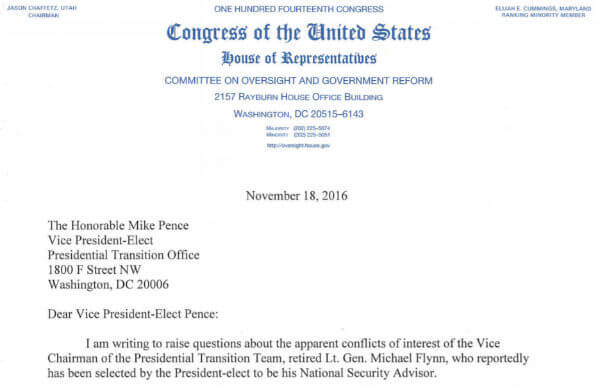
Mike Flynn and Trump administration defined by conflicts of interest

The Washington Post reports: Attorneys for Michael Flynn, President Trump’s former national security adviser, informed the incoming White House legal counsel during the transition that Flynn might need to register with the government as a foreign agent — a phone call that raised no alarms within Trump’s team, despite the unusual circumstance of having a top national security post filled by someone whose work may have benefited a foreign government.

The firm Flynn headed, Flynn Intel Group, was hired last year when Flynn was an adviser to the Trump campaign by the Netherlands-based firm ­Inovo BV, which is owned by Turkish businessman Ekim Alptekin. Alptekin has close ties to Turkish President Recep Tay­yip Erdogan. [Continue reading…]

The Daily Caller reports: While serving as a top adviser on Donald Trump’s presidential campaign, Michael Flynn signed a contract in which he agreed to utilize an “investigative laboratory” made up of elite former intelligence officials, including a former CIA director, to conduct research and make “criminal referrals” on behalf of a Dutch shell company linked to the Turkish government, federal records show.

But Flynn appears to have over-promised on the contract, which was signed on Aug. 9 between his firm, Flynn Intel Group, and Inovo BV, the shell company.

R. James Woolsey, the former CIA director identified by his title in the contract as a member of Flynn Intel’s “investigative laboratory,” says he was not aware of and never agreed to perform any of the work laid out in the contract.

The investigative work promised by Flynn Intel was most likely focused on Fethullah Gulen, a Muslim cleric exiled in the U.S. whose extradition is being sought by the Turkish government. [Continue reading…]

Facebooktwittermail

The Dutch far right’s election donors are almost exclusively American

Quartz reports: While Europe has been busy fretting about Russian meddling in its politics, a few Americans have been quietly doing their part to boost the continent’s far right.

Wealthy American conservatives have poured large sums into the electoral campaign of far-right leader Geert Wilders of the Netherlands’ Dutch Freedom Party, in support of his anti-Islam, anti-EU views.

Three American donors gave €141,668 ($150,430) to Dutch political parties between 2015 and 2017, according to campaign finance documents released this week by the Dutch interior ministry. Two of these donors funded the far-right Dutch Freedom Party. [Continue reading…]

Facebooktwittermail