Category Archives: News

Why Putin loves Trump

Ivan Krastev writes: “Vladimir Vladimirovich, is war coming?”

The question is asked in the first frame of “Myroporyadok” (“World Order”), a manifesto-style documentary aired in the last days of December on Russian state television. And in the following two-plus hours, President Vladimir V. Putin, aided by diplomats, policy analysts, conspiracy theorists and retired foreign statesmen, attempts to provide an answer.

Though the Russian leader resists sounding the alarm, the audience is nonetheless convinced that if nothing changes in the coming months, the Big War could be imminent. And the Kremlin isn’t doing much to dissuade them: Days after the film’s airing, its new national security strategy, which declares NATO and the United States as fundamental threats to Russia’s future, was unveiled.

“Myroporyadok” is a powerful expression of the Kremlin’s present state of mind. It views the world as a place on the edge of collapse, chaotic and dangerous, where international institutions are ineffective, held hostage to the West’s ambitions and delusions. Nuclear weapons represent the sole guarantee of a country’s sovereignty, and sovereignty is demonstrated by a willingness and capacity to resist Washington’s hegemonic agenda. [Continue reading…]

Facebooktwittermail

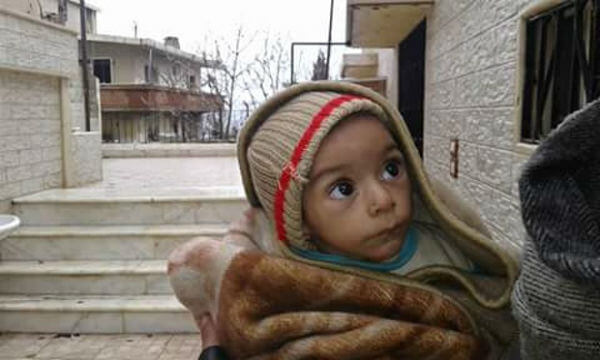
UN war crimes investigators gathering testimony from starving Syrian town

starving-child-madaya

Reuters reports: Residents of a besieged Syrian town have told U.N. investigators how the weakest in their midst, deprived of food and medicines in violation of international law, are suffering starvation and death, the top U.N. war crimes investigator told Reuters on Tuesday.

An aid convoy on Monday brought the first food and medical relief for three months to the western town of Madaya, where 40,000 people are trapped by encircling government forces.

Another United Nations official who oversaw the aid delivery described on Tuesday how he saw malnourished residents, particularly children, some of whom were little more than skeletons and barely moving.

The U.N. commission of inquiry documenting war crimes in Syria has been in direct contact with residents inside Madaya, the commission’s chairman Paulo Pinheiro said in an emailed reply to Reuters questions.

“They have provided detailed information on shortages of food, water, qualified physicians, and medicine. This has led to acute malnutrition and deaths among vulnerable groups in the town.” he said in the email sent from his native Brazil.

The U.N. inquiry, composed of independent experts, has long denounced use of starvation by both sides in the Syrian conflict as a weapon of war, and has a confidential list of suspected war criminals and units from all sides which is kept in a U.N. safe in Geneva. [Continue reading…]

Facebooktwittermail

U.S. taxpayer due to subsidize Koch-controlled coal mine

Reuters reports: The Obama administration is set to refund as much as $14 million in royalties to a coal company run by billionaire investor William Koch that says it is entitled to the money since the now-shut mine on federal land was costly to operate.

The Interior Department recommended the payout in a December letter to Colorado Governor John Hickenlooper, seen by Reuters, that gives the state executive a chance to object.

The subsidy, part of a decades-old program to promote coal production on public lands, is now under scrutiny since President Barack Obama has vowed to curb the nation’s reliance on fossil fuels, which contribute to global warming. [Continue reading…]

Facebooktwittermail

An attack on democracy? Worries over Poland mount in Brussels and Berlin

Der Spiegel reports: No, Frans Timmermans says, unfortunately he still hasn’t received an answer. The deputy head of the European Commission has written to the government in Warsaw twice in recent weeks to express his concern over the rule of law in Poland. Instead of the requested letter, all he got was gloating on the part of new Polish Foreign Minister Witold Waszcykowski. Any EU official “who came to office via political connections” is “not a legitimate partner” for a government elected by the people, Waszcykowski scoffed.

Timmermans these days is having to exercise his utmost diplomatic skill in order to avoid an escalation of tensions. When, during a visit to Amsterdam on Thursday, Timmermans was asked about the Polish foreign minister’s jibe, he could have struck back. But there is already enough tension, so he chose to take a different tack, instead praising the transformation of Eastern European countries from socialist dictatorships to free societies. But, he added, true democracies include two important elements: the protection of human rights and adherence to the rule of law.

The fact that Timmermans had to utter something that obvious says a lot about the current state of the European Union — and developments in Poland. In less than two months, the country’s new nationalist-conservative government has succeeded in disempowering the constitutional court, passing a law establishing government control over public broadcasting and installing party-aligned political appointees at the head of its intelligence services. “We want to cure our country of a few illnesses,” Foreign Minister Waszcykowski told Germany’s tabloid Bild earlier this month.

It’s a choice of words most often associated with autocrats and has alarmed the European Commission. On Wednesday, the EU executive is expected to discuss whether or not it will open the so-called “rule of law mechanism.” Should it do so, it would mark the first time a member state has been subjected to that level of scrutiny for violating the fundamental values of the European Union. [Continue reading…]

Facebooktwittermail

What ISIS speaking in an English accent tells us about the group’s strategy

By Alan Greene, Durham University

A new year brings with it the feeling of hope that can only come with starting afresh. It did not take long, however, for us to be abruptly reminded of the most unpleasant aspects of 2015.

The release of a new Islamic State execution video became almost common place last year, so IS obviously feels the need to ratchet up the shock factor.

The latest video, released on January 4, did just that. It showed a young child with an English accent threatening to kill all non-believers in the UK. The video is also notable for the appearance of a so-called “new Jihadi John” following the death of Mohammed Emwazi, the previous owner of that moniker, in a US drone-strike in November.

A key suspect in the scramble to identify this new IS executioner is Siddhartha Dhar, a British Muslim convert from east London who skipped bail and travelled to Syria to join IS in 2014. Dhar was awaiting trial for being a member of the prescribed organisation Al-Muhajiroun. He is also known as Abu Rumaysah.

Continue reading

Facebooktwittermail

Iran’s swift release of U.S. sailors hailed as a sign of warmer relations

The New York Times reports: Iran’s release of 10 United States Navy sailors on Wednesday, less than 24 hours after they were detained on the Persian Gulf, is being hailed in both countries as a sign that their relations have evolved since the signing of the nuclear accord last summer.

Secretary of State John Kerry thanked the Iranians “for their cooperation in swiftly resolving this matter” and suggested in a statement that the quick resolution of the issue was a product of the nearly daily back-and-forth that now takes place between Washington and Tehran, after three decades of hostility and stony silence.

In an appearance later Wednesday at the National Defense University in Washington, Mr. Kerry said that his focus on diplomacy with a country “we hadn’t talked to for 35 years” before the nuclear negotiations had paid off.

“These are always situations that as everybody knows, if not properly handled, can get out of control,” Mr. Kerry said. “We can all imagine how a similar situation might have played out three or four years ago.” [Continue reading…]

Facebooktwittermail

The cyberattack on Ukraine’s power grid is a warning of what’s to come

By Nilufer Tuptuk, UCL and Stephen Hailes, UCL

When more than 100,000 people in and around the Ukrainian city of Ivano-Frankivsk were left without power for six hours, the Ukrainian energy ministry accused Russia of launching a cyberattack on the country’s national energy grid.

Now reports released by security researchers from the SANS Industrial Control Systems team and the Industrial Control Systems Cyber Emergency Response Team confirm their belief that a cyberattack was responsible for the power cut, making the incident one of the first significant, publicly reported cyberattacks on civil infrastructure.

This is a rare event, of which the most famous example is the Stuxnet malware used to destroy equipment in the Iranian nuclear programme. Many consider Stuxnet so sophisticated that national governments must have been involved. But as is frequently the case, attributing responsibility for Stuxnet has proved difficult, and it’s likely that, despite circumstantial evidence, it will be the same in this case. While the Ukrainian Security Service (SBU) and the international press were quick to blame Russian state-backed hackers, Moscow has remained silent.

Continue reading

Facebooktwittermail

Gaza journalist says he was tortured in Hamas jail

The Associated Press reports: Palestinian journalist Ayman al-Aloul frequently writes about the hardships of life in the Gaza Strip, and is one of the few voices willing to publicly criticize the rule of the Islamic Hamas movement.

But after nine days in jail, al-Aloul says he won’t be writing about politics anymore. He said a painful experience that included beatings and being forced to sit uncomfortably in a tiny chair has made him a “new man” and that he will now focus on less controversial topics like sports, food, literature and fashion.

“I’ve decided not to talk about the general situation anymore,” al-Aloul said in an interview at his home Tuesday, a day after he was released. “The experience I went through was very difficult.”

Al-Aloul’s experience is part of a crackdown by Hamas at a time when the continuing miseries of life in Gaza appear to be driving its population toward more open dissent. Critics have grown bolder on social media sites, and attempts by Hamas to impose new taxes have triggered rare public protests. [Continue reading…]

Facebooktwittermail

Revolt in governing party shakes Tunisian politics

The New York Times reports: Tunisia’s main Islamist party, Ennahda, re-emerged as the dominant faction in Parliament on Monday as mass resignations from President Béji Caïd Essebsi’s secular party continued, largely to protest his son’s position as party chief.

The upheaval in the governing party, Nidaa Tounes, just over a year after it defeated Ennahda in parliamentary elections and swept Mr. Essebsi to power in a presidential vote, had been brewing for months. The splintering is not expected to bring down the coalition government that Nidaa Tounes leads — indeed, a cabinet reshuffle was confirmed Monday evening despite the resignations — but the shift in power is likely to complicate politics going forward. The lawmakers kept their seats in Parliament but are unaffiliated with a political party for now.

Tunisia has been praised for its democratic progress in the five years since a popular uprising overthrew the dictator Zine el-Abidine Ben Ali, inciting the Arab Spring. But it has had five governments in five years, and many political parties have struggled to find a firm footing. [Continue reading…]

Facebooktwittermail

Without education, Syria’s children will be a lost generation

Gordon Brown writes: mid the Syrian chaos of carnage, starvation and evacuation, there is a tiny glimmer of hope. The Lebanese government has declared that it has taken 207,000 Syrian refugee children off the streets and given them places in their country’s public schools.

And today I am setting out a plan to extend the opportunity of education to 1 million refugee boys and girls across Lebanon, Jordan and Turkey during the course of 2016 – with the ambition that by next year every refugee child will be offered a place at school.

Through a combination of generous European Union funding by development commissioner Johannes Hahn and contributions from both public and private sectors in the region itself, $250m has been raised – the first instalment of the $750m we need to deliver this bold initiative. And in the run-up to the UN pledging conference in London on 4 February we are asking donors from public and private sectors to do more.

What has unlocked the chance of hundreds of thousands of extra school places is the introduction of a “double-shift school system”. Local Lebanese children are educated in the morning in their neighbourhood schools but the same classrooms are now being thrown open to refugee children in the afternoon and early evenings.

Because the double-shift system uses existing schools and so avoids the huge capital costs of building, the average cost is just $10 per school place per week. Already 200 Lebanese schools are offering double-shift education and there are now robust plans to offer 400,000 places by doubling the number of schools.

And as a direct result of Lebanon’s success, Turkey and Jordan are now ready to make double-shift schools the centrepiece of this year’s educational efforts for refugees. Working with Unicef, Turkey has set out its goals to double its school places for refugees to more than 450,000 this year. In Jordan, where just over 100,000 refugees are already in school, the aim is to double places. [Continue reading…]

Facebooktwittermail

Convoys enter besieged Syrian towns to deliver food and medical aid

The New York Times reports: The first trucks from a convoy carrying food and medical aid entered the besieged Syrian town of Madaya on Monday, only to discover harrowing scenes of desperation, including 400 people who needed immediate medical evacuation, United Nations officials said Monday night.

The 400 were in the town hospital and included patients who were severely malnourished and were facing other medical complications, the United Nations emergency relief coordinator, Stephen O’Brien, said after briefing members of the Security Council behind closed doors. “They are in grave peril of losing their lives,” he said.

The delivery of food packages, which included rice, lentils and oil, came amid a growing international outcry over the increasing number of deaths from malnutrition in Madaya, which along with neighboring Zabadani, is besieged by pro-government forces, including the Lebanese militia group Hezbollah.

The aid shipment there was being coordinated with a similar delivery to the northern Syrian towns of Fouaa and Kfarya in Idlib Province, which are surrounded by Syrian insurgent groups.

After a last-minute flurry of negotiations as the convoys idled at the entrances to the towns, trucks and sport utility vehicles began rolling in, Pawel Krzysiek, a spokesman for the Syria branch of the International Committee of the Red Cross, said by text message from Madaya. Unloading was expected to last through the night, he said on Twitter. [Continue reading…]

Facebooktwittermail

Russia is arming Hezbollah, say two of the group’s field commanders

The Daily Beast reports: Lebanese Hezbollah field commanders with troops fighting in Syria tell The Daily Beast they are receiving heavy weapons directly from Russia with no strings attached. The commanders say there is a relationship of complete coordination between the Assad regime in Damascus, Iran, Hezbollah, and Russia. At the same time they say the direct interdependence between Russia and Hezbollah is increasing.

The United States and the European Union have both listed Hezbollah as a terrorist organization with global reach and accuse it of serving Tehran’s interests. But there is more to it than that. Organized, trained, funded, and armed by Iran with Syrian help after the Israeli invasion of Lebanon in 1982, it initially gained fame for suicide bombings hitting Israeli, French, and American targets there, including the U.S. Marine barracks in Beirut where 241 American servicemen were killed in 1983.

Over the years Hezbollah grew to be a parallel army in Lebanon, stronger than the national military, and for years it was regarded in much of the Arab world as the avant-garde of the fight against Israeli occupation of Lebanese territory. It also developed into the most powerful political party in the fractured Lebanese parliamentary system. But its reputation as a nationalist force has been tarnished since it began fighting in Syria to defend the Assad regime, and as The Daily Beast reported in December, some of its soldiers have refused to go back.

The Daily Beast met the commanders on separate occasions at the end of December and the beginning of this year in Dahiya, a majority Shia working-class southern suburb of Beirut. They declined to use their real names because they are not authorized to speak to the media, but both say Hezbollah is directly receiving long-range tactical missiles, laser guided rockets, and anti-tank weapons from Russia. [Continue reading…]

Facebooktwittermail

ISIS suicide bomber targets foreign tourists in Istanbul

Hurriyet Daily News reports: An Islamic State of Iraq and the Levant (ISIL) militant killed at least 10 foreign nationals, most of them Germans, and wounded 15 other people after blowing himself up at a tourist spot in Istanbul’s old city on Jan. 12.

Nabil Fadli, a 28-year-old ISIL militant of Syrian origin who was born in Saudi Arabia in 1988, blew himself up after blending into a tourist group of 33 German citizens on a visit to the Obelisk of Theodosius in Sultanahmet Square near the Blue Mosque in the morning hours of Jan. 12 when the popular square was relatively less crowded compared to the rest of the day.

Tourist sites including the Hagia Sophia and the nearby Basilica Cistern were closed by the Istanbul Governor’s Office following the attack.

Turkish Prime Minister Ahmet Davutoğlu said all victims killed in the Sultanahmet suicide attack were foreigners while the suicide bomber was an ISIL militant. [Continue reading…]

Facebooktwittermail

ISIS has been driven out of Ramadi, but does Iraq have a future?

Emma Sky talked to Jaber al-Jaberi, a former member of the Iraqi parliament for Anbar province, about how ISIS gained control of his native city, Ramadi. She writes: I peppered Jaber with questions: How had everything gone so badly wrong in Ramadi? How had Daesh been able to take over? Who were these people?

Looming large is the question of how to break the corrosive cycle of revenge and retribution.
Jaber described a subculture in Ramadi of uneducated men in their twenties and thirties. Some were thieves and petty criminals. Others had developed fundamentalist thinking. And when al-Qaeda in Iraq came into existence after the fall of the former regime, it was within that organization that they found a sense of power and identity.

However, when the Sahwa, the Anbar Awakening, turned against al-Qaeda, and aligned with US forces during the Surge in 2007, many of these same young men were drawn away from the insurgency and swapped sides, turning themselves into local police. And that was why the violence in Anbar had dramatically declined from 2007 onwards and stability had returned to the province.

The agreement that my former boss, Gen. Raymond Odierno, the then-commander of U.S. forces in Iraq had negotiated with former Prime Minister Nuri al-Maliki was that 20 percent of the Sahwa would be integrated into the security forces and 80 percent into civilian jobs. But the deal was never implemented.

Rather, as U.S. forces withdrew, Maliki reneged on his promises to the Sahwa and arrested its leaders. He accused Sunni politicians of terrorism, driving them out of the political process. In response, Sunnis set up protest camps. But Maliki refused to meet their demands and sent in security forces to violently crush the demonstrations.

With the citizens of Ramadi so at odds with the central government once again, it had been easy for Daesh to rise up out of the ashes of al-Qaeda in Iraq and proclaim itself as the defender of the Sunnis. Daesh had taken over Anbar university and converted it into a prison.

Jaber explained that the tribes in Anbar had lost trust in the government and refused to fight Daesh. They remembered only too clearly how the Sahwa had been betrayed. “We could not convince them that the experience would be different from before.”

Finally, 9,000 tribesmen were persuaded to join the tribal al-Hashd, the popular mobilization force, and received training from U.S. troops in bases at Taqqadum and al-Asad. And it was these tribesman who had supported the counter-terrorism forces in their efforts to liberate Ramadi from Daesh at the end of 2015.

Governor al-Rawi has been nominated as the head of the Crisis Committee, which includes representatives of ministries, and is tasked with cleaning up the city, removing explosives, and restoring basic services to make Ramadi inhabitable once more so that its displaced citizens will return.

But difficult times remain ahead. There are huge challenges to rebuilding Ramadi, particularly with scarce resources available from the government due to the steep drop in oil prices to under $35 a barrel.

And looming large is the question of how to break the corrosive cycle of revenge and retribution that has led to so many deaths and displacement.

Jaber was recently appointed to the new Higher Committee for National Reconciliation established under the auspices of Iraq’s prime minister, the president, and the speaker of parliament, and with the mandate to promote “historic national reconciliation.”

Reconciliation has been talked about continually in Iraq over the last decade—but little has been done to address the structural challenges facing the country, to agree on a workable system of government and to reinvent an inclusive national identity to which Iraqi’s diverse peoples can relate.

Many observers believe that Iraq is finished: the Kurds are moving increasingly towards independence; Shia militias dominate the Iraqi government; Iranian influence is pervasive; and Sunni leadership is weak and fragmented. [Continue reading…]

Facebooktwittermail

Israel faces new brand of terrorism, this time from young settlers

The New York Times reports: To hear his father tell it, Mordechai Meyer, 18, a high school dropout, has spent the past few years camping out with his teenage friends in the rolling hills around Jewish outposts like this one in the northern West Bank. They want “to live simply, to build their own things and to commune with God,” said the father, Gedalia Meyer.

But Israel’s domestic security agency, Shin Bet, says the younger Mr. Meyer belongs to a Jewish terrorist network, some of whose members have been charged with grave crimes, including the July arson attack that killed a Palestinian toddler and his parents in the West Bank village of Duma. The two suspects in that case also spent time in these hills.

The existence of the network, known as the Revolt for the title of its manifesto, became known about six months ago, after the arrest of several suspected members. This latest manifestation of Jewish terrorism is the creation of young extremists rebelling against what they view as the inertia of the Israeli establishment, and it has fermented in lawless outposts like Baladim, a tiny encampment outside Maale Shlomo, and Geulat Zion to the north. [Continue reading…]

Facebooktwittermail

Afghan forces struggle as ranks thinned by ‘ghost’ soldiers

The Associated Press reports: Afghan forces are struggling to man the front lines against a resurgent Taliban, in part because of untold numbers of “ghost” troops who are paid salaries but only exist on paper.

The nationwide problem has been particularly severe in the southern Helmand province, where the Taliban have seized vast tracts of territory in the 12 months since the U.S. and NATO formally ended their combat mission and switched to training and support.

“At checkpoints where 20 soldiers should be present, there are only eight or 10,” said Karim Atal, head of Helmand’s provincial council. “It’s because some people are getting paid a salary but not doing the job because they are related to someone important, like a local warlord.”

In some cases, the “ghost” designation is more literal — dead soldiers and police remain on the books, with senior police or army officials pocketing their salaries without replacing them, Atal said. [Continue reading…]

Facebooktwittermail

Iran ‘fills Arak nuclear reactor core with concrete’

BBC News reports: Iran has removed the core of its Arak heavy-water nuclear reactor and filled it with cement, according to the country’s Fars news agency.

The fate of the reactor was one of the toughest sticking points in Iran’s long nuclear negotiations last year.

Under the terms of the deal, Iran agreed the heavy-water reactor would be reconfigured so it was not capable of yielding material for a nuclear weapon.

The removal of the core is one of the final steps required by the deal. [Continue reading…]

Facebooktwittermail

Syrians in Madaya who once dreamed of freedom now dream of food

madaya

The New York Times reports: In the hills near the Lebanese border, an hour’s drive from downtown Damascus, much of a Syrian town is starving, according to residents and international humanitarian workers.

The town, Madaya, is controlled by rebels and encircled by pro-government forces with barbed wire, land mines and snipers. People there make soups of grass, spices and olive leaves. They eat donkeys and cats. They arrive, collapsing, at a clinic that offers little but rehydration salts. Neighbors fail to recognize neighbors in the streets because their faces are so sunken.

Syria, once classified as a middle-income country, now reports periodic malnutrition deaths. At least 28 people, including six babies, have died from hunger-related causes at a clinic in Madaya aided by Doctors Without Borders, medics there say. And the 42,000 people that the United Nations counts as trapped in Madaya are about a tenth of those stranded in besieged or hard-to-reach areas as conditions grow steadily worse.

Their plight represents a stark failure of international powers that has worsened even as they intensify military and diplomatic activities, all in the name of resolving the conflict.

This is happening as the United Nations plans a new round of peace talks for Jan. 25. It is happening amid escalating military interventions by Russia and the United States. And in some ways, according to diplomats and humanitarian workers, it is happening not just despite those efforts, but also because of them, as the warring parties flout international law while being courted for negotiations.

Yet in Madaya and neighboring Zabadani, once popular mountain resorts, thoughts of political change have receded in the face of hunger. Hamoudi, 27, a business-school graduate who took up arms after the government’s crackdown on protests in 2011, said many people would surrender in order to eat, even though they expected arrests and retribution to follow.

“In the revolution I was dreaming of democracy, freedom,” Hamoudi said slowly in an interview via Skype, exhaustion evident in his voice. “Today all my dreams are food. I want to eat. I don’t want to die from starvation.” [Continue reading…]

Facebooktwittermail