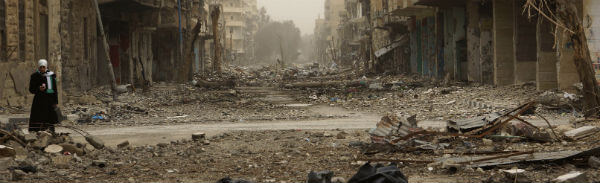
The National reports: This Christmas season in Bethlehem, death, depression and anger are in the air at Aida refugee camp, three kilometres from Nativity Church.
Aida, wedged between Israel’s West Bank separation barrier and an army checkpoint, has been a major flashpoint of clashes during the two-and-a-half-month-old wave of violence known in the Palestinian media as the haba shaabiya or popular rising.
At least 126 Palestinians and 19 Israelis have been killed since the beginning of October, according to the Palestinian Maan news agency.
Five of the Palestinian dead were from the Bethlehem area and two from Aida camp, including Abdul Rahman Shadi Obeidallah, 13, who camp residents say was killed by a sniper on October 5 as he stood in the street with friends. [Continue reading…]
Category Archives: News
Why Turkey and Israel are renewing their frozen relations
Joseph Dana writes: Turkey and Israel are close to agreeing on a full restoration of diplomatic ties after five years of hostility. The dispute began when Israeli commandos stormed the Mavi Marmara, a ship carrying Turkish activists attempting to break Israel’s blockade of the Gaza Strip, killing 10. The heavy-handed Israeli response had a dramatic effect on the Turkish public and provided Recep Tayyip Erdogan with an ideal scapegoat to advance his own regional policy. Now, the countries are close to becoming friends again, with economics, not ideology, driving the reconciliation.
In the years that followed the Mavi Marmara attack, Mr Erdogan fashioned himself as a regional champion of Palestinian rights. After the Arab Spring, Turkish leaders sensed a new regional order on the horizon and tried to capitalise on it. Mr Erdogan’s support for Hamas in Gaza, along with Turkey’s close cooperation with the Muslim Brotherhood in Egypt, positioned Ankara as part of a new axis of power in the region.
The Turkish economy was strong and Istanbul was re-emerging as a global city. The national airline was opening new routes at a frenzied speed, bringing the world to Istanbul. Ankara aligned itself with the new regimes in the region and forcefully adopted an anti-Assad stance in Syria.
Mr Erdogan’s pro-Palestinian stance was a critical aspect of his new regional appeal. But attacking Israelis with rhetoric belied the deep economic relationship between the two countries. At the height of the standoff between Tel Aviv and Ankara, Turkish Airlines was the second-largest operator of flights out of Tel Aviv’s international airport. [Continue reading…]
Saudi Arabia’s ‘coalition’ is a brazen challenge to Syria, Iran, and the U.S.
By Scott Lucas, University of Birmingham
Deputy crown prince and minister of defense of Saudi Arabia Mohammed bin Salman’s announcement of a new Saudi-led counter-terrorism coalition surprised allies like the US, adversaries such as Iran, and other interested parties including Russia.
Prince Mohammed said the Saudis had formed a 34-nation “Islamic military coalition” to fight Islamic State (IS) and other terrorist groups. A headquarters in Riyadh will provide military, intelligence, logistics, and other support to members as needed.
This was so surprising that countries in the new coalition said they were unaware they were founding members. Pakistan’s foreign secretary Aizaz Chaudhry said he had only learned of the initiative when he read the prince’s statement, and that he had asked Pakistan’s ambassador in Riyadh to get a clarification from Saudi officials.
The Indonesian Foreign Ministry was only slightly more diplomatic, saying that “the government is still observing and waiting to see the modalities of the military coalition”. Malaysian defence minister Hishammuddin Hussein, while supporting the coalition, ruled out “any military commitment”.
So this was hardly the unveiling of a grand military initiative. Instead, it was a political message – not just to Russia and Iran, but to Riyadh’s nominal allies in Washington.
Crimes against Muslim Americans and mosques rise sharply
The New York Times reports: Hate crimes against Muslim Americans and mosques across the United States have tripled in the wake of the terrorist attacks in Paris and San Bernardino, Calif., with dozens occurring within just a month, according to new data.
The spike includes assaults on hijab-wearing students; arsons and vandalism at mosques; and shootings and death threats at Islamic-owned businesses, an analysis by a California State University research group has found.
President Obama and civil rights leaders have warned about anecdotal evidence of a recent Muslim backlash, particularly in California. But the analysis is the first to document the rise, amid a crescendo of anti-Islamic statements from politicians.
“The terrorist attacks, coupled with the ubiquity of these anti-Muslim stereotypes seeping into the mainstream, have emboldened people to act upon this fear and anger,” said Brian Levin, a criminologist at California State University, San Bernardino. [Continue reading…]
‘They want something that happens everywhere at the same time,’ says German ISIS returnee
Der Spiegel reports on Harry S., a 27-year-old from Bremen, who may shed light on ISIS’s plans for new attacks: Harry S. returned to Germany from Syria and is now in investigative custody. He has told security officials everything about the brief time he spent with Islamic State and has also demonstrated his readiness to deliver extensive testimony to German public prosecutors. He stands accused of membership in a terrorist group. His lawyer Udo Würtz declined to offer a detailed response when contacted, but said of his client: “He wants to come clean.”
German investigators are extremely interested in the testimony of the apparently repentant returnee, even as they are likely unsettled by what he has to say.
Harry S., after all, is more than just a witness to firing squads and decapitations. He also says that on several occasions, IS members tried to recruit volunteers for terrorist attacks in Germany. In the spring, just after he first arrived in Syria, he says that he and another Islamist from Bremen were asked if they could imagine perpetrating attacks in Germany. Later, when he was staying not far from Raqqa, the self-proclaimed Islamic State capital city, masked men drove up in a jeep. They too asked him if he was interested in bringing the jihad to his homeland. Harry S. says he told them that he wasn’t prepared to do so.
Harry S. was only in IS controlled territory for three months. Yet he might nevertheless become a vital witness for German security officials. Since the Nov. 13 attacks in Paris, fear of terrorism has risen across Europe, including in Germany, and security has been stepped up in train stations and airports. And the testimony from the Bremen returnee would seem to indicate that the fear is justified. Harry S. says that, during his time in the Syrian warzone, he frequently heard people talking about attacks in the West and says that pretty much every European jihadist was approached with the same questions he had been asked. “They want something that happens everywhere at the same time,” Harry S. says. [Continue reading…]
Raqqa tribes challenge Syria Kurds
NOW reports: A group of tribes in Syria’s Raqqa province have warned the Kurdish People’s Protection Units (YPG) against entering areas it controls, in the latest sign of simmering tensions between ethnic Arabs and Kurds in the province where ISIS maintains its de-facto capital.
“No one from the YPG may enter the Arab areas where are our fighters are present,” the Collective of Raqqa Tribes said in a statement issued Tuesday.
The group further called on the Kurdish militia to “hand over” the flashpoint Tal Abyad, a strategic Raqqa border area populated by ethnic Arabs and Turkmen that the Kurdish Democratic Union Party (PYD) has joined to its Democratic Self-Rule Administration. [Continue reading…]
As another activist is murdered, the least we owe ‘Raqqa is Being Slaughtered Silently’ is our attention
Kyle Orton writes: From the outset of the Syrian uprising, the regime of Bashar al-Assad and the Isis have been united on their strategic goal: eliminate the moderate opposition and make Syria a binary choice between themselves. This is why on the battlefield Assad and Isis largely leave one-another alone and the Assad regime’s propaganda—that the whole rebellion is composed of Islamist terrorists—reinforces Isis’s propaganda claim that it is the only effective protection for Sunnis against the regime. Both IS and the Assad regime are led by military and intelligence officers trained in the KGB and both rely on propaganda as a means of internal control, not only of controlling their international image, which is why both so virulently repress independent media that contradicts their officially sanctioned version. Last night, IS again struck down a member of an activist group that has tried to bring the truth about life under its rule to the outside world. [Continue reading…]
Russia’s family business
Reuters reports on the rewards Kirill Shamalov gained after marrying Vladimir Putin’s daughter, Katerina, in February, 2013: Within 18 months, Kirill acquired a large chunk of shares in a major Russian oil and petrochemical processor called Sibur – a stake now worth an estimated $2.85 billion, based on the value of recent share deals. He also quit his job as a business manager and set up a company to run his personal investments.
How did such a young businessman go so far, so fast? A Reuters examination of Shamalov’s career shows that in the summer of 2013, months after he married Putin’s daughter, Kirill opened discussions about buying shares in Sibur from one of the president’s wealthiest friends.
A year later, he was able to borrow more than $1 billion, judging by the published accounts of his investment company. The loan came from a bank headed by another longtime associate of Putin, and where Shamalov’s brother holds a senior position. The money was used to make an investment in Sibur that within months proved highly profitable for Kirill.
Asked about his business deals and the wedding, Kirill Shamalov and Sibur declined to comment.
The trajectory of Kirill’s fortunes sheds new light on how people close to Putin have taken commanding positions in key companies – and how such opportunities are now being extended to a new generation. [Continue reading…]
Israel and Turkey agree to restore diplomatic ties
The New York Times reports: Israel and Turkey have reached a preliminary agreement to begin restoring full diplomatic relations after years of deep freeze, Israeli officials said on Thursday.
The two countries, once close regional allies, fell out after a deadly confrontation in 2010 between Israeli commandos and Turkish activists on a passenger vessel seeking to breach Israel’s naval blockade of the Gaza Strip.
The ship, the Mavi Marmara, was part of a flotilla carrying aid to Gaza when Israeli naval commandos rappelled onto the ship’s deck and killed nine activists after being met with violent resistance. A 10th activist died of his wounds much later.
A senior Israeli official, speaking on the condition of anonymity because the reconciliation deal had not been finalized, said that Israel would create a compensation fund for the families of those killed on the Mavi Marmara. The Israeli news media reported that the compensation would be about $20 million, but Emmanuel Nahshon, a spokesman for the Israeli Ministry of Foreign Affairs, said the amount had not been set. [Continue reading…]
Pete Seeger’s FBI file reveals how the folk legend first became a target of the feds
David Corn writes: From the 1940s through the early 1970s, the US government spied on singer-songwriter Pete Seeger because of his political views and associations. According to documents in Seeger’s extensive FBI file—which runs to nearly 1,800 pages (with 90 pages withheld) and was obtained by Mother Jones under the Freedom of Information Act—the bureau’s initial interest in Seeger was triggered in 1943 after Seeger, as an Army private, wrote a letter protesting a proposal to deport all Japanese American citizens and residents when World War II ended.
Seeger, a champion of folk music and progressive causes—and the writer, performer, or promoter of now-classic songs, including as “If I Had a Hammer,” “Where Have All the Flowers Gone?,” Turn! Turn! Turn!,” “Kisses Sweeter Than Wine,” “Goodnight, Irene,” and “This Land Is Your Land”—was a member of the Communist Party for several years in the 1940s, as he subsequently acknowledged. (He later said he should have left earlier.) His FBI file shows that Seeger, who died in early 2014, was for decades hounded by the FBI, which kept trying to tie him to the Communist Party, and the first investigation in the file illustrates the absurd excesses of the paranoid security establishment of that era. [Continue reading…]
Pentagon officers: We will quit if Trump wins
The Daily Beast reports: Republican presidential candidate and business mogul Donald Trump has repeatedly vowed to build up the U.S. military if elected president.
But it is not clear he will have the experienced commanders within the ranks to do it.
In the halls of the Pentagon, there is a different plan afoot for the Trump presidency. Here, officers are privately contemplating what they would do should Trump become their commander-in-chief. And more often than not, they proclaim they will leave.
“By 2016 I will have my 20 years in and can get out of here,” one military official said, referring to the amount of time a service member needs to collect retirement pay.
Spend enough time with a service member, and the topic of Trump comes up, always unsolicited. It is far less political than it sounds. Trump’s attack plans for the so-called Islamic State widely known as ISIS — his call to ban Muslims from the United States, his suggestions that cutting off the flow of information through the Internet can protect the homeland — many said, are an affront to the values they vowed to die to defend. [Continue reading…]
Donald Trump gets strong endorsement from Vladimir Putin
CNN reports: Donald Trump has said that he would “get along very well” with Russian President Vladimir Putin.
The feeling is apparently mutual.
Putin offered high praise for the billionaire businessman-turned-Republican presidential front-runner on Thursday during an annual news conference with reporters.
“He is a bright and talented person without any doubt,” Putin said, adding that Trump is “an outstanding and talented personality.”
And in remarks closely mirroring Trump’s assessment of the campaign, the Russian leader called Trump “the absolute leader of the presidential race,” according to the Russian TASS news agency. [Continue reading…]
On the need to listen to Arab public opinion
Commenting on the results of a recent Zogby poll of over 7,400 adults in six Arab countries (Egypt, Lebanon, Jordan, Iraq, Saudi Arabia, and the UAE), Turkey, and Iran, Rami G. Khouri writes: As expected, people in Iraqi are divided on their views of their own national institutions and regional players’ actions in their country. Sunnis mostly lack confidence in the Iraqi military, Iran’s involvement, or the Popular Mobilization Units that are fighting “Islamic State” (ISIS), while Iraqi Shiites support the actions of all these. The more significant finding, however, is the “remarkable consensus” on two important issues: that the cause of the conflict in Iraq is that, “the government in Baghdad does not represent all Iraqis,” and that, “the best way to ultimately resolve the conflict…is forming a more inclusive representative government” — and not partition, with the Kurds also supporting such a representative central government.
I would guess that this Iraqi desire for inclusive, representative governance within a unified national framework is mirrored in most Arab countries that are wracked by war and sectarian tensions, like Libya, Yemen, Bahrain, Lebanon, and Syria. Ordinary citizens probably hold much more rational and constructive views on how to resolve those conflicts than the warlords and officials, not to mention foreign powers that now mostly shape policy.
The poll found that ISIS was mentioned as the most serious extremist problem facing the region in every country except Jordan, where Al-Qaeda is ranked first. More interestingly — and significant for counter-terrorism purposes — is that in most countries polled citizens identified, “corrupt, repressive, and unrepresentative governments” and, “religious figures and groups promoting extremist ideas” as the most important causes of religious extremism. [Continue reading…]
Extinguishing the flames of the Arab Spring
Al Jazeera reports: Five years ago today, Mohamed Bouazizi, a 26-year-old street vendor, set himself on fire outside a local municipal office in his hometown of Sidi Bouzid to protest against police corruption – a solitary act that would set off a stunning chain of events throughout the Arab world.
In the years since Bouazizi’s death, Tunisia has gone through tremendous change. After street protests forced President Zine El Abidine Ben Ali into exile after two decades of his rule, Tunisia adopted a new constitution and held national elections in 2014.
Earlier this month, the country’s National Dialogue Quartet was awarded the Nobel Peace Prize for assisting Tunisia’s transition to democracy.
But despite the changes that have taken place around them, residents of Sidi Bouzid say their lives are no better than they were before the uprising.
“Before the toppling of the regime of Ben Ali, we had hopes,” Ramzi Abdouli, 29, a graduate from Sidi Bouzid, told Al Jazeera. “We thought that maybe when Ben Ali left our reality would change. Unfortunately, it was not the case.”
Like many of Tunisia’s youth, Abdouli participated in the 2010-2011 protests, hoisting banners against the regime. Even after Ben Ali was deposed, Abdouli marched more than 250km from Sidi Bouzid to Tunis in April 2012 to reiterate demands for social justice and employment.
Today, via social media, he remains a relentless critic of the current government and its political affairs – and is pessimistic about the years ahead. [Continue reading…]
Iran’s pivotal elections could be decided next week — two months before anyone votes
Bobby Ghosh writes: With barely more than two months to go before what may be the Islamic Republic’s most important elections in a generation, there are no visible signs of campaigning in the streets of Tehran. One reason: the Iranian political cycle is, perhaps mercifully, much shorter than the American one. But another reason emerges in my conversations with politicians, clerics, and businessmen. There’s no electioneering, at least not the kind you see in most democracies, because nobody can be entirely certain who is running.
Registration of candidates opens tomorrow, Dec 17. But the fate of many aspirants will be decided within a week — long before the voting begins — by a small group of clerics and jurists, known as the Guardian Council, who are constitutionally tasked to ensure that the Islamic Republic remains true to its religious ideals.
Under the Iranian system, candidates for any election must first be vetted by this 12-member body, which has, since the founding of the Islamic Republic, been controlled by the country’s Supreme Leader—first ayatollah Ruhollah Khomeini, and now ayatollah Ali Khamenei. The Guardians also have veto power over any legislation enacted by parliament, and most of the decisions of the country’s president.
This makes the Council a powerful instrument by which the Supreme Leader can head off political and social reforms at the pass, by preventing reformists from standing for elections, or perform an end-run around any attempted reforms by the legislative or executive branches.
Iran’s February elections are for two powerful institutions: the 290-member Majlis, or parliament, and the highly influential, 86-member Assembly of Experts. The latter is especially important this time around because its mandate is to select, supervise, and, at least in theory, remove the Supreme Leader. It has an eight-year term, twice the duration of parliament, so this particular Assembly will likely play the pivotal role of deciding who gets to succeed Khamenei. [Continue reading…]
The world needs drastic action to meet Paris climate goals
Wired reports: Last week’s UN climate meeting took place inside six massive, climate-controlled warehouses, on the grounds of France’s oldest commercial airport. That airport is in the suburb of Le Bourget, which itself is part of the Paris metropolitan region—home to some 12 million people and their homes, workplaces, commutes, appetites, and pastimes. With the exception of a small but growing slice powered by renewables, the majority of everything that everybody does in Paris and beyond is powered by fossil fuels.
That’s the electricity powering your computer, Xbox, microwave, refrigerator, and heater. Gas goes in your car, into the trucks that deliver your year-round vegetables, into the ship that brought your hoverboard over from China. Coal provides the heat to make the steel in every building, every train track. It’s essential for concrete, too.
The goal of the Paris climate deal is to keep average global temperature increase well below 2 degrees Celsius, and as close to 1.5 degrees Celsius as possible. Let’s assume the best case scenario, compliance-wise. Every nation outdoes their pre-submitted plans (which currently add up to 2.7 degrees above global average by the end of the century). Every five years every nation ratchets up their commitments, and carbon pricing sends a planet-wide price signal to the economy that it is cheaper to do business with renewables. What does all that look like? What exactly needs to happen in order to meet that ambitious goal? [Continue reading…]
Mass deaths and torture in Syria’s detention facilities
Human Rights Watch reports: Nine months of research reveals some of the human stories behind the more than 28,000 photos of deaths in government custody that were smuggled out of Syria and first came to public attention in January 2014.
The 86-page report, “If the Dead Could Speak: Mass Deaths and Torture in Syria’s Detention Facilities,” lays out new evidence regarding the authenticity of what are known as the Caesar photographs, identifies a number of the victims, and highlights some of the key causes of death. Human Rights Watch located and interviewed 33 relatives and friends of 27 victims whose cases researchers verified; 37 former detainees who saw people die in detention; and four defectors who worked in Syrian government detention centers or the military hospitals where most of the photographs were taken. Using satellite imagery and geolocation techniques, Human Rights Watch confirmed that some of the photographs of the dead were taken in the courtyard of the 601 Military Hospital in Mezze.
“Just about every detainee in these photographs was someone’s beloved child, husband, father, or friend, and his friends and family spent months or years searching for him,” said Nadim Houry, deputy Middle East director at Human Rights Watch. “We have meticulously verified dozens of stories, and we are confident the Caesar photographs present authentic – and damning – evidence of crimes against humanity in Syria.”
Countries meeting about possible peace negotiations in Syria – including Russia, as the Syrian government’s biggest backer – should make the fate of the thousands of detained people in Syria a priority, Human Rights Watch said. Concerned countries should insist that the Syrian government give international monitors immediate access to all detention centers and that Syria’s intelligence services must stop forcibly disappearing and torturing detainees. [Continue reading…]
Assad, thanks to Russia and Iran, is too strong for a political settlement to be made right now in Syria

Aron Lund writes: Wrapped up on time, on December 10, the event [the Syrian opposition conference held in Riyadh] was met with widespread and unsurprising acclaim from the organizing governments and other nations sympathetic to the Syrian opposition. “We welcome the positive outcome of the gathering of the Syrian opposition in Riyadh,” wrote the U.S. State Department in a congratulatory message, hailing the “broad and representative group of 116 participants.”
At the meeting, a final statement was adopted that laid out the principles for the upcoming negotiations with the government of Syrian President Bashar al-Assad. Among them, according to a widely circulated draft, was “faith in the civilian nature of the Syrian state and its sovereignty over all of Syria’s territory, on the basis of administrative decentralization.” The document also expressed a commitment to “a democratic mechanism through a pluralistic system that represents all segments of the Syrian people, men and women, without discrimination or exclusion on a religious, sectarian, or ethnic basis,” organized by way of “free and fair elections.” The delegates promised to “work to preserve the institutions of the Syrian state, although it will be necessary to reorganize the structure and formation of its military and security institutions.” There would be a state monopoly on armed force. They condemned terrorism and stressed their refusal of “the presence of any foreign fighters.”
Regarding the upcoming talks, the delegates expressed their readiness to engage in a UN-supervised political process such as that described in the November 14 Vienna communiqué, which calls for Syrian-Syrian negotiations by January 2016 and a ceasefire by June of the same year. However, they asked the international community to “force the Syrian regime to perform measures ascertaining its good faith before the start of the negotiating process,” such as an end to death sentences and starvation tactics and a release of prisoners. The start of a ceasefire was linked to the creation of a transitional government, as sketched out in the Geneva Communiqué of 2012. Regarding the most crucial question of all, the conference stated that “Bashar al-Assad and his clique” have to leave power at the start of the transition — not at the end of it.
Last but not least, the delegates also agreed to create a High Negotiations Committee, tasked with electing and overseeing a team of 15 negotiators who will face the government delegation and decide the future of the country. And that, of course, was where it got tricky. [Continue reading…]
Kyle Orton writes: The opposition now has some diplomatic clout because it has a reasonably credible return address, but “as soon as negotiations in Vienna begin they will falter over the central issue: Iran and Russia will insist that Assad stays,” says Thomas Pierret, a lecturer on contemporary Islam at Edinburgh University and author of Religion and State in Syria: The Sunni Ulama from Coup to Revolution. “The United States is unable to change the Iranian and Russian demands,” Pierret adds, “so will face the choice of either accepting the failure of the negotiating process they’ve invested in, or pressuring the opposition — whom the U.S. can effect—into a ‘creative solution,’ which is to say allowing Assad to stay.”
The removal of Assad and his instruments of repression is key to ending the civil war and defeating ISIS, but unless Assad is military checkmated he and his Iranian and Russian supporters will have no reason to negotiate his departure. At the present time Assad is simply too secure and there is little sign of a Western appetite to make him less so. This means the Vienna process offers many more potential costs than benefits for the opposition. [Continue reading…]