Category Archives: News

Losing control in the Caucasus

Politico reports: Nagorno-Karabakh, the former Soviet Union’s oldest and most dangerous conflict, is waking up again. The 1994 ceasefire between Armenia and Azerbaijan is under severe strain. Where there was occasional sniper fire two years ago, mortars are now being fired. Rockets are raining down on the Armenia-Azerbaijan border and the ceasefire line east of Karabakh itself. There have been around a dozen casualties in the last week.

It is still premature to talk about a return to the kind of full-scale war that raged here for three years in the 1990s. But the leaders in both Baku and Yerevan are digging themselves into warlike positions that they will find hard to give up.

This is not about the “hand of Russia” — although Russia’s behavior is not helping. The danger of the Caucasus is that no one is fully in charge and that Karabakh is becoming another link in a chain of disorder stretching from Ukraine to Syria, in which Russia meddles but is not fully in charge. [Continue reading…]

Facebooktwittermail

Iran lawmakers vote to implement nuclear deal

The New York Times reports: Iran’s parliament voted Tuesday to support implementing a landmark nuclear deal struck with world powers despite hard-line attempts to derail the bill, suggesting the historic accord will be carried out.

The bill will be reviewed by Iran’s 12-member Guardian Council, a group of senior clerics who could return it to lawmakers for further discussion. However, Iran’s Supreme Leader Ayatollah Ali Khamenei, who has the final say on key policies, has said it is up to the 290-seat parliament to approve or reject the deal.

Signaling the nuclear deal’s likely success, a spokesman for moderate President Hassan Rouhani’s administration welcomed the parliament’s vote and called it a “historic decision.”

“Members of parliament made a well-considered decision today showing they have a good understanding of the country’s situation,” Mohammad Bagher Nobakht said. “We hope to see acceleration in progress and development of the country from now on.”

The European Union’s foreign policy chief Federica Mogherini, who helped facilitate the nuclear talks, also praised the vote as “good news” in a message on Twitter.

In the parliamentary session carried live by state radio, 161 lawmakers voted for implementing the nuclear deal, while 59 voted against it and 13 abstained. Another 17 did not vote at all, while 40 lawmakers did not attend the session.

A preliminary parliamentary vote Sunday saw 139 lawmakers out of the 253 present support the outline of the bill. But despite getting more support Tuesday, hard-liners still tried to disrupt the parliament’s session, shouting that Khamenei himself did not support the bill while trying to raise numerous proposals on its details. [Continue reading…]

The Wall Street Journal reports: Tensions between the U.S. and Iran, rather than easing as a result of July’s nuclear accord, are increasing over a wide spectrum of issues tied to the broader Middle East security landscape and to domestic Iranian politics, current and former U.S. officials say.

Just in the past two days, Iran has test-fired a ballistic missile and announced the conviction of American journalist Jason Rezaian, fueling suspicions the historic nuclear agreement has allowed Tehran’s Islamist clerics to step up their long-held anti-U.S. agenda.

Washington’s closest Mideast allies, particularly Israel and Saudi Arabia, are more broadly concerned about Iran’s ability to use the diplomatic cover provided by the nuclear accord—and the promised release of tens of billions of dollars of frozen oil revenues—to strengthen its regional position and that of its allies. [Continue reading…]

Reuters reports: Iran’s Supreme Leader Ayatollah Ali Khamenei on Wednesday banned any further negotiations between Iran and the United States, putting the brakes on moderates hoping to end Iran’s isolation after reaching a nuclear deal with world powers in July.

Khamenei, the highest authority in the Islamic Republic, already said last month there would be no more talks with the United States after the nuclear deal, but has not previously declared an outright ban. [Continue reading…]

The New York Times reports: The Washington Post said on Monday that its correspondent Jason Rezaian, who has been jailed for 14 months in Iran on espionage charges, had been convicted after a trial that ended two months ago.

While the conviction could not be independently confirmed — a spokesman for the Iranian judiciary said on Sunday that a verdict had been handed down, but he did not disclose specifics — Iran appeared to be moving on Monday to position Mr. Rezaian’s case as part of a broader effort to get the release of Iranians detained in the United States.

On Monday, a state television news channel accused Mr. Rezaian, a dual American-Iranian citizen, of providing information to the United States about individuals and companies who were helping Iran circumvent international economic sanctions.

Iranian leaders, including President Hassan Rouhani, have raised the idea of a prisoner swap, suggesting that Mr. Rezaian, 39, could be exchanged for people who Tehran says are being held by or on the orders of the United States for violating sanctions. [Continue reading…]

Facebooktwittermail

Oil unlikely to ever be fully exploited because of climate concerns, says BP

The Guardian reports: The world’s oil resources are unlikely to ever be fully exploited, BP has admitted, due to international concern about climate change.

The statement, by the group’s chief economist, is the clearest acknowledgement yet by a major fossil fuel company that some coal, oil and gas will have to remain in the ground if dangerous global warming is to be avoided.

“Oil is not likely to be exhausted,” said Spencer Dale in a speech in London. Dale, who chief economist at the Bank of England until 2014, said: “What has changed in recent years is the growing recognition [of] concerns about carbon emissions and climate change.”

Scientists have warned that most existing fossil fuel reserves must stay in the ground to avoid catastrophic global warming and Dale accepted this explicitly. [Continue reading…]

Facebooktwittermail

Russia doubles number of daily airstrikes in Syria as rebels intensify their attacks

The New York Times reports: Russian warplanes are carrying out more airstrikes in support of Syrian government ground troops as rebels are firing more American antitank weapons, deepening the impression that a proxy war between the United States and Russia is joining the list of interlocking conflicts in Syria.

Russia doubled the number of its airstrikes over the weekend to more than 60 a day, Russian state news media said, helping government troops take two villages on Monday.

Videos posted online by pro-Russian outlets, from an area above the village of Tal Skayk, in Hama Province, showed Syrian troops and allied militias watching as heavy barrages sent smoke towering from clusters of houses, while a narrator enthusiastically described progress in fighting “terrorists.”

At the same time, the handful of insurgent groups that received covert assistance from the United States have intensified their use of TOW antitank guided missiles, posting more than two dozen videos in the past few days of the missiles weaving over open fields before hitting their targets. [Continue reading…]

The Washington Post reports: It is unclear whether the TOWs will be able to change the course of the war, as did the Stinger antiaircraft missiles introduced in the 1980s by the CIA in Afghanistan, where they were used by the mujahideen to shoot down Russian helicopters and paralyze the Soviet army.

Now that the Russians have introduced more intensive and heavier airstrikes and, for the first time, combat helicopters have been seen in videos strafing villages in the Hama area, the TOW missiles may only be able to slow, but not block, government advances.

The rebels have appealed for the delivery of Stinger missiles or their equivalents to counter the new threat from the air, but U.S. officials say that is unlikely. The Obama administration has repeatedly vetoed past requests from the rebels, as well as their Turkish and Saudi allies, for the delivery of antiaircraft missiles, out of concerns that they could fall into extremist hands.

But the TOW missile program is already in progress, and all the indications are that it will continue. Saudi Arabia, the chief supplier, has pledged a “military” response to the Russian incursion, and rebel commanders say they have been assured more will arrive imminently.

Under the terms of the program, the missiles are delivered in limited quantities, and the rebel groups must return the used canisters to secure more, to avoid stockpiling or resale.

The supplies of the missiles, manufactured by Raytheon, are sourced mainly from stocks owned by the Saudi government, which purchased 13,795 of them in 2013, for expected delivery this year, according to Defense Department documents informing Congress of the sale. Because end-user agreements require that the buyer inform the United States of their ultimate destination, U.S. approval is implicit, said [Oubai ] Shahbandar, a former Pentagon adviser. [Continue reading…]

Facebooktwittermail

Turkey bombs PKK after Ankara’s deadly blasts as unrest persists

Bloomberg reports: Turkey’s military said it killed dozens of Kurdish separatists hours after explosions in Ankara left at least 97 people dead, making good on the government’s vow to continue attacking the group even after it was reported to have declared a unilateral cease-fire.
Thirty-five members of the Kurdistan Workers’ Party, or PKK, were killed when fighter jets targeted their bases in northern Iraq, state-run Anadolu news agency reported on Sunday. Another 14 died in airstrikes in Turkey’s largely Kurdish Diyarbakir province, the military said in a statement. Two soldiers and a policeman were killed in the operations, Hurriyet newspaper reported, while clashes broke out between police and protesters in Turkish cities.
The violence leaves Turkey in the throes of deepening domestic unrest three weeks before a general election. Authorities have said the carnage in Ankara, for which no one claimed responsibility, could be the work of Islamic State militants who are battling allies of the PKK in Syria. Police are analyzing DNA samples from the families of 16 suspects, according to Hurriyet. [Continue reading…]

Facebooktwittermail

ISIS suicide bombers suspected in the Ankara attack

The Daily Beast reports: The so-called Islamic State has emerged as the main suspect behind the deadliest bomb attack in Turkish history, which killed almost 100 people in the capital Ankara on Saturday. Analysts say the incident shows that the conflict in neighboring Syria is destabilizing Turkey, a crucial U.S. ally and NATO member in the Middle East.

There has been no official statement by police or the government blaming ISIS jihadists for the twin suicide attack on a peace rally in Ankara. But the official Anadolu news agency quoted police sources as saying the bombs used in Ankara— packs of TNT fortified with metal balls for increased destructive effect— were similar to the one a suspected ISIS suicide bomber used in an attack in the town of Suruc on July 20 that killed more than 30 people.

Several Turkish newspapers also reported that one of the two suicide bombers, Yunus Emre Alagoz, 25, was the brother of Suruc bomber Seyh Abdurrahman Alagoz. The other Ankara bomber was a woman, news reports said. The Alagoz brothers allegedly traveled to Syria last year to join ISIS and received bomb-making training before returning to Turkey. [Continue reading…]

Facebooktwittermail

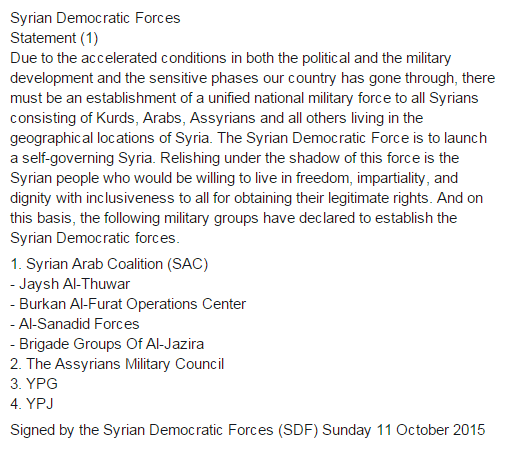
New Syrian alliance unites Kurds, Arabs, and Assyrians

Reuters reports: A Kurdish militia that has been fighting Islamic State in Syria with help from U.S.-led air strikes has joined forces with Arab groups in an alliance announced on Monday that may be a prelude to an attack on the jihadists’ base of operations in Raqqa.

The alliance calling itself the Democratic Forces of Syria includes the Kurdish YPG militia and Syrian Arab groups, some of which fought alongside it in a campaign that drove Islamic State from wide areas of northern Syria earlier this year.

The Arab groups in the new alliance are operating under the name “The Syrian Arab Coalition” – a grouping which U.S. officials have said would receive support under a new U.S. strategy aimed at fighting Islamic State in Syria.

A U.S. military official has told Reuters that the Syrian Arab Coalition would push down towards Raqqa, Islamic State’s de facto capital, while staying east of the Euphrates river. [Continue reading…]

A statement issued yesterday by the Syrian Democratic Forces says:

sdfstatement

Facebooktwittermail

Syria: New Russian-made cluster munition reported

Human Rights Watch: An advanced type of Russian cluster munition was used in an airstrike southwest of Aleppo on October 4, 2015, Human Rights Watch said today. The use of the weapon near the village of Kafr Halab raises grave concerns that Russia is either using cluster munitions in Syria or providing the Syrian air force with new types of cluster munitions to use.

New photographs and videos also suggest renewed use of air-dropped cluster munitions as well as ground-fired Russian-made cluster munition rockets as part of the joint Russian-Syrian offensive in northern Syria.

“It’s disturbing that yet another type of cluster munition is being used in Syria given the harm they cause to civilians for years to come,” said Nadim Houry, deputy Middle East director at Human Rights Watch. “Neither Russia nor Syria should use cluster munitions, and both should join the international ban without delay.” [Continue reading…]

Last month, Human Rights Watch researcher, Ole Solvang, wrote about Saudi Arabia’s use of cluster bombs in Yemen: Cluster munitions were used in Yemen in past wars and now Saudi Arabia and members of its coalition are dropping bombs and launching rockets with this indiscriminate weapon on populated areas.

The U.S. is providing logistical and intelligence support for the coalition, and if it is providing targeting assistance for cluster munition strikes, it could be complicit in resulting laws-of-war violations. What’s more, the evidence we found of cluster rocket use just a few weeks ago showed that they were manufactured by U.S. companies. U.S. officials have expressed concern at the use of cluster munitions by Syria, South Sudan, Ukraine, and Sudan yet when it comes to the use of cluster munitions by the coalition in Yemen, the U.S. has been silent. [Continue reading…]

Facebooktwittermail

Shiites in Iraq hail ‘Sheikh Putin’

The New York Times reports: One of the most popular Facebook posts in Iraq’s Shiite heartland is a Photoshopped image of President Vladimir V. Putin of Russia dressed in the robe of a southern tribal sheikh.

It was the American-led invasion in 2003 that toppled Saddam Hussein and empowered Iraq’s long-repressed Shiite majority. The United States also took the lead more than a year ago to assemble a coalition to conduct airstrikes in Syria and Iraq against the Sunni militants of the Islamic State.

But with the struggle against the Islamic State largely stalemated, it is the naked display of Russian military power in neighboring Syria, as well as the leadership of “Sheikh Putin,” that is being applauded by residents of this Shiite power center. Russian planes continued to hit targets in Syria on Sunday, the Russian Defense Ministry said.

“What the people in the street care about is how to get Daesh out of Iraq,” Ibrahim Bahr al-Ulum, a member of Iraq’s Parliament, said, using an Arabic name for the Islamic State, also known as ISIS or ISIL. “Now they feel Russia is more serious than the United States.” [Continue reading…]

Facebooktwittermail

Afghan Taliban’s reach is widest since 2001, UN says

The New York Times reports: The Taliban insurgency has spread through more of Afghanistan than at any point since 2001, according to data compiled by the United Nations as well as interviews with numerous local officials in areas under threat.

In addition, the United Nations Assistance Mission in Afghanistan over the past two weeks has evacuated four of its 13 provincial offices around the country — the most it has ever done for security reasons — according to local officials in the affected areas.

The data, compiled in early September — even before the latest surge in violence in northern Afghanistan — showed that United Nations security officials had already rated the threat level in about half of the country’s administrative districts as either “high” or “extreme,” more than at any time since the American invasion ousted the Taliban in 2001.

That assessment, which has not been publicly released but is routinely shared by the United Nations with countries in the international coalition, appears at odds with the assessment of its American commander, Gen. John F. Campbell, in his testimony to Congress last week. [Continue reading…]

Facebooktwittermail

Major investors call on governments to secure a clear, long-term goal on climate action in Paris

We Mean Business: Almost 400 institutional investors representing more than $24 trillion in assets relased a statement in top-tier business and finance journals around the world, today.

In a previous letter to the G7 governments, investors noted that with the right market signals from policy makers, investment in low-carbon and climate resilient opportunities can flow and climate impacts and resulting economic damages can be mitigated.

Today’s statement from the group of investors who are responsible for managing the retirement savings and investments of millions of people, called for governments who will meet at the December climate negotiations in Paris to secure a clear, long-term goal. A long-term goal will enable investors to deploy more capital and unleash a wave of innovation, reduce emissions, build climate resilience and protect the investments and the livelihoods of millions of citizens around the world. [Continue reading…]

Facebooktwittermail

ISIS seizes ground from Aleppo rebels under cover of Russian airstrikes

The Guardian reports: Islamic State militants have scored their most significant advances in the province of Aleppo, the closest they have come to Syria’s former commercial capital in two years, as it becomes increasingly clear that they are taking advantage of Russian airstrikes against the rest of the opposition to march into new territory.

As Russian planes continued to pound rebel forces in western Aleppo and other frontlines in the country, many of the opposition fighters who ousted Isis from the province at great cost last year found themselves pinned down and unable to halt the terror group’s largely unopposed advance towards the city at the end of last week.

“Russian planes are striking the Free Syrian Army and laying the groundwork for Daesh [Isis] control of strategic areas in Aleppo,” said a source from Tajammu al-Izzah, a moderate opposition group backed by western and Gulf states which has been hit by Russian airstrikes. “The truth is that Russia is backing Isis.” [Continue reading…]

The Associated Press adds: CIA-backed rebels in Syria, who had begun to put serious pressure on President Bashar Assad’s forces, are now under Russian bombardment with little prospect of rescue by their American patrons, U.S. officials say.

Over the past week, Russia has directed parts of its air campaign against U.S.-funded groups and other moderate opposition in a concerted effort to weaken them, the officials say. The Obama administration has few options to defend those it had secretly armed and trained. [Continue reading…]

Facebooktwittermail

World will pass crucial 2C global warming limit, experts warn

The Guardian reports: Pledges by nations to cut carbon emissions will fall far short of those needed to prevent global temperatures rising by more than the crucial 2C by the end of the century. This is the stark conclusion of climate experts who have analysed submissions in the runup to the Paris climate talks later this year.

A rise of 2C is considered the most the Earth could tolerate without risking catastrophic changes to food production, sea levels, fishing, wildlife, deserts and water reserves. Even if rises are pegged at 2C, scientists say this will still destroy most coral reefs and glaciers and melt significant parts of the Greenland ice cap, bringing major rises in sea levels.

“We have had a global temperature rise of almost 1C since the industrial revolution and have already seen widespread impacts that have had real consequences for people,” said climate expert Professor Chris Field of Stanford University. “We should therefore be striving to limit warming to as far below 2C as possible. However, that will require a level of ambition that we have not yet seen.” [Continue reading…]

Facebooktwittermail

Anti-Muslim rallies end up inspiring acts of love and service

Carol Kuruvilla writes: A loosely affiliated group of armed protestors organized anti-Muslim hate rallies across the country on Friday and Saturday. But instead of dividing the communities they targeted, news about the rallies strengthened bonds between interfaith allies and inspired numerous acts of community service around the U.S.

Grassroots organizers behind the so-called “Global Rally For Humanity” used Facebook to encourage “fellow patriots” to protest Islam outside their local mosques and Muslim community centers. On some pages, the protests were billed as “open carry” events and participants were encouraged to come armed with guns.

Although up to 35 Facebook pages were created in support of the rally, according to the anti-bigotry group Center for New Community, the majority of these were deactivated in the days leading up to Friday.

And in an extraordinary show of solidarity, interfaith networks in neighborhoods across America and online stepped up to show their support for their Muslim friends. [Continue reading…]

Facebooktwittermail

Assad tries to force the West to choose between regime and ISIS

The Wall Street Journal reports: Syrian President Bashar al-Assad and his inner circle are engaged in a high-stakes gamble for the future of their fractured nation, betting Russian attacks on rebel positions will shift momentum in the conflict and shore up support from their core constituency.

Russia’s intervention is lending credence to what is widely believed to be Mr. Assad’s ultimate aim: Leave only one opponent in the multisided war—Islamic State—and force the West to choose between the extremist group and his regime.

Jubilant Assad loyalists have boasted that Moscow’s expanded involvement has foiled more than four years of efforts by the West and its allies to dislodge the strongman by backing Syria’s more-moderate armed opposition. The U.S. and its Western allies have said Russian airstrikes are primarily targeting these rebels, and not Islamic State.

“The heroic and extraordinary move by our friends in the Russian Federation will create a new history and geography for the region,” Faisal al-Mekdad, Syria’s deputy foreign minister, said on state television late Wednesday. “This is a transitional period, not for us, but for those in the enemy camp. It is they who will make the shift,” he added, referring to the U.S. and its Arab allies. [Continue reading…]

The Washington Post reports: Islamic State militants advanced against rival insurgents in wide swaths of Aleppo province Friday, activists and local media said, as Russia ramped up its campaign to recapture rebel-held territory for the Syrian government.

In a surprise advance — marking some of the Islamic State’s biggest gains in recent months — jihadists routed Syrian rebels from at least five villages and threatened the outskirts of Aleppo city, Syria’s second-largest city, activists said. [Continue reading…]

Facebooktwittermail

Iranian general killed in Syria by ISIS

The Wall Street Journal reports: A top Iranian military commander who played a crucial role in Tehran’s efforts to defend the Syrian regime was killed in the outskirts of the northern Syrian city of Aleppo, Iran’s state media said Friday.

Brig. Gen. Hossein Hamedani died at the hands of “Daesh terrorists” on Thursday while conducting advisory duties, Iranian state media said, quoting a statement by the Islamic Revolutionary Guard Corps, or IRGC.

Although the statement used the Arab acronym for the extremist group Islamic State to describe those responsible for Gen. Hamedani’s death, the circumstances of his demise weren’t disclosed. The Iranian government, like the Syrian regime, tends to use “Daesh” and “terrorists” as catchall terms for all opponents of President Bashar al-Assad.
Gen. Hamedani, a longtime commander in the elite military unit of the IRGC, is believed to have directly overseen the organization of pro-Assad forces into groups such as the Popular Committees, which were later folded into the so-called National Defense Force.

These local militias are now estimated to number anywhere between 150,000 and 190,000 people. They are mainly members of Mr. Assad’s Shiite Muslim-linked Alawite sect, while some belong to Syria’s own small Shiite community. The majority of those fighting Mr. Assad are Sunni.

Before he was dispatched to Syria to provide know-how and training to the Assad regime, Gen. Hamedani was a commander in the IRGC’s elite military unit that led crackdowns on Iranian protesters in 2009. [Continue reading…]

Facebooktwittermail

White House hopes to de-escalate the conflict while Assad remains in power

Josh Rogin & Eli Lake write: “The White House somehow thinks we can de-escalate the conflict while keeping Assad in power,” one senior administration official told us.

That view, being pushed by top White House National Security staffers, including senior coordinator for the Middle East Rob Malley, is not new. But it has received fresh emphasis given Russian intervention.

If Assad is staying and there’s no political process in sight, this argument goes, the U.S. might as well focus on alleviating the suffering of the Syrian people and mitigate the growing refugee crisis.

Local ceasefires have been struck sporadically throughout the war, mostly in areas under siege by the Assad regime. The United Nations special envoy for Syria, Staffan de Mistura, has been pushing this idea for over a year.

“The current policy of the United States and its partners, to increase pressure on Assad so that he ‘comes to the table’ and negotiates his own departure, must be rethought,” Malley’s predecessor at the National Security Council, Philip Gordon, wrote at Politico as Russia was amassing its forces in Syria.

The NSC view is opposed by top officials in other parts of the government, especially Secretary of State John Kerry and U.S. Ambassador to the UN Samantha Power. They are trying to persuade Obama that the only way to solve Syria is to increase the pressure on Assad in the hopes he will enter negotiations.

Yet Kerry and Power now find themselves without any hope that Putin might bring the Syrian regime to the table. Kerry, though always skeptical of Russia, has been the point man on engaging the Russian government through several conversations with Foreign Minister Sergei Lavrov. But it’s now clear the Russians were leading the Obama administration down the primrose path.

“In Syria, much as it did in Ukraine, Russia has hidden its true intentions, using the ruse of joining the fight against ISIL to provide cover for Russia’s military intervention to prop up the Assad regime,” Senate Armed Services Committee ranking Democrat Jack Reed said Thursday. “Russia’s actions, however, increasingly expose their true objectives.”

The de-escalation and delay-Assad’s-departure approach pushed by Malley and Gordon “has always been on the table. It is fully operative now,” former State Department official Frederic Hof wrote in response to Gordon’s Politico article. The problem, he said, is that it won’t work because “neither the regime, nor Tehran, nor Moscow have demonstrated any interest in it.” [Continue reading…]

Facebooktwittermail

Russians in Syria due to success of U.S. policy, claims Obama official

The Daily Beast reports: The Russian airstrikes on Syria are a sign that U.S. policy is working, a senior State Department official told shocked Syrian-American advocates in a private meeting on Monday.

The “Russians wouldn’t have to help Assad if we didn’t weaken him,” U.S. special envoy for Syria Michael Ratney said, according to multiple participants in the meeting and contemporaneous notes. Russian intervention, he went on to say, is a sign of success for American policy on Syria. [Continue reading…]

Facebooktwittermail