Category Archives: News

Torture by another name: CIA used ‘water dousing’ on at least 12 detainees

The Guardian reports: At least a dozen more people were subjected to waterboard-like tactics in CIA custody than the agency has admitted, according to a fresh accounting of the US government’s most discredited form of torture.

The CIA maintains it only subjected three detainees to waterboarding. But agency interrogators subjected at least 12 others to a similar technique, known as “water dousing”, that also created a drowning sensation or chilled a person’s body temperature – sometimes through “immersion” in water, and often without use of a board.

New lawsuits, recently released documents and the Senate’s landmark torture report indicate that at least 13 men in total experienced “water dousing”. Those familiar with their cases and an interrogator cited in the Senate report consider water dousing’s departure from waterboarding to be “a distinction without a difference”.

Water dousing, however, added an element of hypothermia. Some detainees reported their CIA captors dousing them with “cold or refrigerated” water, then wrapping them in similarly frigid sheets of plastic, keeping their temperatures low. [Continue reading…]

Facebooktwittermail

Worst job in Syria being given to Cubans

Update: The Cuban government denies these reports.

*

University of Miami:

The Institute for Cuban and Cuban-American Studies has received information that General Leopoldo Cintra Frias, Head of the Cuban Armed Forces, visited Syria recently leading a group of Cuban military personnel sent by Cuba in support of Syria’s dictator Assad and Russian involvement in that country.

The Cuban military contingent will be primarily deployed in Syria manning Russian tanks provided to Assad by the Russians.

“An Arab military officer at the Damascus airport reportedly witnessed two Russian planes arrive there with Cuban military personnel on board. When the officer questioned the Cubans, they told him they were there to assist Assad because they are experts at operating Russian tanks, according to Jaime Suchlicki, the institute’s executive director,” reports Fox News.

As well as providing expertise in their assigned task, the Cubans enter the war with two other “advantages”: they don’t speak Arabic and thus won’t be exposed to dispiriting battlefield accounts from their Syrian counterparts, and prior to their arrival in Syria they almost certainly had no access to YouTube (Cuba has very limited broadband internet access) so may not be aware of the high toll American-made anti-tank missiles have taken in recent weeks.

Facebooktwittermail

The Ankara bomber owned one of Turkey’s most well-known ISIS hangouts

Bloomberg reports: The person named as a suicide bomber in Turkey’s deadliest terror attack was the owner of an Islamic State gathering place well known to Turkish authorities and Turkish media, which had been sounding the alarm about his cell for more than two years.

Yunus Emre Alagoz, identified on Thursday by newspapers including the pro-government Yeni Safak as one of two who killed 99 people at a peace march in Turkey’s capital on Saturday, was the older brother of Seyh Abdurrahman Alagoz, a suicide bomber who killed 33 pro-Kurdish activists in the town of Suruc on July 20. The two brothers had operated a cafe called the “Islam Tea House” in the southeastern city of Adiyaman, a nexus of Islamic State activity in Turkey. Orhan Gonder, who was charged with bombing a rally for a pro-Kurdish party in Diyarbakir on June 5, was a friend of the two brothers from the tea house, according to a field report from Adiyaman in August by the main opposition party known as the CHP.

While war between Islamic State and Kurdish forces rages across the border in Syria, the three increasingly bold attacks by the Adiyaman cell show the threat is coming home to Turkey. The latest attack also illustrates how Islamist radicals are being groomed in plain sight in Turkey, as President Recep Tayyip Erdogan’s ruling party focuses its security and intelligence efforts on Kurdish militants and the pro-Kurdish political party instead. [Continue reading…]

Facebooktwittermail

Frederic Hof: I got Syria so wrong

I did not think it inevitable that Assad — a computer-savvy individual who knew mass murder could not remain hidden from view in the 21st century — would react to peaceful protest as violently as he did, with no accompanying political outreach. And as Syria began to descend into the hell to which Assad was leading it, I did not realize that the White House would see the problem as essentially a communications challenge: getting Obama on “the right side of history” in terms of his public pronouncements. What the United States would do to try to influence Syria’s direction never enjoyed the same policy priority as what the United States would say.

Frederic C. Hof joined the State Department in 2009, where he advised Special Envoy George Mitchell on the full range of Arab-Israeli peace issues falling under his purview and focusing on Syria-Israel and Israel-Lebanon matters. Weeks before the popular uprising in Syria in 2011, Hof had won Bashir al-Assad’s provisional support for a peace deal with Israel which, if supported by Israel, would have resulted in the return of all Syrian territory lost in 1967.

Assad, told me in late February 2011 that he would sever all anti-Israel relationships with Iran, Hezbollah and Hamas and abstain from all behavior posing threats to the State of Israel, provided all land lost by Syria to Israel in the 1967 war — all of it — was returned. My conversation with him was detailed in terms of the relationships to be broken and the behavior to be changed. He did not equivocate. He said he had told the Iranians that the recovery of lost territory — the Golan Heights and pieces of the Jordan River Valley — was a matter of paramount Syrian national interest. He knew the price that would have to be paid to retrieve the real estate. He implied that Iran was OK with it. He said very directly he would pay the price in return for a treaty recovering everything.

Israeli Prime Minister Benjamin Netanyahu was interested. He was not at all eager to return real estate to Syria, but he found the idea of prying Syria out of Iran’s grip fascinating. And the negative implications for Hezbollah of Lebanon following Syria’s peace accord with Israel were not lost on him in the least. Although there were still details to define about the meaning of “all” in the context of the real estate to be returned, Netanyahu, too, knew the price that would ultimately have to be paid to achieve what he wanted. [Continue reading…]

Facebooktwittermail

Young Palestinians sound off on current unrest, Israeli occupation

Al Jazeera reports: While media headlines focus on the dramatic stabbing attacks by Palestinians and Israelis on one another in recent weeks, thousands of young Palestinians have at the same time taken to the streets of Israel, East Jerusalem, the West Bank and Gaza Strip to demand an end to Israel’s decades-long occupation, protest violence by Israeli forces and settlers, and call for recognition of their human rights.

The stabbings are a new element, of course, while protests are an old story — except that today they involve a new generation of Palestinians, those who’ve grown up in the era of the Oslo Peace process and its attendant frustrations and failures. Like the protests of the First Intifada uprising of 1987, some of today’s demonstrations are peaceful, but others have transformed into clashes with Israeli forces.

As Palestinian veterans and analysts grapple with the question of whether current events bear the hallmarks of a new intifada, Al Jazeera reached out to a number of Palestinians under the age of 30 throughout the region. We asked them two questions:

(1) Where do you see the current unrest headed?

(2) If these protests and clashes continue, how do you expect Israeli forces, settlers and the Palestinian Authority to respond? [Continue reading…]

Facebooktwittermail

Mother of Saudi man sentenced to crucifixion begs Obama to intervene

The Guardian reports: The mother of a Saudi protester sentenced to death by beheading and crucifixion has begged Barack Obama to intervene to save her son’s life.

In her first interview with foreign media, Nusra al-Ahmed, the mother of Ali Mohammed al-Nimr, whose case has made headlines around the world, described the intended punishment as savage and “backwards in the extreme”.

Human rights groups including Amnesty International and Reprieve, the US talkshow host Bill Maher and the British prime minister, David Cameron, have all weighed in with calls for clemency to stop Nimr, who was 17 at the time of his arrest, from being beheaded and then crucified. [Continue reading…]

Facebooktwittermail

Old and new: How the brain evokes a sense of familiarity

Science News reports: It’s happened to all of us at one time or another: You’re walking through a crowd, and suddenly a face seems incredibly familiar — so much so that you do a double-take. Who is that? How do you know them? You have no idea, but something about their face nags at you. You know you’ve seen it before.

The reason you know that face is in part because of your perirhinal cortex. This is an area of the brain that helps us to determine familiarity, or whether we have seen an object before. A new study of brain cells in this area finds that firing these neurons at one frequency makes the brain treat novel images as old hat. But firing these same neurons at another frequency can make the old new again.

“Novelty and familiarity are both really important,” says study coauthor Rebecca Burwell, a neuroscientist at Brown University in Providence, R.I. “They are important for learning and memory and decision making.” Finding a cache of food and knowing it is new could be useful for an animal’s future. So is recognizing a familiar place where the pickings were good in the past.

But knowing that something is familiar is not quite the same thing as knowing what that thing is. “You’re in a crowd and you see a familiar face, and there’s a feeling,” Burwell explains. “You can’t identify them, you don’t know where you met them, but there’s a sense of familiarity.” It’s different from recalling where you met the person, or even who the person is. This is a sense at the base of memory. And while scientists knew the perirhinal cortex was involved in this sense of familiarity, how that feeling of new or old was coded in the brain wasn’t fully understood. [Continue reading…]

Facebooktwittermail

Iran and Hezbollah losing senior commanders in Syria at a rapid rate

The Daily Beast reports: With the aid of Russian airstrikes, Iranian-backed foreign fighters, and a combination of Syrian dictator Bashar al-Assad’s regular and militia forces are on the march. Yet Iran and its proxies have taken some significant high-ranking casualties since the start of their recruitment and deployment drives to Syria.

These losses all serve to map out the current offensive being launched in the northwest of the country, including Idlib, Hama, and Aleppo. While other significant losses had been suffered in past engagements, deaths of key members were often more sporadic or concentrated on one group during a specific battle. If the goal is to secure an Assad-led coastal Syrian rump-state, it is coming at high cost to Assad’s Iranian ally.

The most well known of Tehran’s casualties was the 67 year old Islamic Revolutionary Guard Corps (IRGC) Brigadier General, Hossein Hamedani. Announced as having been killed on October 9th, Hamedi was reportedly killed in Aleppo. Officially, he was described by the Iranians as a, “high-ranking military advisor” to Assad. But to write Hamedani off as merely an “advisor” would be the equivalent of referring to Napoleon as just, “a French general.” [Continue reading…]

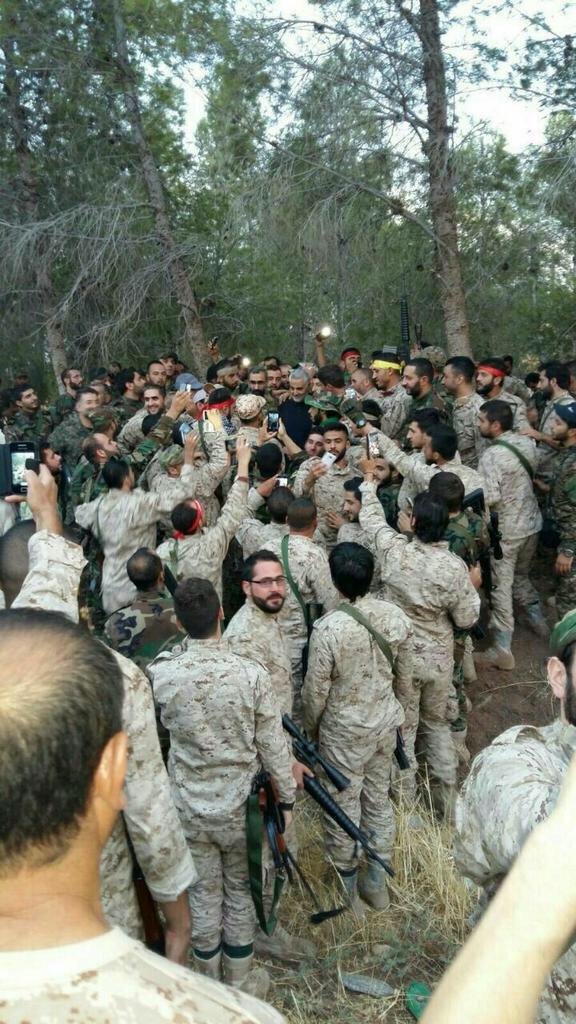
In what appears to have been a morale-boosting effort, General Qassem Soleimani, the commander of Iran’s elite Qods Forces, has made an appearance in a location open to question, where soldiers took the opportunity to take selfies with the man widely viewed as the architect of the current Russian-led campaign.

Facebooktwittermail

Iran sends thousands of troops to Syria to bolster the planned ground offensive in Aleppo

Reuters reports: A delegation of Iranian lawmakers arrived in Damascus on Wednesday in the build-up to a joint operation against insurgents in northwest Syria, and said U.S.-led efforts to fight rebels had failed.

The visit, led by the chairman of the Iranian parliament’s National Security and Foreign Policy Commission, Alaeddin Boroujerdi, came as Iranian troops prepared to bolster a Syrian army offensive that two senior officials told Reuters would target rebels in Aleppo.

The attack, which the officials said would be backed by Russian air strikes, underlined the growing involvement in the civil war of Syrian President Bashar al-Assad’s two main allies, which has alarmed a U.S.-led coalition opposed to the president that is bombing Islamic State militants.

“The international coalition led by America has failed in the fight against terrorism. The cooperation between Syria, Iraq, Iran and Russia has been positive and successful,” Boroujerdi was quoted as saying by Iran’s state broadcaster IRIB as he arrived at Damascus airport.

The delegation was due to meet Assad, said officials.

Iran has sent thousands of troops into Syria in recent days to bolster the planned ground offensive in Aleppo, the two officials told Reuters. [Continue reading…]

Facebooktwittermail

ISIS confirms killing of number two in U.S. air strike

AFP reports: The Islamic State group’s spokesman confirmed on Tuesday the killing of the jihadist organisation’s second in command in a US air strike earlier this year.

“America is rejoicing over the killing of Abu Mutaz al-Qurashi and considers this a great victory,” Abu Mohamed al-Adnani said in an audio recording posted on jihadist websites.

“I will not mourn him… he whose only wish was to die in the name of Allah… he has raised men and left behind heroes who, God willing, are yet to harm America,” he added.

Adnani did not say, however, in what circumstances Qurashi died. [Continue reading…]

Facebooktwittermail

A cyclone brews over Saudi Arabia

David Ignatius writes: An internal political storm is roiling Saudi Arabia, as the crown prince and his deputy jockey for power under an aging King Salman — while some other members of the royal family agitate on behalf of a third senior prince who they claim would have wider family support.

For the secretive oil kingdom, whose internal debates are usually opaque to outsiders, the recent strife has been unusually open. The tension between Crown Prince Mohammed bin Nayef and his deputy, Mohammed bin Salman (the king’s son), is gossiped about across the Arab world. Dissenters from the royal family have begun circulating open letters that have drawn tens of thousands of readers online.

Succession worries were in the background in early September when Salman, 79, visited Washington, accompanied by son Mohammed bin Salman, 30. U.S. officials were eager to meet the young deputy crown prince. But they were concerned that “MBS,” as he’s known, might be challenging Mohammed bin Nayef, who is viewed in Washington as a reliable ally against al-Qaeda. [Continue reading…]

Facebooktwittermail

Why Egypt’s new parliament will be born broken

Nathan J. Brown writes: Over the coming weeks, Egyptians will vote in parliamentary elections in which nobody knows who will win yet everybody knows the result. The regime will then claim (inaccurately) that the “road map” — announced when former president Mohamed Morsi was deposed in July 2013 — has been completed. Few observers have high hopes for the new parliament, but its lackluster future has roots in the state’s complicated past.

Regardless of the results of individual races, the parliament will play the same role: the body will be weak but not toothless; it will be less a rubber stamp than an annoying speed bump for Egypt’s rulers. Virtually everyone is likely to come away disappointed: Egypt’s leaders who show no interest in politics will find a parliament that must be massaged; the opposition will find few points of entry; deputies will enjoy little authority; and voters will find little choice. Egypt’s parliamentary system seems to serve no purpose but appears to have been built on purpose. What is the secret behind the apparently planned obsolescence of the parliament?

This is not a Stalinist election. Multiple candidates and party slates are competing. With a new set of rules, some redrawn boundaries, untested electoral actors and influential local bigwigs jockeying in new alliances, it is difficult to forecast individual races. But the expected outcome — a motley group of politicians, pundits and patrons (but not strong parties) seeking access to resources, platforms for posturing and prestige — remains the same. [Continue reading…]

Facebooktwittermail

KRG ruling party ejects rivals, escalating political crisis in Iraqi Kurdistan

Iraq Oil Report: The Kurdistan Regional Government’s (KRG) ruling party has begun using its control of security forces to unilaterally expel its most potent political rivals from government – dramatically destabilizing a region already roiled by war, economic crisis, and popular discontent.

Security forces answering to the Kurdistan Democratic Party (KDP) of Massoud Barzani, who continues acting as president after the expiration of his term on Aug. 19, prevented KRG Parliament Speaker Yousif Mohammed, a member of the rival Gorran party, from passing a checkpoint into the Kurdish capital of Erbil on Monday. KDP-aligned forces also barred Gorran ministers from entering government offices.

“An effort has been orchestrated as a military coup d’état against the Parliament, a legitimate institution,” Mohammed said. [Continue reading…]

Facebooktwittermail

Russia airstrikes help push Syria rebels closer, for now

The Wall Street Journal reports: Moscow’s intervention in Syria’s multisided civil war has spurred some of the country’s fractious rebels to fight together, offering another shot at a more unified front against the Assad regime and its Russian and Iranian allies.

Since Russian warplanes entered the conflict two weeks ago, three local rebel alliances have emerged across the provinces where President Bashar al-Assad aims to regain ground and consolidate control. Although such alliances have been short-lived in the past, rebels said more were expected in the coming weeks.

Opposition factions including U.S.-backed rebels and Nusra Front, al Qaeda’s affiliate in Syria, have come together to counter a regime offensive across several fronts in the northwest, while others continue to fight Islamic State militants.

On Monday, regime forces briefly retook part of Kafar Nabouda, a rebel-held town in Hama province, which it has been attacking for a week. More than 700 rockets were fired on rebels and Russian planes launched numerous airstrikes, said Abu al-Majid al-Homsi, a commander in Hama with Suqoor al-Ghab, a rebel group that has received training by the Central Intelligence Agency.

But hours later, rebels were able to push them back as a result of tight coordination through a joint command post they established last week, he said.

“Any coalition will benefit the rebels,” said Maj. Yasser Abdolraheem, a commander with Faylaq al-Sham, a moderate group that has fighters in several provinces. “But time and time again problems and differences emerge and they don’t survive.”

Rebel coalitions have formed and disbanded regularly over the 4½-year war, and their ideological and strategic differences remain profound. Rivalries among rebel leaders have also endured, and scores are sometimes settled violently among the rank-and-file.

“You have those kinds of local-unity projects and ad hoc alliances forming all the time, and it’s usually in preparation for when they are going to attack something or for a certain goal or a certain offensive,” said Aron Lund, editor of Syria in Crisis, a website run by the Carnegie Endowment for International Peace, a Washington-based think tank. “Most of these unity experiments tend to either fade away after that goal is achieved or they fade away without that goal being achieved.”

Amid the latest fighting, Islamic State militants also have seized the opportunity to advance against the rebels in some areas. [Continue reading…]

Aymenn al-Tamimi writes: In a joint statement released on 5 October, 41 Syrian rebel factions condemned the “Russian military aggression against the Syrian people,” describing it as a “genuine occupation of the land even if some sides claim that it was done on official request from the Assad regime.” The statement added that the Russian airstrikes in Homs province, which left “approximately 50 martyrs from the civilians,” should be considered Russia’s first war crime in Syria. The statement went on to describe “any forces occupying the land of our beloved homeland” as “legitimate targets,” and repeated the standard mantra of commitment to Syria’s territorial unity, opposing any sort of “partition project,” while concluding with a call on “all armed revolutionary factions” to “unite ranks” and put aside differences.

The language of the statement, especially in referring to Syria as watanina al-habib (Arabic for “our beloved homeland”), excludes groups with transnational jihadist agendas. The signatories include familiar mainstream groups whose vision is confined to the national framework, such as Jaish al-Islam (based primarily in Damascus), Ahrar al-Sham (arguably the single most powerful rebel group in Syria), the Saudi-backed quietist Salafi coalition known as the Authenticity and Development Front and the southern FSA Yarmouk Army. But does this statement actually represent greater unity among these factions? Or will the Russian intervention push rebels toward jihadi factions like Syria’s al-Qaida affiliate Jabhat al-Nusra – as is widely feared?

The answer is that the prospect for real mergers among these signatories is marginal. Whatever impressions of political unity dealings in Turkey and joint online statements might convey, groups on the ground are localized and tend to be divided. The case of Jabhat al-Shamiyya, one of the signatories to the statement, is emblematic of the problem. [Continue reading…]

Facebooktwittermail

Turkey warns U.S., Russia against backing Kurdish militia in Syria

Reuters reports: Turkey has warned the United States and Russia it will not tolerate Kurdish territorial gains by Kurdish militia close to its frontiers in north-western Syria, two senior officials said.

“This is clear cut for us and there is no joking about it,” one official said of the possibility of Syrian Kurdish militia crossing the Euphrates to extend control along Turkish borders from Iraq’s Kurdistan region towards the Mediterranean coast.

Turkey fears advances by Kurdish YPG militia, backed by its PYD political wing, on the Syrian side of its 900 km (560-mile) border will fuel separatist ambitions among Kurds in its own southeastern territories. But Washington has supported YPG fighters as an effective force in combating Islamic State.

“The PYD has been getting closer with both the United States and Russia of late. We view the PYD as a terrorist group and we want all countries to consider the consequences of their cooperation,” one of the Turkish officials said.

Turkey suspects Russia, which launched air strikes in Syria two weeks ago, has also been lending support to the YPG and PYD.

“With support from Russia, the PYD is trying to capture land between Jarablus and Azaz, going west of the Euphrates. We will never accept this,” the official said. [Continue reading…]

Facebooktwittermail

Amnesty: U.S.-backed Kurdish rebels may have committed war crimes in Syria

The Washington Post reports: A new report from human rights group Amnesty International suggests that Kurdish forces in northern Syria, among the most significant U.S. ground partners in the fight against the Islamic State, may have committed war crimes with a campaign of displacement and home demolitions aimed mostly at the local Arab population.

In the report released on Monday, Amnesty says it has found evidence that the local armed group known as the People’s Protection Units – better known by the acronym “YPG” – forced Arabs and Turkmen in northern Syria from their homes on behalf of the Democratic Union Party (PYD), a Kurdish political organization that has held de facto control of northern Syria’s so-called “Autonomous Administration” since January 2014.

“By deliberately demolishing civilian homes, in some cases razing and burning entire villages, displacing their inhabitants with no justifiable military grounds, the Autonomous Administration is abusing its authority and brazenly flouting international humanitarian law, in attacks that amount to war crimes,” Lama Fakih, a senior crisis adviser at Amnesty, said in a statement. [Continue reading…]

Facebooktwittermail

Russian airstrikes allow ISIS to advance

The Guardian reports: Bunkered down in his base just north of Hama, Captain Mustafa of the Free Syria Army (FSA) is getting used to the Russian airstrikes. And he is growing just as accustomed to the assurances of his American backers: “We can have most of the weapons we want,” he says. “But nothing to shoot down the planes.”

More than a week since the Russian strikes began targeting them, and days after the US announced an end to its efforts to train forces to fight Isis, the original anti-Assad rebels of Syria’s north-west remain entrenched, though battered, in the towns and villages of their heartland.

Nearby, Syrian forces, which had barely moved for the past year, are trying to advance from the south, said Mustafa, the military spokesman of an FSA unit, Tajamul Ala’Azza. Further away in the north-east, Isis has made its strongest gains in many months, advancing across the top of Aleppo, while a mix of opposition groups clash nearby with Russian jets and artillery.

“The Russians have given them a boost, which is what they wanted to do by attacking the Syrian people,” said Mustafa. “The biggest disaster for them would be to acknowledge that a real opposition remains defiant and strong.

“Well, we say to the Russian bear that we will chase you to your grave. You don’t know what you’ve got yourself into.”

Among the rebel groups, of northern and western Syria, a reckoning has been taking place ever since Moscow ramped up its efforts to defend Bashar al-Assad’s regime earlier this month. The opposition has been gaming whether its allies would follow suit, giving them the firepower it had long withheld to combat the threat from the skies.

So far the answer is no. “It’s the same as it’s always been,” said Mustafa. “Our supply lines are still open, but we still can’t get any anti-aircraft missiles. The Americans have never changed their position on that.” he sighed. “That’s politics.”

Rebels in the vicinity of the regime strongholds of Tartous and Latakia, and the nearby Alawite hinterland, have been hit especially hard in the Russian offensive which was touted as a campaign against Isis, but which the US, Nato, and rebel groups claim has almost exclusively targeted non-jihadi opposition groups.

Other rebel groups in Idlib province have also been pounded and fear that Russia’s strategy is to destroy the opposition, leaving only the regime army and Isis standing. The Russian offensive west of Aleppo has stymied an opposition squeeze on the city. Meanwhile, Isis’s moves since Thursday have seen the terror group gain more ground than it had in many months. [Continue reading…]

Facebooktwittermail

How pro-Kremlin tweeps are framing the Syrian debate

RFE/RL reports: Support among Russians for military intervention in Syria has more than doubled, to 31 percent in early October from 14 percent in September, according to independent pollster Levada Center.

The increase comes with coverage of air strikes filling Russian state airwaves, press, and the Internet, and social-media salvoes fired from both sides of the debate.

On social networks like Twitter, expressions of support for Moscow’s air raids appear to fit into three distinct categories: perceived cultural and historical affinities between Syria and Russia; purported Western helplessness in the face of the continuing Syrian crisis; and the conflation of any armed forces opposing Syrian President Bashar al-Assad’s regime under the “terrorist” banner. [Continue reading…]

Facebooktwittermail