AFP reports: The ideological leader of Yemen-based Al-Qaeda in the Arabian Peninsula (AQAP) said Friday that France had surpassed the United States as the top enemy of Islam.
With the “weakening” of the United States in recent years, France has replaced America in the “war on Islam,” Ibrahim al-Rubaish said in an audio message published by AQAP’s media arm on YouTube.
US intelligence agencies consider AQAP to be the most dangerous branch of the jihadist network.
One of the group’s ideologues, Nasser bin Ali al-Ansi, has claimed in a video that AQAP was behind the January 7 attack on French satirical weekly Charlie Hebdo that left 12 people dead.
Cartoons of the Prophet Mohammed published by the magazine have angered many Muslims.
Western governments say it remains unclear if AQAP directly orchestrated the attack on the weekly, although they do believe one or both of the attackers, brothers Said and Cherif Kouachi, spent time with jihadists in Yemen. [Continue reading…]
Category Archives: News
ISIS surprises Kurds in Iraq, killing a commander in a day of attacks
The New York Times reports: Exploiting a foggy night as cover, Islamic State militants launched a surprise attack on Iraqi Kurdish positions on the outskirts of Kirkuk early Friday, killing a senior Kurdish commander and at least five of his men, security officials in the city said.
The assault was one of the most aggressive undertaken against Kirkuk in months by the Islamic State, the jihadist group that straddles a large stretch of Iraq and Syria. The city, in northern Iraq, is an oil hub that is seen as central to the aspiration of Iraqi Kurdish leaders and that poses an attractive strategic target for the Islamic State, also known as ISIS or ISIL.
Families fled their homes as the fighting intensified, and at one point, the militants stormed an abandoned hotel in the Kirkuk city center.
The deadly foray on Friday demonstrated the continued ability of Islamic State fighters to harass Iraq’s cities, despite a punishing monthslong campaign by Iraqi forces backed by United States airstrikes to dislodge the extremists. [Continue reading…]
How hostage pilot drama is feeding an antiwar movement in Jordan
Taylor Luck reports: The ongoing drama of a Jordanian pilot held hostage by the Islamic State has escalated into a political crisis for King Abdullah II, threatening the position of a stalwart US ally and leading player in the coalition against the jihadist group.
Jordanians have been gripped by the detention of Lt. Muath Kassasbeh, whose fighter jet crashed near Raqqa, Syria on Dec. 24.
A sunset deadline passed Thursday with the government refusing to pull the trigger on a prisoner swap with the jihadist movement, saying IS had failed to provide proof Lt. Kassasbeh was still alive and well.
Rather than blame IS for the protracted hostage crisis, the public at large and members of the pilot’s family have turned on the government. They are hitting the streets and faulting Amman for putting Jordanians into harm’s way in a war they say is not their own. [Continue reading…]
Stunning astronomical discovery vanishes in cloud of dust
Space.com reports: It is the announcement no one wanted to hear: The most exciting astronomical discovery of 2014 has vanished. Two groups of scientists announced today (Jan. 30) that a tantalizing signal — which some scientists claimed was “smoking gun” evidence of dramatic cosmic expansion just after the birth of the universe — was actually caused by something much more mundane: interstellar dust.
In the cosmic inflation announcement, which was unveiled in March 2014, scientists with the BICEP2 experiment, claimed to have found patterns in light left over from the Big Bang that indicated that space had rapidly inflated at the beginning of the universe, about 13.8 billion years ago. The discovery also supposedly confirmed the existence of gravitational waves, theoretical ripples in space-time.
But in a statement today, scientists with the European Space Agency said that data from the agency’s Planck space observatory has revealed that interstellar dust caused more than half of the signal detected by the Antarctica-based BICEP2 experiment. The Planck spacecraft observations were not yet available last March when the BICEP2 science team made its announcement. [Continue reading…]
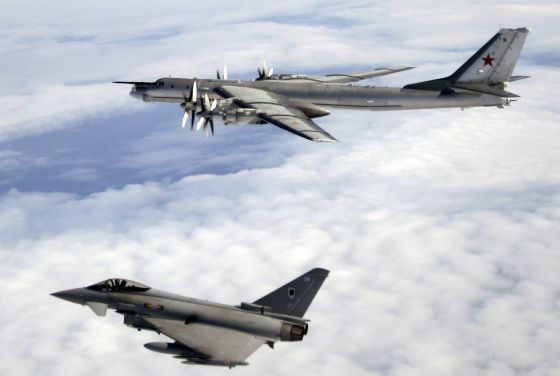
Russian bombers disrupt civil aviation over Britain after Litvinenko murder inquiry opens

Reuters reports: Britain summoned the Russian ambassador on Thursday and asked him to explain why two Russian “Bear” long-range bombers had flown over the English Channel the previous day, forcing British authorities to reroute civil aircraft.
A British government source told Reuters the incident, which forced Britain to scramble Typhoon interceptor jets, was viewed as “a significant escalation” and marked a change in strategy since Russian aircraft had previously largely confined themselves to flying close to Scotland.
“It was very dangerous. Civil aircraft flying to the UK had to be rerouted,” the source said. “The Russians were flying with their transponders turned off so could only be seen on military radar. They haven’t flown this far south before.”
The Foreign Office said it had summoned Russian Ambassador Alexander Yakovenko to account for the incident, saying the episode was part of an increasing pattern of “out of area operations” by Russian aircraft.
“The Russian planes caused disruption to civil aviation. That is why we summoned the Russian Ambassador today to account for the incident,” it said in a statement.
Last year, NATO conducted more than 100 interceptions of Russian aircraft, about three times as many as in 2013, amid increased tensions between the West and Moscow over the Ukraine crisis. [Continue reading…]
The Guardian reports: Observers said a possible explanation of the timing ofWednesday’s flypast was the start this week of a public inquiry in London into the 2006 killing of a former Russian intelligence officer, Alexander Litvinenko, by radioactive poisoning.
The UK has charged two former KGB agents with the murder. A lawyer for Litvinenko’s widow has claimed in court that the assassination was ordered by Vladimir Putin.
“This may be timed with the Litvinenko court case as a signal of displeasure,” Ian Kearns, the director of the European Leadership Network, and an associate fellow at the Royal United Services Institute, said. “But it fits with a wider posture of a more assertive Russian demonstration of a growing capability to defend and assert its interests as it sees fit.”
ISIS affiliate in Egypt claims responsibility for attack that killed 32 in Sinai
Reuters: Egyptian President Abdel Fattah al-Sisi cut short a visit to Ethiopia for an African Union summit on Friday after Islamic State’s Egyptian wing claimed the killing of at least 30 soldiers and police officers in the Sinai Peninsula.
The four separate attacks on security forces in North Sinai on Thursday night were among the bloodiest in years and the first significant assault in the region since the most active Sinai militant group swore allegiance to IS in November.
Militant attacks in Sinai, while far from Cairo and tourist attractions, has crimped government efforts to project an image of stability to woo back foreign investors and tourists driven away by frequent political violence since a popular uprising four years ago that overthrew veteran autocrat Hosni Mubarak.
In strategic shift, U.S. draws closer to Yemeni rebels
The Wall Street Journal reports: The U.S. has formed ties with Houthi rebels who seized control of Yemen’s capital, White House officials and rebel commanders said, in the clearest indication of a shift in the U.S. approach there as it seeks to maintain its fight against a key branch of al Qaeda.
American officials are communicating with Houthi fighters, largely through intermediaries, the officials and commanders have disclosed, to promote a stable political transition as the Houthis gain more power and to ensure Washington can continue its campaign of drone strikes against leaders of the group al Qaeda in the Arabian Peninsula, officials said.
“We have to take pains not to end up inflaming the situation by inadvertently firing on Houthi fighters,” a senior U.S. official said. “They’re not our military objective. It’s AQAP and we have to stay focused on that.”
Washington’s outreach to the Houthis, who in January routed forces loyal to President Abed Rabbo Mansour Hadi, a close American ally, represents a contrast from years of U.S. support for the Hadi government, which the Houthis have opposed.
The shift also could place it on the same side as Iran in the Yemen conflict. The Houthis are drawn from their country’s Zaidi population. Zaidis, who by some estimates make up roughly a third of the population, practice a form of Shiite Islam and are concentrated in northwest Yemen. U.S. officials believe the militia has received considerable funding and arms from Shiite-dominated Iran, something Houthi leaders have variously confirmed and denied.
White House and State Department officials confirmed to The Wall Street Journal the contacts with the Houthis, but stressed they were focused on promoting political stability in Yemen and safeguarding the security of Americans. [Continue reading…]
Ancient skull sheds light on human dispersal out of Africa
Ivan Semeniuk reports: Francesco Berna still remembers his first visit to Manot Cave, accidentally discovered in 2008 on a ridge in northern Israel. A narrow passage steeply descends into darkness. It then opens onto a 60-metre-long cavern with side chambers, all dramatically ornamented with stalactites and stalagmites.“It’s a spectacular cave,” said Dr. Berna, a geoarcheologist at Simon Fraser University in Burnaby, B.C. “It’s basically untouched.”
Now Manot Cave has yielded a tantalizing sign of humanity’s initial emergence out of Africa and a possible forerunner of the first modern humans in Europe, an international team of researchers that includes Dr. Berna said on Wednesday.
The find also establishes the Levant region (including Israel, Lebanon and part of Syria) as a plausible setting where our species interbred with its Neanderthal cousins.
The team’s key piece of evidence is a partial human skull found during the initial reconnaissance of the cave.
Based on its features and dimensions, the skull is unquestionably that of an anatomically modern human, the first such find in the region. The individual would probably have looked like the first Homo sapiens that appeared in Africa about 200,000 years ago and been physically indistinguishable from humans today.
“He or she would look very modern. With a tie on, you would not be able to tell the difference,” said Israel Hershkovitz, a biological anthropologist at Tel Aviv University and lead author of a paper published this week in the journal Nature that documents the Manot Cave find.
The age of the fossil is the crucial detail. The team’s analysis shows it is about 55,000 years old. That is more recent than the fragmentary remains of some not-so-modern-looking humans that drifted into the region at an earlier stage. But it coincides exactly with a period when a wetter climate may have opened the door to the first modern human migration out of Africa.
Fossils of modern humans that are only slightly less old than the Manot Cave skull have been found in the Czech Republic and Romania, making the new find a potential forerunner of the first Europeans. [Continue reading…]
Much of the reporting on these findings makes reference to “the first Europeans” and even though anthropologists might be clear about what they mean when they use to term Europe, they might consider avoiding using it, given the common meaning that is usually attached to the word.
Indeed, the lead researcher cited above, Israel Hershkovitz, illustrates the problem as he reinforces cultural stereotypes by implying that the human has fully evolved once he adorns the symbol of European, masculine power: a necktie. The irony is compounded by the fact that he and his team were trumpeting the significance of their discovery of a woman’s skull.
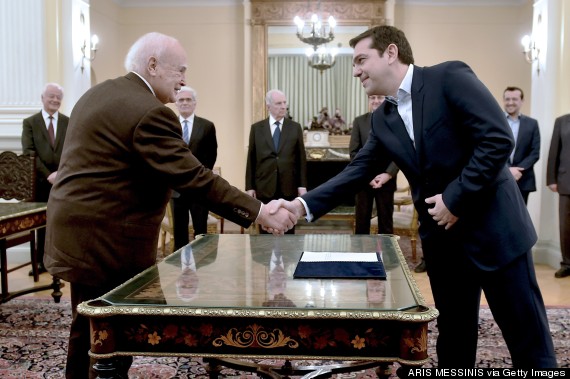
(No doubt many Europeans and others with European affectations have been disturbed this week to see Greece’s new prime minister, in the birthplace of democracy, assuming power without a necktie.)
The Oxford archeologist, Barry Cunliffe, has referred to the region of land that recently got dubbed “Europe” as “the westerly excrescence of the continent of Asia.”
Europeans might object to the suggestion that they inhabit an excrescence — especially since the terms suggests an abnormality — but in terms of continental topography, it points to Europe’s unique feature: its eastern boundaries have always been elastic and somewhat arbitrary.
More importantly, when it comes to human evolution, to frame this in terms of the advance into Europe revives so many echoes of nineteenth century racism.
It cannot be overstated that the first Europeans were not European.
Europe is an idea that has only been around for a few hundred years during which time it has been under constant revision.
Migration is also a misleading term since it evokes images of migrants: people who travel vast distances to inhabit new lands.
Human dispersal most likely involved rather short hops, one generation at a time, interspersed with occasional actual migrations driven by events like floods or famine.

Global democracy is in retreat
The Guardian reports: Global democracy is at greater risk than at any time in the past 25 years, according to a landmark report by the independent watchdog Freedom House.
In the annual report, Discarding Democracy: Return to the Iron Fist, the Washington-based group said 61 countries were going backwards as far as democracy was concerned, compared with only 33 moving forwards. Moreover, some of the transgressors, including Russia, Egypt, Thailand, Nigeria and Turkey, are global or regional powers setting a bad example to others, it said.
Its findings come despite the fact that 2014 was a record year for democracy, with more people casting votes in national ballots than ever before. But holding elections does not always translate into healthy democracy. As the authoritarian Hungarian leader, Viktor Orban, put it: “A democracy does not necessarily have to be liberal.”
“Acceptance of democracy as the world’s dominant form of government – and of an international system built on democratic ideals – is under greater threat than at any other point in the last 25 years,” said Arch Puddington, vice-president for research at Freedom House. [Continue reading…]
Facebook censorship more tangible than its support for free speech
Caitlin Dewey writes: Only two weeks after Facebook CEO Mark Zuckerberg released a strongly worded #JeSuisCharlie statement on the importance of free speech, Facebook has agreed to censor images of the prophet Muhammad in Turkey — including the very type of image that precipitated the Charlie Hebdo attack.
It’s an illustration, perhaps, of how extremely complicated and nuanced issues of online speech really are. It’s also conclusive proof of what many tech critics said of Zuckerberg’s free-speech declaration at the time: Sweeping promises are all well and good, but Facebook’s record doesn’t entirely back it up.
Just this December, Facebook agreed to censor the page of Russia’s leading Putin critic, Alexei Navalny, at the request of Russian Internet regulators. (It is a sign, the Post’s Michael Birnbaum wrote from Moscow, of “new limits on Facebook’s ability to serve as a platform for political opposition movements.”) Critics have previously accused the site of taking down pages tied to dissidents in Syria and China; the International Campaign for Tibet is currently circulating a petition against alleged Facebook censorship, which has been signed more than 20,000 times. [Continue reading…]
Saudi Arabia classified security documents leaked on Twitter
Al-Akhbar reports: The Mufti of Saudi Arabia was right on the mark when he recently said that Twitter was a source of “evil” and a “scourge” for his kingdom. Secret Saudi documents from the interior and defense ministries were leaked on Twitter on Tuesday.
The documents reveal much about the Saudi government’s efforts to spy on its citizens and monitor their accounts, as well as details on arrest warrants and detention of individuals who called for political reform, and the “royal hysteria” over otherwise unremarkable articles published online.
Saudi Arabia being a police state won’t come as news to most people. What is new, however, is that the public can now examine the kingdom’s administrative mechanisms for spying and surveillance — thanks to classified documents leaked on social media sites.
A twitter account called “Monaseron” posted the documents on Tuesday. The account claimed that the set of documents came from the Saudi ministries of interior and defense. [Continue reading…]
ACLU asks judge to block attempt to repossess copies of CIA torture report
The Guardian reports: The American Civil Liberties Union is turning to federal court to stop the chairman of the Senate intelligence committee from repossessing the secret copies of a landmark inquiry into CIA torture.
In an emergency motion filed late on Tuesday, the ACLU asked Judge James Boasberg of the District of Columbia federal district to prevent Senator Richard Burr’s “extraordinary post-hoc request” for all copies of the full, classified 6,900-page report currently held by the Obama administration.
It is part of a persistent effort from human rights groups to keep up pressure for disclosure over one of the most infamous episodes in CIA history, despite moves by both the committee and the CIA to move on.
“The full torture report is critical for meaningful public scrutiny of the CIA’s horrific acts, as well as its lies and evasions to Congress, the courts, and the American public,” said the ACLU attorney Hina Shamsi.
The battle highlights the partisan differences over CIA torture and the investigation of it. The report was produced when the committee was led by the California Democrat Dianne Feinstein. Once Burr, a North Carolina Republican, took over the committee, he moved almost immediately to keep the full report permanently under wraps. [Continue reading..]
MI5 says rendition of Libyan opposition leaders strengthened al Qaeda
The Guardian reports: A secret UK-Libyan rendition programme in which two Libyan opposition leaders were kidnapped and flown to Tripoli along with their families had the effect of strengthening al-Qaida, according to an assessment by the UK security service, MI5.
Prior to their kidnap, Abdel Hakim Belhaj and Sami al-Saadi had ensured that their organisation, the Libyan Islamic Fighting Group (LIFG), focused on the overthrow of Colonel Gaddafi, the classified assessment says. Once handed over to the Gaddafi regime, their places at the head of the LIFG were taken by others who wanted to bring the group closer to al-Qaida.
The two men were seized in Thailand and Hong Kong in March 2004 with the assistance of the UK’s intelligence service MI6, and were “rendered” to Tripoli along with Belhaj’s pregnant wife and Saadi’s wife and four children, the youngest a girl aged six.
In an assessment made 11 months later, MI5 concluded that the capture of the pair had cast the group “into a state of disarray”, adding: “While these senior-ranking members have always jealously guarded the independence of the LIFG, providing it with a clear command structure and set goals, the group is now coming under pressure from outside influences.
“In particular, reporting indicates that members including Abu Laith al-Libi and Abdallah al-Ghaffar may be pushing the group towards a more pan-Islamic agenda inspired by AQ [al-Qaida].” [Continue reading…]
Fear and loathing: Argentina’s infamous spy agency
BBC News reports: The death in Argentina of special prosecutor Alberto Nisman, who was found with a bullet in his head hours before presenting evidence before Congress against President Cristina Fernandez de Kirchner, has led to plans to overhaul Argentina’s infamous intelligence service.
Days after Mr Nisman’s body was found on 18 January, Ms Fernandez said his death was part of an intelligence “operation” to harm her government.
On Monday, Ms Fernandez announced the creation of a new body to replace the Intelligence Secretariat (SI), more widely known by its previous initials, Side.
She said the leadership of the new Federal Intelligence Agency would be chosen by the government but would be subject to senate approval.
“We must work to reform the Argentine intelligence system because the one we have has not served the interests of the nation,” she announced in a national address.
The SI is one of Argentina’s most feared and hated state agencies. [Continue reading…]
The New York Times reports: Argentina’s government on Wednesday cast greater suspicion on an aide to Alberto Nisman, the prosecutor whose mysterious death this month has shaken the country, by describing the aide as an intelligence operative — adding to its assertions that rogue spies were involved in the events around Mr. Nisman’s death.
“This kid’s situation is starting to look worrisome,” Aníbal Fernández, the president’s chief of staff, told reporters here Wednesday morning, referring to the aide, Diego Lagomarsino, 35.
Mr. Lagomarsino worked in the prosecutor’s investigative unit as an information technology consultant and lent Mr. Nisman the .22-caliber Bersa pistol used in his death, investigators say. [Continue reading…]
Escalation would benefit neither Israel nor Hezbollah
The Daily Star reports: Within the space of a few hours, two Israeli soldiers were dead, and Wednesday had turned from just another weekday to the day that Lebanese started asking themselves: Are we about to see a repeat of 2006?
That year saw a full-on war with Israel develop following a deadly cross-border attack by Hezbollah on an Israeli patrol. The 2006 war, which ended up costing more than 1,000 lives and severely damaging infrastructure across the country, came after years of “tit-for-tat” incidents between the two sides as part of a carefully calibrated game for which both sides thought they knew the rules.
The name of the unit that attacked an Israeli convoy in the occupied Shebaa Farms Wednesday, killing two and wounding seven others, was the Qunaitra Martyrs – a clear reference to the airstrike last week on a Hezbollah vehicle in Qunaitra, Syria.
That attack killed six party fighters, including the highly symbolic Jihad Mughniyeh – son of assassinated commander Imad – and a senior Iranian military figure. Everyone knew that Hezbollah would have to retaliate.
As a result, most have interpreted the Shebaa Farms incident as part of the contained mini-war between the two sides. But could Hezbollah have been looking for something more following such a bold and humiliating attack on its troops in Syria? Or could their response accidentally have paved the way for something bigger, as it did back in 2006, due to unpredictable internal Israeli factors?
“Never rule out war between these two antagonists,” said Bilal Saab, a senior fellow for Middle East security at the Atlantic Council. “But Hezbollah has already done what it wanted to do: a limited, deadly and precise attack.”
He pointed to the significance of Hezbollah’s decision to respond to the Qunaitra attack from the Shebaa Farms, a heavily disputed territory in the Israeli-occupied Syrian Golan Heights that Lebanon claims as its own.
“The very choice of geography shows the organization does not want to escalate,” Saab said. “It’s cautious, the choice of Shebaa, it means we are back to the previous rules of engagement, which were stable until 2006, when everything broke down.”
“It didn’t attack inside Israel, or inside Syria in the Golan Heights. Hezbollah is not after major escalation, if it was, it could have done much, much more, and Israel understands this,” he added. [Continue reading…]
Ron Ben-Yishai writes: Hezbollah’s “achievement” Wednesday was to shed the blood of Israeli soldiers. Even by Lebanese criteria, this is barely a tactical achievement. For Israel it is – and rightly so – hard to come to terms with the death and injury of its soldiers, but grief in itself does not justify a move that would cause tens and hundreds of deaths and injuries on the Israeli side if and when a third Lebanon war breaks out. This is a cold and cruel consideration – but someone has to do it.
Another consideration is the composition of the government and cabinet. After the dismissal of the Yesh Atid and Hatnua ministers, the security cabinet is purely rightwing; it is devoid of legitimacy and a balance that is vital to decisions on war and peace.
The final consideration concerns the upcoming elections. If the present government decides on a harsh response that would trigger a major escalation, it would almost immediately be accused of dragging Israel into a political war designed to serve the ends of Netanyahu, Avigdor Lieberman and Naftali Bennett. No rational arguments, strategic justifications and considerations of national pride would help Israel’s current political leadership. They would suffer a defeat at the polls.
Hezbollah ambush kills at least 2 Israeli soldiers
The Daily Star reports: Hezbollah fighters attacked an Israeli military convoy Wednesday in the occupied Shebaa Farms, in south Lebanon, killing at least two soldiers and wounding seven, in retaliation for Israel’s recent airstrike in the Golan Heights.
A U.N. Spanish peacekeeper was also killed in the heavy exchange of fire that followed the Hezbollah attack, as UNIFIL commander Maj. Gen. Luciano Portolano urged “maximum restraint” from all parties to prevent escalation on the Lebanese-Israeli frontier.
Media reports had earlier said that four Israeli soldiers were killed in the attack.
A security source told The Daily Star that 30 shells were fired from the Israeli side across the Lebanese border following the 11:30 a.m. attack that struck a convoy, destroying at least two vehicles. Hezbollah’s Al-Manar TV said the attack destroyed 9 vehicles.
Hezbollah claimed the attack on the Israeli military convoy in a statement.
“At 11:25 [Wednesday morning] the Qunaitra Martyrs unit targeted with appropriate missile weapons an Israeli military convoy comprising several vehicles and [transporting] Zionist officers and soldiers causing the destruction of several vehicles and inflicting many casualties on the enemy,” the brief statement read.
According to Israeli media, a number of Israeli Army troops were being treated with “light-to-moderate wounds” at a hospital in Safed.
About two hours after the initial attack, Israeli warplanes carried out mock air raids over the scene of the attack as their soldiers lobbed shells into Shebaa Farms and the surrounding hills.
Israeli Prime Minister Benjamin Netanyahu threatened to make Hezbollah “pay” for the attack.
“Those behind the attack today will pay the full price,” Netanyahu said, after cutting a trip to Sderot short to visit the Defense Ministry for “consultations.” [Continue reading…]
Litvinenko lawyer accuses Putin of running ‘mafia state’
The Guardian reports: Vladimir Putin is a “common criminal dressed up as a head of state” who presides over a mafia regime and who personally authorised the sensational murder eight years ago of the former Russian spy Alexander Litvinenko, a public inquiry heard on Tuesday.
On the first day of the inquiry at the high court in London, Ben Emmerson QC, acting for Litvinenko’s widow, Marina, said the Russian had been the victim of a “horrifying” political assassination. He said Moscow had decided to silence Litvinenko after he threatened to expose links between Putin and Europe’s largest organised crime group.
Two former KGB agents – Andrei Lugovoi and Dmitry Kovtun – allegedly murdered Litvinenko after meeting him on 1 November 2006 at the Millennium hotel in central London. They slipped radioactive polonium-210 into his green tea. That both men were the killers was beyond any “reasonable doubt”, Emmerson said.
In scathing terms, Emmerson suggested that Litvinenko was the victim of a dysfunctional state in which criminals and politicians had merged. “The trail of polonium traces leads not just from London to Moscow but directly to the door of Vladimir Putin’s office,” he said. “Mr Putin should be unmasked by the inquiry as nothing more than a common criminal dressed up as a head of state.” [Continue reading…]
Inside Kobane
'Inside Kobane'. How @Kilicbil brought back first images from Syria town. #photojournalism http://t.co/5Q653xsiVo pic.twitter.com/2nlMvHundz
— AFP Correspondent (@AFPblogs) January 28, 2015
Bulent Kilic writes: We’ve been waiting for two days to get into Kobane, ever since Kurdish fighters wrested back the town from IS jihadists. Finally, this morning, the Turkish authorities say they will allow us access for a few hours. The police take down our names, and we’re escorted over the border into Kobane, about 20 reporters from Turkish and foreign media. [Continue reading…]