Wired reports: The Supreme Court today rejected a challenge to the National Security Agency’s once-secret telephone metadata spying program.
The justices, without comment, declined to entertain a challenge from the Electronic Privacy Information Center seeking to halt the program that was disclosed in June by NSA leaker Edward Snowden.
The court’s inaction means that the there isn’t likely to be any court resolution to constitutional challenges to the metadata program for years. Legislation, however, is pending to gut the program.
What’s more, several cases challenging the snooping are pending in federal courts across the country. EPIC’s petition was unusual in that it went directly to the Supreme Court without first being litigated in the lower courts.
The Washington, D.C. based non-profit privacy group went straight to the justices after Snowden’s leak because of the gravity of the phone spying, which includes telephone companies having to provide the NSA the phone numbers of both parties involved in all calls, the International Mobile Subscriber Identity (IMSI) number for mobile callers, calling card numbers used in the call, and the time and duration of the calls. [Continue reading…]
Category Archives: News
In Germany, legacy of Stasi puts different perspective on NSA spying
The Washington Post reports: The secret police, or Stasi, roped in an estimated 190,000 part-time, secret informants and employed an additional 90,000 officers full time – in total, more than one in every 50 adult East Germans as of 1990. East Germans who dared to criticize their government — even to a spouse, a best friend or a pastor — could wind up disappearing into its penal system for years.
In east Berlin sits the former Hohenschoenhausen prison, which was reserved for East Germany’s most politically sensitive cases.
Hubertus Knabe — a West German who smuggled banned books into the East, and later discovered that he had been betrayed by a priest who had encouraged him to do so — now has a plate-glass view of the most perilous destination for victims of Stasi surveillance. He is the director of the prison museum, which is hidden away in a Berlin neighborhood whose rows of imposing apartment blocks still house many former Stasi officers.
Knabe said the consequences of the Stasi’s excesses were far more devastating than anything ever associated with the NSA. “They forget what it’s like to live in a dictatorship versus a democracy,” he said of people who say that the NSA has behaved like the Stasi.
Former inmates now lead tours of the dank, tiny cells in which they were incarcerated, and they say they sometimes run into their old tormenters on the street or at the grocery store.
Many Germans — from both sides of the German border, since East German spying reached deep into its sibling country — have thick Stasi files that they can now request to see. More painfully, they can also learn which of their friends or associates did the collecting of information in those files.
Thousands of people who were collaborators have been chased from public life. Even now, new accusations of Stasi associations can dog politicians and celebrities around Germany.
“We hear that the Stasi was some kind of dilettante agency compared to the NSA,” since the NSA is probably collecting more data overall than the East Germans did, Knabe said. “But East Germans know that the Stasi was a lot worse.”
Knabe said the East German system created a level of fear that few of his fellow citizens truly have about the American spy efforts. Nevertheless, he said, there were other similarities. He has filed a criminal complaint about the NSA spying in a German court.
“The western system punished someone when they had committed a crime. The eastern system punished people when they were only thinking about committing a crime,” he said. If the NSA’s material starts being used not just for counterterrorism efforts but for other kinds of preemptive crime-fighting, he said, “that would be a completely different type of state.”
According to an ARD-Infratest dimap poll released Friday, just 35 percent of Germans find the U.S. government trustworthy, second only to Russia as a target of mistrust. [Continue reading…]
The high cost of the Pentagon’s bad bookkeeping
Part One — How the Pentagon’s payroll quagmire traps America’s soldiers:
As Christmas 2011 approached, U.S. Army medic Shawn Aiken was once again locked in desperate battle with a formidable foe. Not insurgents in Iraq, or Taliban fighters in Afghanistan – enemies he had already encountered with distinguished bravery.This time, he was up against the U.S. Defense Department.
Aiken, then 30 years old, was in his second month of physical and psychological reconstruction at Fort Bliss in El Paso, Texas, after two tours of combat duty had left him shattered. His war-related afflictions included traumatic brain injury, severe post-traumatic stress disorder (PTSD), abnormal eye movements due to nerve damage, chronic pain, and a hip injury.
But the problem that loomed largest that holiday season was different. Aiken had no money. The Defense Department was withholding big chunks of his pay. It had started that October, when he received $2,337.56, instead of his normal monthly take-home pay of about $3,300. He quickly raised the issue with staff. It only got worse. For all of December, his pay came to $117.99.
All Aiken knew was that the Defense Department was taking back money it claimed he owed. Beyond that, “they couldn’t even tell me what the debts were from,” he says.
At the time, Aiken was living off base with his fiancee, Monica, and her toddler daughter, while sharing custody of his two children with his ex-wife. As their money dwindled, the couple began hitting church-run food pantries. Aiken took out an Army Emergency Relief Loan to cover expenses of their December move into a new apartment. At Christmas, Operation Santa Claus provided the family with presents – one for each child, per the charity’s rules.
Eventually, they began pawning their possessions – jewelry, games, an iPhone, and even the medic bag Aiken used when saving lives in Afghanistan. The couple was desperate from “just not knowing where food’s going to come from,” he says. “They just hit one button and they take your whole paycheck away. And then you have to fight to get the money back.”
Aiken’s injuries made that fight more difficult. He limped from office to office to press his case to an unyielding bureaucracy. With short-term and long-term memory loss, he struggled to keep appointments and remember key dates and events. His PTSD symptoms alienated some staff. “He would have an outburst … (and) they would treat him as if he was like a bad soldier,” says Monica. “They weren’t compassionate.”
They were also wrong. The money the military took back from Aiken resulted from accounting and other errors, and it should have been his to keep. Further, even after Aiken complained, the Defense Department didn’t return the bulk of the money to Aiken until after Reuters inquired about his case. [Continue reading…]
Part Two — Behind the Pentagon’s doctored ledgers, a running tally of epic waste:
Linda Woodford spent the last 15 years of her career inserting phony numbers in the U.S. Department of Defense’s accounts.Every month until she retired in 2011, she says, the day came when the Navy would start dumping numbers on the Cleveland, Ohio, office of the Defense Finance and Accounting Service, the Pentagon’s main accounting agency. Using the data they received, Woodford and her fellow DFAS accountants there set about preparing monthly reports to square the Navy’s books with the U.S. Treasury’s – a balancing-the-checkbook maneuver required of all the military services and other Pentagon agencies.
And every month, they encountered the same problem. Numbers were missing. Numbers were clearly wrong. Numbers came with no explanation of how the money had been spent or which congressional appropriation it came from. “A lot of times there were issues of numbers being inaccurate,” Woodford says. “We didn’t have the detail … for a lot of it.”
The data flooded in just two days before deadline. As the clock ticked down, Woodford says, staff were able to resolve a lot of the false entries through hurried calls and emails to Navy personnel, but many mystery numbers remained. For those, Woodford and her colleagues were told by superiors to take “unsubstantiated change actions” – in other words, enter false numbers, commonly called “plugs,” to make the Navy’s totals match the Treasury’s.
Jeff Yokel, who spent 17 years in senior positions in DFAS’s Cleveland office before retiring in 2009, says supervisors were required to approve every “plug” – thousands a month. “If the amounts didn’t balance, Treasury would hit it back to you,” he says.
After the monthly reports were sent to Treasury, the accountants continued to seek accurate information to correct the entries. In some instances, they succeeded. In others, they didn’t, and the unresolved numbers stood on the books.
At the DFAS offices that handle accounting for the Army, Navy, Air Force and other defense agencies, fudging the accounts with false entries is standard operating procedure, Reuters has found. And plugging isn’t confined to DFAS (pronounced DEE-fass). Former military service officials say record-keeping at the operational level throughout the services is rife with made-up numbers to cover lost or missing information. [Continue reading…]
The challenge of removing Syria’s chemical weapons
The New York Times reports: A plan announced over the weekend for getting the bulk of Syria’s chemical weapons out of the country in coming weeks has raised major concerns in Washington, because it involves transporting the weapons over roads that are battlegrounds in the country’s civil war and loading them onto a ship that has no place to go.
Security for the shipments is being provided entirely by Syrian military units loyal to President Bashar al-Assad, who has surprised American officials with how speedily he has complied with an agreement brokered by Russia to identify and turn over his chemical weapon stockpiles. Intelligence analysts and Pentagon officials say the shipments will be vulnerable to attack as they travel past the ruins of a war that has raged for two and a half years.
Asked over the weekend what the backup plan would be if the chemical weapons components were attacked by opposition forces linked to Al Qaeda, or even elements of Mr. Assad’s own forces, a senior American official said: “That’s the problem — no one has attempted this before in a civil war, and no one is willing to put troops on the ground to protect this stuff, including us.”
Another official noted that the choice now facing the United States and other nations was to “either leave the stuff in place and hope for the best, or account for it, get it out of there, and hope for the best. That’s the ‘least worst’ option.”
A range of current and former administration and Pentagon officials discussed the risks of moving the Syrian chemical munitions on the condition of anonymity. Most were reluctant to even disclose their concerns, because of the delicacy of the continuing operations to clear the country of chemical weapons. Even if the chemicals make it safely to a Syrian port and are loaded on cargo ships to be taken out of Syrian territory by the deadlines set in the agreement — Dec. 31 for the most critical material, Feb. 5 for most of the rest — the problems would hardly be over.
On Friday, Albania turned down an appeal by the United States to destroy the weapons on its territory, after thousands of Albanians took to the street in protest. Norway rejected an earlier request, saying it did not have the expertise or the facilities to destroy the weapons. The issue caused a major political dispute there as well.
As a result, Syria’s chemical weapons material may be on the high seas for a long time, as officials seek a country willing and able to destroy it. Already there are fears that the cargo ships bearing the material could become the weapons equivalent of a barge loaded with garbage that left Long Island in 1987 but could not find a place to unload for four months. American law prohibits the importation of chemical weapons for destruction here, and Russia says it is still overwhelmed by the task of destroying its own stockpiles. [Continue reading…]
Since the primary threat posed by these weapons (other than the threat they posed to Syria’s own population) was to Israel and since Israel is the primary beneficiary of Syria being disarmed, why not destroy the chemical weapons in Israel rather than transport them any greater distance?
Qatar migrant workers ‘treated like animals’
BBC News reports: Qatar’s construction sector is rife with abuse, Amnesty International (AI) has said in a report published as work begins on Fifa World Cup 2022 stadiums.
Amnesty says migrant workers are often subjected to non-payment of wages, dangerous working conditions and squalid accommodation.
The rights group said one manager had referred to workers as “animals”.
Qatari officials have said conditions will be suitable for those involved in construction of World Cup facilities.
It has not yet commented on the latest report.
Amnesty said it conducted interviews with 210 workers, employers and government officials for its report, The Dark Side of Migration: Spotlight on Qatar’s construction sector ahead of the World Cup. [Continue reading…]
Leader of prominent Syrian rebel group dies of wounds from strike last week
The Associated Press reports: The leader of one of Syria’s most prominent rebel units died early Monday of wounds sustained during a strike by government forces last week, his group said, dealing another blow to fighters reeling from a series of recent battlefield losses.
The death of Abdul-Qadir Saleh, founder of the Tawhid Brigade, followed advances by President Bashar Assad’s troops against rebels on two key fronts: the capture of a string of opposition-held suburbs south of Damascus and the taking of two towns and a military base outside the northern city of Aleppo.
An ongoing offensive meanwhile is driving hundreds of refugees into neighboring Lebanon, as government forces seek to dislodge rebels from a mountainous area that stretches north of the Syrian capital. A total of 6,000 have crossed to a Lebanese border town over the last three days, the U.N. says.
The Tawhid Brigade is one of Syria’s best known and powerful rebel groups, with an estimated 10,000 fighters, and is particularly strong in Aleppo province. Under Saleh’s command, the group last year spearheaded a rebel push that seized large sections of the provincial capital Aleppo. [Continue reading…]
Libyan official abducted amid unrest in Tripoli
The New York Times reports: The deputy chief of Libya’s intelligence service was abducted from the parking lot of the airport in Tripoli on Sunday afternoon as a standoff between militias and a general strike against militia rule virtually shut down the city.
The deputy intelligence chief, Mustafa Noah, was abducted just two days after a militia from the coastal city of Misurata opened fire on a nonviolent demonstration against the domination of Tripoli, Libya’s capital, by such armed brigades. The confrontation degenerated into a shootout that killed at least 43 and wounded hundreds, according to Libyan health officials.
Many across Libya called the weekend a watershed for the vexed revolution that ousted Col. Muammar el-Qaddafi two years ago. It brought the first large demonstration by residents of the capital against the freewheeling militias that arrived to help oust Colonel Qaddafi and never left the city, and it posed a major test of the weak transitional government’s ability to control the militias. Around nightfall on Sunday, a local council in Misurata said in a statement that all its fighters had withdrawn from the capital.
Today the Associated Press reports that Noah has been released.
State of emergency declared in Libyan capital
Al Jazeera reports: A 48-hour state of emergency has been declared in the Libyan capital, Tripoli, after a fresh wave of clashes broke out following a deadly protest against armed groups.
At least one person was killed and dozens wounded in Saturday’s clashes that took place a day after more than 40 people were killed in firing by gunmen.
Saturday’s gun battles broke out to the east of the capital in Tajoura, where rival gunmen clashed at checkpoints set up to stop more gunmen nearby city of Misrata from entering Tripoli, Mohammad Sasi, a local member of Libya’s congress said.
Thousands of protesters gathered in the city centre to mourn those killed in Friday’s attack when militias fired on a crowd urging the dissolution of unlawful armed groups.
Mourners called on their government to resign and armed militias to leave the city. [Continue reading…]
GCHQ monitors hotel reservations to track diplomats
Der Spiegel reports: Britain’s GCHQ intelligence service monitors diplomats’ travels using a sophisticated automated system that tracks hotel bookings. Once a room has been identified, it opens the door to a variety of spying options.
When diplomats travel to international summits, consultations and negotiations on behalf of governments, they generally tend to spend the night at high-end hotels. When they check-in, in addition to a comfortable room, they sometimes get a very unique form of room service that they did not order: a thorough monitoring by the British Government Communications Headquarters, or GCHQ in short.
Intelligence service documents from the archive of NSA whistleblower Edward Snowden show that, for more than three years, GCHQ has had a system to automatically monitor hotel bookings of at least 350 upscale hotels around the world in order to target, search and analyze reservations to detect diplomats and government officials.
The top secret program carries the codename “Royal Concierge,” and has a logo showing a penguin wearing a crown, a purple cape and holding a wand. The penguin is apparently meant to symbolize the black and white uniform worn by staff at luxury hotels. [Continue reading…]
Egypt’s Brotherhood offers talks to end Morsi crisis
AFP reports: An Islamist coalition led by the Muslim Brotherhood on Saturday offered negotiations to end the deadly tumult since Egyptian president Mohamed Morsi’s overthrow, without explicitly insisting on his reinstatement.
The coalition “calls on all revolutionary forces and political parties and patriotic figures to enter a deep dialogue on exiting the current crisis,” it said in a statement.
The proposal comes after more than 1,000 people, mostly Morsi supporters, were killed in clashes with police and thousands more arrested following his overthrow by the military on July 3.
The coalition, which has organised weekly protests despite the crackdown, insisted in its statement on keeping up “peaceful opposition”, but said it wanted a “consensus for the public good of the country”.
Much of the Brotherhood’s leadership has been put on trial, including Morsi himself.
“We have no conditions, and neither should they,” Imam Youssef, a leader of the Islamist coalition member the Asala party, told AFP.
But he said the talks must lead to a “democratic” solution, and the coalition wanted them to start within two weeks.
The Islamists were prepared to respect the demands of the millions of protesters who called for Morsi’s ouster, Youssef said.
“We want a democratic solution, and it does not necessarily mean we have to be in power,” he added. [Continue reading…]
Jeremy Hammond: FBI directed my attacks on foreign government sites
The Guardian reports: The Anonymous hacktivist sentenced on Friday to 10 years in federal prison for his role in releasing thousands of emails from the private intelligence firm Stratfor has told a Manhattan court that he was directed by an FBI informant to break into the official websites of several governments around the world.
Jeremy Hammond, 28, told a federal court for the southern district of New York that a fellow hacker who went under the internet pseudonym “Sabu” had supplied him with lists of websites that were vulnerable to attack, including those of many foreign countries. The defendant mentioned specifically Brazil, Iran and Turkey before being stopped by judge Loretta Preska, who had ruled previously that the names of all the countries involved should be redacted to retain their secrecy.
Within a couple of hours of the hearing, the three countries had been identified publicly by Forbes, the Huffington Post and Twitter feeds serving more than a million followers. “I broke into numerous sites and handed over passwords and backdoors that enabled Sabu – and by extension his FBI handlers – to control these targets,” Hammond told the court.
The 28-year-old hacker has floated the theory in the past that he was used as part of an effective private army by the FBI to target vulnerable foreign government websites, using the informant Sabu – real name Hector Xavier Monsegur – as a go-between. Sabu, who was a leading figure in the Anonymous-affiliated hacking group LulzSec, was turned by the FBI into one of its primary informants on the hacker world after he was arrested in 2011, about six months before the Stratfor website was breached. [Continue reading…]
WikiLeaks publishes secret trade text to rewrite copyright laws, limit internet freedom
Wikileaks: On November 13, 2013, WikiLeaks released the secret negotiated draft text for the entire TPP (Trans-Pacific Partnership) Intellectual Property Rights Chapter. The TPP is the largest-ever economic treaty, encompassing nations representing more than 40 per cent of the world’s GDP. The WikiLeaks release of the text comes ahead of the decisive TPP Chief Negotiators summit in Salt Lake City, Utah, on 19-24 November 2013. The chapter published by WikiLeaks is perhaps the most controversial chapter of the TPP due to its wide-ranging effects on medicines, publishers, internet services, civil liberties and biological patents. Significantly, the released text includes the negotiation positions and disagreements between all 12 prospective member states.
The TPP is the forerunner to the equally secret US-EU pact TTIP (Transatlantic Trade and Investment Partnership), for which President Obama initiated US-EU negotiations in January 2013. Together, the TPP and TTIP will cover more than 60 per cent of global GDP. Both pacts exclude China.
Since the beginning of the TPP negotiations, the process of drafting and negotiating the treaty’s chapters has been shrouded in an unprecedented level of secrecy. Access to drafts of the TPP chapters is shielded from the general public. Members of the US Congress are only able to view selected portions of treaty-related documents in highly restrictive conditions and under strict supervision. It has been previously revealed that only three individuals in each TPP nation have access to the full text of the agreement, while 600 ‘trade advisers’ – lobbyists guarding the interests of large US corporations such as Chevron, Halliburton, Monsanto and Walmart – are granted privileged access to crucial sections of the treaty text. [Continue reading…]
Feinstein promotes bill to strengthen NSA’s hand on warrantless searches
The Guardian reports: A Senate bill promoted as a surveillance reform would codify the ability of the National Security Agency to search its troves of foreign phone and email communications for Americans’ information, and permit law enforcement agencies to search the vast databases as well.
The Fisa Improvements Act, promoted by Dianne Feinstein, the California Democrat who chairs the Senate intelligence committee, would both make permanent a loophole permitting the NSA to search for Americans’ identifying information without a warrant – and, civil libertarians fear, contains an ambiguity that might allow the FBI, the DEA and other law enforcement agencies to do the same thing.
“For the first time, the statute would explicitly allow the government to proactively search through the NSA data troves of information without a warrant,” said Michelle Richardson, the surveillance lobbyist for the ACLU.
“It may also expand current practices by allowing law enforcement to directly access US person information that was nominally collected for foreign intelligence purposes. This fourth amendment back door needs to be closed, not written into stone.” [Continue reading…]
Eric Holder doesn’t see any basis to prosecute Glenn Greenwald… for now
Mike Masnick writes: It’s not a complete promise, but in an interview with the Washington Post, Attorney General Eric Holder suggested that, while he disagrees with some of what Glenn Greenwald is doing, he still thinks it’s legitimate journalism and he’s not looking to prosecute him for anything related to the Ed Snowden NSA leaks:
Holder indicated that the Justice Department is not planning to prosecute former Guardian reporter Glenn Greenwald, one of the journalists who received documents from Snowden and has written a series of stories based on the leaked material. Greenwald, an American citizen who lives in Brazil, has said he is reluctant to come to the U.S. because he fears detention and possible prosecution.
“Unless information that has not come to my attention is presented to me, what I have indicated in my testimony before Congress is that any journalist who’s engaged in true journalistic activities is not going to be prosecuted by this Justice Department,” Holder said.
“I certainly don’t agree with what Greenwald has done,” Holder said. “In some ways, he blurs the line between advocate and journalist. But on the basis of what I know now, I’m not sure there is a basis for prosecution of Greenwald.”
That’s not exactly a ringing endorsement of freedom of the press, nor is it probably enough to make Greenwald feel comfortable. [Continue reading…]
Libya protest turns deadly as militias open fire
The New York Times reports: Dozens of people were killed in the Libyan capital, Tripoli, on Friday after militiamen opened fire on unarmed protesters, setting off some of the worst violence in the capital since the revolt against Col. Muammar el-Qaddafi almost three years ago.
The bloodshed at the protest on Friday afternoon quickly devolved into clashes involving armed citizens and rival militias, witnesses said. At hospitals, bodies arrived mangled by heavy-weapons fire. Air force jets flew sorties over the city, as pickup trucks carrying reinforcements of fighters raced to the clashes.
The protest that led to the violence was part of a rising tide of citizen anger against Libya’s multitude of militias, made up of thousands of men who fought Colonel Qaddafi’s forces and never laid down their arms. The militias have fed Libya’s chronic insecurity, fighting among themselves while exerting control over vital installations and even resources like oil. Fighters pledge loyalty to their commanders, tribes or towns, rather than the weak central government.
Yet the nature of the violence on Friday seemed to represent an especially ominous turn for the country, dragging it back to the winter three years ago when Colonel Qaddafi’s soldiers, roaming the capital in jeeps, gunned down protesters in the streets. [Continue reading…]
Syrian Army Retakes important towns in Aleppo, Homs and Damascus. Both Salah and Salameh, leaders of largest Aleppo militia, wounded
Syria Comment: The Syrian Army has gone on the offensive, retaking a key town – al-Sfireh – on the south-east of Aleppo. On Monday, the town of Tal Aran, on the Safira-Aleppo road, also fell. The army then secured the area around the city’s airport and retook a strategically important base nearby, named Base 80, a large military position which rebels had held since February. Analysts claim that the base will help regime troops move on opposition-held areas of Aleppo.
The response of rebel militas was immediate. A statement by the Islamic State of Iraq and the Levant (ISIS) urged “all brigades and Muslims to face off against the enemy.” Liwa al-Tawhid urged people in Aleppo to “face up to regime attacks” and called for a mass mobilisation in Aleppo to halt a government advance. They claimed that government forces backed by fighters from the Lebanese Shia Islamist movement Hezbollah, Iranian Revolutionary Guards and members of Abu al-Fadl Abbas, an Iraqi Shia militia, had launched a “fierce offensive to reoccupy” Aleppo.
Within a few days, The Syrian Army killed a number of the leaders of Aleppo’s largest militia – Liwaa al-Tawhid. Its top leaders, Abd al-Qader al-Saleh & Abd Aziz Salehmeh were both injured, but are in good condition. The unit commander Youssef al-Abbas was killed. The regime bombed a meeting of Liwaa al-Tawhid leaders, suggesting it has improved its intelligence operations. Liwaa la-Tawhid has about 25-30 unit commanders joined at the top by Saleh/Salame, the majority stationed in the Aleppo region. [Continue reading…]
CIA collecting data on international money transfers, officials say
The New York Times reports: The Central Intelligence Agency is secretly collecting bulk records of international money transfers handled by companies like Western Union — including transactions into and out of the United States — under the same law that the National Security Agency uses for its huge database of Americans’ phone records, according to current and former government officials.
The C.I.A. financial records program, which the officials said was authorized by provisions in the Patriot Act and overseen by the Foreign Intelligence Surveillance Court, offers evidence that the extent of government data collection programs is not fully known and that the national debate over privacy and security may be incomplete.
Some details of the C.I.A. program were not clear. But it was confirmed by several current and former officials, who spoke on the condition of anonymity because the matter is classified.
The data does not include purely domestic transfers or bank-to-bank transactions, several officials said. Another, while not acknowledging the program, suggested that the surveillance court had imposed rules withholding the identities of any Americans from the data the C.I.A. sees, requiring a tie to a terrorist organization before a search may be run, and mandating that the data be discarded after a certain number of years. The court has imposed several similar rules on the N.S.A. call logs program.
Several officials also said more than one other bulk collection program has yet to come to light.
“The intelligence community collects bulk data in a number of different ways under multiple authorities,” one intelligence official said. [Continue reading…]
NSA and DHS try to suppress free speech

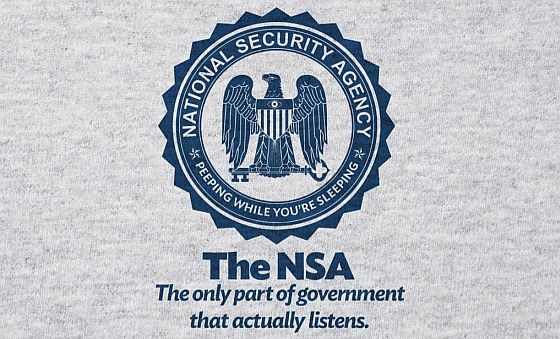
VOA reports: The U.S. National Security Agency and the Department of Homeland Security have threatened legal action to block the sale of T-shirts that ridicule these two powerful government agencies. But the T-shirt designer says NSA and DHS are the ones breaking the law by assaulting free speech, a pillar of democratic society.
A judge may decide who is right.
One T-shirt calls the NSA the “only part of the government that actually listens,” a joke that plays on the NSA’s controversial, and critics say overzealous, monitoring of communications worldwide. Americans tend to laugh out loud when they see the message.
Another shirt parodies the DHS logo, rewritten as the “Department of Homeland Stupidity.”
Agency officials have sent stern letters to the printer who makes and distributes these designs, demanding an immediate halt, according to T-shirt designer Dan McCall. He says the letters cite federal laws banning unauthorized use or defacement of official logos. [Continue reading…]