Category Archives: News

Mikhail Lesin’s death in Washington DC was ruled an accident, but many U.S. officials suspect it was a Russian hit

BuzzFeed reports: Vladimir Putin’s former media czar was murdered in Washington, DC, on the eve of a planned meeting with the US Justice Department, according to two FBI agents whose assertions cast new doubts on the US government’s official explanation of his death.

Mikhail Lesin’s battered body was discovered in his Dupont Circle hotel room on the morning of Nov. 5, 2015, with blunt-force injuries to the head, neck, and torso. After an almost yearlong “comprehensive investigation,” a federal prosecutor announced last October that Lesin died alone in his room due to a series of drunken falls “after days of excessive consumption of alcohol.” His death was ruled an “accident,” and prosecutors closed the case.

But the two FBI agents — as well as a third agent and a serving US intelligence officer — said Lesin was actually bludgeoned to death. None of these officials were directly involved in the government’s investigation, but they said they learned about it from colleagues who were.

“Lesin was beaten to death,” one of the FBI agents said. “I would implore you to say as much. There seems to be an effort here to cover up that fact for reasons I can’t get into.”

He continued: “What I can tell you is that there isn’t a single person inside the bureau who believes this guy got drunk, fell down, and died. Everyone thinks he was whacked and that Putin or the Kremlin were behind it.”

In another previously unreported revelation, the two FBI agents said it was the Department of Justice that paid for the hotel room where Lesin died. DOJ officials had invited the Russian to Washington to interview him about the inner workings of RT, the Kremlin-funded network that Lesin founded, they said. [Continue reading…]

Facebooktwittermail

Here’s the real reason Anthony Scaramucci hates Reince Priebus

HuffPost reports: In the public feud between Anthony Scaramucci and Reince Priebus, what hasn’t been fully explained is why Scaramucci so dislikes the president’s now-former chief of staff — a man he alternates between calling “Reince Penis” and “Rancid Penis,” according to an adviser to the White House.

The acrimony first surfaced during the presidential transition. The two men had been cordial before then. They met six years ago, when Scaramucci was a fundraiser for presidential candidate Mitt Romney and Priebus was chair of the Republican National Committee. They interacted peaceably during Donald Trump’s campaign as Scaramucci made the rounds on television and at donor events.

After Trump’s victory, Priebus was named chief of staff, and Scaramucci, according to someone close to the transition, was assured that he was also in line for a big position within the administration. (Sources for this story requested anonymity to discuss the details of sensitive conversations.)

While preparing for his move into government, Scaramucci struck a deal — which is still under regulatory scrutiny — to sell his stake in his hedge fund, SkyBridge Capital, to Chinese conglomerate HNA Group and another company. He assumed that he’d be put in charge of the public liaison office, a job that Valerie Jarrett held in the Obama administration. He had it all mapped out, according to the White House adviser. He identified 2,500 influential business leaders across the United States and had come up with a clever name for them: Trump Team 2,500. He believed these people would help pressure Congress into supporting the president’s agenda.

But Scaramucci’s plans were foiled in early January. That’s when Priebus, according to a confidant of both Scaramucci and the president, told Trump, “He played you.”

“How’s that?” Trump asked Priebus, according to the same source, who has spoken to several people within the White House about the conversation.

Priebus then told Trump that he felt Scaramucci had been offered too much for SkyBridge by HNA Group. The deal, he implied, smelled bad — as if the Chinese might expect favors from within the administration for that inflated price. The source also said that Priebus mentioned there was email traffic between Scaramucci and the Chinese proving this. [Continue reading…]

The Washington Post reports: Allies to Priebus said he told them he had resigned on Thursday, concluding that the internal chaos would only escalate. One Priebus friend said the chief of staff had described the situation as “unsustainable,” saying he felt demeaned by the president’s treatment of him and was frustrated that he could not assert control over basic White House functions, such as policy development, communications and even White House announcements — which sometimes were made impulsively by the president, such as this week’s announcement to ban transgender people from serving in the military.

But some White House officials said the decision for Priebus to depart was made by Trump — a decision that had been a couple weeks in the making — and that the president forced him on Friday. These officials noted that Priebus presided over the morning senior staff meeting and accompanied Trump to a law enforcement event in New York.

Regardless, his final departure was a humiliating coda for what had been a largely demeaning tenure during which Priebus endured regular belittling and emasculation from rival advisers — and even, at times, the president himself.

When Air Force One touched down Friday afternoon at Andrew’s Air Force Base, Priebus, senior policy adviser Stephen Miller and social media director Dan Scavino all loaded into a Suburban. But moments later, Miller and Scavino hopped out of the vehicle, and as word trickled out about the chief of staff’s ouster, reporters inched close to snap photos of Priebus, who sat alone on the rain-soaked tarmac. Priebus’ vehicle then pulled out of the presidential motorcade, which proceeded along to the White House without him.

“I think any observer — including one that did not speak English and knew nothing about politics and came from another planet and solar system — could, after observing the situation in the White House, realize the White House is failing,” said one informal White House adviser, who spoke on the condition of anonymity to share a candid assessment. “And when the White House is failing, you can’t replace the president.” [Continue reading…]

Facebooktwittermail

How to take down Kim Jong Un — without firing a shot

Tom Malinowski writes: At my Senate confirmation hearing a few years ago, I made a promise to the panel deciding my fate: never to use the phrase “there are no good options.” After all, if there were obvious solutions to the hardest—and most interesting—problems we face in the world, they would already have been found. Our job in the U.S. government—I served in the State Department as an assistant secretary focused on human rights—was not to make excuses in such situations, but to use whatever inherently limited tools we had to try to make things better, and to avoid making them worse.

North Korea tests this proposition like nothing else. Since its latest provocative missile test, thoughtful observers have pointed out that neither sanctions nor diplomacy are likely to dissuade Kim Jong Un from deploying nuclear weapons that can reach the United States, that we cannot depend on China to stop him for us, but that the alternative of a military strike on North Korea could cause a war that would lay waste to our ally South Korea. When it comes to North Korea, the phrase “there are no good options” has become a mantra.

Though we’ve been slow to admit it, the reasons have been plain for some time. Kim Jong Un, like all totalitarian leaders, wants above all to ensure his survival. He is convinced that a nuclear strike capability is necessary to deter the United States and South Korea from threatening his regime, and to extract concessions that might prolong its life. There is nothing crazy about this conviction. And because the matter is existential for Kim, more economic pressure will not change his mind. His regime survived a famine and can risk economic hardship. What he apparently will not risk is following the example of Saddam Hussein and Muammar Qadhafi, who gave up nuclear programs and found themselves defenseless against foreign interventions that claimed their lives.

But there is an opportunity in Kim’s obsession with survival. While he assumes the United States would not start a catastrophic war to stop his nuclear program, he also knows that were he to start that war, the U.S. would have no reason to hold back. We could, and likely would, destroy his regime. This means that even if we can’t prevent North Korea from gaining the ability to hit us or our allies, we can deter it from actually doing so, and thus have time to pursue, by means more effective than sanctions and less dangerous than war, our ultimate goal of a reunified Korea that threatens no one.

Kim is right to feel insecure. His life depends on the preservation of a regime, and of a country, that are both artificial constructs. There is no good reason for the existence of a North Korean state that is vastly poorer than its ethnically identical South Korean neighbor, other than to enable his family to rule. To hold on, the Kim regime has thus had to do more than make the North Korean people afraid of its executioners; it has tried to maintain a total information blockade to keep them from knowing just how artificial this situation is.

But knowledge—about the prosperity and freedom of their fellow Koreans south of the DMZ, and about the abnormality of their own suffering—is spreading among North Koreans. We are learning more about them, too—they are not brainwashed, “robotic” denizens of an “ant colony,” as they are so often described. They are resilient, increasingly entrepreneurial people with normal aspirations, who will some day want a say in the fate of their country.

No one can predict when and how Kim’s hold will weaken, and it would be foolish to think we can force change from the outside. So if anyone reading this has fantasies about setting up governments in exile or fomenting coups or calling for uprisings, please put them aside—that kind of talk will only get people inside North Korea killed. There are, however, forces in play within North Korea that will probably lead to the end of its regime and its reason to exist as a country. Political change in Pyongyang and the reunification of Korea, as hard as it may be to imagine, is actually much more likely than the denuclearization of the present regime. The central aim of our strategy should be to foster conditions that enable this natural, internal process to move faster, while preparing ourselves, our allies and the North Korean people for the challenges we will face when change comes.

This approach will carry its own risks and costs. And in the meantime, we should continue to oppose North Korea’s nuclear program, using diplomacy and sanctions to manage the danger it poses to us and to our allies. But our primary focus should be on shaping something that can happen in North Korea, rather than expending all our energies on something that will not.

The possibility of change in North Korea arose from its greatest calamity—the famine in the 1990s, in which over a million of its citizens died. Until then, according to defectors, most North Koreans were simply unaware that different ways of life or forms of government existed in the world. Other totalitarian states—Stalin’s in Russia, Mao’s in China, Pol Pot’s in Cambodia—tried to isolate their people from knowledge of the world, but none could sustain the feat long enough (two generations in the case of North Korea) to create a population unable to imagine alternatives.

The famine began to weaken the regime’s hold on its people and their imaginations. As the state-run food distribution system broke down, North Koreans became less trusting of and dependent on their state. Eventually, private markets sprung up around the country. People started crossing the border to China, not just to find food, but to bring back goods to be sold in these markets. From China, they also brought back stories of a country where people could enjoy private lives, choose their professions, own property, travel and learn about the world—like North Korea, a communist dictatorship, but vastly freer than theirs. [Continue reading…]

Facebooktwittermail

North Korea may have just shown a capability to strike California

Military Times reports: North Korea launched another ballistic missile Friday morning and experts believe it may have been, for the first time, an intercontinental ballistic missile with the capability to strike the continental United States.

Analysts raised concerns — with the caveat that preliminary reports could change — that this test could represent yet another step forward for North Korea’s nuclear posture.

Pentagon spokesman Navy Capt. Jeff Davis did not immediately have details on the launch, such as whether it was an intercontinental or intermediate range missile, and whether the missile had yet splashed down.

“The U.S. Department of Defense detected and tracked a single North Korea missile launch today at about 10:41 a.m. [Eastern Daylight Time,]” said Pentagon spokesman Navy Capt. Jeff Davis, reading the departments official statement on the launch. “We assess that this missile was an intercontinental ballistic missile, as had been expected.”

Davis said the missile was launched at 10:41 am local Washington time Friday from Mupyong-ni, and said it traveled “about 1,000 kilometers before splashing down in the Sea of Japan.”

Mupyong-ni “is an arms plant up in the far north of North Korea, north of Pyongyang,” Davis said. The missile “splashed down inside Japan’s exclusive economic zone, about 88 nautical miles from Hokkaido,” Davis told reporters at the Pentagon.

“We’re working with our interagency partners for a more detailed assessment,” he said.

NORAD assessed the launch and “determined it was not a threat to North America,” Davis said

Jeffrey Lewis, director of the East Asia Nonproliferation Program at the James Martin Center for Nonproliferation Studies, told Defense News that the decision to do a night launch from a new location “demonstrates that we can’t preempt them” from future launches.

Most worryingly, Lewis noted the reported 45 minute flight time of the missile and other data, which would “be consistent” with longer-range estimates of the weapon’s capabilities — perhaps putting its range in the 10,000 KM range — distance enough to put California and other continental U.S. locations at risk. [Continue reading…]

Facebooktwittermail

The crisis of regional order in the Gulf

Ahmet Davutoglu, the former prime minister of Turkey, writes: At a time when the Middle East is in dire need of a positive agenda and a plan to overcome division, ominous new developments are dominating the scene and the forces of disintegration appear to have been unleashed.

The current “Gulf” crisis is just the latest manifestation of this trend. Before considering the way out of this crisis, it is important to accurately depict it, its root causes, and its regional implications.

There have been many depictions of the Qatari crisis, and several different names have been used to describe the nature of the issue.

“The Qatari crisis”, “the Gulf crisis”, “the contest to define a new regional order”, and “the latest chapter of the Arab Spring showdown” have all been employed on various occasions to describe the crisis.

These are all valid descriptions contingent upon observers’ own operational logic. In fact, the politics of naming a crisis is no frivolous endeavour. [Continue reading…]

Facebooktwittermail

First support for a physics theory of life

Natalie Wolchover writes: The biophysicist Jeremy England made waves in 2013 with a new theory that cast the origin of life as an inevitable outcome of thermodynamics. His equations suggested that under certain conditions, groups of atoms will naturally restructure themselves so as to burn more and more energy, facilitating the incessant dispersal of energy and the rise of “entropy” or disorder in the universe. England said this restructuring effect, which he calls dissipation-driven adaptation, fosters the growth of complex structures, including living things. The existence of life is no mystery or lucky break, he told Quanta in 2014, but rather follows from general physical principles and “should be as unsurprising as rocks rolling downhill.”

Since then, England, a 35-year-old associate professor at the Massachusetts Institute of Technology, has been testing aspects of his idea in computer simulations. The two most significant of these studies were published this month — the more striking result in the Proceedings of the National Academy of Sciences (PNAS) and the other in Physical Review Letters (PRL). The outcomes of both computer experiments appear to back England’s general thesis about dissipation-driven adaptation, though the implications for real life remain speculative.

“This is obviously a pioneering study,” Michael Lässig, a statistical physicist and quantitative biologist at the University of Cologne in Germany, said of the PNAS paper written by England and an MIT postdoctoral fellow, Jordan Horowitz. It’s “a case study about a given set of rules on a relatively small system, so it’s maybe a bit early to say whether it generalizes,” Lässig said. “But the obvious interest is to ask what this means for life.”

The paper strips away the nitty-gritty details of cells and biology and describes a simpler, simulated system of chemicals in which it is nonetheless possible for exceptional structure to spontaneously arise — the phenomenon that England sees as the driving force behind the origin of life. “That doesn’t mean you’re guaranteed to acquire that structure,” England explained. The dynamics of the system are too complicated and nonlinear to predict what will happen. [Continue reading…]

Facebooktwittermail

Russia seizes 2 U.S. properties and orders embassy to cut staff

The New York Times reports: Russia took its first steps on Friday to retaliate against proposed American sanctions for Moscow’s suspected meddling in the 2016 election, seizing two American diplomatic properties and ordering the United States Embassy to reduce staff by September.

The moves, which Russia had been threatening for weeks, came a day after the United States Senate approved a measure to expand economic sanctions against Russia, as well as against Iran and North Korea. The bill, mirroring one passed by the House on Tuesday, now goes to President Trump for his signature.

In its statement, the Russian Foreign Ministry noted that the United States Congress had voted to toughen sanctions. “This yet again attests to the extreme aggressiveness of the United States when it comes to international affairs,” the statement said.

Dmitri S. Peskov, the spokesman for President Vladimir V. Putin, said the Russian leader had signed off on the measures despite saying a day earlier that he would wait for the final version of the law before taking any such steps.

The version that emerged from the Senate vote late Thursday seemed to be the final version, Mr. Peskov noted, and the White House has already suggested that it might reject this law in favor of something even more onerous.

“The White House said that the bill could be toughened, so it doesn’t change the essence of the situation,” Mr. Peskov said. [Continue reading…]

Facebooktwittermail

Palestinians met with tear gas upon return to al-Aqsa

Al Jazeera reports: More than 100 Palestinians have been injured as Israeli forces fired tear gas, stun grenades and sound bombs at worshippers who returned to Jerusalem’s al-Aqsa Mosque compound for the first time in nearly two weeks.

As the call to prayer sounded from al-Aqsa Mosque again, thousands of men, women and children made their way to the compound on Thursday, after Israel removed surveillance equipment and other obstacles from the gates leading to the holy site.

On Thursday night, dozens of Palestinians who have taken shelter inside the al-Qibli Mosque were surrounded by Israeli forces who cut off electricity in an attempt to force them outside of the compound.

Earlier in the day, the scenes of eupohria and celebrations inside the compound were cut short by Israeli forces who stormed in at the heels of the crowds that had entered the al-Aqsa Mosque complex.

Raed Saleh, a resident of occupied East Jerusalem, said that re-entering the compound on their own conditions was a victory for Palestinians.

“We never saw this kind of win for our people,” he told Al Jazeera. “People are coming from everywhere just to support us in this occasion.

“The Israeli government will now understand that Palestinians from Jerusalem will not accept everything they [Israelis] will tell them. We control ourselves. No one is controlling us.” [Continue reading…]

Facebooktwittermail

Why Trump’s White House won’t stop leaking

Alex Conant writes: The new White House communications director is launching a take-no-prisoners mole hunt, promising to stop future leaks.

He won’t succeed.

Over the past 15 years, I’ve worked in dozens of political organizations that all leaked to varying degrees. In 2008, I was the national press secretary for the Republican National Committee when internal concerns about vice presidential nominee Sarah Palin turned the final weeks of John McCain’s presidential campaign into a gusher of leaks.

In contrast, last year I was the communications director on Marco Rubio’s presidential campaign, an organization that proudly rarely leaked. Our campaign embraced a practice of not indulging self-serving media narratives that distracted from our message, which helped discourage unauthorized leaks—even as it became clear Donald Trump would win the nomination. (Our campaign was so leak-free that when CNN claimed to have a leak in the final weeks of Rubio’s run, I confidently went on air to call BS.)

To borrow from Tolstoy: Political organizations that don’t leak are all alike; every one that does leak is leaky in its own way. In some leaky organizations, people leak to advance agendas or undermine opponents. Some leakers seek to enhance their egos or curry favor with reporters. Sometimes people leak without even realizing it, speaking carelessly to journalists or lobbyists, who then repeat the story to others. The common thread is that unauthorized leaks are a symptom of political organizations that have a broken culture: They lack unity, trust and self-discipline. [Continue reading…]

Facebooktwittermail

Donald Trump has turned the White House into a snake pit

Ryan Lizza writes: On Wednesday night, I received a phone call from Anthony Scaramucci, the new White House communications director. He wasn’t happy. Earlier in the night, I’d tweeted, citing a “senior White House official,” that Scaramucci was having dinner at the White House with President Trump, the First Lady, Sean Hannity, and the former Fox News executive Bill Shine. It was an interesting group, and raised some questions. Was Trump getting strategic advice from Hannity? Was he considering hiring Shine? But Scaramucci had his own question—for me.

“Who leaked that to you?” he asked. I said I couldn’t give him that information. He responded by threatening to fire the entire White House communications staff. “What I’m going to do is, I will eliminate everyone in the comms team and we’ll start over,” he said. I laughed, not sure if he really believed that such a threat would convince a journalist to reveal a source. He continued to press me and complain about the staff he’s inherited in his new job. “I ask these guys not to leak anything and they can’t help themselves,” he said. “You’re an American citizen, this is a major catastrophe for the American country. So I’m asking you as an American patriot to give me a sense of who leaked it.”

In Scaramucci’s view, the fact that word of the dinner had reached a reporter was evidence that his rivals in the West Wing, particularly Reince Priebus, the White House chief of staff, were plotting against him. While they have publicly maintained that there is no bad blood between them, Scaramucci and Priebus have been feuding for months. After the election, Trump asked Scaramucci to join his Administration, and Scaramucci sold his company, SkyBridge Capital, in anticipation of taking on a senior role. But Priebus didn’t want him in the White House, and successfully blocked him for being appointed to a job until last week, when Trump offered him the communications job over Priebus’s vehement objections. In response to Scaramucci’s appointment, Sean Spicer, an ally of Priebus’s, resigned his position as press secretary. And in an additional slight to Priebus, the White House’s official announcement of Scaramucci’s hiring noted that he would report directly to the President, rather than to the chief of staff.

Scaramucci’s first public appearance as communications director was a slick and conciliatory performance at the lectern in the White House briefing room last Friday. He suggested it was time for the White House to turn a page. But since then, he has become obsessed with leaks and threatened to fire staffers if he discovers that they have given unauthorized information to reporters. Michael Short, a White House press aide considered close to Priebus, resigned on Tuesday after Scaramucci publicly spoke about firing him. Meanwhile, several damaging stories about Scaramucci have appeared in the press, and he blamed Priebus for most of them. Now, he wanted to know whom I had been talking to about his dinner with the President. Scaramucci, who initiated the call, did not ask for the conversation to be off the record or on background.

“Is it an assistant to the President?” he asked. I again told him I couldn’t say. “O.K., I’m going to fire every one of them, and then you haven’t protected anybody, so the entire place will be fired over the next two weeks.” [Continue reading…]

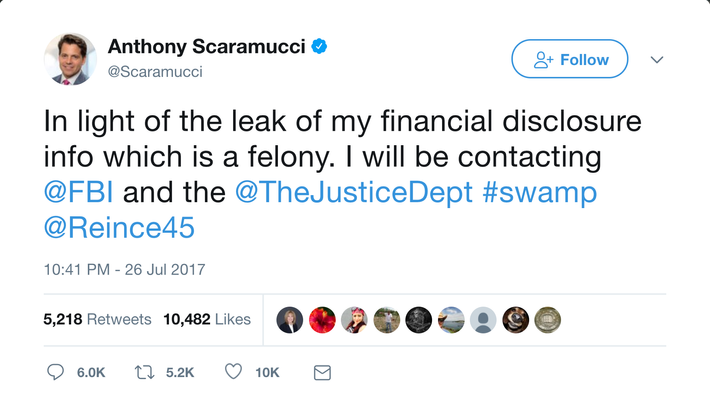
As the New York Times points out, Scaramucci is hunting for the source of a leak that might not be a leak.

Still, it was not at all clear that there was actually a leak in the first place, much less an illegal one.

Mr. Scaramucci filed the disclosure form in connection with his previous, short-lived job with the Trump administration at the Export-Import Bank. Under federal law, anyone can request such a report on a government website 30 days after its receipt.

Mr. Scaramucci’s report says it was filed on June 23, which means it could be publicly released by the bank on July 23, or last Sunday. Politico did not indicate whether it obtained the report through such a regular request.

Asked why he thought the report had been leaked illegally, Mr. Scaramucci responded by text: “They aren’t in process yet.” But when told his form could be released on July 23, he did not respond further.


Facebooktwittermail

With new sanctions, Senate forces Trump’s hand on Russia

The New York Times reports: The Senate on Thursday approved sweeping sanctions against Russia, forcing President Trump to decide whether to accept a tougher line against Moscow or issue a politically explosive veto amid investigations into ties between his presidential campaign and Russian officials.

The Senate vote, 98-2, followed the passage of a House bill earlier this week to punish Russia, Iran and North Korea for various violations by each of the three American adversaries. In effect, it would sharply limit the president’s ability to suspend or lift sanctions on Russia, and won near unanimous support across the Republican-led Congress.

Mr. Trump’s team has argued it needs flexibility to pursue a more collaborative diplomacy with Russia which, by American intelligence consensus, interfered in last year’s presidential election. But now the president will face a decision he had hoped to avoid as the legislation slowly churned through Congress.

White House aides have acknowledged privately that a veto would be politically awkward — at the least — for Mr. Trump to justify during the continuing investigations into whether his campaign colluded with Moscow. [Continue reading…]

Reuters reports: Russia risks being saddled with U.S. sanctions for decades, curbing economic growth and preventing it from regaining its status as a leading economic power, an adviser to President Vladimir Putin said in an interview.

Alexei Kudrin told Reuters that the current proposed tightening of sanctions in Washington should not have any serious impact. But he called for a major structural reform program after the 2018 presidential election.

He said that was the only way for Russia to return to growth of more than 2 percent a year.

Putin has not yet said whether he will run for re-election next year, but is widely expected to do so and to win what would be a fourth term as president. [Continue reading…]

Facebooktwittermail

Joint Chiefs: ‘No modifications’ to transgender policy from Trump tweet

Politico reports: There will be “no modifications” to the military’s transgender policy as a result of President Donald Trump’s declared ban on transgender men and women on Twitter, the chairman of the joint chiefs said in a message to top military officers on Thursday — the latest sign of the disarray following the commander in chief’s abrupt announcement.

Marine Gen. Joe Dunford also wrote in the message, which was sent to the chiefs of the military branches and senior enlisted leaders, that the military will continue to “treat all of our personnel with respect.”

“I know there are questions about yesterday’s announcement on the transgender policy by the President,” Dunford wrote in the internal communication, a copy of which was provided to POLITICO. “There will be no modifications to the current policy until the President’s direction has been received by the Secretary of Defense and the Secretary has issued implementation guidance.”

“In the meantime, we will continue to treat all of our personnel with respect. As importantly, given the current fight and the challenges we face, we will all remain focused on accomplishing our assigned missions,” he continued. [Continue reading…]

Facebooktwittermail

Russia used Facebook to try to spy on Macron campaign

Reuters reports: Russian intelligence agents attempted to spy on President Emmanuel Macron’s election campaign earlier this year by creating phony Facebook personas, according to a U.S. Congressman and two other people briefed on the effort.

About two dozen Facebook accounts were created to conduct surveillance on Macron campaign officials and others close to the centrist former financier as he sought to defeat far-right nationalist Marine Le Pen and other opponents in the two-round election, the sources said. Macron won in a landslide in May.

Facebook said in April it had taken action against fake accounts that were spreading misinformation about the French election. But the effort to infiltrate the social networks of Macron officials has not previously been reported. [Continue reading…]

Facebooktwittermail

The strange role North Korea is playing in the Persian Gulf crisis

Adam Taylor writes: In the ongoing diplomatic crisis in the Persian Gulf between Qatar and a Saudi-led bloc, an unusual role is being played by a country thousands of miles away: North Korea.

In recent days, both sides of the dispute have been accused of having an illicit economic relationship with the isolated nation — a touchy subject in Washington, given Pyongyang’s advancing nuclear weapons program and antagonism toward the United States.

Last week, reports detailing an alleged arms deal worth $100 million between North Korea and a company in the United Arab Emirates resurfaced online. Then on Tuesday, UAE rival Qatar was accused of having a “dangerous” relationship with North Korea in an op-ed published in the Hill newspaper.

There’s at least some truth to both allegations. Details of the sale of North Korean weapons to an Emirati company were revealed in a 2015 leak of UAE government emails first reported by the New York Times; the emails showed that Yousef al-Otaiba, the UAE ambassador to the United States, was summoned to a meeting with the State Department because of the deal. [Continue reading…]

Facebooktwittermail

Half the atoms inside and around us came from outside the Milky Way

The Guardian reports: Nearly half of the atoms that make up our bodies may have formed beyond the Milky Way and travelled to the solar system on intergalactic winds driven by giant exploding stars, astronomers claim.

The dramatic conclusion emerges from computer simulations that reveal how galaxies grow over aeons by absorbing huge amounts of material that is blasted out of neighbouring galaxies when stars explode at the end of their lives.

Powerful supernova explosions can fling trillions of tonnes of atoms into space with such ferocity that they escape their home galaxy’s gravitational pull and fall towards larger neighbours in enormous clouds that travel at hundreds of kilometres per second.

Astronomers have long known that elements forged in stars can travel from one galaxy to another, but the latest research is the first to reveal that up to half of the material in the Milky Way and similar-sized galaxies can arrive from smaller galactic neighbours.

Much of the hydrogen and helium that falls into galaxies forms new stars, while heavier elements, themselves created in stars and dispersed in the violent detonations, become the raw material for building comets and asteroids, planets and life. [Continue reading…]

Facebooktwittermail

Cost of transgender medical services in military, minimal; cost of an imbecile as commander-in-chief, incalculable

The New York Times reports: The president, Ms. Sanders said, had concluded that allowing transgender people to serve openly “erodes military readiness and unit cohesion, and made the decision based on that.”

Mr. Mattis, who was on vacation, was silent on the new policy. People close to the defense secretary said he was appalled that Mr. Trump chose to unveil his decision in tweets, in part because of the message they sent to transgender active-duty service members, including those deployed overseas, that they were suddenly no longer welcome.

The policy would affect only a small portion of the approximately 1.3 million active-duty members of the military. Some 2,000 to 11,000 active-duty troops are transgender, according to a 2016 RAND Corporation study commissioned by the Pentagon, though estimates of the number of transgender service members have varied widely, and are sometimes as high as 15,000.

The study found that allowing transgender people to serve openly in the military would “have minimal impact on readiness and health care costs” for the Pentagon. It estimated that health care costs would rise $2.4 million to $8.4 million a year, representing an infinitesimal 0.04 to 0.13 percent increase in spending. Citing research into other countries that allow transgender people to serve, the study projected “little or no impact on unit cohesion, operational effectiveness or readiness” in the United States.

Lt. Commander Blake Dremann, a Navy supply corps officer who is transgender, said he found out his job was in danger when he turned on CNN on Wednesday morning. Commander Dremann came out as transgender to his commanders in 2015, and said they had been supportive of him.

He refused to criticize Mr. Trump — “we don’t criticize our commander in chief,” he said — but said the policy shift “is singling out a specific population in the military, who had been assured we were doing everything appropriate to continue our honorable service.”

He added: “And I will continue to do so, until the military tells me to hang up my boots.”

The announcement came amid the debate on Capitol Hill over the Obama-era practice of requiring the Pentagon to pay for medical treatment related to gender transition. Representative Vicky Hartzler, Republican of Missouri, has proposed an amendment to the spending bill that would bar the Pentagon from spending money on transition surgery or related hormone therapy, and other Republicans have pressed for similar provisions.

Mr. Mattis had worked behind the scenes to keep such language out of legislation, quietly lobbying Republican lawmakers not to attach the prohibitions, according to congressional and defense officials. [Continue reading…]

Facebooktwittermail

Scaramucci still stands to profit from SkyBridge from the White House

Politico reports: Anthony Scaramucci finally has his White House job, but he still stands to profit from an ownership stake in his investment firm SkyBridge Capital.

The incoming White House communications director earned $4.9 million from his ownership stake in SkyBridge in addition to more than $5 million in salary between Jan. 1, 2016, and the end of June, when he joined the Export-Import Bank, according to a financial disclosure filed with the Office of Government Ethics.

The disclosure form, which is publicly available upon request, hasn’t been previously reported.

The disclosure highlights the extensive wealth Scaramucci has accumulated in his career — much like many of Trump’s other top advisers and Cabinet secretaries — and also the challenge he faces in extracting himself from the potential conflicts his investments could pose. [Continue reading…]

Scaramucci then appears to have threatened White House chief of staff Reince Priebus in a tweet he later deleted — as though he actually has the power to cover his tracks:

Facebooktwittermail

Trump talks privately about the idea of a recess appointment to replace Sessions

The Washington Post reports: President Trump has discussed with confidants and advisers in recent days the possibility of installing a new attorney general through a recess appointment if Jeff Sessions leaves the job, but he has been warned not to move to push him out because of the political and legal ramifications, according to people briefed on the conversations.

Still raging over Sessions’s recusal from the Justice Department’s escalating Russia investigation, Trump has been talking privately about how he might replace Sessions and possibly sidestep Senate oversight, four people familiar with the issue said.

Two of those people, however, described Trump as musing about the idea rather than outlining a plan of action, and a senior White House official said no action is imminent. Several people familiar with the discussions said that Trump’s fury peaked over the weekend and that he and Sessions now seem to be heading toward an uneasy detente.

When asked Wednesday about the president’s discussions of a recess appointment, the White House released a one-sentence denial from Trump: “More fake news from the Amazon Washington Post.” The Washington Post is owned by Jeffrey P. Bezos, the founder and chief executive of Amazon.

Those who have discussed Sessions this week with Trump or with top West Wing officials have drawn different conclusions from their conversations — in part because the president ruminates aloud and floats hypotheticals, often changing his views hour to hour. [Continue reading…]

Facebooktwittermail