



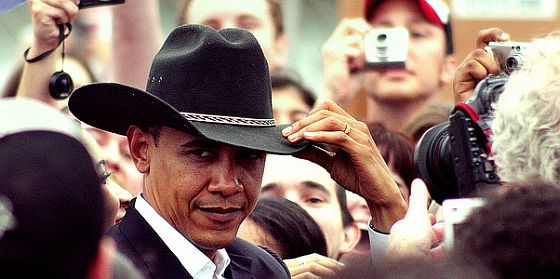
“I don’t want to just end the war, I want to end the mindset that got us into war in the first place,” Barack Obama said referring to Iraq while campaigning in January 2008.
On January 22, 2009, two days after taking office, Obama appeared to be making good on that aspiration as he signed an executive order which said: “The detention facilities at Guantánamo for individuals covered by this order shall be closed as soon as practicable, and no later than 1 year from the date of this order.”
At the time, his decision was hailed by commentators as a sign of presidential boldness, yet four years later it’s clear to most observers that whatever Obama’s virtues might be, they don’t seem to include courage.
In the 2008 election campaign, the promise to close Guantánamo seemed to play well as it dovetailed into a widely felt disenchantment with the war in Iraq. Americans were tired of the war and ready to move on — like selling off a bad investment — and closing Guantánamo made sense as part of that wider sentiment.
Even so, by February 2012, three years after the prison was supposed to have been shut down, 70% of Americans approved of the fact that it remained open. An even higher number — 83% — approved of drone warfare. In other words, there was overwhelming support for Obama’s de facto policy of killing rather than capturing suspected terrorists.
If initial support for the prison’s closure had much to do with the idea that it was a stain on America’s image, it’s hard to see why the same reasoning would not also apply to the use of drones.
Guantánamo became a stain on America because through its use of torture and disregard for legal rights and due process, it mirrored the forms of governance to which this nation claims it is opposed.
Yet drone warfare is the modern counterpart of sending out a posse. Its purpose is to hunt down outlaws and serve summary justice. The fact that it is bad for America’s image is of much less significance — inside America — than the fact that it resonates with a deeply rooted American conception of the rule of law. The best way to deal with bad guys is to shoot ’em.
Obama’s dubious accomplishment is that he has replaced a president who favored cowboy rhetoric with one who spurns such language yet perpetuates the cowboy mentality.
Since he has suffered no domestic political cost for failing to close Guantánamo, and since his promotion of vigilantism has proved so popular, why would the president now be moved by appeals by editorial writers (such as the one below) or human rights activists?
Indeed, at a time when senators are calling for the surviving Boston bomber to be shipped off to Guantánamo, Obama is less likely than ever to make a concerted effort to close the facility.
But there is one fact that Americans should consider at this time: when Dzhokhar Tsarnaev gets the trial to which he is entitled, what will differentiate him from the prisoners at Guantánamo is not the danger that each pose; it is that whereas Tsarnaev stands accused of a crime, nearly all the prisoners that America chooses to forget stand accused of nothing whatsoever.
Their ‘crime’ is that they are not American. That they have been deprived of justice is a testimony to American Islamophobia and xenophobia.
A New York Times editorial says: All five living presidents gathered in Texas Thursday for a feel-good moment at the opening of the George W. Bush Presidential Library and Museum, which is supposed to symbolize the legacy that Mr. Bush has been trying to polish. President Obama called it a “special day for our democracy.” Mr. Bush spoke about having made “the tough decisions” to protect America. They all had a nice chuckle when President Bill Clinton joked about former presidents using their libraries to rewrite history.
But there is another building, far from Dallas on land leased from Cuba, that symbolizes Mr. Bush’s legacy in a darker, truer way: the military penal complex at Guantánamo Bay where Mr. Bush imprisoned hundreds of men after the Sept. 11, 2001, attacks, a vast majority guilty of no crime.
It became the embodiment of his dangerous expansion of executive power and the lawless detentions, secret prisons and torture that went along with them. It is now also a reminder of Mr. Obama’s failure to close the prison as he promised when he took office, and of the malicious interference by Congress in any effort to justly try and punish the Guantánamo inmates.
There are still 166 men there — virtually all of them held without charges, some for more than a decade. More than half have been cleared for release but are still imprisoned because of a law that requires individual Pentagon waivers. The administration eliminated the State Department post charged with working with other countries to transfer the prisoners so those waivers might be issued.
Of the rest, some are said to have committed serious crimes, including terrorism, but the military tribunals created by Mr. Bush are dysfunctional and not credible, despite Mr. Obama’s improvements. Congress long ago banned the transfer of prisoners to the federal criminal justice system where they belong and are far more likely to receive fair trials and long sentences if convicted.
Only six are facing active charges. Nearly 50 more are deemed too dangerous for release but not suitable for trial because they are not linked to any specific attack or because the evidence against them is tainted by torture.
The result of this purgatory of isolation was inevitable. Charlie Savage wrote in The Times on Thursday about a protest that ended in a raid on Camp Six, where the most cooperative prisoners are held. A hunger strike in its third month includes an estimated 93 prisoners, twice as many as were participating before the raid. American soldiers have been reduced to force-feeding prisoners who are strapped to chairs with a tube down their throats.
That prison should never have been opened. It was nothing more than Mr. Bush’s attempt to evade accountability by placing prisoners in another country. The courts rejected that ploy, but Mr. Bush never bothered to fix the problem. Now, shockingly, the Pentagon is actually considering spending $200 million for improvements and expansions clearly aimed at a permanent operation.
Polls show that Americans are increasingly indifferent to the prison. We received a fair amount of criticism recently for publishing on our Op-Ed page a first-person account from one of the Guantánamo hunger strikers.
But whatever Mr. Bush says about how comfortable he is with his “tough” choices, the country must recognize the steep price being paid for what is essentially a political prison. Just as hunger strikes at the infamous Maze Prison in Northern Ireland indelibly stained Britain’s human rights record, so Guantánamo stains America’s.

The New York Times reports: In the early afternoon quiet, guards in camouflage fatigues walked the two-tiered cellblocks of Camp Six, where the most cooperative of the 166 terrorism suspects held in the military prison here are housed. From a darkened control room, other guards watched banks of surveillance monitors showing prisoners in white clothing — pacing, sleeping or reading — in their cells.
But the relative calm on display to visiting reporters last week was deceiving. Days earlier, guards had raided Camp Six and locked down protesting prisoners who had blocked security cameras, forbidding them to congregate in a communal area. A hunger strike is now in its third month, with 93 prisoners considered to be participating — more than half the inmates and twice the number before the raid.
“They are not done yet, and they will not be done until there is more than one death,” said a Muslim adviser to the military, identified as “Zak” for security reasons, who fears there may be suicides. Only one thing, he predicted, will satisfy the detainees: if someone is allowed to leave.
The spark for the protest is disputed. Detainees, through their lawyers, say that when guards conducted a search of their cells on Feb. 6, they handled their Korans in a disrespectful way. Prison officials dispute that.
But both military officials and lawyers for the detainees agree about the underlying cause of the turmoil: a growing sense among many prisoners, some of whom have been held without trial for more than 11 years, that they will never go home. [Continue reading…]
The Wall Street Journal reports: A federal judge decided to advise Boston bombing suspect Dzhokhar Tsarnaev of his Miranda rights, even though investigators apparently still wanted to question him further under a public-safety exception.
The judge’s move, made on Monday in the hospital where Mr. Tsarnaev was recovering, has prompted some Republican lawmakers to press the Justice Department as to why it didn’t make a stronger bid to resist the judge’s plans.
Those lawmakers say Mr. Tsarnaev’s interrogation should have continued without him being advised of his right to remain silent, because they say agents should have had more time to determine if there were other undetected bombs or plotters. After being read his rights, the suspect stopped talking to investigators, officials said.
“There will be more instances like this, and we will need to have a much better understanding about what is appropriate,” House Intelligence Committee Chairman Mike Rogers (R., Mich.) said in an interview Thursday. “We have a long-standing tradition that the judiciary does not interfere with investigations. This sets a very dangerous precedent.”
Justice Department spokesman Dean Boyd said Thursday, “The rules of criminal procedure require the court to advise the defendant of his right to silence and his right to counsel during the initial appearance.” Mr. Boyd said Magistrate Judge Marianne Bowler made it clear on Sunday, after the first sealed charges were filed in her court against Mr. Tsarnaev, 19 years old, that the hearing would be held the following day.
Federal rules require that defendants appear before a judge without unnecessary delay—usually defined as within one business day. [Continue reading…]
Patricia Park writes: As a non-white American, I’m often asked where I’m from and whether I’ve been “back home”. And people don’t mean New York City, where I was born and raised. They look at me, and my ethnic face, and they mean South Korea.
That was how I used to answer, too. Even though I had never lived in South Korea until I was almost 30. Even though my parents were born in what is now North Korea, fled to the South as wartime refugees, then took the slow boat to Argentina, before becoming naturalized Americans. Despite the fact that I recited the pledge of allegiance at school each morning, despite my blue US passport, I never self-identified as American while growing up; it had never occurred to me that I was.
What I describe is hardly a new phenomenon: scores of fellow ethnic “others” have long felt similarly un-American growing up in the US, facing subtle rhetorical reminders of our out-group status. It’s well-trodden territory, treated in My Big Fat Greek Wedding, The Joy Luck Club, and the works of Chang-Rae Lee. As “hyphenated Americans,” our identities are qualified – our Americanness is made subordinate, and secondary, to all the ethnic matter that precedes it. We are constantly told to look to that other home, our “real” home, as the place where we truly belong.
But what we have failed to address is the reverse phenomenon: what exactly awaits us when we “return” to the quote-unquote motherland. As a society we carry romantic notions of stepping off the plane – or boat – and being met with open arms, perpetuated by the likes of Olive Garden commercials (“When you’re here, you’re family!”) and even Jersey Shore, where Snooki et al set off for Italy to search for their roots under every pizza box and carafe of Chianti. Conan O’Brien famously parodied this romanticized attachment to the “old country” when he traveled to Ireland and pressed his giant orange head into the bosom of each and every startled passerby, claiming kinship. [Continue reading…]
BBC News reports: US intelligence agencies believe “with varying degrees of confidence” that Syria has used chemical weapons against rebels, the White House has said.
It said the nerve agent sarin had been deployed on a “small scale”, and did not say where or when it had been used.
The White House has warned chemical weapons use would be a “red line” for possible intervention, but says this intelligence does not represent proof.
Republicans in Congress called on Thursday for a strong US response.
The assessment was made in letters to lawmakers on Thursday signed by Miguel Rodriguez, White House director of the office of legislative affairs.
“Our intelligence community does assess, with varying degrees of confidence, that the Syrian regime has used chemical weapons on a small scale in Syria, specifically, the chemical agent sarin,” one of the letters said.
But it added: “Given the stakes involved, and what we have learned from our own recent experiences, intelligence assessments alone are not sufficient – only credible and corroborated facts that provide us with some degree of certainty will guide our decision-making.”
The phrase “varying degrees of confidence” is normally used to reflect differences in opinion within the intelligence community.
The Washington Post adds: In informing Congress Thursday that Syria’s government may have used chemical agents against the population, the Obama administration stated that “no option is off the table” should future evidence confirm the mounting suspicions.
The phrase, evoking America’s current confrontation with Iran and past ones with Iraq, prompts more questions than it offers clarity for how President Obama will navigate a worsening civil war that already has killed more than 70,000 people.
Would Obama send American forces to Syria if a United Nations investigation proves Syria’s President Bashar al-Assad has used the nerve agent Sarin in restive towns? And if he would not do so at a time when, in his words, “the tide of war is receding” after more than a dozen years of overseas conflict, would U.S. prestige suffer in the eyes of allies and antagonists alike?
The administration is already behind France, Britain and Israel in asserting that Assad most likely used chemical weapons against his people, and members of Congress from both parties were quick Thursday to seize on the acknowledgment as a “game changer” for U.S. policy. Even public opinion, according to recent polling, suggests that may be the case.
“The administration has confirmed that the Assad regime in Syria has crossed a dangerous, game-changing red line,” House Minority Leader Eric Cantor (R-Va.) said in a statement, which called on members to attend a classified briefing Friday morning.
The administration has made clear that it has monitored closely allegations of the Syrian government’s chemical weapons use since December, when reports first surfaced. But Obama has sought to downplay them as much as possible, given the consequences facing the administration if true.
On Thursday, Miguel Rodriguez, Obama’s chief liaison to Congress, made clear in a letter to the Hill that the administration will continue to seek a United Nations investigation to determine definitely whether chemical weapons have been used and to what extent.
Doing so buys the administration some time to decide a course of action, even as congressional Republicans raised concern about delays.
Henry Farrell, who was asked to speak at the summer school for Il Partito Democratico, the Italian Democratic Party, in Cortona last year, writes: In the 1990s and the 2000s, right-wing parties were the enthusiasts of the market, pushing for the deregulation of banks, the privatisation of core state functions and the whittling away of social protections. All of these now look to have been very bad ideas. The economic crisis should really have discredited the right, not the left. So why is it the left that is paralysed?
Colin Crouch’s disquieting little book, Post-Democracy (2005), provides one plausible answer. Crouch is a British academic who spent several years teaching at the European University Institute in Florence, where he was my academic supervisor. His book has been well read in the UK, but in continental Europe its impact has been much more remarkable. Though he was not at the Cortona summer school in person, his ideas were omnipresent. Speaker after speaker grappled with the challenge that his book threw down. The fear that he was right, that there was no palatable exit from our situation, hung over the conference like a dusty pall.
Crouch sees the history of democracy as an arc. In the beginning, ordinary people were excluded from decision-making. During the 20th century, they became increasingly able to determine their collective fate through the electoral process, building mass parties that could represent their interests in government. Prosperity and the contentment of working people went hand in hand. Business recognised limits to its power and answered to democratically legitimated government. Markets were subordinate to politics, not the other way around.
At some point shortly after the end of the Second World War, democracy reached its apex in countries such as Britain and the US. According to Crouch, it has been declining ever since. Places such as Italy had more ambiguous histories of rise and decline, while others still, including Spain, Portugal and Greece, began the ascent much later, having only emerged from dictatorship in the 1970s. Nevertheless, all of these countries have reached the downward slope of the arc. The formal structures of democracy remain intact. People still vote. Political parties vie with each other in elections, and circulate in and out of government. Yet these acts of apparent choice have had their meaning hollowed out. The real decisions are taken elsewhere. We have become squatters in the ruins of the great democratic societies of the past.
Crouch lays some blame for this at the feet of the usual suspects. As markets globalise, businesses grow more powerful (they can relocate their activities, or threaten to relocate) and governments are weakened. Yet the real lessons of his book are about more particular forms of disconnection.
Neo-liberalism, which was supposed to replace grubby politics with efficient, market-based competition, has led not to the triumph of the free market but to the birth of new and horrid chimeras. The traditional firm, based on stable relations between employer, workers and customers, has spun itself out into a complicated and ever-shifting network of supply relationships and contractual forms. The owners remain the same but their relationship to their employees and customers is very different. For one thing, they cannot easily be held to account. As the American labour lawyer Thomas Geoghegan and others have shown, US firms have systematically divested themselves of inconvenient pension obligations to their employees, by farming them out to subsidiaries and spin-offs. Walmart has used hands-off subcontracting relationships to take advantage of unsafe working conditions in the developing world, while actively blocking efforts to improve industry safety standards until 112 garment workers died in a Bangladesh factory fire in November last year. Amazon uses subcontractors to employ warehouse employees in what can be unsafe and miserable working conditions, while minimising damage to its own brand.
Instead of clamping down on such abuses, the state has actually tried to ape these more flexible and apparently more efficient arrangements, either by putting many of its core activities out to private tender through complex contracting arrangements or by requiring its internal units to behave as if they were competing firms. As one looks from business to state and from state to business again, it is increasingly difficult to say which is which. The result is a complex web of relationships that are subject neither to market discipline nor democratic control. Businesses become entangled with the state as both customer and as regulator. States grow increasingly reliant on business, to the point where they no longer know what to do without its advice. Responsibility and accountability evanesce into an endlessly proliferating maze of contracts and subcontracts. As Crouch describes it, government is no more responsible for the delivery of services than Nike is for making the shoes that it brands. The realm of real democracy — political choices that are responsive to voters’ needs — shrinks ever further.
Politicians, meanwhile, have floated away, drifting beyond the reach of the parties that nominally chose them and the voters who elected them. They simply don’t need us as much as they used to. These days, it is far easier to ask business for money and expertise in exchange for political favours than to figure out the needs of a voting public that is increasingly fragmented and difficult to understand anyway. Both the traditional right, which always had strong connections to business, and the new left, which has woven new ties in a hurry, now rely on the private sector more than on voters or party activists. As left and right grow ever more disconnected from the public and ever closer to one another, elections become exercises in branding rather than substantive choice. [Continue reading…]

Archbishop Desmond Tutu: A person with Ubuntu is open and available to others, affirming of others, does not feel threatened that others are able and good, for he or she has a proper self-assurance that comes from knowing that he or she belongs in a greater whole and is diminished when others are humiliated or diminished, when others are tortured or oppressed.
One of the sayings in our country is Ubuntu – the essence of being human. Ubuntu speaks particularly about the fact that you can’t exist as a human being in isolation. It speaks about our interconnectedness. You can’t be human all by yourself, and when you have this quality – Ubuntu – you are known for your generosity.
We think of ourselves far too frequently as just individuals, separated from one another, whereas you are connected and what you do affects the whole world. When you do well, it spreads out; it is for the whole of humanity.
Wired reports: Senior Obama administration officials have secretly authorized the interception of communications carried on portions of networks operated by AT&T and other Internet service providers, a practice that might otherwise be illegal under federal wiretapping laws.
The secret legal authorization from the Justice Department originally applied to a cybersecurity pilot project in which the military monitored defense contractors’ Internet links. Since then, however, the program has been expanded by President Obama to cover all critical infrastructure sectors including energy, healthcare, and finance starting June 12.
“The Justice Department is helping private companies evade federal wiretap laws,” said Marc Rotenberg, executive director of the Electronic Privacy Information Center, which obtained over 1,000 pages of internal government documents and provided them to CNET this week. “Alarm bells should be going off.”
Those documents show the National Security Agency and the Defense Department were deeply involved in pressing for the secret legal authorization, with NSA director Keith Alexander participating in some of the discussions personally. Despite initial reservations, including from industry participants, Justice Department attorneys eventually signed off on the project. [Continue reading…]
The New York Times reports: As Islamists increasingly fill the ranks of Syrian rebels, President Bashar al-Assad is waging an energized campaign to persuade the United States that it is on the wrong side of the civil war. Some government supporters and officials believe they are already coaxing — or at least frightening — the West into holding back stronger support for the opposition.
Confident they can sell their message, government officials have eased their reluctance to allow foreign reporters into Syria, paraded prisoners they described as extremist fighters and relied unofficially on a Syrian-American businessman to help tap into American fears of groups like Al Qaeda.
“We are partners in fighting terrorism,” Syria’s prime minister, Wael Nader al-Halqi, said.
Omran al-Zoubi, the information minister, said: “It’s a war for civilization, identity and culture. Syria, if you want, is the last real secular state in the Arab world.”
Despite hopes in Damascus, President Obama has not backed off his demand that Mr. Assad step down. The administration has also kept up economic pressure on his government and has increased nonlethal aid to the opposition while calling for a negotiated settlement to the fighting.
But the United States has signaled growing discomfort with the rising influence of radical Islamists on the battlefield, and it remains unwilling to arm the rebels or to consider stepping in more forcefully without conclusive evidence that the Syrian government used chemical weapons, as some Israeli officials assert. [Continue reading…]
Geoffrey Wheatcroft writes: Over the last months before his much-lamented death in August 2010, Tony Judt talked at length with Timothy Snyder, his friend and fellow historian. Their conversations, published after Judt died as Thinking the Twentieth Century, were about “the politics of ideas,” the subject of the book on which Judt had embarked after Postwar, his splendid history of Europe since V-E Day, but which he knew he would not live to write. Some of these political ideas had affected him personally, in particular Zionism. As a schoolboy in London and a Cambridge undergraduate, Judt had been not only a committed supporter but also an energetic activist in Dror, a small socialist-Zionist group. He spent summers working on a kibbutz and in 1967 flew to Israel in the hour of peril as the Six-Day War began.
The story of Judt’s disenchantment with Israel and Zionism is well known, culminating in a 2003 essay in the New York Review of Books in which he concluded that Zionism, as a version of late nineteenth-century nationalism, had itself become anachronistic in a twenty-first century of open borders and multiple identities. In Thinking the Twentieth Century, Judt talks again at some length about these questions, and there is one particularly arresting passage. Despite his own early indoctrination in the socialist variant of Zionism, “I came over time to appreciate the rigor and clear-headed realism of Jabotinsky’s criticisms.”
Today there are perhaps not many readers of the New York Times or the Washington Post, let alone most other Americans, even if they warmly support Israel, who could identify Vladimir Jabotinsky by name. “Jabo” died in 1940 at a training camp near New York City and might seem a remote historical figure. And yet, as a South African historian once wrote, although his pages told of distant events, “they are also about today.” While such essays as Akiva Eldar’s fascinating “Israel’s New Politics and the Fate of Palestine” in this magazine give much insight into the here and now, that in itself cannot be understood without the there and then. What Jabotinsky once said and did is acutely relevant now, ninety years after he founded his “Revisionist” New Zionist Organization.
He may have died long ago, but his soul went marching on. In 1946–1948, the Irgun, the Revisionist armed force — “terrorists” to the British and the New York Times at the time — practiced violence against British and Arabs. It was led by Menachem Begin, who in 1977 would become the first Israeli prime minister from the Right, ending almost three decades of Labor hegemony. Two more recent leading Israeli politicians, Ehud Olmert and Tzipi Livni, a former prime minister and a one-time foreign minister, respectively, are children of Irgun activists. Jabo’s portrait hangs at Likud party meetings, and Benjamin Netanyahu, the present Likud leader and prime minister, has a direct personal connection with him. As for the Jewish Americans who continue to support the Jewish state, they may never have read a word of him, but they might be troubled if they did. Jabo is very much about today. [Continue reading…]

Jason Leopold reports: Former Secretary of Defense Donald Rumsfeld once declared that individuals captured by the US military in the aftermath of 9/11 and shipped off to the Guantanamo Bay prison facility represented the “worst of the worst.”
During a radio interview in June 2005, Rumsfeld said the detainees at Guantanamo, “all of whom were captured on a battlefield,” are “terrorists, trainers, bomb makers, recruiters, financiers, [Osama Bin Laden’s] body guards, would-be suicide bombers, probably the 20th hijacker, 9/11 hijacker.”
But Rumsfeld knowingly lied, according to a former top Bush administration official.
And so did then Vice President Dick Cheney when he said, also in 2002 and in dozens of public statements thereafter, that Guantanamo prisoners “are the worst of a very bad lot” and “dangerous” and “devoted to killing millions of Americans, innocent Americans, if they can, and they are perfectly prepared to die in the effort.”
Now, in a sworn declaration obtained exclusively by Truthout, Col. Lawrence Wilkerson, who was chief of staff to former Secretary of State Colin Powell during George W. Bush’s first term in office, said Bush, Cheney, and Rumsfeld knew the “vast majority” of prisoners captured in the so-called War on Terror were innocent and the administration refused to set them free once those facts were established because of the political repercussions that would have ensued. [Continue reading…]
Salon: Of all the ways in which last week’s horror in Boston showed the resilience and cooperation of a community in the wake of disaster, the tragedy will also inevitably go down as a shining example of the desperate, despicable scramble to hunt, to accuse, to blame first – and worry about ethics and responsibility later. If ever.
We saw it in the epic bungling of mainstream media outlets like CNN and the New York Post. We saw it in the frenzy of Redditors and overeager tweeters. We saw it, most cruelly, in the story of a missing student, a young man whose body may have been pulled Tuesday night from the Providence harbor. [Tripathi’s death has now been confirmed.]
Sunil Tripathi was already making headlines before the Boston Marathon bombing. The Brown undergraduate was last seen on March 16, wearing “a black jacket, blue jeans and a Philadelphia Eagles cap.” In the early days of his disappearance, the news focused on his friends and Pennsylvania family, who posted a video on YouTube pleading for him to come back. “Hey, Sunny,” they say to the man whose nickname belied a reported history of depression. “We miss you.” It was, at first, the haunting mystery of a philosophy student with a “warm smile and generous gentle spirit,” who’d taken a leave from school while he was “trying to figure out his future.”
And then Boston happened. In what was later far too generously referred to as the “confusion” of its aftermath, the amateur detectives of Reddit decided that the missing man could be seen in images at the scene of the bombing. [Continue reading…]
The Associated Press reports: Sixteen hours after investigators began interrogating him, the surviving suspect in the Boston Marathon bombings went silent: he’d just been read his constitutional rights.
Dzhokhar Tsarnaev immediately stopped talking after a magistrate judge and a representative from the U.S. Attorney’s office entered his hospital room and gave him his Miranda warning, according to four officials of both political parties briefed on the interrogation. They insisted on anonymity because the briefing was private.
Before being advised of his rights, the 19-year-old suspect told authorities that his older brother, Tamerlan Tsarnaev, 26, only recently had recruited him to be part of the attack that detonated pressure-cooker bombs at the marathon finish line, two U.S. officials said.
The CIA, however, had named Tamerlan to a terrorist database 18 months ago, said officials close to the investigation who spoke to The Associated Press on condition of anonymity because they were not authorized to discuss the case with reporters.
The new disclosure that Tamerlan Tsarnaev was included within a huge, classified database of known and suspected terrorists before the attacks was expected to drive congressional inquiries in coming weeks about whether the Obama administration adequately investigated tips from Russia that Tsarnaev had posed a security threat.
Shortly after the bombings, U.S. officials said the intelligence community had no information about threats to the marathon before the April 15 explosions that killed three people and injured more than 260.
A 60 Minutes report which aired on Sunday provided a glimpse of the 9/11 Museum in New York, currently under construction and scheduled to open next year. The report underlined the degree to which 9/11 has become a pillar in America’s national mythology.
For many Americans the events of that day clearly hold more significance than perhaps any other event in American history — more significance than the war in Vietnam, the Civil Rights Movement, the Cold War, World War Two, Hiroshima, the Great Depression, the Civil War, or the American Revolution.
Central to the 9/11 narrative is the idea that the attacks on the World Trade Center and the Pentagon constituted an attack on America. This central presupposition is virtually never publicly questioned. Indeed, 9/11 has been sacralized and the site of the attacks in New York has become a place of pilgrimage. 9/11 has been made central to American identity.
That an event whose physical effects were so limited could nevertheless become a turning point in a nation’s history is remarkable. One could also argue that it was wholly unwarranted. But even if it seems unreasonable to believe that nineteen men have the capacity to attack a nation of over 300 million people, it is a fact that 9/11 is generally viewed as an attack on America.
There is a counterpart to this view that rarely gets mentioned in American discourse: that America’s response to 9/11 was to launch a war on Islam. On the occasions that the post-9/11 era is described in that way, it is almost always prefaced with “some Muslims believe…” The notion of an American war on Islam is treated as an expression of Muslim paranoia.
Wars and military operations in Afghanistan, Iraq, Pakistan, Yemen, and Somalia — all Muslim nations; the creation of a prison system in which all the detainees are Muslims; the deaths of about a million Muslims and the displacement of millions more; at a time that close to half of Americans believe that Islam and American values are incompatible.
If this isn’t a war on Islam, what would a war on Islam look like?
At the very least, can it not be admitted that the perception of a war on Islam has a stronger objective basis than the perception of America facing a national threat?
Consider then one of the latest reports on evidence being gathered which describes the motives of the Boston bombers:
The 19-year-old suspect in the Boston Marathon bombings has told interrogators that the American wars in Iraq and Afghanistan motivated him and his brother to carry out the attack, according to U.S. officials familiar with the interviews.
From his hospital bed, where he is now listed in fair condition, Dzhokhar Tsarnaev has acknowledged his role in planting the explosives near the marathon finish line on April 15, the officials said. The first successful large-scale bombing in the post-Sept. 11, 2001, era, the Boston attack killed three people and wounded more than 250 others.
The officials, who spoke on condition of anonymity to describe an ongoing investigation, said Dzhokhar and his older brother, Tamerlan Tsarnaev, who was killed by police as the two attempted to avoid capture, do not appear to have been directed by a foreign terrorist organization.
Rather, the officials said, the evidence so far suggests they were “self-radicalized” through Internet sites and U.S. actions in the Muslim world.
American actions in the Muslim world — or to put it more bluntly, Americans killing Muslims.
Historians will eventually be forced to shed the euphemisms and the geopolitical gloss that currently accounts for America’s actions over the last decade, and instead acknowledge that the needs for vengeance and restoration of power, justified in the name of combating terrorism, were what — even if it was never formally named as such — amounted to a war on Islam.
Christoph Reuter reports: In peacetime, 40,000 people lived in Zabadani, Muslims and Christians. Only 3,000 remain — out of defiance, fear or because they’re defending the city. Anyone left stays in the basements or on the ground floors. All buildings are abandoned above the first floor. Land was expensive in the valley, so property developed upward. And the fact that many buildings are five stories high has become a life-saving circumstance. “A direct hit from a tank shell destroys about one floor,” says one of the rebels, who as a construction engineer is familiar with such calculations. “Since they almost always attack from above, we just hide out underground for a while.”
The city is being demolished floor by floor. The army shells Zabadani with a certain regularity, in the morning and in the late afternoon for one to two hours. A few people die every week.
Yet over time the city has developed a tough and sophisticated independent existence. More than a year ago, 50 representatives from the big Zabadani families met to elect a 15-person city council. It now organizes food deliveries, the underground hospital, law enforcement, courts and even the nighttime disposal of rubble. Only when the streets are clear can you drive through them in the dark.
‘We Have Files for Everything’
The council has a budget and a Facebook profile where it registers the money, most of which comes from Syrians in exile. The profile also reports what it does with the money, which has to be carried in cash over the mountains. There’s a basement prison where two soldiers and two burglars are sitting, and even an evidence room for the courts. In its door hangs a standard 21-by-30 centimeter paper listing everything that is required and prohibited: No member of the court may physically or verbally abuse people, and no one can make decisions without authorization.
The prison warden and the chairman of the justice committee, the first a farmer and the second an attorney, describe a new system of law under absurd circumstances. “We have files for every proceeding,” says the attorney. “We inventory the stolen goods so that the owners can claim them. We investigated two cases of homicide.” The murder cases occurred when two groups of rebels mistook each other for government troops and fired at each other.
“And we’re planning to get uniforms for the police,” the attorney continues, “and photo IDs!” It’s preliminary, he concedes, adding that right now they are happy simply to survive until the next day. “That’s exactly why we need institutions and rules, not just people. If one of us dies, the next one has to be able to take over without everything collapsing.” [Continue reading…]
Hassan Hassan writes: Fears that the Syrian conflict may spill over the country’s borders are being realised, but in reverse: the Lebanese conflict is coming to Syria.
Ahmed Al Aseer, an influential Lebanese Sunni cleric, declared on Monday that jihad in Syria is now mandatory for all capable Muslims. Sheikh Al Aseer said that the decision was taken after Hizbollah’s involvement in Syria became clear.
“We felt that [Hizbollah] was militarily involved and everyone was denying,” he said in a video statement posted on YouTube on Monday. “But now that has become clear.”
Hizbollah’s initial denial of involvement in Syria appears to have changed to justification, primarily because it has become difficult for the group to continue denying reports as an increasing number of dead fighters are sent back from Syria. Although the party’s leader, Hassan Nasrallah, admitted in October that party members were fighting alongside the Assad regime, he said those fighters were acting as individuals and not under his orders.
This escalation should not be played down as part of traditional Lebanese sectarian bickering. Hizbollah’s decision to openly support the Syrian regime is a serious move that merits a closer look.
The obvious question is, why now?
According to accounts, the party’s fighters in Syria are numerous and well-trained. Additionally, the structure of Hizbollah allows it to order the fighters to withdraw if needed.
But why would the party opt to wage war against the people of a neighbouring country that is far larger than Lebanon, offers access to its allies in Iraq and Iran, and most of all, has a vast number of supporters inside Lebanon?
The escalation of Hizbollah’s involvement in Homs follows a series of media reports that suggests the party, in coordination with Tehran, has moved aggressively and openly to back the regime of Bashar Al Assad. According to the Kuwaiti newspaper Al Rai, Nasrallah visited Tehran this week and met with Supreme Leader Ayatollah Ali Khamenei and the commander of the Al Quds Brigades, General Qasim Sulaimani. [Continue reading…]