Jazz warrior defending Mali’s values

The New York Times reports: Cheick Tidiane Seck played a concert in Bamako last Saturday, the capital of his native Mali, just before he returned to his home in Paris.

A war was raging in the north of the country, as Malian and French troops bore down on the fabled desert city of Timbuktu that had been held by Tuareg rebels and their Islamist allies since spring. The jihadist fighters, as they retreated, set fire to a library containing thousands of priceless manuscripts dating from as far back as the 13th century, according to reports that emerged later.

But in the concert hall that night, Mr. Seck, on the piano, made music with other well-known stars of Mali’s jazz scene, playing to an audience of people from all over the country. “There were Tuaregs in the hall, and out in the streets,” Mr. Seck recalled, “and nobody threatened them.”

Sitting at a corner table in the basement of a cafe below his Paris apartment, Mr. Seck was unmistakable: A young Malian waiter stopped by to pay his respects to the 59-year-old music legend. A large man, Mr. Seck looked larger still in a flowing brown robe, upon which he had purposely hung a colorful beaded purse. “It’s Tuareg,” he said.

If Mr. Seck has a message today — a rare moment when the world can locate Mali on a map — it is that his country’s culture must endure, as it has for thousands of years.

But until France intervened last month to stop Islamist forces from moving south to Bamako, Mr. Seck was not so sure Mali itself would survive.

“I was afraid for my country,” he said. “Once I knew that they had conquered all the cities in the north, a chill went down my spine. It was an unspeakable wound.”

In his view, the Islamists’ acts of violence — against people, but also against the ancient culture of Timbuktu — were crimes against humanity. A 15th-century Malian proverb proclaims: “Salt comes from the north, gold from the south, but the word of God and the treasures of wisdom are only to be found in Timbuktu.”

According to some reports, much of the precious collection of manuscripts assembled in the Ahmed Baba Institute was saved by archivists and local residents before Timbuktu was seized by Islamist rebels last April; the documents remain hidden for fear that the jihadists will return.

But the wanton destruction of the graves of Timbuktu’s Sufi saints, considered idolatrous by orthodox Salafists, is undisputed, like the banning of music, the enforced veiling of women, the floggings and the amputations.

“A people has the right not to be ruled by violence,” Mr. Seck said. “They were going to impose Shariah across the whole country. They were going to destroy what was left of the harmony in the country.”

Now, he believes that danger has receded thanks to a decision by President François Hollande of France to intervene on Jan. 11. “The French knew that they had to do that in order to block this Islamic fundamentalism,” Mr. Seck said. “It must be stopped; they must be stopped.”

“So I say, ‘Bravo, Hollande,”’ he said. “I say, ‘A big bravo,’ and I am not the only one to say that. You can see French and Malian flags flying together all over Bamako.”

Now comes the hard part, as a fragile country tries to pull itself back together. Mr. Seck said he remained optimistic. [Continue reading…]


Facebooktwittermail

Inside Gao where Arab jihadis took bloody sharia retribution on Mali’s black Africans

Lindsey Hilsum reports: The jihadis carried out amputations in the sandy square where the residents of Gao used to watch basketball. The men who ruled Gao for nine months, until French and Malian troops drove them out last weekend, replaced the words “Place de l’Indépendence” in the green, red and yellow of the national flag with simple white on black: Place de la Sharia.

A thief would lose his right hand. Those accused of burglary would lose both right hand and left foot. On 21 December last year, people were assembled, as they had been several times before, and told to watch.

“No one was allowed to speak,” said Issa Alzouma. “Then they cut off my hand with a knife.”

Alzouma had been accused of stealing a motorbike, which he denies. At 39, he made a living digging gravel for construction companies. It was enough to support his wife and three children. Now he roams Gao in tattered clothes, the stump of his right arm wrapped in a grubby bandage, a flimsy black plastic bag dangling from his remaining wrist. Inside he keeps a few antibiotics and replacement bandages given by a Red Cross doctor who treated him at Gao hospital a week after his amputation.

“The doctor had to cut in and remove flesh because it was infected,” he said. “Under the bandage you can see my bones. It hurts and I feel as if my bones are coming out.”

Alzouma has no idea how he and his family will survive. “My wife just cries and cries,” he said. His friend Algalas Yatara, who was also accused of stealing a motorbike, carries a sheaf of papers in Arabic in his remaining hand. He thinks it is the judgment but is not quite sure, as neither man can read Arabic.

At least 12 men had hands or feet cut off after MUJAO (Movement for Jihad and Unity), and its allies in AQIM (al-Qaida in the Islamic Maghreb), took control of Gao last April. The exact number is not known because some were amputated in the military base where no non-jihadi was allowed. The mayor’s office, a few yards from the punishment ground, was turned into a sharia court. Outside, the sand has turned black where the enforcers of hesbah, or justice, ground down cigarettes and whipped those found smoking. Inside, the floor is littered with documents, including a ring-binder with details of the women flogged for not wearing the veil. Family members were made to put a thumbprint to show they acknowledged the punishment and would supervise the accused in future.

Suspects were confined to a small room where they were tied up and beaten, before being brought before Islamic judges, known as marabous, who sat every Monday and Thursday.

Ali Altini and Mohammed Aklini were due to be executed for homosexuality the Friday before last. French air strikes saved their lives, as the jihadis who would have carried out the sentence were killed or fled. The two men, who deny they are gay, were arrested on 12 December, bound, beaten, then interrogated. ” They asked me where the brothels are,” said Altini. “I answered that I didn’t know. Then they asked me to show them where people made pornographic movies. I answered again that I didn’t know.”

According to Altini, his six interrogators were Pakistanis, who communicated through a local translator. Altini and Aklini were arraigned before three marabous, one of whom they believed to be a Tunisian. [Continue reading…]

Facebooktwittermail

The world is facing viral mutations of the human psyche

Wole Soyinka writes: My mind, frankly, was on anything but peace as I entered the United Nations conference hall to participate in a Culture of Peace and Non-Violence event. On that same day – 21 September 2012 – yet another UN resolution had been released on the crisis in Mali. I felt overwhelmed by the ponderousness of the UN machine. That the UN, in association with African political leaders, recognised the danger posed by fundamentalist aggression to the Sahel and west Africa was not in doubt. The sense of urgency, however, lagged so far behind my own that it was a marvel I did not invade the conference hall with a banner, screaming: TAKE BACK MALI – YESTERDAY!

The security council had already set out a “roadmap” for a west African force of intervention in the Sahel – it required the secretary general to report back on “progress” a few months later. This, it struck me, was an instruction not to the secretary general, but to the fundamentalist invaders to report to the world on the progress they would have made in destroying the ancient libraries of Timbuktu; amputating the arms of a few more Malians; and stoning to death deviationists from their “moral code”.

It was an invitation to Ansar Dine’s allies Boko Haram to nudge a few more terminators into Nigeria; demolish a few more educational, cultural and religious institutions; eliminate what was left of the UN presence after its bomb attack on the UN HQ in Abuja; and continue its project of unleashing death and destruction in southern Nigeria.

Before the conference, I had button-holed senior Nigerian officials at every opportunity. None needed any persuasion about the danger to west Africa if the fundamentalist menace were not contained, rapidly. President Jonathan himself, I was assured, was sensitive to the ramifications of Mali’s northern takeover. So were a number of African heads of state. What was lacking was the practical preparedness for action. To any student of the fundamentalist temperament, this imperative of urgent response should be second nature. Africa’s political leadership should be in a state of permanent consciousness – and responsiveness. We are not novices, after all, to the ruthless nature of fundamentalist insurgency, its territorial desperation and, above all, its contempt for humanity. [Continue reading…]

Facebooktwittermail

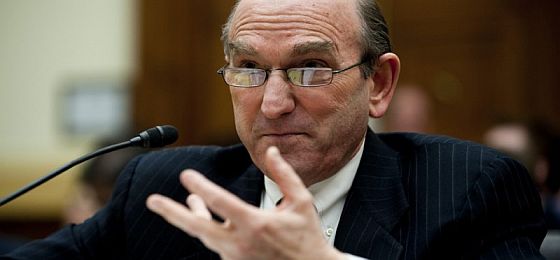
Can Elliott Abrams be stopped?

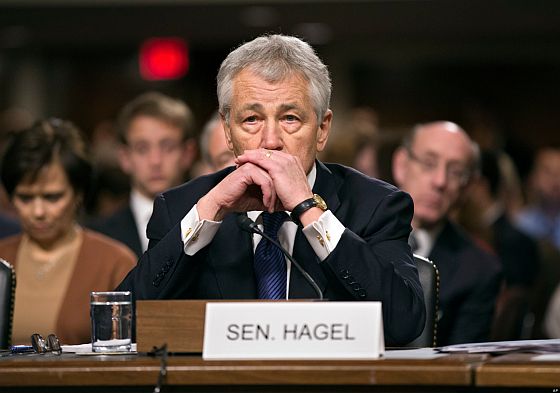
Jordan Michael Smith reports: Though secretary of defense nominee Chuck Hagel’s confirmation hearings were bruising, thanks to aggressive questioning from Sens. John McCain and Lindsey Graham, it could have been worse. His staunchest critic was absent.

More than anyone else, it is Elliott Abrams who has questioned the former Nebraska senator’s qualifications and character. Abrams twice called Hagel an outright anti-Semite, a smear other neoconservatives hinted at but couldn’t bring themselves to utter. So outrageous was Abrams’ slur that the head of the Council on Foreign Relations, where Abrams is a senior fellow, publicly criticized it.

Neoconservatives deploy baseless accusations of anti-Semitism as frequently as they indulge in nepotism, of course. But that Abrams has, once more, pushed himself to the center of a foreign policy debate is remarkable: The man is, after all, a convicted criminal. And yet, not only was Abrams exempt from serving prison time for his misconduct — he was later pardoned by President George H.W. Bush, in the days after his loss to Bill Clinton — but he has since been fully accepted back into the highest echelons of the Republican foreign-policy community. Abrams’ bizarre reincarnation as a pseudo-statesman shows that even committing crimes counts as insufficient to merit excommunication from government service.

Abrams seems cooked from a neoconservative recipe. Born to a Jewish New York home, he was once a reliable Democrat. He opposed the Vietnam War and criticized police handling of student protesters in the 1960s. But he rejected the counterculture and began writing for Commentary and the Public Interest, magazines themselves alienated from the New Left and on a trajectory from left to right. He joined the staff of hawkish Washington Sen. Henry “Scoop” Jackson, a key influence on so many neocons, from Abrams to Paul Wolfowitz to Richard Perle, and later went to work in New York Sen. Daniel Patrick Moynihan’s office.

1980 was a big year for Abrams. He married the daughter of Norman Podhoretz, the longtime Commentary editor before his son succeeded him. And he joined Democrats for Reagan, having been disgusted by Jimmy Carter’s foreign policy and personally offended by being shut out of Carter’s government. “Carter never had a human rights philosophy except that the U.S. was generally a bad place going around the world doing bad things,” he complained to a reporter. Abrams was tapped for the innocuous-sounding post of assistant secretary of state for international organization — but there was nothing innocuous about Abrams. [Continue reading…]

Facebooktwittermail

Victim of Egyptian police torture says ‘officers were helping me’

Al Ahram reports: Hamada Saber, the man who was dragged and beaten by Central Security Forces (CSF) as recorded on a video aired by Al-Hayat satellite TV on Friday night, told prosecutors on Saturday that protesters and not security forces “initiated” the assault against him, according to a report on Ahram Arabic news website.

The one-and-a-half minute video that shocked Egypt and the world showed an unarmed, naked Saber repeatedly kicked by police officers, dragged on the asphalt and beaten with batons as CSF officers battled anti-Morsi protesters in the vicinity of the presidential Palace on Friday night.

Speaking from a police hospital where he is recieving medical treatment, the 50 year old house-painter told investigators that the CSF officers protected him, adding that “the ministry of interior is standing by my side and they are providing me with medical care.”

However, late on Friday night, in a phone call also to ONTV, Reda Sobhi, Saber’s nephew, had condemned the police attack on his uncle saying Saber was peacefully attending the protest with his wife and children.

“God is our only saviour,” Sobhi told the Satellite channel ONTV in desperation saying he and lawyers failed to locate his uncle’s whereabouts in the hours after the video of the assault was aired as police declined to give them exact information of where they took Saber.

However, in a shocking turnaround of events on Saturday, Saber and his wife, speaking from the same police hospital the CSF transferred Saber to in the wake of their assault on him, seemed to blame the protesters for the bulk of the suffering he was subjected to on the previous night.

“I was standing at Roxy Square [near the palace] drinking a soda, when a large number of protesters who mistook me for a CSF officer because of my black attire attacked me and stripped me of my clothes,” said Saber.

“The protesters were angered by the fact that I tried to dissuade them from firing bird shots at the police,” claimed Saber.

Fathya, the assaulted man’s wife who was by his bedside at the police hospital, sent a message of gratitude to the ministry of interior.

“The police are very respectful and are standing by our side, and the minister’s assistant for human rights has passed by and will come again tomorrow [Saturday],” Fathya told ONTV.

Moreover, on Saturday night, Saber, told state TV that he was caught in the fight between protesters and the police.

“The protesters fired an unknown bullet at me and robbed me. When I saw the CSF soldiers coming at the crowd, I was scared and I ran. The soldiers chased after me yelling they wanted to help me. When I fell, they caught me and said: ‘you gave us a hard time, man.'”

Police and presidency conduct immediate damage control

Immediately after the gruesome assault video hit channels and social media outlets worldwide on Friday night, the ministry of interior issued a statement condemning the attack, and vowed to open an immediate inquiry.

As the Minister of Interior Mohamed Ibrahim faced angry calls for him to resign, the statement assured the public that “the ministry rejects the involvement of its officers in such assaults which affect the relationship between the people and the police.”

As many activists held President Morsi politically responsible for the assault on Saber because of his publicly stated, unconditional support for police actions against protesters, the presidency also issued a statement condemning the assault.

Facebooktwittermail

Egypt protests galvanised by video of police beating naked man

The Guardian reports: A video of a protester being beaten and stripped naked has galvanised protests against the police and government in Egypt.

Hamada Saber, a middle-aged man, remained in a police hospital on Saturday, the morning after he was shown on television, dragged over naked tarmac and beaten by half a dozen policemen who had pulled him to an armoured vehicle near the presidential palace.

President Mohamed Morsi’s office promised an investigation into the incident, which followed the deadliest wave of bloodshed of his seven-month rule. His opponents say it proves that he has chosen to order a brutal crackdown like that carried out by Hosni Mubarak against the uprising that toppled him in 2011.

Another protester was shot dead on Friday and more than 100 were injured, many seriously, after running battles between police and demonstrators who attacked the palace with petrol bombs.

That unrest followed eight days of violence that saw dozens of protesters killed in the Suez Canal city of Port Said and Morsi respond by declaring a curfew and state of emergency there and in two other cities.

“Stripping naked and dragging an Egyptian is a crime that shows the excessive violence of the security forces and the continuation of its repressive practices – a crime for which the president and his interior minister are responsible,” the liberal politician Amr Hamzawy said on Twitter.

The incident recalled the beating of a woman by riot police on Tahrir Square in December 2011. Images of her being dragged and stomped on – her black abaya cloak torn open to reveal her naked torso and blue bra – became a rallying symbol for the revolution and undermined the interim military rulers who held power between Mubarak’s fall and Morsi’s rise.

Facebooktwittermail

The son of a shopkeeper, now one of Syria’s leading rebel commanders

C.J. Chivers offers a profile of Abdulkader al-Saleh, a k a Hajji Marea, leader of the military wing of Al Tawhid, the largest antigovernment fighting group operating in and near Aleppo.

At the core of a simplistic narrative about Syria that has been popularized in Western antiwar circles is the idea that a legitimate protest movement got hijacked by foreign jihadists operating as mercenaries for Gulf states. Those who still hold this view will presumably dismiss Chivers’ account as propaganda. However, for anyone who thinks that reporters like this are able to shed more light on events in Syria than do people like George Galloway or anyone else promoting the “good terrorist, bad terrorist” meme, this profile is worth reading. It represents a political arc that has been replicated all over Syria as protesters picked up arms and the common cause of toppling the Assad regime united individuals and groups covering a broad political spectrum.

An enduring preoccupation of many observers — whether they be policymakers inside Washington or the politically engaged with no institutional affiliations — is the need to peg Syrians into ideological or sectarian groupings. Syrians such as Saleh, however, seem to have little interest in political labels. What concerns them much more is Washington’s hypocrisy: that stern warnings are issued to Damascus about the use of chemical weapons being unacceptable, while Assad’s continuing slaughter of ordinary Syrians every day with conventional weapons receives little comment.

Abdulkader al-Saleh

Men like Mr. Saleh present both a challenge and an opportunity for the West as it struggles to understand what is happening in Syria and to nurture networks that might provide stability and routes for Western influence should the government fall.

Mr. Saleh’s long-term intentions are not entirely clear. He says he is focused solely on winning the war, and promotes a tolerant pluralistic vision for the future. He is also openly aligned with Al Nusra Front, a growing Islamic militia that has been blacklisted by the United States, which accuses it of embracing terrorist tactics.

Officials in Washington are aware of Mr. Saleh, and other commanders of his standing. There is no evidence that they have connections with them, or a plan for how to develop relations in a Syria that is partly under their influence.

Mr. Saleh, wounded in battle multiple times, survived an assassination attempt in the fall, adding to his legend in the Aleppo governorate, where he is the rebels’ primary military commander.

“Was it $200,000?” he asked a peer, during a recent interview in a command post hidden in an Aleppo basement, about the bounty for his head. He seemed uninterested by the answer.

“Our concern now is only in the military side and how to fight this regime and finish this,” he said.

The son of a shopkeeper in Marea, just north of Aleppo, Mr. Saleh took an indirect route to guerrilla leader. As a young man, he served two and a half years as an army conscript, working, he said, in a chemical weapons unit.

He later joined the Dawa religious movement as a missionary. He traveled abroad, including, one of his brothers said, to Jordan, Turkey and Bangladesh, where he taught and studied Islam and invited people to hear the call to faith.

Life in Syria lured him back. His hometown lies in an agricultural belt, ringed by dark-soiled fields. Mr. Saleh opened a shop on one of Marea’s main streets, from where he imported and sold seeds. He married and started a family, which grew to include five children.

Not long after the uprising began, he joined with neighbors and relatives to organize demonstrations against what he described as the government’s repression.

When the fighting began, and rebels formed underground cells to plan ambushes, make bombs and persuade government soldiers to defect, Mr. Saleh’s standing grew. People spoke of a successful commander who was honest, organized and almost serenely calm under fire.

In many quarters his identity remained unknown. “We were secretive,” he said. “The public knew there was someone named Hajji Marea who led the demonstrations. But nobody knew who he was.”

Though he stands a little more than six feet tall, Mr. Saleh is unimposing, retaining an open face and youthful lankiness. Outsiders might not even make him for a fighter. One recent day, wearing a hoodie and moving with a loping gait, he could have passed for a graduate student.

His battlefield name, Hajji Marea, roughly translated, means “the respectable man from Marea.” [Continue reading…]

Facebooktwittermail

Exposing the myths of America’s shadow war

Dr. Loch K. Johnson writes: The United States faces a world of constantly shifting circumstances, as underscored by the Arab Spring uprisings. To shield the nation in a global setting where uncertainty and hostilities are commonplace, officials in Washington have crafted a range of responses to international events that includes diplomacy and the use of armed force. The most hidden and least understood of these responses is covert action — a tightly held operational secret in the U.S. government. This secrecy has yielded several myths that have misled the American people about a controversial, and sometimes lethal, approach to foreign policy.

MYTH #1: The meaning of covert action is clearly delineated.

With the Intelligence Authorization Act of 1991, the government did craft a formal statutory definition of covert action as “an activity or activities of the United States government to influence political, economic, or military conditions abroad, where it is intended that the role of the United State Government will not be apparent or acknowledged publicly.” Put simply, covert action attempts to influence world events through the secret use of propaganda, political, economic, and paramilitary activities. The concept of “secret influence” is spongy, though, and can blur the distinction between activities carried out by the Central Intelligence Agency (CIA) or by the military. Take the training of foreign covert forces by U.S. Special Operations Forces. The SOF consists of soldiers out of uniform, acting on an unacknowledged basis — precisely the kind of operation engaged in by the CIA. By calling such activities “traditional military operations,” the Pentagon is able to sidestep the legal procedures for reporting covert actions to Congress.

MYTH #2: Covert action offers a quiet approach to America’s foreign relations.

An appealing aspect of covert action is the promise that it may allow the United States to address vexing problems overseas in a quiet manner. Indeed, one of the euphemisms for covert action is “the quiet option.” Yet consider such CIA operations as the failed attempt in 1961 to overthrow the Castro regime with an invasion of Cuba at the Bay of Pigs; or the use of mines to blow up shipping in Nicaraguan harbors during the Reagan administration. Nothing quiet about these “secret” activities. Today drones can fly silently, but there is nothing quiet about the explosions of Hellfire missiles as they strike targets on the ground. [Continue reading…]

Facebooktwittermail

Israel: Iran slowing nuclear program, won’t have bomb before 2015 or 2016

McClatchy reports: Israeli intelligence officials now estimate that Iran won’t be able to build a nuclear weapon before 2015 or 2016, pushing back by several years previous assessments of Iran’s nuclear ambitions.

Intelligence briefings given to McClatchy over the last two months have confirmed that various officials across Israel’s military and political echelons now think it’s unrealistic that Iran could develop a nuclear weapons arsenal before 2015. Others pushed the date back even further, to the winter of 2016.

“Previous assessments were built on a set of data that has since shifted,” said one Israeli intelligence officer, who spoke to McClatchy only on the condition that he not be identified. He said that in addition to a series of “mishaps” that interrupted work at Iran’s nuclear facilities, Iranian officials appeared to have slowed the program on their own.

“We can’t attribute the delays in Iran’s nuclear program to accidents and sabotage alone,” he said. “There has not been the run towards a nuclear bomb that some people feared. There is a deliberate slowing on their end.” [Continue reading…]

Facebooktwittermail

Over $1 million spent on anti-Hagel advertising

Eli Clifton reports: While the Sunlight Foundation estimates the ad blitz by anti-Hagel astroturf at over $100,000, research by Lobe Log suggests that the actual total probably exceeds $1 million.

Sunlight based its conclusions on FCC-required disclosures on ad buys by two groups who hide their donors’ identities: Americans for a Strong Defense and Use Your Mandate. But that barely scratches the surface of the anonymously funded media campaign aimed against Hagel’s nomination as the next secretary of defense.

Anti-Hagel advertising — including tv and newspaper ads, website banner ads, and direct mailing — paid for by the American Future Fund (AFF), the Emergency Committee for Israel (ECI), Log Cabin Republicans, and Use Your Mandate brings the estimated total to over $1 million, according to Lobe Log’s research. [Continue reading…]

Facebooktwittermail

U.S.-Israeli exceptionalism: above the law

Rami G Khouri writes: For anyone who wonders why so many people around the world criticize American and Israeli foreign policy and militarism, this has been a valuable learning week. I refer to the U.S. Senate Foreign Relations Committee hearings on Chuck Hagel’s nomination to be the next U.S. defense secretary, and the twin Israeli attacks against military targets in Syria.

The juxtaposition of these two events clarifies again two core trends in American and Israeli foreign policy: their insistence that they are above international law and can use their military anytime, anywhere in the world, if they feel this serves their security interests, regardless of the credibility of the evidence to justify their attacks; and, the unwritten rule that American policies in the Middle East should conform above all else to the dictates of Israel, before considering the interests of the U.S. itself or the nearly 600 million other people who live in the Middle East.

My gut reaction to watching some of the Hagel confirmation hearings is to thank the American Founding Fathers for implementing the doctrine of the separation of powers and checks-and-balances among the different branches of government. For if some of the ideological zealots, intellectual wrecks, and pro-Israel songbirds who sit on the Senate foreign relations committee were ever to assume executive power, the world would be a much more violent and dangerous place. [Continue reading…]

Facebooktwittermail

How the Israel lobby’s toadies savaged Hagel

Michael Cohen writes: [W]hat made Hagel such an interesting secretary of defense candidate was that he was willing to make provocative statements about national security and the actual limits on US power. This week, we saw the neutered version of that candidate and it wasn’t pretty.

In defense of Hagel, though, it’s hard to imagine a sadder display of senatorial prerogatives than what the country witnessed in Thursday’s hearing. There were basically three categories of questions asked of Hagel:

• “Is Israel a great country, or is it the greatest? And if it’s the former, can you explain your lack of support for America’s most important ally?”

• “Why don’t you think Iran is crazy, unbalanced and a military competitor of the United States, as I do?”

• “Let me tell you more about the vital national security rule played by the weapons system or military base located in my home state.”

I’m not really exaggerating when I say these three themes accounted for practically 80% of the questions asked of Hagel, particularly by Republicans. In fact, according to a tweet from Washington Post reporter Rajiv Chandrasekaran that made the rounds yesterday evening, Israel was mentioned 136 times in the hearing and Iran 135 times:

Even though the defense secretary nominee said repeatedly that he supports Israel, that he considers Iran a state sponsor of terrorism and that he wouldn’t take military force off the table in dealing with its potential nuclear program, Republicans mined practically every statement ever made by Hagel (and often taken out of context) in an effort to assert that he doesn’t hold as uncompromising a position on these issues as they do.

The day reached its point of high comedy when Senator Lindsey Graham began interrogating Hagel on whether he believes – as he allegedly said several years ago – that the so-called “Jewish lobby” causes US senators to occasionally do dumb things that harm US foreign policy. Hagel hemmed and hawed on the question when, in an ideal world, he should have said, “Yes, and this hearing is example A.”

Senator Lindsey Graham: Name one person in your opinion who’s intimidated by the Israeli lobby in the United States Senate?
Chuck Hagel (if he felt at liberty to speak the truth): With all due respect, Senator Graham, I think you are? Why else would you be asking me this question?

Facebooktwittermail

Is Israel heading towards yet another war?

Following an Israeli strike on Syria this week, the Wall Street Journal reports: Inside Syria, rebels and members of the opposition pointed to the lack of an immediate retaliatory strike as proof that the Syrian regime is impotent against enemies even as it is quick to target its own people.

“It’s a disgrace when Israeli war planes attack Syria and your jets have no other job but to attack bakeries, mosques, universities and civilians,” Mouaz al-Khatib, head of the Western-backed Syrian opposition umbrella group known as the National Coalition, wrote Thursday on his Facebook account, addressing President Bashar al-Assad.

On Wednesday, Mr. Khatib said he was willing to start a dialogue with representatives of the Syrian regime provided it releases 160,000 opposition detainees, prompting a sharp rebuke from other members of the coalition.

Most members of the Syrian opposition consider Hezbollah and Iran accomplices in the suppression of their quest to topple Mr. Assad. On the ground Thursday, clashes raged on the outskirts of Damascus, the northern city of Aleppo and other flash points around Syria as the regime continued to use heavy artillery and aerial bombardment, according to residents and opposition activists.

Iran’s Foreign Minister Ali Akbar Salehi condemned the attack on Syria, calling it a blatant violation of sovereignty. Mr. Salehi’s deputy announced Tehran would give Syria a $200 million aid package that included funds to rebuild a damaged electrical plant and hospital, according to Iranian state media.

In an analysis, Fars News Agency, which is affiliated with Iran’s Revolutionary Guard Corps and is considered a mouthpiece for the group’s views, said Israel’s military strike had several goals, among them weakening Syria’s military and weapons stocks, demoralizing Syria’s army and preparing public opinion for foreign military intervention in Syria. The agency suggested that the best way to retaliate against Israel would be to better arm and fund Hezbollah in Lebanon.

There was little apparent anxiety in Israel a day after the attack. The prevailing view in Israel, as well as among many regional analysts, is that Syria and its allies currently have no stomach for an open conflict with the Jewish state.

“Syria is in a process of disintegration. It can’t afford to escalate with Israel, because Israel is capable of destroying a large part of the military in a short time, and it will make the job of the rebels easier,” said Shlomo Brom, a fellow at Tel Aviv University’s Institute for National Strategic Studies and a former senior military planner.

“It is difficult for Hezbollah to respond in an open way,” he continued. “They are weaker. They moved from a situation in which they were adored by the Arab states, to a situation in which they are the bad guys because they are cooperating with those who are oppressing the people,” he said, referring to Hezbollah’s ties to Mr. Assad.

But Israel shouldn’t risk a strategically costly entanglement in Syria’s civil war for a tactical goal of blocking weapons transfers, cautioned Guy Bechor, head of the Middle East department at the Herzliya Interdisciplinary Center. He said Israel should continue to watch from the sidelines, like most foreign powers, while its enemy is embroiled in a debilitating internal conflict.

“This is not our war,” he told Israel Radio. “We’ve sat on the sidelines for two years. No one else is intervening, so why are we?”

AFP adds: There was still no official Israeli comment on Syrian claims that Israeli warplanes bombed a military site near Damascus on Wednesday or on separate reports that its aircraft struck a weapons convoy along the Syria-Lebanon border.

[Israeli] Newspapers, however, seemed to have little doubt on what had happened or the likely consequences.

“Complete restraint over the long term to Israel’s actions could be considered weakness by Hezbollah, so we should expect some form of response, even if not immediately and not necessarily a broad rocket and missile attack on Israel,” defence commentator Amos Harel wrote in the left-leaning Haaretz daily.

“The Hezbollah convoy, which according to foreign reports was attacked from the air while travelling from Syria to the Bekaa Valley in Lebanon, laden with explosives, will not be the last,” Nahum Barnea wrote in Yediot Aharonot.

“It would seem, from a pessimistic view, that we are on the way to a military confrontation on at least one of the two northern fronts,” he added, referring to Israel’s borders with Syria and Lebanon.

Facebooktwittermail

Syria: how we can end the bloodshed

Jonathan Steele writes: The motives behind Israel’s attack on Syria on Wednesday are still as obscure as the nature of the target. But two things seem clear. It was related to Israel’s long war with Hezbollah in Lebanon rather than any desire to intervene in the fighting in Syria. Yet the attack was also a reminder that Syria’s turmoil is having dangerously unpredictable consequences across the region.

Finding a viable political solution is therefore all the more urgent. So it was good to hear that Moaz al-Khatib, who leads the Syrian National Coalition – the group of exiles who support armed intervention against the Syrian government and are backed by western and Gulf Arab states – now advocates talks with Basher al-Assad’s people. This is not the view of French, British and US leaders or most of Khatib’s Syrian colleagues, who talk vaguely of a political outcome but only mean Assad’s unilateral surrender.

Their unrealistic line was on display again on Monday, when France hosted the so-called Friends of Syria. Its analysis was gloomy. State institutions are collapsing, Islamist groups are gaining ground, more and more Syrians are dying, and there is no breakthrough in sight. “We cannot let a revolution that started as a peaceful and democratic protest degenerate into a conflict of militias,” said Laurent Fabius, the French foreign minister, even as he talked of more aid on the battlefield.

Several civic groups that reject the armed struggle were equally pessimistic at a meeting in Geneva. Theirs is the voice of Syria’s secular intelligentsia, who oppose foreign military intervention and favour a ceasefire and a negotiated solution on the lines that Lakhdar Brahimi, the UN/Arab League mediator, is trying to broker. Because they do not support the western line, they tend to be ignored by foreign politicians. [Continue reading…]

Facebooktwittermail

John Kerry and the restraint of American power in U.S. foreign policy

Stephen Kinzer writes: In some parts of the world, especially in the volatile region that stretches from the Persian Gulf to Central Asia, [newly confirmed Secretary of State, John] Kerry is already a familiar figure in the corridors of power. He has also established an evidently strong working relationship with Obama. Even the fact that his friends in the Senate brutally crushed his main rival for the job, Susan Rice, who is one of Obama’s close and trusted advisers, was not enough to sour the president on his nomination.

One fundamental aspect of American foreign policy making will not change as Kerry takes over the job Hillary Clinton has held for the last four years. Major policy decisions will be made in the White House, not at the State Department – and the secretary of state may not even be in the room when they are made.

Nonetheless, Kerry will be a key figure as the United States confronts the crises of the moment. His most encouraging credential is that he truly believes diplomacy is preferable to war – hardly a unanimous view in Washington. Whether this will result in a serious change in America’s approach to the world, however, is far from certain.

The first test will be Iran. Kerry is less prone than some others in Washington to throw around threats about war being an option that is “on the table”, and it is hard to imagine him blithely reminding Iranians, as Clinton did, that the United States has the power “to totally obliterate them”. Yet, the essence of American policy toward Iran – shaped around threats, sanctions, and demands that Iran submit to western power without expecting much in return – is unlikely to change.

Kerry will also be unable, and quite possibly unwilling, to rein in the ever-expanding US drone war, which is not run by the State Department but feeds the anti-Americanism that will make his job ever more difficult. Nor is there much prospect that he will be able to calm the fundamentalist radicalism that is surging through Egypt, Syria, and Israel.

The area in which Kerry may be able to have the greatest impact is redefining the meaning of national security for Americans. He recognizes that the main threats to the United States no longer come from foreign armies or what George W Bush liked to call “evil-doers”. His most encouraging statements are those that suggest he recognizes the enormous security challenges posed by climate change, global energy politics, and economic troubles at home. [Continue reading…]

Facebooktwittermail