IPS reports: The world economy would bear substantial costs if the United States took steps to significantly escalate the conflict with Iran over its controversial nuclear programme, according to the findings of a Federation of American Scientists’ (FAS) special report released here Friday.
Based on consulations with a group of nine bipartisan economic and national security experts, the findings showed the effects of U.S. escalatory action against Iran could range from 64 billion to 1.7 trillion dollars in losses for the world economy over the initial three-month term.
The least likely scenario of de-escalation, which would require U.S. unilateral steps showing it was willing to make concessions to resolve the standoff, would result in an estimated global economic benefit of 60 billion dollars.
“The study’s findings suggest that there are potential costs to any number of U.S.-led actions and, in general, the more severe the action, the greater the possible costs,” Mark Jansson, FAS’s special projects director, told IPS.
“That being said, even among experts, there is tremendous uncertainty about what might happen at the higher end of the escalation ladder,” added Jansson, the second author of the report after Charles P. Blair, an FAS senior fellow on state and non-state threats.
The six plausible scenarios of U.S.-led actions against Iran included isolation and a Gulf blockade, which would include U.S. moves to “curtail any exports of refined oil products, natural gas, energy equipment and services”, the banning of the Iranian energy sector worldwide (incurring an estimated global economic cost of 325 billion dollars), and a comprehensive bombing campaign that would also target Iran’s ability to retaliate (incurring an estimated global economic cost of 1.082 trillion dollars). [Continue reading…]
Gaza is no longer alone

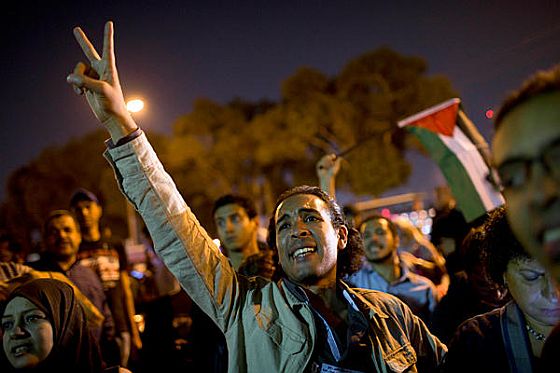
Egyptians in Cairo on Wednesday protesting against latest Israel airstrikes on Gaza.
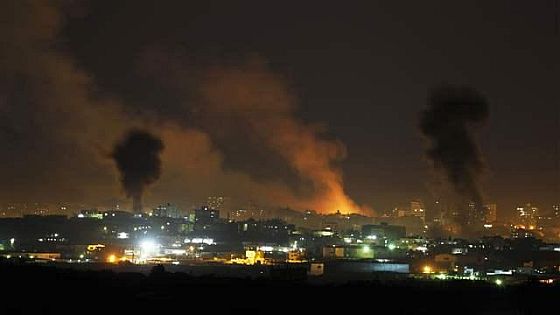
Ahdaf Soueif writes: If you click here, you can listen to the Israeli attacks on Gaza. You can hear explosions, drones and ambulances. This is the soundtrack of the lives of Palestinians there now. They’re recording it and transmitting it, and their friends all over the world – particularly the Arab world – are listening to it live.
We are also reading the tweets and blogs the young Gazans are putting out, and taking a good look at the images they’re posting – like the one of Ranan Arafat, before and after. Before, she’s a pretty little girl with green eyes, a green halter-neck top and green ribbons in her hair. After the Israeli bomb, she’s a charred and shrunken figure. Her mouth is open. A medic lifts – for just a moment – her blue hospital shroud.
In that hospital, Shifa in Gaza City, we watched the Egyptian prime minister, Hisham Kandil, this morning. For the first time in 42 years an Egyptian prime minister was where we Egyptians wanted him to be. For the first time a government official was telling the truth when he said he spoke for the Egyptian people. And he was spot on when he referred to the Egyptian people first, before the Egyptian president.
Since he won the presidency, Mohamed Morsi has tried to be a pragmatic politician. He pressed on with “security co-ordination” with Israel in Sinai; he started sealing up the tunnels that provide a lifeline to the besieged Gazans; he rejected the proposal of a free trade area on the borders between Egypt and Gaza; and he sent an ambassador to Tel Aviv with a fulsome letter to Shimon Peres. And so he found himself uncomfortably cosied up with remnants of the Mubarak regime and aficionados of the military government.
The rank and file of the Muslim Brotherhood and their Freedom and Justice party had a hard time justifying the actions of their man in the presidential palace to the rest of the country. Progressives and liberals mocked them for their big talk on Palestine all the years they were in opposition, and their resounding silence now they were in power. Skits about Morsi’s “love letter” to Peres appeared online and parodies on Cairo walls.
Now, the Israelis have pushed him – pushed him perhaps into a position where he’ll find himself more at ease in his presidency, and more in tune with the people. Large groups of young Egyptians have been heading for Gaza; my youngest niece is one of them. Like the efforts of the world’s civil society to send ships to Gaza, young Egyptian civilians with a passion for freedom are going to support their friends. [Continue reading…]
Trapped in Gaza
Lara Aburamadan writes: I don’t know how the story ends.
What I know is that this all started on a quiet day with my friends, as we sat down to watch the initial movie in a series that was supposed to be part of a “Nordic Film Festival” — the first of its kind in Gaza. The main character’s name was Sebbe, a Swedish boy five years my junior.
But halfway in, just as Sebbe’s story began to arc, the reel stopped, just as surely as the world around me.
A festival organizer interrupted the film and relayed the news: The Israelis, we were told, had just assassinated someone. There was already word of retaliatory rockets fired from Gaza. Things were going to get bad quickly, and we had better get home, where it would be safer.
But it hasn’t been. In the last 48 hours, my mother and I have kept vigil by my siblings’ side — my twin, an adolescent brother and a sister within earshot of her high school valediction. We sit together, my mother and I, in an inner room without a view, watching the furrowed brows of my brother and two sisters straining to sleep.
And all the while, we hear bombs. Bombs that bear autumn’s scent and winter’s chill. Bombs that batter. Bombs that kill. I still have waking nightmares of the bombs that tore through our sky nearly four years ago, when a classmate, Maha, lost her mother in an Israeli strike. And a childhood friend, Hanan, who saw her mother’s leg severed under the rubble from another strike. [Continue reading…]
Another ceasefire, another assassination
Mark Perry writes: Gerson Baskin’s entry in these pages — “Assassinating The Chance For Calm” — has given the readers a valuable insight into the workings of the Israeli-Palestinian conflict. But as Baskin himself knows, this is not the first time that “calm” has been assassinated.
In July of 2002, I was an integral part of a small team working to end the second Intifada. I was the lone American on the team, the only one who was not an intelligence officer, and the only one with a direct line to Yasser Arafat and the senior leadership of Fatah. Our task was to gain the approval of Palestinian factions for a draft ceasefire that would end attacks on Israelis not living in the Occupied Territories. My job was to actually draft the ceasefire and serve as liaison with Arafat’s envoy in the process — Hani al-Hassan.
The task proved more difficult than I supposed. Hassan, whom I had forged a strong bond with over many years, disagreed with my multiple drafts of the document. And the document itself had to be approved by the eleven member “Fatah Higher Committee” in the West Bank, the several layers of the Al Aqsa Martyrs Brigades (and particularly their most intransigent cells in Nablus), as well as the head of the Hamas military wing in Gaza.
In addition, I was intent that the ceasefire be put in place precisely at one minute after midnight on July 22 and that the press be notified of its start. My reasoning was that Israel had acted with impunity in breaking a previous ceasefire, in January, by assassinating Raed Karmi. The problem then was simple: no one in the international community even knew that a ceasefire had been agreed to. I vowed that this would not be the case now, which is why the team of which I was a part kept Israeli officials informed of our progress.
It took many days of talks with Hani al-Hassan to produce a final ceasefire document, and weeks of negotiation to gain approval for it among the Fatah Higher Committee and the West Bank’s myriad resistance brigades. But by July 20, all seemed in place. Only Salah Shehadeh, the head of Hamas’s military wing in Gaza, needed to give his approval — and he had informed our team, through a Fatah intermediary, that he was prepared to do so. His signature on the ceasefire document was to be obtained on the evening of July 22, during a meeting between him and a senior Fatah official in Gaza City. It had taken weeks of talks with Hamas to gain his approval.Salah Shehadeh
I remember sitting on the 11th floor of the David Citadel Hotel as the clock ticked off the minutes leading to midnight on the night of July 21. I was in contact with our Fatah intermediary in Gaza by cell phone, urging him to complete his visit to Shehadeh — at times, shouting at him: “You need to move, you need to see this man.” He assured me that the meeting with Shehadeh had been set, and that he was on his way, just then, to meet with him.
But then, with just ten minutes to go before the ceasefire took effect, his cell phone went dead. And then, thirty minutes later, an Israeli F-16 dropped a one ton bomb on Shehadeh’s home in Gaza City. The Israeli bomb killed Shahadeh and fourteen other people, including Shehadeh’s wife and daughter. Seven people who lived next door, all innocent, were also killed. The then Deputy Chief of Staff of the IDF, Major General Dan Halutz later said that had he known that innocent people would be killed in the bombing, it would not have been ordered. I know otherwise. Later, he added: “What do I feel when I drop a bomb? A slight bump in the airplane.”
The next morning, as I walked from my hotel near the Damascus Gate to a meeting of the ceasefire team, I was approached by an Israeli official who we’d been dealing with. He smiled at me. “Ah, the naïve American,” he said, in greeting. “You had rough night.” I said nothing, but he continued: “You know Mr. Perry, you don’t seem to understand. We don’t want a ceasefire.” And he walked away.
I have thought about Salah Shehadeh in the years since, and about my own role in his death, and the death of those he loved and knew. I know now that someone on my team was working against us, and someone in Fatah — most likely the intermediary who was to meet with him that night in Gaza City. These are very painful memories, to be sure. In the end, perhaps, the Israeli was right: I was naïve.
I’m not now.

Israel’s shortsighted assassination
Gershon Baskin writes: Ahmed al-Jabari — the strongman of Hamas, the head of its military wing, the man responsible for the abduction of the Israeli soldier Gilad Shalit — was assassinated on Wednesday by Israeli missiles.
Why? Israel’s government has declared that the aim of the current strikes against Gaza is to rebuild deterrence so that no rockets will be fired on Israel. Israel’s targeted killings of Hamas leaders in the past sent the Hamas leadership underground and prevented rocket attacks on Israel temporarily. According to Israeli leaders, deterrence will be achieved once again by targeting and killing military and political leaders in Gaza and hitting hard at Hamas’s military infrastructure. But this policy has never been effective in the long term, even when the founder and spiritual leader of Hamas, Sheik Ahmed Yassin, was killed by Israel. Hamas didn’t lay down its guns then, and it won’t stop firing rockets at Israel now without a cease-fire agreement.
When we were negotiating with Hamas to release Mr. Shalit, members of the Israeli team believed that Mr. Jabari wouldn’t make a deal because holding Mr. Shalit was a kind of “life insurance policy.” As long as Mr. Jabari held Mr. Shalit, Israelis believed, the Hamas leader knew he was safe. The Israeli government had a freer hand to kill Mr. Jabari after Mr. Shalit was released in October 2011. His insurance policy was linked to their assessment of the value of keeping him alive. This week, that policy expired.
I believe that Israel made a grave and irresponsible strategic error by deciding to kill Mr. Jabari. No, Mr. Jabari was not a man of peace; he didn’t believe in peace with Israel and refused to have any direct contact with Israeli leaders and even nonofficials like me. My indirect dealings with Mr. Jabari were handled through my Hamas counterpart, Ghazi Hamad, the deputy foreign minister of Hamas, who had received Mr. Jabari’s authorization to deal directly with me. Since Mr. Jabari took over the military wing of Hamas, the only Israeli who spoke with him directly was Mr. Shalit, who was escorted out of Gaza by Mr. Jabari himself. (It is important to recall that Mr. Jabari not only abducted Mr. Shalit, but he also kept him alive and ensured that he was cared for during his captivity.)
Passing messages between the two sides, I was able to learn firsthand that Mr. Jabari wasn’t just interested in a long-term cease-fire; he was also the person responsible for enforcing previous cease-fire understandings brokered by the Egyptian intelligence agency. Mr. Jabari enforced those cease-fires only after confirming that Israel was prepared to stop its attacks on Gaza. On the morning that he was killed, Mr. Jabari received a draft proposal for an extended cease-fire with Israel, including mechanisms that would verify intentions and ensure compliance. [Continue reading…]
Hamas finds greater support in a changed Middle East
The Washington Post reports: As the conflict between Israel and militants in the Gaza Strip intensifies, Arab governments are throwing their weight behind the territory’s long-isolated Islamist leaders in a reflection of the region’s shifting political dynamics after nearly two years of upheaval.
Long kept at a distance by Arab autocrats wary of Hamas’s hard-line ideology, the group has found a new set of highly influential friends — including the democratically elected governments of Egypt, Tunisia and Turkey, all U.S. allies. Those backers give Hamas stronger standing internationally, and perhaps greater room to maneuver as it faces the second major Israeli operation in Gaza in four years.
Egyptian President Mohamed Morsi signaled the extent of the shift on Friday when he sent his prime minister to Gaza in a show of solidarity with Hamas. The move was a radical break from the policy of Morsi’s ousted predecessor, Hosni Mubarak, and came as Israel was attempting to turn up the heat on a group it considers a terrorist organization.
Egyptian Prime Minister Hesham Kandil toured Gaza alongside Hamas Prime Minister Ismail Haniyeh, a longtime Mubarak foe, in the highest-profile Egyptian visit to Gaza since Hamas took power in 2007. Morsi, meanwhile, warned Israel of a “high price” for continued military operations in the coastal enclave.
“Egypt will not leave Gaza alone,” Morsi said in a speech to a crowd of worshippers at a mosque on Cairo’s outskirts. “I speak on behalf of all of the Egyptian people in saying that Egypt today is different from Egypt yesterday, and the Arabs today are different from the Arabs of yesterday.”
Morsi’s words were echoed Friday throughout the region, where Islamist movements with ideological ties to Hamas have gained influence through popular uprisings and elections. [Continue reading…]
Cairo leading intense push for Israel-Hamas ceasefire
Haaretz reports: Cairo was leading intense efforts to reach a ceasefire between Israel and Hamas, Senior Egyptian sources told Haaretz on Saturday. The efforts, they said, were led by Egyptian Intelligence Minister Rafat Shehata.
Shehata has been conducting meetings in the Egyptian capital with the head of Hamas’ politburo Khaled Meshal and his deputy Moussa Abu Marzuk. According to the sources, Egyptian intelligence hopes to achieve agreement on a ceasefire that could go into effect within the next 24-48 hours.
It was not yet clear what the principles of this ceasefire would be, but it’s possible that Egypt will agree to a gesture toward Hamas by lifting some of the limitations it places on the entrance of goods through the Rafah crossing.
The reported push for lull in fighting began on Friday, as soon as Egyptian Prime Minister Hesham Kandil culminated his visit to the Gaza Strip.
As part of the efforts to reach ceasefire agreement between the sides, Turkish Prime Minister Recep Tayyip Erdogan, Qatar’s Emir Hamad bin Khalifa Al Thani, and Egyptian President Mohammad Morsi were holding a meeting in Cairo.
Hamas’ political leader Khaled Meshal was also in Cairo, along with Ramdan Shallah, the Islamic Jihad secretary-general. Tunisian Foreign Minister Rafik Abdesslem who is visiting in Gaza, is expected to arrive in Cairo later on Saturday.
Rocket fire from Gaza could destroy Israel — in 4 million years
During the 2008-2009 war on Gaza, Michael Oren, now Israel’s ambassador to the US wrote that Gaza rockets and mortars being fired at southern Israel were “more than a crude attempt to kill and terrorize civilians — they were expressions of a genocidal intent.”
Phan Nguyen has crunched the numbers in order to figure out how long it would take for that genocidal intent to be realized, based on the current rate of fatalities caused by projectiles launched from Gaza. Admittedly, Nguyen opts for a maximal definition of genocide — the elimination of the entire Jewish population of Israel — but based on the current ratio of rockets and mortars fired and fatalities, it would require 4,477,714,286 attacks, and 4,477,714 years.
The fact is, over the last twelve years an average of two Israelis a year have been killed by rocket and mortar fire. Whatever the risks of premature death might be for most Israelis, being killed by militants in Gaza is probably the least among them.
I’m losing hope for a peaceful Israel
Jessica Apple writes: Mr. Netanyahu has been ignoring the peace process for most of his current four-year term. For the first time since Yitzhak Rabin and Yasir Arafat shook hands in 1993, and as Israel prepares to elect a new Knesset in January, its political leaders are not talking about a two-state solution.
When I moved to Israel 15 years ago, the picture was very different. There was never a question of whether Israel and the Palestinians would make peace, only of when. The dream of peace inspired me, and even after an intifada, scores of suicide bombings and a war, I stayed in Israel. I remained hopeful.
But today, as the missiles get closer to Tel Aviv, I think of leaving. It’s not the missiles that are breaking me. It’s the lack of an alternative to them.
Mr. Netanyahu has avoided the Palestinian issue while enabling and encouraging settlement building; he has ignored the Arab initiative and focused solely on the threat of Iran. Late last month he struck a coalition deal with his ultranationalist foreign minister, Avigdor Lieberman, to have their two parties run one slate in the next elections in January. It signaled that Mr. Netanyahu would have no plans to make peace if he were re-elected.
Now Mr. Netanyahu has chosen to enter into a conflict that ensures that the vote in the upcoming elections will be about security — something he says he can provide. There is no great surprise in that. The surprise is that there is no opposition to Mr. Netanyahu’s policies — a signal that Israelis are resigned to living indefinitely with the threat of war. [Continue reading…]
Video: Israelis protesting against and for the attack on Gaza
The Anonymous cyber attack on Israel
The Next Web: When the Israel Defense Forces (IDF) this week began taking military action in the Gaza strip against Hamas (as the IDF announced on Twitter), Anonymous declared its own war as part of #OpIsrael. Among the casualties are thousands of email addresses and passwords, hundreds of Israeli Web sites, government-owned as well as privately owned pages, as well as databases belonging to Bank Jerusalem and the Ministry of Foreign Affairs.
Notes from an Egyptian mujahid in Syria
Mara Revkin writes: If there is such a thing as a stereotypical jihadist, Ahmed is not it. The 22-year-old Egyptian Salafi tweets prolifically from his iPad, quotes Martin Luther King, Jr., and works part-time for a successful alternative media start-up company.
Like a lot of college students, Ahmed loves road trips. But unlike most Egyptians his age, Ahmed’s last journey was to a war zone – Syria – where he spent six weeks fighting with rebel forces against Bashar al-Assad’s entrenched regime. Ahmed is one of a growing number of mujahideen (predominately Sunni guerrilla fighters) traveling from Egypt, Tunisia, and as far as Croatia and Pakistan to volunteer with the Free Syrian Army (FSA).
The United Nations estimates that the number of foreign combatants on the ground may lie in the hundreds, but anecdotal reports indicate that the true figure may be in the thousands and growing. On September 17, the United Nations expressed concern that the influx of foreign fighters could be contributing to the radicalization of rebel forces. The head of the UN inquiry into Syria’s civil war, Paulo Pinheiro, warned, “Such elements tend to push anti-government fighters towards more radical positions.” Among the mujahideen are veteran jihadists who fought alongside Muslim separatists in Bosnia and Chechnya. Others have ties to al-Qaeda affiliates and fought against Coalition Forces in Iraq and Afghanistan.
Half a dozen jihadist groups are currently operating in Syria. The FSA does not condone the extreme tactics of these groups, and their assassinations and suicide bombings against military and civilian targets have become a major liability in the rebels’ campaign to cultivate international goodwill and credibility. While the FSA has tried to distance itself from extremists groups, as the conflict drags on, the over-extended and under-supplied rebels have become heavily reliant on any reinforcements they can find, however radical. [Continue reading…]
A week in Syria
During the week running from November 10 till November 16, 876 Syrians (including 33 women and 49 children) were killed by government forces. (Statistics compiled by the Local Coordination Committees of Syria.)
Tehran looks ready to tango
Reza Marashi and Sahar Namazikhah write: “The Iranian regime is not interested in a diplomatic solution with the United States. Sustained enmity with America is a defining, inextricable pillar of the Islamic Republic. Any shift in this paradigm will irreparably destabilise the regime.” This is the argument proffered by those opposed to sustained US-Iran diplomacy.
At face value, regular chants of “Death to America” and yearly commemorations of the US embassy hostage seizure lend credence to these claims. But behind these assertions lies a deeper reality – and the latest demonstration comes from a surprising source: Iran’s Ministry of Intelligence and Security (MOIS).
As the Washington Post‘s correspondent in Tehran, Jason Rezaian, pointed out last week, the MOIS published a report – publicly available on its website – that assesses Israeli threats of war over Iran’s nuclear programme and highlights the benefits of negotiations with the US to avert a deeper crisis.
To the surprise of many, Iran’s Intelligence Ministry shares the assessment of its counterparts in the US and Israel: the potential destruction caused by military strikes on Iran’s nuclear facilities would set back the programme only a few years. More telling is their final conclusion: diplomacy is the preferred way forward.
This sober, pragmatic analysis is devoid of the rhetoric commonly emanating from the Islamic Republic. More importantly, it suggests three important points for policymakers in Washington to consider: [Continue reading…]
Obama gives Netanyahu green light to continue airstrikes on Gaza

CNN reports: The major concern of the United States in the current Israeli-Hamas conflict is a potential Israeli ground incursion into Gaza, U.S. officials said Friday.
That would be a disastrous escalation that could trigger a larger conflict, a senior U.S. official told CNN.
“Escalation is what we are concerned about. We don’t want it to escalate to the point where Israel feels it has to take additional action, specifically ground force action,” the official said.
So, if Israel continues bombing and in response, rockets continue being fired from Gaza, President Obama will not be too concerned. He will no doubt periodically insist that Israel takes care to avoid killing civilians, but the line he has drawn is no ground troops. Kill the enemy without risking the lives of your own troops — this seems to be the Obama doctrine. It looks like Netanyahu might be quite happy to oblige with that particular external constraint.
Matthew Bell, Middle East Correspondent for the BBC, asked Amos Yadlin, who was head of Israel’s defense intelligence from 2005-2010, whether Israel will send ground troops into Gaza.
Ynet reports: In discussions held between Home Front Command Chief Major-General Eyal Eisenberg, regional commanders and heads of local authorities in the center and in the south, authorities have been instructed to prepare for a seven-week period of combat as part of Operation Pillar of Defense and to prepare emergency supplies, accordingly.
Israeli master spy says time to flatten Gaza

Dahiya, Beirut before and after Israel's 2006 carpet bombing.
Rafi Eitan, the former head of Mossad, calls for the destruction of Gaza.
Israel Today: Is there a way to bring an end to the Gaza rocket fire on southern Israel?
Eitan: My opinion is that we should do in Gaza what we did to Hezbollah in Lebanon – we destroyed the Hezbollah’s infrastructure and they stopped shooting. And they haven’t dared to start again. And we don’t need a ground operation to accomplish this in Gaza, we can do it from the air.
Israel Today: Won’t the world condemn Israel for taking such harsh action?
Eitan: So they condemn. We should first tell the UN and the US that if Hamas is not made to stop the rocket fire, we will destroy the entire infrastructure of Gaza. We provide a warning, and then we do it.
The asymmetry of violence
Since the end of the war on Gaza in 2009, 271 Palestinians in Gaza have been killed by the IDF. During the same period, until the latest outbreak of violence, not a single Israeli civilian had been killed by rocket fire from Gaza. The asymmetry of violence is now as clear as ever.
The caption to the CNN report below says: “As bombs drop around them, a Gaza resident and an Israeli resident speak with Isha Sesay about living among the violence.” Note “around them” because CNN like every other US news outlet wants to portray Israelis and Palestinians in Gaza as though the lives of each are in equal jeopardy — a narrative that is echoed by the Israeli being interviewed here in Ashkelon. The sounds and images however tell a radically different story. Watch the video through to the end.
Israel gathers forces for ground invasion of Gaza

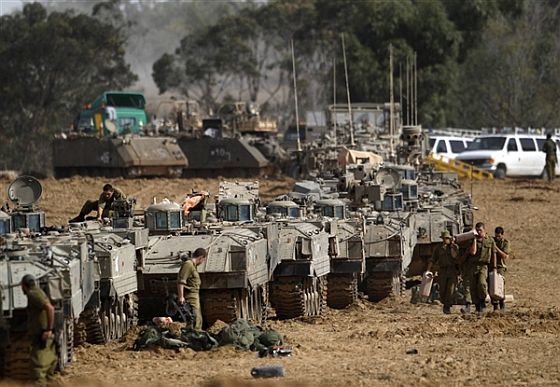
Israeli soldiers prepare armored personnel carriers near the border with the Gaza Strip on Friday.
NBC News: Israeli troops have massed near the Palestinian territory and witnesses said they could see Israeli ships off Gaza’s coast, NBC’s Ayman Mohyeldin reported. Israel’s army would be heavily dependent on reservists to fight any prolonged war. The military has received a green light to call in up to 30,000 reserve troops.
It was unclear Friday whether Israel’s move to call up reservists presaged a ground invasion or was intended more as an intimidation tactic to pressure Hamas.
Visit NBCNews.com for breaking news, world news, and news about the economy