Egypt PM condemns Israeli ‘aggression’ on Gaza

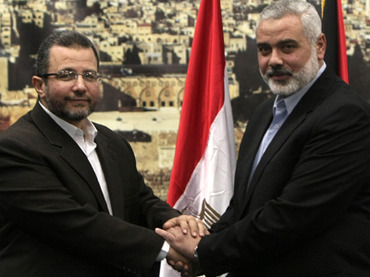
Hamas leader Ismail Haniya receives Egyptian Prime Minister Hesham Kandil in Gaza City, November 16, 2012

Al Jazeera reports: On a brief visit to the Gaza Strip, Egyptian Prime Minister Hesham Qandil has denounced Israel’s attacks on the Palestinian territory and said Cairo would try to secure a ceasefire.

“Egypt will spare no effort … to stop the aggression and to achieve a truce,” Kandil said during a visit with wounded residents at a Gaza hospital on Friday.

Fighting reportedly continued along the Israel-Gaza border during Qandil’s three-hour visit, although Israel had announced it would hold its fire while Qandil was in the enclave on the condition that Hamas fighters did the same.

Hamas said strikes on Friday morning killed three Palestinians, including a child.

Israel’s military denied it had carried out attacks during the temporary cessation, but said about 50 rockets were fired from Gaza while Qandil was in the Palestinian territory.

“Hamas does not respect the Egyptian prime minister’s visit to Gaza and violates the temporary ceasefire that Israel agreed to during the visit,” Ofir Gendelman, spokesman for Israeli Prime Minister Binyamin Netanyahu, wrote on Twitter.

Egypt, now led by an Islamist government seen as ideologically close to Hamas, has arranged previous informal truces between Israel and Palestinian groups in the Gaza Strip.

As air raid sirens sounded on Friday, one rocket hit the sea off the coast of Tel Aviv some 200 metres from the US embassy. On Thursday, two rockets from Gaza crashed near the city in the first such attacks on Israel’s commercial capital in 20 years.

The Israeli army said it had carried out 466 air strikes since it launched “Operation Pillar of Defence” on Wednesday afternoon with the targeted killing of Hamas commander Ahmed Jabari.

Facebooktwittermail

Why Palestine must match Israel in the branding war

Arwa Mahdawi writes: Ever since it officially came into existence in 1948, Israel has gone methodically about the creation of a “Brand Israel”. This originally began with an emphasis of the religious significance of a state for the Jewish people. Then, in 2005, when it was time for a rebrand, the Israeli government consulted with American marketing executives to develop a positioning that would appeal to a new generation: an Israel that was “relevant and modern” rather than a place of “fighting and religion”. So Israel did some pinkwashing, and suddenly became a vocal champion of gay rights. It fought to retain cultural ownership of falafel, hummus, and Kafka. It poured millions of dollars into tourism campaigns that sought to replace imagery of wartorn landscapes with sun-kissed seascapes.

When it comes to winning modern wars, a robust marketing campaign is as important as a military campaign. But while Israel has long been aware of this, the Palestinians have never been quite so PR-savvy. Back in 2005, the Economist quoted a Palestinian official who said that Israelis “spend a lot of time in marketing, and they succeed, whereas the Palestinians have a really good product, but invest nothing in selling it”. Several years on, nothing has changed. The Palestinian messaging currently being most amplified by the media consists of Hamas’s crazed proclamations about “gates of hell“. This curries no international favour for the broader, more moderate Palestinian community – which, being half-Palestinian, I number myself among.

While Palestine should certainly not be looking at emulating the IDF’s feverous Twitter-tactics, it should be following Israel’s lead in a more sophisticated approach towards nation-branding. Because, in today’s world, if there is ever to be a Palestine there needs to first be a “Brand Palestine”.

Facebooktwittermail

How Twitter has become part of Israel’s war machine

BuzzFeed: The Israel Defense Forces just launched a bloody assault on the Palestinian militant group Hamas. And it launched the assault on Twitter.

The advent of CNN and its live coverage of first Persian Gulf War may have been the first real taste we had of watching war happen in real time, and that is more or less how we’ve consumed war ever since.

But while Americans’ interest in Iraq and Afghanistan faded since the dramatic “shock and awe” assault on Baghdad in March of 2003, before YouTube, Twitter, and Facebook came into their own or even existed, the media and technology have become more sophisticated. And Israel’s government, ever conscious of its image with sometimes-skeptical European and American allies, has changed effectively with the times. In 2010, for instance, the IDF was quick to post to YouTube a video of its bloody and controversial assault on a humanitarian “flotilla” to Gaza. The video, annotated with text, circles, and arrows, showed activists attacking Israeli commandos as the Israelis tried to seize their ship, and effectively complicated the international impulse to condemn the incident.

Now the official Twitter account of the Israel Defense Forces’ live-tweeting its assault on Hamas may well be the most meaningful change in our consumption of war in over 20 years. This is something new.

Much of the criticism of the American media during the height of the Iraq War focused on its role repeating White House talking points and propaganda. But using the tools of social media, as Israel is doing, reveals there’s no longer a need to rely a media middleman, or to filter the raw feed of war through an “embedded” — and, military officials hope, captured — journalist’s mouth or keyboard. A nation is officially tweeting its wartime activities. The military can broadcast exactly what it wants to, directly to its citizens, allies, and enemies. The IDF even appropriates the language of news, prefacing several tweets with “BREAKING” — and native social media, at one point saying “in case you missed it” before pointing to a YouTube video of it killing Ahmed Jabari in a missile strike. And unlike any propaganda machine before it, it’s inherently viral. It’s designed to spread. So the IDF spokesperson provides posters and YouTube videos and a constantly updated Flickr account; they’re more shareable than plain text. Its tweets are a mixture of documentation, saber rattling, sober reminders of the reality of war, and upbeat updates on the advanced state of its technology. All delivered direct to you. Please RT.

(Twitter did not respond to requests asking it to comment as to whether the IDF’s tweets violates Twitter’s terms of service.)

Facebooktwittermail

Israeli police spokesperson: ‘If they dare to strike Tel Aviv… we’ll wipe the whole place out’

Philip Weiss writes: There is a famous knoll outside Sderot in southern Israel where reporters and other spectators of war gather to watch Israeli operations against Gaza—“we want to see fireworks,” as one young man explained this afternoon– and we had been there only ten minutes when Micky Rosenfeld, an Israeli police spokesperson on security matters, arrived with a colleague.

“There’s a strike, check it out,” he said proudly as a plume of smoke rose from Gaza City. “You can see it well in the setting sun.”

Around us, photographers balanced long telephoto lenses on knees or tripods to make the golden shot of destruction about a dozen miles away. Four men seated under a fir tree guzzled bottles of beer.

Then Rosenfeld spoke with controlled anger about a possible Israeli invasion of the strip if Gazan rocket attacks persist. “It won’t be for two days… It could be two weeks. It could be a month. It could be two months. It is not going to be like last time.”

And my colleague Allison Deger reports that when she asked Rosenfeld about Gaza hitting Tel Aviv with rockets, he was even more emphatic: “If they dare to strike Tel Aviv… we’ll wipe the whole place out.”

Facebooktwittermail

Another day in Syria

Local Coordination Committees in Syria: By the end of Thursday the LCC managed to document 130 martyrs (including 11 children and 5 women), 59 martyrs were reported in Damascus and its Suburbs, 21 martyrs in Aleppo, 17 martyrs in Homs, 10 martyrs in Idlib, 8 martyrs in Daraa, 5 martyrs in Raqqa, 5 martyrs in Hama, 3 martyrs in Deir Ezzor and 2 martyrs in Lattakia

The LCC documented 206 shelled points, 146 points were shelled by artillery, 46 points by mortars and 23 points by missiles
Also 21 points in Syria were targeted by the regime Warplane by throwing 6 explosive barrels in 6 points and Thermobaric Bombs in 4 points

The FSA had clashes with the regime forces in 84 points, and they shot down a MiG Warplane in Bokamal, they also liberated the Agriculture Bank and the Military Security in Bokamal, the FSA announced a full liberation of Bokamal City.

EA Worldview adds: The city (map) is Syria’s gate to Iraq, and any supplies and reinforcements that come with it. Furthermore, the FSA is using Al Bukamal to eat away at the regime’s control in Deir Ez Zor. Though the Assad regime has pockets of stiff resistance, for the most part its control of the entire eastern province of Deir Ez Zor has been slipping for months.

With Ma’arrat al Nouman in Idlib (map) still under FSA control, and Assad’s supply routes to Idlib and Aleppo cut, the FSA is strangling Assad’s military, and Assad may not have enough firepower to spare in order to retake Al Bukamal, if the city has indeed fallen.

But the FSA’s struggle to take Deir Ez Zor has been painstakingly slow, if steady. It will likely be a long time before they convert victories here into control of eastern Syria.

Facebooktwittermail

Hypocrisy, as usual

Robin Yassin-Kassab writes: [M]any of those who are quite correctly calling for demonstrations today against Zionist terror have not stirred in the last two years as forty thousand Syrians have been slaughtered, except perhaps to explain that the victims are enacting a dastardly plot against a resistance regime. A recent Facebook status from Sharif Nashashibi serves as an excellent rejoinder: “Sadly, there are people who condemn the slaughter of Palestinians but defend the slaughter of Syrians, and vice versa. As a Palestinian and a Syrian, I totally reject these hypocrites’ so-called support. The suffering of Palestine is the suffering of Syria, and vice versa. We are one and the same.”

This is absolutely correct. The slaughter of the people of bilad ash-Sham is as much of an abomination in Syria as it is in Palestine. American support for the frenzied Zionist bombing of Gaza is no more or less disgusting than Russian (and Iranian) support for Asadist barbarism. Furthermore, both Palestinians and Syrians have the right to self-defence. This is why I support providing anti-aircraft weaponry to both the Syrian and the Palestinian resistance.

Many analysts believe the timing of Israel’s attack has been determined by upcoming elections. Netanyahu needs to look tough for his rabid public, so he brings more trauma and death to Gaza. It is grotequely easy for Zionists to act out their impulses on the Palestinians, just as they used to find south Lebanon easy. In this revolutionary age, is no Arab power going to make the slaughter more expensive?

Saad el-Katatny of Egypt’s Muslim Brotherhood says, “The brutal aggression on Gaza proves that Israel has not yet learned that Egypt has changed.” So far, President Morsi has recalled the Egyptian ambassador from Tel Aviv, called a UN Security Council meeting, and opened the Rafah border for medical evacuations. This is far more than Mubarak would have done, but it’s still not nearly enough. The Qatari foreign minister says, “This filthy crime must not pass without a punishment.” Again, words are not enough. (By the by, I wonder if infantile leftists will decide that Palestinian resistance is a foreign plot now that the Qatari emir has visited Gaza and funded some projects there?)

While pointless adventurism would be criminally stupid at this moment of general Arab crisis, the new leaders of revolutionary Egypt, Tunisia and Libya, and old leaders seeking to adapt to the revolutionary wave, should remember that national dignity as expressed through a pro-Arab and anti-imperialist foreign policy is one of the key demands of Arab revolutionaries. This is a test for the Egyptian Muslim Brotherhood in particular. The Palestinians must not be left alone indefinitely.

Facebooktwittermail

Video: Nasrallah says Arab nations must pressure West to rein in Israel

The Wall Street Journal reports: Mr. Netanyahu and his government have been effusive in praising Mr. Obama for his support of the Gaza operation. “We couldn’t have asked for more,” said Michael Oren, Israel’s ambassador to the U.S., in an interview.

The White House and State Department, meanwhile, have been pressing Egypt’s government to constrain Hamas. Mr. Obama called Mr. Morsi on Wednesday night. And Secretary of State Hillary Clinton talked with her counterpart, Foreign Minister Mohammed Amr, Thursday.

Facebooktwittermail

Turkey recognizes Syrian National Coalition

The New York Times reports: Turkey made it clear on Thursday that it officially recognized a newly formed rebel coalition as the legitimate leader of the Syrian people, an important step in the group’s effort to attract legitimacy and, it hopes, more weapons to bring about the end of President Bashar al-Assad’s rule.

Turkey “once again reiterates its recognition of the Syrian national coalition as the legitimate representative of the Syrian people,” Turkey’s foreign minister, Ahmet Davutoglu, said in a speech at an Organization of Islamic Cooperation meeting in Djibouti, the tiny country on the Horn of Africa.

The announcement by Turkey, Syria’s northern neighbor and a haven for thousands of Syrian refugees and rebel fighters, was the third significant recognition of the new group this week.

On Monday, members of the Gulf Cooperation Council — Saudi Arabia, Bahrain, the United Arab Emirates, Oman, Qatar and Kuwait — recognized the group, known as the National Coalition of Syrian Revolutionary and Opposition Forces.

On Tuesday, France became the first Western country to do so, and it said it was considering providing arms to the insurgent groups within Syria that have been engaged in a 20-month-long war with the government that has claimed nearly 40,000 lives.

Facebooktwittermail

Egypt’s Mursi condemns Israel, orders prime minister to Gaza

Reuters reports: President Mohamed Mursi condemned Israeli air strikes on the Gaza Strip as unacceptable aggression on Thursday and ordered Egypt’s prime minister to visit the besieged enclave in a show of support for the Palestinians.

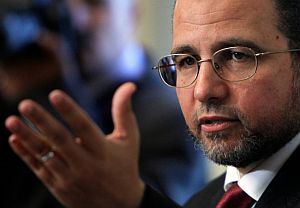
Hesham Qandil, Prime Minister of Egypt

Facing his biggest test since becoming Egypt’s first popularly elected president this year, Mursi – whose roots are in the Muslim Brotherhood – has to balance the need to show solidarity with fellow Islamists running Gaza with the country’s dependence on about $2 billion a year in U.S. aid.

“We are in contact with the people of Gaza and with Palestinians and we stand by them until we stop the aggression,” Mursi said in a televised address. “The Israelis must realize that this aggression is unacceptable and would only lead to instability in the region.”

A cabinet source said the prime minister and intelligence chief would visit Gaza on Friday to meet officials from Hamas, which runs Gaza, and show support to Palestinians. Presidential spokesman Yasser Ali said the health minister and some of Mursi’s assistants would accompany the prime minister.

Egypt has already recalled its ambassador to Israel and appealed to the UN Security Council to end the fighting in which 16 Palestinians, five of them children, and three Israelis have been killed.

But sending a high-level delegation would raise the stakes – potentially forcing Israel to choose between suspending its shelling of Gaza or risking the lives of senior officials from a country with which it signed a peace treaty in 1979.

Facebooktwittermail

The story behind the photo: Journalist’s 11-month-old son killed in Gaza strikes

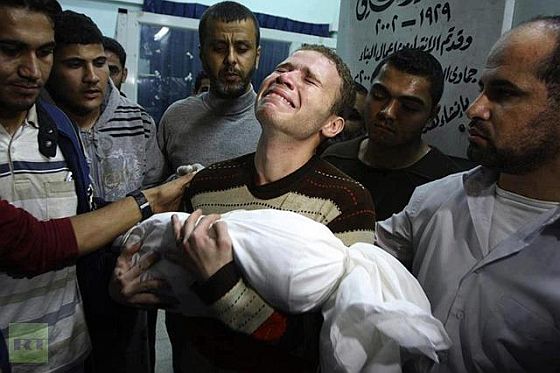
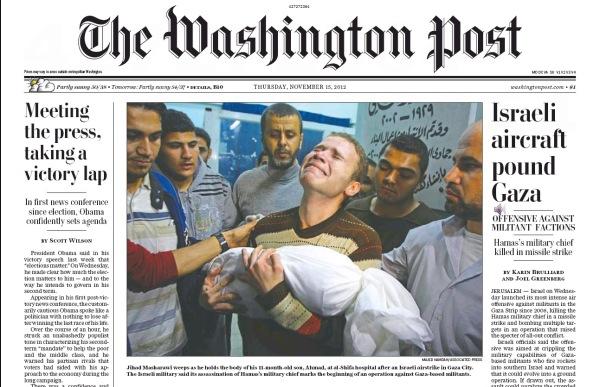
Max Fisher writes: The front page photo on Thursday’s Washington Post tells, in a single frame, a very personal story from Wednesday’s Israeli airstrikes on the Gaza Strip. Jihad Misharawi, a BBC Arabic journalist who lives in Gaza, carries the body of his 11-month old son, Omar, through al-Shifa hospital in Gaza City.

Omar Misharawi

An Israeli round hit Misharawi’s four-room home in Gaza Wednesday, killing his son, according to BBC Middle East bureau chief Paul Danahar, who arrived in Gaza earlier Thursday. Misharawi’s sister-in-law was also killed, and his brother wounded. Misharawi told Danahar that, when the round landed, there was no fighting in his residential neighborhood.

“We’re all one team in Gaza,” Danahar told me, saying that Misharawi is a BBC video and photo editor. After spending a “few hours” with his grieving colleague, he wrote on Twitter, ”Questioned asked here is: if Israel can kill a man riding on a moving motorbike (as they did last month) how did Jihad’s son get killed.” [Continue reading…]

Facebooktwittermail

Bodies for ballots

Yousef Munayyer writes: They say when all you have is a hammer, everything looks like a nail. But when you are a politician and all you have is a hammer, you must convince voters every problem looks like a nail. This is the only thinking that can explain Israel’s behavior in escalating bombardment of Gaza.

The Israeli spin machines are out in full force in the hopes of convincing Israelis and the rest of the world that the attacks on Gaza are in self-defense. But anyone following the situation closely and over time will tell you that cannot be the case.

Gaza is a tiny territory where 1.7 million Palestinians, most of whom are refugees, are denied the right to return to their homes simply because they are not Jewish. It is from this besieged territory that militants have fired mostly rudimentary projectiles at Israel. While Israeli officials are quick to rattle off the numbers of projectiles fired from Gaza, rarely do they tell you what they fire into Gaza, what the effects of this fire is and what the fallout from it is.

For example, in 2011, the projectiles fired by the Israeli military into Gaza have been responsible for the death of 108 Palestinians, of which 15 where women or children, and the injury of 468 Palestinians, of which 143 where women or children. The methods by which these causalities were inflicted by Israeli projectiles breaks down as follows: 57 percent, or 310, were caused by Israeli aircraft missile fire; 28 percent, or 150, where from Israeli live ammunition; 11 percent, or 59, were from Israeli tank shells; while another 3 percent, or 18, were from Israeli mortar fire.

Through September 2012, Israeli weaponry caused 55 Palestinian deaths and 257 injuries. Among these 312 casualties, 61, or roughly 20 percent, were children and 28 were female. 209 of these casualties came as a result of Israeli Air Force missiles, 69 from live ammunition fire, and 18 from tank shells. It is important to note that these figures do not represent a totality of Israeli projectiles fired into Gaza but rather only Israeli projectiles fired into Gaza which cause casualties. The total number of Israeli projectiles fired into Gaza is bound to be significantly larger.

For context, consider this: more Palestinians were killed in Gaza yesterday than Israelis have been killed by projectile fire from Gaza in the past three years. [Continue reading…]

Facebooktwittermail

Gaza and the politics of resistance

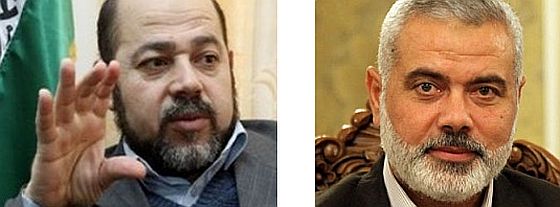
Musa Abu Marzook and Ismail Haniyeh - both contending to become leader of Hamas.

Hussein Ibish writes: The internal dynamic of Hamas has traditionally been that leaders in its Politburo, which is based almost entirely in neighboring Arab countries, were more militant than their compatriots inside Gaza. It was the leaders in exile who maintained close relations with the radical regimes in Iran and Syria, while the Hamas government in Gaza was more restrained because it had more to lose from violence with Israel.

That calculation has been inverted in recent months as Hamas’s foreign alliances have undergone a dramatic transformation and its domestic wing has made a bold attempt to assert its primacy. Hamas’s relationship with Damascus completely collapsed when the group came out in opposition to President Bashar al-Assad’s regime. The Politburo had to abandon its Damascus headquarters, and is now scattered in capitals throughout the Arab world. This has also created enormous strains with Iran, which is apparently supplying much less funding and material to Hamas than before.

Hamas leaders in Gaza, meanwhile, have increasingly been making the case that the Politburo does not represent the organization’s paramount leadership — but rather its diplomatic wing, whose main role is to secure aid and support from foreign governments. It is the Hamas government and paramilitary force in Gaza, they argue, that are in the driver’s seat, because they are actually involved in fighting Israel.

The desire to be the tip of the spear against Israel explains why Hamas involved itself in rocket attacks against Israel earlier this year, and has done much less to prevent other groups from launching attacks in recent weeks. The attacks are part of the case for the transfer of paramount leadership away from the exiles and to the Hamas political and military leadership in Gaza, which portrays itself as doing the ruling and the fighting.

This internal struggle has been given renewed urgency by the September announcement from the group’s current head, Khaled Meshaal, that he would step down. The two contenders for the top spot are Hamas’s de facto leader in Gaza, Ismail Haniyeh, and the present Politburo number two, the Cairo-based Musa Abu Marzook. A Haniyeh victory would cement the transfer of power within Hamas to Gaza, while Abu Marzook represents continued hopes that Hamas’s fortunes hinge on benefiting from the region-wide “Islamic Awakening” — the group’s interpretation of what others call the Arab Spring.

These rocket attacks don’t just come at a time of intense internal wrangling within Hamas, but also Israel’s upcoming election in January. Prime Minister Benjamin Netanyahu and his government have been under enormous pressure to forcefully respond to the continued rocket fire — more than 800 rockets so far this year, according to Israeli officials — and Jaabari’s assassination sends the most powerful of messages. Netanyahu has made his political career on security issues, but even if he hopes to limit the conflagration, it could spiral out of everyone’s control.

The third vital context for Wednesday’s offensive is the upcoming initiative by the Palestine Liberation Organization to formally request an upgrade at the U.N. General Assembly to “non-member observer state status.” Israel is vehemently opposed to this resolution, which is certain to win a majority if it is submitted. Jerusalem has reacted with a series of dire threats — including cutting off the tax revenues it collects on behalf of the Palestinian Authority, declaring the Oslo Agreements “null and void,” overthrowing Palestinian President Mahmoud Abbas, greatly expanding settlement activity, or even unilaterally annexing parts of the occupied West Bank.

Israel has also been marshaling U.S. and European opposition to the PLO’s statehood bid, apparently with a great deal of success. Together, they have been able to paint the move as “unilateral” and provocative, setting the stage for retaliatory measures. But the Israelis must be aware that any further financial, diplomatic, or political blows to the badly ailing Palestinian Authority — which is currently unable to meet the public employee payroll, on which the majority of Palestinians in both the West Bank and Gaza depend — can only strengthen Hamas.

During last year’s PLO initiative at the United Nations, Hamas was in such disarray from its growing crisis with Syria and Iran that it was in no condition to exploit Israeli “punishment” of the PLO. This time, however, Hamas is in an entirely different position: It appears to be on the brink of achieving considerable regional and international legitimacy. The emir of Qatar recently visited Gaza, becoming the first head of state to do so, and promised $400 million in reconstruction aid to the de facto Hamas government there. Turkish Prime Minister Recep Tayyip Erdogan is also reportedly considering a formal visit to Gaza. Egypt, too, is vying for Hamas’s affections, although President Mohammed Morsy’s government has done little to practically help the group.

Hamas can claim, for the first time in many years, to have a vision for the future, reliable patrons, and regional momentum as the primary beneficiaries of a wave of Islamist political victories across the Middle East. The PLO, Hamas can argue, has no money, no friends, no vision, and no future. [Continue reading…]

Facebooktwittermail

Assassinating the chance for calm

The Israeli peace activist Gershon Baskin, who brokered the deal to free captured Israeli soldier Gilad Shalit, was pressing a long-term ceasefire proposal on the Israeli government and Hamas when the latest round of escalations recently began. At Open Zion, Baskin writes:

The key actor on the Hamas side was Ahmed Jaabari, the commander of Ezedin al Qassam, the military wing of Hamas. When he was convinced that Israel was ready to stand down as well, Jaabari was always ready to take the orders to force the ceasefire on all of the other factions and on Hamas.

Both Israel and Hamas had decided months ago not to take action on my proposed ceasefire option, which included within it a mechanism that would prevent Israeli pre-emptive actions and would enable Hamas to prove that it was prepared to prevent terror attacks against Israel. Both sides responded very seriously to the proposal, but without any signal that there was an openness on the other side, neither was willing to advance the possibility for testing it.

Several weeks ago, I decided to try once again and, through my counterpart in Hamas, we both began speaking to high level officials on both sides. A few days ago I met my counterpart in Cairo and we agreed that he would draft a new proposal based on our common understanding of what was required to make it work.

Yesterday morning, hours before Israel assassinated Ahmed Jaabari, my counterpart in Hamas presented the draft to Jaabari and to other Hamas leaders. Senior Hamas leaders on the outside had already seen it and had instructed him to check the reactions to it in Gaza. I was supposed to receive the draft yesterday evening to present to Israeli officials who were waiting for me to send it to them.

That option is now off the table. [Continue reading…]

Facebooktwittermail

Gaza rocket strikes near Tel Aviv

The Associated Press reports: Palestinian militants barraged Israel with nearly 150 rockets on Thursday, killing three people as Israel pressed a punishing campaign of airstrikes on militant targets across the Gaza Strip. Three rockets struck the densely populated Tel Aviv area, and air raid sirens blared in the city as night fell.

The fighting, which has also killed 15 Palestinians in two days, showed no signs of slowing after dark. The attacks in the Tel Aviv area, some of the deepest rocket strikes on record, raised the likelihood of an even tougher Israeli response. Gaza militants launched the rocket barrage in retaliation for Israel’s killing of the Hamas military chief in an airstrike on Gaza Wednesday.

Israeli Channel 2 TV showed panicked Tel Aviv residents running for cover and lying down on the ground after the air-raid sirens began sounding. The military said two rockets had been fired at the city, and residents heard an explosion. But there was no word on where they landed or reports of injuries. Police were exploring the possibility that the rockets landed in the sea.

Facebooktwittermail

Four key tests face the Syrian opposition

Rami G Khouri writes: The rapid developments in recent days in the world of the Syrian groups fighting to overthrow the regime of President Bashar Assad will be a game-changer if the new coalition of opposition forces actually becomes a unified movement that achieves four critical and linked goals: coordinating internal military action, generating legitimate and credible local governance bodies in areas liberated from government control, connecting with Alawites, senior security personnel and other regime supporters to convince them of their safety in a post-Assad Syria, and managing a rising flow of international diplomacy and aid. That is a tall order, but for the country and ancient culture that gave the world its first alphabet and musical notations, among other wonders, it is doable.

The new “National Coalition for Revolutionary Forces and the Syrian Opposition” was agreed upon during a weekend marathon negotiation and political pressure cooker in Doha, Qatar. This kind of reconciliation and consensus-building exercise has now become a hallmark of the dynamic Qatari approach to resolving thorny issues among Lebanese, Palestinians, Yemenis, Sudanese and now Syrians: lock the recalcitrant participants in a luxury hotel for a few days, shower them with fine hospitality and promises of substantial aid in the future, focus the world’s media and political attention on them, and tell them they cannot leave until they have reached an agreement.

The Syrian opposition coalition that was born through this kind of Qatari midwifery faces many hurdles, but it also carries the hopes of tens of millions of Syrians and hundreds of millions of Arabs who wish to see it prevail. It has already been recognized as the legitimate Syrian government by heavyweights like Saudi Arabia, Qatar and the rest of the Gulf Cooperation Council, Egypt, the U.S., Germany, Italy and France. Pulling recognition from the Assad family regime and bestowing it upon this new opposition coalition is one of the few safe moves that foreign countries can make, given their hesitancy in offering serious weaponry to the opposition groups, for fear of promoting the fortunes of Islamists among them. This is an easy step, but we will soon discover if it is also meaningful. [Continue reading…]

Facebooktwittermail

Obama’s ‘tough’ approach to climate change

In his press conference yesterday, when President Obama talked about tackling climate change he said it would involve making some “tough political choices.” He didn’t say what those would be. Indeed, the agenda he’s apparently willing to support has to be one that reverses climate change while boosting American prosperity (as defined by economic growth). We can save the planet and get rich in the process. In other words, Obama wants to tackle climate change but only if he can do so without making any tough political choices.

Mat McDermott responded to Obama’s comments:

Good on the President for repeatedly asserting the scientifically correct fact that the planet is indeed warming and that human activity is causing it—although it’s a bit sad that this is the state of discussion regarding climate in the United States that simply admitting the issue exists deserves kudos.

And good on the President for increasing fuel efficiency standards. Indeed it’s one his genuine environmental victories of his first term in office.

But it all goes downhill from there, quickly.

The President makes a huge rhetorical mistake in repeating and therefore reinforcing the erroneous notion that combatting climate change will cost jobs.

He also makes the intellectual mistake of continuing the fetishization of the universal good of economic growth, when the evidence is solidly on the side of, using renowned ecological economist Herman Daly’s words, future expansion of the scale of the economy is actual uneconomic growth—in other words, it actually does more harm than good. More economic growth, if defined as increased consumption of natural resources, is itself the problem of the century, of which climate change is but a subset, albeit perhaps the most dramatic one.

Facebooktwittermail

Massed Israeli troops poised for invasion of Gaza

The Independent reports: Israeli troops massed on the Gaza border last night, poised for a possible ground invasion as Israel launched a major military operation it said was designed “to severely impair the command and control chain of the Hamas leadership, as well as its terrorist infrastructure.”

Military sources told The Independent that a ground invasion was “a distinct possibility”. The army has deployed extra infantry units near the Gaza border, halted major exercises, cancelled soldiers’ leave and mobilised some reserve forces.

Jerry Haber writes: All military actions, indeed, all actions having to do with Gaza, have one goal in mind: the subjugation of the Palestinian people there with minimum cost to Israel. In hasbara speak this is called “protecting Israelis,” “defeating terror,” “defending national security,” even “protecting national honor,” but it boils down to the same thing — Israel cannot be secure if the Palestinians have real independence. That is why Israelis are divided into those who want to subjugate Palestinians by giving them no self-determination and those who want to subjugate them by giving them quasi self-determination in a quasi-state.

I spoke with an expert on the Israeli military shortly after “Operation Cast Lead,” and when I told him that many argued that the operation was a reaction to Hamas rocket-fire, he laughed. He said that Hamas rocket-fire was deliberately provoked when Israel broke the cease-fire so that Israel could do a little “spring cleaning,” deplete Hamas’s arsenal of weapons. He told me that this happens every few years, and that I should expect it to happen in another few years. Israel will assassinate a Hamas leader, Hamas will have to respond (wouldn’t Israel, under those circumstances?) and Israel will perform a “clean up” operation. If Hamas is smart and doesn’t play into Israel’s hands, then Israel will also come out ahead, because it will be weakened in the eyes of the Palestinian public. It’s win-win for Israel. That’s what having control means.

Ynet reports: On Wednesday, US President Barack Obama spoke to Prime Minister Benjamin Netanyahu and Egyptian President Mohamed Morsi and reiterated US support for Israel’s right to self-defense in light of rocket attacks from Gaza, the White House said.

“The President urged Prime Minister Netanyahu to make every effort to avoid civilian casualties. The two agreed that Hamas needs to stop its attacks on Israel to allow the situation to de-escalate,” the statement said.

“The two leaders agreed to stay in close touch in the coming days. Earlier today, Vice President Biden received a briefing from Prime Minister Netanyahu on the events in Gaza,” the statement noted.

“The President also spoke with President Morsi given Egypt’s central role in preserving regional security. In their conversation, President Obama condemned the rocket fire from Gaza into Israel and reiterated Israel’s right to self-defense,” it said.

United Nations Secretary-General Ban Ki-moon called for an “immediate de-escalation of tensions.” In a statement, Ban said that “Both sides should do everything to avoid further escalation and they must respect their obligations under international humanitarian law to ensure the protection of civilians at all times.”

MENA reports: The Muslim Brotherhood called for protests before major mosques nationwide on Thursday afternoon to demand that the Egyptian government sever diplomatic and trade ties with Israel.

The group also called for a rally at Al-Azhar Mosque following Friday prayers.

In a press release on Thursday, the Brotherhood described the Israeli assaults on Gaza as “crimes” and said the aggression threatens regional stability. It also criticized the US for supporting Israel and blamed Arab countries for “doing nothing while watching the bloodshed in Palestine.”

DPA reports: Egyptian authorities opened the Rafah border crossing following the Israeli attack on the Gaza Strip.

An Egyptian security source told the German news agency DPA that the Egyptian authorities decided Wednesday evening to open the Rafah border crossing on Thursday and Friday. Border workers’ holiday vacations were canceled.

“Work would resume on both sides of the border in order to be ready for the arrival of any injured Palestinians so they could be transferred to Arish Public Hospital, which is ready to receive them,” the source said.

IMEU provides a timeline on Israel’s latest escalation in Gaza.

Facebooktwittermail