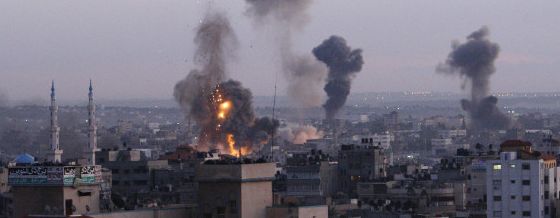
Haaretz reports: A senior government official in Jerusalem said during a press briefing late Wednesday that Israel is preparing for “a significant expansion of the operation, including a ground incursion into the Gaza Strip, and summoning the reservists.”
The official said that until now, the operation has already achieved several goals, including severe damage to Hamas’ long-range Fajr missiles, which can reach Tel Aviv and the Gush Dan area.
Prime Minister Benjamin Netanyahu spoke on the phone Wednesday with U.S. President Obama adn thanks him for hi support. “I appreciate you backing Israel’s right to defend itself,” Netanyahu told Obama. The prime minister also spoke with Vice President Joe Biden and EU foreign policy chief Catherine AshtonCatherine Ashton. Netanyahu is also expected to speak with UN Secretary General Ban Ki Moon. “The prime minister will continue diplomatic efforts and explain that Israel will operate to change the reality in the Gaza Strip and to stop the fire,” the official said.
The new Syrian National Coalition
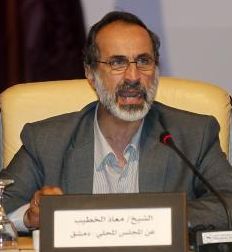
Robin Yassin-Kassab writes: Following my previous comment on the astounding failures of Syrian political elites, I must report some optimism. The Syrian National Council has accepted its place within the new Syrian National Coalition (it makes up a third of the new body), and the Coalition has won recognition by the Arab League, France, Japan and others.Ahmad Muaz al-Khatib
The Coalition’s choice of leaders is the most inspiring sign, one which suggests both that the Coalition is no foreign front, and that another, much more positive aspect of Syria is finally coming to the fore.
President Ahmad Muaz al-Khatib is a mosque imam, an engineer and a public intellectual. He is Islamist enough for the Islamists and less extreme Salafists of the armed resistance to give him a hearing, but not Islamist enough to scare secularists and minority groups. He has written books on the importance of minority religious rights and women’s rights in a just Islamic society. His speeches since assuming his position have reached out to minorities and to the soldiers in Asad’s army, who he described as victims of the regime.
Vice President Riyadh Saif is a businessman, former MP, and a liberal democrat.
And Vice President Suheir al-Atassi, daughter of foundational Ba’athist Jamal al-Atassi, is a human rights activist, a secular feminist, a founder of the Syrian Revolution General Commission, and a key activist of the grassroots Local Coordination Committees. She is the sort of person who should have been representing the Revolution at the highest level from the very start. [Continue reading…]
Video: Interview with Hamas spokesperson Osama Hamdan
Egypt recalls envoy in Israel over assault on Gaza
Reuters reports: Egypt recalled its ambassador from Israel on Wednesday after Israeli strikes on the Gaza Strip killed Hamas’s top military commander and at least six other Palestinians, presidential spokesman Yasser Ali said.
“President Mohamed Mursi has followed the Israeli brutal assault in which a number of martyrs and sons of the Palestinian people were killed,” Yasser Ali said in a statement aired on television.
“On this basis he has recalled the Egyptian ambassador from Israel; has ordered the Egyptian representative at the United Nations to call for an emergency meeting at the Security Council … and summoned the Israeli ambassador in Egypt in protest over the assault,” the statement added.
“On behalf of the Egyptian people the president gives his condolences to the Palestinian people over their martyrs,” Ali said.
Egypt has recalled its ambassador from Tel Aviv on previous occasions, including August, 2011 when Israeli forces killed five Egyptian security personnel along the border while pursing gunmen.
Egypt also withdrew its envoy during Israel’s 1982 invasion of Lebanon and heavy Israeli shelling of the Gaza Strip in 2000.
Another war on Gaza? Not yet

Tony Karon writes: A repeat of the inconclusive 2008 invasion that killed hundreds of Palestinians and destroyed much of Gaza, traumatized Israelis and left their country diplomatically isolated is unlikely to be what the preternaturally cautious Netanyahu has in mind. “The Israelis are not specifying an ambitious end game in terms of clearing out Hamas as [then-Prime Minister Ehud] Olmert did in 2008,” says Daniel Levy, a former Israeli peace negotiator now at the European Council on Foreign Relations. “Instead, they’re talking about ‘reestablishing Israel’s deterrence’, which is a vaguely defined goal. You can claim success whenever you choose to.” Even then, precisely because Hamas has a say in the matter, Netanyahu may not necessarily be able to manage the escalation to his own specifications.
Hamas, meanwhile, has had to reconcile the pragmatic needs of governing in Gaza with those of being a resistance movement, and to navigate the regional political shifts of the past two years. The movement’s leadership is being contested by the Cairo-based Abu Musa Marzook and the Gaza-based prime minister Ismail Haniyeh, who may represent somewhat different orientations. Marzook is part of the exiled leadership that has moved to reposition the movement as part of the regionally ascendant Islamist mainstream, breaking its alliance of convenience with Iran and taking advantage of the emergence of its parent organization, Egypt’s Muslim Brotherhood, as the ruling party in Cairo — as well as the willingness of Turkey and Qatar to strongly back a more pragmatic Hamas. Haniyeh is based in Gaza, where the outlook in the movement has been somewhat more hardline, and where its military wing has more influence than it does in exile. It also faces a constant challenge on the ground from the more radical Salafists eating into its base.
So, while Hamas may have no interest in a sustained confrontation that brings renewed industrial-scale death and destruction upon Gaza’s civilian population, it may find it politically challenging to prevent the sort of retaliation that would require even tougher action according to the Israeli narrative of “deterrence.” Preventing a cycle of escalation is that much more difficult, today, when the politics of the wider Middle East are in flux. Operation Cast Lead in late December 2008 was the beginning of a major rupture in relations with Israel’s longtime strategic ally Turkey, as that country’s moderate Islamist government channeled public rage at the Israeli campaign. Hopes of repairing that relationship remain remote if the Gaza confrontation becomes a sustained one.
Nor can Israel rely, this time, on President Hosni Mubarak serving as the wall at Hamas’ back in Gaza, tacitly supporting Israel’s efforts to break the grip of a movement aligned with his own Muslim Brotherhood nemesis. Egypt today is governed by leaders from Hamas’ parent organization, the Muslim Brotherhood, and is far more responsive to Egyptian public opinion which is innately hostile to Israeli military action in Gaza. Responding to the strikes, the Brotherhood’s Freedom and Justice Party demanded “swift Arab and international action” to stop the Israeli attacks, warning that Israel to “take into account the changes in the Arab region and especially Egypt,” vowing that the new Egyptian government “will not allow the Palestinians to be subjected to Israeli aggression, as in the past.” Egypt is highly unlikely to respond in any way that contravenes the Camp David agreements, but has called for an economic boycott of Israel and summoned its ambassador back from Tel Aviv. Qatar, a key U.S. ally on Syria, has committed a half-billion dollars in reconstruction aid to Gaza, and is unlikely to take kindly to Israeli President Shimon Peres’ exhortation, in a speech Wednesday, to cut ties with Hamas.
Israel’s latest assault on Gaza
Al Jazeera reports: The killing of Jabari sparked furious protests in Gaza City, with hundreds of members of Hamas and the Ezzedine al-Qassam Brigades chanting for revenge inside Shifa hospital.
Outside, armed men fired weapons into the air, and mosques throughout the city called prayers to mourn the commander’s death.
Osama Hamdan, a Hamas representative in based in Lebanon, talking to Al Jazeera in Doha, confirmed that Jabari’s son was also killed in the targeted air strike that killed the military chief.
“We will respond [to the assassination], this I have to say clearly.”
“The Israelis are working to target the local leaders and political leaders in Gaza. We are expecting acts and reactions from the Palestinians.”
Saeb Erekat, a Palestinian negotiator based in the West Bank, told Al Jazeera: “We condemn this Israeli crime and assassination of Ahmad Jabari.
“We are witnessing a major escalation against our people in Gaza, and it seems to me the Israeli agenda is war, not truce or a ceasefire. We hold the Israeli government responsible.”
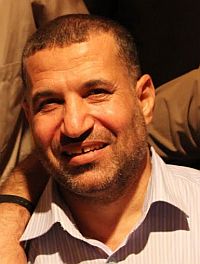
Ahmed al-Jaabari: the Hamas ‘general’ who kept out of the limelight

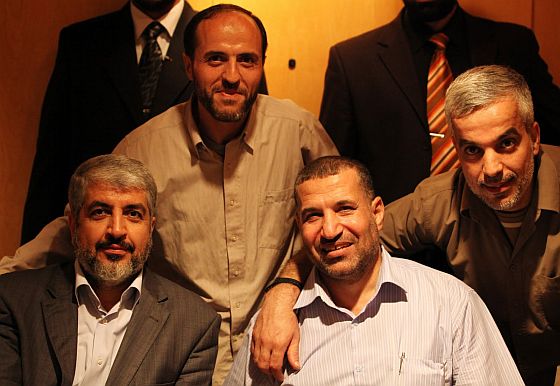
Ahmed al-Jaabari (right) alongside Hamas political chief, Khaled Meshaal
The Guardian reports: Ahmed al-Jaabari, the operational commander of the Izz ad-Din al-Qassam Brigades, Hamas’s military wing, kept largely out of the limelight.
Blamed by Israel for being the captor-in-chief of the kidnapped Israeli soldier Gilad Shalit in 2006, he confirmed that role by escorting Shalit to the handover when he was finally released last year.
Jaabari was also heavily involved in the negotiations between Israel and Hamas for the soldier’s release, hosted by Egypt.
Jaabari, 52, was killed on Wednesday along with an unnamed associate when their car was blown apart by an Israeli missile. Palestinians said nine people were killed, including a seven-year-old girl.
Video from Gaza showed the charred and mangled wreckage of a car belching flames, as emergency crews picked up what appeared to be body parts.
Born in the Shujiya area of Gaza City in 1960, Jaabari came from a noted activist family and studied history at Gaza’s Islamic University.
Originally a member of Yasser Arafat’s Fatah, he was imprisoned in 1982 where he first encountered some of the founding figures of Hamas, including Abdel Aziz al-Rantissi, who would also be killed in an Israeli attack. [Continue reading…]
Riots erupt in Jordan: The end of absolute monarchy

Christopher Dickey reports: The blue-eyed king and beautiful queen of Jordan are facing the biggest crisis of their reign. On Tuesday night, riots and protests broke out in many of the country’s cities. Some in the crowd shouted “the people want the fall of the regime.” Others burned the monarch’s portrait. One longtime supporter of the royals even suggested privately “it’s not a question of if, but when” King Abdullah’s rule will end. That may well be an overstatement. The protests only included a few thousand people all told. But the pressures for truly major political reforms are mounting.
“I think this ushers in the beginning of the end of absolute monarchy, not themonarchy,” says Labib Kamhawi, 61, a former political science professor at Jordan University who is now a spokesman for an umbrella group of opposition parties and movements. (Kamhawi is facing sedition charges from the nervous regime for, as he puts it, “saying what I am saying to you.”)
Monarchies traditionally rely on a mystique that blends bloodlines with patriotism, and throughout history the wisest royals have been those who managed to remain above the fray of day to day politics. The latest riots, which started over a hike in fuel prices, show that the 50-year-old Abdullah is finding that game increasingly hard to play.
One buffer after another between Abdullah and popular anger has fallen away: He has named four prime ministers in the last year alone. His powerful intelligence chiefs have toppled repeatedly since he succeeded to the throne in 1999, as he first relied on them for his survival, then fired them and threw them in prison. [Continue reading…]
Hamas military chief Ahmed Jabari killed by Israeli airstrike
Haaretz reports: Ahmed Jabari, head of Hamas’ military wing, was killed Wednesday in a targeted strike by Israeli forces in the Gaza Strip.
The Palestinian Islamist group said an Israeli airstrike hit a car in the Gaza Strip, killing both Jabari, who ran the organization’s armed wing, the Izz el-Deen Al-Qassam, and a passenger.
Israel’s Shin Bet domestic intelligence service confirmed it had carried out the attack, saying it had killed Jabari because of his “decade-long terrorist activity.”
The incident appeared to end a 24-hour lull in cross-border violence that surged this week.
Jabari is the most senior Hamas official to be killed since an Israeli invasion of Gaza four years ago. He has long topped Israel’s most-wanted list.
America’s royal generals

An article in the Daily Telegraph which focuses on Jill Kelley’s role as a hostess and prominent Tampa socialite reports:
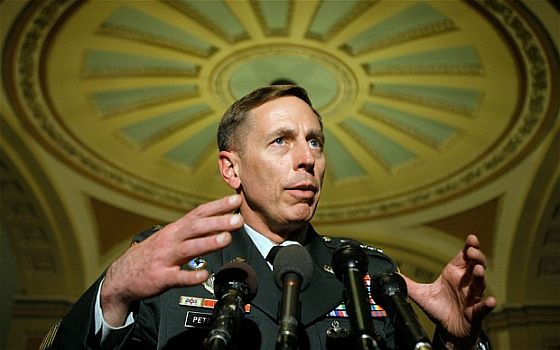
Mrs Kelley, a mother-of-three and unpaid “social liaison” for the US military in Tampa, is said to have spared no expense at such parties to honour top brass stationed at nearby US Central Command. She was pictured at one event at her $1.2 million mansion in 2010 with Gen Petraeus, who arrived in a 28-man police motorcycle escort.
No wonder Petraeus has been dubbed King David.
Spencer Ackerman and Noah Shachtman write:
If there’s a possible silver lining to this rather weird and icky cloud, it’s that these scandals might provoke a reevaluation of how the military treats its highest-ranking general officers. Today, many three and four stars are pampered like British royals – and we all know the kind of trouble those Windsors get themselves into.
“I worry about a creeping entitlement culture,” a former senior military officer tells Danger Room. “They’re so far removed from the daily realities – everything’s taken care of. There’s too many bells and whistles, too many perks,” says the former officer. “They’re ferried from place to place in black SUVs. Some of them have their own airplanes. Aides make their dinner reservations, get their clothes cleaned even cook their dinners. Many guys running big corporations aren’t living this large. And it all seems perfectly normal to them.”
Peeling away the entourages might bring some generals back down to the plane of mere mortals.
Americans have a very confused relationship with privilege. This country was founded as a republic because the idea anyone should be subject to rule under a monarch offended the conception that “all men are created equal.” But rather than completely rejecting the idea that some people can assume the right to rule over others, the preference has often seemed that “equality” can consist of common access to royal power. No one can be born a king but everyone can become a king. And thus presidents become invested with regal authority and the ability to start wars — not an actual legal right but a kind of cultural right that naturally belongs to whichever king currently rules from his white palace.
Video: The rush to profit from the destruction of the arctic
Don’t abandon Iran’s internet generation to online oppression
A Green Movement supporter and activist in Tehran writes: Imagine you live in a country like the Oceania of George Orwell’s Nineteen Eighty-Four, where Big Brother seeks to control almost every aspect of your life, particularly your interaction with the media — determining the news and information to which you are permitted access and watching every move you make on the Internet. Imagine yourself struggling to open a small window in the invisible but all too real wall erected by the ruling system to take a peek at reality, or to scream out so others might hear that you exist and are hurting. You want to feel what it is like to live emancipated, if not in the real world at least in the cyber realm. You are aware that every time you make such an attempt, the government is likely to detect it, and if it feels threatened in any way by your activity will hunt you down and throw you in one of its grim prisons. You hold out hope that those who enjoy freedom on the “other side” do not forget you, and if they do not lend a hand in opening that little window, at least will not act, however unwittingly, in concert with Big Brother.
Yet that is the gist of what now confronts Iran’s Internet generation, the young people whose courageous defiance of the engineered presidential election of 2009 brought Iranians’ long-stifled aspirations for democracy and freedom to the world’s attention. The situation has been highlighted by the death last week of Sattar Beheshti, 35, a Green Movement supporter who maintained a blog in which he criticized the regime and its treatment of political prisoners. A laborer living in one of Tehran’s poorest suburbs, Beheshti — despite not using his full name on his blog page — was tracked down and arrested in early November by the Islamic Republic’s cyber police. His death was reportedly the result of torture he endured during interrogation.
Beheshti’s tragic death underlines the deeply besieged mentality of Iran’s theocratic regime and how far it will go to suppress any voice of popular opposition. The aftermath of the 2009 election impressed on the government the grave danger posed to it by a free flow of information and an informed citizenry. An enormous amount of money was allocated to the acquisition of some of the world’s most sophisticated systems for monitoring and tracking electronic communications, restricting the Internet, and jamming satellite broadcast signals. [Continue reading…]
Video: Golden Dawn taps into international network of fascists
Racism and classism in the heart of America’s capital
Michael Shank writes: Of the two rivers that cup our nation’s capital – the Potomac and the Anacostia – the latter of the two is, perhaps, the most apt reflection of where America is at socio-economically. The Anacostia River – the Anglicised namesake of which was first officially recorded by Thomas Jefferson and referred to the Nacochtank Native American tribe dwelling east of the river – is just down the hill from my Anacostia house and reflects well what divides our nation’s capital, and, ultimately, America.
A quick dig into the District’s demographics and it is painfully apparent: A growing white majority living west of the river, encroaching east, and a predominantly African American majority living east of the river. There is no question that we are a deeply and demographically divided city. As I take Metro’s green line home to Anacostia after work, I am frequently the only white person on the train. Any remaining white folks on the green line generally disembark at Navy Yard, the last stop before crossing east of the Anacostia River.
As it happens in DC, so too does it happen in America: This year, researchers at Dartmouth, the University of Georgia, and the University of Washington looked at Census neighbourhood data to compare trends in racial diversity and found that highly diverse neighbourhoods are actually rare, African Americans remain concentrated in segregated neighbourhoods, and newly arrived immigrants continue to settle in concentrated racial residential patterns.
Yet, this trend is not the only divider in the District. Anacostia River is a divider of class as well, with a majority of the town’s wealth living to the west of the river and a much poorer population living to the east. Hovering much lower than the national average of $50,000, the average median household income in Anacostia struggles at $30,000 for a family of four, compared with Washington, DC’s $60,000, and the broader DC metro area at well over $80,000. In fact, US Census data cites the income gap in the District as one the highest in the nation. Furthermore, the unemployment rate west of the river is roughly 8.9 percent, while east of the river it’s 35 percent. [Continue reading…]
Video: African refugees in Israel fight for their rights
Music: Ibrahim Maalouf — live improvisation
The health of the planet must come first

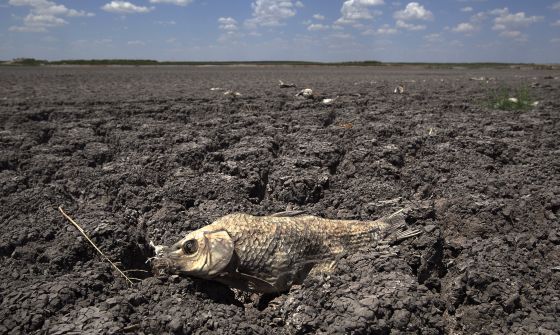
The remains of a carp in a dried out lake bed in San Angelo, Texas, August, 2011.
David Remnick writes: Barack Obama can take pride in having fought off a formidable array of deep-pocketed revanchists. As President, however, he is faced with an infinitely larger challenge, one that went unmentioned in the debates but that poses a graver threat than any “fiscal cliff.” Ever since 1988, when NASA’s James Hansen, a leading climate scientist, testified before the Senate, the public has been exposed to the issue of global warming. More recently, the consequences have come into painfully sharp focus. In 2010, the Pentagon declared, in its Quadrennial Defense Review, that changes in the global climate are increasing the frequency and the intensity of cyclones, droughts, floods, and other radical weather events, and that the effects may destabilize governments; spark mass migrations, famine, and pandemics; and prompt military conflict in particularly vulnerable areas of the world, including the Middle East, Southeast Asia, and sub-Saharan Africa. The Pentagon, that bastion of woolly radicals, did what the many denialists in the House of Representatives refuse to do: accept the basic science.
The economic impact of weather events that are almost certainly related to the warming of the earth—the European heat wave of 2003 (which left fifty thousand people dead), the Russian heat waves and forest fires of 2010, the droughts last year in Texas and Oklahoma, and the preëlection natural catastrophe known as Sandy—has been immense. The German insurer Munich Re estimates that the cost of weather-related calamities in North America over the past three decades amounts to thirty-four billion dollars a year. Governor Andrew Cuomo, of New York, has said that Sandy will cost his state alone thirty-three billion. Harder to measure is the human toll around the world—the lives and communities disrupted and destroyed.
“If we are willing to work for it, and fight for it, and believe in it,” Obama said, when he clinched the Democratic nomination in 2008, future generations will look back and say, “This was the moment when the rise of the oceans began to slow and our planet began to heal.” Those generations assuredly will not. Although Obama, unlike his predecessor, recognized the dimensions of the problem, he never pursued measures remotely equal to it. To his credit, his Administration has directed ninety billion dollars to investments in clean energy, and has secured several billion for energy-conservation upgrades; he got Detroit to agree to better gas-mileage standards, and finally introduced CO2 emission standards for commercial trucks and buses. For the most part, though, the accumulating crisis of climate change has been treated as a third-tier issue.
Last week, in his acceptance speech, Obama mentioned climate change once again. Which is good, but, at this late date, he gets no points for mentioning. The real test of his determination will be a willingness to step outside the day-to-day tumult of Washington politics and establish a sustained sense of urgency. There will always be real and consuming issues to draw his and the political class’s attention: a marital scandal at the C.I.A., a fiscal battle, an immigration bill, an international crisis. But, all the while, a greater menace grows ever more formidable. [Continue reading…]

Greece’s far-right party goes on the offensive

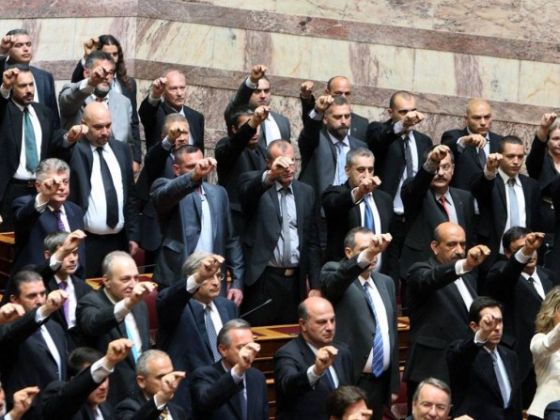
Golden Dawn MPs give fascist salute in Greek parliament.
Reuters reports: Arm raised in a Nazi-style salute, the leader of Greece’s fastest-rising political party surveyed hundreds of young men in black T-shirts as they exploded into cheers. Their battle cry reverberated through the night: Blood! Honour! Golden Dawn!
“We may sometimes raise our hand this way, but these hands are clean, not dirty. They haven’t stolen,” shouted Nikolaos Mihaloliakos as he stood, floodlit, in front of about 2,000 diehard party followers filling an open-air amphitheatre at Goudi park, a former military camp near Athens.
“We were dozens, then a few hundred. Now we’re thousands and it’s only the beginning,” cried the leader of Golden Dawn, a far-right party that is seeing its support soar amid Greece’s economic collapse. Last month’s rally revealed the party, which describes itself as nationalist and pledges to expel all illegal foreigners, has a new-found sense of triumph, even a swagger, that some find menacing.
Riding a wave of public anger at corrupt politicians, austerity and illegal immigration, Golden Dawn has seen its popularity double in a few months. A survey by VPRC, an independent polling company, put the party’s support at 14 percent in October, compared with the seven percent it won in June’s election.
Political analysts see no immediate halt to its meteoric ascent. They warn that Golden Dawn, which denies being neo-Nazi despite openly adopting similar ideology and symbols, may lure as many as one in three Greek voters. [Continue reading…]