What Obama should say about Iran in the debate

Robert Wright writes: Sunday’s New York Times carried a story that will presumably come up in Monday’s foreign policy debate between President Obama and Mitt Romney: The U.S. and Iran have reportedly agreed “in principle” to have direct bilateral negotiations over Iran’s nuclear program, negotiations that could start after the election if Obama wins it.

If true, this is good news. Iran has long resisted direct talks with the U.S., and lots of people think this format would be more productive than the current cumbersome format known as “P5+1” (the permanent members of the UN Security Council plus Germany on one side of the table, Iran on the other). One reason Iran may have been reluctant to depart from the P5+1 format is that it includes Russia and China, which are relatively sympathetic to Tehran. Maybe, now that sanctions are starting to do serious damage to its economy, Iran figures it can’t afford to hold out for the optimal deal and needs to cut to the chase. In any event, the new Iranian position reported by the Times is auspicious.

So, if we lived in a rational world, the New York Times story would be hailed as validation of Obama’s foreign policy — there might even be suspicions that the Obama administration leaked the news to glorify itself!

But we don’t live in a rational world. We live in a world where (on much of the right, at least) negotiation is equated with capitulation. And that explains why there’s been much speculation that the Times story was leaked by people who oppose these negotiations and/or people who want to help Mitt Romney. The thinking goes like this: In Monday’s debate, Romney can depict this as Obama’s secret plan to implement Munich-style appeasement after re-election, cutting some shady deal that would be bad for the U.S. and for its ally Israel. [Continue reading…]

Facebooktwittermail

The undisclosed Mitt Romney

Thomas B. Edsall writes: Early in the general election campaign, Mitt Romney made it clear that he was not going to disclose the details of his plans before voters cast their ballots.

“One of the things I found in a short campaign against Ted Kennedy was that when I said, for instance, that I wanted to eliminate the Department of Education, that was used to suggest I don’t care about education,” Mitt Romney told the Weekly Standard in an interview published April 2:

So I think it’s important for me to point out that I anticipate that there will be departments and agencies that will either be eliminated or combined with other agencies. So for instance, I anticipate that housing vouchers will be turned over to the states rather than be administered at the federal level, and so at this point I think of the programs to be eliminated or to be returned to the states, and we’ll see what consolidation opportunities exist as a result of those program eliminations. So will there be some that get eliminated or combined? The answer is yes, but I’m not going to give you a list right now.

This was a dangerous assertion. It amounted to waving a red flag in front of reporters.

With the presidential election just two weeks away, Romney’s gamble may be paying off. He has failed to specify where he would wield the budget knife, and he has defied, with a striking degree of success, the relatively quiet group of people who have called for him to honor a host of traditional disclosure and campaign practices. [Continue reading…]

Facebooktwittermail

Former Israeli spymaster: We need to talk to Iran

Laura Rozen writes: Efraim Halevy served as chief of the Israeli intelligence service, Mossad, under three Israeli prime ministers and led the secret negotiations with Jordan’s King Hussein that made way for Israel’s historic 1994 peace treaty with that country. Other assignments in a four-decade government career include serving as Mossad station chief in Washington in the 1970s under then-Israeli ambassador to the United States Yitzhak Rabin, for whom, as prime minister, Halevy served as Mossad chief until Rabin’s 1995 assassination. Halevy also served as Israeli national security advisor and Israeli ambassador to the European Union in the late 1990s.

Born in Britain — Halevy moved to Israel in 1948 at the age of 14 — and wearing a trench coat with a newspaper tucked under his arm on a drizzly morning in Washington on Friday, Oct. 19, Halevy, 78, evoked George Smiley, the protagonist in the John Le Carre British spy novels, who is burdened by the knowledge of state secrets too sensitive and ugly to share. But it is Halevy’s fierce advocacy for dialogue with mortal enemies such as Iran and Hamas, combined with a biography laden with hard political experience, that makes him so iconoclastic, especially in the current Israeli political and national security landscape.

“I was 40 years in the business of dealing with adversaries — some of them very bitter ones, some we fought successive wars with,” Halevy said in an interview with Al-Monitor. “Over the years … I realized that, in order to be effective with one’s enemies, you have to have two essential capabilities: To overcome them by force if necessary … And do everything you can to get into their minds and try to understand how they see things … and where if at all there is room for common ground of one kind or another.”

“I think that what we have had over the years is an abundance of one side, and a dearth of the other,” Halevy said.

Halevy most especially emphasized the need for dialogue with Iran, and to try to understand the Iranians — a position rarely heard from top Israeli officials, even those who have expressed opposition to unilateral Israeli military action on Iran.

“The Iranians, in their heart of hearts, would like to get out of their conundrum,” Halevy told Al-Monitor. “The sanctions have been very effective. They are beginning to really hurt.” [Continue reading…]

Facebooktwittermail

The U.S. must supply anti-aircraft missiles to the Syrian opposition

Joshua Landis writes: The US government should tell Assad that he must launch serious negotiations for a transition government. If he does not, Western governments should supply opposition militias with ground to air missiles in sufficient numbers to bring down the Syrian air-force. Circumstantial evidence suggests that US officials in Libya may already have been working to facilitate the transfer of portable heat-seeking missiles—the bulk of them SA-7s—from Libya to Syria.

As soon as the elections are over in the US, Washington should redouble its efforts at changing the balance of power in Syria, if Assad does not begin to form a transitional government in earnest. He must come to terms with the most powerful rebel leaders or see his air force neutralized.

Lakhdar Brahimi of the UN should be empowered to monitor and report on these negotiations, judging if they are sincere.

Assad should be encouraged to work toward some sort of agreement comparable to the Taif Agreement — or National Reconciliation Accord — that ended the Lebanese civil war. It may be impossible to get the Sunni militias to accept such a solution, particularly as they remain so divided. All the same it is worth trying.

It is unclear whether Assad will chose to fall back to the Alawite Mountains, where he can may struggle to protect Alawites from uncontrolled retribution, but where his capacity to damage to the rest of Syria is severely limited.

Assad has no possibility of regaining control of Syria. He does not have soldiers enough to retake lost cities. But he insists on using his air force to destroy what remains of rebel held towns. This is senseless destruction. He has no hope of recapturing them. It should be stopped. He has been carrying out a scorched earth policy that is killing thousands, leaving hundreds of thousands homeless, and destroying Syria’s precious architectural heritage.

I have long resisted supporting US intervention, believing that the US should refuse to get sucked into Syria. It cannot determine what is fair. No one truly understands the “real” Syria today, as Syrians are only beginning to emerge from 40 years of sever authoritarianism that stopped politics in its tracks. What new social forces will emerge in the coming years is impossible to determine. Most importantly, the opposition has been too fragmented to replace the Syrian Army as a source of stability and security. Syrians need to find their own way forward and to create a new balance among the sects and regions. Decapitating the regime too suddenly, I believe, would likely result in a number of unhappy endings: a massacre of the Alawites, a civil war among militias that could bring even greater suffering, or a melt-down of security as happened in Iraq.

The various Syrian factions have to find a new equilibrium, which would not happen with an overpowering US intervention. Even one limited to the use of American air power, such as that carried out in Libya, could be too much force, used too quickly.

The supply of portable heat-seeking missiles, however, seems to be increasingly justified. US politicians fear that elements of the Syrian opposition may misuse ground to air missiles, but surely they cannot be misused more than are Assad’s jets and helicopters. Assad’s air superiority combined with his inability to rule Syria, is causing endless misery. Air power is so destructive that it should be denied to both sides. Fewer people would be killed and a new balance would emerge as an expression of regional forces.

Assad and his increasingly Alawite manned army can no longer control Aleppo and Damascus, which are overwhelmingly Sunni. Assad may not even be able to defend the Alawite Mountains from the growing strength of Sunni militias. The fate of the Alawite region is likely to depend on whether Sunni forces can unify — an eventuality that is not assured. The US should stay out of the struggle to define the internal arrangement of Syrian factions. Who knows how Syria will look when the fighting is over? Will the Kurds gain independence or a large measure of autonomy? How will the Alawite Territory be connected to Syria? Will the city of Latakia become an Alawite or Sunni dominated city? Will the government in Damascus hold central power as firmly in its hands as it has over the last 50 years? Or will Syria find unity in a larger measure of federalism? One can change views on these questions every day — the outcome depends on decisions yet to be made by Syria’s many leaders — but it seems clear that the Syrian air force has simply become an instrument of destruction. The day of reckoning for Alawites and for Syrians at large is only being put off by the lopsided use of air power. The US has already played a decisive role in tipping the balance of power in Syria against the Assad regime. It is time to help the Syrian opposition stop the government use of air-power.

Facebooktwittermail

Gunbattles flare in Lebanon as political crisis deepens

Reuters reports: The Lebanese army promised decisive action to quell unrest linked to the Syria conflict as gunbattles flared in the capital Beirut and elsewhere on Monday after the assassination of a senior intelligence officer last week.

The army command urged political leaders to be cautious in their public statements so as not to inflame passions further.

It issued the warning after troops and gunmen exchanged fire in Beirut’s southern suburbs on Monday morning, wounding five people, while protesters blocked roads with burning tires.

In the northern city of Tripoli, four people were killed, including a 9-year-old girl, and 12 wounded in clashes overnight and in the morning, security and medical sources said.

The violence heightened fears that the civil war in Syria next door was spreading into Lebanon, upsetting its delicate political balance and threatening to usher in a new era of bloodshed between Lebanese allies and opponents of President Bashar al-Assad.

Lebanon has been boiling since Friday after Brigadier General Wissam al-Hassan, an intelligence chief opposed to the Syrian leadership, was assassinated in a car bombing.

Many politicians have accused Syria of being behind the killing and angry protesters tried to storm the government palace after Hassan’s funeral on Sunday.

Opposition leaders want Prime Minister Najib Mikati to resign, saying he is too close to Assad and his Lebanese militant ally Hezbollah, which is part of Mikati’s government.

“The last few hours have proven without doubt that the country is going through a decisive and critical time and the level of tension in some regions is rising to unprecedented levels,” the army said in a statement.

“We will take decisive measures, especially in areas with rising religious and sectarian tensions, to prevent Lebanon being transformed again into a place for regional settling of scores, and to prevent the assassination of the martyr Wissam al-Hassan being used to assassinate a whole country.” [Continue reading…]

Facebooktwittermail

Video: Jordan claims to have foiled al Qaeda terror plot

If the Arab Spring had for some time appeared to bypass Jordan there are now indications that it is about to erupt and shake the Hashemite Kingdom. Rulers in peril have an uncanny ability to foil terrorist plots.

Last week, Ruba al-Husayni wrote in As-Safir: Jordan was not spared from the repercussions of the Arab revolutions. Despite a few, benign protests — in comparison to the million-man demonstrations in Tunisia and Egypt, and the use of weapons in Libya and Syria — the Kingdom had to deal with an escalation of demands from political movements on the one hand, and popular demonstrations on the other.

Furthermore, there are those who are calling for curtailing the powers of King Abdullah II, while others are calling for the fall of the monarchy altogether.

Similar to the Arab Spring countries, political Islam groups in Jordan — namely the Muslim Brotherhood — enjoy prominent support in society, and are known for negotiating with the regime.

The fact that the Brotherhood is adamant about boycotting the legislative elections, and called a few months ago for staging weekly demonstrations to demand political reforms, is seen as an attempt to drag the regime to the dialogue table once again. This will lead to the participation of the Brotherhood in the elections, and as a result political representation, which will pave the way for the group to control the regime in the future.

On another note, there are demands calling for the fall of the regime by other forces, which were accused of crossing red lines. These forces have been active over the past month, in which they organized protests in the al-Tafilah neighborhood, one of the largest neighborhoods in Amman.

Activists in the Ahrar Movement from al-Tafilah neighborhood issued a strongly worded statement following the arrest of its members, warning those “in the palaces” that “you are not safe from the Arab Spring.”

The activists said that the Jordanian king is “hiding under the cloak of democracy and freedom,” adding, “You are attempting to conceal the fact that you adopt fascism, and control the fate of the country and the livelihood of the citizens.”

Jordanian political Islam forces have acknowledged the presence of the aforementioned calls — even though they are very few — however, Brotherhood Deputy Comptroller General Zaki Bani Arshid told As-Safir that the Brotherhood “has not and will not adopt such calls.” [Continue reading…]

Facebooktwittermail

Kuwaitis protest electoral law changes

Al Jazeera reports: Police in Kuwait have used teargas, stun grenades and baton charges to disperse tens of thousands of demonstrators protesting against changes to the electoral law, which the opposition has called a “constitutional coup” by the government.

Protesters gathered in various parts of the capital, Kuwait City, on Sunday to march towards the government’s headquarters, but riot police swiftly surrounded some groups and used teargas and stun grenades to disperse them, witnesses said.

The opposition decided to take to the streets after the government – which is dominated by the ruling al-Sabah family – announced last week it was calling elections for December 1 and would change the electoral law.

The opposition called for a boycott of the poll, which follows the dissolution of the parliament elected earlier this year in which it had held a majority.

The announcement was the latest move in an intensifying power struggle between the ruling establishment and parliament that has seen eight governments come and go since the emir, Sheikh Sabah al-Ahmad al-Sabah, came to power in 2006.

Facebooktwittermail

U.S. and Iran deny plan for nuclear talks

The New York Times reports: The question of whether the United States should seek to engage Iran in one-on-one talks on its nuclear program joined the likely topics for Monday’s final presidential debate as supporters of President Obama and Mitt Romney jousted on Sunday over the issue.

The prospect of such talks was raised in an article published over the weekend by The New York Times that said Iran and the United States had agreed in principle to direct talks after the presidential election.

On Saturday, the White House denied that a final agreement on direct talks had been reached, while saying that it remained open to such contacts. On Sunday, the Iranian Foreign Ministry dismissed the report.

But if the report proved to be true, said a supporter of Mr. Romney, the Republican candidate, Iran’s motives should be seriously questioned.

“I hope we don’t take the bait,” Senator Lindsey Graham, Republican of South Carolina, said on “Fox News Sunday.” “I think this is a ploy by the Iranians” to buy time for their nuclear program and divide the international coalition, he said.

A supporter of Mr. Obama, Senator Richard J. Durbin, Democrat of Illinois, said on the same program that the tough international sanctions the president helped marshal against Iran might be bearing fruit exactly as hoped, forcing Iran to blink.

“This month of October, the currency in Iran has declined 40 percent in value,” said Mr. Durbin, a member of the Foreign Relations Committee. “There is unrest in the streets of Tehran, and the leaders in Iran are feeling it. That’s exactly what we wanted the sanctions program to do.”

The Times, citing unnamed senior Obama administration officials, reported over the weekend that after secret exchanges, American and Iranian officials had agreed in principle to hold one-on-one negotiations between the nations, which have not had official diplomatic relations since the 1979 Islamic Revolution in Iran.

Iran’s foreign minister, Ali Akbar Salehi, denied on Sunday that any direct talks had been scheduled. “We do not have anything such as talks with the United States,” he told the semiofficial Fars news agency. [Continue reading…]

Facebooktwittermail

The daily revolutions of Arab women

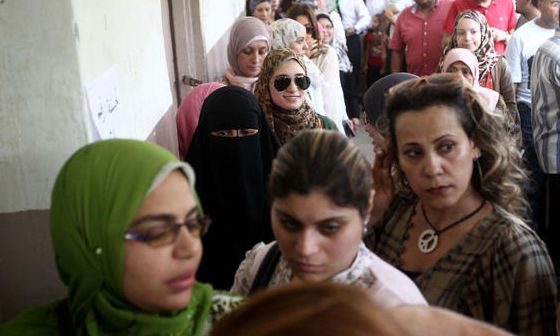
Millions of women voted in Egypt's first free presidential election but none were on the ballot.

At Aeon Magazine, Amal Ghandour writes: The face, a nod to her Egyptian mother, is pharaonic, curls freefalling all around it. The muscles packing her body betray countless hours of toil in the pool, on the bench press, on her feet — running. Her attire is as blunt in its skimpiness as Jordan, where she lives, is adamant in its conservatism. But while the look screams a fight easily won, her demeanor is tactful, her tenor even-keeled. This is a woman used to negotiating her way through life.

I will call her Hadaf, a common enough Arabic name, befitting a woman whose 34 years have been just that: hadaf, meaning singular purpose. At first glance, neither her impressive résumé nor her place in Jordanian society surprise. The milestones are all there: a BA in graphic design from Yarmouk University, up north in Irbid; a stint with a successful advertising agency, followed by a top executive job in a global company; and, just recently, an MBA from the London Business School. In Jordan, among the well-heeled, an education and a career with the tight skirts to match are not unusual.

Get to know Hadaf a little better, though, and you uncover a life that encapsulates the hard-going, incessant, yet finally successful struggles of Arab women to transform their unforgiving circumstances into a better set of odds.

Hadaf’s Palestinian father and Egyptian mother met in Egypt in the late 1960s. She was studying interior design, he agricultural engineering. Like thousands of Palestinians looking for a living, and indeed a home, he moved to Kuwait to teach. Hadaf’s mother soon followed, becoming a teacher herself so as to tiptoe neatly around her husband’s ego; interior design, they both knew, would have made them better money, but it would have made him feel less of a man.

When Saddam Hussein invaded Kuwait in 1990 and Yasser Arafat took his side, many Palestinians found themselves no longer welcome in the Gulf emirate, and so they moved to Jordan to try to reconstitute a decent life. Hadaf’s father was among them. Settling on the outskirts of the capital, he started up a spare-parts business, but it failed even before it had built up steam, plunging the entire family into near poverty.

There is no equivalent dramatic moment when Hadaf’s own battles began. No epiphanies that made her want to reach for something different. Her father’s tumble from middle-class status was not drastic. The neighbourhood was more ‘a social than an economic slum’ — very conservative and very comfortable with it. Her mother donned the veil when she hit 40, because that’s what women in her milieu do upon reaching the gateway to middle age. Her father stopped drinking alcohol but did not pray his way through the days. And there was love around — plenty of it. It’s just that Hadaf walked to the beat of a different drum.

‘Inch by inch. This is how I escaped marriage at 16 to a car mechanic; how I shortened the skirt and rolled up the sleeves a tiny bit; how I managed to go to Yarmouk; how I worked as a waitress there, and at the Hard Rock Café in Amman during the summers… I lobbied my mother, talked my father to death; had him visit the dorms, had him meet the owner of the restaurant up in Irbid, had him pick me up at 2am from the Hard Rock… But, you see, I was making a living. It was very difficult for them to argue with that.’

There were, of course, many fudges, omissions and fibs. ‘I did not tell my parents that I moved into my own apartment the second year of college [and] I escaped marriage to that mechanic by parading in a T-shirt in front of his shop. He was the one to break off the engagement. All I had to do then was persuade my father to let me finish high school.’

When Hadaf started to win the family’s bread, as it were, the parents went quiet. And they’ve been quiet ever since. Yet, even now, for their sake, Hadaf says, ‘I have two wardrobes at home: one for me, for my life; and one for them, when I go visiting.’

The Hadafs of the Arab world outnumber women like me, for whom life has been much gentler. But we don’t strain to reach out for each other across the divides. I did not have to go in search of her for insight. She lives everywhere around me. Hadaf populates the Middle East.

That said, hers is a distinctly upbeat story. Other women are fighting tooth and nail for much smaller breaks. They do win in the end — inch by inch — but the toll tends to draw age early on a young face, and the demands on grit and courage are almost always insufferably unkind.

A 22-year-old Palestinian – I’ll call her Suad – works with me on a region-wide community development initiative. She has just set aside her veil in conservative surroundings. She describes her own and her female friends’ lives in Beirut as an incessant search for opportunity amid a heap of constraints. ‘You worry about the consequences, and then you take a step, and then another one after that, and another one after that… You make use of every opening.’

This particular step, her unveiling, has proven to be especially charged. Suad took up the veil, a blend of shapes and colours in her case, at the age of 17, the last in her class to do so. Although most of her school friends were veiled, her parents’ leftist inclinations helped check the growing calls for Suad to amass herself into the fold. It was her teacher’s warning that finally tipped the scales. ‘She brought me before the entire class and told me that my mother would go to hell if I did not wear it. I succumbed.’

Suad took off her hijab two months ago, inspired by the rousing theme of nonconformity threading through her English literature courses. She felt she was being true to her identity.

Yet reactions to her move in a milieu that actively discourages feminine unorthodoxies are mixed. Suad’s father is happy to see her let her hair down and so, she thinks, would have been her mother, had she lived to witness this pointed return to visibility. So far, however, the neighbourhood has been worryingly quiet; and the backlash at work, especially among the men, upsetting. In the midst of widespread opprobrium, only one friend has said: ‘If that’s what you want, then do it.’ Suad shrugs. ‘Better this than hypocrisy.’

On their own, such triumphs as Suad’s and Hadaf’s stand as little more than heartening anecdotes on the margins of what is a crushingly discouraging situation for Arab women. One is tempted to ask: only this, after so many years of struggle? But pulled together and read differently, these small victories create a different norm of empowerment — one that, paradoxically, draws strength from the very subtlety and everyday nature of the ‘dissident’ acts themselves. [Continue reading…]

Facebooktwittermail

Tehran’s astute observers of American presidential politics

A correspondent for Tehran Bureau reports: If there were global statistics regarding which nations have been paying the most attention to the U.S. presidential campaign, Iran would probably be at the top. The crushing sanctions imposed over the past year aimed at forcing Iran to curb or abandon its nuclear program have created more pain than ever for average Iranians. They see President Barack Obama as prepared to effectively destroy their country’s economy even as he has shown that he is not eager to launch a military strike on the Islamic Republic.

On the other hand, they consider former Massachusetts Governor Mitt Romney as George W. Bush redux, and many believe that, if elected president, he will order a military attack on Iran.

“I believe it would be better if Romney was elected. We will suffer for a month, and then we will be all set,” says Ali Reza, 34, who peddles jeans around Rah Ahan Circle in south Tehran. What if armed conflict turns Iran into another Iraq? I ask. “That would be a catastrophe, by God!” he replies. “What can I say? They are both awful choices. Our luck here is that whichever way we turn, it’s a misfortune.”

Heading up to Vali Asr Square, I get into the front seat of a cab. The driver, Mahmoud, is playing a pop tune on his stereo. I ask him who he prefers, Obama or Romney. “This Islamic Republic that we see here needs a fist over its head. Obama has made a fool of himself for four years. Someone has to come and put these guys in their places.”

Across from the Tehran City Theater stand three young adults — two women and a man, students at the nearby Art College. I ask what they think of the American political system. Laleh, 21, says, “The two U.S. parties seem the same to me, except that the Democrats keep their cards over the table, while the Republicans keep them under the table. But the Democrats are quite slick.”

I ask for her election prediction. “If Romney wins, Obama’s long-term programs will be put aside. But it is clear that Obama will win.”

Houman, 24, says that he has enjoyed following the campaign. “It’s become complicated. It is very close.”

Who does he prefer? I ask.

“There’s no difference!”

“Not at all?”

“Their Iran policies match. Obama will have to get fervid too.”

I remind him that Romney has criticized Obama for interceding on behalf of the Green Movement after its rise in 2009. Houman says, “Ya, I was totally against interceding. It would have made things worse.”

I ask if he believes there would have been any difference if Romney had been in office? “Obama chose that position at the request of the Green Movement leaders and their own calculus. If Romney believes in the Green Movement, he should study some of Mir Hossein Mousvai’s communiqués.”

Mousavi, the former prime minister, issued a series of communiqués during and after his 2009 campaign as a reformist candidate for the Iranian presidency (the incumbent, Mahmoud Ahmadinejad, was declared the winner of the June vote amid widespread accusations of electoral fraud). In his seventh of these statements, Mousavi said that the regime’s crushing of domestic media outlets was opening the door to foreign intervention.

In his ninth communiqué, issued in July 2009 after the postelection protests and their violent suppression by the authorities, he added, “No matter how bitter this situation, it’s a feud between kindred, and we will regret it if we act immaturely and involve outsiders.”

Houman glances at his watch and sees that he has time to continue with the conversation. “The Republicans who attack Obama about the Green Movement didn’t speak up back then.”

And Romney?

He replies, “He is better than other Republican candidates, more moderate and more realistic.” He adds, “He seems to be a more intelligent person compared to George Bush’s team.”

With no security agents visible in the immediate vicinity, Golnoosh, who appears to be Houman’s girlfriend, is clasping his arm. “The issue of Iran has no effect on the U.S. voters,” she says. “Look, [former Secretary of State Henry] Kissinger in his recent interview said the same things about Iran as [Ambassador to the United Nations] Susan Rice and [Secretary of State] Hillary Clinton have said. American foreign policy has never been so homogeneous over the last decade.”

How so?

“Because they have gone through major crises, like the Iraq war and Bin Laden, and nobody relishes making up new crises.”

Houman agrees. “Obama himself knows that this is not the time to attack Iran.” [Continue reading…]

Facebooktwittermail

Intelligence shows no planning for Benghazi consulate attack

ABC News reports: The latest intelligence assessment of the attack on the U.S. diplomatic mission in Benghazi indicates there was little if any pre-planning for it and that it was in part an opportunistic response to the protests at the U.S. Embassy in Cairo.

Ambassador Chris Stevens and three other Americans were killed in the attack, which has become a political hot potato in the presidential campaign with questions over when the Obama administration called the attack an act of terrorism.

“Right now, there isn’t any intelligence that the attackers pre-planned their assault days or weeks in advance,” said a U.S. intelligence official. “The bulk of available information supports the early assessment that the attackers launched their assault opportunistically after they learned about the violence at the U.S. Embassy in Cairo.” But the official added that “no one is ruling out that some of the attackers may have aspired to attack the U.S. in Benghazi.”

Republican lawmakers have seized on U.S. Ambassador to the U.N. Susan Rice’s comments on Sunday talk shows days on September 16 attributing the deadly Benghazi attack to spontaneous protests against an anti-Muslim film made in the U.S. that had been posted on the Internet. As more information emerged they pointed to the use of mortars and RPG’s in the attack as indicating it was not a spontaneous protest as the Obama administration had claimed, but an act of terrorism. [Continue reading…]

The boundary between ‘planned’ and ‘spontaneous’ is pretty fuzzy.

The New York Times has reported: “Benghazi militia leaders who know Ansar al-Shariah say it was capable of carrying out the attack by itself with only a few hours’ planning, and as recently as June one of its leaders, [Mohammed Ali] Zahawi, declared that it could destroy the American Mission.”

The same report also said:

Most of the attackers made no effort to hide their faces or identities, and during the assault some acknowledged to a Libyan journalist working for The New York Times that they belonged to the group. And their attack drew a crowd, some of whom cheered them on, some of whom just gawked, and some of whom later looted the compound.

The fighters said at the time that they were moved to act because of the video [Innocence of Muslims], which had first gained attention across the region after a protest in Egypt that day. The assailants approvingly recalled a 2006 assault by local Islamists that had destroyed an Italian diplomatic mission in Benghazi over a perceived insult to the prophet. In June the group staged a similar attack against the Tunisian Consulate over a different film, according to the Congressional testimony of the American security chief at the time, Eric A. Nordstrom.

For many Americans, the definition of terrorism is very broad. If Americans get attacked or killed by Muslims, it’s terrorism. The U.S. government also has its own legal definition of terrorism, but if the term is to retain any meaning at all, a distinction needs to be made between a violent protest and an act of terrorism.

The identities of the participants doesn’t determine whether an act of violence can be understood as an act of terrorism. If a few Salafists conduct an armed robbery of a store in Benghazi, even though they might have extreme views, it’s still just a robbery. Likewise, identifying the consulate’s assailants as members of Ansar al-Shariah does not in and of itself make the attack an act of terrorism — even though Americans died.

Even the fact that the attack involved the use of RPGs and mortars does not necessarily make this an act of terrorism. No doubt everyone in Benghazi knows where the U.S. consulate is located and if an Ansar al-Shariah leader had already been bragging that he could destroy the facility, it would hardly be surprising if a few of his followers had already figured out some of the logistics.

Terrorism is above all a macabre form of political theater. Acts of violence are designed to portray state power as impotent. The terrorists’ very limited power is concentrated into a dramatic event, which is why explosions serve such a purpose much more often than battles. From this perspective, the use of RPGs and mortars may say much more about the current state of Libya than the designs of the attackers.

Protest on the other hand is a participatory activity where the focus is more on the engagement than the outcome.

Did the Benghazi attackers/protesters have the intent to burn down the building? Probably. Did they hope to kill the U.S. ambassador? My guess is: probably not. In which case, in spite of the ongoing political debate this has stirred up in the U.S. presidential race, the contexts in which the attack should be placed are: 1) the fragile security state in a country that has yet to establish effective governance — those who claim Libya should already be much more stable just a year after Gaddafi’s death are either being naive or disingenuous, and 2) the political flux that is dramatically reshaping the whole region and within which power is being contested at many levels.

Or, to put it another way, the Americans who died in Benghazi happened to be in the wrong place at the wrong time.

Facebooktwittermail

What can you really know?

The theoretical physicist, Freeman Dyson, writes: Jim Holt’s Why Does the World Exist?: An Existential Detective Story is a portrait gallery of leading modern philosophers. He visited each of them in turn, warning them in advance that he was coming to discuss with them a single question: “Why is there something rather than nothing?” He reports their reactions to this question, and embellishes their words with descriptions of their habits and personalities. Their answers give us vivid glimpses of the speakers but do not solve the riddle of existence.

The philosophers are more interesting than the philosophy. Most of them are eccentric characters who have risen to the top of their profession. They think their deep thoughts in places of unusual beauty such as Paris and Oxford. They are heirs to an ancient tradition of academic hierarchy, in which disciples sat at the feet of sages, and sages enlightened disciples with Delphic utterances. The universities of Paris and Oxford have maintained this tradition for eight hundred years. The great world religions have maintained it even longer. Universities and religions are the most durable of human institutions.

According to Holt, the two most influential philosophers of the twentieth century were Martin Heidegger and Ludwig Wittgenstein, Heidegger supreme in continental Europe, Wittgenstein in the English-speaking world. Heidegger was one of the founders of existentialism, a school of philosophy that was especially attractive to French intellectuals. Heidegger himself lost his credibility in 1933 when he accepted the position of rector of the University of Freiburg under the newly established Hitler government and became a member of the Nazi Party. Existentialism continued to flourish in France after it faded in Germany.

Wittgenstein, unlike Heidegger, did not establish an ism. He wrote very little, and everything that he wrote was simple and clear. The only book that he published during his lifetime was Tractatus Logico-Philosophicus, written in Vienna in 1918 and published in England with a long introduction by Bertrand Russell in 1922. It fills less than two hundred small pages, even though the original German and the English translation are printed side by side. I was lucky to be given a copy of the Tractatus as a prize when I was in high school. I read it through in one night, in an ecstasy of adolescent enthusiasm. Most of it is about mathematical logic. Only the last five pages deal with human problems. The text is divided into numbered sections, each consisting of one or two sentences. For example, section 6.521 says: “The solution of the problem of life is seen in the vanishing of this problem. Is not this the reason why men, to whom after long doubting the sense of life became clear, could not then say wherein this sense consisted?” The most famous sentence in the book is the final section 7: “Wherof one cannot speak, thereof one must be silent.”

I found the book enlightening and liberating. It said that philosophy is simple and has limited scope. Philosophy is concerned with logic and the correct use of language. All speculations outside this limited area are mysticism. Section 6.522 says: “There is indeed the inexpressible. This shows itself. It is the mystical.” Since the mystical is inexpressible, there is nothing more to be said. Holt summarizes the difference between Heidegger and Wittgenstein in nine words: “Wittgenstein was brave and ascetic, Heidegger treacherous and vain.” These words apply equally to their characters as human beings and to their intellectual output.

Wittgenstein’s intellectual asceticism had a great influence on the philosophers of the English-speaking world. It narrowed the scope of philosophy by excluding ethics and aesthetics. At the same time, his personal asceticism enhanced his credibility. During World War II, he wanted to serve his adopted country in a practical way. Being too old for military service, he took a leave of absence from his academic position in Cambridge and served in a menial job, as a hospital orderly taking care of patients. When I arrived at Cambridge University in 1946, Wittgenstein had just returned from his six years of duty at the hospital. I held him in the highest respect and was delighted to find him living in a room above mine on the same staircase. I frequently met him walking up or down the stairs, but I was too shy to start a conversation. Several times I heard him muttering to himself: “I get stupider and stupider every day.”

Finally, toward the end of my time in Cambridge, I ventured to speak to him. I told him I had enjoyed reading the Tractatus, and I asked him whether he still held the same views that he had expressed twenty-eight years earlier. He remained silent for a long time and then said, “Which newspaper do you represent?” I told him I was a student and not a journalist, but he never answered my question.

Wittgenstein’s response to me was humiliating, and his response to female students who tried to attend his lectures was even worse. If a woman appeared in the audience, he would remain standing silent until she left the room. I decided that he was a charlatan using outrageous behavior to attract attention. I hated him for his rudeness. Fifty years later, walking through a churchyard on the outskirts of Cambridge on a sunny morning in winter, I came by chance upon his tombstone, a massive block of stone lightly covered with fresh snow. On the stone was written the single word, “WITTGENSTEIN.” To my surprise, I found that the old hatred was gone, replaced by a deeper understanding. He was at peace, and I was at peace too, in the white silence. He was no longer an ill-tempered charlatan. He was a tortured soul, the last survivor of a family with a tragic history, living a lonely life among strangers, trying until the end to express the inexpressible. [Continue reading…]

Facebooktwittermail

Fatah’s support in West Bank continues to dwindle

The Associated Press reports: Palestinian election officials said Sunday that voters choosing new local councils in the West Bank rebuffed candidates from President Mahmoud Abbas’ Fatah movement in five of the 11 main towns, an apparent blow to the Palestinian leader.

Fatah had hoped to revive its flagging political legitimacy with Saturday’s municipal elections, the first voting in the Palestinian territories in more than six years. With main rival Hamas boycotting the election, Fatah counted on a strong endorsement from voters.

Fatah won local council majorities in six towns, but lost in five others, a performance some said fell below expectations. In four of the towns where Fatah lost, including Ramallah, the seat of Abbas’ government, voters preferred independent lists dominated by Fatah breakaways. In a fifth, biblical Bethlehem, never a Fatah stronghold, leftists and independents won.

Election officials spoke anonymously as official results were not to be released until later in the day.

Fatah spokesman Ahmed Assad claimed Sunday that the results, also reported in the local media, signaled “huge support for the party and its program.”

However, analysts portrayed the outcome as a blow to Abbas and Fatah’s leadership. “The elections reflected people’s disappointment in the leadership’s ability to lead them to a common goal,” said pollster Nader Said.

Elections were held in 93 West Bank towns and villages, with close to 55 percent of 505,000 eligible voters casting ballots, election officials said. In 261 smaller communities, local leaders were picked by consensus or there were no candidates. Official results were expected later Sunday.

The vote was held at a difficult time for Abbas.

His Palestinian Authority, the self-rule government that controls parts of the West Bank, has been plagued by a chronic cash crisis for months, struggling to pay the salaries of some 150,000 public sector employees.

Fatah once dominated Palestinian politics, but has been in disarray since the death of Abbas’ predecessor, Yasser Arafat, in 2004. Even after being trounced by the Islamic militant group Hamas in parliament elections in 2006, Fatah largely failed to reform or reinvent itself. [Continue reading…]

Facebooktwittermail

Washington denies secret plan for direct talks with Iran

The Guardian reports: The Obama administration has moved quickly to water down a report that the US and Iran have agreed in principle to meet one-on-one for negotiations on Iran’s nuclear programme.

The New York Times said secret talks between officials that began early in Barack Obama’s term as president had delivered the provisional agreement. Iran had insisted the talks wait until after the November presidential election, the New York Times said, attributing the information to a senior official in the Obama administration.

However the National Security Council spokesman Tommy Vietor said in response that the United States would continue to work with fellow permanent members of the UN security council and Germany.

“It’s not true that the United States and Iran have agreed to one-on-one talks or any meeting after the American elections,” the statement said.

“We continue to work with the P5+1 [five permanent members of the UN security council plus Germany] on a diplomatic solution and have said from the outset that we would be prepared to meet bilaterally.”

Vietor said on Saturday that Obama had made clear that he would do whatever was necessary to prevent Iran from getting a nuclear weapon. Vietor said Iran must meet its obligations or it would “continue to face crippling sanctions and increased pressure”.

This sounds like a non-denial denial — and also suggests that the New York Times has been used (willingly) to tee-up a question that Obama wants the next debate to focus on: the candidates’ willingness to negotiate with Iran.

The assumption, reasonably, is presumably that Romney cannot persuasively argue that negotiation is a bad thing, nor that willingness to negotiate is in and of itself a sign of weakness. Yet, in expressing his reservations about negotiating he will also inevitably present himself as a handicapped negotiator and thus make Obama look like the more viable deal maker.

Facebooktwittermail

U.S. officials say Iran has agreed to nuclear talks

The New York Times reports: The United States and Iran have agreed for the first time to one-on-one negotiations over Iran’s nuclear program, according to Obama administration officials, setting the stage for what could be a last-ditch diplomatic effort to avert a military strike on Iran.

Iranian officials have insisted that the talks wait until after the presidential election, a senior administration official said, telling their American counterparts that they want to know with whom they would be negotiating.

News of the agreement — a result of intense, secret exchanges between American and Iranian officials that date almost to the beginning of President Obama’s term — comes at a critical moment in the presidential contest, just two weeks before Election Day and the weekend before the final debate, which is to focus on national security and foreign policy.

It has the potential to help Mr. Obama make the case that he is nearing a diplomatic breakthrough in the decade-long effort by the world’s major powers to curb Tehran’s nuclear ambitions, but it could pose a risk if Iran is seen as using the prospect of the direct talks to buy time.

It is also far from clear that Mr. Obama’s opponent, Mitt Romney, would go through with the negotiation should he win election. Mr. Romney has repeatedly criticized the president as showing weakness on Iran and failing to stand firmly with Israel against the Iranian nuclear threat. [Continue reading…]

This puts Romney in an interesting and awkward position.

He’ll find it hard to say that he refuses to enter into such negotiations. “I promise that I won’t talk to the Iranians,” just won’t sound like a vote winner from a guy who currently wants to paint himself as Mr Moderation.

But neither does he want to cast himself as an echo of Obama 2008 — willing to talk to America’s enemies.

So how’s he going to fashion some sort of credible middle ground?

To talk, or not to talk. That is the question.

Facebooktwittermail