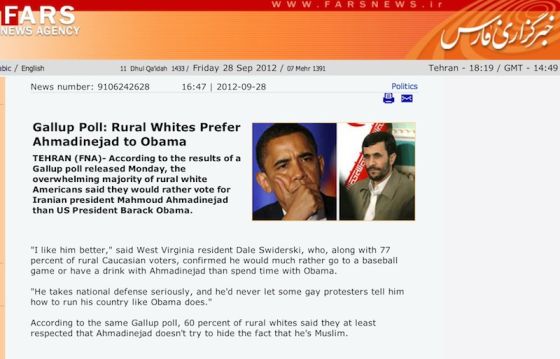
The Onion: According to the results of a Gallup poll released Monday, the overwhelming majority of rural white Americans said they would rather vote for Iranian president Mahmoud Ahmadinejad than U.S. president Barack Obama. “I like him better,” said West Virginia resident Dale Swiderski, who, along with 77 percent of rural Caucasian voters, confirmed he would much rather go to a baseball game or have a beer with Ahmadinejad, a man who has repeatedly denied the Holocaust and has had numerous political prisoners executed, than spend time with Obama. “He takes national defense seriously, and he’d never let some gay protesters tell him how to run his country like Obama does.” According to the same Gallup poll, 60 percent of rural whites said they at least respected that Ahmadinejad doesn’t try to hide the fact that he’s Muslim.
For more on this story, please visit our Iranian subsidiary organization, Fars😉
Satellite data reveal how the new record low Arctic sea ice extent, from Sept. 16, 2012, compares to the average minimum extent over the past 30 years (in yellow). NASA/Goddard Scientific Visualization Studio
THE TRUTH, as Winston Churchill put it, is incontrovertible. “Malice may attack it, ignorance may deride it, but in the end, there it is.” Scrape away the layers of denial, obfuscation and spin that cloud climate change and one unvarnished truth emerges: the Arctic ice cap is dying – and, with it, humanity’s best hopes for a prosperous, predictable future.
In the most dramatic reconfiguration of the map of the world since the end of the last Ice Age, the Arctic ice cap is now committed to accelerated collapse.
In 2007, the intergovernmental panel on climate change warned that, unless emissions were drastically curbed globally, the Arctic ocean could be clear of summer sea ice towards the end of this century.
They were hopelessly optimistic. On September 16th last, Arctic sea ice hit its lowest level ever recorded, at 3.41 million sq km, barely half the 1979-2000 average. The area of sea ice lost is 41 times larger than the island of Ireland. While the drop in sea ice extent is alarming, the 72 per cent decline in its volume is worse. Not only is ice cover shrinking, the surviving ice is thinning precipitously.
Prof Peter Wadhams of the Polar Ocean Physics Group described the September 2012 figures as a “global disaster”. He now projects the destruction of Arctic summer sea ice by 2015-16 – more than half a century ahead of the IPCC’s projections. “The final collapse towards that state is now happening and will probably be complete by those dates,” he added.
It is difficult to overstate the magnitude of what is now unfolding in the Arctic region. The Arctic ice cap used to cover 2 per cent of the Earth’s surface, and the ice albedo effect meant vast amounts of solar energy were bounced back into space from the bright white ice mass.
Losing this ice, and replacing it with dark open ocean, creates a dramatic tipping point in planetary energy balance. [Continue reading…]
Reuters reports: More than 100 million people will die and global economic growth will be cut by 3.2 percent of gross domestic product (GDP) by 2030 if the world fails to tackle climate change, a report commissioned by 20 governments said on Wednesday.
As global average temperatures rise due to greenhouse gas emissions, the effects on the planet, such as melting ice caps, extreme weather, drought and rising sea levels, will threaten populations and livelihoods, said the report conducted by humanitarian organisation DARA.
It calculated that five million deaths occur each year from air pollution, hunger and disease as a result of climate change and carbon-intensive economies, and that toll would likely rise to six million a year by 2030 if current patterns of fossil fuel use continue.
More than 90 percent of those deaths will occur in developing countries, said the report that calculated the human and economic impact of climate change on 184 countries in 2010 and 2030. It was commissioned by the Climate Vulnerable Forum, a partnership of 20 developing countries threatened by climate change.
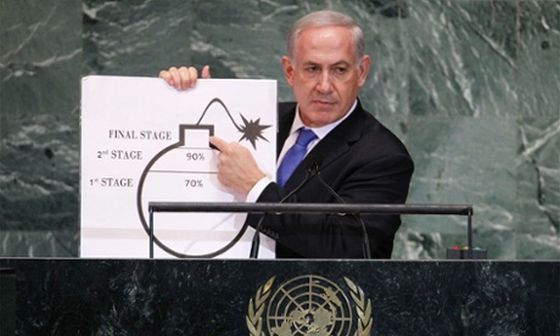
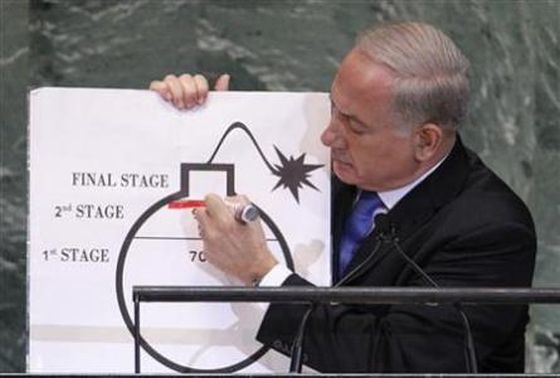
Benjamin Netanyahu must be a happy man. He’s been yearning to draw a red line and now, in front of an assembly of world leaders at the United Nations General Assembly, he’s done just that.
Here’s Bibi with bomb:
Bibi's bomb
And here comes the red marker pen. Voila! A red line has been drawn.
Bibi's red line
There’s a fitting irony at a time when Muslims get mocked because a few among their ranks get irate about cartoons of the Prophet Muhammad, that one of the arch demonizers of Islam, Benjamin Netanyahu, would allow a cartoon bomb to blow up in his face.
The Israeli prime minister even managed to embarrass one of his most reliable American defenders, Jeffrey Goldberg:
Okay, it’s official: #Netanyahu has no idea what he’s doing. He has just turned a serious issue into a joke.
Still, Netanyahu can’t take all the blame. He had accomplices in this bomb-making event. An artist was employed. Perhaps there was a meeting of Netanyahu’s inner cabinet. The graphic was displayed. The assembled all agreed: this’ll show the world.
Darn right! But maybe it didn’t signal the intended message.
Egypt’s newly elected president, Mohammed Morsi, gave an historic speech at the United Nations General Assembly yesterday.
The focus of Morsi’s speech was Palestine — yet you wouldn’t know it if you read the New York Times. The preoccupation of its reporter seemed to be the Egyptian leader’s omission of a stalwart defense of free speech. In other words, the New York Times, which prides itself as “the paper of record,” is acutely attuned to this constitutional and libertarian issue at the very same time that — more artfully than Izvestia ever did — it engages in self-censorship. At least in the Soviet Union everyone knew they were being lied to. The average reader of the Times on the other hand remains blissfully ignorant about the information that their trusted newspaper chooses not to report.
This is the part of Morsi’s speech — its core — that the New York Times neglected to mention:
The first issue which the world must exert all its efforts in resolving, on the basis of justice and dignity, is the Palestinian cause. Long decades have passed since the Palestinian People expressed their longing for restoring their full rights and for building their independent state, with Jerusalem as its capital. Despite their continued struggle, through all legitimate means to attain their rights, and despite the acceptance by their representatives of the resolutions adopted by the international community as a basis for resolving its problems, this international legitimacy remains unable until now to realize the hopes and aspirations of the Palestinian people. The resolutions remain far from being implemented.
Our brothers and sisters in Palestine must also taste the fruits of freedom and dignity. It is shameful that the free world accepts, regardless of the justifications provided, that a member of the international community continues to deny the rights of a nation that has been longing for decades for independence. It is also disgraceful that settlement activities continue on the territories of these people, along with the delay in implementing the decisions of international legitimacy.
Proceeding from the perspective of defending truth, freedom, and dignity and from my duty to support our Palestinian brothers and sisters, I place the international community face to face with its responsibilities which require the achievement of a just and comprehensive peace and the end of all forms of occupation of Arab lands, and the implementation of relevant international resolutions. I call for immediate and significant measures to put an end to colonization, settlement activities, and the alteration in the identity of Occupied Jerusalem.
The entire Palestinian leadership has charted a clear path towards the restoration of the rights of the Palestinian people, within and outside Palestine. The Arab world has given it its full support. The latter has also presented a comprehensive peace initiative based on just peace. One that restores the usurped rights of the Palestinian People, is founded on international legitimacy, and lays the foundation of an independent sovereign Palestinian state. One that also achieves the security and stability the peoples of the region have long been waiting for.
On that basis, I assure you of Egypt’s full support to any course of action Palestine decides to follow in the United Nations. I call upon all of you, just as you have supported the revolutions of the Arab peoples, to lend your support to the Palestinians in their endeavors to regain the full and legitimate rights of a people struggling to gain its freedom and establish its independent state.
I say it loudly to those wondering about our position vis-a-vis the international agreements and conventions that we have previously adhered to: we are committed to what we have signed on. We also support the inalienable rights of the Palestinian people and are determined to pursue all efforts side by side with them until they regain their rights.
To reiterate: “The first issue which the world must exert all its efforts in resolving, on the basis of justice and dignity, is the Palestinian cause” — but apparently it’s the last issue that concerns the New York Times.
But this was not the only noteworthy feature of Morsi’s speech. Repeatedly he referred to Egypt as an African nation, underlining its pivotal place joining two continents and positioning the new democracy not only as a leader of the Arab world but more broadly the developing world.
The New Egypt is determined to regain its standing among nations, and assume an effective role in global issues, stemming from the will of its people, as well as the legitimacy on which its regime is founded. This will is rooted in Egypt’s ancient and modern history, its Arabic and Islamic spheres, as well as its African identity. Egypt’s involvement in Arab, Islamic and African issues is the reflection of the essential role it plays in defense of interconnected fates and interlinked interests and values.
Turning to the current epicenter of Middle East strife, Morsi said:
Egypt is committed to pursue the sincere efforts it has been exerting to put an end to the catastrophe in Syria, within an Arab, regional and international framework. One that preserves the unity of this brotherly state, involves all factions of the Syrian people without racial, religious or sectarian discrimination, and spares Syria the dangers of foreign military intervention that we oppose.
On the imminent threat of a war against Iran, instigated by Israel, Morsi laid down multiple challenges:
The will of the people, especially in our region, no longer tolerates the continued non-accession of any country [namely, Israel] to the Nuclear Non-Proliferation Treaty and the non-application of the safeguards regime to their nuclear facilities, especially if this is coupled with irresponsible policies or arbitrary threats. In this regard, the acceptance by the international community of the principle of pre-emptiveness or the attempt to legitimize it is in itself a serious matter and must be firmly confronted to avoid the prevalence of the law of the jungle.
Cognizant of the danger that the status quo entails on the security of this important region, with its natural resources and trade passages, Egypt stresses the necessity of mobilizing international efforts to hold the conference on achieving a Middle East free of nuclear weapons and all other weapons of mass destruction before the end of the current year 2012, with the participation of all concerned parties without exception. And I say it very clearly: the only solution is to get rid of nuclear weapons, and all weapons of mass destruction. But we also emphasize the right of all countries of the region to the peaceful use of nuclear energy within the framework of the NPT, with a commitment to honor their obligations in this respect and provide the necessary guarantees to the countries of the region so as to remove any doubts surrounding their intentions.
Noting that the United Nations in its structure still enshrines the inequities of a bygone era, Morsi called for a new order based on equality and mutual respect.
Egypt would like to stress that the international system will not get fixed as long as the application of double standards remains. We expect from others, as they expect from us, that they respect our cultural particularities and religious points of reference, and not seek to impose concepts that are unacceptable to us or politicize certain issues and use them as a pretext to intervene in the affairs of others.
What Muslims and migrants are going through in a number of regions worldwide, in terms of discrimination and violation of their human rights, and vicious campaigns against what they hold sacred, is unacceptable. It is opposed to the most basic principles of the Charter of the Organization where we meet today. These practices have become pervasive enough that they now carry a name: Islamophobia.
We must join hands in confronting these regressive ideas that hinder cooperation among us. We must act together in the face of extremism, discrimination, and incitement to hatred on the basis of religion or race. The General Assembly, as well as the Security Council, has the principal responsibility in addressing this phenomenon that is starting to have implications that clearly affect international peace and security.
The obscenities recently released as part of an organized campaign against Islamic sanctities is unacceptable and requires a firm stand. We have a responsibility in this international gathering to study how we can protect the world from instability and hatred. Egypt respects freedom of expression.
One that is not used to incite hatred against anyone. One that is not directed towards one specific religion or culture.
A freedom of expression that tackles extremism and violence. Not the freedom of expression that deepens ignorance and disregards others. But we also stand firmly against the use of violence in expressing objection to these obscenities.
Colum Lynch reports: Libya’s president Mohammed Magarief today contradicted American claims that the deadly attack on the U.S. consulate was a spontaneous reaction to an anti-Islamic film, telling NBC’s Anne Curry in an interview broadcast this morning.
“It has nothing to do with this attack,” said Magarief, noting that the assailants used rocket propelled grenades and mortar fire in the attack. “It’s a preplanned act of terrorism against American citizens.”
The remarks came more than one week after Susan Rice, the U.S. ambassador to the United Nations, argued that the attack, which killed four American nationals, including U.S. ambassador J. Christopher Stevens, had been triggered by popular anger from Libyan Muslim’s offended by the film.
The Libya Herald reports: Mahmoud Jibril has said that Libya’s transition to democracy cannot succeed without an all-embracing dialogue that would include even radical Islamists with links to Al-Qaeda.
The National Forces Alliance chief made the remarks during a meeting of moderate political leaders in Cairo aimed at combining and learning from different regional experiences in the wake of the Arab Spring uprising that swept across North Africa and the Middle East last year.
The remarks come as the Government and the National Army seek to impose greater control over the myriad armed militias still operating in Libya, a process which Jibril said could not succeed unless all factions and political groups felt included in the process.
“When you are excluded from taking part in the future of your country, you may become extreme,” he said in an interview on Monday. “In a national dialogue, no one is excluded; no Salafists, no Al-Qaeda, no Ansar Al-Sharia will be excluded.”
Jibril reminded his audience that many Islamist groups played an important role in helping to topple the Qaddafi regime during last year’s revolution, and argued that they should be enticed back into civilian [life] by providing them with jobs and giving loans to small business as opposed to alienating them from Libyan society.
“The way we should deal with them is by dignifying and appreciating what they did.”
Ghaith Abdul-Ahad reports: The rusting green Mercedes truck could have been mistaken for a removal lorry. It was parked in a narrow street outside a luxurious villa a short distance from the Turkish border, and the arms and legs of chairs and tables protruded from the tarpaulin that covered the back. Beneath the furniture, however, was 450,000 rounds of ammunition and hundreds of rocket-propelled grenades destined for the Syrian rebels in Aleppo.
Inside the villa two rebel commanders and a chubby civilian in jeans and T-shirt were exchanging pieces of paper, which the civilian signed. He issued a series of instructions to the men outside, who began transferring crates into the commanders’ white Toyota pickup.
“All what I want from you is that you shoot a small video and put it on YouTube, stating your name and your unit, and saying we are part of the Aleppo military council,” the civilian told one of the commanders, who fought with the Islamist Tawheed brigade. “Then you can do whatever you want. I just need to show the Americans that units are joining the council.
“I met two Americans yesterday in Antakya (Turkey). They told me that no advanced weapons would come to us unless we were unified under the leadership of the local military councils. So shoot the video and let me handle the rest.” Looking in the back, it was clear the ammunition was new. The RPG rounds were still wrapped in plastic.
It was past midnight in Aleppo when Captain Abu Mohamed and Captain Abu Hussein received a phone call informing them the ammunition from Turkey had arrived. Abu Mohamed, a portly 28-year-old member of Aleppo military council, perched unsteadily on a plastic chair in a garage on the edge of the Salah al-Din neighbourhood. He had a handsome face and a great round belly. He and Abu Hussein, a short man with a blond goatee, had been close friends since they were cadets in Aleppo military academy. Abu Mohamed had defected first. Abu Hussein followed him a couple of months later.
Abu Mohamed described where the weapons had come from. Different donors in Saudi Arabia were channelling money to a powerful Lebanese politician in Istanbul, he said. He in turn co-ordinated with the Turks – “everything happens in co-ordination with Turkish intelligence” – to arrange delivery through the military council of Aleppo, a group composed mostly of defected officers and secular and moderate civilians.
Because of its virtual monopoly on ammunition supplies, the council has grown into a significant force in the Syrian civil war, rivalling existing powers like the Muslim Brotherhood and Islamist factions. [Continue reading…]
Perhaps that is why riot police felt they could hide their identity badges – a move that protesters say proves they feel themselves to be above the law. A startling example of police culture came in a tweet from José Manuel Sánchez of the Unified Police Union (SUP). “We support them not wearing badges for violent demonstrators,” he said during the demonstration. “Give it to them hard.” Television pictures of baton charges and rubber bullets suggest they did exactly that.
Organisers had said the attempt to ring the parliament building would be peaceful, but they also clearly expected arrests. Authorities said on Wednesday they had found 260kg of rocks that had been hurled at police – not indignado behaviour.
Opposition politicians warned the protest could not be ignored. “The country is slipping out of the government’s hands,” the socialist opposition leader Alfredo Pérez Rubalcaba said. “After yesterday’s demonstration it would be a mistake for politicians to talk only about public order.”
But while events in Madrid caught headlines, the settlement between Spaniards that has allowed them to enjoy almost four decades of democracy since the 1975 death of dictator General Francisco Franco was crumbling in a more serious fashion elsewhere.
In Barcelona it was legislators, not demonstrators, who were challenging the post-Franco settlement. Artur Mas, leader of the Catalan regional government called early elections for 25 November as politicians of all colours adapted to a game-changing demonstration for independence that brought hundreds of thousands of Catalans onto the city’s streets earlier this month.
Mas has called for Catalonia to have its own state. The upcoming elections will be seen as a plebiscite on that, however much his nationalist Convergence and Union coalition wraps itself in euphemisms and refuses to actually use the word “independence”. Once let out of its cage, the independence tiger may now prove impossible to put back – with polls showing a slim majority now in favour.
Huffington Post reports: Facing mounting doubts over the legitimacy of a business card-sized Coptic papyrus fragment that appears to quote Jesus Christ discussing his wife, the Harvard professor who acquired the artifact said Wednesday that she stands behind her findings, but is “open to questions about authenticity.”
Karen L. King, the Harvard Divinity School professor whose announcement at a Coptic studies conference in Rome last week about a 1½-by-3-inch fragment inspired “Jesus’ Wife” headlines worldwide, said the badly damaged artifact has been sent for testing. She said the tests should determine if it is from the fourth century as originally proposed, or if parts of it are a modern forgery, as an increasing number of scholars of Coptology and papyrology have suggested.
The fragment, which has eight mostly legible dark lines on the front side and six barely legible faded lines on the back, was never meant to prove Jesus was married, King said, since its writing dates back to hundreds of years after his death. It was intended to highlight that some early Christians may have believed he was married. That would be significant because debates over sexuality and marriage have dominated contemporary discussions about Christianity; the Catholic Church cites Jesus’ celibacy as one reason its priests must not have sex or marry. [Continue reading…]
Nazila Fathi reports: Nobel Laureate Shirin Ebadi has a lot on her mind these days. She’s spent her life working for the defense of human rights in her home country of Iran, but the reformists she sympathizes with are on the defensive, reeling from years of harsh repression. For the past three years she’s been living in virtual exile in an undisclosed location in Western Europe, unable to return home without fear of arrest. The government has seized her property (including her Nobel Prize medal) and subjected her family members to harassment and detention. Now she spends her days traveling the world, fighting to draw attention to the abuses of human rights by the government in Tehran. “I feel it’s my duty to help bring the voices of activists, and my comrades who are in prison, to the world,” she says.
But now she has something even more serious to worry about: What if Israel launches a military strike against Iran? What if the crisis over Iran’s nuclear program escalates out of control and spreads across the region?
The Israeli media have warned in recent weeks that a military attack may be imminent, since a presumed window allowing Israel to strike at Iran’s nuclear program may close soon. The Israeli government claims that Iran’s quest to continue with its nuclear program poses a serious threat, especially now that Iran seems to have expedited its efforts to enrich uranium — a key stop on the path to building a nuclear bomb. The Iranian regime has maintained a hostile position toward Israel since the founding of the Islamic Republic in 1979.
Iran contends that its nuclear program is peaceful, intended solely for power generation to bolster up a beleaguered economy. In any case, analysts have warned that a military strike is unlikely to halt the program and may only delay it for a few years. Iran has sheltered its nuclear facilities deep underground to protect from any possible military strikes, and has vowed that it would retaliate harshly if it comes under attack.
But Ebadi points to another problem. War with Israel, she says, may rescue the Iranian regime at a time when it is extremely unpopular at home and is clinging to power with an iron fist. “It is the only thing that can save the regime,” she said. “A war will stir nationalistic feelings and rally the people behind the government to defend the country. It will be catastrophic for the [Iranian] people, the country, and the region, but it will save Iran’s rulers.” [Continue reading…]
Amy Zegart writes: A quarter of all Americans are willing to use nuclear weapons to kill terrorists. No joke. This was among many surprising findings in a new national poll that YouGov recently ran for me on hot-button intelligence issues. (The poll, conducted between Aug. 24 and 30, 2012, surveyed 1,000 people and has a margin of error of +/- 4 percentage points).
To be honest, I threw in the nuclear bomb question on a lark, not expecting to find much. Boy, was I wrong. Aside from learning that 25 percent of Americans would stop the next terrorist plot with a several-hundred-kiloton atomic bomb, the poll numbers suggest that Americans have become more hawkish on counterterrorism policy since Barack Obama became president.
Consider this: In an October 2007 Rasmussen poll, 27 percent of Americans surveyed said the United States should torture prisoners captured in the fight against terrorism, while 53 percent said it should not. In my YouGov poll, 41 percent said they would be willing to use torture — a gain of 14 points — while 34 percent would not, a decline of 19 points.
Sure, the devil is in the details. Poll responses are highly susceptible to question wording. So I had the pollsters ask some of the exact same questions in the exact same way that appeared in a January 2005 USA Today/CNN/Gallup poll, the most detailed pre-Obama poll on interrogation techniques that I could find. It turns out that Americans don’t just like the general idea of torture more now. They like specific torture techniques more too.
Respondents in 2012 are more pro-waterboarding, pro-threatening prisoners with dogs, pro-religious humiliation, and pro-forcing-prisoners-to-remain-naked-and-chained-in-uncomfortable-positions-in-cold-rooms. [Continue reading…]
Christian Science Monitor reports: Casino mogul Sheldon Adelson grabbed the spotlight in the US earlier this year for making multi-million dollar campaign contributions to Republican presidential candidates on the bet that their policies would better jibe with those of Israeli Prime Minister Benjamin Netanyahu than with President Obama’s.
In Israel, Mr. Adelson is better known as the force behind the five-year-old free newspaper, “Yisrael Hayom” (Israel Today), which is seen by some as the Israeli print equivalent of Fox News. Touting Israeli patriotism, it is among the most widely read newspapers in the country and has a reputation for its fiercely loyal coverage of Mr. Netanyahu – and now Republican presidential nominee Mitt Romney.
Adelson rejects accusations of bias, insisting in a previous interview that his paper is a “fair and balanced” alternative to other newspapers more critical of the government and that he is breaking rival newspaper Yediot Ahranot’s monopoly on the market. Many Israelis nonetheless see the paper as a political vehicle to support the prime minster, and now, American Republican politicians. And with other newspapers floundering financially while Adelson puts his substantial wealth behind Yisrael Hayom, some worry that he is squeezing other political ideologies out of the market.
“You can see completely biased coverage always emphasizing good news for the Republicans, or always hiding or eliminating bad news for the Republicans,” says Oren Persico, who writes a daily analysis of print news coverage for Israel’s media magazine “The Seventh Eye.” “It’s one-sided, so Israelis will stand behind Romney.”
An opinion poll conducted by Hebrew University and released yesterday showed Mr. Romney with an eight percentage point advantage over Mr. Obama among Israelis – 34 percent to 26 percent, with 20 percent undecided. Another opinion poll from earlier this month suggested that the gap was more than two to one.
Since Israel is clearly not a swing state, there’s no need for the Obama campaign to waste its resources. Let Romney take the delegates. Oh, right. There are no delegates. I was forgetting that most Israelis don’t have the right to vote in U.S. elections. But seriously, are there any other countries outside the U.S. where anyone is running polls on the presidential race? Probably not. And there’s almost certainly only one country in the world where Romney has an eight point lead.
The New York Times reports: On a recent evening, a hip-looking young woman was sorting through a stack of crates outside a fruit and vegetable store here in the working-class neighborhood of Vallecas as it shut down for the night.
At first glance, she looked as if she might be a store employee. But no. The young woman was looking through the day’s trash for her next meal. Already, she had found a dozen aging potatoes she deemed edible and loaded them onto a luggage cart parked nearby.
“When you don’t have enough money,” she said, declining to give her name, “this is what there is.”
The woman, 33, said that she had once worked at the post office but that her unemployment benefits had run out and she was living now on 400 euros a month, about $520. She was squatting with some friends in a building that still had water and electricity, while collecting “a little of everything” from the garbage after stores closed and the streets were dark and quiet.
Such survival tactics are becoming increasingly commonplace here, with an unemployment rate over 50 percent among young people and more and more households having adults without jobs. So pervasive is the problem of scavenging that one Spanish city has resorted to installing locks on supermarket trash bins as a public health precaution.
A report this year by a Catholic charity, Caritas, said that it had fed nearly one million hungry Spaniards in 2010, more than twice as many as in 2007. That number rose again in 2011 by 65,000.
As Spain tries desperately to meet its budget targets, it has been forced to embark on the same path as Greece, introducing one austerity measure after another, cutting jobs, salaries, pensions and benefits, even as the economy continues to shrink.
Most recently, the government raised the value-added tax three percentage points, to 21 percent, on most goods, and two percentage points on many food items, making life just that much harder for those on the edge. Little relief is in sight as the country’s regional governments, facing their own budget crisis, are chipping away at a range of previously free services, including school lunches for low-income families.
For a growing number, the food in garbage bins helps make ends meet. [Continue reading…]
The Los Angeles Times reports: Management consultants say 60% of senior executives experience high stress and anxiety on a regular basis, and a thriving industry of motivational speakers teaches business leaders how to manage their corrosive burden of stress. But just how uneasy lies the head that wears the crown?
Not so uneasy, it turns out.
A new study reveals that those who sit atop the nation’s political, military, business and nonprofit organizations are actually pretty chill. Compared with people of similar age, gender and ethnicity who haven’t made it to the top, leaders pronounced themselves less stressed and anxious. And their levels of cortisol, a hormone that circulates at high levels in the chronically stressed, told the same story.
The source of the leaders’ relative serenity was pretty simple: control.
Compared with workers who toil in lower echelons of the American economy, the leaders studied by a group of Harvard University researchers enjoyed control over their schedules, their daily living circumstances, their financial security, their enterprises and their lives.
“Leaders possess a particular psychological resource — a sense of control — that may buffer against stress,” the research team reported Monday in Proceedings of the National Academies of Sciences.
Though the finding appeared to fly in the face of conventional wisdom, it came as no surprise to those who have studied the role that social status plays in the well-being of our primate relatives. [Continue reading…]
This website or its third-party tools use cookies, which are necessary to its functioning. By closing this banner, you agree to the use of cookies.