For more music see individual artists A-F, G-K, L-S, T-Z, and the complete playlist.




Stanford International Human Rights and Conflict Resolution Clinic (Stanford Law School) and the Global Justice Clinic (NYU School of Law) have released a new 182-page report, Living Under Drones: Death, injury, and trauma to civilians from U.S. drone practices in Pakistan. Here are the report’s executive summary and recommendations:
In the United States, the dominant narrative about the use of drones in Pakistan is of a surgically precise and effective tool that makes the US safer by enabling “targeted killing” of terrorists, with minimal downsides or collateral impacts.[1]
This narrative is false.
Following nine months of intensive research—including two investigations in Pakistan, more than 130 interviews with victims, witnesses, and experts, and review of thousands of pages of documentation and media reporting—this report presents evidence of the damaging and counterproductive effects of current US drone strike policies. Based on extensive interviews with Pakistanis living in the regions directly affected, as well as humanitarian and medical workers, this report provides new and firsthand testimony about the negative impacts US policies are having on the civilians living under drones.
Real threats to US security and to Pakistani civilians exist in the Pakistani border areas now targeted by drones. It is crucial that the US be able to protect itself from terrorist threats, and that the great harm caused by terrorists to Pakistani civilians be addressed. However, in light of significant evidence of harmful impacts to Pakistani civilians and to US interests, current policies to address terrorism through targeted killings and drone strikes must be carefully re-evaluated.
It is essential that public debate about US policies take the negative effects of current policies into account.
First, while civilian casualties are rarely acknowledged by the US government, there is significant evidence that US drone strikes have injured and killed civilians. In public statements, the US states that there have been “no” or “single digit” civilian casualties.”[2] It is difficult to obtain data on strike casualties because of US efforts to shield the drone program from democratic accountability, compounded by the obstacles to independent investigation of strikes in North Waziristan. The best currently available public aggregate data on drone strikes are provided by The Bureau of Investigative Journalism (TBIJ), an independent journalist organization. TBIJ reports that from June 2004 through mid-September 2012, available data indicate that drone strikes killed 2,562-3,325 people in Pakistan, of whom 474-881 were civilians, including 176 children.[3] TBIJ reports that these strikes also injured an additional 1,228-1,362 individuals. Where media accounts do report civilian casualties, rarely is any information provided about the victims or the communities they leave behind. This report includes the harrowing narratives of many survivors, witnesses, and family members who provided evidence of civilian injuries and deaths in drone strikes to our research team. It also presents detailed accounts of three separate strikes, for which there is evidence of civilian deaths and injuries, including a March 2011 strike on a meeting of tribal elders that killed some 40 individuals.
Second, US drone strike policies cause considerable and under-accounted-for harm to the daily lives of ordinary civilians, beyond death and physical injury. Drones hover twenty-four hours a day over communities in northwest Pakistan, striking homes, vehicles, and public spaces without warning. Their presence terrorizes men, women, and children, giving rise to anxiety and psychological trauma among civilian communities. Those living under drones have to face the constant worry that a deadly strike may be fired at any moment, and the knowledge that they are powerless to protect themselves. These fears have affected behavior. The US practice of striking one area multiple times, and evidence that it has killed rescuers, makes both community members and humanitarian workers afraid or unwilling to assist injured victims. Some community members shy away from gathering in groups, including important tribal dispute-resolution bodies, out of fear that they may attract the attention of drone operators. Some parents choose to keep their children home, and children injured or traumatized by strikes have dropped out of school. Waziris told our researchers that the strikes have undermined cultural and religious practices related to burial, and made family members afraid to attend funerals. In addition, families who lost loved ones or their homes in drone strikes now struggle to support themselves.
Third, publicly available evidence that the strikes have made the US safer overall is ambiguous at best. The strikes have certainly killed alleged combatants and disrupted armed actor networks. However, serious concerns about the efficacy and counter-productive nature of drone strikes have been raised. The number of “high-level” targets killed as a percentage of total casualties is extremely low—estimated at just 2%.[4] Furthermore, evidence suggests that US strikes have facilitated recruitment to violent non-state armed groups, and motivated further violent attacks. As the New York Times has reported, “drones have replaced Guantánamo as the recruiting tool of choice for militants.”[5] Drone strikes have also soured many Pakistanis on cooperation with the US and undermined US-Pakistani relations. One major study shows that 74% of Pakistanis now consider the US an enemy.[6]
Fourth, current US targeted killings and drone strike practices undermine respect for the rule of law and international legal protections and may set dangerous precedents. This report casts doubt on the legality of strikes on individuals or groups not linked to the terrorist attacks of September 11, 2011, and who do not pose imminent threats to the US. The US government’s failure to ensure basic transparency and accountability in its targeted killing policies, to provide necessary details about its targeted killing program, or adequately to set out the legal factors involved in decisions to strike hinders necessary democratic debate about a key aspect of US foreign and national security policy. US practices may also facilitate recourse to lethal force around the globe by establishing dangerous precedents for other governments. As drone manufacturers and officials successfully reduce export control barriers, and as more countries develop lethal drone technologies, these risks increase.
In light of these concerns, this report recommends that the US conduct a fundamental re-evaluation of current targeted killing practices, taking into account all available evidence, the concerns of various stakeholders, and the short and long-term costs and benefits. A significant rethinking of current US targeted killing and drone strike policies is long overdue. US policy-makers, and the American public, cannot continue to ignore evidence of the civilian harm and counter-productive impacts of US targeted killings and drone strikes in Pakistan.
This report also supports and reiterates the calls consistently made by rights groups and others for legality, accountability, and transparency in US drone strike policies:
- The US should fulfill its international obligations with respect to accountability and transparency, and ensure proper democratic debate about key policies. The US should:
- Release the US Department of Justice memoranda outlining the legal basis for US targeted killing in Pakistan;
- Make public critical information concerning US drone strike policies, including as previously and repeatedly requested by various groups and officials:[7] the targeting criteria for so-called “signature” strikes; the mechanisms in place to ensure that targeting complies with international law; which laws are being applied; the nature of investigations into civilian death and injury; and mechanisms in place to track, analyze and publicly recognize civilian casualties;[8]
- Ensure independent investigations into drone strike deaths, consistent with the call made by Ben Emmerson, UN Special Rapporteur on the promotion and protection of human rights and fundamental freedoms while countering terrorism in August 2012;[9]
- In conjunction with robust investigations and, where appropriate, prosecutions, establish compensation programs for civilians harmed by US strikes in Pakistan.
- The US should fulfill its international humanitarian and human rights law obligations with respect to the use of force, including by not using lethal force against individuals who are not members of armed groups with whom the US is in an armed conflict, or otherwise against individuals not posing an imminent threat to life. This includes not double-striking targets as first responders arrive.
- Journalists and media outlets should cease the common practice of referring simply to “militant” deaths, without further explanation. All reporting of government accounts of “militant” deaths should include acknowledgment that the US government counts all adult males killed by strikes as “militants,” absent exonerating evidence. Media accounts relying on anonymous government sources should also highlight the fact of their single-source information and of the past record of false government reports.
………..
[1] The US publicly describes its drone program in terms of its unprecedented ability to “distinguish … effectively between an al Qaeda terrorist and innocent civilians,” and touts its missile-armed drones as capable of conducting strikes with “astonishing” and “surgical” precision. See, e.g., John O. Brennan, Assistant to the President for Homeland Security and Counterterrorism, The Efficacy and Ethics of U.S. Counterterrorism Strategy, Remarks at the Woodrow Wilson International Center for Scholars (Apr. 30, 2012), available at http://www.wilsoncenter.org/event/the-efficacy-and-ethics-us-counterterrorism-strategy.
[2] See Obama Administration Counterterrorism Strategy (C-Span television broadcast June 29, 2011), http://www.c-spanvideo.org/program/AdministrationCo; see also Strategic Considerations, infra Chapter 5: Strategic Considerations; Contradictions Chart, infra Appendix C.
[3] Covert War on Terror, The Bureau of Investigative Journalism, http://www.thebureauinvestigates.com/category/projects/drones/ (last visited Sept. 12, 2012).
[4] Peter Bergen & Megan Braun, Drone is Obama’s Weapon of Choice, CNN (Sept. 6, 2012), http://www.cnn.com/2012/09/05/opinion/bergen-obama-drone/index.html.
[5] Jo Becker & Scott Shane, Secret ‘Kill List’ Proves a Test of Obama’s Principles and Will, N.Y. Times (May 29, 2012), http://www.nytimes.com/2012/05/29/world/obamas-leadership-in-war-on-al-qaeda.html?pagewanted=all.
[6] Pew Research Center, Pakistani Public Opinion Ever More Critical of U.S.: 74% Call America an Enemy (2012), available at http://www.pewglobal.org/files/2012/06/Pew-Global-Attitudes-Project-Pakistan-Report-FINAL-Wednesday-June-27-2012.pdf.
[7] See, e.g., Special Rapporteur on extrajudicial, summary or arbitrary executions, Study on Targeted Killings, Human Rights Council, UN Doc. A/HRC/14/24/Add.6 (May 28, 2010) (by Philip Alston), available at http://www2.ohchr.org/english/bodies/hrcouncil/docs/14session/A.HRC.14.24.Add6.pdf; US: Transfer CIA Drone Strikes to Military, Human Rights Watch (Apr. 20, 2012), http://www.hrw.org/news/2012/04/20/us-transfer-cia-drone-strikes-military; Letter from Amnesty International et al. to Barack Obama, President of the United States (May 31, 2012), available at http://www.justforeignpolicy.org/node/1242.
[8] Letter from Amnesty International et al., supra note 7.
[9] Terri Judd, UN ‘Should Hand Over Footage of Drone Strikes or Face UN Inquiry’, Independent (Aug. 20, 2012), http://www.independent.co.uk/news/world/asia/us-should-hand-over-footage-of-drone-strikes-or-face-un-inquiry-8061504.html.
For more information visit Living Under Drones.
Untold atrocities: Stories of Syria’s children
Save the Children has released a new report containing testimony from children who, along with their parents, are now receiving help as refugees. Wael, a sixteen-year old boy describes his experience in Syria.
I’ve been here in Za’atari for a month now. Why did I leave? What a question. There’s no one left in Syria.
At the beginning we could just about survive. We would go to the shelter, we would hide, and we would live. But now they’re using different weapons. Before, the shelters were safe, but now the weapons destroy even those in the basements of houses. I couldn’t stand what was happening: the shelling, the destruction, the torture.
At my home in Syria, we dug a hole in the garden to hide in. It was only big enough for three people to crouch in, but whenever we knew that violence was coming, I would climb in there with my brothers. My mother would lead us in and then cover it over with corrugated iron, and throw sand over the top. And we would wait, sometimes for hours.
The last time I was in there it was from 7am to 5pm. It was terrifying – I was so worried that they would find us and kill me and my two brothers. We’d hide in the hole when armed men were walking the streets, and in the basement when shelling happened. The shelling was almost daily. We’d use the hole at least once a week, often on Thursdays. Thursdays are a big day for massacres and crackdowns because prayers on a Friday can be a trigger for protest.
Once, I was arrested along with hundreds of other people. They separated out the children and I was the oldest at 16. I can’t tell you how many there were, but there were many. We were forced into a small cell together. There was nowhere to go – there wasn’t even a toilet, just a hole in the floor.
There was a group of small children with us whose parents were ‘wanted’. There were perhaps 13 children in total. They weren’t allowed food or water. When it was time for us to eat, their group was surrounded by armed men who stopped anyone giving them food. These children were too weak to even cry. They just lay on the floor.
They were also subjected to repeated beating with sticks, worse than us. I knew a boy called Ala’a. He was part of that group. He was only six years old. He didn’t understand what was happening. His dad was told that his child would die unless he gave himself up. I’d say that this six-year-old boy was tortured more than anyone else in that room. He wasn’t given food or water for three days, and he was so weak he used to faint all the time. He was beaten regularly. I watched him die. He only survived for three days and then he simply died. He was terrified all the time. They treated his body as though he was a dog.
I wasn’t able to think about anything by then. I thought I’d die in that cell and I couldn’t see past that. If they overheard us talking, we were beaten fiercely and repeatedly. So we didn’t talk. All we heard was screaming, crying and silence.
When I left that place I felt I’d escaped death. Now, I feel that no one cares about Syria. No one is helping us and we’re dying. If there was even 1% of humanity in the world, this wouldn’t happen.
I feel as though I’m dying from the inside. At least when I die this will be over. [At this point Wael begins to cry.] Torture is not only physical, it’s mental. When you see women and children scream and die, it has an effect. Each and every Syrian has been devastated mentally by this war.
Before, I laughed all the time, now I don’t, what do I have to laugh about? Some children from my village have become mute because of what they’ve seen. Young children are worse. They don’t understand why – none of us do, really. They are just sad, terrified children. These children used to be taken to the park by their mother, now their mothers are forcing them into basements for protection and they don’t understand.
There’s no way I can cope, no way I can turn over a new page. I have seen children slaughtered. I don’t think I’ll ever be OK again.
The U.S. and Iran on a dead end path to war?
At Open Democracy, Trita Parsi writes: There are three ways war between US and Iran can begin: through a deliberate decision by either Washington, Tehran or Tel Aviv; through a naval incident in the Persian Gulf that escalates out of control; or through the gradual elimination of all other policy options – the dead end path to war.
Of these three, it is the last one that is most worrisome and likely.
The Obama administration is not seeking war with Iran. Obama’s push back against the Netanyahu Government’s campaign for war with Iran and the harsh statements from the US military against such reckless adventurism demonstrates this lack of desire for war.
While neoconservative elements within the US foreign policy elite may differ, they remain dangerous but are in minority. A very timely report published by the Iran Project last week showed that the center of the US foreign policy establishment not only opposes war, it views it as a grave mistake.
The report was signed by close to 30 prominent foreign policy hands in Washington, including former National Security Advisers Zbigniew Brzezinski and Brent Scowcroft, former Undersecretary of State Thomas Pickering, president of the Ploughshares Foundation Joe Cirincione, and former chairman of the Federal Reserve bank, Paul Volcker. [Continue reading…]
Defusing Israel’s ‘detonator’ strategy
Patrick Tyler writes: Over six decades and through as many wars, the U.S. has escalated its commitment to Israel’s security, but it has neglected a corresponding insistence that Israel develop the institutions of diplomacy, negotiation and compromise necessary to fully engage the Arabs during a crucial period of Arab awakening. Every president since Eisenhower has pressed Israel to make the kind of concessions that are necessary for peace.
President Nixon said he would give Israel the “hardware” of weapons if Golda Meir would supply the “software” of diplomatic flexibility.
“The philosophical underpinning of U.S. policy toward Israel,” President Ford said, “had been our conviction — and certainly my own — that if we gave Israel an ample supply of economic aid and weapons, she would feel strong and confident, more flexible and more willing to discuss a lasting peace.” But after serial wars and a strong aversion within the ruling elite to compromise, Ford lamented, “I began to question the rationale for our policy.”
Israel deserves our attention and protection. But 60 years after its founding, it remains in the thrall of an original martial
impulse, the depth of which has given rise to succeeding generations of leaders who seem ever on the hair trigger in dealing with their rivals, and whose contingency planners embrace only worst-case scenarios in a process that magnifies the sense of national peril, encourages military preemption and covert subversion, and undermines any chance for a more engaging diplomacy based on compromise and accommodation.
Israel’s second prime minister, Moshe Sharett, a lifelong diplomat whose political career was destroyed by the circle of strong militaristic figures who coalesced around David Ben-Gurion in the 1950s, admonished his countrymen that “the question of peace must not be lost sight of for one single moment.” Yet Israel in the modern era has lost sight of peace.
Muslims are no different, or why Bill Maher’s blood libel is bigotry
Juan Cole writes: Comedian Bill Maher puts himself in the company of “9/11 liberals” who believe that Islam as a religion is different and decidedly worse than all other religions. He said Friday that “at least half of all Muslims believe it is all right to kill someone who insults the Prophet.” His bad faith is immediately apparent in the reference to 9/11, not the work of mainstream Muslims but of a political cult whose members often spent their time in strip clubs.
Now, it may be objected that Maher has made a career of attacking all religions, and promoting irreverence toward them. So Islam is just one more target for him. But that tack wouldn’t entirely be true. He explicitly singles Islam out as more, much more homocidal than the other religions. He is personally unpleasant to his Muslim guests, such as Keith Ellison. His reaction to the youth of the Arab Spring gathering to try to overthrow their American-backed dictators was “the Arabs are revolting.” Try substituting “Jews” to see how objectionable that is.
Maher ironically has de facto joined an Islamophobic network that is funded by the Mellon Scaife Foundation and other philanthropies tied to the American Enterprise Institute, etc. which is mainly made up of evangelical Christians, bigoted American Jews who would vote for the Likud Party if they could, and cynical Republican businessmen and politicians casting about for something with which to frighten working class Americans into voting for them. [Continue reading…]
America’s never-ending war against the world — 2005-2012
Since its creation, the United States has made eleven formal declarations of war, yet from 1798 to the present day, this country has used its armed forces abroad hundreds of times.
The Congressional Research Service has compiled a list of America’s use of military force abroad. The report is in a PDF which for the convenience of readers I have converted into five sections: 1798-1899, 1900-1985, 1986-1998, 1999-2004, and 2005-2012.
When viewed in its totality, this record makes clear that military force has in varying degrees always been the prism through which the U.S. government views the world. And keep in mind: this is just a list of the use of armed forces — it does not include the use of the CIA to topple governments, the support of proxy wars, the arming of insurgencies or the supply of the global weapons market which fuels conflict around the world.
- 2005 Terrorism threat/Horn of Africa/Kosovo/Bosnia.
On May 20, 2005, the President sent to Congress “consistent with the War Powers Resolution,” a consolidated report giving details of multiple ongoing United States military deployments and operations “in support of the global war on terrorism,” as well as operations in Iraq, where about 139,000 U.S. military personnel were deployed. U.S. forces are also deployed in Kenya, Ethiopia, Yemen, Eritrea, and Djibouti assisting in “enhancing counterterrorism capabilities” of these nations. The President further noted that U.S. combatequipped military personnel continued to be deployed in Kosovo as part of the NATO-led KFOR (1,700 personnel). Approximately 235 U.S. personnel are also deployed in Bosnia and Herzegovina as part of the NATO Headquarters-Sarajevo who assist in defense reform and perform operational tasks, such as counter-terrorism and supporting the International Criminal Court for the Former Yugoslavia.- 2005 Terrorism threat/Horn of Africa/Kosovo/Bosnia/Iraq.
On December 7, 2005, the President sent to Congress “consistent” with the War Powers Resolution, a consolidated report giving details of multiple ongoing United States military deployments and operations “in support of the global war on terrorism,” and in support of the Multinational Force in Iraq, where about 160,000 U.S. military personnel were deployed. U.S. forces were also deployed in the Horn of Africa region—Kenya, Ethiopia, Yemen, and Djibouti—assisting in “enhancing counter-terrorism capabilities” of these nations. The President further noted that U.S. combat-equipped military personnel continued to be deployed in Kosovo as part of the NATO-led KFOR (1,700 personnel). Approximately 220 U.S. personnel were also deployed in Bosnia and Herzegovina as part of the NATO Headquarters-Sarajevo who assist in defense reform and perform operational tasks, such as “counter-terrorism and supporting the International Criminal Court for the Former Yugoslavia.”- 2006 Terrorism threat/Kosovo/Bosnia/Iraq.
On June 15, 2006, the President sent to Congress “consistent” with the War Powers Resolution, a consolidated report giving details of multiple ongoing United States military deployments and operations “in support of the war on terror,” and in Kosovo, Bosnia and Herzegovina, and as part of the Multinational Force (MNF) in Iraq. About 131,000 military personnel were deployed in Iraq. U.S. forces were also deployed in the Horn of Africa region, and in Djibouti to support necessary operations against al-Qaida and other international terrorists operating in the region. U.S. military personnel continue to support the NATO-led Kosovo Force (KFOR). The U.S. contribution to KFOR was about 1,700 military personnel. The NATO Headquarters-Sarajevo was established in November 22, 2004 as a successor to its stabilization operations in Bosnia-Herzegovina to continue to assist in implementing the peace agreement. Approximately 250 U.S. personnel were assigned to the NATO Headquarters-Sarajevo to assist in defense reform and perform operational tasks, such as “counter-terrorism and supporting the International Criminal Court for the Former Yugoslavia.”- 2006 Lebanon.
On July 18, 2006, the President reported to Congress “consistent” with the War Powers Resolution, that in response to the security threat posed in Lebanon to U.S. Embassy personnel and citizens and designated third country personnel,” he had deployed combat-equipped military helicopters and military personnel to Beirut to assist in the departure of the persons under threat from Lebanon. The President noted that additional combat-equipped U.S. military forces may be deployed “to Lebanon, Cyprus and other locations, as necessary.” to assist further departures of persons from Lebanon and to provide security. He further stated that once the threat to U.S. citizens and property has ended, the U.S. military forces would redeploy.America’s never-ending war against the world — 1999-2004
Since its creation, the United States has made eleven formal declarations of war, yet from 1798 to the present day, this country has used its armed forces abroad hundreds of times.
The Congressional Research Service has compiled a list of America’s use of military force abroad. The report is in a PDF which for the convenience of readers I have converted into five sections: 1798-1899, 1900-1985, 1986-1998, 1999-2004, and 2005-2012.
When viewed in its totality, this record makes clear that military force has in varying degrees always been the prism through which the U.S. government views the world. And keep in mind: this is just a list of the use of armed forces — it does not include the use of the CIA to topple governments, the support of proxy wars, the arming of insurgencies or the supply of the global weapons market which fuels conflict around the world.
- 1999 Bosnia.
On January 19, 1999, President Clinton reported to Congress that he was continuing to authorize the use of combat-equipped U.S. Armed Forces in Bosnia and other states in the region as participants in and supporters of the NATO-led Stabilization Force (SFOR). He noted that the U.S. SFOR military personnel totaled about 6,900, with about 2,300 U.S. military personnel deployed to Hungary, Croatia, Italy and other regional states. Also some 350 U.S. military personnel remain deployed in the Former Yugoslav Republic of Macedonia (FYROM) as part of the U.N. Preventive Deployment Force (UNPREDEP).- 1999 Kenya.
On February 25, 1999, President Clinton reported to Congress that he was continuing to deploy U.S. military personnel in that country to assist in providing security for the U.S. embassy and American citizens in Nairobi, pending completion of renovations of the American embassy facility in Nairobi, subject of a terrorist bombing in August 1998.- 1999 Yugoslavia.
On March 26, 1999, President Clinton reported to Congress that, on March 24, 1999, U.S. military forces, at his direction, and in coalition with NATO allies, had commenced air strikes against Yugoslavia in response to the Yugoslav government’s campaign of violence and repression against the ethnic Albanian population in Kosovo.- 1999 Yugoslavia/Albania.
On April 7, 1999, President Clinton reported to Congress, that he had ordered additional U.S. military forces to Albania, including rotary wing aircraft, artillery, and tactical missiles systems to enhance NATO’s ability to conduct effective air operations in Yugoslavia. About 2,500 soldiers and aviators are to be deployed as part of this task force. The President also reported the deployment of U.S. military forces to Albania and Macedonia to support humanitarian disaster relief operations for Kosovar refugees.America’s never-ending war against the world — 1986-1998
Since its creation, the United States has made eleven formal declarations of war, yet from 1798 to the present day, this country has used its armed forces abroad hundreds of times.
The Congressional Research Service has compiled a list of America’s use of military force abroad. The report is in a PDF which for the convenience of readers I have converted into five sections: 1798-1899, 1900-1985, 1986-1998, 1999-2004, and 2005-2012.
When viewed in its totality, this record makes clear that military force has in varying degrees always been the prism through which the U.S. government views the world. And keep in mind: this is just a list of the use of armed forces — it does not include the use of the CIA to topple governments, the support of proxy wars, the arming of insurgencies or the supply of the global weapons market which fuels conflict around the world.
- 1986 Libya.
On March 26, 1986, President Reagan reported to Congress that, on March 24 and 25, U.S. forces, while engaged in freedom of navigation exercises around the Gulf of Sidra, had been attacked by Libyan missiles and the United States had responded with missiles.- 1986 Libya.
On April 16, 1986, President Reagan reported that U.S. air and naval forces had conducted bombing strikes on terrorist facilities and military installations in Libya.- 1986 Bolivia.
U.S. Army personnel and aircraft assisted Bolivia in anti-drug operations.- 1987-88 Persian Gulf.
After the Iran-Iraq War resulted in several military incidents in the Persian Gulf, the United States increased U.S. joint military forces operations in the Persian Gulf and adopted a policy of reflagging and escorting Kuwaiti oil tankers through the Gulf. President Reagan reported that U.S. Navy ships had been fired upon or struck mines or taken other military action on September 23, October 10, and October 20, 1987 and April 19, July 4, and July 14, 1988. The United States gradually reduced its forces after a cease-fire between Iran and Iraq on August 20, 1988.- 1988 Panama.
In mid-March and April 1988, during a period of instability in Panama and as pressure grew for Panamanian military leader General Manuel Noriega to resign, the United States sent 1,000 troops to Panama, to “further safeguard the canal, U.S. lives, property and interests in the area.” The forces supplemented 10,000 U.S. military personnel already in Panama.America’s never-ending war against the world — 1900-1985
Since its creation, the United States has made eleven formal declarations of war, yet from 1798 to the present day, this country has used its armed forces abroad hundreds of times.
The Congressional Research Service has compiled a list of America’s use of military force abroad. The report is in a PDF which for the convenience of readers I have converted into five sections: 1798-1899, 1900-1985, 1986-1998, 1999-2004, and 2005-2012.
When viewed in its totality, this record makes clear that military force has in varying degrees always been the prism through which the U.S. government views the world. And keep in mind: this is just a list of the use of armed forces — it does not include the use of the CIA to topple governments, the support of proxy wars, the arming of insurgencies or the supply of the global weapons market which fuels conflict around the world.
- 1900 China.
May 24 to September 28. American troops participated in operations to protect foreign lives during the Boxer rising, particularly at Peking. For many years after this experience a permanent legation guard was maintained in Peking, and was strengthened at times as trouble threatened.- 1901 Colombia (State of Panama).
November 20 to December 4. U.S. forces protected American property on the Isthmus and kept transit lines open during serious revolutionary disturbances.- 1902 Colombia.
April 16 to 23. U.S. forces protected American lives and property at Bocas del Toro during a civil war.- 1902 Colombia (State of Panama).
September 17 to November 18. The United States placed
armed guards on all trains crossing the Isthmus to keep the railroad line open, and
stationed ships on both sides of Panama to prevent the landing of Colombian troops.- 1903 Honduras.
March 23 to 30 or 31. U.S. forces protected the American consulate and the steamship wharf at Puerto Cortez during a period of revolutionary activity.- 1903 Dominican Republic.
March 30 to April 21. A detachment of marines was landed to protect American interests in the city of Santo Domingo during a revolutionary outbreak.- 1903 Syria.
September 7 to 12. U.S. forces protected the American consulate in Beirut when a local Muslim uprising was feared.- 1903-04 Abyssinia.
Twenty-five marines were sent to Abyssinia to protect the U.S. Consul General while he negotiated a treaty.- 1903-14 Panama.
U.S. forces sought to protect American interests and lives during and following the revolution for independence from Colombia over construction of the Isthmian Canal. With brief intermissions, United States Marines were stationed on the Isthmus from November 4, 1903, to January 21, 1914, to guard American interests.America’s never-ending war against the world — 1798-1899
Since its creation, the United States has made eleven formal declarations of war, yet from 1798 to the present day, this country has used its armed forces abroad hundreds of times.
The Congressional Research Service has compiled a list of America’s use of military force abroad. The report is in a PDF which for the convenience of readers I have converted into five sections: 1798-1899, 1900-1985, 1986-1998, 1999-2004, and 2005-2012.
When viewed in its totality, this record makes clear that military force has in varying degrees always been the prism through which the U.S. government views the world. And keep in mind: this is just a list of the use of armed forces — it does not include the use of the CIA to topple governments, the support of proxy wars, the arming of insurgencies or the supply of the global weapons market which fuels conflict around the world.
- 1798-1800 Undeclared Naval War with France.
This contest included land actions, such as that in the Dominican Republic, city of Puerto Plata, where marines captured a French privateer under the guns of the forts. Congress authorized military action through a series of statutes.- 1801-05 Tripoli.
The First Barbary War included the U.S.S. George Washington and Philadelphia affairs and the Eaton expedition, during which a few marines landed with United States Agent William Eaton to raise a force against Tripoli in an effort to free the crew of the Philadelphia. Tripoli declared war but not the United States, although Congress authorized U.S. military action by statute.- 1806 Mexico (Spanish territory).
Capt. Z. M. Pike, with a platoon of troops, invaded Spanish territory at the headwaters of the Rio Grande on orders from Gen. James Wilkinson. He was made prisoner without resistance at a fort he constructed in present day Colorado, taken to Mexico, and later released after seizure of his papers.- 1806-10 Gulf of Mexico.
American gunboats operated from New Orleans against Spanish and French privateers off the Mississippi Delta, chiefly under Capt. John Shaw and Master Commandant David Porter.- 1810 West Florida (Spanish territory).
Gov. Claiborne of Louisiana, on orders of the President, occupied with troops territory in dispute east of the Mississippi River as far as the Pearl River, later the eastern boundary of Louisiana. He was authorized to seize as far east as the Perdido River.- 1812 Amelia Island and other parts of east Florida, then under Spain.
Temporary possession was authorized by President Madison and by Congress, to prevent occupation by any other power; but possession was obtained by Gen. George Matthews in so irregular a manner that his measures were disavowed by the President.- 1812-15 War of 1812.
On June 18, 1812, the United States declared war between the United States and the United Kingdom of Great Britain and Ireland. Among the issues leading to the war were British interception of neutral ships and blockades of the United States during British hostilities with France.- 1813 West Florida (Spanish territory).
On authority given by Congress, General Wilkinson seized Mobile Bay in April with 600 soldiers. A small Spanish garrison gave way. The U.S. advanced into disputed territory to the Perdido River, as projected in 1810. No fighting.- 1813-14 Marquesas Islands.
U.S. forces built a fort on the island of Nukahiva to protect three prize ships which had been captured from the British.- 1814 Spanish Florida.
Gen. Andrew Jackson took Pensacola and drove out the British with whom the United States was at war.America’s inevitable retreat from the Middle East
Pankaj Mishra writes: The murder of four Americans in Libya and mob assaults on the United States’ embassies across the Muslim world this month have reminded many of 1979, when radical Islamists seized the American mission in Tehran. There, too, extremists running wild after the fall of a pro-American tyrant had found a cheap way of empowering themselves.
But the obsession with radical Islam misses a more meaningful analogy for the current state of siege in the Middle East and Afghanistan: the helicopters hovering above the roof of the American Embassy in Saigon in 1975 as North Vietnamese tanks rolled into the city.
That hasty departure ended America’s long and costly involvement in Indochina, which, like the Middle East today, the United States had inherited from defunct European empires. Of course, Southeast Asia had no natural resources to tempt the United States and no ally like Israel to defend. But it appeared to be at the front line of the worldwide battle against Communism, and American policy makers had unsuccessfully tried both proxy despots and military firepower to make the locals advance their strategic interests.
The violent protests provoked by the film “Innocence of Muslims” will soon subside, and American embassies will return to normal business. But the symbolic import of the violence, which included a Taliban assault on one of the most highly secured American bases in Afghanistan, is unmistakable. The drama of waning American power is being re-enacted in the Middle East and South Asia after two futile wars and the collapse or weakening of pro-American regimes.
In Afghanistan, local soldiers and policemen have killed their Western trainers, and demonstrations have erupted there and in Pakistan against American drone strikes and reported desecrations of the Koran. Amazingly, this surge in historically rooted hatred and distrust of powerful Western invaders, meddlers and remote controllers has come yet again as a shock to many American policy makers and commentators, who have promptly retreated into a lazy “they hate our freedoms” narrative.
It is as though the United States, lulled by such ideological foils as Nazism and Communism into an exalted notion of its moral power and mission, missed the central event of the 20th century: the steady, and often violent, political awakening of peoples who had been exposed for decades to the sharp edges of Western power. [Continue reading…]
Breaking the wall of religious dogma
At Open Democracy Sara Azmeh Rasmussen argues that commentary on the protests triggered by the anti-Islam film, Innocence of Muslims, has focused on the political and economic dimensions of the protests while side-stepping religious questions and specifically the issue of the infallibility of the prophet.
The tradition and collective experience of Islam has been shaped by a multitude of influences – and I believe that is grounds for cautious optimism. The explosive rage on behalf of the prophet is inextricably connected to dogma and doctrine developed in a phase of Islam long after the death of the prophet himself. The orthodox dogma of the Quran an eternally existing, rather than created, message, and the doctrine of the infallibility of the messenger of God, is a theological-philosophical pairing constructed in a time when civil war raged under the caliph Ali ibn Abi Talib. In the year 827 the dogma was consolidated by the caliph al-Ma´mun, after one of two rival factions, the Umayyads (today’s Sunnis), had marginalised Ali’s followers (the Shias). In other words, centralizing political power in the newly established Islamic empire went hand in hand with the cementing of the holy texts and elimination of all theological challenges. A significant school at the time, Mu´tazila, distanced itself from these irrational doctrines, and for that reason had to go into hiding.
But what has history from eight and ninth century Arabia to do with the attacks on embassies and widespread violence in response to a film critical of Islam produced in 21st century USA? Everything! To attack the ”sacredness” of the prophet was, logically, interpreted as an attack on the fundaments of the classical faith. In this rigid theological context, a caricature that humanises and reduces the prophet is an outright attack on the very underpinnings of the faith.
I’ve spent a lot of time pondering this in recent years. It has become apparent to me that this dogma must be challenged, not only to resolve the current conflict between speech versus faith, but to free the Islamic tradition from the cage that has led to intellectual and philosophical stagnation for centuries. This is the most significant barrier to a reform theology, and to the introduction of liberal ideas into Muslim culture and society.
A simple feat of logic should be what is needed to break this wall of dogma, on which such a large volume of classical theological literature is based. But as we know, logic isn’t the optimal way to counter what resides in the spiritual and religious sphere. Nevertheless, it is my moral duty to present this challenge to my own. I keep within the Islamic tradition, and will not support my argument with a single non-Muslim source. I adamantly believe we Muslims have the knowledge and tools we need for analysis within our own tradition. All we need is to read with new eyes.
The following story is found in classical Islamic history books and is known to most Muslims: shortly before the battle at Badr in the western park of the Arabian peninsula (624), and after the prophet Muhammad had placed his troops in formation, a disciple, Hubab, asks if this choice of military position is revealed by God, or is a tactical choice by the prophet himself. The prophet replies it was his own choice, to which Hubab replies: “Prophet, this isn’t the right position.” In the story, the prophet follows the advice of Hubab and orders the troops to march to the nearest source of water and block the enemy from accessing it. Only due to this new tactic do the Muslims win the battle, considered the turning point in the Muslim fight against the heathen tribes.
The prophet made a serious miscalculation in a critical war situation, in a crucial phase of Islamic history. The guidance that corrected it came from an individual in the Muslim community, not directly from God.
The Rafsanjanis’ influence in Iran once again growing?
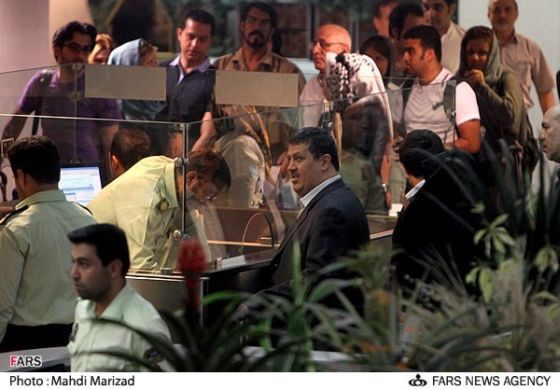
Mehdi Hashemi Rafsanjani passing through immigration at Tehran airport late on Sunday
Reuters reports: The son of former Iranian president Akbar Hashemi Rafsanjani returned to Iran from exile to answer charges of inciting unrest after a disputed election in 2009, fuelling speculation that Rafsanjani’s influence in Tehran may once again be growing.
Mehdi Hashemi Rafsanjani arrived in Tehran late on Sunday, Fars news agency reported, having spent three years in the United Kingdom following his alleged involvement in the widespread protests that followed the re-election of President Mahmoud Ahmadinejad.
Mehdi Rafsanjani had spent several days in Dubai and been expected to return to Iran on Sunday, an independent source told Reuters.
Analysts say his return indicates a deal has been agreed with authorities to resolve the charges he faces, and suggests his father’s political fortunes may be reviving.
Akbar Rafsanjani played a central role in the Non-Aligned Movement summit in Tehran last month, being photographed walking alongside Iran’s most powerful authority, Ayatollah Ali Khamenei, and sat next to U.N. Secretary General Ban-Ki Moon.
As oil sanctions continue to bite and with a presidential election set for next year, some are tipping the pragmatic yet conservative Rafsanjani as a surprise candidate.
Iran set to block access to Google
The Guardian reports: Iran was set to block access to Google and Gmail in reaction to the anti-Islam film that has triggered protests across the Muslim world.
“Google and Gmail will be filtered throughout the country until further notice,” said Abdolsamad Khoramabadi, an Iranian official with the state-run body in charge of online censorship and computer crimes, according to the semi-official Ilna news agency. There was no indication as to whether the filtering would be temporary or permanent.
Khoramabadi claimed the decision was taken after Iranians pressed the authorities to filter the sites because of links to the film.
The Young Journalists Club, an Iranian semi-official news agency that broke the news, said the move was in reaction to YouTube’s refusal to take down the anti-Islam film, Innocence of Muslims.
Despite a series of regime-sponsored protests in Tehran over the film, many Iranians appear not to be bothered by it.
The life-endangering choice of coming out as gay in Iran
William Dameron writes: Recently I received an email from a filmmaker, Wajahat Ali Abbasi, who is filming a movie about the true story of two Iranian boys executed by public hanging in 2005 for the crime of loving each other.
My first thought after receiving this email was, This is another part of the world. It couldn’t happen here. But then I thought about our politicians who spew lies and hate about me; about the pastor from my home state of North Carolina who called for gays to be executed; about one of my own family members who called me sick and will not speak to me; about the former classmate who hurled a homophobic epithet at us during our high-school reunion.
Dehumanizing a population makes it possible to extinguish them. In eight countries, including Iran, being gay is punishable by death.
When I asked Wajahat what the motivation was for making this film, he told me of his friend, a bright, 20-year-old boy with a promising career. This boy came out to his friends and family and experienced relentless, daily bullying. He became afraid of leaving his home. One day, while returning from college, he disappeared. Two days later his body was found. His murder was declared a suicide.
The film, Sin, is Wajahat’s attempt to tell the personal story, to put a human face on the two boys who were blindfolded and hanged in July 2005. You can view his Kickstarter page here. The trailer is at the bottom of this post.
I learned some sobering facts while researching this post. One of them is that because I am gay, I am 41 times more likely to become a victim of a hate crime. The question is not whether I would die for love, but whether I will.
Music: Nusrat Fateh Ali Khan & Michael Brook — ‘Tracery’
Syria: the foreign fighters joining the war against Bashar al-Assad
Ghaith Abdul-Ahad reports from Aleppo, alongside the internationals that the Syrian fighters refer to collectively as the “Turkish brothers”.
Inside the [commandeered] school was a Jordanian who often roamed the frontline with his Belgian gun, for which he had only 11 bullets. He was a secular and clean-shaven former officer in the Jordanian army who lived in eastern Europe running an import-export business. He had come to Aleppo without telling his wife and children where he was going.
“This is my duty,” he said. “Originally I was from Palestine. I know what this [Syrian] regime did to the Palestinians, shelling the camps in Lebanon, assassinating the commanders. Half of the miseries of our nation are because of Israel and the other half are because of the Syrian regime.
“Many Arab men I know want to come and fight. Some lack the means and others the energy, but so many people hate this regime. For 20 years the regime has destroyed the Arab world.”
If some of the foreign fighters in Aleppo were callow, others such as Abu Salam al Faluji boasted extraordinary experience. Abu Salam, a rugged Iraqi with a black keffiyeh wrapped around his head, said he had fought the Americans in Falluja when he was a young man. Later he joined al-Qaida in Iraq and spent many years fighting in different cities before moving to Syria to evade arrest. These days he was a commander of the one of the muhajiroun units.
I found him watching a heated debate between the Syrian commanders about how to defend the buckling frontline.
The government attack had begun as predicted and mortars were exploding in the streets nearby, the sound of machine-gun fire ricocheting between the buildings. The mortars were hammering hard against the walls, sending a small shower of shrapnel and cascading glass, but Abu Salam stood unflinching. One Syrian, breathing hard, said that he had fired three times at the tank and the RPG didn’t go off.
“Don’t say it didn’t go off,” Abu Salam admonished him. “Say you don’t know how to fire it. We used to shoot these same RPGs at the Americans and destroy Abrams tanks. What’s a T72 to an Abrams?
“Our work has to focus on IEDs and snipers,” he told the gathering. “All these roofs need fighters on top and IEDs on the ground. You hunt them in the alleyways and then use machine-guns and RPGs around corners.
“The problem is not ammunition, it’s experience,” he told me out of earshot of the rebels. “If we were fighting Americans we would all have been killed by now. They would have killed us with their drone without even needing to send a tank.
“The rebels are brave but they don’t even know the difference between a Kalashnikov bullet and a sniper bullet. That weakens the morale of the men.
“They have no leadership and no experience,” he said. “Brave people attack, but the men in the lines behind them withdraw, leaving them exposed. It is chaos. This morning the Turkish brothers fought all night and at dawn they went to sleep leaving a line of Syrians behind to protect them. When they woke up the Syrians had left and the army snipers had moved in. Now it’s too late. The army has entered the streets and will overrun us.”
He seemed nonchalant about the prospect of defeat.
“It is obvious the Syrian army is winning this battle, but we don’t tell [the rebels] this. We don’t want to destroy their morale. We say we should hold here for as long as Allah will give us strength and maybe he will make one of these foreign powers come to help Syrians.”
The irony was not lost on Abu Salam how the jihadis and the Americans – bitter enemies of the past decade – had found themselves fighting on the same side again. [Continue reading…]