



Update — The Guardian interview’s HRW’s researcher Ole Solvang:
Human Rights Watch: Armed opposition groups have subjected detainees to ill-treatment and torture and committed extrajudicial or summary executions in Aleppo, Latakia, and Idlib, Human Rights Watch said today following a visit to Aleppo governorate. Torture and extrajudicial or summary executions of detainees in the context of an armed conflict are war crimes, and may constitute crimes against humanity if they are widespread and systematic.
Opposition leaders told Human Rights Watch that they will respect human rights and that they have taken measures to curb the abuses, but Human Rights Watch expressed serious concern about statements by some opposition leaders indicating that they tolerate, or even condone, extrajudicial and summary executions. When confronted with evidence of extrajudicial executions, three opposition leaders told Human Rights Watch that those who killed deserved to be killed, and that only the worst criminals were being executed.
“Declarations by opposition groups that they want to respect human rights are important, but the real test is how opposition forces behave,” said Nadim Houry, deputy Middle East director at Human Rights Watch. “Those assisting the Syrian opposition have a particular responsibility to condemn abuses.”
Military and civilian Syrian opposition leaders should immediately take all possible measures to end the use of torture and executions by opposition groups, including condemning and prohibiting such practices, Human Rights Watch said. They should investigate the abuses, hold those responsible to account in accordance with international human rights law, and invite recognized international detention monitors to visit all detention facilities under their control. Initiatives to have armed opposition groups adopt and enforce codes of conduct that promote respect for human rights and international humanitarian law should be encouraged.
Human Rights Watch presented its research findings and detailed recommendations in meetings with opposition leaders in northern Aleppo in August and in a letter sent to several opposition leaders on August 21, 2012. In a written response, the Military Council for the Aleppo Governorate said that, in light of the findings, it had reiterated its commitment to humanitarian law and human rights to Free Syrian Army (FSA) groups, that it was in the process of establishing special committees to review detention conditions and practices, and that it would hold responsible those who act “contrary to the guidelines.”
Countries financing or supplying arms to opposition groups should send a strong signal to the opposition that they expect it to comply strictly with international human rights and humanitarian law, Human Rights Watch said.
Human Rights Watch documented more than a dozen extrajudicial and summary executions by opposition forces. Two FSA fighters from the Ansar Mohammed battalion in Latakia told Human Rights Watch, for example, that four people had been executed after the battalion stormed a police station in Haffa in June 2012, two immediately and the others after a trial.
Six of 12 detainees interviewed by Human Rights Watch in two opposition-run detention facilities said that FSA fighters and officials in charge of detention facilities had tortured and mistreated them, in particular by beating them on the soles of their feet. Abuse appeared to be more prevalent during the initial stages of detention, before the detainees were transferred to civilian opposition authorities.
Because of inconsistencies in their accounts and visible injuries consistent with torture, Human Rights Watch has reason to believe that FSA fighters and prison authorities had also tortured or mistreated at least some of the six detainees who denied during their interviews that they had been abused.
“Sameer,” whom the FSA arrested in the beginning of August, told Human Rights Watch.
The FSA fighters who caught me first brought me to their base. I spent a night there, together with one other prisoner. They beat me a lot, with a wooden stick, on the soles of my feet. It lasted for about two hours. First, I refused to confess, but then I had to. Once I confessed, they stopped beating me.
Human Rights Watch has also reviewed more than 25 videos on YouTube in which people reportedly in the custody of armed opposition groups show signs of physical abuse. Human Rights Watch cannot independently confirm the authenticity of these videos.
The head of the Aleppo Governorate Revolutionary Council told Human Rights Watch that the authorities do not execute or torture detainees, but that beating detainees on the soles of the feet was “permissible” because it did not cause injuries. When Human Rights Watch explained that beating on the soles of the feet constitutes torture and is unlawful according to international law, he said that he would provide new instructions to FSA fighters and those in charge of detention facilities that such beating was not permitted.
“Time and again Syria’s opposition has told us that it is fighting against the government because of its abhorrent human rights violations,” Houry said. “Now is the time for the opposition to show that they really mean what they say.”
Local opposition authorities told Human Rights Watch that they have appointed judicial councils that review accusations against detainees and issue sentences. In some towns, these judicial councils relied exclusively on Sharia law. In other towns, the judicial councils relied on Sharia law for civil matters, but still relied on Syrian criminal law for criminal matters.
Descriptions of the trials by detainees and members of the judicial councils indicate that the trials did not meet international due process standards, including the right to legal representation and the opportunity to prepare one’s defense and challenge all the evidence and witnesses against them.
All armed forces involved in the hostilities, including non-state armed groups, are required to abide by international humanitarian law. The FSA, at least in the areas where Human Rights Watch has conducted its research, appears to be capable of ensuring respect for international humanitarian law by its forces given its level of organization and control. A number of countries are providing armed opposition groups in Syria with financial and military support. Interviews with Syrian opposition activists as well as media reports indicate that Saudi Arabia, Qatar, and Turkey are actively assisting a number of armed groups. The United States, the United Kingdom, and France, have also pledged non-lethal aid to opposition groups. Human Rights Watch urged countries assisting opposition groups to condemn publicly the human rights and humanitarian law abuses by those groups.
Human Rights Watch has repeatedly documented and condemned widespread violations by Syrian government security forces and officials, including extrajudicial executions and other unlawful killings of civilians, enforced disappearances, use of torture, and arbitrary detentions. Human Rights Watch has concluded that government forces have committed crimes against humanity.
The United Nations Security Council should refer the situation in Syria to the International Criminal Court (ICC), which would have jurisdiction to investigate violations by both government and opposition forces, Human Rights Watch said. Russia and China should support such a referral.
“An ICC referral would give the ICC jurisdiction to investigate crimes committed by both the government and the opposition,” Houry said. “This is one measure that all Security Council members, including Russia, should find it easy to agree on if they are truly concerned about the violations committed in Syria.” [Continue reading…]
Reihan Salam writes: Occupy succeeded in expanding the boundaries of our political conversation, creating new possibilities for the American left.
As our slow-motion economic crisis grinds on, it is worth asking: How might these possibilities be realized? For some, Occupy was a liberating experience of collective effervescence and of being one with a crowd. As one friend put it, it was “the unspeakable joy of taking to the streets, taking spaces, exploring new relations and environments” that resonated most. For others, it created a new sense of cross-class solidarity. Jeremy Kessler, a legal historian who covered the Occupy movement for the leftist literary journal N + 1 and the New Republic, senses that it has already shaped the political consciousness of younger left-liberals. “There is more skepticism towards the elite liberal consensus,” and so, “for instance, there is more support for the Chicago teachers union and more wariness towards anti-union reformers.” Ideological battle lines have in this sense grown sharper. Yet it is still not clear where Occupy, and the left, will go next.
Perhaps the most politically fruitful path for the American left would be to go back to the future – to draw on the lessons of the Populists of the William Jennings Bryan era, who sought to unite farmers and industrial workers against the stranglehold of Eastern capital. Back then, the Populists failed, as the interests of industrial workers were more closely tied to their bosses than to those of highly indebted smallholders living in the prairies. Now, however, millions of middle-income households struggle under the burden of underwater mortgages.
In the latest issue of the Nation, David Graeber, the anarchist anthropologist considered an intellectual leading light of the Occupy movement, argues that the “financialization” of the economy should be understood as “an enormous engine of debt extraction,” through which the 1 percent extracts wealth from the 99 percent. Rather than champion specific policies designed to reduce the burden of debt, Graeber calls for a campaign of mass resistance devoted to delegitimizing what he calls “Mafia capitalism.” While Graeber’s language is bracing, and it will undoubtedly appeal to at least some radicals who hope to keep the spirit of Occupy alive, it is not obvious that his idea of mass resistance can build a mass movement.
But might a softer version of Graeberism succeed? As the Georgetown University historian Michael Kazin argues in The Populist Persuasion, American populist movements have traditionally pitted the producing majority against a parasitic elite. That is one reason why “We Are the 99 Percent,” the slogan coined by Graeber and his allies, has proved so resonant: It invokes older American political traditions. [Continue reading…]
David Graeber writes: The idea of the “99 percent” managed to do something that no one has done in the United States since the Great Depression: revive the concept of social class as a political issue. What made this possible was a subtle change in the very nature of class power in this country, which, I have come to realize, has everything to do with debt.
As a member of the team that came up with the slogan “We Are the 99 Percent,” I can attest that we weren’t thinking of inequality or even simply class but specifically of class power. It’s now clear that the 1 percent are the creditors: those who are able to turn their wealth into political influence and their political influence back into wealth again. The overriding imperative of government policy is to do whatever it takes, using all available tools—fiscal, monetary, political, even military—to keep stock prices from falling. The most powerful empire on earth seems to exist first and foremost to guarantee the stream of wealth flowing into the hands of that tiny proportion of its population who hold financial assets. This allows an ever-increasing amount of wealth to flow back into the system of legalized bribery that American politics has effectively become.
When we were organizing the Wall Street occupation in August of 2011, we really didn’t have any clear idea who, if anyone, would actually show up. But almost immediately we noticed a pattern. The overwhelming majority of Occupiers were, in one way or another, refugees of the American debt system. At first, that meant student debt: the typical complaint was “I worked hard and played by the rules, and now I can’t find a job to pay my student loans—while the financial criminals who trashed the economy got themselves bailed out.”
What was remarkable wasn’t so much the fact that the camp began to fill with so many debt refugees, but how much their plea resonated across the political spectrum. In the 1960s or early ’80s, the plight of a college graduate juggling loans wasn’t the sort of thing most likely to wring the hearts of transit or sanitation workers. But Occupy received warmth and solidarity from organized labor. Something clearly had changed. We had come to see ourselves as members of the same indebted class. [Continue reading…]
David Gregory, presenter of NBC’s Meet the Press, is Jewish. On today’s show which fell on Rosh Hashanah, the Jewish New Year, Gregory addressed the Israeli prime minister, Benjamin Netanyahu, as “the leader of the Jewish people.” No doubt many American Jewish viewers’ jaws dropped as they said/thought, say what?!
Gregory later tweeted for clarification, “This am I called Israeli PM the leader of the jewish ppl. Better to say he’s leader of jewish state.” And, “Didn’t mean to imply all jews believe he represents them.”
His clarifications are interesting. Had he just stuck with the first tweet, we’d have been left to assume that he simply misspoke. But his second tweet was perhaps more illuminating since it suggests that some American Jews do regard Netanyahu as their leader.
Visit NBCNews.com for breaking news, world news, and news about the economy
In the interview, Netanyahu retreats from his hardline on red lines — the point that would trigger a U.S. attack on Iran. He’s now introduced a new metaphor and says that we’re already in a “red zone” and Iran mustn’t be allowed to make a “touch down.”
If we’re already in the red zone then apparently Iran has not crossed the red line. And if crossing that red line would mean they scored a touch down, it sounds an awful lot like Netanyahu has wiggled over to Obama’s position: that Iran can’t be allowed to produce nuclear weapons. I know it’s just a metaphor, but touch down sounds much more like weapons than capability.
Moreover, while Netanyahu continued employing his red-line line, note this ambiguity: he says that the Iranians respect red lines. They are rational actors. But they can’t be allowed to create nuclear weapons because they are suicidal maniacs.
Throughout the interview, Netanyahu attempts to tie “the fanatics” who have been attacking U.S. embassies across the region with “the fanatics” who rule Iran. Most observers acknowledge that Salafists have been a driving force in the protests — radicals who primarily draw their support from Saudi Arabia and have no connection at all with Iran. But that distinction matters little to the Israeli leader since his goal is to continue pressing on the same theme that he has hammered away at since 9/11: that Israelis and Americans are one people united against a common enemy. It’s less important that that enemy be clearly identified than that the illusion of our indivisible interests be perpetuated.
The Guardian reports: The president of Libya’s parliament, Mohamed al-Magariaf, has said military action is being considered against militants blamed for the killing of the US ambassador Chris Stevens.
Magariaf also confirmed reports from Washington that US officials intercepted communications discussing the planned attack on the UN consulate in Benghazi, which he said linked al-Qaida in the Maghreb to an Islamist brigade, Ansar al-Sharia. “Yes, that happened,” he said.
Magariaf said the intercepts matched other evidence indicating members of the brigade took part in Tuesday’s all-night assault on the compound and an accommodation site. “It seems there is a division within Ansar al-Sharia about this attack, some for participation, some against,” he said. “We are in the process of investigation.”
Such transmissions would be powerful evidence linking al-Sharia to the attack, and Magariaf said Libya had been passed the information by the US government. He confirmed that the intercepted communications discussed the timing of last week’s assault. But he urged the US not to act unilaterally, fearing it would antagonise public opinion.
“We will not hesitate to act, to do what is our duty,” Magariaf said. “Let us start first by ourselves and if we are not capable, then whoever can help us. My experience with the Americans, they know what they have to do.”
His comments came as Libya’s interior ministry said that weekend raids had led to the arrest of 50 suspects, but gave no details and did not say whether they were Islamist militants.
Tension is building in Benghazi amid speculation that military action is imminent against the al-Sharia brigade, whose commanders deny responsibility for the consulate attack.
Two US warships equipped with Tomahawk cruise missiles are stationed off the coast and a propeller-driven aircraft with no lights, thought to be a drone, has spent hours in the skies above the city for the past two nights.
The Pentagon has dispatched elite marine rapid response teams to Libya and Yemen, but a team deployed to Khartoum on Friday was turned back when the Sudanese government objected.
The US defence secretary, Leon Panetta, said on Sunday the Pentagon had “deployed our forces to a number of areas in the region to be prepared to respond to any requests that we receive to be able to protect our personnel and our American property”.
The al-Sharia brigade remains in its base in Benghazi, and its soldiers are guarding a hospital where medical officials say two wounded militants are being treated. Sharia guards there refused to allow access or comment on the attack.
Magariaf said the attack on the US mission, the fifth on diplomatic targets in Benghazi since April, was part of a wider campaign by militants to destabilise Libya, taking advantage of the disorder of a country still without cohesive government.
“This is a turning point for the country. The confrontation is necessary and inevitable with these elements,” he said. “[It is] either them or Libya being safe and united. Today it is the Americans, tomorrow it is going to be Libyans.”
Magariaf rose to prominence in the 1980s when, having fled to Britain, he led the anti-Gaddafi National Front for the Salvation of Libya. He won a seat in the new parliament in July in an election in which tribal and liberal parties prevailed against the Muslim Brotherhood.
He said he had evidence “foreign countries” were involved in supporting the attack on the consulate but declined to name them. “It’s a deliberate, calculated action by a group working in collaboration with non-Libyan extremists. I would not be surprised if it’s another country, but it’s not Saudi Arabia or Qatar, I’m sure.”
In Benghazi, evidence linking members of the Sharia brigade to the attack is growing. The chief of the city’s supreme security council, Libya’s gendarmerie, said witnesses and mobile phone footage showed members were involved.
This was confirmed by an eyewitness who was among bystanders who turned up to see what began as an anti-US protest on Tuesday night. [Continue reading…]
Reuters reports: Four U.S. troops fighting with the NATO-led alliance were killed in another suspected “insider” attack in southern Afghanistan on Sunday, bringing the total number of deaths this weekend caused by Afghans turning on their allies to six.
Four troops were found dead and two wounded when a response team arrived at the scene from a nearby checkpoint, a spokesman for the coalition said. A Pentagon spokesman confirmed that the four dead were Americans.
One of the six members of the Afghan National Police (ANP) operating the observation post with six coalition troops was also found dead, while the other five had disappeared.
“The fighting had stopped by the time the responders arrived,” said Major Adam Wojack, a spokesman for the NATO-led coalition.
Sunday’s shooting took place in Zabol, a province where U.S. forces are based, according to a local official.
The attack came a day after two British soldiers were shot dead by an Afghan policeman while returning from a patrol in the southerly Helmand province, one of the strongholds of the Taliban-led insurgency.
At least 51 foreign military personnel have been killed in “insider” attacks this year, deaths that have badly strained the coalition’s relations with Afghan forces as it moves towards handing security responsibility to them by the end of 2014.
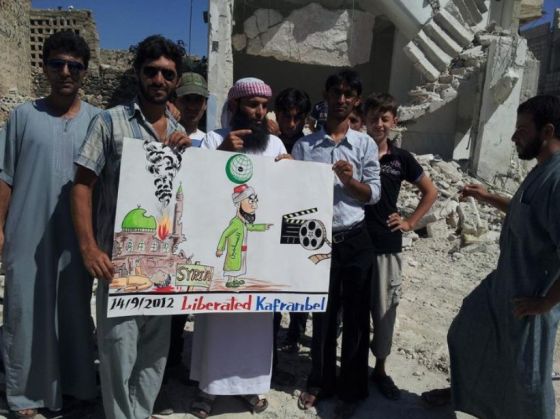
To residents in Kafranbel it's clear that protests across the region against a provocative film are simply a massive distraction directing attention away from the devastation inside Syria.
Robin Yassin-Kassab writes: This video is not suitable for children nor for those of a nervous disposition. I include myself in the latter category. At first I couldn’t watch it, then I made myself do so in order to hear the words. Before the usual “Freedom? You want freedom?” the torturee is forced to declare that Bashaar al-Asad is his ‘lord’ (the Arabic word ‘rabb’, which means God). The violent (but very small) protests which have swept the Muslim world in response to a ridiculous low-budget smear of the Prophet Muhammad are in part the expression of a deeply humiliated people who remember Western support of Zionism and Muslim dictatorships, Western invasions of Iraq and Afghanistan, and so on. They are in part the result of the failure of Arab and Muslim dictatorships to build functioning education systems, and a symptom of a profound and generalised despair that requires wounded symbols through which to manifest itself. Most importantly, they are signals of an opportunistic power play by the extreme right-wing Salafist minority. It’s a case of extreme right-wing Islamophobes, Zionists, Coptic extremists and American Republicans on the one hand and extreme right-wing Islamists on the other, feeding off each other. The furore has made the ridiculous anti-Islam film a Youtube hit. Nobody would have heard of it had Egyptian Islamists not publicised it, and had the American ambassador to Libya, apparently a friend of the Arabs who was critical of US policy on Palestine, not been murdered. As with all the episodes in the ‘culture wars’, it’s an enormous diversion from the really serious issues. The torture video here was first pointed out by the Syrian activist Wissam Tarif. He asked a simple question. Where are the furious demonstrations against this blasphemy? Why have no Syrian embassies been burnt following the repeated bombing of mosques and churches, the murder, rape, torture and humiliation of tens of thousands of Syrian Muslims? [Continue reading…]

Thirty years after Robert Fisk drew the attention of the world to the Sabra and Chatila massacre — a massacre in which the victims had initially been dubbed ‘terrorists’ — it’s ironic that he would have chosen to become a mouthpiece of the Syrian government in its effort to cover up the Daraya massacre where as many as 500 people were slaughtered.
At Open Democracy Yassin Al Haj Saleh and Rime Allaf write: The international media has not always been kind to Syria’s revolutionary people. For months on end, many of the latter turned themselves into instant citizen-journalists to document their uprising and the violent repression of the Syrian regime, loading clips and photos taken from their mobile-phones to various social networks; still, the established media, insinuating that only it could really be trusted, covered these events with an ever-present disclaimer that these images could not be independently verified. Since the Damascus regime was refusing to allow more than a trickle of foreign media personnel into the country, chaperoned by the infamous minders, what the Syrians themselves were reporting was deemed unreliable.
Nevertheless, an increasing number of brave journalists dared to sneak into Syria at great personal risk, reporting the same events which activists had attempted to spread to the world. For the most part, experienced journalists were perfectly capable of distinguishing between straight propaganda from a regime fighting for its survival and real information from a variety of other sources. Overwhelmingly, ensuing reports about Syria gave a voice to “the other side” or at least quoted opposing points of view, if only for balance. In some cases, journalists found no room to cater for the regime’s claims, especially when reporting from civilian areas under relentless attack by Bashar al-Assad’s forces.
It was from the wretched Homs district of Baba Amr, under siege and shelling for an entire month, that the late Marie Colvin, amongst others, testified on the eve of her death under the regime’s shells about the “sickening situation” and the “merciless disregard for the civilians who simply cannot escape.” Like her, most of those who managed to get into Syria have testified about the regime’s repression of a popular uprising, even after the latter evolved to include an armed rebellion.
Robert Fisk, a seasoned war correspondent who has covered the region for decades, surprisingly broke a mould, gradually allowing himself to become a part, and not simply a witness, of the Syrian regime’s propaganda campaign.
On 30 October 2011, Fisk – who works for the Independent newspaper, and whose reports are widely republished – was a guest of Syrian state television for an extended interview during which his legendary directness seemed subdued, as he meekly advised his host that he feared the Syrian authorities were running out of time to turn the situation around. In an article entirely dedicated to Bouthaina Shaban, one of Assad’s advisors, he quoted some of her extraordinary tales without adding one of his trademark comments: thus, he didn’t challenge the claim that a Christian baker in Homs was accused (supposedly by the extremists the regime says are leading the uprising) of mixing whisky in the bread.
Over the last few months, Fisk’s pieces on Syria have consisted more of commentary than of reporting, with a growing emphasis on the conspiracy scenario as he reminds readers that the governments criticising the Assad regime were themselves hardly examples of freedom or democracy. This is indeed true in many cases, but is not directly relevant to the Syrian people’s uprising, which moreover he increasingly reports in the sectarian terminology he had previously criticised when covering the invasion and occupation of Iraq.
But even copious editorialising of this nature could not have heralded Fisk’s shocking decision to embed with the Syrian regime’s armed forces, when he had previously stated (on 22 January 2003) that “war reporters should not cosy up to the military”. In Syria, Fisk embedded first in Aleppo with the commander of operations in the embattled city, and then in Damascus and its suburbs under attack by the regime. In particular, his piece on Daraya’s gruesome massacre has shocked many Syrians. [Continue reading…]
Rami G Khouri writes: The criminal tragedy of the death of four American diplomats in Benghazi has rightly captured the attention of the world and raised questions about whether attacks against embassies are a reasonable way for people to express their anger. It is clear that the three things we witnessed this week – spontaneous mob scenes, pre-planned orderly demonstrations and organized military attacks against American facilities – represent three different phenomena, each of which reflected a significant political reality in the Arab world today. Why these three all gravitate to American embassies is a relevant question that deserves more analysis, but for another day.
At the other end is the spark of this week’s dynamics, namely the vulgar and deliberately provocative film by anti-Islamic criminals in the United States (including some of Egyptian Coptic origin) who know that if they insult the Prophet Mohammad they will incite demonstrations and violence across parts of the Arab-Islamic world. A small number of virulent Islamophobic movements in North America and Europe vent their racist insults through websites, publications and other means, and when these are translated into Arabic and spread through the digital world, the result is what we witnessed this week in Libya, Egypt, Yemen and other countries.
But what, in fact, did we witness? It is important to try to understand the separation lines between the different players comprising the new scorecard of Arab political cultures in a process of deep transformation, and, in cases like Libya, that also represent the birth of totally new national political and governance systems. Small groups of armed Salafist militants carry out operations such as the attack against the American consulate in Benghazi, while the mainstream Muslim Brotherhood in Egypt and other such Islamists tend to stick to orderly and peaceful demonstrations. Spontaneous groups of angry citizens fall somewhere in between when they vent their anger at the insulting film about the Prophet Mohammad by storming American embassies and tearing down or burning the flag.
These groups represent the equivalent of the American terrorist Timothy McVeigh, the ideological Tea Party, those many Americans who spontaneously gathered, danced and celebrated when Osama bin Laden was killed, and those few Americans who burned down mosques around the country. The criminals in this mix must be viewed and dealt with very differently from the others who are angry, energetic and excitable, but not necessarily criminal in either their intent or their conduct. [Continue reading…]
The Libya Herald reports: In his strongest attack to date of the actions of extremists, Libya’s Grand Mufti, Sheikh Sadeq Al-Ghariani, has issued a fatwa condemning Tuesday’s killing of US Ambassador Chris Stevens along with three other American diplomatic staff and a number of Libya security guards. He said those involved were criminals who were damned by their action.
He also condemned the production of any film, picture or article insulting the Prophet Mohammad or any of the prophets by “extreme fanatics” in the US or elsewhere.
The Prophet Muhammad, Ghariani said, had specifically forbidden the killing of ambassadors and envoys.
He also pointed to a hadith in which the Prophet had said: “He who kills a confederate will not enter paradise.” (A “confederate” is seen as someone who come to a Muslim country and lives peacefully among Muslims.)
The fatwa criminalised anyone taking part in armed attacks without the consent of the legitimate authorities.
What had happened in Benghazi was, it stated, “an attempt to undermine state authority”. It said that all Libyans who cared about their country, anyone who was intelligent, indeed anyone who considered themselves as Muslims should “despise” what had happened.
“Such an act, in fact, is likely to cause severe harm to the higher interests of the country, could unite nations against us, would give others justification to classify us amongst states sponsoring terrorism”, the fatwa stated.
Accusing extremists of twisting and perverting the message of Islam, it added that the attack could “give Islam a bad name, inciting hatred towards us, putting off those who were contemplating Islam”. It could even create a backlash among Muslims.
Ghariani’s ruling also accused the authorities over the killings. The attack was a “clear indication of chaotic security”, it declared. What had happened was the inevitable result of nothing being done in recent months about several violent incidents carried out by armed militias “which used arms without the authority of the state”.
Amena Raghei writes: During the Gaddafi regime, women’s participation in Libyan public life was perceived as little more than a tool in Gaddafi’s arsenal of oppression. Recent interviews with female activists and candidates repeatedly echo the sentiment that, unlike today, women who took on public roles during Gaddafi’s time were considered women of ill repute, literally tarnished by Gaddafi’s hands.
While this attitude has been entrenched in the Libyan cultural mindset, it is currently undergoing seismic shifts. As a result of the February 17, 2011 revolution, women have started participating in public life at unprecedented levels. For some members of Libyan society, these changes have been difficult to accept. Nevertheless, Libya’s newly empowered women seem undeterred and determined to protect their new few found public roles.
In Libyan society, it was once implicitly understood that women holding positions in the Gaddafi government or pubic positions in general had been chosen not for their ostensible bureaucratic qualifications but, more often than not, as an expression of the “brother leader’s” personal interests, tastes, and worse. Libya’s traditionally patriarchal society did not easily allow women to be objects of public scrutiny, especially as decreed by the arbitrary rules of a silently hated dictator.
Gaddafi’s infamous female bodyguards, Benghazi’s female mayor, Huda Ben Amir (better known as Huda the Executioner), and the ubiquitous Revolutionary Committees (which were known to recruit young women and girls to satisfy Gaddafi’s perverse predilections) are a few of examples of female public positions abhorred by the average Libyan.
In order to avoid these negative associations and protect themselves, women often willingly took a backseat to men and refrained from participating in political – or any other public – activities. While this may have preserved women’s reputation, it also created a culture where women’s social roles tended to be restricted mainly to the household. In cases where women ventured outside the home, they were often limited to traditionally acceptable posts with little public exposure or decision-making ability. Their involvement in society remained socially acceptable as long as they stayed away from the limelight and did not seek public attention.
The revolution of February 17 would see a quick and decisive change in this attitude as women, out of necessity, became active, productive, and respected members of a national movement. No longer would their political activity carry Gaddafi’s imprimatur.
This summer marked a turning point in Libya’s swift evolution from dictatorship to democracy. It was doubly special for Libyan women, who made their voices heard and took their role in building the new Libya very seriously. Women’s new political roles extended from and even surpassed the contributions made during the revolution. They not only helped in their country’s rebirth, but also took on a new identity as collaborative members in Libya’s public sphere. [Continue reading…]
Ahed Al Hendi says, as the media turn their attention to senseless violence elsewhere, the struggling, besieged people of Syria wonder: Where’s the demonstrators’ anger about what’s happening to us?
“Dear Arabs, if you had dared to protest against Bashar in the same way of your protest against the American embassies, Bashar would not have been able to kill 200 Syrians a day.”
So read a banner in Syria satirizing the absurd and exaggerated outrage against the Web trailer for Innocence of Muslims. Another read: “We have an Assad-esque movie that offends the messenger [Muhammad] and the god of the messenger. It’s been playing for 18 months.”
Many Syrians on Twitter, Facebook, and other social-media sites have expressed outrage about the production of this Web film. But their anger is largely directed at the Arab world’s reaction. Bashar al-Assad’s forces are slaughtering people on a daily basis not in a movie, but in real life, while the media and protesters elsewhere have shifted attention to what many Syrians call “a silly movie.”
“What happened affected us Syrians negatively,” Yassin Al Haj Saleh, a prominent Syrian writer and dissident based in Damascus, tells me over Google Chat. “First, media attention was focused on this story. Second, the movie and the violent reaction served the regime and its supporters by giving them an excuse—that a regime that looks modernist from the outside and depends on a criminal intelligence apparatus would be the best for the Middle East.”
Al Haj Saleh, who was one of 11 people recently awarded the Prince Claus Award for his work, did not rule out the possibility that the acts of violence were backed by remnants of ousted regimes or opportunistic populist movements.
Many Syrian activists share Saleh’s view of the movie. They fear that Western governments will use the turmoil as a pretext not to support Syrian opponents of the Assad regime. [Continue reading…]
Roger Ebert writes: Set aside for a moment all of the controversy. Do me the favor of reading the actual words of the statement released by our Egyptian Embassy six hours before it was attacked by radicals, and before a similar attack in Libya that took four innocent lives. Here it is:
“The Embassy of the United States in Cairo condemns the continuing efforts by misguided individuals to hurt the religious feelings of Muslims — as we condemn efforts to offend believers of all religions. Today, the 11th anniversary of the Sept. 11, 2001, terrorist attacks on the United States, Americans are honoring our patriots and those who serve our nation as the fitting response to the enemies of democracy. Respect for religious beliefs is a cornerstone of American democracy. We firmly reject the actions by those who abuse the universal right of free speech to hurt the religious beliefs of others.”
What exactly, is wrong with those words? Which ones do you disagree with? Let me set the stage for the statement. A “trailer” of dubious origin, for a film that has not been seen, was released some time ago on YouTube and widely overlooked. Then the “trailer” was translated into Arabic, and predictably stirred up outrage. As outrage spread in the Middle East, a press official for the Embassy wrote and released the statement without higher approval.
I agree with every word of this statement. Which parts would you disagree with? Why?
Sentence One: One-quarter of the earth’s population is Muslim, including many Americans. Yes, their feelings can be hurt by a crude attack on the Prophet. I would go so far as to suggest those who made the trailer hoped to hurt their feelings. Why else, when their original effort failed to attract attention, did they pay to have it translated into Arabic, so it could be understood in nations where the box office appeal of the so-called film would be non-existent? The only purpose must have been to hurt feelings.
Children are experts at having and causing hurt feelings. They do nasty things and make each other cry. And then adults or older children have to step in and teach them about empathy and consideration for others and the need we all have to live in harmony.
When government officials or commentators scold those who disparage Muslims, they end up sounding like school teachers admonishing troublesome children, saying, don’t be so nasty to the Muslims. You’re being insensitive. And look what you did. Now you made them cry.
Not only is this utterly condescending to Muslims, but it also totally mischaracterizes the nature of acts of provocation such as the creation and promotion of the Innocence of Muslims.
This is not a film intended to hurt the feelings of Muslims. It is designed to provoke outrage and then capitalize on that outrage. It is provocation intended to trigger an over-reaction so that scorn can then be poured on those who are so easily provoked. This goes way beyond the intention to hurt feelings.
Islamophobes are not social blunderers who go around hurting Muslims feelings. They are social engineers attempting to show why Muslims must be kept in their place and are not fit to be treated as equals. Their goal is to breed contempt for Muslims in just the same way that the Nazis turned their venom on Jews.
Nakoula Basseley Nakoula, a California Coptic Christian with a long criminal record may be at the center of the current furor, but let’s not lose sight of the fact that as an ideological objective, keeping Muslims in their place is central to one cause more than any other: Zionism. Inside the villa in the jungle no one is in any doubt about whose comforts must be protected and who must be treated like a wild animal.