Apocalypse fairly soon

Paul Krugman writes: Suddenly, it has become easy to see how the euro — that grand, flawed experiment in monetary union without political union — could come apart at the seams. We’re not talking about a distant prospect, either. Things could fall apart with stunning speed, in a matter of months, not years. And the costs — both economic and, arguably even more important, political — could be huge.

This doesn’t have to happen; the euro (or at least most of it) could still be saved. But this will require that European leaders, especially in Germany and at the European Central Bank, start acting very differently from the way they’ve acted these past few years. They need to stop moralizing and deal with reality; they need to stop temporizing and, for once, get ahead of the curve.

I wish I could say that I was optimistic.

The story so far: When the euro came into existence, there was a great wave of optimism in Europe — and that, it turned out, was the worst thing that could have happened. Money poured into Spain and other nations, which were now seen as safe investments; this flood of capital fueled huge housing bubbles and huge trade deficits. Then, with the financial crisis of 2008, the flood dried up, causing severe slumps in the very nations that had boomed before.

At that point, Europe’s lack of political union became a severe liability. Florida and Spain both had housing bubbles, but when Florida’s bubble burst, retirees could still count on getting their Social Security and Medicare checks from Washington. Spain receives no comparable support. So the burst bubble turned into a fiscal crisis, too.

Europe’s answer has been austerity: savage spending cuts in an attempt to reassure bond markets. Yet as any sensible economist could have told you (and we did, we did), these cuts deepened the depression in Europe’s troubled economies, which both further undermined investor confidence and led to growing political instability.

And now comes the moment of truth.

Greece is, for the moment, the focal point. Voters who are understandably angry at policies that have produced 22 percent unemployment — more than 50 percent among the young — turned on the parties enforcing those policies. And because the entire Greek political establishment was, in effect, bullied into endorsing a doomed economic orthodoxy, the result of voter revulsion has been rising power for extremists. Even if the polls are wrong and the governing coalition somehow ekes out a majority in the next round of voting, this game is basically up: Greece won’t, can’t pursue the policies that Germany and the European Central Bank are demanding.

Nouriel Roubini writes: The Greek euro tragedy is reaching its final act: it is clear that either this year or next, Greece is highly likely to default on its debt and exit the eurozone.

Postponing the exit after the June election with a new government committed to a variant of the same failed policies (recessionary austerity and structural reforms) will not restore growth and competitiveness. Greece is stuck in a vicious cycle of insolvency, lost competitiveness, external deficits, and ever-deepening depression. The only way to stop it is to begin an orderly default and exit, coordinated and financed by the European Central Bank, the European Commission, and the International Monetary Fund (the “Troika”), that minimizes collateral damage to Greece and the rest of the eurozone.

Greece’s recent financing package, overseen by the Troika, gave the country much less debt relief than it needed. But, even with significantly more public-debt relief, Greece could not return to growth without rapidly restoring competitiveness. And, without a return to growth, its debt burden will remain unsustainable. But all of the options that might restore competitiveness require real currency depreciation.

The first option, a sharp weakening of the euro, is unlikely, as Germany is strong and the ECB is not aggressively easing monetary policy. A rapid reduction in unit labor costs, through structural reforms that increased productivity growth in excess of wages, is just as unlikely. It took Germany ten years to restore its competitiveness this way; Greece cannot remain in a depression for a decade. Likewise, a rapid deflation in prices and wages, known as an “internal devaluation,” would lead to five years of ever-deepening depression.

If none of those three options is feasible, the only path left is to leave the eurozone. A return to a national currency and a sharp depreciation would quickly restore competitiveness and growth.

Of course, the process would be traumatic – and not just for Greece. The most significant problem would be capital losses for core eurozone financial institutions. Overnight, the foreign euro liabilities of Greece’s government, banks, and companies would surge. Yet these problems can be overcome. Argentina did so in 2001, when it “pesofied” its dollar debts. The United States did something similar in 1933, when it depreciated the dollar by 69% and abandoned the gold standard. A similar “drachmatization” of euro debts would be necessary and unavoidable.


Facebooktwittermail

Austerity will send Greece to hell, warns Alexis Tsipras

The Guardian reports: The two main figures in what promises to be Greece’s most electric election in living memory were on a collision course on Thursday, with one predicting “hell” if Athens adheres to EU-mandated austerity and the other forecasting a “nightmare” if the nation abandons reforms and gives up the euro.

Emboldened by yet another poll showing his party’s wide appeal, the leftwing Syriza leader, Alexis Tsipras, said the international accord that Greece had signed up to in return for rescue loans was catastrophic for the country. Instead of a rescue, the debt-stricken nation has been thrown into its worst recession since the second world war.

“With this policy [bailout agreement] we are going directly to hell,” he told CNN. “To save Europe we need to change direction,” insisted the politician who has pledged to “tear up” the €130bn (£104bn) “memorandum of understanding” that Athens reached with the EU and IMF earlier this year.

The 38-year-old, who has sent shockwaves through EU capitals with his fiery anti-austerity rhetoric, made the remarks as Syriza announced that he would be visiting Berlin and Paris next week for talks. It was unclear whom Tsipras would be meeting, although aides said the German chancellor, Angela Merkel, would not be among those lined up.

Within hours, the leading credit agency Fitch had downgraded Greece’s sovereign rating to CCC from B-, citing “the risk of a Greek exit from European Monetary Union … in the near term”.

Earlier in the day, Antonis Samaras, who heads the conservative New Democracy party, painted a very different picture in a speech that conjured images of a living hell if Athens quit the EU.

In the event of the debt-stricken country reneging on the pledges it had made, the road ahead would be a “nightmarish” one, he said.

Reversion to the drachma would mean wages, deposits and property values all being “cut in half”, and the price of imported commodities, such as food and fuel, skyrocketing, he predicted. “This is the nightmare that those who speak of a unilateral condemnation [of the loan agreement] will bring,” he told his parliamentary group at its last meeting before the 300-seat house is dissolved and the election campaign officially announced .

“The battle that begins the day after tomorrow for the new elections is not about any single party or its electoral influence,” said the 61-year-old politician, ashen-faced as he delivered the speech. “It’s about whether Greece will remain in Europe, a Europe which is itself changing. Or if Greece will be found to leave Europe, losing much and risking even more.” [Continue reading…]

Facebooktwittermail

Anti-intellectualism is taking over the U.S.

Patricia Williams writes: Recently, I found out that my work is mentioned in a book that has been banned, in effect, from the schools in Tucson, Arizona. The anti-ethnic studies law passed by the state prohibits teachings that “promote the overthrow of the United States government,” “promote resentment toward a race or class of people,” “are designed primarily for pupils of a particular ethnic group,” and/or “advocate ethnic solidarity instead of the treatment of pupils as individuals.” I invite you to read the book in question, titled Critical Race Theory: An Introduction, so that you can decide for yourselves whether it qualifies.

In fact, I invite you to take on as your summer reading the astonishingly lengthy list of books that have been removed from the Tucson public school system as part of this wholesale elimination of the Mexican-American studies curriculum. The authors and editors include Isabel Allende, Junot Díaz, Jonathan Kozol, Rudolfo Anaya, bell hooks, Sandra Cisneros, James Baldwin, Howard Zinn, Rodolfo Acuña, Ronald Takaki, Jerome Skolnick and Gloria Anzaldúa. Even Thoreau’s Civil Disobedience and Shakespeare’s The Tempest received the hatchet.

Trying to explain what was offensive enough to warrant killing the entire curriculum and firing its director, Tucson school board member Michael Hicks stated rather proudly that he was not actually familiar with the curriculum. “I chose not to go to any of their classes,” he told Al Madrigal on The Daily Show. “Why even go?” In the same interview, he referred to Rosa Parks as “Rosa Clark.”

Facebooktwittermail

Texas’s war on history

Katherine Stewart writes: Don McLeroy, chairman of the Texas State Board of Education from 2007 to 2009, is a “young earth” creationist. He believes the earth is 6,000 years old, that human beings walked with dinosaurs, and that Noah’s Ark had a unique, multi-level construction that allowed it to house every species of animal, including the dinosaurs.

He has a right to his beliefs, but it’s his views on history that are problematic. McLeroy is part of a large and powerful movement determined to impose a thoroughly distorted, ultra-partisan, Christian nationalist version of US history on America’s public school students. And he has scored stunning successes.

If you want to see a scary movie about this movement, consider taking in Scott Thurman’s finely-crafted documentary Revisionaries, currently making the festival circuit, which records the antics of McLeroy and a hard right majority on the Texas State Board of Education (SBOE) as they revise the textbook standards that will be used in Texas (and many other states).

The first part of this documentary deals with the familiar “science wars”, in which one side seeks to educate children in the sciences, and the other side proposes to “teach the controversy” in order to undermine those aspects of science that conflict with its religious convictions. But it’s the second part of the movie where the horror really kicks in. As I explain in more detail in The Good News Club: The Christian Right’s Stealth Assault on America’s Children, the history debate makes the science debate look genteel. While the handful of moderates on the SBOE squeals in opposition, the conservative majority lands blow after blow, passing resolutions imposing its mythological history on the nation’s textbooks. [Continue reading…]

Facebooktwittermail

Obama’s biggest mistake in the world

Michael Hastings writes: President Obama will arrive in Chicago this weekend to participate in a charade that has one not-so-hidden goal: Get the hell out of Afghanistan.

After Obama made what many around him now privately acknowledge was a mistake to escalate the conflict three years ago — essentially creating a new war of his own, tripling the size of U.S. forces after he caved under intense pressure from the Pentagon — the White House has been desperately searching for a way out. Ideally, one that couldn’t be spun as a full on retreat.

The administration didn’t find it at the last NATO Summit in Lisbon, Portugal, two years ago. The U.S. still had to pretend they were in it for the next decade. There, NATO Secretary General Anders Foghs Rasmussen boldly committed the U.S. and Europe beyond 2014. “One thing must be very clear: NATO is in this for the long term,” he told reporters at the time.

Today, the calculus has changed completely, while the strategy’s failure is nearly impossible to deny. Bin Laden’s killing — which, for what it’s worth, had zero relationship to the counterinsurgency plan we adopted — gave Obama the political cover to pull it off. Finally, Obama could overrule his generals (which he did a month after the Osama raid) whose plan called for 130,000 troops to stay for years more to come.

“People are ready to see the war be wound down,” says Heather Hurlburt, executive director of the National Security Network. “They don’t really understand. It’s been ten years, Bin Laden is gone, what exactly are we there for again?”

By rarely speaking about the war publicly — Obama has given only four major addresses on Afghanistan, or, about one speech for every 484 soldiers killed — the president allowed the horrible news to fill the void. The public was treated to one fiasco, embarrassment, or atrocity after the other, culminating with a crescendo of upsetting events this year that seemed to solidify public opinion against the fight. (The Koran burning, urinating on the Taliban, the massacre of 17 civilians, posing with dead body photos…)

With almost 70 percent of the public now against it, the war became politically safe enough to quit. “Since [the majority of] Americans neither care nor understand what the hell we’ve done there or in Iraq, he can do as he likes,” says Colonel Douglas MacGregror, a retired officer and influential military analyst. “We are at the beginning of turning inward for ten years.” [Continue reading…]

Facebooktwittermail

U.S. envoy to Israel: U.S. ready to strike Iran

The Associated Press reports: The U.S. has plans in place to attack Iran if necessary to prevent it from developing nuclear weapons, Washington’s envoy to Israel said, days ahead of a crucial round of nuclear talks with Tehran.

Dan Shapiro’s message resonated Thursday far beyond the closed forum in which it was made: Iran should not test Washington’s resolve to act on its promise to strike if diplomacy and sanctions fail to pressure Tehran to abandon its disputed nuclear program.

Shapiro told the Israel Bar Association the U.S. hopes it will not have to resort to military force.

“But that doesn’t mean that option is not fully available. Not just available, but it’s ready,” he said. “The necessary planning has been done to ensure that it’s ready.”

Iran says its nuclear program is for peaceful purposes, like energy production. The U.S. and Israel suspect Iran is pursuing nuclear weapons, but differences have emerged in how to persuade Tehran to curb its program.

Washington says diplomacy and economic sanctions must be given a chance to run its course, and is taking the lead in the ongoing talks between six global powers and Iran.

Israel, while saying it would prefer a diplomatic solution, has expressed skepticism about these talks and says time is running out for military action to be effective.

President Barack Obama has assured Israel that the U.S. is prepared to take military action if necessary, and it is standard procedure for armies to draw up plans for a broad range of possible scenarios. But Shapiro’s comments were the most explicit sign yet that preparations have been stepped up.

In his speech, Shapiro acknowledged the clock is ticking.

“We do believe there is time. Some time, not an unlimited amount of time,” Shapiro said. “But at a certain point, we may have to make a judgment that the diplomacy will not work.”

Facebooktwittermail

Turkey’s PM threatens theaters after actor ‘humiliates’ daughter

The Guardian reports: In a tale which could have come straight from the time of the sultans, when one wrong word could seal your fate, the Turkish prime minister, Recep Tayyip Erdogan, is threatening to withdraw state support from the country’s theatres after his daughter said she was insulted by an actor during a play.

Erdogan, who dabbled in amateur dramatics as a student, has a reputation for wearing his heart on his sleeve. But his tirades against “arrogant, alcoholic actors” and an arts establishment he claims holds ordinary people in contempt have shocked Turkey.

Theatres cannot take government subsidies and then criticise the hand that feeds them, he said. “They have started to humiliate and look down on us and all conservatives.”

Actors took to the streets in protest after civil servants were handed artistic control of Istanbul theatres overnight last month in a separate row over an “obscene” play.

“If support is needed, then we the government can support the plays we want,” Erdogan said. “I am privatising the theatre. No theatres are being run by the state in almost any developed country. Here there is freedom. When we privatise the theatres you can play whatever you want. Sorry, but you cannot get your salary from the municipality and then criticise the management. There is no such absurdity.”

He railed against the “despotic arrogance” of intellectuals who always think they know best: “For God’s sake, who are you? From where do you get the authority to express opinions on every issue, to argue that you know everything? Are theatres your monopoly in this country? Are arts your monopoly? These days are gone.”

What some are calling “Turkey’s culture war” began in April last year when his youngest daughter, Sümeyye Erdogan, 30, walked out of a performance of Young Osman at the Ankara state theatre. Its story of a young, reforming sultan overthrown by a boorish military has a rich echo for the Erdogans and the AK party, who have broken the army’s hold on Turkey. What exactly happened during an improvised sequence when the uncouth soldiers growl at the audience is still disputed, but she claims she was humiliated by an actor, Tolga Tuncer, who picked on her because she was wearing a headscarf, mimicking her chewing gum and making offensive “haka-style” gestures at her.

Sümeyye Erdogan went to university overseas – studying in the US and at the London School of Economics – because headscarves were banned at the time in Turkish academic institutions. In an impassioned letter to Tuncer on Facebook, she appealed for the kind of tolerance she was accorded in Britain and the US. “As an artist you should be first to treat people who are different with respect … you had better get used to people with headscarves. Half of the people of Turkey are women and many of them wear headscarves. I don’t want to live my life fighting you. I will continue to love art and theatre and continue attending the theatre with my headscarf.” [Continue reading…]

Facebooktwittermail

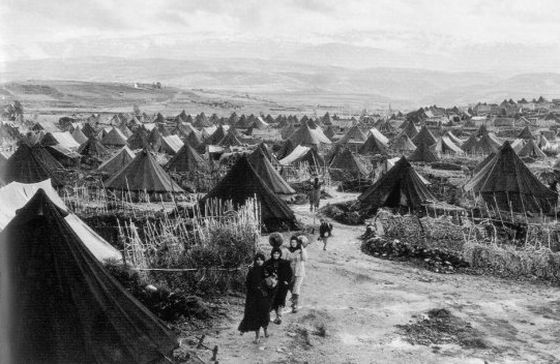
Erasing the Nakba

A refugee crisis that has lasted for 64 years following the ethnic cleansing of Palestine in 1948 in which the indigenous population was driven out by Zionists.

Neve Gordon writes: I first heard about the Nakba in the late 1980s, while I was an undergraduate student of philosophy at Hebrew University. This, I believe, is a revealing fact, particularly since, as a teenager, I was a member of Peace Now and was raised in a liberal home. I grew up in the southern city of Be’er-Sheva, which is just a few kilometres from several unrecognised Bedouin villages that, today, are home to thousands of residents who were displaced in 1948. I now know that the vast majority of the Negev’s Bedouin population was not as lucky, and that, in the late 1940s and early 1950s, most Bedouin either fled or were expelled from their ancestral lands to Jordan or Gaza.

How is it possible that a left-leaning Israeli teenager who was living in the Negev during the early 1980s (I graduated from high-school in 1983) had never heard the word “Nakba”?

How, in other words, is collective amnesia engendered?

There are many explanations of how master narratives are created and how they suppress and marginalise competing historical accounts. In addition to the work carried out by state institutions and apparata, this careful erasure also demands the ongoing mobilisation of scholars, novelists and artists – as well as other producers of popular culture.

When I was growing up, the history depicted in Israeli high-school textbooks, as well as the historical narrative promulgated by the mass media (there was only one television channel in Israel at the time, which was government run), was validated by famous novelists and public intellectuals. According to a PhD thesis written by Alon Gan from Tel Aviv University, Amos Oz, for example, interviewed soldiers after the 1967 war and used his editorial prerogative to excise descriptions of abuse in order to produce an image of the moral Israeli combatant.

Thinking back to the days when I was involved in Peace Now, I now realise that, even for most Israeli doves at the time, a conflicted history only emerged post-1967 – with the occupation of the Sinai, West Bank, Gaza Strip and the Golan Heights. Accordingly, the solution offered by Peace Now addressed the wrongs created in 1967, but had nothing to say about 1948. Indeed, I do not recall any reference to the Palestinian refugees in their publications. The seamless way in which the state had managed to completely suture the happenings of 1948, even among the Israeli peace camp, was indeed remarkable. [Continue reading…]

Facebooktwittermail

TED responds to criticism

This is the talk which TED earlier declined to post:

And this is Chris Anderson’s explanation about what happened:

Today TED was subject to a story so misleading it would be funny… except it successfully launched an aggressive online campaign against us.

The National Journal alleged we had censored a talk because we considered the issue of inequality “too hot to handle.” The story ignited a firestorm of outrage on Reddit, Huffington Post and elsewhere. We were accused of being cowards. We were in the pay of our corporate partners. We were the despicable puppets of the Republican party.

Here’s what actually happened.

At TED this year, an attendee pitched a 3-minute audience talk on inequality. The talk tapped into a really important and timely issue. But it framed the issue in a way that was explicitly partisan. And it included a number of arguments that were unconvincing, even to those of us who supported his overall stance. The audience at TED who heard it live (and who are often accused of being overly enthusiastic about left-leaning ideas) gave it, on average, mediocre ratings.

At TED we post one talk a day on our home page. We’re drawing from a pool of 250+ that we record at our own conferences each year and up to 10,000 recorded at the various TEDx events around the world, not to mention our other conference partners. Our policy is to post only talks that are truly special. And we try to steer clear of talks that are bound to descend into the same dismal partisan head-butting people can find every day elsewhere in the media.

We discussed internally and ultimately told the speaker we did not plan to post. He did not react well. He had hired a PR firm to promote the talk to MoveOn and others, and the PR firm warned us that unless we posted he would go to the press and accuse us of censoring him. We again declined and this time I wrote him and tried gently to explain in detail why I thought his talk was flawed.

So he forwarded portions of the private emails to a reporter and the National Journal duly bit on the story. And it was picked up by various other outlets.

And a non-story about a talk not being chosen, because we believed we had better ones, somehow got turned into a scandal about censorship. Which is like saying that if I call the New York Times and they turn down my request to publish an op-ed by me, they’re censoring me.

For the record, pretty much everyone at TED, including me, worries a great deal about the issue of rising inequality. We’ve carried talks on it in the past, like this one from Richard Wilkinson. We’d carry more in the future if someone can find a way of framing the issue that is convincing and avoids being needlessly partisan in tone.

Also, for the record, we have never sought advice from any of our advertisers on what we carry editorially. To anyone who knows how TED operates, or who has observed the noncommercial look and feel of the website, the notion that we would is laughable. We only care about one thing: finding the best speakers and the best ideas we can, and sharing them with the world. For free. I’ve devoted the rest of my life to doing this, and honestly, it’s pretty disheartening to have motives and intentions taken to task so viciously by people who simply don’t know the facts.

One takeaway for us is that we’re considering at some point posting the full archive from future conferences (somewhere away from the home page). Perhaps this would draw the sting from the accusations of censorship. Here, for starters, is the talk concerned. You can judge for yourself…

No doubt it will now, ironically, get stupendous viewing numbers and spark a magnificent debate, and then the conspiracy theorists will say the whole thing was a set-up!

OK… thanks for listening. Over and out.

The way Anderson tells the story it sounds simply like a case of someone getting turned down at an audition and then not being willing to accept a rejection. But given that Anderson describes this as an account of “what actually happened,” he fails to explain what appears to be a key component of the story: that he had written to Hanauer telling him that his talk “probably ranks as one of the most politically controversial talks we’ve ever run, and we need to be really careful when” to post it. He wrote “when” not “if” but later backtracked.

No doubt Anderson and the other folks at TED don’t appreciate the way Hanauer and his PR representatives have handled this and his talk certainly doesn’t rank as one of the most inspired TED talks, but was it really so politically controversial?

Facebooktwittermail

Libyan women hope for gains in elections

Al Jazeera reports: Buoyed by the winds of change sweeping the region, Libyan women are eyeing a far greater role for themselves after next month’s national assembly elections.

The June 19 poll – the first since the fall of dictator Muammar Gaddafi – will see the country electing 200 candidates to the body that will draft the country’s constitution.

Recent polls in neighbouring Egypt and Tunisia have had mixed results for women, and the lessons are not lost on their Libyan counterparts.

In Egypt, parliamentary elections saw less than two per cent of the seats go to women – eight seats, compared to the 64 guaranteed to them by law. It was somewhat better in Tunisia, with 49 women getting elected.

Halloum al-Fallah, an independent candidate hopeful from the eastern city of Benghazi, said Libyan women are taking lessons from the Arab Spring in terms of how to fight for their place in politics.

“We are learning from the mistakes in Egypt and Tunisia, but also learning from what other countries are doing well,” said Fallah. [Continue reading…]

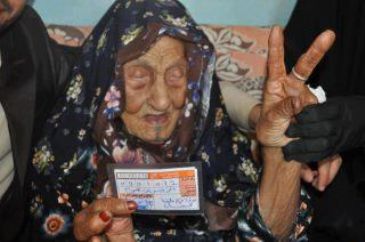
118 year old Nuwara Faraj Fahajan holds her vote registration card high in her right hand and the Victory sign by her left for the media and the admiring gathering to see, May 16 2012. Registration for voting in Libya is injecting new energy in all age groups in the country and providing them something to celebrate. (Tripoli Post)

Facebooktwittermail

Concern grows over jihadist numbers in eastern Libya

CNN reports: Diplomats and other observers in Libya say that with elections one month away, the National Transitional Council is struggling to exert control over various militia prominent in the uprising against Moammar Gadhafi.

The situation is further complicated by tribal rivalries and a growing presence of Islamist militants in some areas.

One source briefed by Western intelligence officials said that of particular concern is the city of Derna on the Mediterranean coast some 160 miles (260 kilometers) west of the Egyptian border.

The source told CNN that hundreds of Islamist militants are in and around the town, and there are camps where weapons and physical training are provided to militants. He said one official had described the area as “a disaster zone.”

Tensions have grown between local people and the militants. Last month, a number of Derna residents went to a camp on the outskirts of the city, according to the source, and forced militants to leave.

There have also been a number of car bomb explosions in Derna in recent months, apparently as rival Islamist factions compete for supremacy in the area. One is said to have targeted Abdel Hakim al Hasadi, a former member of the Libyan Islamic Fighting Group who spent time in Afghanistan in the 1990s. [Continue reading…]

Facebooktwittermail

With state weak, Libyans look to God for help

Reuters reports: Students from all over Libya come to study Islamic law and to memorize the Islamic holy book, the Koran, at the university and school built around the shrine [which houses the tomb of the 15th-century Sufi scholar Abdel Salam al-Asmar in Zlitan, west of Tripoli]. Now, numbers are down.

In the school halls, the voices of young boys and girls echo in unison.

“We usually have 600 girls a day come to memorize Koran, but the parents are now afraid the Salafis will attack so only 100 show up,” said teacher Wafa al-Ati.

Sufism, a mystical strain of Islam, dates back to the faith’s early days. Apart from the standard prayers, Sufi devotions include singing hymns, chanting the names of God or dancing to heighten awareness of the divine.

Sufis also build shrines to revered holy men and scholars and make pilgrimages to them. There are hundreds of the shrines all over Libya. Even Gaddafi, with his ambivalent attitude to religion, did not try to interfere in a practice that is so deep-seated in Libyan culture.

But since the end of Gaddafi’s rule, a new trend has emerged to challenge Sufi traditions.

Under Gaddafi’s rule, many Salafis were jailed for their beliefs and those not imprisoned spent years avoiding any outward manifestation of their beliefs.

Files from Gaddafi’s internal security agency, seen by Reuters after the revolt, show there was a special department set up to track hardline Islamists. Anyone suspected of affiliation was denied the right to travel abroad, enroll in university or take public sector jobs.

Since that system of repression collapsed, Salafis have become emboldened. Some have acquired weapons and used them to enforce their ultra-purist view of Islam.

The Salafis believe Islam should be followed in the simple, ascetic form practiced by the Prophet Mohammed and his disciples. Any later additions to the faith — including tombs or lavish grave markings – are viewed by them as idolatry.

They have alarmed many secularist Libyans by trying to enforce their strict moral code. The Salafis have burned down halls were parties are held and harassed women who do not cover their heads.

In the eastern city of Benghazi, organizers of a rap concert featuring a famous Tunisian artist were forced to cancel the event after being threatened by a Salafi brigade called Libya’s Shield.

Worried that the Salafis would attack their joyful annual parades to celebrate the Prophet Mohammad’s birthday in February, Sufi mosques sought safety in numbers and held a joint procession in Tripoli’s walled old city. The event, which Salafis also consider idolatrous, went off without incident. [Continue reading…]

Facebooktwittermail

A bombed Libyan village where NATO’s ‘collateral damage’ has a name and a face

Le Monde reports: Nine months have passed but the rubble has yet to be removed. Bombed by NATO last August, the house of the Gafez family in Majer, a town about 150 kilometers east of Tripoli, still looks like a shriveled soufflé. Fourteen people died in the explosion. Twenty others died a few minutes later when bombs struck the farm of the neighbors, the Jaroods. Men, women and children, struck dead in the middle of a Ramadan evening.

What about clearing away the debris? Rebuilding? Haj Ali, the patriarch of the Gafez family never considered it. There are questions of money and of health, but also of honor, says the friendly mustachioed man. That’s because NATO doesn’t want to hear about the martyrs of Majer. The military alliance continues to insist that the bombs dropped on Aug. 8 were aimed at “legitimate military targets.”

International human rights organizations disagree. New York-based Human Rights Watch (HRW) published a well-documented report this week citing numerous errors NATO committed during its 2011 Libya campaign. According to the authors, the seven months of bombings that led to the fall of the Muammar Gaddafi regime caused the death of 72 civilians. The “relatively low” toll “shows that NATO acted with caution” all along the operation, the report states. This said, HRW laments that the military organization did not recognize its faults, did not open any probes, and did not pay any compensation to the victims of its firepower.

As an act of protest, the surviving members of the Gafez family have transformed the ruins of their house into a memorial museum. Visitors are greeted by a furious message painted on the front gate: “Is that human rights?” The words are in reference to the principle of “protecting the civilians” that French Foreign Minister Alain Juppé invoked when lobbying the U.N. Security Council to support the NATO bombing campaign. [Continue reading…]

Facebooktwittermail

The NDAA’s section 1021 coup d’etat foiled

Naomi Wolf writes: On Wednesday 16 May, at about 4pm, the republic of the United States of America was drawn back – at least for now – from a precipice that would have plunged our country into moral darkness. One brave and principled newly-appointed judge ruled against a law that would have brought the legal powers of the authorities of Guantánamo home to our own courthouses, streets and backyards.

US district judge Katherine Forrest, in New York City’s eastern district, found that section 1021 – the key section of the National Defense Authorization Act (NDAA) – which had been rushed into law amid secrecy and in haste on New Year’s Eve 2011, bestowing on any president the power to detain US citizens indefinitely, without charge or trial, “facially unconstitutional”. Forrest concluded that the law does indeed have, as the journalists and peaceful activists who brought the lawsuit against the president and Leon Panetta have argued, a “chilling impact on first amendment rights”. Her ruling enjoins that section of the NDAA from becoming law.

In her written opinion, the judge noted that she had been persuaded by what the lead plaintiffs – who include Pulitzer prize-winner Chris Hedges of the Nation Institute, editor Jennifer Bolen of RevolutionTruth, Noam Chomsky, Daniel Ellsberg, co-founder of Occupy London Kai Wargalla, Days of Rage editor Alexa O’Brien, and the Icelandic parliamentarian and WikiLeaks activist Birgitta Jónsdóttir – had argued. In their testimonies (in court and by affidavit), these plaintiffs compiled a persuasive case that they had “standing” to sue because it was reasonable for them to worry that they could conceivably could be detained indefinitely under the section 1021 law because their work requires them to have contact with sources the US government might assert were “terrorists” or “associated forces” of al-Qaida.

The key claim made by the plaintiffs – of which Judge Forrest was persuaded – was that the language in section 1021 is so vague that it could sweep up anyone. The law fails to define or specify what “associated forces” or the concept of “substantial support” actually mean. [Continue reading…]

Glenn Greenwald writes: The ruling was a sweeping victory for the plaintiffs, as it rejected each of the Obama DOJ’s three arguments: (1) because none of the plaintiffs has yet been indefinitely detained, they lack “standing” to challenge the statute; (2) even if they have standing, the lack of imminent enforcement against them renders injunctive relief unnecessary; and (3) the NDAA creates no new detention powers beyond what the 2001 AUMF already provides.

As for the DOJ’s first argument — lack of standing — the court found that the plaintiffs are already suffering substantial injury from the reasonable fear that they could be indefinitely detained under section 1021 of the NDAA as a result of their constitutionally protected activities. As the court explained (h/t Charles Michael):

In support of their motion, Plaintiffs assert that § 1021 already has impacted their associational and expressive activities–and would continue to impact them, and that § 1021 is vague to such an extent that it provokes fear that certain of their associational and expressive activities could subject them to indefinite or prolonged military detention.

The court found that the plaintiffs have “shown an actual fear that their expressive and associational activities” could subject them to indefinite detention under the law,and “each of them has put forward uncontroverted evidence of concrete — non-hypothetical — ways in which the presence of the legislation has already impacted those expressive and associational activities” (as but one example, Hedges presented evidence that his “prior journalistic activities relating to certain organizations such as al-Qaeda and the Taliban” proves “he has a realistic fear that those activities will subject him to detention under § 1021″). Thus, concluded the court, these plaintiffs have the right to challenge the constitutionality of the statute notwithstanding the fact that they have not yet been detained under it; that’s because its broad, menacing detention powers are already harming them and the exercise of their constitutional rights.

Significantly, the court here repeatedly told the DOJ that it could preclude standing for the plaintiffs if they were willing to state clearly that none of the journalistic and free speech conduct that the plaintiffs engage in could subject them to indefinite detention. But the Government refused to make any such representation. Thus, concluded the court, “plaintiffs have stated a more than plausible claim that the statute inappropriately encroaches on their rights under the First Amendment.” [Continue reading…]

Facebooktwittermail