Arild Andersen, double bass, with Elin Rosseland, vocal, Arve Henriksen, trumpet and vocal.




Arild Andersen, double bass, with Elin Rosseland, vocal, Arve Henriksen, trumpet and vocal.
Edward Wasserman writes: When President Obama addressed the American Society of News Editors convention last month, the real news was what didn’t happen. The watchdogs didn’t bark. No discouraging word from the gathering of 1,000 of the country’s top news people, facing a president whose administration has led a vigorous attack on journalism’s most indispensable asset — its sources.
Obama took office pledging tolerance and even support for whistleblowers, but instead is prosecuting them with a zeal that’s historically unprecedented. His Justice Department has conducted six prosecutions over leaks of classified information to reporters. Five involve the Espionage Act, a powerful law that had previously been used only four times since it was enacted in 1917 to prosecute spies.
Some spies. We’re no longer in the era of Aldrich Ames, Robert Hanssen or Kim Philby, infamous Cold War turncoats.
Instead, there’s Thomas Drake, a career official of the National Security Agency, who faced 35 years in prison for telling a Baltimore Sun reporter about what The New York Times called “a potential billion-dollar computer boondoggle.” At stake was bureaucratic embarrassment, not national security. (The case against Drake collapsed last summer.)
Then there’s Shamai Leibowitz, a translator for the FBI, who believed he had intercepted evidence of illegal influence-peddling by the Israeli embassy. When his boss wouldn’t act, he leaked transcripts to a blogger. He got 20 months.
Ex-CIA agent John Kiriakou was indicted in January for allegedly identifying a Guantánamo interrogator (who was not working undercover;) Stephen Kim, a State Department analyst, allegedly told a reporter for Fox News — wait for it — that the U.S. was worried North Korea might respond to new U.N. sanctions by testing another A-bomb; and Jeffrey Sterling, who allegedly disclosed a botched CIA operation in Iran that was described in a 2006 book by a Times reporter.
And there’s the biggest case, the court martial of Bradley Manning, the Army private accused of engineering the mammoth dumps of U.S. military and diplomatic data that Wikileaks, the online whistleblower network, turned over to leading newspapers in 2010 and 2011. [Continue reading…]
Robert Fisk writes: How many tracts, books, documentaries, speeches and doctoral theses have been written and produced about Islamophobia? How many denunciations have been made against the Sarkozys and the Le Pens and the Wilders for their anti-immigration (for which, read largely anti-Muslim) policies or – let us go down far darker paths – against the plague of Breivik-style racism?
The problem with all this is that Muslim societies – or shall we whittle this down to Middle Eastern societies? – are allowed to appear squeaky-clean in the face of such trash, and innocent of any racism themselves.
A health warning, therefore, to all Arab readers of this column: you may not like this week’s rant from yours truly. Because I fear very much that the video of Alem Dechasa’s recent torment in Beirut is all too typical of the treatment meted out to foreign domestic workers across the Arab world (there are 200,000 in Lebanon alone).
Many hundreds of thousands have now seen the footage of 33-year-old Ms Dechasa being abused and humiliated and pushed into a taxi by Ali Mahfouz, the Lebanese agent who brought her to Lebanon as a domestic worker. Ms Dechasa was transported to hospital where she was placed in the psychiatric wing and where, on 14 March, she hanged herself. She was a mother of two and could not stand the thought of being deported back to her native Ethiopia. That may not have been the only reason for her mental agony.
Lebanese women protested in the centre of Beirut, the UN protested, everyone protested. Ali Mahfouz has been formally accused of contributing to her death. But that’s it. [Continue reading…]
Haaretz reports: Undercover soldiers hurled stones in the “general direction” of IDF soldiers as part of their activity to counter weekly demonstrations in the Palestinian village of Bil’in, the commander of the Israeli Prison Service’s elite “Masada” unit revealed during his recent testimony in the trial of MK Mohammed Barakeh (Hadash).
Barakeh has been charged with assaulting a border guard in Bil’in who was attempting to arrest a demonstrator.
Since 2005, the weekly protests against the separation barrier in Bil’in, which cuts the village off from much of its residents’ land, have attracted international attention as well as the participation of Israeli and international activists.
Several “Masada” fighters testified two weeks ago in Barakeh’s trial in the Tel Aviv Magistrate’s court. The fighters testified from behind a curtain and their identity is to remain secret. The central witness was “Fighter 102,” an officer in “Masada,” who told the court that “we were sent to counter the disruptions at the separation barrier in Bil’in. It was the first time I was undercover. Two men were arrested, they were Palestinians.”
When quizzed by defense attorney Orna Kohn if the undercover soldiers hurled stones, “102” answered that they did. When asked if he hurled stones toward IDF soldiers, he answered “in the general direction.”
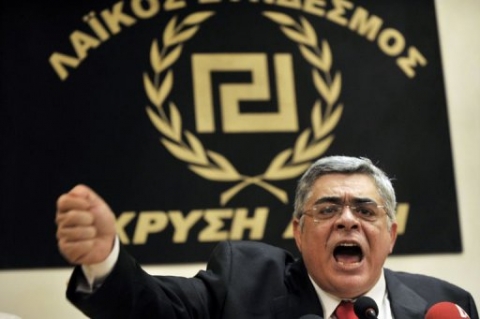
Nikolaos Michaloliakos: 'Those who betray this country - it’s time for them to be afraid. We are coming.'
The Associated Press reports: The leader of an extreme-right, anti-immigrant party on course for shock success in Greece’s general elections Sunday lashed out at those he described as “traitors” responsible for the country’s financial crisis and said his party was ushering in a “revolution.”
The far-right Golden Dawn party is set to win 7 percent of the parliamentary vote, according to early projections, as Greeks punished the traditionally dominant parties who backed harsh austerity measures tied to debt-relief agreements.
Parties must exceed a 3-percent threshold of the vote to be represented in Greece’s parliament. In the last general election in 2009, Golden Dawn received merely 0.29 percent. It has seen its support jump as a wave of anti-immigrant sentiment has spread in financially devastated Greece.
Golden Dawn leader Nikolaos Michaloliakos told The Associated Press in an interview that his party had delivered a blow against the country’s corrupt leadership.
“They slandered us, slung mud at us, and shut us out of all the news media — the TV channels of the corrupt elite — and we beat them,” the 55-year-old leader said as the votes came in. “The day of national revolution by the Greeks has begun against those who are selling us out and looting the sweat of the Greek people.”
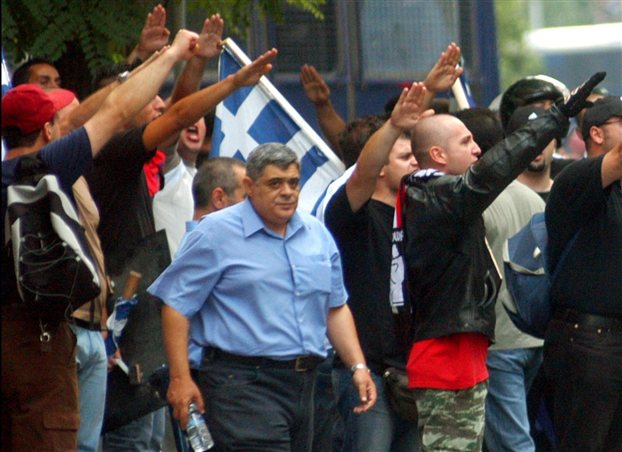
Golden Dawn campaigned hard against illegal immigration, and its supporters have been blamed for a recent spike in inner-city street attacks against mostly Asian immigrants.
The party’s supporters, routinely seen intimidating dark-skinned immigrants in run-down parts of the capital, wear black shirts, and its emblems resemble Nazi insignia. But Michaloliakos has rejected the neo-Nazi label widely used for his party, stressing that it is staunchly nationalist.

Earth Times reports: Species extinction and loss of biodiversity could be as devastating for the earth as climate change and air pollution. That’s the finding of a new study by a group of scientists from nine countries. The research aims for the first time to comprehensively compare the consequences of biodiversity loss with other possible environmental issues caused by humans.
Ecologist and University of Michigan assistant professor, Bradley Cardinale, who helped write the study, says, “Loss of biological diversity due to species extinctions is going to have major impacts on our planet, and we better prepare ourselves to deal with them. These extinctions may well rank as one of the top five drivers of global change.”
The study, which suggests that more moves must be made to strengthen biodiversity at all levels, has just been published online in the Nature journal.
Research conducted over the last 20 years has showed that production increases in ecosystems with the widest biodiversity. This raised worries that today’s high extinction rates from harvesting increases, habitat reduction and other environmental issues, could affect vital issues such as food production, pure water and a stable climate.
But until this study, it had been difficult to separate the effects due to the loss of biodiversity against problems caused by human activity.
Lead author of the research, David Hooper, a Western Washington University biologist, says it had been believed that the effects of biodiversity were minor, but the findings of the new study suggests that future species loss has as big an effect on reducing plant production as global warming and pollution.
Richard Pearson writes: Nearly 20,000 species of animals and plants around the globe are considered high risks for extinction in the wild. That’s according to the most authoritative compilation of living things at risk — the so-called Red List maintained by the International Union for Conservation of Nature.
This should keep us awake at night.
By generalizing from the few groups that we know fairly well — amphibians, birds and mammals — a study in the journal Nature last year concluded that if all species listed as threatened on the Red List were lost over the coming century, and that rate of extinction continued, we would be on track to lose three-quarters or more of all species within a few centuries. We know from the fossil record that such rapid loss of so many species has previously occurred only five times in the past 540 million years. The last mass extinction, around 65 million years ago, wiped out the dinosaurs.
The Red List provides just a tiny insight into the true number of species in trouble. The vast majority of living things that share our planet remain undiscovered or have been so poorly studied that we have no idea whether their populations are healthy, or approaching their demise. Less than 4 percent of the roughly 1.7 million species known to exist have been evaluated. And for every known species, there are most likely at least two others — possibly many more — that have not yet been discovered, classified and given a formal name by scientists. Just recently, for instance, a new species of leopard frog was found in ponds and marshes in New York City. So we have no idea how many undiscovered species are poised on the precipice or were already lost.
It is often forgotten how dependent we are on other species. Ecosystems of multiple species that interact with one another and their physical environments are essential for human societies.
These systems provide food, fresh water and the raw materials for construction and fuel; they regulate climate and air quality; buffer against natural hazards like floods and storms; maintain soil fertility; and pollinate crops. The genetic diversity of the planet’s myriad different life forms provides the raw ingredients for new medicines and new commercial crops and livestock, including those that are better suited to conditions under a changed climate.
This is why a proposed effort by the I.U.C.N. to compile a Red List of endangered ecosystems is so important. The list will comprise communities of species that occur at a particular place — say, Long Island’s Pine Barrens or the Cape Flats Sand Fynbos in South Africa. This new Red List for ecosystems will be crucial not only for protecting particular species but also for safeguarding the enormous benefits we receive from whole ecosystems. [Continue reading…]
The Jerusalem Post reports: A former senior Pentagon official said Saturday that now is not an opportune time for an Israeli strike on Iran, and that any such strike would inevitably draw in the United States.
Colin Kahl, who served as deputy assistant secretary of defense for the Middle East until December, said that any Israeli strike that prompted an Iranian retaliation would affect the United States.
“Even if it’s just retaliation against Israel, the Americans will be in it from the beginning,” he said, since the US would provide assistance to Israeli defense and because Iran would see an Israeli attack as inseparable from an American attack.
Kahl assessed that the Iranian response would be far-reaching and include rocket attacks on American embassies in the region, using area allies and proxies and threatening the functioning of the Strait of Hormuz.
“No one should delude themselves that … the prospect of America getting dragged into this is minor. It’s not,” he warned.
Kahl also laid out conditions that he felt should be in place before any country undertook a strike on Iran: that other options such as diplomacy and sanctions have run their course; that Iran had clearly decided to move toward nuclear weaponization; that the military action could seriously degrade Tehran’s capabilities; that an international coalition could be maintained after a strike.
“One reason I’ve been so critical about the Israelis taking action against Iran’s nuclear program is that at this moment they don’t satisfy any of those four criteria,” he said.
Omar H Rahman writes: As midnight approached on April 17, Khader Adnan, a Palestinian political prisoner who made headlines around the world after going on hunger strike for 66 days, was given a hero’s welcome as he returned to his home. Fireworks coloured the night sky, horns blared and people on foot, in cars, and on tractors rushed off to receive Adnan at the gates of his village.
“I won’t believe he is out of prison until I see him for myself,” said his visibly anxious wife, Randa, who had borne a heavy burden during her husband’s four-month ordeal. Yet, in a gesture indicative of the leader Adnan has recently become, he refused to be taken to his own home before visiting relatives of those other political prisoners from his village who remained in prison and on hunger strike.
Adnan, who had been detained for four months, was never charged with a criminal offence or presented any evidence of wrongdoing. In addition, as part of the agreement that eventually led to his release, Israel had the ability to bring new evidence against him and put him on trial. By failing to do so in the nearly two months between the end of his hunger strike and his release, Israel tacitly admitted that it lacked such evidence to begin with. It has also exposed once more the ease with which a Palestinian can be taken from his or her home without charge and incarcerated for months or, in the worst cases, even years.
His hunger strike set off a wave of similar protests in Israeli prisons and on the day he gained his freedom, approximately 1,500 Palestinian prisoners began a collective, open-ended hunger strike to protest Israel’s continued policy of wide-scale detention and its treatment of prisoners. What has been billed the “War of Empty Stomachs” now has all the makings of a movement. [Continue reading…]
Philip Farah writes: In a recent op-ed in the Wall Street Journal, Israeli Ambassador Michael Oren claimed that Christians in Israel are better off than their brethren anywhere else in the Middle East. Two Sundays ago, “60 Minutes” made clear he attempted to intimidate Bob Simon by going over Simon’s head to speak to Jeff Fager, the head of CBS News and executive producer of “60 Minutes,” to complain that Simon’s story on Christian Palestinians was “a hatchet job” against Israel. In fact, it was a hard-hitting, but honest piece in which Simon helped to expose the terrible harm the Israeli occupation — not Muslim Palestinians as the ambassador claimed — is doing to Christian Palestinians in the Holy Land.
I am a Palestinian Christian, now a U.S. citizen, and my own experience and that of my family attest to the falsity of Ambassador Oren’s assertion. I was born in East Jerusalem, Jordan in 1952, only a few years after my family and the majority of Palestinians fled from their homes when the newly established Jewish state took over three-quarters of historical Palestine. My family, like almost all the other Palestinians who fled — Christians and Muslims alike — became refugees, losing their fields, orchards, homes and practically everything else, to Israel. Israel defied the international consensus and a U.N. resolution calling on it to allow the Palestinian refugees to return.
Had Israel allowed the Palestinians to return, it would not have become a majority Jewish state. Israel’s fear of a Palestinian presence within its borders continues to drive its brutal policies of occupation, which victimize Palestinian Christians as well as Muslims. Israel occupied the rest of historical Palestine in 1967, gaining control over a large Palestinian Arab population which many Israelis view as a threat to the “Jewish character” of their country.
There is a simple test of Ambassador Oren’s claims: I say to him, “Mr. Ambassador: If your country is so good to Christians, why don’t you allow me, my family and thousands of Palestinian Christians to return to our homes in the part of Jerusalem which Israel occupied in 1967 or the western part of the city from which Palestinians were forced out in 1948? Why is it that any Jew from any country in the world can claim full rights of citizenship as soon as he or she sets foot in Jerusalem, while I, whose family roots in Jerusalem go back many centuries, am barred from living with full human rights in my hometown?” [Continue reading…]
Human Rights Watch: In a statement at the Woodrow Wilson Center on April 30, 2012, chief US counterterrorism advisor John Brennan sought to clarify and justify the US use of aerial drones in targeted killings in Pakistan, Yemen, and elsewhere.
He acknowledged that all targeted killings are governed by the requirements of international and domestic US law. At the same time, he asserted, consistent with previous statements of administration officials, that targeted killings are justified under the laws of war against anyone who is “part of” al Qaeda, the Taliban, or associated forces, even in situations far from a recognizable battlefield. However, including anyone ambiguously considered “part of” an armed group as a valid military target exceeds what is permissible under the laws of war. During an armed conflict between a state and a non-state armed group, it is lawful to target only persons taking a direct part in hostilities. This would include individuals planning and directing operations, but not those linked to the armed group in a non-operational way.
Moreover, “part of” is an elastic standard, and given the unilateral way in which it is being applied, it is dangerous to suggest that only the laws of war are relevant. Rather, in situations away from a recognized battlefield, the more appropriate standard is found in international human rights law. It permits the use of force only as a last resort to stop an imminent threat to life, not simply because someone is “part of” a violent organization or may have committed acts of violence in the past. Brennan mentioned these standards – pledging that the US will use lethal force not to punish individuals for past acts, but against those it believes are planning or carrying out future attacks, and only in parts of the world where arresting a suspect is not feasible. But he treats these as discretionary, not as legal requirements. In the case of the “imminence” requirement, he incorrectly suggests it is legally binding only when US citizens are targeted, though in fact it applies to all people, irrespective of citizenship.
Addressing these concerns is all the more important because, as Brennan acknowledged, many nations are seeking and will obtain drone technology. He said the administration was “very mindful that as our nation uses this technology, we are establishing precedents that other nations may follow, and not all of them will be nations that share our interests or the premium we put on protecting human life, including innocent civilians.” Because the US treats many of the most important constraints on the use of force as matters of discretionary prudence rather than legal requirements, the US approach would not forbid the Russians to target an alleged Chechen militant in New York, or the Chinese a Uighur separatist in Washington, DC, if they said they were at war with these groups and the US didn’t apprehend them. That is a deeply troublesome precedent to set. If the US is in fact willing to live within these constraints as a matter of policy, it should be willing to promote wider observance of them as a matter of law.
Brennan says the administration is committed to “greater transparency,” but then suggests that this commitment is satisfied – if not exceeded – by his speech. Despite administration assertions that “innocent civilians” have not been injured or killed, except in the “rarest of circumstances,” there has been no clear accounting of civilian loss or opportunity to meaningfully examine the administration’s assertions. Moreover, given that the CIA is one of the least transparent agencies, with no tradition of public accountability, Human Rights Watch repeats its call to transfer command of drone operations to the US armed forces.
Brian Whitaker writes: The Assad regime issued an emphatic denial this morning that it is planning to invite the Dalai Lama for an official visit to Syria.
On the face of it, the idea of Assad hobnobbing with the Tibetan Buddhist leader is preposterous – not least because it would infuriate the Chinese government which up to now has been one of the Syrian regime’s key supporters in the diplomatic arena. For that reason, the story sounds like disinformation cooked up by Assad’s opponents – which is certainly how the official news agency is presenting it. It quotes a foreign ministry spokesman as saying:
“These reports are baseless. The timing and content indicate that the purpose of these reports is damaging the Syrian-Chinese relations … Syria highly appreciates the Chinese stance and undoubtedly supports the One-China policy.”
It will be interesting, though, to see what steps the authorities take to track down and punish the source of this baseless story – since the source appears to be none other than President Assad himself. [Continue reading…]
The Wall Street Journal reports: As Libya’s Moammar Gadhafi fell last year with the help of the West and an interim regime took the reins, the hope among some oil companies was that they would receive new tax breaks and a better share of fields’ output in current and future deals.
But the interim government in Libya, as well as administrations elsewhere, largely plan to keep the same tough terms in place for most conventional fields, as governments are mindful not to appear to be selling out their countries’ crown jewels.
New opportunities lie mostly in so-called unconventional projects, which are especially expensive or require advanced technology to develop. Higher oil prices are needed for such projects to pay off, making them riskier and less profitable than those available to national oil companies.
For such projects in Libya, investment conditions “can be improved,” Libyan Oil Minister Abdulrahman Benyezza said in a recent interview.
For decades, many European companies had enjoyed deals that granted them half of the high-quality oil produced in Libyan fields. Some major oil companies hoped the country would open further to investment after sanctions from Washington were lifted in 2004 and U.S. giants re-entered the North African nation.
But in the years that followed, the Gadhafi regime renegotiated the companies’ share of oil from each field to as low as 12%, from about 50%. Libya’s state-owned National Oil Co. continues to get the bulk of the barrels produced in joint ventures with oil majors.
Just after the fall of the regime, several foreign oil companies expressed hopes of better terms on existing deals or attractive ones for future contracts. Among the incumbents that expressed hopes in Libyan expansion were France’s Total SA and Royal Dutch Shell PLC.
Peter Beaumont reports: There is a narrow footbridge overlooking the entrance to the ministry of defence in the Abbasiya district of Cairo. On Friday afternoon, this crowded bridge provided the best view of the frontline in the latest round of violent clashes between the army and demonstrators who suspect the country’s ruling generals of wanting to hold on to power.
On one side of a ring of barbed wire, soldiers hurled bricks and fired tear gas. Below the bridge, the protesters facing the soldiers threw their own missiles, while others removed the injured on motorbikes or carried them limp on their shoulders, some insensible, others spattered in blood.
I bumped into Hazem Abdel Rahman, a young protester, drenched in sweat, holding his injured arm. “I came here this morning and everything was peaceful. People linked arms to keep the crowd back from the ministry of defence. But then after Friday prayers people came who we did not know and infiltrated our demonstration and started throwing stones,” he said.
Others say the trouble started after some protesters were grabbed by the soldiers trying to cross the wire. A few minutes after I spoke to Hazem, the first sound of live gunfire rang out, driving the protesters back in panic. I ran, but found myself trapped between two groups of soldiers, forced to climb several walls and cross a railway line to escape, only to be confronted by an angry group of supporters of the military.
“You are a spy,” one shouted, attempting to drag me away for questioning, prevented in his efforts by the intervention of other residents. Other journalists covering events in Abbasiya in the last few days have not been so fortunate. Eighteen have been arrested or injured, including one who reportedly had an ear cut off during an attack.
Egypt’s long-awaited presidential elections – the first round of which begins on 23 May – appear to be unravelling amid rising violence and protest. By the end of Friday, two people were dead, including a soldier; hundreds had been injured or arrested; and a curfew had been imposed by the army in the area where the violence was worst.
Once again, the most significant faultline of the protests – one that threatens to overshadow the election campaign – has been the growing rift between the generals and the political parties who would replace them when – or rather if – the army relinquishes power, as it has promised to do, on 30 June.
Some of those out protesting on Friday have special reason to despise them. In Tahrir Square a few hours before the violent dispersal of the protest in Abbasiya, I had met Mohammed Atta, a 45-year-old tour guide. He had been in Abbasiya on Wednesday and witnessed the baltagiya – well-organised gangs of armed thugs – attack a sit-in dominated by ultra-conservative Salafi Muslims and supported by revolutionaries, outside the defence ministry. That day at least 11 people died, many shot in the head at close quarters.
I encountered Atta attending a protest in the square called by the Muslim Brotherhood to protest at those killings. “I was in the middle of the street [in Abbasiya] when they came in from one end,” Atta recalled. “I saw them come out from where the police were.”
Atta fled, chased by 12 men. He left behind him the body of his murdered friend, Atif al-Gohary, a 41-year-old chef. “He went over to talk to them, to ask them to be peaceful,” he recalled. Instead, al-Gohary was shot in the chest and his face was stamped in.
“He was like a brother to me. He taught me about revolution. On 25 January last year when I came here to Tahrir Square at the beginning of the revolution, I was afraid to go beyond the police lines. But he called me down to join him and told me not to be afraid.”
Atta had come to Tahrir Square on Friday to participate in the millioneya – the million-man protest organised by the Muslim Brotherhood and other parties to call on Egypt’s military council, which has ruled since the fall of dictator Hosni Mubarak more than a year ago, to keep its promise and stand down.
But if the Brotherhood had hoped to pack the square that became the symbol of the resistance to both the Mubarak regime and military rule, they were to be disappointed, despite bussing in supporters from hundreds of miles away. The Brotherhood, once regarded as Egypt’s most organised and potent political force, has begun to wane. [Continue reading…]
Egypt Independent reports: As the race heats up between the nation’s two leading Islamist presidential candidates, the Muslim Brotherhood is mixing its new-found political rhetoric with the more comfortable — and potentially popular — religious discourse that dominated the group for generations.
Observers believe that the revival of the Brotherhood’s religious discourse reflects the group’s confusion and threatens the tenuous trust it is building with secular Egyptians and the West.
Since he launched his campaign, the Muslim Brotherhood’s candidate, Mohamed Morsy, affirmed his commitment to the group’s “Nahda” (renaissance) political platform, which seeks to establish democracy, ensure equality and justice and improve the general welfare. But at campaign rallies, Morsy’s campaign often strays from these terrestrial aims.
Besides his constant pledge to implement God’s Sharia, Morsy has been touring the country with backers who portray him as the sole Islamist candidate invoking an overtly religious language. His cheerleaders have tweaked the revolution’s famous slogan, “The people want to bring down the regime” into “The people want God’s Sharia to be implemented.”