Haaretz reports: On March 23, in the middle of the night, an undercover force of the Duvdevan special-ops unit entered the prosperous and serene Palestinian village of Kafr Ramun, reportedly as part of a training exercise. Three brothers woke up, alarmed, thinking the men outside were thieves, and tried to chase them away with sticks and kitchen knives on the street. Without identifying themselves – the members of this unit operate in the guise of Arabs – the special-ops force fired 11 bullets at the brothers, continuing to shoot even after they were injured. One of the brothers was killed and the other two were severely wounded. The soldiers also kicked one of the brothers, and for a long time prevented all of them from receiving medical attention.
Army Radio initially reported that “terrorists” had tried to stab an Israel Defense Forces soldier; subsequently the IDF announced that the military Criminal Investigation Division would not be looking into the incident.
A few days ago the two surviving brothers were released from a hospital in Israel. They say they are planning to sue the IDF.
The incident would not have occurred if the undercover soldiers had identified themselves to the three men. It also would not have occurred had the IDF refrained from entering a quiet village like Ramun in the middle of the night, ostensibly in order to train among its houses. [Continue reading…]
Reuters reports: Rebel fighter Mustafa and his trio of burly men look out of place at a trendy Turkish cafe near the Syrian border, dressed in tattered jeans and silently puffing on cigarettes as they scoop into tall ice-cream sundaes.
Their battleground is across the frontier in Syria, where they are fighting to topple President Bashar al-Assad. But like many rebels in northern Syria, they are so desperate for weapons and money, they are searching for new donors in Turkey.
“When it comes to getting weapons, every group knows they are on their own,” says the 25-year-old with a patchy beard. “It’s a fight for resources.”
Nominally Mustafa’s rebels fight for the Free Syrian Army (FSA), but the FSA, lacking international recognition or direct state funding, is a often just a convenient label for a host of local armed groups competing fiercely for scarce financing.
So fiercely, they sometimes turn their guns on each other.
“Everyone needs weapons. There is tension. There is anger and yes, sometimes there is fighting if rebels in one town seem to have an unfair share of weapons,” said Mustafa, who comes from Syria’s northwestern province of Idlib, which borders Turkey and has been a hotbed of resistance to Assad.
Such mistrust is compounded by the competing agendas of outside parties who are further fragmenting the rebel movement.
Finding a donor usually means using personal connections, rebels say. They get relatives or expatriate friends to put them in touch with businessmen or Syrian groups abroad.
But once fighters go to private donors for weapons, they have to negotiate, and the price may be ideological.
Many say Islamist groups, from hard-line Salafists to the exiled Muslim Brotherhood, bankroll many battalions that share their religious outlook. The Brotherhood has representatives in Antakya ready to meet interested rebels, fighters say.
Leftist politicians and other opponents of Islamists are trying to counter that influence by funding rival armed bands.
“These groups are all making their own militias, like they are some kind of warlords. This is dividing people,” said one activist who asked not to be named. “They aren’t thinking about military strategies, they are thinking about politics.”
The Guardian reports: A United Nations investigator probing discrimination against Native Americans has called on the US government to return some of the land stolen from Indian tribes as a step toward combatting continuing and systemic racial discrimination.
James Anaya, the UN special rapporteur on the rights of indigenous peoples, said no member of the US Congress would meet him as he investigated the part played by the government in the considerable difficulties faced by Indian tribes.
Anaya said that in nearly two weeks of visiting Indian reservations, indigenous communities in Alaska and Hawaii, and Native Americans now living in cities, he encountered people who suffered a history of dispossession of their lands and resources, the breakdown of their societies and “numerous instances of outright brutality, all grounded on racial discrimination”.
“It’s a racial discrimination that they feel is both systemic and also specific instances of ongoing discrimination that is felt at the individual level,” he said.
Anaya said racism extended from the broad relationship between federal or state governments and tribes down to local issues such as education.
“For example, with the treatment of children in schools both by their peers and by teachers as well as the educational system itself; the way native Americans and indigenous peoples are reflected in the school curriculum and teaching,” he said.
“And discrimination in the sense of the invisibility of Native Americans in the country overall that often is reflected in the popular media. The idea that is often projected through the mainstream media and among public figures that indigenous peoples are either gone or as a group are insignificant or that they’re out to get benefits in terms of handouts, or their communities and cultures are reduced to casinos, which are just flatly wrong.”
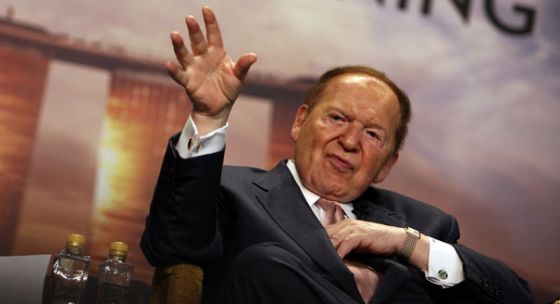
Sheldon Adelson on the Olmert government: 'This is an illegitimate government. It must be thrown out.'
CNN reports: In the explosive second part of his exclusive interview on Friday’s Amanpour, Ehud Olmert, former Israeli Prime Minister, said certain elements in the Jewish community in the United States had deliberately derailed the peace process.
Olmert was speaking of the peace plan he proposed in 2008, when he was Prime Minister. Knowing the political risks, Olmert sought a “full comprehensive peace between us and the Palestinians” – a two-state solution based on the 1967 borders.
“It broke my heart, the most difficult decision of my life,” said Olmert, once the Mayor of Jerusalem. “Because for me to propose a division of Jerusalem was really terrible. I did it because I reached a conclusion that without which, there will not be peace.”
“It was a killer for me,” he said. “It was a killer for me not only because of the opposition in Israel. I think that, by the way, in Israel the majority of the Israelis would have supported my plan, had it come for elections.”
Then, he leveled his astonishing charge: “But I had to fight against superior powers, including millions and millions of dollars that were transferred from this country (the U.S.) by figures which were from the extreme right wing, that were aimed to topple me as Prime Minister of Israel. There is no question about it.”
When asked to name names, Olmert answered: “Next time.”
If and when Olmert names names, there’s little doubt who will be at the top of his list: the American casino boss and billionaire, Sheldon Adelson.
In May 2008, this is how Nahum Barnea, a columnist for Israel’s Hebrew daily Yediot Ahronot, described Adelson’s plans to topple Olmert. “This is an illegitimate government. It must be thrown out,” Barnea quotes Adelson as saying.
Adelson is convinced that Netanyahu, not Olmert, must be prime minister of Israel. In order to advance this idea, Adelson established an anti-Olmert newspaper devoted to praising Netanyahu. Allegedly, this investment is the largest election gift ever given to Israel.
Daniel Levy translated the bulk of Barnea’s column which appeared just after Adelson appeared as the keynote speaker at a presidential conference celebrating Israel’s 60th anniversary.
When Sheldon Adelson gave his speech on the podium of the International Convention Center two days ago, I looked at Shimon Peres. I was happy for him. The impressive, sparkling conference that he convened will warm his heart…Many important, highly-respected people. An excellent organization. Well done.
As a citizen of the country, I was less happy. I saw a gambling tycoon from Las Vegas who bought my country’s birthday with three million dollars. I thought with sorrow: Is the country worth so very little? Were the champagne, wine and sushi that were given out for free in the lobby—breaking convention for such events—worth the humiliation?
Adelson is a Jew who loves Israel. Like some other Jews who live at a safe distance from here, his love is great, passionate, smothering. It is important to him that he influences the policies, decisions and compositions of Israeli governments. He is not alone in this, either: even back in the days of Baron Rothschild, wealthy Jews from the Diaspora felt that this country lay in their pocket, alongside their wallet. Regrettably, in the latest generation, we are being led by politicians who look at these millionaires with calf’s eyes.
Such deference to the wallets of other people—that is the common denominator of Rabin and Peres, Netanyahu, Barak and Olmert…
Adelson is like the others, and yet different. He has the gift of authority and the bluntness of someone who made a lot of money quickly. He does not ask; he commands.
“He talks to me as though I were his property,” the director of an important Jewish-American organization, one of the guests at the conference, told me. I heard similar complaints from others—both Israelis and Americans— about Adelson. Not long ago, the mayor of a large city received word that he had to meet Adelson immediately. He acceded, of course—the man is a big donor. When they met, Adelson ordered him to tell the municipal inspectors to leave the employees of his business (who were violating municipal law) alone.
There is a story about an anti-Arab propaganda film that Adelson had heard of. When he telephoned the director-general of a Jewish organization, asking him to buy and distribute the film, the man told him that the film was distorted, and that no one would believe it. Adelson responded—“so edit it”. When the man countered that film could not be edited, Adelson replied that he would buy the film at his expense, but that the other man would then distribute it. “He would like all the Arabs to disappear,” another activist for a Jewish organization told me. “It seems that he thinks that the Arabs are chips to be gambled with.”
Several months ago, Adelson contacted another Jewish-American millionaire and asked him to donate a large sum of money for a campaign that he was organizing against the current Israeli government. The man politely refused. “You know what”, Adelson told him, “do not donate, just sign”. When the man refused again, Adelson accused him of funding anti-Israel research. “I do not know what you mean”, the man answered. “When my man in charge of these things is in Las Vegas, he will come to you and he’ll look into the matter.”
The ensuing meeting at Adelson’s office, in the Venetian hotel-casino, was a stormy one. Adelson took out a written list of accusations, many of them childish. “You hosted (PA prime minister) Salam Fayyad,” he said. “He is a terrorist with blood on his hands. He is one of the founders of Fatah.” “Salam Fayyad was never involved in terrorism,” said the interlocutor. “He is not a member of Fatah. Where did you get these accusations from?”
Adelson responded that he had gotten them from Steve Emerson (an American Jew who often analyzes terrorism). “You work with Olmert’s government,” he added. “This is an illegitimate government. It must be thrown out.” “I thought”, said the man, “that Olmert is your friend.”
And, indeed, they were friends. Such good friends that Olmert wrote him [Adelson] a letter, asking him to buy mini-bars for his hotels from a company that Talansky represented.
Adelson is convinced that Netanyahu, not Olmert, must be prime minister of Israel. In order to advance this idea, Adelson established an anti-Olmert newspaper devoted to praising Netanyahu. Allegedly, this investment is the largest election gift ever given to Israel. I do not claim this. Firstly, it is a legitimate legal gift. Secondly, when Netanyahu is elected prime minister, he will have to act within the constraints of the State of Israel, not take dictates of a patron from Las Vegas.
Adelson, surrounded by guards, was king of the conference. He sat in the first row, with Shimon Peres between him and Olmert. He put his hand out to Olmert. Olmert shook it with a sour face. They did not exchange a single word.
Reuters reports: Hagai Amir, the brother of the man who assassinated late Israeli Prime Minister Yitzhak Rabin in 1995, said he was proud of his own role in the murder plot after he was freed from prison on Friday.
Amir was released after serving 16 years for helping his brother murder Rabin, considering such plans as rigging his car with explosives and poisoning him before deciding to shoot him in a crime that shook the Jewish state.
Yigal Amir, his brother, killed Rabin at a peace rally in Tel Aviv in 1995 and is serving a life sentence. He said he shot the politician to stop him from handing parts of what he believed were the biblical land of Israel to the Palestinians in peace negotiations.
On his release, Hagai Amir, who was also found guilty of planning attacks against Palestinians in the West Bank and later handed an additional one year term in prison for threatening to kill the then Prime Minister Ariel Sharon, was defiant.
“I am not regretful. I am proud of what I did,” Amir, an Israeli Jew, told reporters as family members whisked him into a car and drove away.
Mairead Maguire writes: In 2009 Israel’s foreign minister Avigdor Liebermann ordered all foreign missions to distribute a 1941 photograph of the then Palestinian leader in exile, Haj Amin Al Husseini meeting Hitler. The motivation behind Liebermann’s order lay in international criticism of Israel’s decision to further expand its illegal settlements in occupied East Jerusalem; the not too subtle subtext being that as Palestinians are Nazis any policy implemented against them is justified.
This week the David Horowitz’s Freedom Center perpetrated the same historical distortion in its advertisement comparing college professors who advocate Boycott, Divestment and Sanctions (BDS) against the state of Israel to the Nazi government’s persecution of Jews. Ignoring the political and human rights context in which the call for BDS has been made, and its ultimate aim of securing compliance with international human rights standards, its proponents are instead vilified as Jew haters and their opposition to illegal Israeli policies presented as hatred of ‘the Jewish state.’ Through a series of outrageous assertions their support for Palestinian human rights is linked to the Nazis, calls for genocide and the Toulouse murders.
The truth however is that the call for BDS lies neither anti-Semitic in intent or effect, but reflects the recognition that after 20 years of failed negotiations and almost 44 years of military occupation and illegal colonization, there is no means by which Palestinians can achieve their basic human rights and freedoms except through the activism of international civil society. [Continue reading…]
Paul Krugman writes: The depression we’re in is essentially gratuitous: we don’t need to be suffering so much pain and destroying so many lives. We could end it both more easily and more quickly than anyone imagines—anyone, that is, except those who have actually studied the economics of depressed economies and the historical evidence on how policies work in such economies.
The truth is that recovery would be almost ridiculously easy to achieve: all we need is to reverse the austerity policies of the past couple of years and temporarily boost spending. Never mind all the talk of how we have a long-run problem that can’t have a short-run solution — this may sound sophisticated, but it isn’t. With a boost in spending, we could be back to more or less full employment faster than anyone imagines.
But don’t we have to worry about long-run budget deficits? Keynes wrote that “the boom, not the slump, is the time for austerity.” Now, as I argue in my forthcoming book — and show later in the data discussed in this article — is the time for the government to spend more until the private sector is ready to carry the economy forward again. At that point, the US would be in a far better position to deal with deficits, entitlements, and the costs of financing them.
Meanwhile, the strong measures that would all go a long way toward lifting us out of this depression should include, among other policies, increased federal aid to state and local governments, which would restore the jobs of many public employees; a more aggressive approach by the Federal Reserve to quantitative easing (that is, purchasing bonds in an attempt to reduce long-term interest rates); and less timid efforts by the Obama administration to reduce homeowner debt.
But some readers will wonder, isn’t a recovery program along the lines I’ve described just out of the question as a political matter? And isn’t advocating such a program a waste of time? My answers to these two questions are: not necessarily, and definitely not. The chances of a real turn in policy, away from the austerity mania of the last few years and toward a renewed focus on job creation, are much better than conventional wisdom would have you believe. And recent experience also teaches us a crucial political lesson: it’s much better to stand up for what you believe, to make the case for what really should be done, than to try to seem moderate and reasonable by essentially accepting your opponents’ arguments. Compromise, if you must, on the policy—but never on the truth. [Continue reading…]
Matthieu Aikins writes: Last fall, “Kardokh,” a 25-year-old dissident and computer expert in the Syrian capital of Damascus, met with British journalist and filmmaker Sean McAllister. (Kardokh is his online pseudonym, used at his request.) McAllister, who’s made award-winning films in conflict zones like Yemen and Iraq, explained that he was shooting a documentary for Britain’s Channel 4 about underground activists in Syria, and asked if Kardokh would help him.
At the time, the situation in Syria was deteriorating rapidly, as protests against President Bashar al-Assad’s repressive regime turned violent following a vicious crackdown by security forces. The Syrian government had drastically curtailed visits by foreign journalists, but McAllister had managed to get in undercover. Kardokh was grateful for a chance to tell his story. “Any journalist who was making the effort to show the world what was happening, that was a very important thing for us,” he told me in February.
At the time, Kardokh was providing computer expertise and secure communications to the resistance. He agreed to be interviewed about his work on camera by McAllister, who filmed his face, telling Kardokh that he would blur it out before publishing the footage. McAllister also asked Kardokh to put him in touch with other activists.
But some of McAllister’s practices made him uneasy, Kardokh said. He worried that the filmmaker didn’t realize how aggressive and pervasive the regime’s surveillance was. Kardokh and his fellow activists took elaborate measures with their digital security, encrypting their communications and using special software to hide their identities online. “I started to feel that Sean was careless,” Kardokh told me. He said he had urged McAllister to take more precautions in his communications and to encrypt his footage. “He was using his mobile and SMS, without any protections.”
Then, in October, McAllister was arrested by Syrian security agents. He wasn’t harmed, but was held for five days and said that he could hear the cries of prisoners being tortured in nearby rooms. Eventually, he was released and returned to the UK. “I didn’t realize exactly what they were risking until I went into that experience,” McAllister said in an interview on Channel 4 after his release.
The Syrians had interrogated McAllister about his activities, and seized his laptop, mobile phone, camera, and footage. All of McAllister’s research was now at the disposal of Syrian intelligence. When Kardokh heard that McAllister had been arrested, he didn’t hesitate—he turned off his mobile phone, packed his bag, and fled Damascus, staying with relatives in a nearby town before escaping to Lebanon. He said that other activists who had been in touch with McAllister fled the country as well, and several of those who didn’t were arrested. “I was happy that I hadn’t put him in contact with more people,” Kardokh said.
Rami Jarah, a Syrian activist based in Cairo, said that he tried to help another activist, known as Omar al-Baroudi, get out of the country after McAllister’s arrest. “He was terrified,” Jarrah said. “His face was in those videos. He said that his number was on Sean’s phone.” The next day, Baroudi disappeared, and Jarah said that he has not been heard from since.
Officials at Channel 4 say they took action to help McAllister’s sources after his arrest. “We have been in contact with everyone who felt at risk because they spoke to Sean,” said Amy Lawson, the channel’s head of communications. “He is an experienced filmmaker and took steps to protect his material. Syria is an extremely difficult environment to work in, so we continue to look for ways to minimize that risk whilst ensuring we tell this important story.”
It’s easy to argue that McAllister should have taken stronger precautions, but what, exactly? How many reporters are familiar enough with the technical aspects of digital security that they could protect their computers and phones from the Syrian intelligence service? The fact that McAllister, an experienced and committed journalist, jeopardized his sources with inadequate digital precautions is indicative of a broader problem in journalism today: We haven’t kept pace with technological advancements that have revolutionized both information-gathering and surveillance. [Continue reading…]
Barbara Slavin writes: Newly released correspondence from Osama bin Laden’s hideout in Pakistan contradicts U.S. assertions that al-Qaeda has a close relationship with Iran.
According to a U.S. analysis of letters found in the Abbottabad compound when U.S. Special Forces killed bin Laden a year ago, “the relationship is not one of alliance, but of indirect and unpleasant negotiations over the release of detained jihadis and their families, including members of bin Laden’s family.”
The report by the Combating Terrorism Center (CTC) at West Point, released Thursday, goes on to say that Iran’s detention of some prominent al-Qaeda members who fled Afghanistan after 9-11 “seems to have sparked a campaign of threats, taking hostages and indirect negotiations …that have been drawn out for years and may still be ongoing.”
Iran and the group that became al-Qaeda have had some sort of ties for more than two decades, but the nature of the relationship has been subject to considerable speculation and hype. The newly released documents suggest that the two are largely antagonistic and underline the view that the George W. Bush administration missed what could have been a major opportunity to work with Iran against the Sunni militant group responsible for the 9-11 attacks.
Iran and al-Qaeda did establish a relationship in the 1990s in Sudan when Khartoum was a terrorist haven. According to the 9/11 Commission, the two reached an “informal agreement to cooperate in providing support — even if only training — for actions carried out primarily against Israel and the United States.”
Eight of the 10 Arab “muscle hijackers” who took part in the 9-11 attacks entered Afghanistan via Iran between October 2000 and February 2001 but the commission “found no evidence that Iran or Hezbollah was aware of the planning for what later became the 9/11 attack.”
However, after the attacks, Iran turned against al-Qaeda and detained hundreds of Arab fighters fleeing the U.S. war in Afghanistan. According to research I did for my book, Bitter Friends, Bosom Enemies, Iran extradited a number of these detainees to their home countries.
But Iran held on to high-profile detainees including several children of bin Laden and Saif al-Adel, then al-Qaeda’s number three, for insurance against al-Qaeda and as potential bargaining chips. [Continue reading…]
Nicholas Carr writes: With a reported 900 million active members, Facebook is, by far, the largest digital-sharecropping operation that the internet has yet produced. About one out of every eight people on the planet sharecrops for Facebook today – and their collective labor is expected to put about a billion dollars of cash into CEO Mark Zuckerberg’s pocket when the company goes public in a few weeks. In a 2006 post, I explained why sharecropping is such a powerful business model for social networks and other online businesses:
One of the fundamental economic characteristics of Web 2.0 is the distribution of production into the hands of the many and the concentration of the economic rewards into the hands of the few. It’s a sharecropping system, but the sharecroppers are generally happy because their interest lies in self-expression or socializing, not in making money, and, besides, the economic value of each of their individual contributions is trivial. It’s only by aggregating those contributions on a massive scale – on a web scale – that the business becomes lucrative. To put it a different way, the sharecroppers operate happily in an attention economy while their overseers operate happily in a cash economy. In this view, the attention economy does not operate separately from the cash economy; it’s simply a means of creating cheap inputs for the cash economy.
Facebook’s most recent financial filing provides a great illustration of the “two economies” that underpin digital sharecropping. As Techcrunch noted, Facebook reported that it earned an average of $1.21 in revenue from each of its members during the first quarter of this year. [Continue reading…]
Donatella Rovera, Amnesty International’s senior crisis adviser, was in Syria for 10 days during the second half of April. Rovera has worked at Amnesty International for 20 years and has extensive experience of working in conflict zones, including Libya, South Sudan, Ivory Coast and Gaza. Here she reports some of the first-hand accounts of the brutal crackdown by the Syrian regime against its people.
“Soldiers came to our home and took my son. Later, as I was peering out of the window I saw soldiers line up eight young men standing facing the wall with their hands tied at the back and shoot them. Then they put the bodies in the back of a pick-up truck and left. I don’t know if the men were all dead or injured. At that point I did not know that one of the men was my son. His body was found with other bodies at a school not too far from our home.”
A relative of another man, who was also killed that day told me: “Members of the military security came to the house of our relatives, where we were staying and asked for our ID and did not find any problem; we were not wanted. Then one of the soldiers looked at my relative’s cell phone and found a pro-revolution song. They took him outside … A neighbour told me the soldiers had shot him and then taken him to a nearby house; I went there and found him injured. He had been shot in the ear and neck but was still breathing. Some neighbours helped to carry him to the car and three of them took him to a field hospital (normal hospitals have long been out of bounds to people injured by the army/security forces) but on the way there they were stopped by soldiers and were killed. Their bodies were later found at a school, except the body of my relative who had been taken back to the house where he had previously been left for dead. They had finished him off with an additional shot to the head.”
These are the accounts of relatives of victims and witnesses of extrajudicial executions carried out by the Syrian government’s security forces in the city of Idlib on 16 April. They only agreed to meet me and speak on condition that their names and any details that could identify them would not be published. Others, whom I was able to reach after much chasing, said they could not speak as the danger of retaliation against them and their families is too great.
To say that families of victims and eyewitnesses are scared is an understatement. Those I met were literally terrified.
CNET reports: The FBI is asking Internet companies not to oppose a controversial proposal that would require the firms, including Microsoft, Facebook, Yahoo, and Google, to build in backdoors for government surveillance.
In meetings with industry representatives, the White House, and U.S. senators, senior FBI officials argue the dramatic shift in communication from the telephone system to the Internet has made it far more difficult for agents to wiretap Americans suspected of illegal activities, CNET has learned.
The FBI general counsel’s office has drafted a proposed law that the bureau claims is the best solution: requiring that social-networking Web sites and providers of VoIP, instant messaging, and Web e-mail alter their code to ensure their products are wiretap-friendly.
“If you create a service, product, or app that allows a user to communicate, you get the privilege of adding that extra coding,” a person who has reviewed the FBI’s draft legislation told CNET. The requirements apply only if a threshold of a certain number of users is exceeded, according to a second person briefed on it.
The FBI’s proposal would amend a 1994 law, called the Communications Assistance for Law Enforcement Act, or CALEA, that currently applies only to telecommunications providers, not Web companies. The Federal Communications Commission extended CALEA in 2004 to apply to broadband networks.
Declan Walsh reports: In the shadows of the American operation that killed Osama bin Laden, the fate of a small-town Pakistani doctor recruited by the C.I.A. to help track the Qaeda leader still looms between the two countries, a sore spot neither can leave untouched.
Picked up by Pakistani intelligence agents days after the Bin Laden raid a year ago and now in secret detention, the doctor, Shakil Afridi, has embodied the tensions between Washington and Islamabad. To some American officials he is a hero, worthy of praise and protection; Defense Secretary Leon E. Panetta has personally appealed for his release. But inside Pakistan’s powerful military, still smarting from the raid on its soil, he is seen as a traitor who should face treason charges that could bring his execution. “We need to make an example of him,” one senior intelligence official said.
Beyond hard feelings and talk, however, his case has had a much wider effect: It has also roiled the humanitarian community in Pakistan, giving rise to a wave of restrictions that have compromised multimillion dollar aid operations serving millions of vulnerable Pakistanis.
Hardest hit is Save the Children, the largest international aid agency in Pakistan.
Dr. Afridi has told interrogators for the top Pakistani military intelligence agency, the ISI, that he was introduced to the C.I.A. through Save the Children, according to Pakistani officials and Western aid workers. Save the Children vigorously denies the claim, saying it has been made a scapegoat by a desperate man who, according to senior American officials, has been tortured in Pakistani custody. Nevertheless his claims have had a stark impact on an organization that says it spent $105 million last year helping seven million Pakistanis, most of them women and children.
Senior managers have been forbidden from leaving the country, other staff members have been refused visas, and aid supplies have been blocked by customs officials, depriving an estimated 35,000 infants of medical care over a three-month period. Pakistani intelligence has monitored the phone calls and residences of Save the Children staff.
Other aid groups complain of problems, too, largely at the hands of Pakistani officials convinced that their employees could be spies. To them, the affair sheds new light on a murky practice that they say should never take place: the recruitment of aid workers as intelligence operatives in a sensitive country like Pakistan, already awash in conspiracy theories about Western meddling. [Continue reading…]
Henry A Giroux writes: Since 9/11, the war on terror and the campaign for homeland security have increasingly mimicked the tactics of the enemies they sought to crush. Violence and punishment as both a media spectacle and a bone-crushing reality have become prominent and influential forces shaping American society. As the boundaries between “the realms of war and civil life have collapsed,” social relations and the public services needed to make them viable have been increasingly privatized and militarized. The logic of profitability works its magic in channeling the public funding of warfare and organized violence into universities, market-based service providers and deregulated contractors. The metaphysics of war and associated forms of violence now creep into every aspect of American society.
As the preferred “instrument of statecraft,” war and its intensifying production of violence cross borders, time, space and places. Seemingly without any measure of self-restraint, state-sponsored violence flows and regroups, contaminating both foreign and domestic policies. One consequence of the permanent warfare state is evident in the public revelations concerning a number of war crimes committed recently by US government forces. These include the indiscriminate killings of Afghan civilians by US drone aircraft; the barbaric murder of Afghan children and peasant farmers by American infantrymen infamously labeled as “the kill team”; disclosures concerning four American Marines urinating on dead Taliban fighters; and the recent uncovering of photographs showing “more than a dozen soldiers of the 82nd Airborne Division’s Fourth Brigade Combat Team, along with some Afghan security forces, posing with the severed hands and legs of Taliban attackers in Zabul Province in 2010.” And, shocking even for those acquainted with standard military combat, there is the case of Army Staff Sgt. Robert Bales, who “walked off a small combat outpost in Kandahar province and slaughtered 17 villagers, most of them women and children and later walked back to his base and turned himself in.” Mind-numbing violence, war crimes and indiscriminate military attacks on civilians on the part of the US government are far from new, of course, and date back to infamous acts such as the air attacks on civilians in Dresden along with the atomic bombings of Hiroshima and Nagasaki during World War II. Military spokespersons are typically quick to remind the American public that such practices are part of the price one pays for combat and are endemic to war itself.
The history of atrocities committed by the United States in the name of war need not be repeated here, but some of these incidents have doubled in on themselves and fueled public outrage against the violence of war. One of the most famous was the My Lai massacre, which played a crucial role in mobilizing anti-war protests against the Vietnam War. Even dubious appeals to national defense and honor can provide no excuse for mass killings of civilians, rapes and other acts of destruction that completely lack any justifiable military objective. Not only does the alleged normative violence of war disguise the moral cowardice of the warmongers, it also demonizes the enemy and dehumanizes soldiers. It is this brutalizing psychology of desensitization, emotional hardness and the freezing of moral responsibility that is particularly crucial to understand, because it grows out of a formative culture in which war, violence and the dehumanization of others becomes routine, commonplace and removed from any sense of ethical accountability. [Continue reading…]
This website or its third-party tools use cookies, which are necessary to its functioning. By closing this banner, you agree to the use of cookies.