MoveOn’s 99 Percent Spring, Obama and the Dems march in lock-step

“The Insider” writes: In an earlier installment, I noted that eight smoking guns point to the fact that the much-ballyhooed “99-Percent Spring,” taking place from April 9-15, is merely a front group for MoveOn.org and the Democratic Party. More specifically, it is a front for the Obama Administration and the Party’s 2012 electoral efforts.

The article has proven contentious in many circles, and was analyzed in many lefty publications, including Salon.com, The Huffington Post, The Nation, TaylorMarsh.com, and Dissent Magazine, to name several. Those articles wrestled with the ongoing battle occurring between genuine, mostly volunteer grassroots Occupy activists and well-paid full-time Democratic Party-allied “activists.” ‘

In the main, the articles dug into the whether or not The 99 Spring was playing a constructive, supportive role of the real on-the-ground Occupy movements in cities nationwide and worldwide, or on the contrary, if The 99 Spring’s raison d’etre is simply to co-opt the Occupy movement and steal it as its own, while pooling those efforts into the Democratic Party’s electoral efforts in 2012.

These liberal commentators shared similar observations:

● “All parties seem mindful of the dreaded accusations of co-option, but rarely does such an annexation occur overnight,” explained The Nation’s Allison Kilkenny on April 6.

● “It seems to me that the 99 Percent Spring does indeed complement large sections of Occupy efforts – the sorts of actions, accessible to media narratives, that directly protest institutions like Bank of America, ALEC or rulings like Citizens United,” posited Salon.com’s Natasha Lennard.

The Huffington Post’s Ryan Grim wrote, “It’s a reflection of how the Occupy movement has forced some institutional liberal groups to radicalize — or at least appear to — to meet the new fervent climate, as stubborn unemployment and yawning inequality push activism outside the confines of traditional electoral politics.

The so-called “independent media” and news shows, such as AlterNet, TruthOut, The Nation on multiple occasions, Bill Moyers‘ new show, The Thom Hartmann Show on two occasions, and The Nation Washington Editor Chris Hayes’ show “Up with Chris Hayes,” have also offered shameless plugs and interviews for The 99 Spring’s organizers, and have been likely been “in on the take,” so to speak and in varying degrees, of this well-coordinated effort.

Above and beyond softball coverage of the prospective “movement,” though, is a fundamental misunderstanding, among all factions, of the type of co-option MoveOn.org and Friends have already achieved and continue to achieve, of the Occupy movement.

There are a number of ways to derail or co-opt social justice movements.

Government agents and/or corporate agents can go right in, infiltrate it with informants and agent provocateurs, and behave in such a way so as to delegitimize the movement in the public sphere. This is generally done by intelligence agencies and police forces, such as the FBI, CIA and NYPD, both at home and abroad.

Governments, corporations and foundations can also seduce the leadership of movements with money and power, and get organizations to work in ways palatable to them.

In this case, the co-option of the Occupy Movement has occurred in a classic fashion developed by MoveOn.org and its network of liberal foundation funded, Democratic Party allies. All claim to be “responsible progressives working for fundamental social change,” yet the reality is far more mendacious.

MoveOn.org directed networks, such as The 99 Spring, excel at the creation of dog and pony shows, pageantry, and theatrical performances to co-opt the imagery, language, and ideas of a movement, including the very idea of direct action itself.

In this case, it’s the Occupy movement, showing the servile mainstream media, as well as the so-called “left” media (with which it shares the same funding streams) that The 99 Spring is the organized, more professional, and more responsible heir to the Occupy movement, with a suave spokesman, too: Van Jones, head of theRebuild the Dream “movement.”

For a group like MoveOn.org, the existence of an on-the-ground social justice movement, after all, is perfect — it relies on movements of this sort to co-opt for its own purposes: electing Democrats. [Continue reading…]


Facebooktwittermail

Syrian opposition vows protest to test shaky truce

The Associated Press reports: Syria’s opposition called for widespread protests Friday to test the regime’s commitment to an internationally brokered cease-fire that the U.N. chief described as so fragile it could collapse with a single gunshot.

Regime forces halted heavy shelling and other major attacks in line with the truce that began at dawn Thursday, though there were accusations of scattered violence by both sides. The government ignored demands to pull troops back to barracks, however, defying a key aspect of the plan, which aims to calm a year-old uprising that has killed 9,000 people and has pushed the country toward civil war.

“The onus is on the government of Syria to prove that their words will be matched by their deeds at this time,” U.N. Secretary-General Ban Ki-moon told reporters in Geneva. He said the world was watching with skeptical eyes.

“This cease-fire process is very fragile. It may be broken any time,” Ban added, saying “another gunshot” could doom the truce.

The presence of tanks and troops could discourage any large gatherings, but the leader of the opposition Syrian National Council, Burhan Ghalioun, urged Syrians to demonstrate peacefully on Friday. “Tomorrow, like every Friday, the Syrian people are called to demonstrate even more and put the regime in front of its responsibilities – put the international community in front of its responsibilities.”

A massive protest would be an important test of the cease-fire – whether President Bashar Assad will allow his forces to hold their fire and risk ushering in a weekslong sit-in or losing control over territory that government forces recently recovered from rebels.

Facebooktwittermail

NATO says monitoring tension in Turkey-Syria border

Today’s Zaman reports: NATO said on Thursday that it was concerned about an incident on the Turkish-Syrian border this week that caused casualties on the Turkish side of the frontier, after Turkish Prime Minister Recep Tayyip Erdoğan said Turkey could seek NATO’s help if similar incidents occur.

Two Turkish nationals and two Syrians were injured in a refugee camp in Kilis province when Syrian forces fired across the border during clashes with opposition fighters that reportedly had attempted to seize control of the border gate and then fled to Turkey. Erdoğan called the incident a border violation and said Turkey would pursue measures under international law in response, raising prospects of military retaliation.

On Wednesday, he further said that “NATO has responsibilities to protect the Turkish border according to Article 5.” The premier was referring to the fifth article of the alliance’s treaty stating that an attack against one NATO member shall be considered an attack against all members.

Carmen Romero, a NATO spokeswoman, expressed concern over the incident and said Thursday that the military alliance is “monitoring the situation very closely and will continue to do so.”

The NATO spokeswoman, however, said Turkey did not ask the Alliance for help in dealing with Syria’s cross-border attacks.

Facebooktwittermail

Irving Moskowitz, controversial backer of Israeli settlements, gives $1 million to anti-Obama super PAC

Paul Blumenthal writes: Even in the era of unbridled campaign contributions, Irving Moskowitz’s $1 million donation in February to American Crossroads, the Karl Rove-linked super PAC, is eye-catching.

A retired physician who made a fortune purchasing hospitals and running bingo and casino operations in the economically depressed California town of Hawaiian Gardens, Moskowitz is well-known to those who follow the Israel-Palestine conflict. His contributions to far-right Jewish settler groups, questionable archaeological projects and widespread land purchases in East Jerusalem and the West Bank have routinely inflamed the region over the past four decades and, according to many familiar with the conflict, made him a key obstacle to peace in the Middle East.

Now, at age 83, Moskowitz has turned his money on the American political realm in a more prominent fashion than ever before, funding “birther” groups that question the legitimacy of President Barack Obama’s U.S. citizenship and others that stoke fears about the president’s alleged ties to “radical Islam.”

Although he has funded Republican politicians and organizations in the past, his $1 million donation to American Crossroads is his biggest contribution to U.S. electoral politics to date. Moskowitz did not respond to requests for comment from The Huffington Post. American Crossroads told HuffPost that it does not comment on its donors.

Moskowitz’s contribution was made possible by the Supreme Court’s Citizens United ruling and a subsequent lower court decision that freed corporations, unions and individuals to make unlimited contributions to independent electoral efforts.

And it indicates that supporters of Israel’s right to control the West Bank, occupied since the end of the 1967 war, will vigorously oppose President Obama in his campaign for reelection. [Continue reading…]

Facebooktwittermail

Israel bravely faces threat of imminent invasion

Gideon Levy writes: And with what shall we frighten the Israeli public in advance of the seventh day of Passover? How will we provide the dose of fear to which it has long since become addicted? After a week of a quiet and safe vacation, we have to find something, after all. The Iranian threat has entered a negotiations freeze, terror is quiet, even the Grad missiles have diminished in number, there is no mass plague on the horizon and even the circumstances of the attack against the Jew in Kiev have not become sufficiently clear.

But Israel has not been abandoned, and the Israeli mind finally hit on something: the pro-Palestinian fly-in “provocation,” as it has already been called. The minister of public security is convening feverish consultations, the airlines have received the “blacklist” prepared in advance by the omniscient security networks, the crime reporter – of course this is about crime, what else? – has already been sent to Ben-Gurion International Airport to greet the looming danger.

Israel is prepared for D-Day this coming Sunday. They say 2,500 activists will land in Israel and sow great fear. Although the crime reporter explained to the nation that the activists do not plan to bear arms or resort to violence, still, when it comes to danger, to terror, to scare-mongering, the forces are already prepared for the big day. The last time, about a year ago, it ended with 127 detainees who were immediately expelled, as they deserved, and the danger was nipped in the bud.

The intentions of the organizers – a visit to demonstrate solidarity with the Palestinian people, a trip directly from Ben-Gurion to Bethlehem without any violent intent – were immediately blurred and replaced with the usual Israeli accusation: terror and delegitimization. As we accuse any peace lover or human rights activist.

Had Israel not inflated the story to such terrifying dimensions, few people would have paid attention to this innocent protest. Had Israel also welcomed them warmly and sent them on their way to Bethlehem, that would have embarrassed them and even undermined their objective. But the State of Israel will not stand by idly. It certainly won’t miss an opportunity to look ridiculous and even more contemptible in the eyes of the world. It will immediately turn them into personae non grata, as it did to Gunter Grass, as well as an airborne threat.

Entry into Israel is permitted only to its declared friends. Not a Spanish clown and not a German writer, certainly not human rights activists. An ignorant, extremist, Christian American right-winger is welcome; an intellectual, conscientious European left-winger is sent to the expulsion cell. Israel 2012.

In the case of flotillas as well as fly-ins, these are activists, most of whom mean well. The Swedish writer Henning Mankell turned to us before the most recent flotilla to Gaza: “For once report the truth. Don’t you see that there is no declaration of war here, but a declaration of peace?” And of course his words fell on deaf ears. Mankell participated in two flotillas to Gaza, was expelled twice from Israel in disgrace, and published his harsh impressions in the world’s leading newspapers.

Had Israel not confiscated his computer and his property and treated him like a terrorist, his impressions would have been different. Had Israel invited him to present its viewpoint, perhaps his criticism would have been less harsh. Mankell and his friends will not give up. Now another flotilla is being organized in Sweden, this time on a sailboat carrying flowers, which we will probably also treat as though it were an aircraft carrier about to attack Israel.

The roots of this paranoia are deep and thought-provoking. Were Israel convinced of the justice of its path, it wouldn’t behave this way. If Israel really thought the occupation is just and legal, it wouldn’t be frightened by every conscientious activist who opposes it. If it had nothing to hide, it would respectfully invite them to visit.

But when the ground is burning beneath our feet, and the fire of doubt and insecurity is consuming everything, the only response is a violent and unrestrained attack. On Sunday, when the farce of arrests and the grotesque expulsion take place once again, the activists will register another significant victory: Once again they will prove that Israel does have something to hide, that in spite of all its propaganda, Israel is well aware that there are skeletons in its closet and anyone who dares come near them will suffer the same fate – expulsion.

Facebooktwittermail

Grass compares Israel to Myanmar, East Germany after entry ban

Bloomberg reports: Guenter Grass, the Nobel Prize winning author of “The Tin Drum,” compared the ban on his entering Israel to his treatment by dictatorships in Myanmar and East Germany in an article for the Sueddeutsche Zeitung newspaper.

On April 8, Interior Minister Eli Yishai declared Grass persona non grata and barred him from entering Israel, after Germany’s best-known living writer published a poem calling the nation’s nuclear capacity a threat to world peace.

“I have been denied entry into a country three times,” Grass wrote in the short article, which was pre-released by the Sueddeutsche Zeitung before its publication tomorrow. He compared the wording of Yishai’s ruling to the tone of his ban by Erich Mielke, the minister in charge of East Germany’s Stasi, or secret police.

Grass wrote that the experience would not erase fond memories of his journeys to Israel, a country to which he still felt “irrevocably bound.” He repeated his criticism of Israel. “As a nuclear power of uncontrolled dimensions, the Israeli government acts only on its own authority and heeds no reprimands,” Grass wrote.

Alex Pearlman writes: Grass’ controversial past could explain away Israel’s actions against that German writer in particular. But it isn’t just the poem. Israel has a free speech problem.

In 2010 renowned professor and linguist Noam Chomsky was banned from entry to Israel after an attempt to give a lecture at Bir Zeit University in Ramallah. Norman Finkelstein, also a Jewish professor, was arrested, deported, and banned from Israel for 10 years in 2008. [Here’s a slideshow of more controversial critics of Israel who have been banned from entering the country.]

“The decision to prevent someone from voicing their opinions by arresting and deporting them is typical of a totalitarian regime,” said Oded Peler, a lawyer for Israel’s Association for Civil Rights to the Guardian after Finkelstein’s deportation. “A democratic state, where freedom of expression is the highest principle, does not shut out criticism or ideas just because they are uncomfortable for its authorities to hear. It confronts those ideas in public debate.”

And it isn’t just Israel itself that has a free speech problem — the modus operandi of Israel’s supporters in the US has long been to use all means possible to silence Israel’s critics.

Facebooktwittermail

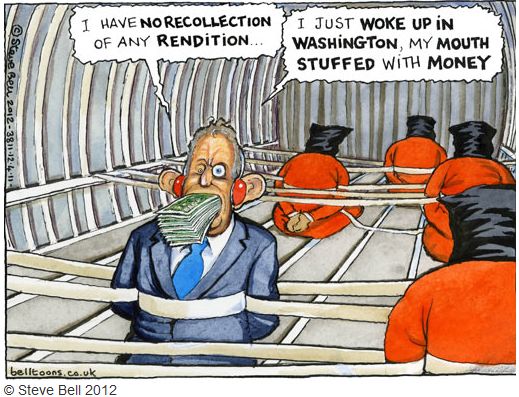
Tony Blair has ‘no recollection’ of Libyan dissident’s rendition

The Guardian reports: Tony Blair, prime minister at the time MI6 rendered Abdel Hakim Belhaj, a prominent Libyan dissident, to the Gaddafi regime in 2004, has said he had “no recollection” of the incident.

But he said he was sure the operation would be investigated “as it should be”.

Interviewed for BBC Radio 4’s World at One programme, Blair added that it should be remembered that “people in the Middle East were also trying to fight terrorism and extremism”. Britain’s co-operation with Libya at the time was important, the former prime minister said.

He referred to comments made by the then foreign secretary, Jack Straw, who said the government had been opposed to unlawful rendition. “As far as I know [the government] kept to that position,” Blair said.

Straw has said: “We were opposed to unlawful rendition. We were opposed to any use of torture. Not only did we not agree with it; we were not complicit in it and nor did we turn a blind eye to it.”

However, Straw has added: “No foreign secretary can know all the details of what its intelligence agencies are doing at any one time.”

Facebooktwittermail

Syria mostly calm after UN truce deadline

The Associated Press reports: A fragile cease-fire brokered by the U.N. took hold in Syria on Thursday with regime forces apparently halting widespread attacks on the opposition, but there were reports of scattered violence and the government defied demands by international envoy Kofi Annan to pull troops back to barracks.

A civilian and a Syrian soldier were reported killed after the 6 a.m. cease-fire deadline, but there was no sign of the normally intense shelling, rocket attacks and sniper fire that have become routine.

If the truce holds, it would be the first time the regime has observed an internationally brokered cease-fire since Bashar Assad’s regime launched a brutal crackdown 13 months ago on mass protests calling for his ouster.

However, troops intensified searches at checkpoints, tightening controls ahead of possible large-scale protests Friday called by the opposition and meant to test the regime’s commitment to the Annan plan.

There was deep skepticism that the regime would halt its fire for long, given that Assad has broken promises in the past. Also, the regime said Wednesday, on the eve of the truce deadline, that it reserves the right to respond to any aggression, potentially a pretext for breaking the truce.

Annan’s plan calls for the deployment of international observers and talks on a political transition once a truce is in place. The initiative has broad international support, including from Assad allies Russia, China and Iran, and is widely seen as the last chance for diplomacy to end the violence. The increasingly militarized uprising has been veering toward an armed insurgency.

Analysts said the apparent halt in government attacks suggests Assad’s allies are pressuring him for the first time, after shielding him from international condemnation in the past. Annan has visited Russia, Iran and China to get the broadest possible backing for the plan.

Facebooktwittermail

North America’s dirty oil boom and the threat to the environment and environmentalists

The New York Times reports: The reversal of fortune in America’s energy supplies in recent years holds the promise of abundant and cheaper fuel, and it could have profound effects on what people drive, domestic manufacturing and America’s foreign policy.

Cheaper fuel produced domestically could reduce the cost of shipping and manufacturing, trim heating and cooling bills, improve the auto market and provide tens of thousands of new jobs.

It might also pose new environmental challenges, both predictable and unforeseen, by damping enthusiasm for clean forms of energy and derailing efforts to wean the nation from its wasteful energy habits.

But for Americans battered by rising gasoline prices, frustrated by the dependence on foreign oil, skeptical of the benefits or practicality of renewable fuels and afraid of nuclear power, the appeal of plentiful domestic oil and gas could far outweigh the costs.

Just a few years ago, the dominant theme in discussions about energy was of declining production and the fear of running out of oil. Even today, political tensions in the Middle East, particularly in the Persian Gulf, have fanned fears of supply disruptions that are keeping prices high.

But a new boom in energy production in recent years has upended these expectations in record time. High energy prices led to a wave of successful oil and gas exploration in North America, including in fields that were deemed uneconomical only a few years ago. Using techniques like horizontal drilling and hydraulic fracturing, oil companies are tapping into deeply buried reserves in shale rocks and in the ocean’s depths.

The surge in energy prices, along with a recession and new government rules that tightened fuel-economy standards, led to a sharp cutback in gasoline consumption. This decline in demand in the last five years reversed decades of almost uninterrupted growth that made the United States the world’s top energy consumer, accounting for one in every four barrels of oil burned around the globe.

The North American energy revival is primarily the result of so-called unconventional sources of energy — like shale oil and shale gas across the United States, oil sands in Canada and deepwater production in the Gulf of Mexico. In the last five years, the United States and Canada combined have become the fastest-growing sources of new oil supplies around the world, overtaking producers like Russia and Saudi Arabia.

“The transformation unfolding in North America represents a potentially decisive shift in the history of energy,” Rex W. Tillerson, the chairman and chief executive of Exxon Mobil, who is not usually given to hyperbole, said in a speech in Houston last month.

Ed Morse, head of global commodity research at Citigroup and a longtime energy analyst, says North America has the potential to become a “new Middle East.”

“The reduced vulnerability of North America — and the world market — to oil price spikes also has deep consequences geopolitically, including the reduced strategic importance to the U.S. of changes in oil- and natural gas-producing countries worldwide,” Mr. Morse said in a recent 92-page report called Energy 2020. ”Pressures towards isolationism in the U.S. will likely grow, with consequences for global stability that can only just begin to become understood.”

“The only thing that could stop this is politics — environmentalists getting the upper hand over supply in the U.S., for instance,” the report said. [Continue reading…]

Facebooktwittermail

Growth of income inequality is worse under Obama than Bush

Matt Stoller writes: Yesterday, the President gave a speech in which he demanded that Congress raise taxes on millionaires, as a way to somewhat recalibrate the nation’s wealth distribution. His advisors, like Gene Sperling, are giving speeches talking about the need for manufacturing. A common question in DC is whether this populist pose will help him win the election. Perhaps it will. Perhaps not. Romney is a weak candidate, cartoonishly wealthy and from what I’ve seen, pretty inept. But on policy, there’s a more interesting question.

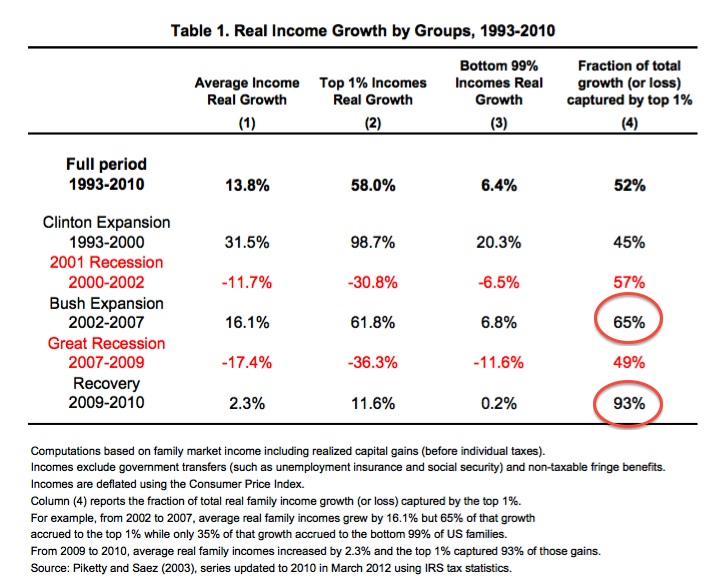
A better puzzle to wrestle with is why President Obama is able to continue to speak as if his administration has not presided over a significant expansion of income redistribution upward. The data on inequality shows that his policies are not incrementally better than those of his predecessor, or that we’re making progress too slowly, as liberal Democrats like to argue. It doesn’t even show that the outcome is the same as Bush’s. No, look at this table, from Emmanuel Saez (h/t Ian Welsh). Check out those two red circles I added.

Yup, under Bush, the 1% captured a disproportionate share of the income gains from the Bush boom of 2002-2007. They got 65 cents of every dollar created in that boom, up 20 cents from when Clinton was President. Under Obama, the 1% got 93 cents of every dollar created in that boom. That’s not only more than under Bush, up 28 cents. In the transition from Bush to Obama, inequality got worse, faster, than under the transition from Clinton to Bush. Obama accelerated the growth of inequality.

Facebooktwittermail

The liberal betrayal of Bradley Manning

Charles Davis writes: More than three years into the presidency of Barack Obama, it’s almost a cliché now to ask: What if George W. Bush did it? From dramatically escalating the war in Afghanistan to institutionalizing the practice of indefinite imprisonment, Obama has dashed hopes he would offer a change from the Bush’s national security policies – but he hasn’t faced a whole lot of resistance from liberals who once decried those policies as an affront to American values.

Like those on the right who now crow about fascism but spent the Bush years gleefully declaring left-wing celebrities “enemies of the state,” many of those on the liberal-left treat issues of war and civil liberties as useful merely for partisan purposes. When a Democrat’s in power those issues become inconvenient. And usually ignored.

Former dean of the Yale Law School Harold Koh, for instance, used to rail against the imperial presidency, speaking of the horror of torture and “indefinite detention without trial.” Now a legal adviser for the Obama State Department, he recently declared that “justice” can be delivered with or with out a trial. Indeed, “Drones also deliver.” Don’t expect much more than a yawn from Democratic pundits, though, much less any calls for impeachment. It’s an election year, after all. And what, would you rather Mitt Romney be the guy drone-striking Pakistani tribesmen?

“Obama and the Democrats being in power in Washington defangs a lot of liberal criticism,” Chase Madar, a civil rights attorney in New York, told me in an interview. Indeed, but with a few exceptions – Michael Moore, Dennis Kucinich, The Nation – those who would be inclined to defend Manning were Bush still in office are the ones either condemning him or condoning his treatment, which has included spending the better part of a year in torturous solitary confinement, an all too common feature of American prisons. Even his progressive defenders, remaining loyal to the Democratic Party, tend to downplay Obama’s role in the Bradley Manning affair; his authorizing the abuse of an American hero is certainly no means not to vote for him again.

“The whole civil libertarian message only really seems to catch fire among liberals when there’s a Republican in the White House,” says Madar. When there’s not a bumbling Texan to inveigh against, all the sudden issues that were morally black and white become complex, and liberal media starts finding nuance where there wasn’t any before.

Facebooktwittermail

Did MoveOn rip off Occupy?

Natasha Lennard writes: “The 99 Percent Spring” certainly appears like an Occupy Wall Street campaign. The effort — to give nonviolent direct action training and teach-ins on income inequality and Wall Street malfeasance to 100,000 people across the country between April 9 and 12 –- sounds born of a general assembly, from the emphasis on putting “bodies on the line” to the calls to “rise up” in the face of corporate hegemony.

It’s unsurprising then that some media reports described it as Occupy’s new tactic; and although numerous individuals involved in Occupy are taking part in the spring trainings, an Occupy Wall Street initiative this is not. The 99 Percent Spring is spearheaded by MoveOn.org and supported by around 60 progressive nonprofits and major unions, including the AFL-CIO, the Teamsters, Greenpeace, the Working Families Party and Van Jones’ Rebuild the Dream organization.

Inside Occupy’s (now-figurative) camps, cries of “co-optation!” abound. The fear, expressed by numerous Occupy participants I spoke to in different cities, is that the 99 Percent Spring trainings will steer energy away from Occupy spring actions and toward support for the Democrats this coming general election. Many still believe that MoveOn, as a recent CounterPunch article put it, is a “front for the Democratic Party.”

Facebooktwittermail

Omissions, half-truths, lies: Ambassador Oren in Foreign Policy

Noam Sheizaf writes: When Prime Minister Binyamin Netanyahu appointed Professor Michael Oren – a historian and researcher at the conservative Shalem institute, author of a popular book on the 1967 war – as his ambassador to Washington, he was probably hoping to capitalize on the latter’s name-recognition and credibility, especially with the political establishment and the Jewish elites. And indeed, as criticism of the occupation and of various Knesset legislative initiatives intensified, Prof. Oren has published numerous articles in leading publications, defending his government policies. In doing so, he has enjoyed the credibility of the scholar, while doing pure political advocacy work.

Ambassador Oren’s latest’s piece, titled “Israel’s Resilient Democracy,” is a good example of this fact. I decided to review some of the main problems with this text, due to the considerable attention it received, as well as the credibility people give to Professor Oren’s work.

Prof. Oren opens by citing some of the criticism over his government and its policies, before declaring his intention in writing this piece in an academic-like tone:

…are the allegations justified? Is Israeli democracy truly in jeopardy? Are basic liberties and gender equality — the cornerstones of an open society — imperiled? Will Israel retain its character as both a Jewish and a democratic state — a redoubt of stability in the Middle East and of shared values with the United States?

These questions will be examined in depth, citing comparative, historical, and contemporary examples. The answers will show that, in the face of innumerable obstacles, Israeli democracy remains remarkable, resilient, and stable.

So let’s go in depth.

One of Ambassador Oren’s major points is that democratic principles were upheld in Israel and minority rights were respected even in times of war. He writes:

Israeli democracy is distinguished not only by its receptiveness to public opinion but, perhaps most singularly, by its ability to thrive during conflict. Whether by suspending habeas corpus or imprisoning a suspected ethnic community, as the United States did in its Civil War and World War II, embattled democracies frequently take measures that depart from peacetime norms.

What Michael Oren doesn’t say is that Israel didn’t have to change its laws in wartime because it adopted upon inception – and still retains – the British Mandate’s emergency regulations, which allow the state to shut down newspapers, detain people in secrecy and/or without trial and much more at any given moment. The state of emergency was never lifted.

Furthermore, in the last 45 years (amounting to two-thirds of the country’s history), the Palestinian population in the occupied territories has been under military law, which grants the state even more power.

Israeli legal scholars I consulted on this matter tended to agree that habeas corpus, mentioned above, does exist under military occupation (due to the Supreme Court’s extended jurisdiction), but they also said that in the military court system, this fact is all but meaningless. Over the years, Israel has held between hundreds and thousands Palestinians under administrative detention at any moment (the current number is roughly 300), without trial. Detainees under administrative detention are brought before a military judge – an officer in uniform – only after seven days; the evidence against them is confidential and the hearing takes place behind closed doors. They are not tried, so they have no real way to defend themselves. At times, Israel also held Palestinians as “enemy combatants,” with even fewer rights. There is one person held with this status even now.

Even when Palestinians are brought to trial, the burden of proof resting on the prosecution in Israel’s military courts is extremely low, and the result is an astonishing 99.7 conviction rate. (It should be noted that the conviction rate in the Israeli criminal system is also in the high 90s; that’s not an excuse, but rather a different problem.) Again, these are not temporary measures, but the permanent system under which all Palestinians – including hundreds of minors – are tried. Their Jewish neighbors living in the settlements are tried in Israeli courts, where they enjoy full rights as citizens.

Professor Oren knows all this. He also knows, but somehow fails to mention, that upon its creation in 1948, Israel placed all of its Palestinian citizens under military rule, which was lifted only in December 1966. The six-month period that lasted from that date to the Six Day War comprises the only time in Israel’s history when a majority of the Arab population under its control was not subject to military rule.

“The litmus test for any democracy is its ability to protect the rights of its minorities,” writes Oren. But does subjecting millions of people – the largest minority under the state’s control – to the arbitrary and often abusive control of the army, and be that “the most moral army in the world,” constitute a success in this test? [Continue reading…]

Facebooktwittermail

There are no images

Tim Parks writes: “There are no images.” This was the first time I noticed Riccardo Manzotti. It was a conference on art and neuroscience. Someone had spoken about the images we keep in our minds. Manzotti seemed agitated. The girl sitting next to me explained that he built robots, was a genius. “There are no images and no representations in our minds,” he insisted. “Our visual experience of the world is a continuum between see-er and seen united in a shared process of seeing.”

I was curious, if only because, as a novelist I’d always supposed I was dealing in images, imagery. This stuff might have implications. So we had a beer together.

Manzotti has a degree in engineering and another in philosophy. He teaches in the psychology department at IULM University, Milan. The move from engineering to philosophy was prompted by conceptual problems he’d run into when first seeking to build robots. What does it mean that a subject sees an object? “People say the robot stores images of the world through its video camera. It doesn’t, it stores digital data. It has no images.”

Manzotti is what they call a radical externalist: for him consciousness is not safely confined within a brain whose neurons select and store information received from a separate world, appropriating, segmenting, and manipulating various forms of input. Instead, he offers a model he calls Spread Mind: consciousness is a process shared between various otherwise distinct processes which, for convenience’s sake we have separated out and stabilized in the words subject and object. Language, or at least our modern language, thus encourages a false account of experience.

His favorite example is the rainbow. For the rainbow experience to happen we need sunshine, raindrops, and a spectator. It is not that the sun and the raindrops cease to exist if there is no one there to see them. Manzotti is not a Bishop Berkeley. But unless someone is present at a particular point no colored arch can appear. The rainbow is hence a process requiring various elements, one of which happens to be an instrument of sense perception. It doesn’t exist whole and separate in the world nor does it exist as an acquired image in the head separated from what is perceived (the view held by the “internalists” who account for the majority of neuroscientists); rather, consciousness is spread between sunlight, raindrops, and visual cortex, creating a unique, transitory new whole, the rainbow experience. Or again: the viewer doesn’t see the world; he is part of a world process. [Continue reading…]

Facebooktwittermail

Goldberg slipping on Grass

The idea that the world can be divided into powers that can be trusted with nuclear weapons and those that can’t is the foundation of the dispute with Iran, but if this idea really carried any weight, why would President Obama be an advocate of global nuclear disarmament?

Admittedly, he’s a half-hearted advocate — he’s presented it as a long-term goal, but a goal without a deadline is just a dream. Disarmament is Obama’s nice idea. But any serious proponent of disarmament recognizes that no one can be trusted with nuclear weapons.

Imagine your Uncle Harry and Aunt Judy come over for dinner. Uncle Harry’s a retired nuclear scientist and quite a handyman. Over dinner Aunt Judy proudly mentions he has just completed a project he’s been laboring over for many years: he’s constructed a suitcase nuclear bomb and it’s in the trunk of their car outside.

You flip out.

“Don’t worry,” Aunt Judy assures you. “Uncle Harry’s totally trustworthy.”

But you don’t care whether Uncle Harry is as trustworthy as Moses. It doesn’t make you any less scared of the bomb.

As for how trustworthy the Israelis are with their arsenal of nuclear bombs, since they won’t even admit they possess any, I’d say they should inspire less confidence than Uncle Harry.

And as for the method and extent of a possible Israeli attack on Iran — whether it would only involve conventional weapons and whether it would just employ aircraft or perhaps also ballistic missiles — I don’t recall anything specific be placed upon or removed from that proverbial table that accommodates all threats. So who’s to say one way or the other whether Günther Grass’s fears about such an attack are overblown? We don’t know.

Jerry Haber writes: Grass’s poem What must be said has been defended and attacked throughout the globe. The poem protests against the German sale of a nuclear submarine to Israel; appeals for international control of the Israel and Iranian nuclear program by an authority accepted by both governments; and, though by a German author, refuses to be silent about Israel’s nuclear power, despite Germany’s past crimes against the Jewish people (and humanity). Grass speaks as a German who does not want to be indirectly responsible for a horrific catastrophe, but rather, as he puts it,  wants to give help to Israelis, Palestinians, and others in the region “and, finally, to ourselves as well.” This part of Grass’s poem, the main part, is eminently reasonable. Only a twisted mind would find it anti-Semitic or even anti-Zionist.

The poem employs, however, rhetoric that is offensive to Iranians and to Israelis.  It calls the Iranian leader a loudmouth who keeps his people under his thumb and pushes them  to organized cheering. It imputes to the Israeli leaders the claim to have a right to a first strike capability that could “snuff out” or “annihilate” the Iranian people by using the nuclear submarine sold it by the Germans.Both claims belong more to the exaggerated bombast of living rooms (and blogs) than to a serious cri de coeur. They demean the poet, and they enable the poem to be easily dismissed by the partisans.

But suppose Grass had been more accurate in his description of the possible consequences of Israel’s attack? Suppose that instead of writing “a strike to snuff out the Iranian people” he had written  “a strike that may kill or maim hundreds of thousands of people”?

According to the Center for the Strategic and International Studies, a strike on the Bushehr Nuclear Reactor alone “will cause the immediate death of thousands of people living in or adjacent to the site, and thousands of subsequent cancer deaths or even up to hundreds of thousands depending on the population density along the contamination plume.”

Criticism of Israel on that score would not only not count as being anti-Semitic; it could even be advanced by those “sympathetic to Israel’s dilemma.” Or so says Bloomberg’s Jeffrey Goldberg:

The morality of a [pre-emptive Israeli] strike, which could cause substantial Iranian casualties, would be questioned even by those sympathetic to Israel’s dilemma.

Goldberg is astounded at the line that Grass did use and considers the poem anti-Semitic. But had Grass’s poem included the more “modest” claim of the possible hundreds of thousands of casualties, rather than the possible annihilation of the Iranian people, would Goldberg have dropped the anti-Semitism charge? In a post accusing Grass of anti-Semitism, Goldberg says that Israel is “contemplating targeting six to eight nuclear sites in Iran for conventional aerial bombardment,” which may be correct,though one retired American general thinks otherwise.  There is, to be sure, a clear difference between the nuclear bombing of conventional sites and the conventional bombing of nuclear sites. But what they share in common is the possible causation of  “substantial Iranian casualties,” to use Goldberg’s phrase. So why is Grass being anti-Semitic when he morally criticizes the consequences of an Israeli strike, whereas Goldberg is not?

If I understand Goldberg correctly, there are two distinctions between Grass’s standing vis-à-vis the moral criticism of Israel, and his own. First,  Grass is a German and a former member of the SS.  So he has to shut up – unless, perhaps, he proves himself to be one of those Germans who are “sympathetic to Israel’s dilemma.”

Second, Goldberg misreads Grass as saying that Israel seeks to annihilate the Iranians. This is nowhere stated or implied by Grass in his poem.  Instead, he says that Israel seeks the right of a preventative first strike which could annihilate the Iranian people. What’s the difference between the two? Well, it’s the difference between saying that Israel attacked Gaza in Operation Cast Lead in a way that could (and, in fact, did) kill fourteen hundred Gazans and between saying that  Israel sought to kill fourteen hundred Gazans.

Why does Goldberg read Grass in this way? He writes

To make yourself believe that Israel is seeking to murder the 74 million people of Iran, you must make yourself believe that the leaders of the Jewish state outstrip Adolf Hitler in genocidal intent.

Goldberg reads Grass as accusing Israel of outdoing Hitler in its evil “genocidal intent” – a reading that is interesting for what it says about Goldberg’s own mind,  but it is more interesting for what it says about the manner in which some Israeli advocates  think about criticism of Israeli military power, to turn one of Goldberg’s felicitous phrases.  What could be more anti-Semitic than accusing Israel of being more genocidal than Hitler? After all, to call for a nuclear embargo on Israel is to imply that Israelis cannot be trusted to act responsibly in the use of nuclear weapons, or in the bombing of nuclear facilities. It is to demean the Israelis, to place them on the same level, if not lower, than the Islamist regime in Iran. It is to claim that like the Iranians the Israelis are not to be trusted with nuclear weapons because we suspect them of genocidal intent. [Continue reading…]

Facebooktwittermail