Obama’s kill doctrine

Jonathan Turley writes: On Monday, March 5, Northwestern University School of Law was the location of an extraordinary scene for a free nation. U.S. Attorney General Eric Holder presented President Barack Obama’s claim that he has the authority to kill any U.S. citizen he considers a threat. It served as a retroactive justification for the slaying of American-born cleric Anwar al-Awlaki last September by a drone strike in northeastern Yemen, as well as the targeted killings of at least two other Americans during Obama’s term.

What’s even more extraordinary is that this claim, which would be viewed by the Framers of the U.S. Constitution as the very definition of authoritarian power, was met not with outcry but muted applause. Where due process once resided, Holder offered only an assurance that the president would kill citizens with care. While that certainly relieved any concern that Obama, or his successor, would hunt citizens for sport, Holder offered no assurances on how this power would be used in the future beyond the now all-too-familiar “trust us” approach to civil liberties of this administration.

In his speech, Holder was clear and unambiguous on only one point: “The president may use force abroad against a senior operational leader of a foreign terrorist organization with which the United States is at war — even if that individual happens to be a U.S. citizen.” The use of the word “abroad” is interesting because senior administration officials have previously asserted that the president may kill an American anywhere and anytime, including within the United States. Holder’s speech does not materially limit that claimed authority, but stressed that “our legal authority is not limited to the battlefields in Afghanistan.” He might as well have stopped at “limited” because the administration has refused to accept any limitations on this claimed inherent power.

Holder became highly cryptic in his assurance that caution would be used in exercising this power — suggesting some limitation that is both indefinable and unreviewable. He promised that the administration would kill Americans only with “the consent of the nation involved or after a determination that the nation is unable or unwilling to deal effectively with a threat to the United States.” He did not explain how the nation in question would consent or how a determination would be made that it is “unable or unwilling to deal” with the threat. [Continue reading…]

Facebooktwittermail

Borrowed ideas

Casey Schwartz writes: It is the voice inside our head.

The culture to which we belong — whatever it happens to be — fills us with its peculiar inventory. We are shaped by its mandates and its expectations, its anxieties and aspirations, its preferences and aversions. The basic texture of our inner lives is sewn from cultural threads.

And all of this even though we got here, wherever we are, only as a matter of chance.

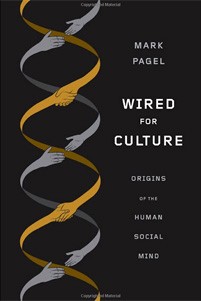
So Mark Pagel reminds us in his new book, Wired for Culture: Origins of the Human Social Mind.

The culture we inherit, he writes, “is an accident of birth, but it is one to which we show a surprising and sometimes alarming devotion. People will risk their health and well-being, their chances to have children, or even their lives for their culture. People will treat others well or badly merely as an accident of their cultural inheritance.”

How does culture have this kind of grip on us? And what purpose does it serve? These are the central questions of Pagel’s lengthy, multifaceted book.

Pagel, an evolutionary biologist at the University of Reading, belongs to the intellectual hot bed of the edge.org set, a salon of scientific thinkers that has assembled over the years under the auspices of their intriguing host, John Brockman. The ethos of the edge.org crowd is one of unapologetic sophistication; its mission is to bring cutting-edge thinkers together in an ongoing, open-ended conversation, where ideas can beget ideas.

And in his new book, Pagel’s big idea is that culture is the single greatest force for both social and biological change in human history. It has proven itself to be the winning strategy for the survival of our species, bar none. As a result, it has shaped our brains so that they are primed to perpetuate it. [Continue reading…]

Facebooktwittermail

Islamism and the Syrian uprising

Nir Rosen writes: James Clapper, the United States Director of National Intelligence, warned last month of al Qaeda taking advantage of the growing conflict in Syria. The Syrian regime and its supporters frequently claim that the opposition is dominated by al Qaeda-linked extremists. Opposition supporters often counter that the uprising is completely secular. But months of reporting on the ground in Syria revealed that the truth is more complex.

Syria’s uprising is not a secular one. Most participants are devout Muslims inspired by Islam. By virtue of Syria’s demography most of the opposition is Sunni Muslim and often come from conservative areas. The death of the Arab left means religion has assumed a greater role in daily life throughout the Middle East. A minority is secular and another minority is comprised of ideological Islamists. The majority is made of religious-minded people with little ideology, like most Syrians. They are not fighting to defend secularism (nor is the regime) but they are also not fighting to establish a theocracy. But as the conflict grinds on, Islam is playing an increasing role in the uprising.

Mosques became central to Syria’s demonstrations as early as March 2011 and influenced the uprising’s trajectory, with religion becoming increasingly more important. Often activists described how they had “corrected themselves” after the uprising started. Martyrs became important to a generation that had only seen martyrs on television from Iraq, Palestine, and Lebanon. “People got more religious,” one activist in Damascus’s Barzeh neighborhood explained, “they got closer to death, you could be a martyr so people who drank or went out at night corrected themselves.” Some Arab satellite news stations have also contributed to the dominance of Islamists by interviewing more of them and focusing on them as opposed to more secular opposition figures or intellectuals. In Daraa activists complained that satellite networks were marginalizing prominent leftists.

Clerics were influential from the beginning in much of the country, but their authority is not absolute. Sheikhs have often played a positive role in the uprising, enforcing discipline and exhorting armed and unarmed activists to act responsibly. One reason why Homs has not descended into Bosnia-like sectarian massacres is because of the strong influence of opposition sheikhs. [Continue reading…]

Facebooktwittermail

Cybersecurity bill is broad enough to use against WikiLeaks and The Pirate Bay

The Electronic Frontier Foundation says: Congress is doing it again: they’re proposing overbroad regulations that could have dire consequences for our Internet ecology. The Cyber Intelligence Sharing and Protection Act of 2011 (H.R. 3523), introduced by Rep. Mike Rogers and Rep. Dutch Ruppersberger, allows companies or the government1 free rein to bypass existing laws in order to monitor communications, filter content, or potentially even shut down access to online services for “cybersecurity purposes.” Companies are encouraged to share data with the government and with one another, and the government can share data in return. The idea is to facilitate detection of and defense against a serious cyber threat, but the definitions in the bill go well beyond that. The language is so broad it could be used as a blunt instrument to attack websites like The Pirate Bay or WikiLeaks. Join EFF in calling on Congress to stop the Rogers’ cybersecurity bill.

Under the proposed legislation, a company that protects itself or other companies against “cybersecurity threats” can “use cybersecurity systems to identify and obtain cyber threat information to protect the rights and property” of the company under threat. But because “us[ing] cybersecurity systems” is incredibly vague, it could be interpreted to mean monitoring email, filtering content, or even blocking access to sites. A company acting on a “cybersecurity threat” would be able to bypass all existing laws, including laws prohibiting telcos from routinely monitoring communications, so long as it acted in “good faith.”

The broad language around what constitutes a cybersecurity threat leaves the door wide open for abuse. For example, the bill defines “cyber threat intelligence” and “cybersecurity purpose” to include “theft or misappropriation of private or government information, intellectual property, or personally identifiable information.”

Yes, intellectual property. It’s a little piece of SOPA wrapped up in a bill that’s supposedly designed to facilitate detection of and defense against cybersecurity threats. The language is so vague that an ISP could use it to monitor communications of subscribers for potential infringement of intellectual property. An ISP could even interpret this bill as allowing them to block accounts believed to be infringing, block access to websites like The Pirate Bay believed to carry infringing content, or take other measures provided they claimed it was motivated by cybersecurity concerns.

Facebooktwittermail

Israel, Iran and America: Auschwitz complex

Sometimes a piece of commentary simply has to be re-presented in its entirety. This comes from The Economist’s Democracy in America blog:

During his meeting with Barack Obama on Monday, Bibi Netanyahu said Israel “must have the ability always to defend itself, by itself, against any threat.”

“I believe that’s why you appreciate, Mr. President, that Israel must reserve the right to defend itself,” Netanyahu said. “After all, that’s the very purpose of the Jewish state, to restore to the Jewish people control over our destiny. That’s why my supreme responsibility as prime minister of Israel is to ensure that Israel remains master of its fate.”

News flash: Israel is not master of its fate. It’s not terribly surprising that a country with less than 8m inhabitants is not master of its fate. Switzerland, Sweden, Serbia and Portugal are not masters of their fates. These days, many countries with populations of 100m or more can hardly be said to be masters of their fates. Britain and China aren’t masters of their fates, and even the world’s overwhelmingly largest economy, the United States, isn’t really master of its fate.

But Israel has even less control over its own destiny than Portugal or Britain do. The main reason is that, unlike those countries, Israel refuses to give up its empire. Israel is unable to sustain its imperial ambitions in the West Bank, or even to articulate them coherently. Having allowed its founding ideology to carry it relentlessly and unthinkingly into what Gershom Gorenburg calls an “Accidental Empire” of radical religious-nationalist settlements that openly defy its own courts, Israel is politically incapable of extricating itself. The partisan battles engendered by its occupation of Palestinian territory render it less and less able to pull itself free. It is immobilised, pinned down, in a conflict that is gradually killing it. Countries facing imperial twilight, like Britain in the late 1940s, are often seized by a sense of desperate paralysis. For over a decade, the tone of Israeli politics has been a mix of panic, despair, hysteria and resignation.

No one bears greater responsibility for the trap Israel finds itself in today than Mr Netanyahu. As prime minister in the late 1990s, he did more than any other Israeli leader to destroy the peace process. Illegal land grabs by settlers were tolerated and quietly encouraged in the confused expectation that they would aid territorial negotiations. Violent clashes and provocations erupted whenever the peace process seemed on the verge of concrete steps forward; the most charitable spin would be that the Israelis failed to exercise the restraint they might have shown in retaliating against Palestinian terrorism, had they been truly interested in progress towards a two-state solution. Mr Netanyahu believed that the Oslo peace agreements were a mirage, and his government’s actions in the late 1990s helped make it true.

Having trapped themselves in a death struggle with Palestinians that they cannot acknowledge or untangle, Israelis have psychologically displaced the source of their anxiety onto a more distant target: Iran. An Iranian nuclear bomb would not be a happy development for Israel. Neither was Pakistan’s, nor indeed North Korea’s. The notion that it represents a new Holocaust is overstated, and the belief that the source of Israel’s existential woes can be eliminated with an airstrike is mistaken. But Iran makes an appealing enemy for Israelis because, unlike the Palestinians, it can be fitted into a familiar ideological trope from the Jewish national playbook: the eliminationist anti-Semite. With brain-cudgeling predictability, Mr Netanyahu marked his meeting with Mr Obama by presenting him with a copy of the Book of Esther. That book concerns a plot by Haman, vizier of King Ahasuerus of Persia, to massacre his country’s Jews, and the efforts of the beautiful Esther, Ahasuerus’s secretly Jewish wife, to persuade the king to stop them. It is a version of the same narrative of repression, threatened extermination and resistance that Jews commemorate at Passover in the prayer “Ve-hi she-amdah”: “Because in every generation they rise up to destroy us, but the Holy One, Blessed be He, delivers us from their hands.”

Mr Netanyahu is less attractive than Esther, but he seems to be wooing Mr Obama and the American public just as effectively. The American-Israeli relationship now resembles the sort of crazy co-dependency one sometimes finds in doomed marriages, where the more stubborn and unstable partner drags the other into increasingly delusional and dangerous projects whose disastrous results seem only to legitimate their paranoid outlook. If Mr Netanyahu manages to convince America to back an attack on Iran, it is to be hoped that the catastrophic consequences will not be used to justify the attack that led to them.

Mr Netanyahu thinks the Zionist mission was to give the Jewish people control over their destiny. No people has control over its destiny when it is at war with its neighbours. But in any case, that is only one way of thinking of the Zionist mission. Another mission frequently cited by early Zionists was to help Jews grow out of the “Ghetto mentality”. Mr Netanyahu’s gift to Mr Obama shows he’s still in it.

Facebooktwittermail

Renewed Israeli assault on Gaza

The latest round of violence was triggered by Israel’s assassination of Zuhair al-Qaisy secretary-general of the Popular Resistance Committees along with two associates in an airstrike on Gaza yesterday.

Ynet reported:

Minister of Home Front Defense Matan Vilnai stressed on Saturday that “the IDF is not planning on launching another military campaign in Gaza.

“This round of fighting began due to the targeted killing of a PRC operative who was in the midst of planning another attack. It was clear to the security establishment that this would lead to an escalation, but targeting him was necessary,” he noted.

Israel repeatedly trots out these two explanations for its attacks: that it is thwarting a Palestinian attack that is being prepared or that it is directly targeting rocket-launching sites. But if the escalation of rocket attacks on Southern Israel (apparently 100 rockets so far) is greater than the attack that has supposedly been thwarted, there’s little logic to this kind of “preemptive” attack.

As always, there seems to be greater reason to think that Israel initiates an action like this for political rather than security reasons.

Hamas’s political power is rising. It has struck a deal on joint governance with Fatah and in response to the Arab Spring is strengthening its ties with other branches of the Muslim Brotherhood while severing its ties with Syria. It now has growing political support from Qatar, Egypt, and Turkey.

In this context, Benjamin Netanyahu would no doubt prefer to see Hamas abandon its ceasefire with Israel. While he is internationally perceived as a man itching to start a war on Iran, a few dozen rockets getting fired at Israel is probably a welcome sight since it helps renew the appearance of Israel as victim rather than aggressor.

Hamas seems unlikely to rise to the bait and given that they already announced that they would not involve themselves in a war between Israel and Iran, many Israelis (especially those in the south) must be wondering how they are served by a defense force that might more accurately be called the Israel Provocation Force.

Facebooktwittermail

How Israelis tried to kill Anthony Shadid in 2002

David Kindred writes: Until the Israeli sniper shot him, it had been a good day. Shadid’s notebook was full because he had been eyewitness to a drama that was a perfect metaphor for the latest Israel-Palestine war. He started a long walk back to the hotel. There he would write for his newspaper, The Boston Globe. He was looking at his notes when he realized that his body was falling. He was halfway to the ground before he heard the gunshot.

It was March 31, 2002. Shadid remembered the sky over Ramallah as cemetery gray. Once the bustling hub of a new Palestine, the city was cloaked in silence. War in its third day had emptied the streets. That day, as on all days, Shadid was driven by a reporter’s questions: Why? How do I put the pieces of the puzzle together? Here in Ramallah, why did Israel’s army wage war against civilians when the nation’s prime minister said the objective was to eliminate a’ “terrorist infrastructure”?

Shadid had gone to Ramallah Hospital to interview doctors, nurses, ambulances drivers, and humanitarian workers. He wanted to talk to people who had found themselves in harm’s way by leading their everyday lives. As he arrived, so did the roar of war. A tank rolled up, and two armored personnel carriers unloaded soldiers. The soldiers rushed toward the hospital with rifles leveled on people who had come outside. Someone said, “This is a hospital!” The soldiers, seemingly in search of an enemy, shouted, “Everyone back, everybody inside!”

Shadid saw it all. The scene spoke to the asymmetry of the conflict Here were doctors in white smocks facing soldiers with M-16s. As an Israeli lieutenant talked to the hospital chief, Shadid listened. In their confrontation, he saw the war. The lieutenant was an army that had to search among civilians for the enemy. The hospital chief was Ramallah, powerless against power.

“The doctor and this Israeli were face-to-face and they were yelling at each other,” Shadid said. “I’m standing right next to them. And I’m writing down every word. This was one of those moments. Through it, I could tell the entire story of this fifty-year conflict. I was so excited. This is it. You could see how the entire story would be structured. So excited.”

When a peaceful compromise was made, Shadid headed back to his hotel with a colleague, Said al-Ghazali. They walked in the middle of the street lest they raise suspicion by moving along walls. Both wore white flak jackets marked on the back with red-taped “TV,” the best-known symbol for international press. He had his notebook in his hands, flipping pages to read notes.

Then he was falling before he heard the gunshot. “It was deafening, like they shot next to my ear,” he said. “Probably twenty-five feet away.” On the street, he couldn’t move. He first thought someone had thrown a stun grenade, a weapon that momentarily paralyzes its target. Then he felt pain on his spine. “Said,” he said to his friend, “I think I was shot.”

Al-Ghazali was down on the pavement with Shadid, searching for blood. “I don’t see anything,” he said. Shadid now reached behind his flak jacket and brought back a bloody hand. He thought to tell his wife and infant daughter good-bye. He thought of ambulances that couldn’t move on Ramallah’s streets. He also thought, “I’ll die if I wait for help.”

Al-Ghazali carried him twenty yards before they fell. “Journalists!” Al-Ghazali shouted. “Help! Bring us a car!” There was no one in the street, no one could hear them, no one except perhaps the Israeli who shot him. Shadid thought that man might now be watching him struggle toward a vehicle in the street ahead.

“He’s wounded!” al-Ghazali shouted.

An Israeli said, “Show us!”

Al-Ghazali turned Shadid so the soldier could see the white flak jacket red with blood. The bullet had passed through Shadid’s left shoulder, sheared off part of a spinal column vertebra, and burst through his right shoulder, a classic M-16 wound: tiny on entry, huge on exit. Twelve pieces of shrapnel remained inside the reporter’s back. In his Boston apartment years later, I asked Shadid, “Did the guy intend to shoot you?”

“There were rumors that Palestinians were posing as Red Cross workers and journalists. I don’t think if they knew I was an American journalist that I’d have been shot. They might have, who knows? They can be rough on journalists. I think they wanted to teach a lesson. ‘Here’s what we’re going to do to people acting as journalists.'”

“God,” I said.

“A cold-blooded execution.”

“From point-blank range,” I said.

“They were looking to kill me. Crazy, but reading my notes may have saved my life. I think they were aiming at my head, and I moved my head down looking at my notes.”

“The M-16 wound makes you sure an Israeli did it?”

“Yes. And the Israelis were in complete control of that area that day.”

He could have been dead. He could have been paralyzed. Instead, he was in a Ramallah hospital away from the one he had visited that day. From his bed, he called Boston and told his editor what happened. He also said, “I got this great story. I think I can still write it.” And the editor said, “If you think you can do it, we’ll take it.” Before Shadid could get his laptop, common sense, in league with morphine, prevailed against the idea. Besides, he hadn’t been in the hospital an hour before here came more Israeli soldiers, guns drawn, entering his room and shouting something in Hebrew, a language he did not understand. He said, “Back off. I’m an American journalist.” They answered, “Get your hands up”—as if he could. He was mummified in bandages around his chest and shoulders. He raised his forearms.

Later that night, an Israeli army officer stopped by. “If we shot you,” he said, “I apologize on behalf of the army.” Then he shrugged. “But you know, you were in a war zone.” [Continue reading…]

(H/t Mondoweiss)

Facebooktwittermail

Syrian brass defect, buoying rebels

The Wall Street Journal reports: Several high-ranking Syrian military officials joined the opposition to President Bashar al-Assad on Thursday and Friday, in the Syrian conflict’s biggest wave of military defections to date.

The defections appeared to boost Syria’s armed opposition, and exposed corrosive sectarian splits in Syria’s army, between a largely Sunni core of soldiers and the highest officials, many of whom are from the same minority Alawite sect as President Assad.

The defections also appeared to lay the ground for new struggles within Syria’s already-fractured opposition. The rebel Free Syrian Army, led by a former Syrian army colonel since its founding last year, has since been joined by higher-ranking officers. A brigadier-general who defected in January is preparing to split into his own armed group, rebels familiar with his plans said Friday.

U.S. intelligence officials said that while the opposition movement is fractured—they cited 32 constituent groups from around Syria, including Islamist, Kurdish and secular groups—the armed rebels appear to be gaining momentum against the regime. The rebels are likely to win out eventually, these officials said, but are up against a more powerful military than insurgents faced in Libya.

Facebooktwittermail

Syria begins withdrawing European ambassadors

Reuters reports: Syria has begun preemptively withdrawing ambassadors from Europe because it fears EU members will expel them in the coming weeks, Arab diplomats said.

The diplomats stressed that Syrian envoys in a number of European Union countries had been told to come home by their government and were preparing to leave as soon as possible, although they did not specify the countries.

EU member states have been discussing proposals, promoted by France, to collectively downgrade diplomatic ties both in EU capitals and Damascus, but with no agreement so far.

In Brussels, an EU foreign policy spokesman said: “There is an ongoing discussion about the status of EU embassies in Syria and Syrian embassies in Brussels and in EU states, but there is no proposal at the moment to expel Syrian diplomats.”

Facebooktwittermail

Mass pro-democracy protest rocks Bahrain

Reuters reports: Tens of thousands of Bahrainis demonstrated on Friday to demand democratic reforms, stepping up pressure on the U.S.-allied government with the biggest protest yet in a year of unrest.

They began marching along a highway near Manama in response to a call from leading Shi’ite cleric Sheikh Isa Qassim, who urged people to renew their calls for greater democracy.

A live blog showed images of the protesters carrying banners denouncing “dictatorship” and demanding the release of detainees.

“We are here for the sake of our just demands that we cannot make concessions over and we stick with them because we have sacrificed for them,” Qassim said before the march in his weekly sermon in the Shi’ite village of Diraz.

Qassim and other Shi’ite clerics led the march.

“It is the biggest demonstration in the past year. I would say it could be over 100,000,” said a Reuters photographer after protesters filled up the main Budaiya highway in the area of Diraz and Saar, west of Manama.

Facebooktwittermail

African critics of Kony campaign detect ‘White Man’s Burden’ syndrome

Robert Mackey writes about the continuing criticism of the viral marketing campaign designed to promote the company, Invisible Children:

While much of the backlash reported in the American news media this week cited objections raised by development experts in the United States and Europe, several African bloggers and activists have objected to what they see as a more fundamental problem. Among them, the possibility that the “Kony 2012″ campaign reinforces the old idea, once used to justify colonial exploitation, that Africans are helpless and need to be saved by Westerners.

Many African critics of the effort to make Mr. Kony, the brutal leader of the Lord’s Resistance Army, a household name said it echoed the ideas in Rudyard Kipling’s poem, “The White Man’s Burden,” written in 1899 to urge Americans to embrace their imperial destiny and rule over the “new-caught, sullen peoples,” of the Philippines — even though the typical native was “half-devil and half-child.”

In a critique of the campaign posted on YouTube, Rosebell Kagumire, a Ugandan blogger, said that “Kony 2012″ viral video summarizing the need for action played “so much on the idea that this war has been going on because millions of Americans” and other Westerners, had “been ignorant about it.”

Facebooktwittermail

Attack Iran or more sanctions? A third option: Israel and Iran forsake nukes

Boaz Atzili writes: For half a century now, Israel’s regional nuclear monopoly has been its “Samson option,” the one weapon it can threaten to use if all else fails and Israel faces a real existential threat. As a scholar concentrating on the Middle East conflict, and also as a native of Israel, I am not comforted by the nuclear security blanket under which I was born.

Now that this monopoly is facing an increasingly possible challenge from Iran, Israel should reconsider its nuclear supremacy – as far fetched as this may sound. The argument in favor of such a radical shift is not moral, but strategic. Israel may well be better off in a Middle East with no nuclear powers than in one with – potentially – several of them.

Iran, too, would have its own reasons to support such an arrangement. And a secure path to a “no nukes” zone may be found not in dismantling Israel’s arsenal, but in relocating it.

In the face of an apparently fast-advancing Iranian nuclear project, the two options mostly discussed are sanctions and military attack. Neither is very appealing. The first is unlikely to halt the Iranian program and the second will only postpone it temporarily while possibly creating a regional conflagration on a large scale.

When Israel developed its own nuclear program, apparently in the late 1950s, it made much strategic sense. Israel was a small country, with very limited human and material resources, surrounded by hostile neighbors. Nuclear arms could provide the ultimate guarantee of security.

But Israel is no longer so vulnerable. True, much of the region is still hostile (despite peace agreements with Egypt and Jordan). Yet Israel holds a profound conventional superiority over any potential rivals – a superiority that makes a nuclear-free Middle East a strong and effective second-best option after a nuclear monopoly.

Facebooktwittermail

Kony baloney

Invisible Children filmmakers pose with officers of the Sudan People’s Liberation Army on the Congo-Sudan border during failed peace talks between the LRA and the Ugandan Government, April 2008. Photo by Glenna Gordon.

Here’s how far behind the crest of the social media wave I ride: it wasn’t until last night that I heard about Kony2012. Google News had by that point insisted that this was the most important news in the world and so I tracked down the video. Mind you, just because something is spreading like a contagious disease (it’s “gone viral”) seems little reason to suppose it must be a good thing.

The New York Times takes a sip of the #StopKony Kool Aid:

Jason Russell said he never knew he was driving into a war zone. At 24, he had just graduated from the University of Southern California after studying film, he said, and was out looking for a story to tell.

Suddenly, he said, gunmen shot at the truck in front of him, and that is how he discovered the horrors wrought by Joseph Kony and his Lord’s Resistance Army. Mr. Russell would dedicate the next nine years of his life, often in obscurity, to making them a household name.

This week, in a testament to the explosive power of social media, he managed to do so in a matter of days, baffling diplomats, academics and Ugandans who have worked assiduously on the issue for decades without anything close to the blitz of attention that Mr. Russell and his tight-knit group of activists have generated.

Since being posted on Monday, their video, “KONY 2012,” has attracted more than 50 million views on YouTube and Vimeo, generating hundreds of thousands of dollars in donations on the first day alone and rocketing across Twitter and Facebook at a pace rarely seen for any video, let alone a half-hour film about a distant conflict in central Africa.

But is this a film about a distant conflict in central Africa?

While we are being told it’s all about the invisible children of Uganda threatened by the baddest man in the world, Joseph Kony, the real stars of the video are its maker, Jason Russell, and his son, Gavin. And as an exercise in awareness raising, Russell sets the bar pretty low — as though it would be enough to promote a message a child of any age could understand. Let’s get the bad guy. Yeah! The filmmaker apparently also has an eye on another prize — an Oscar.

Michael Deibert points out that Invisible Children doesn’t merely oversimplify the issues with its narrow focus on Joseph Kony — it will actually make matters worse by empowering the central government in Kampala.

The problem with Invisible Children’s whitewashing of the role of the government of Uganda’s president Yoweri Museveni in the violence of Central Africa is that it gives Museveni and company a free pass, and added ammunition with which to bludgeon virtually any domestic opposition, such as Kizza Besigye and the Forum for Democratic Change.

By blindly supporting Uganda’s current government and its military adventures beyond its borders, as Invisible Children suggests that people do, Invisible Children is in fact guaranteeing that there will be more violence, not less, in Central Africa.

I have seen the well-meaning foreigners do plenty of damage before, so that is why people understanding the context and the history of the region is important before they blunder blindly forward to “help” a people they don’t understand.

U.S. President Bill Clinton professed that he was “helping” in the Democratic Republic of Congo in the 1990s and his help ended up with over 6 million people losing their lives.

David Leon is similarly enraged by Invisible Children’s fixation on Kony.

In the whole half hour of the video, the name of Yoweri Museveni does not even crop up once. Museveni has been President of Uganda for the past 26 years, and it is against his rule that the LRA rebellion started. He is a corrupt autocrat, ineffective in providing basic social and economic services, with a history of well-documented human rights violations – not least of which was his role as a major instigator of the Second Congo War with his invasion and occupation of the DRC, a conflict which resulted in the deaths of 5.4 million people, making it the bloodiest conflict worldwide since World War II. Although the conflict officially ended in 2003, it was estimated that in the following year, there were 1000 deaths every single day from disease and malnutrition in the Democratic Republic of Congo as a result of the destruction caused by the war– these are the real invisible deaths, not the spectacular kidnappings of a crazed jungle warlord.

A charity that rewards its staff well and uses less than a third of the funds it raises on direct aid, can, as one newspaper in Uganda suggests, be viewed as merely having positioned itself to “make a quick buck” while “feeding off their harrowing tales” of those it claims to help.

Facebooktwittermail

The economic fallout from bombing Iran

Romesh Ratnesar writes: The economic case against war is strong. Jitters about instability in the Middle East have caused the price of Brent crude to rise some 9 percent since the beginning of the year. Even a limited conflict with Iran—the second-largest oil producer in the Organization of Petroleum Exporting Countries, after Saudi Arabia—would jack up insurance premiums on oil tanker traffic through the Persian Gulf. Iran exports 2.5 million barrels per day, and OPEC lacks the spare capacity to make up for the likely loss of Iranian supply in the event of an attack, according to Robert McNally, president of the Rapidan Group, an energy consulting firm. That’s a formula for an oil shock far more painful than what global consumers are currently experiencing. “What we see now is a market that is very fearful and very tight,” says McNally, a former senior director for international energy at the National Security Council. “In those conditions, it doesn’t take much to send the cost of oil soaring.”
[…]
If the U.S. attacks, “the Iranians might feel they have less to lose” by retaliating aggressively, says Michael Makovsky, foreign policy director of the Bipartisan Policy Center in Washington. Tehran might attempt to sabotage oil facilities in Saudi Arabia and southern Iraq, launch missiles into Israel, or deploy small attack vessels to harass tankers in the Arabian Sea. The nightmare scenario would be a move by Iran to choke off access to the Strait of Hormuz—most likely by unleashing its stockpile of 2,000 mines—through which as much as 40 percent of the world’s seaborne oil travels. The U.S. has warned that such a step would provoke an all-out assault on Iran’s military. Would Tehran take that risk? “If Iran concluded its regime were threatened, it might try to make the conflict as big as possible, as quickly as possible, to bring other powers in to mediate,” says McNally.

An analysis by the Rapidan Group predicts that a targeted airstrike on Iran, followed by a token Iranian response, would cause oil prices to jump $23 a barrel before settling back down. (As of March 6, Brent crude was trading at $122 a barrel.) A more protracted conflict, if it involved even a brief closure of the strait, might cause oil prices to spike by more than $60 a barrel. “It would be the biggest geopolitical disruption in the history of the global oil market,” McNally says. Ed Morse, global head of commodities research at Citigroup (C), estimates that if oil were to reach $150 a barrel, the U.S. would lose two percentage points in economic growth, enough to turn the nascent recovery into a recession.

Facebooktwittermail