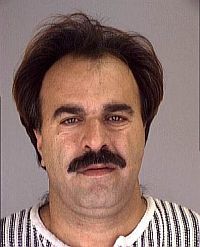
The Obama administration’s fast and furious response to the Iranian bomb plot

The GOP is clearly eager to use whatever weapons it can grab in its campaign to ensure that Obama is a one-term president. Still, it’s hard not to wonder whether there might be a connection between the fact that yesterday, Attorney General Holder leaped into the media spotlight to draw attention to an alleged assassination and bombing plot, and today he has been subpoenaed by a Congressional committee chairman. Both cases involve US surveillance of Mexican drug cartels.

Rep. Darrell Issa (R-Calif.) subpoenaed Attorney General Eric Holder on Wednesday for documents related to the “Fast and Furious” gun tracking operation.

Issa, the chairman of the House Oversight and Government Reform Committee, contends Holder knew more about the botched operation than he has told Congress. His subpoenas are directed to Holder and other senior officials at the Department of Justice.

“Top Justice Department officials, including Attorney General Holder, know more about Operation Fast and Furious than they have publicly acknowledged,” Issa said in a statement announcing the subpoenas.

“The documents this subpoena demands will provide answers to questions that Justice officials have tried to avoid since this investigation began eight months ago. It’s time we know the whole truth.”

The 22-item subpoena seeks documents and communication records between Holder, Deputy Attorney General James Cole, Assistant Attorney General Lanny Breuer, the U.S. Attorney’s office in Arizona, the Executive Office of the President employees — including the White House’s associate communications director Eric Schultz — and nearly 20 other high-ranking officials within the DOJ.

Rep. Elijah Cummings (D-Md.), the ranking Democrat on Issa’s committee, called the subpoena a “deep-sea fishing expedition” and a “political stunt.”

“This subpoena is a deep-sea fishing expedition and a gross abuse of the Committee’s authority,” said Cummings in a statement. “It demands tens of thousands of pages of highly sensitive law enforcement and national security materials that have never been requested before and are completely unrelated to Operation Fast and Furious. Rather than legitimate fact-gathering, this looks more like a political stunt.”

Under Operation Fast and Furious, the Bureau of Alcohol, Tobacco, Firearms, and Explosives (ATF) oversaw the sale of thousands of firearms to known or suspected straw buyers for Mexican drug cartels with the hope of dismantling their gun trafficking routes. But the guns weren’t given proper supervision and most of them disappeared. Two of the guns sold under the operation were found at Border Patrol Agent Brian Terry’s murder scene in Arizona last year.

On Tuesday, Holder said: “[W]hat I want the American people to understand is that in complying with those subpoenas and dealing with that inquiry, that will not detract us from the important business that we here to do at the Justice Department, including matters like the one that we have announced today.”

Meanwhile, CBS News reports:

The Obama administration was taking its case against Iran to the world Wednesday, trying to stir up an international response to charges that the Islamic republic plotted to assassinate the Saudi Arabian ambassador to the U.S.

“It’s critically important that we unite the world in the isolation of and dealing with the Iranians,” Vice President Joe Biden said on “The Early Show” Wednesday. “That’s the surest way to be able to get results.”

Mr. Obama’s top national security aides have said the administration will lobby for the imposition of new international sanctions as well as for individual nations to expand their own penalties against Iran.

The State Department sent a cable to all American embassies and consulates around the world telling them to put the Iran case before their host governments. The officials said the cable, sent late Tuesday by Deputy Secretary of State William Burns and classified secret, tells them to detail the evidence against Iran as presented by federal prosecutors.

Reza Marashi and Trita Parsi warn:

U.S.-Iran tensions have long been a powder keg, overflowing with nuclear programs, human rights abuses, Stuxnet and secret assassinations. And the alleged terror plot against the Saudi Ambassador shows how easily a single incident can spark a wider conflict. Without serious efforts to defuse a crisis that is steadily spiraling out of control, we are on the precipice of a major war in the region.

This is why a containment policy can turn into a self-fulfilling prophecy. Short of a government collapse in Tehran or strategic shift in Washington — both unlikely in the short to medium term — containment has created an environment in which adversaries repeatedly provoke one another, without having the ability to reverse any escalation.

The Obama administration must avoid falling further into this trap — particularly if there are Iranian hardliners trying to bait the U.S. into a conflict.

Even so, as Reuters reports, the administration is showing little hesitation in escalating the emerging crisis:

U.S. officials said on Wednesday it was “more than likely” that Iran’s supreme leader and the head of its Quds force knew of the alleged plot to kill the Saudi ambassador to Washington, but acknowledged the claim was based on analysis rather than hard evidence.

Muhammad Sahimi, at Tehran Bureau, points out:

[D]espite its repressive domestic policy, when it comes to dealing with the outside world, the Islamic Republic of Iran (IRI) has followed a pragmatic approach, based first and foremost on protecting itself from external physical attacks, and then on expanding its influence when and where possible. We can see this from how it dealt with and received weapons from Israel in the 1980s during the notorious Iran-Contra affair, from the pragmatic way it sat out the conflict when the U.S. and its allies attacked Iraq to expel it from Kuwait in 1990 (despite many internal voices demanding that Iran assist Saddam Hussein’s regime against the Western forces), from its arming of the Bosnian Muslims with U.S. consent during the war with the Serbs, and from the significant assistance it provided to the U.S. invasion of Afghanistan in 2001. Based on a purely cost-benefit analysis, it is extremely difficult, if not impossible, to imagine that the IRI could have benefited from such a plot as is alleged. At a time when (a) international pressure on Iran is mounting in response to its gross human rights violations, (b) the sanctions that have been imposed on Iran are showing signs of working, (c) the IRI is deeply worried about the fate of its strategic partner in Syria, the government of Bashar al-Assad, (d) tensions with Turkey are increasing over its hostile policy toward the Assad regime, and (e) a fierce power struggle is underway within Iran between the supporters of Ayatollah Ali Khamenei and President Mahmoud Ahmadinejad, it is essentially impossible to believe that the IRI would act in such a way as to open a major new front against itself.

Moreover, although the IRI has carried out assassination operations beyond Iranian borders, some of which I have described here and here, they targeted Iranian dissidents, not foreign diplomats. Even at the height of the assassination wave, the IRI did not go after non-Iranians. It is keenly aware that it is under the American microscope. It is thus hard to believe that the IRI would actually embark on such a useless assassination involving a low-level, non-player individual, dealing with people that they do not know.

Furthermore, the IRI ended its foreign assassinations in the mid-1990s. And, with a single exception more than 30 years ago, the IRI avoided carrying out any such plots on U.S. soil. The first and last such act occurred in July 1980, when Ali Tabatabaei was murdered at his home in Bethesda, Maryland, by Dawud Salahuddin, an American sympathetic to the 1979 Revolution. Tabatabaei, press attaché in the Iranian Embassy in the United States under the Shah, had joined the opposition after the Revolution. Salahuddin, who was paid $5,000 to kill Tabatabaei, currently lives in Iran.

One may argue that the targets of the operation were Saudi Arabia and Israel. But this seems even more absurd. If the IRI really intends to harm Saudi Arabia, due to the increasing tension with the Riyadh government, why should it try to do it here in the United States and in Washington? Why not attack the Saudis embassies in, for example, chaotic locations in the Middle East, such as Afghanistan, Iraq, and Yemen? Why not carry out a sabotage operation against Saudi Arabia’s oil fields in the eastern part of the country, where the Shia population is centered? That would increase the price of oil dramatically, which would benefit the IRI and hurt the fragile economies of the West.


Facebooktwittermail

The “very scary” Iranian terror plot

Glenn Greenwald writes: The most difficult challenge in writing about the Iranian Terror Plot unveiled yesterday is to take it seriously enough to analyze it. Iranian Muslims in the Quds forces sending maurading bands of Mexican drug cartel assassins onto sacred American soil to commit Terrorism — against Saudi Arabia and possibly Israel — is what Bill Kristol and John Bolton would feverishly dream up while dropping acid and madly cackling at the possibility that they could get someone to believe it. But since the U.S. Government rolled out its Most Serious Officials with Very Serious Faces to make these accusations, many people (therefore) do believe it; after all, U.S. government accusations = Truth. All Serious people know that. And in the ensuing discussion one finds virtually every dynamic typically shaping discussions of Terrorism and U.S. foreign policy.

Facebooktwittermail

Americans warned about global threat posed by used-car salesmen

Manssor Arbabsiar — used-car salesman cum terrorist-mastermind — is in detention and no longer poses a threat to the world, but the State Department wants Americans to take care when traveling overseas: there could be other dumb hustlers out there hatching dastardly plots, so the US government urges all Americans to exercise caution when traveling anywhere or even thinking about it.
The warning contains two anomalies, however:

1. It expires on January 11, 2012, just three months away. Surely the danger will persist right up until November 6, 2012. It seems imprudent to let our guard down before we’ve chosen the next president.

2. Arbabsiar is a US citizen. Don’t we need to be exercising as much if not more caution inside America. After all, who buys a used-car when overseas?

MSNBC reports: The State Department issued a worldwide travel alert late Tuesday for American citizens after the United States accused Iran of backing a plot to kill Saudi Arabia’s ambassador to Washington.

“The U.S. government assesses that this Iranian-backed plan to assassinate the Saudi ambassador may indicate a more aggressive focus by the Iranian government on terrorist activity against diplomats from certain countries, to include possible attacks in the United States,” it said in a statement on its website.

The alert, which expires January 11, 2012, urged Americans living and traveling abroad to be wary.

“U.S. citizens residing and traveling abroad should review the Department’s Worldwide Caution and other travel information when making decisions concerning their travel plans and activities while abroad,” it added.

U.S. authorities said earlier on Tuesday that they had broken up a plot by two men linked to Iran’s security agencies to assassinate Saudi Ambassador Adel al-Jubeir. One, a former Texas used-car dealer named Manssor Arbabsiar, was arrested last month while the other was believed to be in Iran.

However a friend and one-time business partner of Arbabsiar, David Tomscha, said Arbabsiar, known as Jack to his friends, made an unlikely secret agent.

Tomscha said Arbabsiar, 56, a naturalized U.S. citizen who holds an Iranian passport, was likeable, a bit lazy and “no mastermind.”

“I can’t imagine him thinking up a plan like that. I mean, he didn’t seem all that political. He was more of a businessman … He was sort of a hustler,” he said.

Meanwhile, following Attorney General Eric Holder’s dramatic announcement about the plot, a US official has provided the New York Times with additional details:

The alleged plot also included plans to pay the cartel, Los Zetas, to bomb the Israeli Embassy in Washington and the Saudi and Israeli Embassies in Argentina, according to a law enforcement official.

The plotters also discussed a side deal between the Quds Force, part of Iran’s Islamic Revolutionary Guards Corps, and Los Zetas to funnel tons of opium from the Middle East to Mexico, the official said. The plans never progressed, though, because the two suspects — the Iranian-American and an Iranian Quds Force officer — unwittingly were dealing with an informant for the Drug Enforcement Administration, officials said.

It’s quite baffling that Arbabsiar and Shakuri’s plans should have been so limited in their scope — but what a stroke of luck that the feds managed to get on to the case and play such a creative role in allowing it to unfold!

Facebooktwittermail

Obama’s October surprise?

I know an October surprise is meant to happen weeks — not a full year — before a presidential election, but if one considers the different players affected by the alleged Iranian assassination and bombing plot, President Obama is the only who comes out with a clear advantage.

Today’s news might not herald another war, but a year of increasing tension between the US and Iran could serve the interests of a president whose strongest card has turned out to be national security. With no relief in sight on the economic front, the campaign may end up turning on who we are supposed to be more comfortable with in handling an international crisis — the seasoned incumbent or a novice? At least, that’s a scenario that might look appealing to the Obama 2012 campaign right now.

“We see this as a chance to go out to capitals around the world and talk to allies and partners about what the Iranians tried to do,” a White House official tells David Ignatius. “We’re not going to tolerate targeting a diplomat in Washington. We’re going to try to use this to isolate them to the maximum extent possible.”

Meanwhile, James Traub describes how far removed such issues are from the GOP primary campaign:

The world beyond America’s borders just doesn’t figure in the 2012 campaign. In the 2008 Republican debates, candidates regularly crossed swords on the war in Iraq, the nuclear showdown with Iran, and the proper conduct of the war on terror. At this year’s first real debate, held in Manchester, New Hampshire, the rest of the world wasn’t even mentioned until more than 90 minutes into the two-hour event. “Given the focus on economic issues, it’s difficult to get the candidates interested in foreign policy,” laments Jamie Fly, head of the Foreign Policy Initiative, which acts as a transmission belt between conservative intellectuals and politicians. Audiences seem similarly apathetic. The heartiest applause often goes to libertarian Rep. Ron Paul when he calls for as little foreign policy as possible, as he did recently in Iowa during a discussion of the Middle East. His prescription: “Stay out of their internal business. Don’t get involved in these wars. And just bring our troops home.”

To the extent that the Republicans cleave to this domestic-issues-only line, an international crisis in the run up to 2012 could clearly assist Obama.

Whatever Messrs Arbabsiar and Shakuri were up to, one element has become surprisingly predictable in this type of story: each time the Justice Department announces a stunning breakthrough in preventing an act of terrorism, it turns out that federal agents were involved in the plot from early in its conception. In these undercover operations the line between investigation and instigation gets repeatedly blurred.

If the Iranian government had the serious intent to assassinate the Saudi ambassador to the United States and to do so by bombing a restaurant in Washington DC, one wonders why the breaking news was not about a plot being stymied and not instead about a horrific explosion.

The idea that Iran would outsource such an operation to a Mexican drug cartel is being viewed with appropriate skepticism.

Tim Padgett writes:

If Iranian government operatives really did try to contract a Mexican drug cartel to assassinate the Saudi ambassador to the U.S., as the Obama Administration alleges today, then they weren’t just being diabolical. They were being fairly stupid.

Granted, the Zetas – the drug mafia that Iranian-American Manssor Arbabsiar allegedly thought he was dealing with on behalf of Tehran – is certainly Mexico’s most bloodthirsty: they are the narcos that brought beheadings and wholesale massacres of innocent civilians to the nightmarish drug war scene south of the border. But even the Zetas, founded more than a decade ago by former Mexican army commandos, know better than to venture north of the border and invite the kind of U.S. law enforcement heat that a political assassination of this magnitude would have brought on them. They’re more than willing to murder high and low inside Mexico – the Zetas are the chief suspects, for example, in last year’s assassination of Tamaulipas state gubernatorial candidate Rodolfo Torre – but they’ve rarely if ever directed that kind of mayhem inside the U.S.

And for good reason: they’ve experienced the vast difference between cops, prosecutors and judges in Mexico, whom they can buy off or kill with impunity, and the U.S. judicial system. In 2005 and 2006, for example, Zetas murdered at least five rival gangsters in Laredo, Texas, just across the border from one of their strongholds, Nuevo Laredo, Mexico. A number of Zetas were arrested and prosecuted as a result and sent away to U.S. prisons – which are a lot harder to break out of than Mexican penitentiaries are, and where you can’t live the comfortable life that drug lords make for themselves inside Mexican lockups. Zeta leaders like Heriberto Lazcano, aka El Verdugo, or The Executioner, learned fairly quickly that the world across the Rio Grande was a different ballgame – and that if they didn’t want to jeopardize their lucrative drug distribution networks in the U.S., it was best to avoid bloodshed there as well.

And then there is the most basic question: how could Iran possibly benefit if this plot had been carried out?

Max Fisher writes:

What would it really mean for Iran if the Saudi ambassador to the U.S. were killed in a terrorist attack in Washington? The U.S.-Saudi relationship has been bad and getting worse since the start of the Arab Spring, with the Saudi monarchy working increasingly against the democratic movements that the U.S. supports. A senior member of the royal family even threatened to cut off the close U.S.-Saudi relationship if Obama opposed the Palestinian statehood bid, which he did. If the U.S. and Saudi Arabia really broke off their seven-decade, oil-soaked romance, it would be terrific news for Iran. Saudi Arabia depends on the U.S. selling it arms, helping it with intelligence, and overlooking its domestic and regional (see: Bahrain) abuses.

If the U.S.-Saudi alliance fell apart, the Shia-majority Islamic Republic of Iran would have an easier time pushing its regional influence against Saudi Arabia, especially in some of the crucial states between the two: Iraq, Bahrain, and the United Arab Emirates. Iran would be able to reverse its increasing regional isolation and perhaps flip some Arab leaders from the U.S.-Saudi sphere toward its own. The best part of this, for Iran, is that it probably wouldn’t even have to do anything: the U.S.-Saudi special relationship, if it collapses, would do so without Iran having to lift a finger. The dumbest thing that Iran could possibly do, then, would be stop the collapse, to find some way to bring the U.S. and Saudi Arabia back together. For example, by attempting to blow up the Saudi ambassador to the U.S. on American
soil.

The Iranian leadership, for all their twisted human rights abuses and policies that often serve the regime at the cost of actual Iranians, are not idiots.

Facebooktwittermail

Israel, Hamas reach Gilad Shalit prisoner exchange deal, officials say

Haaretz reports: Israel and Hamas have reached a prisoner exchange deal that will secure the release of abducted Israel Defense Forces soldier Gilad Shalit, officials at Prime Minister Benjamin Netanyahu’s office said on Tuesday.

Officials in the Prime Minister’s Office said that “a brief window of opportunity has been opened that would possibly lead to Gilad Shalit’s homecoming,” adding: “The window appeared following fears that collapsing Mideast regimes and the rise of extremist forces would make Gilad Shalit’s return impossible.”

The officials’ comment came following a report by Al-Arabiya, according to which a deal has indeed been reached between Israel and Hamas geared at the release of the IDF soldier, in Hamas captivity in Gaza since 2006.

Netanyahu and Defense Minister Ehud Barak are meeting several ministers in the Prime Minister’s Office in order to pressure them into voting for the deal, with Netanyahu aides estimating that the deal will be approved by the cabinet,

Special attention is reportedly being given to Foreign Minister Avigdor Lieberman no to vote against the deal along with ministers from his Yisrael Beiteinu party. Several Likud ministers who have voiced opposition to freeing terrorists in exchange for Shalit are also being pushed to approve the deal.

Netanyahu called an emergency cabinet meeting scheduled for later Tuesday in which ministers are to discuss the status of talks geared at securing Shalit’s release.

Speaking with Haaertz, one Egyptian official said: “After 64 months of tough negotiations we were able to complete the deal. It was a very difficult task, which included thousands of hours of negotiations.”

Also on Tuesday, top Egyptian officials confimed to Haaretz that there had been significant progress in the attempts to strike a prisoner exchange deal that would lead to Shalit’s release.

The officials confirmed that an Israeli delegation, headed by the head of Shalit negotiations David Meidan, was in Cairo to indirectly discuss the details of a possible deal with the chief of Hamas’ military wing Ahmed Al-Jabari.

Similarly to previous rounds of Shalit talks, the indirect talks are overseen by Egyptian intelligence, headed by intelligence chief General Murad Muwafi and his aides.

Egyptian officials have also said that a the deal which has been reached in recent days also includes accused Israeli spy Ilan Garpal.

Activists linked to Palestinian prisoner rights in Israel have also indicated that a recent hunger strike amid those prisoners in Israeli jails was linked to the protest move, as well as the reason Hamas prisoners did not join the strike.

Marwan Barghouti, who has been referred to as “Palestine’s Mandela” and who has been imprisoned since 2002, is reported to be on the list of prisoners to be released.

Facebooktwittermail

American and Israeli exceptionalism

Foreign Policy‘s latest issue looks at American exceptionalism and Stephen Walt writes:

Over the last two centuries, prominent Americans have described the United States as an “empire of liberty,” a “shining city on a hill,” the “last best hope of Earth,” the “leader of the free world,” and the “indispensable nation.” These enduring tropes explain why all presidential candidates feel compelled to offer ritualistic paeans to America’s greatness and why President Barack Obama landed in hot water — most recently, from Mitt Romney — for saying that while he believed in “American exceptionalism,” it was no different from “British exceptionalism,” “Greek exceptionalism,” or any other country’s brand of patriotic chest-thumping.

Most statements of “American exceptionalism” presume that America’s values, political system, and history are unique and worthy of universal admiration. They also imply that the United States is both destined and entitled to play a distinct and positive role on the world stage.

The only thing wrong with this self-congratulatory portrait of America’s global role is that it is mostly a myth. Although the United States possesses certain unique qualities — from high levels of religiosity to a political culture that privileges individual freedom — the conduct of U.S. foreign policy has been determined primarily by its relative power and by the inherently competitive nature of international politics. By focusing on their supposedly exceptional qualities, Americans blind themselves to the ways that they are a lot like everyone else.

No doubt it behooves Americans to recognize the things that tie this country to the rest of the world, but there is an aspect of exceptionalism Walt does not touch upon — one that sets apart American and Israeli exceptionalism from most others: the exceptionalism of colonizers.

Nations that come into existence by dispossessing, imprisoning and slaughtering the indigenous population have two problems with history:

1. Its ugliness makes it hard to glorify.
2. Its shortness exposes the tenuousness of any claim that this is “our land”.

Others look back at their national history and can trace a rich tapestry of events, places, and people in which the contours of their nation have over the preceding centuries been carved by culture and inscribed in geography. All around are stepping stones that lead into the near, middling, distant, and sometimes ancient past. The punctuations of history rest on a continuum.

If without sentiment we look back into our ancestry as Americans or Israelis, we see migrants and murderers fast preceded by a void. Our actual roots in abandoned lands take us far away from the very thing that supposedly makes us exceptional.

With histories much harder to glorify, we find the need to make our pasts less linear and more mythically grandiose. We ignore the catastrophes that we imposed on others. We didn’t steal the land; it was a gift from God.

Facebooktwittermail

Panic of the plutocrats as Occupy Wall Street heads for their castles

Paul Krugman writes: It remains to be seen whether the Occupy Wall Street protests will change America’s direction. Yet the protests have already elicited a remarkably hysterical reaction from Wall Street, the super-rich in general, and politicians and pundits who reliably serve the interests of the wealthiest hundredth of a percent.

And this reaction tells you something important — namely, that the extremists threatening American values are what F.D.R. called “economic royalists,” not the people camping in Zuccotti Park.

Consider first how Republican politicians have portrayed the modest-sized if growing demonstrations, which have involved some confrontations with the police — confrontations that seem to have involved a lot of police overreaction — but nothing one could call a riot. And there has in fact been nothing so far to match the behavior of Tea Party crowds in the summer of 2009.

Nonetheless, Eric Cantor, the House majority leader, has denounced “mobs” and “the pitting of Americans against Americans.” The G.O.P. presidential candidates have weighed in, with Mitt Romney accusing the protesters of waging “class warfare,” while Herman Cain calls them “anti-American.” My favorite, however, is Senator Rand Paul, who for some reason worries that the protesters will start seizing iPads, because they believe rich people don’t deserve to have them.

Michael Bloomberg, New York’s mayor and a financial-industry titan in his own right, was a bit more moderate, but still accused the protesters of trying to “take the jobs away from people working in this city,” a statement that bears no resemblance to the movement’s actual goals.

And if you were listening to talking heads on CNBC, you learned that the protesters “let their freak flags fly,” and are “aligned with Lenin.”

The way to understand all of this is to realize that it’s part of a broader syndrome, in which wealthy Americans who benefit hugely from a system rigged in their favor react with hysteria to anyone who points out just how rigged the system is.

The New York Daily News reports: Occupy Wall Street protesters are heading uptown Tuesday to get in the face of some of New York’s richest tycoons.

A “Millionaires March” will visit the homes – or, more realistically, the gleaming marble lobbies – of five of the city’s wealthiest residents, including News Corp. CEO Rupert Murdoch, JPMorgan Chase CEO Jamie Dimon and conservative billionaire David Koch.

Marchers want to present the moguls with oversize checks to dramatize how much less they will pay when New York State’s 2% tax on millionaires expires in December.

“Ninety-nine percent of the residents of New York are going to suffer from this tax giveaway so the 1% who already live in absolute luxury can put more money in their pockets,” said Doug Forand, one of the march organizers.

“This is fiscally, economically and morally wrong.”

Gov. Cuomo staunchly opposes calls from his fellow Democrats to renew the tax, which generates up to $5 billion per year in much-needed revenue. He says he fears the rich will move away.

Day 24 of the chaotic, festive protest in Zuccotti Park saw a demonstration by schoolchildren who sang songs and waved signs saying “Money for Schools Not War,” a Native American protest against Columbus Day and a brief frenzy over the arrival of hip-hop icons Kanye West and Russell Simmons.

Facebooktwittermail

U.N. finds ‘systematic’ torture in Afghanistan

Is this why President Obama banned torture? Just so that American hands could remain clean while its allies used torture techniques even more gruesome than the kind George Bush and Dick Cheney approved?

The New York Times reports: Detainees are hung by their hands and beaten with cables, and in some cases their genitals are twisted until the prisoners lose consciousness at sites run by the Afghan intelligence service and the Afghan National Police, according to a United Nations report [PDF] released here on Monday.

The report, based on interviews over the past year with more than 300 suspects linked to the insurgency, is the most comprehensive look at the Afghan detention system and an issue that has long concerned Western officials and human rights groups.

It paints a devastating picture of abuse, citing evidence of “systematic torture” during interrogations by Afghan intelligence and police officials even as American and other Western backers provide training and pay for nearly the entire budget of the Afghan ministries running the detention centers.

The report does not assess whether American officials knew of the abuses. But such widespread use of torture in a detention system supported by American mentors and money raises serious questions about potential complicity of American officials and whether they benefited from information obtained from suspects who had been tortured.

Facebooktwittermail

Libya: Sirte battle flushes out pro-Gaddafi fighters

Peter Beaumont reports: The stories of some of those inside Ibn Sana hospital in Sirte do not add up. Hamad Ashrak Ali from Sudan is lying on a bed in the hospital’s basement. He shows us his wound before explaining the circumstances of it. He has been shot through the side. The bullet exited through one buttock – the wound is becoming septic.

He says he came from Abyei in his own country to Sirte to earn money: “I thought I could earn money here by loading trucks.”

He does not explain why he chose Gaddafi’s hometown in particular and claims at first to have been in the hospital with his wound for 50 days.

But his wound is relatively recent, the muscles still pronounced. He has not spent almost two months in a hospital bed.

“Kids were doing handbrake turns,” – doughnuts, he calls them. “Someone fired a gun and I was shot.” He is asked again how long he has been in hospital. He changes his story. “Since April,” he says.

A bearded fighter from the forces of the NTC suggests quietly that Hamad is lying. Other fighters say they have a list and know who are the mercenaries and pro-Gaddafi fighters in the hospital.

Not far away an emaciated man struggles up from his bed, stick thin.

Other patients in this dreadful place seem comatose, afflicted with wounds long gone rotten, people in desperate need of evacuation.

But for now there is nowhere for them to go.

Not even the Red Cross has been able to evacuate the bombed out hospital. The nearby field hospitals are full, as is the hospital in Misrata. So they are stuck in this shattered shell.

Outside on the street, a three-car convoy drives by towards the Ouagadougou conference centre.

Skinny men with dark-skinned, emaciated faces are packed into two cars, with more sitting slumped in open boots.

Recent deserters from the pro-Gaddafi forces, who have been fighting to defend this city for a fallen and defeated regime, they are guarded by NTC fighters in the final car.

As the new government force push forward from the east and west towards the sea, life in Gaddafi’s home town and in his second capital is revealed.

The pro-Gaddafi forces – for so long invisible in their positions, where they have poured down fire on the advancing fighters – have been revealed for what they are. Ordinary men, frightened, who now want only to survive by surrendering, hiding in the hospital or trying to escape with fleeing civilians.

Time reports: An official on Libya’s governing council said Monday that he believes Muammar Gaddafi is hiding in the southwestern desert near the borders with Niger and Algeria, but denied allegations that the Tuareg minority ethnic group is protecting the fugitive leader.

Moussa al-Kouni, who is a Tuareg representative on the revolution’s leadership body, claimed Gadhafi had sent his son Khamis to the area to set up a radio station and make preparations for a possible escape route two months before Tripoli fell to revolutionary forces in late August.

Al-Kouni provided no evidence, saying he based his assertion on the fact that the Gadhafi regime had used the area before because it has rough terrain and porous borders that would make detection difficult. He also pointed out that Gadhafi had cultivated close ties with the Niger government and could even be going back and forth across the border.

“As far as I am aware, Gadhafi is in that region … on the border with Niger,” he told reporters in Tripoli, adding that Gadhafi could get safe passage through Niger to Mali, where he allegedly has a house in Timbuktu. Niger has put Gadhafi’s son al-Saadi under house arrest.

Facebooktwittermail

‘This is not religious strife, this is state sponsored terrorism’

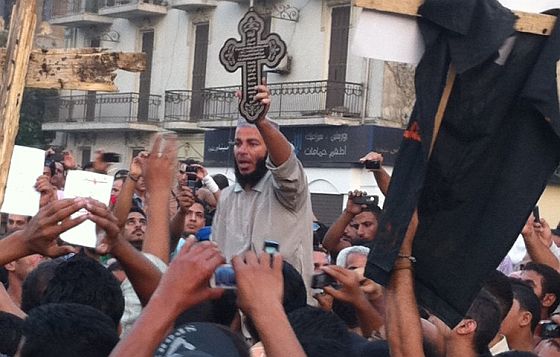
Hani Bushra describes his experience of the violence in Cairo on Sunday night and points to evidence of the ways it was choreographed by state security services intent on fomenting sectarian conflict. “Christians where are you, Islam is here,” was the chant the mobs had been fed. And as these mobs hunted down their victims, innocent people were accused of carrying concealed weapons. (H/t Issandr El Amrani.)

The people marching were chanting “Christians and Muslims are one Hand” and I was leading them in saying that. I met with Alaa of manalaa.com and we continued to march towards Maspero.

The group was peaceful, and I was taking pictures using my Ipad. We reached the point where the 6th October bridge exits towards Maspero, and there was a large cordon of police who are members of the Central Security Forces (CSF). There, I was told not take pictures by people wearing civilian clothing and I fought back saying it was my right.

I began to walk back towards Hilton Ramsis, and suddenly 5 vehicles full of CSF soldiers showed up. People began to pelt them with rocks, destroying the wind shields, and the causing the drivers of the vehicles to panic, thereby hitting into each other and the sides of the road. I and some other people were trying to calm people down into not attacking the vehicles but the people were angry.

At that point, I was alone, and so I began to walk back to Tahrir. I was tweeting at that time. Someone saw me tweeting and came to me. He asked my name and so I said Hani Sobhi, he then grabbed my wrists to see if I had a cross tattoo, and when he did not find it, he asked for my full name. I said Hani Sobhi Bushra. He asked if I was a Muslim or a Christian, and I said that I was a Christian.

At that point he began to scream for others that he caught a Christian, and people began to gather. They wanted to search me and my bag, and I said that I will not let them, and that it was best to go to an officer. At that point there was about 30 people around me, with some of them punching me on my head.

I began to walk quickly to the cordon of the police that I had just came from. At that point, someone yanked my gold chain from across my neck and took the cross. All I did was to tell him “wow, you are such a man” and I clapped for him. That pissed the people who were with me, and so someone snatched my phone from my belt.

I kept shouting at the thief to give me my phone back, and he said that he will give it to me in front of the police officer. By that time, I was being hit from many people, my ankle was sprained and I was called a “Nossrani (Christian)” dog.

We reached the officer (rank of general), and the first thing that I did was to show him my U.S. passport and told him that I am now under his protection. I told him that I was attacked because I was a Christian. One of the men who is a policeman but wearing civilian clothing began to talk to the general that I was a Christian and that I institigated the mob to attack me and that I am carrying weapons in my bag. The officer, who had seen my passport, told him to shut up. This policeman in the civilian clothing seemed to be the coordinator between the mob and the police.

Facebooktwittermail

Wall Street is occupying our planet

Bill McKibben speaking at Occupy Wall Street at Washington Square Park on Saturday: Today in the New York Times there was a story that made it completely clear why we have to be here. They uncovered the fact that the company building that tar sands pipeline was allowed to choose another company to conduct the environmental impact statement, and the company that they chose was a company was a company that did lots and lots of work for them. So, in other words, the whole thing was rigged top to bottom and that’s why the environmental impact statement said that this pipeline would cause no trouble, unlike the scientists who said if we build this pipeline it’s “game over” for the climate. We can’t let this pipeline get built.

On November 6, one year before the election, we’re going to be in DC with a huge circle of people around the White House and they’re going to be carrying signs with quotations from Barack Obama from the 2008 campaign. He said, “It’s time to end the tyranny of oil.” He said, “I will have the most transparent government in history.” We have to go to DC to find out where they have locked that guy up. We have to free Obama, because there is some sort of stunt double there now. So on November 6, I hope we can move, just for a day, Occupy Wall Street down to the White House and get them in the fight against corporate power.

The reason that it’s so great that we’re occupying Wall Street is because Wall Street has been occupying the atmosphere. That’s why we can never do anything about global warming. Exxon gets in the way. Goldman Sachs gets in the way. The whole fossil fuel industry gets in the way. The sky does not belong to Exxon. They cannot keep using it as a sewer into which to dump their carbon. If they do, we’ve got no future and nobody else on this planet has a future.

I spend a lot of time in countries around the world organizing demonstrations and rallies in solidarity. In the last three years at 350.org, we’ve had 15,000 rallies in every country except North Korea. Everywhere around the world, poor people and black people and brown people and Asian people and young people are standing up. Most of those places, don’t produce that much carbon. They need us to act with them and for them, because the problem is 20 blocks south of here. That’s where the Empire lives and we’ve got to figure out how to tame it and make it work for this planet or not work at all.

Thank you guys very much.

Facebooktwittermail

If you want to live the American dream, move to Denmark

AlterNet reports: Americans may be deeply divided about what ails our country, but there’s no denying we’re a nation of unhappy campers.

Danes, on the other hand, consistently rank as some of the happiest people in the world, a fact attributed at least in part to Denmark’s legendary income equality and strong social safety net.

Forbes recently cited another possible factor; the Danes’ "high levels of trust." They trust each other, they trust ‘outsiders,’ they even trust their government. 90% of Danes vote. Tea party types dismiss Denmark as a hotbed of socialism, but really, they’re just practicing a more enlightened kind of capitalism.

In fact, as Richard Wilkinson, a British professor of social epidemiology, recently stated on PBS NewsHour, "if you want to live the American dream, you should move to Finland or Denmark, which have much higher social mobility."

While we debate whether climate change is real and a tax on unhealthy foods is nanny state social engineering, the Danish are actually trying to address these problems head on.

They can afford to, because they don’t spend all their waking hours worrying about whether they’re about to lose their job, or their house, or how they’re going to pay their student loans, or their health insurance premiums.

Facebooktwittermail

In Egypt the days of military rule are numbered

Sandmonkey writes: Today the mood in Cairo was wary & melancholic. With the reality of what went down yesterday at Maspero hitting them with its full might, the general population that yesterday found itself on the brinks of chaos is utterly terrified. The number of phone calls I received from people who were worried and horrified made me wish I could shut off my phone, with everyone looking at the future with an incredibly bleak outlook. It’s easy to fall into that mood — after all you have your army killing your people, a long oppressed minority of it at that — but if one looks beyond what happened, one sees a very different picture. What happened yesterday was the beginning of the end of the military rule over Egypt: The days of the SCAF ruling us are numbered. And not because they don’t want to, but because they will no longer have any other choice.

A quick recap over what has went down yesterday: a huge demo held by Coptic Christians & muslim supporters protesting against yet another fight over the building of a Church was attacked by the Egyptian armed forces there to protect it and plainclothed thugs. Shots were fired at protesters killing them, rocks were thrown by protesters in return, protesters were overrun by armored vehicles, the Egyptian State TV issued a plea asking Egyptian citizens to come to the Demo and “protect the army from Christian thugs”, and a street battle that resulted in over 24 dead and 150 injured. The street battle after a while turned into Egyptian citizens fighting each other, without any of them being able to figure out who was fighting who. Pandemonium, for a lack of a better word.

But the moment the dust settled the questions started presenting themselves: This was obviously planned, so what the hell was the SCAF thinking? How could they attack and kill Egyptians on the street so casually, while their sole purpose is to protect them from getting killed? How could they risk enflaming the country into a huge sectarian battle by having state Media so conscientiously attacking the Christians and promoting violence against them? How did they not see that the choice they made is an inherently flawed one that it could spell their doom? How do you explain last night?

Well, the easy explanation is that they — like every single political force in the country throughout this year — fell into the trap of thinking that they have won and asserted their power, only to have the whole thing blow up in their faces. After believing the political street to be dead, and that the revolution is almost dying, they figured they now have the power to put “people in their proper place” like the old days. So, they went down yesterday to terrorize the Christians, counting that they won’t put up a fight (because they never really did before), and that the sectarian rhetoric will cause them all to fear for their lives, stop them from causing trouble, and quite possibly scare them from participating in the elections. With every single respectable political party formed after the revolution having prominent Christians in their founders and as their candidates, they figured that threatening us with the possibility that the next election will turn into a Muslim vs. Christian election will discourage people from voting and participating, leaving the new parties with fewer seats, with the Christians being underrepresented as always in the parliament, and thus allowing the ex NDP people control of the Parliament as the only other choice against the “Islamists”. To basically return us to the pre-revolution status quo. But had they thought this through for more than 5 minutes, they might have seen the inherent flaws in their old-and-reliable plan. They, somehow, didn’t and now they have overplayed their hand and about to face the consequences.

Facebooktwittermail

Egyptians call for end of military rule

Muslims and Christians unite in protest against Egypt's military council

Al-Masry Al-Youm reports: In the wake of Sunday’s violence between Coptic demonstrators and military forces in Cairo, political party leaders and activists called for an immediate transfer of power to civilian authorities, the establishment of a civilian presidential council to help manage the transition period, and the dismissal of Prime Minister Essam Sharaf’s government.

In a conference Monday morning, politicians criticized the security vacuum as well as the state media’s deceptive coverage of the violence.

The conference drew public figures from across the political spectrum, from billionaire telecom tycoon-turned liberal politician Naguib Sawiris to Amin Iskandar, secretary general of the Nasserist Karama Party. Former Finance Minister Samir Radwan and Hossam Eissa, a constitutional law expert, were also present.

Twenty-five protesters died, according to the Health Ministry, when a march by Copts was attacked by thugs and military forces. The march started in the largely Christian neighborhood of Shubra to protest against attacks on Christians, most notably a recent attack on a church in the Upper Egyptian city of Aswan, which resulted from the construction of a dome.

The military prosecution began to investigate 25 suspects on Monday.

“We as Egyptians are facing a problem. It’s not a Coptic and Muslim problem. It’s not a military or civilians problem, but it’s a problem in Egypt’s flawed society and inter-relations. This could end up in a civil war,” said Amr Moussa, a potential presidential candidate and former foreign minister under Mubarak.

Moussa stressed the importance of ruling with an iron-fist in order to protect the country from looming chaos.

Meantime, Abdel Gelil Mostafa, leader of the National Association for Change, slammed the Mubarak-like rule of the Supreme Council of Armed Forces (SCAF), describing it as “semi-divine.”

Speakers at the conference issued calls for a civilian council to serve as Egypt’s executive authority, instead of SCAF, echoing demands made by Mohamed ElBaradei and other secular political figures shortly after Mubarak stepped down in February.

Ursula Lindsey writes: The automatic goverment agit-prop on this is almost as bad as the deaths. Every single (Arabic language) Egyptian newspaper with the exception of Tahrir newspaper led with stories and images today that emphasized the violence on the part of the demonstrators, not the army. Al Ahram’s disingenuous headine reads: “Twenty-Four Soldiers and Demonstrators Dead.” It really is a full return to the days of the revolution.

Facebooktwittermail

The class warfare the rich don’t understand

Heather Digby Parton writes: There have been rumblings in the corners of the Tea party movement for some time, but the minute president Obama announced that he was going to ask wealthy Americans to kick in a small bit more in taxes to help pay for some infrastructure improvements in his jobs proposal, the Republicans have been clutching their pearls and gasping for breath like Aunt Pittypat awaiting the arrival of the marauding Yankees.

GOP leader Rush Limbaugh called for the smelling salts, saying “If [Obama] would get all of this actually passed, it would represent perhaps a fatal blow to the US private sector … I don’t know how anyone could even argue about the fact that this is on purpose anymore. To boldly lie that it’s not class warfare? It is class warfare. Specifically and purposefully class warfare.”

Republican economic guru Paul Ryan dolefully declared, “Class warfare may make for good politics, but it makes for rotten economics. We don’t need a system that seeks to divide people. We don’t need a system that seeks to prey on people’s fear, envy, and anxiety.” Indeed. What could be more destructive to the average American than to ask the upper one per cent to kick in what amounts to tip money? The guilt they will feel at such unfairness is bound to create a profound spiritual crisis throughout the land.

One would have thought that in 2011, the term “class warfare” would be as out of fashion as Nehru jackets, but after watching the Republicans spend the first two years of Obama’s presidency apoplectic over what they defined as hard core socialism put in practice, it stands to reason the old standard would make a comeback. No matter what you call it, rich people complaining about taxes is evergreen. It is also completely ridiculous.

The fact is that the mega-rich have been gobbling up a greater and greater share of the national wealth for several decades now: in 1976 the top 1 per cent of households received 8.9 per cent of all pre-tax income – by 2008, its share had more than doubled to 21.0 per cent. Between 1979 and 2009, the top 5 per cent of American families saw their real incomes increase 72.7 per cent, according to Census data. Over the same period, the lowest-income fifth saw a decrease in real income of 7.4 per cent (by contrast, the 1947-79 period all income groups saw similar income gains, with the lowest income group actually seeing the largest gains). And perhaps most astonishingly, the tax rate for the highest earners was 91 per cent in 1960, 70 per cent in 1980 and only 35 per cent today, the lowest ever with the exception of a couple of years in the late 80s and early 90s.

And it’s not as if these people have been suffering during this recession. Unlike the bottom 99 per cent, they’ve quite smartly recovered from the 2008 unpleasantness. For instance, according to a recent New York Times report, executive pay at 200 big US companies last year went up by an average 23 per cent over 2009 – the median executive salary was 10.8m USD. Meanwhile, the average American family’s household net worth declined 23 per cent between 2007 and 2009.

Facebooktwittermail

Scientists’ analysis disputes FBI closing of anthrax case

The New York Times reports: A decade after wisps of anthrax sent through the mail killed 5 people, sickened 17 others and terrorized the nation, biologists and chemists still disagree on whether federal investigators got the right man and whether the F.B.I.’s long inquiry brushed aside important clues.

Now, three scientists argue that distinctive chemicals found in the dried anthrax spores — including the unexpected presence of tin — point to a high degree of manufacturing skill, contrary to federal reassurances that the attack germs were unsophisticated. The scientists make their case in a coming issue of the Journal of Bioterrorism & Biodefense.

F.B.I. documents reviewed by The New York Times show that bureau scientists focused on tin early in their eight-year investigation, calling it an “element of interest” and a potentially critical clue to the criminal case. They later dropped their lengthy inquiry, never mentioned tin publicly and never offered any detailed account of how they thought the powder had been made.

The new paper raises the prospect — for the first time in a serious scientific forum — that the Army biodefense expert identified by the F.B.I. as the perpetrator, Bruce E. Ivins, had help in obtaining his germ weapons or conceivably was innocent of the crime.

Both the chairwoman of a National Academy of Science panel that spent a year and a half reviewing the F.B.I.’s scientific work and the director of a new review by the Government Accountability Office said the paper raised important questions that should be addressed.

Alice P. Gast, president of Lehigh University and the head of the academy panel, said that the paper “points out connections that deserve further consideration.”

Dr. Gast, a chemical engineer, said the “chemical signatures” in the mailed anthrax and their potential value to the criminal investigation had not been fully explored. “It just wasn’t pursued as vigorously as the microbiology,” she said, alluding to the analysis of micro-organisms. She also noted that the academy panel suggested a full review of classified government research on anthrax, which her panel never saw.

In interviews, the three authors said their analysis suggested that the F.B.I. might have pursued the wrong suspect and that the case should be reopened. Their position may embolden calls for a national commission to investigate the first major bioterrorist attack in American history.

Facebooktwittermail

China’s debt pileup raises risk of hard landing

Reuters reports: When China announced a nearly $600 billion package to ward off the 2008 global financial crisis, city planners across the country happily embarked on a frenzy of infrastructure projects, some of them of arguable need.

Chengdu, the capital of southwestern Sichuan province, answered the call for stimulus action with a bold plan for a railway hub modeled after Waterloo railway station in London.

Except London’s Waterloo was not ambitious enough.

“I was shocked when I finally got to visit Waterloo. It was so small,” said Chen Jun, a director at Chengdu Communications Investment Group, which built the new Chinese terminal. “I realized we would probably need a station a few times bigger to meet the demands of our city.”

In a manner typical of many infrastructure projects in China, Chengdu more than doubled the size of its planned transport hub, borrowed 3 billion yuan ($473 million) from a state bank to finance it, then set out on a blistering construction timeline that saw the finishing touches put on the project two years later.

But instead of getting the accolades they expected for helping to stimulate the economy, Chengdu Communications and many of China’s 10,000 local government financing vehicles (LGFV) have now come under a harsh spotlight for the grim side-effects of the construction binge.

China’s local governments have piled up a mountain of bad debt, some of it to finance bridges to nowhere and other white elephant projects, which now threatens to constrict growth at a time when the global economy is sputtering. It is adding to other systemic risks in China, including a sharp downturn in the property market and a rapid rise in problematic loans.

Facebooktwittermail