‘Land swaps’: is there enough land to swap?

Nathan Jeffay reports:

It is the magic formula that could end the occupation while letting the majority of settlers stay put. But how would an Israeli-Palestinian land swap, the basis of President Obama’s Middle East vision, outlined on May 19, actually work?

The main practical problem of an Israeli withdrawal from the West Bank is the fact that some 300,000 Israeli settlers live there. Not only would a full evacuation be hazardous for any Israeli government on the domestic political front, but it also would be logistically difficult and exceedingly costly.

The solution Obama talked about, one that is “based on the 1967 lines with mutually agreed swaps,” means that Israel would hold on to some settled areas that it captured in 1967 and compensate the Palestinians with land that currently falls under Israeli sovereignty.

Even if Israeli Prime Minister Benjamin Netanyahu endorses the principle, a problem remains. Every Israeli leader insists on retaining the large settlement blocs — usually defined at a minimum as the Etzion Bloc, Modi’in Illit, Ma’ale Adumim, and Givat Ze’ev and its surroundings — and the national consensus in support of this position is strong. But in Israel, many experts say there simply isn’t enough free land under Israeli sovereignty to exchange for them.

Facebooktwittermail

Threat of violence keeps police out of Jerusalem Haredi neighborhood

Haaretz reports:

Police are reluctant to enter the ultra-Orthodox Jerusalem neighborhood of Mea She’arim because of residents’ violence, a police spokesman said during a recent court hearing over the remand of a neighborhood resident.

A police official said in court Thursday that the reason the police had not arrested a wanted man for more than a month, despite knowing where in Mea She’arim he was, was that every time they go into the neighborhood police property is damaged and they do not want unnecessary confrontations.

Police issued an arrest warrant on April 13 for Shalom Baruch Roset, who is accused of assault, property damage and making threats.

The official said police have “often tried to detain suspects for questioning” who belong to the same group as Roset, with the result that “we were attacked and the station chief sustained a head injury as a result of a stone thrown at him.”

He added that efforts to send police patrols into the neighborhood have “failed.”

Facebooktwittermail

Egypt-Gaza border opening turns out to be less than billed

McClatchy reports:

Mufid al Masry, 46, was so excited about his first trip to Egypt that he couldn’t sleep the night before he set out for the Rafah border crossing, which Egypt’s ruling military council ordered opened Saturday under new hours and fewer restrictions for Palestinian travelers.

So when Egyptian border guards rejected him, citing security concerns, Masry grew belligerent as other Palestinians at the terminal watched in sympathetic silence. An officer ordered him to stop shouting, which only made Masry angrier.

“I’ve been locked in Gaza for the past seven years and just wanted a breath of fresh air!” he said. “If you were locked up for seven years, wouldn’t you be yelling like me?”

The Egyptian government’s decision to permanently open its border with Hamas-controlled territory was heralded — or feared — as a sign of a new Egypt, one willing to risk U.S. and Israeli rebukes to provide a lifeline to Gaza’s 1.5 million residents and to break from the policies of toppled President Hosni Mubarak.

But Saturday’s landmark opening of the Rafah crossing ended with a fizzle.

By dusk, just 400 Palestinians had crossed into Egypt, and another 30 were turned back because their names appeared on a security “blacklist,” according to a senior Egyptian border officer who spoke on condition of anonymity because he wasn’t authorized to make public statements. About 150 Palestinians returned to Gaza from Egypt.

Facebooktwittermail

Surprise turn against Gaddafi is Russia’s latest westward step

Max Fisher writes:

Russia, a quasi-democracy and an imperial power that never quite gave up all of its colonial holdings, has dedicated much of its post-Soviet foreign policy to resisting everything that the NATO intervention in Libya stands for. It shrugs at human rights violators, abhors military intervention, enshrines the sovereign right of states to do whatever they want internally without fear of outside meddling, and above all objects to the West imposing its ideology on others. NATO itself, after all, is a military alliance constructed in opposition to the Soviet Union. But Russian President Dmitri Medvedev took a surprising break from Russian foreign policy precedent on Friday when, in the middle of a G8 summit in France, he declared that Libyan leader Muammar “Qaddafi has forfeited legitimacy” and that Russia plans “to help him go.”

For Libya, Russia’s call for Qaddafi to go is more than just symbolic. Russia abstained from the original UN Security Council resolution authorizing the no-fly zone, but was reportedly upset that NATO states stretched the resolution to launch an extended bombing campaign. Russia’s angry reaction, it was widely assumed, meant it might outright veto any future Security Council measures on Libya. But Medvedev’s recent statement makes clear that his government supports the implicit goal of the air strikes — regime change in Libya — and would not block further action toward that end. If Qaddafi had hoped that he might outlast the Security Council’s will to fight, he is clearly nowhere close. The window for him to leave the country peacefully remains open, but is clearly closing quickly.

Facebooktwittermail

Libya’s Goldman dalliance ends in losses, acrimony

The Wall Street Journal reports:

In early 2008, Libya’s sovereign-wealth fund controlled by Col. Moammar Gadhafi gave $1.3 billion to Goldman Sachs Group to sink into a currency bet and other complicated trades. The investments lost 98% of their value, internal Goldman documents show.

What happened next may be one of the most peculiar footnotes to the global financial crisis. In an effort to make up for the losses, Goldman offered Libya the chance to become one of its biggest shareholders, according to documents and people familiar with the matter.

Negotiations between Goldman and the Libyan Investment Authority stretched on for months during the summer of 2009. Eventually, the talks fell apart, and nothing more was done about the lost money.

An examination of the strange episode casts light on a period of several years when Goldman and other Western banks scrambled to do business with the oil-rich nation, now an international pariah because of its attacks on civilians during its current conflict. This account of Goldman’s dealings with Libya is based on interviews with close to a dozen people who were involved in the matter, and on Libyan Investment Authority and Goldman documents.

Libya was furious at Goldman over the nearly total loss of the $1.3 billion it invested in nine equity trades and one currency transaction, people involved in the matter say. A confrontation in Tripoli between a top fund executive and two Goldman officials left the bankers so rattled that they made a panicked phone call to their bosses, these people say. Goldman arranged for a security guard to protect them before they left Libya the next day, they say.

Facebooktwittermail

Cyber combat: act of war

The Wall Street Journal reports:

The Pentagon has concluded that computer sabotage coming from another country can constitute an act of war, a finding that for the first time opens the door for the U.S. to respond using traditional military force.

The Pentagon’s first formal cyber strategy, unclassified portions of which are expected to become public next month, represents an early attempt to grapple with a changing world in which a hacker could pose as significant a threat to U.S. nuclear reactors, subways or pipelines as a hostile country’s military.

In part, the Pentagon intends its plan as a warning to potential adversaries of the consequences of attacking the U.S. in this way. “If you shut down our power grid, maybe we will put a missile down one of your smokestacks,” said a military official.

Recent attacks on the Pentagon’s own systems—as well as the sabotaging of Iran’s nuclear program via the Stuxnet computer worm—have given new urgency to U.S. efforts to develop a more formalized approach to cyber attacks. A key moment occurred in 2008, when at least one U.S. military computer system was penetrated. This weekend Lockheed Martin, a major military contractor, acknowledged that it had been the victim of an infiltration, while playing down its impact.

The Associated Press reports:

This cyber attack didn’t go after people playing war games on their PlayStations. It targeted a company that helps the U.S. military do the real thing.

Lockheed Martin says it was the recent target of a “significant and tenacious” hack, although the defense contractor and the Department of Homeland Security insist the attack was thwarted before any critical data was stolen. The effort highlighted the fact that some hackers, including many working for foreign governments, set their sights on information far more devastating than credit card numbers.

Information security experts say a rash of cyber attacks this year — including a massive security breach at Sony Corp. last month that affected millions of PlayStation users — has emboldened hackers and made them more willing to pursue sensitive information.

“2011 has really lit up the boards in terms of data breaches,” said Josh Shaul, chief technology officer at Application Security, a New York-based company that is one of the largest database security software makers. “The list of targets just grows and grows.”

Facebooktwittermail

‘Perfect storm’ looms for world’s food supplies

AFP reports:

Oxfam called on Tuesday for an overhaul of the world’s food system, warning that in a couple of decades, millions more people would be gripped by hunger due to population growth and climate-hit harvests.

A “broken food system” means that the price of some staples will more than double by 2030, battering the world’s poorest people, who spend up to 80 percent of their income on food, the British-based aid group predicted.

“The food system is buckling under intense pressure from climate change, ecological degradation, population growth, rising energy prices, rising demand for meat and dairy products and competition for land from biofuels, industry, and urbanization,” Oxfam said in a report.

It added: “The international community is sleepwalking into an unprecedented and avoidable human development reversal.”

Facebooktwittermail

Obama’s mental bookkeeping

David Bromwich writes:

Minutes before midnight last night [on May 26], President Obama, in Paris, by a species of teleportable pen signed into law a four-year extension of the Patriot Act: the central domestic support of the security apparatus devised by the Bush administration, after the bombings of 11 September 2001 and the ‘anthrax letters’ a week later. The first Patriot Act passed the senate on 25 October 2001, by a vote of 98-1 – the opposing vote coming from Senator Russ Feingold of Wisconsin. In the years that followed, a minority view developed, which said that the Patriot Act ‘went too far’; but its steadiest opponents have come from outside the mainstream media: the American Civil Liberties Union, the Cato Institute, and libertarian columnists such as Glenn Greenwald and Nat Hentoff.

In the last few days, two senators, Ron Wyden of Oregon and Mark Udall of Colorado, took up the mantle of Senator Feingold (who lost his bid for re-election in the anti-Obama midterm disaster of 2010). Both spoke against a government interpretation of the new Patriot Act which has not yet been shared with the American people.

The senate as a whole voted (this time 72-23) to renew a law that citizens have had no opportunity to understand, as Wyden and Udall present it, and that few members of Congress have looked into, even to the limited extent allowed. The Patriot Act controls secret investigations. The government, however, according to Wyden, has a private understanding of the law. This interpretation has been classified. So the meaning of a law about secrets is hidden because the government’s view of the law is itself a secret.

Facebooktwittermail

CIA prisons in Poland ‘illegal’

SAPA reports:

Secret prisons operated by the US Central Intelligence Agency (CIA) on Polish territory violated international law and the Polish constitution according to legal experts, reported the daily Gazeta Wyborcza on Monday, citing sources close to an investigation.

The CIA held terror suspects inside a military intelligence training base in Stare Kiejkuty, north-eastern Poland from 2002 to 2005, anonymous Polish intelligence officers have said.

Public prosecutor Jerzy Mierzewski had wanted to charge officials from the 2001-2005 Democratic Left Alliance government with violating the constitution, unlawful detention and participation in crimes against humanity, the daily reported.

The left-wing party is today Poland’s second largest opposition party. Polish politicians who were in power when the prisons allegedly operated have denied allegations that CIA prisons were located in the country.

Mierzewski, however, was withdrawn from the case two weeks ago, the daily wrote. His supervisor, Dariusz Korneluk, declined to comment on the reason for the dismissal.

Facebooktwittermail

A post-9/11 registration effort ends, but not its effects

The New York Times reports:

In the jittery months after the 9/11 attacks, the federal government created a program that required thousands of Arab and Muslim men to register with the authorities, in an effort to uncover terror links and immigration violations.

After complaints that the practice, known as special registration, amounted to racial profiling, the Homeland Security Department scaled back the program in 2003, and ended it late last month, saying it “no longer provides a unique security value.”

But for Mohammed G. Azam, a 26-year-old Bangladeshi native who came to the United States when he was 9, its legacy lives on. When he registered in Manhattan in 2003, officials began deportation proceedings, and now, eight years and numerous hearings later, his case has outlasted the program.

Mr. Azam is one of hundreds, or perhaps thousands, of people still caught in the program’s net, immigration experts say.

Facebooktwittermail

Syria in fragments: divided minds, divided lives

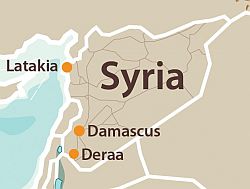
At Syria Comment, Joshua Landis has posted an article written by a contributor from Damascus — “the best piece of writing on Syria since the uprising began,” says Landis. The author requested that his identity not be disclosed and that the piece simply be given the byline “From Damascus.” He writes:

About a week ago I sat with a good friend from the muhafiza (governorate or county) of Dera’a. The raw account of events in Dera’a that he presented to me bore striking contrast to the opinions of people outside that area, people of Damascus, confused people trying to weigh the injustices vs. necessity of the military action in Dera’a.

Details of our conversation that might have been news at the time I spoke with him are now known by most readers at this late date: electricity, water, mobile phone service, land line telephone service, all cut off; rooftop water tanks, common in this area, are shot by military personnel; anyone who moves in the streets is shot. Furthermore, people who have used their own generators to provide power to their homes are visited by the military and the generators are promptly confiscated.

This friend (let’s call him Adham) has a sister and brother who both live in the city of Dera’a with their families. For weeks, they have had no word from them. They don’t even know if they or their children are alive. Adham’s brother was working in Damascus when the occupation of Dera’a began. He was unable to return home to his family. He cannot communicate with or receive any news from his wife or children. He has traveled recently to the city, hoping that after these weeks he would finally be allowed to reunite with his family, but has been prevented from doing so by the military that is keeping the city sealed off.

News that does trickle out of Dera’a seems to be coming from people who have Jordanian cell phones that sometimes find coverage in the area. People are using their car batteries to charge their cell phones, among other devices.

Many Damascenes continue to look me in the eye and tell me that “There’s nothing happening in Syria! Everything is fine!” Consider that Adham’s village in the muhafiza of Dera’a is closer to Damascus than it is to the city of Dera’a, and yet his family is without cell phone service, or even land-line service. Phone service of all types has been cut off from the entire muhafiza. When he comes to work in Damascus, he and his family have no way of checking on each other. This treatment is having the effect of galvanizing oppositional sentiment in the muhafiza and the growing sense of Dera’an separateness.

Adham is an atheist whose family is of Shia background. Being an atheist and coming from a Shia family, he is in no way sympathetic to Sunni Islamism. Therefore, it’s telling when he affirms that “there are no Salafiin in Dera’a. I can say for sure that any group of such people that exists is very, very small.”

Rather, he explains that the government’s siege has been effective in unifying the muhafiza of Dera’a against it. By treating the entire muhafiza as criminal, the sentiments of most of its inhabitants (not just those inside the city of Dera’a) have turned against the regime. It’s interesting that identity runs not only along religious, ethnic, and tribal lines, but also along geographical lines, in that the people of Dera’a—not only the city, but the entire muhafiza—are viewing themselves as a unit, separate from those who comprise the leadership of Syria. “I can say that 90% of people in the entire muhafiza are against the government,” Adham says. Rather than viewing the uprising as one of sectarian character, he explains that “my brother’s family in the city of Dera’a has Christian neighbors. There are many Christians in the city of Dera’a and in other villages who have joined in the protests.”

Dera’a is becoming a unit—I hesitate to say almost separate from Syria—not only in how people there are beginning to view themselves as separate from the state (an understandable effect after feeling attacked by the state), but in the way many other Syrians are reacting to Dera’ans. Adham tells me that in the hospital where he works in Damascus, he is experiencing a new, unmistakable resentment and coldness from his coworkers. “They say nothing, but I can see in their faces that they blame us for the current situation in Syria.” He says that he doesn’t feel safe responding to the opinions voiced by people in his workplace. He believes that people’s opinions are misled and mistaken, but if he defends “his own” Dera’ans, he fears reprisal.

“One Alawi girl who works in the hospital was very happy about the army entering the city. She said, ‘They must destroy the entire city and should kill everyone demonstrating.’” Her comments reflect the result of the government’s successful campaign to demonize the protesters; many people simply believe that there is an insidious cancer of extremism growing inside Syria, that threatens all life, security, and humane values, and that drastic measures are needed to thoroughly wipe it out.

In stark contrast to Adham’s understanding of the situation, I witnessed unreserved approval for the government crack down on a Thursday a week after the siege on Dera’a began. I visited some close Christian friends in Damascus who we can call Samer and Najwah. It was impossible not to broach the subject of the situation in Dera’a, knowing that the next day, Friday, would likely produce significant casualties. This household however, grimly viewed the army’s cordoning off and occupation of the city as necessity. I couldn’t help but begin to argue with them that even if there was a poisonous “Salafi” threat in the town, the siege and suppression would mean the suffering, trauma, and even killing of many innocent people as well. If some people from that area had indeed called for the establishment of an Islamic emirate (and it’s no surprise that some there would be oriented this way), I was just not convinced that the entire city, the many thousands protesting there, were all seeking such a goal.

For Najwah, however, the city of Dera’a has become a single entity containing one kind of people: bad. For her, the terrorist persuasion of the people in that community now justifies virtually any action against them. From her attitude, I felt that if the city was to be wiped off the map, she wouldn’t mind. I began to mention reports of the more grisly examples of violent killings there. “Good!” was her angry response.

I tried to think back and remember if I’d ever been in a country where serious atrocities were taking place and had looked in the eye of someone who rejoiced in them. I couldn’t, and I realized that I was witnessing the kind of passive approval for massacre that one reads about in history books, when individuals or groups become convinced of the evil of another and of the necessity of wiping them out. Najwah is not an evil woman, but the people of Dera’a have become completely vilified in her mind, and she fears them. [Continue reading…]

(H/t Helena Cobban.)

Facebooktwittermail

Apparent torture of boy reinvigorates Syria’s protest movement

The Washington Post reports:

The boy’s head was swollen, purple and disfigured. His body was a mess of welts, cigarette burns and wounds from bullets fired to injure, not kill. His kneecaps had been smashed, his neck broken, his jaw shattered and his penis cut off.

What finally killed him was not clear, but it appeared painfully, shockingly clear that he had suffered terribly during the month he spent in Syrian custody.

Hamza Ali al-Khateeb was 13 years old.

And since a video portraying the torture inflicted upon him was broadcast on the al-Jazeera television network Friday, he has rapidly emerged as the new symbol of the protest movement in Syria. His childish features have put a face to the largely faceless and leaderless opposition to President Bashar al-Assad’s regime that has roiled the country for nine weeks, reinvigorating a movement that had seemed in danger of drifting.

Facebooktwittermail

Dreaming spooks in search of digital metaphors

Michael Rosen writes:

News that a US government intelligence body is going to start analysing the metaphors used in various languages will have brought wry smiles to the faces of writers and critics. Presumably, “Metaphor Program” agents won’t restrict themselves to metaphors as that particular word is often used metonymically for the whole of figurative language – similes, symbols or indeed any use of language that appears to be standing in for something else or representing something else. That in itself is no simple matter, as we shall see, but let it stand for the moment.

“I wandered lonely as a cloud …” to which we are entitled to ask, “What’s lonely about a cloud?” It’s a pretty rare Lake District sky that gives us one cloud on its own. But who says a lonely cloud would have to be on its own to be lonely? Maybe clouds are just lonely things – full of a sense of their isolation in an alienated world. If we find ourselves grasping at straws here, Wordsworth gives us help: “… that floats on high o’er vales and hills”, which suggests that he’s talking about the cloud’s detachment from the earth. It’s the higher-than-hills-ness, floatiness of the cloud that is important.

This is the kind of speculation that metaphor-divining specialises in and it’s fun to think of US spooks chewing over such matters – though presumably they will hire patriotic literature graduates to do the job.

Such servants to the US cause will be able to take their masters on a trip through a forest of suggestion, resonance and ambiguity in their quest to find the hidden value-systems in speakers’ and writers’ use of metaphor. We now know that Wordsworth’s idea of a writer being detached from the world, wrapped up in thoughts about nature and the imagination, was indeed ideological – as he warned us:

“The world is too much with us; late and soon,
Getting and spending, we lay waste our powers.
Little we see in Nature that is ours.”

So, straight away, our US allies can label early Wordsworth an anti-bourgeois subversive – someone who will need to be watched.

But what of Shakespeare? He poses the problem that we can never know for certain that this is Shakespeare talking or one of his many characters through whom he speaks: “Whether ’tis nobler in the mind to suffer/The slings and arrows of outrageous fortune …” This is dense stuff: a cast of thought has to compress our interactions and outcome into one notion: “fortune”, which then has to be personified into a form that can “behave” or have appurtenances, as in this case “slings and arrows”. Aha, militaristic metaphor! Fortune is armed and aggressive. Clearly, Hamlet is a potential terrorist. And indeed he was. Or tried rather ineffectually to be. But the writer who conjured him up? Probably not.

Facebooktwittermail

Gaddafi snatch squads took hundreds of men and boys from Misrata

The Independent reports:

The lifting of the siege of the embattled Libyan city of Misrata has revealed the disappearance of hundreds of people with many of them suspected victims of snatch squads loyal to the Gaddafi regime, relatives and rights workers said yesterday.

A desperate search has begun for “the disappeared”, many of whom were reported to have been taken away to regime prisons or killed during some of the fiercest fighting of a three-month rebel uprising that has reduced parts of the city to rubble.

Witness accounts gathered by The Independent and rights groups indicate that there was a systematic attempt to kidnap men from parts of the city.

Facebooktwittermail

Hundreds of women report rapes by Gaddafi forces

The Associated Press reports:

At first, the responses to the questionnaire about the trauma of the war in Libya were predictable, if tragic: 10,000 people suffering post-traumatic stress, 4,000 children with psychological problems. Then came the unexpected: 259 women said they had been raped by militiamen loyal to Moammar Gadhafi.

Dr. Seham Sergewa had been working with children traumatized by the fighting in Libya but soon found herself being approached by troubled mothers who felt they could trust her with their dark secret.

The first victim came forward two months ago, followed by two more. All were mothers of children the London-trained child psychologist was treating, and all described how they were raped by militiamen fighting to keep Gadhafi in power.

Sergewa decided to add a question about rape to the survey she was distributing to Libyans living in refugee camps after being driven from their homes. The main purpose was to try to determine how children were faring in the war; she suspected many were suffering from PTSD.

To her surprise, 259 women came forward with accounts of rape. They all said the same thing.

“I was really surprised when I started visiting these areas, first by the number of people suffering from PTSD, including the large number of children among them, and then by the number of women who had been raped from both the east and west of the country,” Sergewa said in an interview with The Associated Press.

Facebooktwittermail

Remember Srebrenica? The west’s intervention in Libya is a no-brainer

Peter Preston at The Guardian writes:

It’s fashionable already to cluck apprehensively over Libya. Another botched adventure, another unwanted war. Look how much it’s costing – at this rate, more or less your standard Ministry of Defence project overrun before 2011’s out. Why isn’t it over long since? Why, for all his soaring rhetoric, has Barack Obama decided to rest on his oars? David Cameron broods over sending in four Apache helicopters while the BBC lugubriously reminds us that helicopters can get shot down. If you want to confect a stew of gloom, then any old ingredients will do.

But mix a pinch of foresight with your hindsight, and sprinkle lightly with added realism. Libya isn’t Afghanistan or Iraq. It isn’t even a proper war, more a series of skirmishes strung out along a long coastal strip. Oh! TV reporters talk excitedly as though this was some mighty contest between opposing armies, but they don’t even seem to look at their own pictures. In fact, it’s rag-tag stuff on both sides. There are casualties, of course; but the numbers involved seem relatively small. The colonel’s mercenary regiments are brutal, but militarily feeble. Take away air cover and they’re going nowhere. Will four British Apaches – count them again, yes just four! – make a big difference this week? Merely posing the question helps define this mini-conflict. Its costs and its risks aren’t worth so much rumbling angst.

Recent history tells us Muammar Gaddafi is a menace (especially if you’re in a jumbo jet over Scotland). When he vowed to take revenge on the insurgents, these were no idle threats. His first reaction when the citizens of his second city marched for change was to shoot them down. The chief prosecutor in The Hague already thinks that, just like Ratko Mladic, Gaddafi has a case to answer. On 18 March, as the allies finally prepared to move, his troops were driving into the outer suburbs of Benghazi. No hindsight necessary: it was five minutes to midnight. And no shucking off our own leaders’ responsibility, either.

After Tunisia, after Egypt, the word was the same from Obama to Nicolas Sarkozy to Cameron. The US Senate, the European parliament, the Arab League and the UN security council all knew what had to be done. So did Gaddafi’s man at the UN. There was massacre pending. All the usual recourses had been duly employed: sanctions, seizing overseas assets and the rest. But it wasn’t enough. Hundreds – probably thousands – of Libyan protesters we’d directly encouraged were about to get shot. Do nothing? Then or now, with or without hindsight, it’s a no-brainer.

Facebooktwittermail