The Guardian reports:
Libya’s revolutionary leadership is pressing western powers to assassinate Muammar Gaddafi and launch military strikes against his forces to protect rebel-held cities from the threat of bloody assault.
Mustafa Gheriani, spokesman for the revolutionary national council in its stronghold of Benghazi, said the appeal was to be made by a delegation meeting the French president, Nicolas Sarkozy, and the US secretary of state, Hillary Clinton, in Paris on Monday, as G8 foreign ministers gathered there to consider whether to back French and British calls for a no-fly zone over Libya.
“We are telling the west we want a no-fly zone, we want tactical strikes against those tanks and rockets that are being used against us and we want a strike against Gaddafi’s compound,” said Gheriani. “This is the message from our delegation in Europe.”
Asked if that meant that the revolutionary council wanted the west to assassinate Gaddafi, Gheriani replied: “Why not? If he dies, nobody will shed a tear.”
But with diplomatic wrangling focused on the issue of the no-fly zone, there appeared to be little immediate prospect of a foreign military assault on Gaddafi’s forces, let alone an air strike against the Libyan dictator.
Christian Science Monitor reports:
On Libya’s eastern front, taking towns may be easy for Col. Muammar Qaddafi – but holding them is something else again.
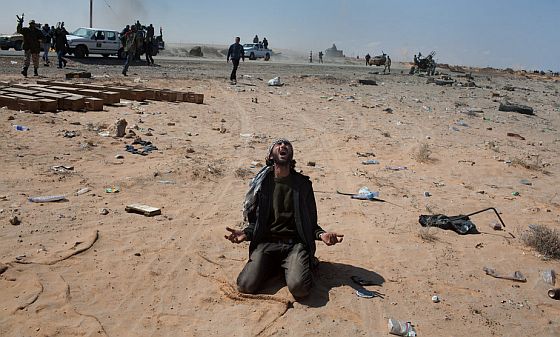
After days of being pounded by rocket fire and bombing runs from forces loyal to Qaddafi, Libya’s rebel army piled into their pickup trucks yesterday afternoon and cut a ragged retreat from the oil town of Brega to Ajdabiya, 40 miles to the east. They left mounds of ammunition and supplies behind them as they fled, Qaddafi’s fighters surging behind.
That was all according to plan, says Mohammed el-Majbouli.
“We drew [Qaddafi’s forces] forward, and then we maneuvered behind them and trapped them,” says Mr. Majbouli, a former member of Qaddafi’s special forces who is now organizing rebel fighters.
He says a reserve force of rebels with military training had been hidden in homes in the eastern third of the sprawling petrochemical complex at Brega. After the Qaddafi men passed at about 8 p.m. last night, the rebels came out, retaking the town as well as about 20 prisoners from Qaddafi’s forces.
Majbouli’s claim of victory, which is also made by senior officers who have defected to the rebel cause, could not be independently confirmed. But if he is right, it would be the fourth time Brega has changed hands in less than two weeks, emphasizing the strange, shimmering nature of the conflict being fought in Libya’s coastal desert.
While it remains easy for Qaddafi to rain mortars and rockets on rebel checkpoints, he doesn’t appear to have more than a few thousand men, at most, committed to his eastward advance. Without indiscriminate fire on the cities of Ajdabiya or Benghazi – just the sort of act that might galvanize the international community into action, which Qaddafi is likely keen to avoid – it’s hard to see his forces advancing quickly much farther east.
On Saturday, The Guardian reported:
Muammar Gaddafi’s army won control of a strategic rebel-held Libyan town and laid siege to another as the revolutionary administration in Benghazi again appealed for foreign military help to prevent what it said would be the deaths of hundreds of thousands of people if the insurgents were to lose.
The rebels admitted retreating from the oil town of Ras Lanuf – captured a week ago – after two days of intense fighting and that the nearby town of Brega was now threatened.
The revolutionary army, in large part made up of inexperienced young volunteers, has been forced back by a sustained artillery, tank and air bombardment about 20 miles along the road to the rebel capital of Benghazi.
The head of Libya’s revolutionary council, Mustafa Abdel Jalil, claimed that if Gaddafi’s forces were to reach the country’s second-largest city it would result in “the death of half a million” people.
Robin Yassin-Kassab writes:
In 2003 America and Britain invaded Iraq without a United Nations mandate. Today NATO is emphasising that it won’t move without both a UN resolution and substantial political support from the Arabs. The Arab League has now called for a no-fly zone.
At the League meeting Omani foreign minister Yusuf bin Alawi warned that if the Arabs didn’t take a strong stance they would open the door to unwanted foreign interference. This may seem contradictory: at the same time he asked the UN to intervene. But his point is a good one. If NATO forces act under a UN resolution and responding to an Arab request, the Arabs will be well-placed to end the intervention at the right moment.
I understand the worries of those who fear Western intervention, after all the West’s crimes against the Arab world. I wish the Arabs were capable of moving by themselves (and I certainly hope that once the revolutions have run their course we will finally see an independent Arab world taking care of internal Arab problems). I like Asa’ad Abu Khalil’s idea of using Egypt and Tunisa as staging posts for volunteer Arab soldiers who wish to aid their brothers in Libya.
It’s a difficult, cloudy situation. The only clear thing is that the Libyans need immediate help. The Transitional National Council’s warning that half a million will be killed is not mere rhetoric, but an entirely logical and legitimate fear.
Ahram Online reports:
Thousands of Libyans march down the Corniche in Benghazi, chanting, “Free Libya,” “Revolutionaries,” “Beasts,” and other slogans. It is part of their military training. They are all volunteers, who chose to become fighters and join the rebel forces in areas like Ras Lanuf, Brega and Zawiyah , which are experiencing heavy air strikes by Gaddafi’s forces.
Among those is Ahmed, 25 years old, an Egyptian who has worked in construction in Libya for the past four years. In spite of his family’s pleas, he refuses to leave Libya. “I came to Libya and it was prosperous, I will leave it as prosperous as it was. I will stay here and fight with my friends until Libya is free, just like Egypt is free now,” said Ahmed who looked pale, but seemed very confident of victory and liberation.Ahmed is one of many Egyptians who decided to stay and join the Libyan revolution. The volunteers are from both genders and all ages. Nada, 18, is a student who was born to an Egyptian mother and a Libyan father. She was born in Alexandria, but moved to Benghazi at the age of eight and has been living there ever since. She still visits Egypt every year.
“I love Egypt, it’s my second home, but I love Libya too, and I am going to stay and fight where I am needed,” said Nada passionately. Nada wears her hair short and she looks very practical in her suit and yellow shirt, which signifies that she is one of the organizers of the anti-Gaddafi sit-in. She joined the sit-in on February 18, along with her mother, another supervisor.
The Independent reports:
Four men have been arrested for the murder of an Al Jazeera journalist and evidence has emerged that Muammar Gaddafi’s regime is sending undercover squads to carry out a campaign of assassinations, rebel officials claimed yesterday.
The Independent was told that four men were caught in the city of Ajdabiya with evidence linking them to the death of Ali Hassaon Al Jaber, who was killed near Benghazi on Saturday. Under questioning, the suspects allegedly confessed they had been ordered to silence opposition figures and drive out international presence from territories of the protest movement.



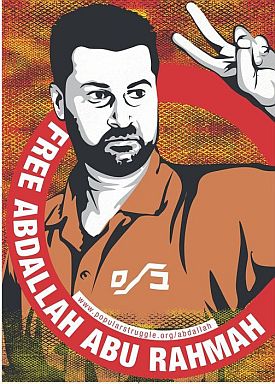 Inside, a man in shackles enters the courtroom. He is wearing a brown prison suit, and his exhausted eyes exchange glances with his wife. The two haven’t met outside the courtroom in more than a year, and for some reason the prison guards are frantically moving the wife so she doesn’t sit too close to her husband, who is officially a “security risk.” Soon the military judge, outfitted in a light green Israel Defense Forces (IDF) uniform and an army beret, enters the room and begins the proceedings.
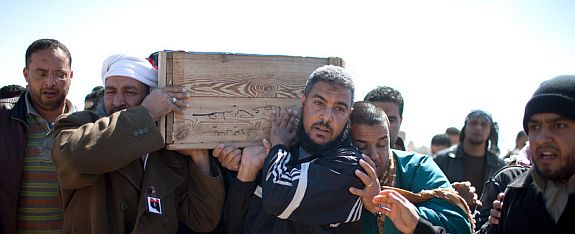

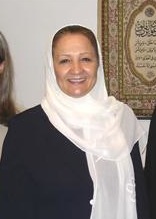 Ask people in Benghazi what awaits them if Muammar Gaddafi’s army fights its way back into the rebel capital and the chances are they will talk about Huda Ben Amer.